Is It Illegal to Buy Email Lists? 2026 Guide
You just dropped $400 on a list of 5,000 "verified" marketing directors. Before you upload that CSV, you should know: depending on where those people live, you might be breaking the law. And even where you're technically fine, you're about to torch your sender reputation.
So is it illegal to buy email lists? The answer depends entirely on jurisdiction. In the United States, buying a list isn't illegal - CAN-SPAM regulates how you send, not where you got the addresses. But in Canada and the EU, emailing a purchased list violates consent requirements in most cases. The UK sits somewhere in between, with rules that hinge on whether you're emailing a generic corporate address or a named individual. The real question isn't legality. It's whether a purchased list will actually work.
It won't. Here's the law, then what to do instead.
Email List Legality by Country
The answer changes dramatically depending on where your recipients sit. A single list can be perfectly legal in one country and a six-figure fine in another.
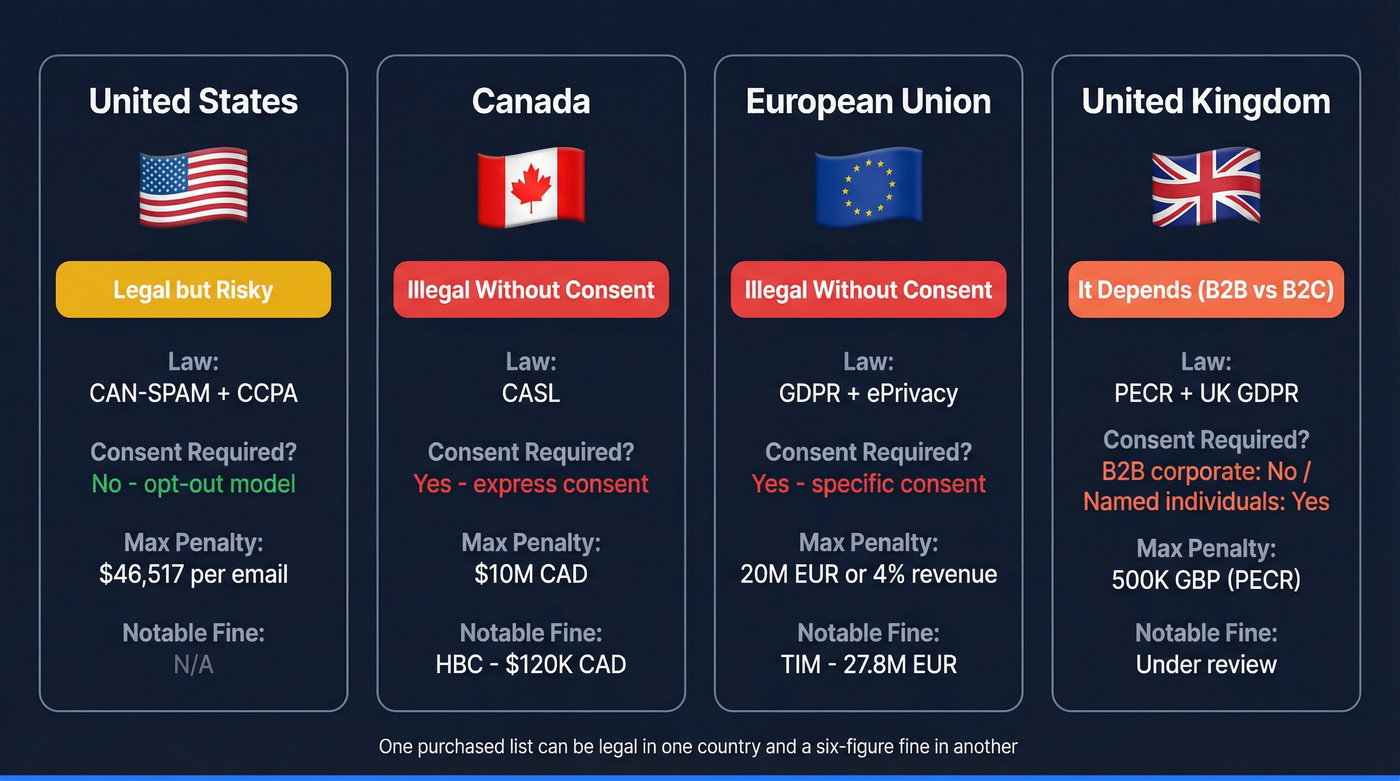
| US | Canada | EU | UK | |
|---|---|---|---|---|
| Law | CAN-SPAM + CCPA | CASL | GDPR + ePrivacy | PECR + UK GDPR |
| Consent needed? | No (opt-out model) | Yes (express) | Yes (specific) | Depends on B2B/B2C |
| Key penalty | $46,517 per violation | Up to $10M CAD | €20M or 4% revenue | £500K (PECR) |
| Notable fine | - | HBC $120K CAD | TIM €27.8M | - |
United States (CAN-SPAM + CCPA)
CAN-SPAM doesn't care where you got the email address. It regulates how you send: physical postal address, clear opt-out mechanism, honest subject lines, no deceptive headers. Each violation carries up to $46,517 in penalties. California's CCPA adds another layer - residents can request deletion and opt out of the sale of their personal data. Purchasing contacts is legal federally, but sloppy execution gets expensive fast.
Canada (CASL)
Canada's Anti-Spam Legislation requires express consent before you send. A purchased list almost never meets that bar. In just six months (October 2024 through March 2025), the Spam Reporting Centre received 208,083 complaints, with 48% citing lack of consent. Hudson's Bay Company got hit with a $120,000 undertaking for sending commercial emails without a working unsubscribe mechanism.
European Union (GDPR + ePrivacy)
Under GDPR, consent must be specific to your company at the time of collection. A list broker collecting emails for "marketing partners" doesn't cut it - the person needed to know you would email them.
Total GDPR fines across all enforcement have reached EUR 5.88B across 2,245 cases. Vodafone Italia paid EUR 12.25M for using purchased email lists affecting 4.5 million individuals. TIM got hit for EUR 27.8M for aggressive email campaigns without consent. Acquiring a list file and emailing it is almost impossible to justify legally under this framework. If you're building outbound in the EU, use a GDPR for Sales and Marketing playbook instead of guessing.
United Kingdom (PECR + UK GDPR)
Here's a nuance almost nobody covers. PECR's electronic mail marketing rules don't apply to corporate subscribers - companies, LLPs, and similar entities. Emailing info@company.co.uk from a purchased list doesn't trigger PECR's consent requirements.
But the moment you email a named individual like jane.smith@company.co.uk, UK GDPR kicks in and you need a lawful basis for processing their personal data. Sole traders are treated like individuals. The ICO notes this guidance is under review following the Data (Use and Access) Act, which came into law on 19 June 2025, so the rules here are actively shifting. If you're prospecting in the UK, this B2B Data UK breakdown is the safer starting point.
Buying vs. Renting a List
Buying means you receive the file - names, emails, the whole CSV - and you send from your own infrastructure. Renting means the list owner sends on your behalf; you never see the addresses.
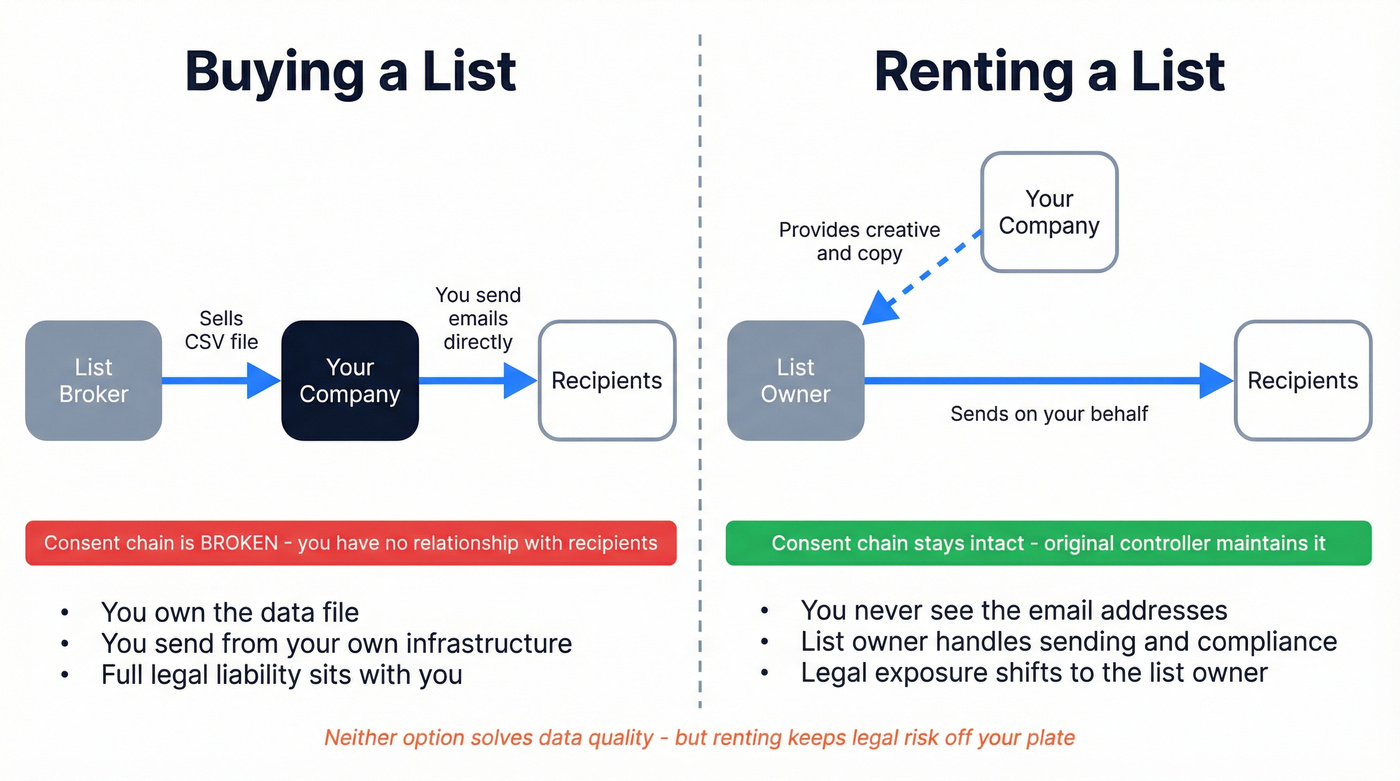
Under EU and UK frameworks, renting is often more defensible because the original data controller maintains the consent chain. Buying usually breaks that chain entirely. Neither option solves the core problem of data quality, but renting at least keeps the legal exposure on someone else's plate. If you're still sending cold outbound, make sure your email sending infrastructure is set up to handle compliance and deliverability.

Purchased lists break consent chains and torch your sender reputation. Prospeo's 5-step verification filters out spam traps and honeypots before you ever hit send - 98% email accuracy, 7-day data refresh, $0.01 per email. No legal gray areas, no domain damage.
Replace risky purchased lists with data that actually delivers.
Why Purchased Lists Fail (Even When Legal)
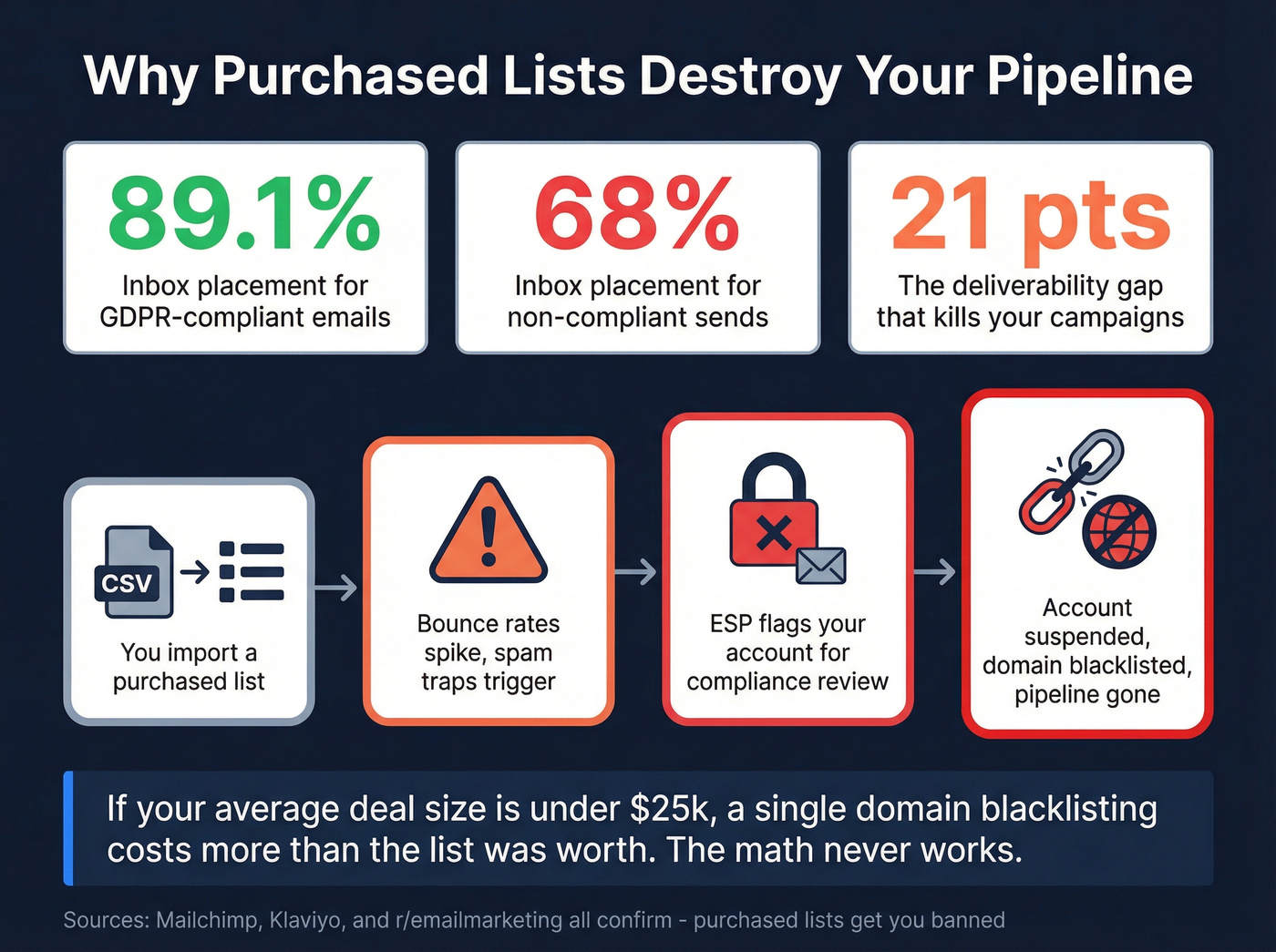
Let's say you're in the US and CAN-SPAM is on your side. Your marketing team imports 10,000 contacts from a list broker. Bounce rates spike. Your ESP flags your account for a compliance review. Then you're dealing with import restrictions, sending limits, or an outright suspension at the worst possible time.
We've seen this pattern play out repeatedly. Ask any SDR who's imported a purchased list into their ESP - the compliance review email is practically a rite of passage. If you want the fix checklist, start with an email deliverability checklist.

The reason is how these lists are assembled. Brokers build them through scraping, co-registration checkboxes, and recycled event data. Nobody verifies whether the addresses still work or whether the people behind them consented to hear from you. The result is predictable: spam traps and honeypots that ISPs use to catch bulk senders, stale addresses from people who changed jobs two years ago, and domains that expired months ago. If you're cleaning a CSV, use a proper email validity check workflow.
Mailchimp and Klaviyo both prohibit imported purchased lists - violating their terms can trigger import rejection or outright account suspension. The consensus on Reddit's r/emailmarketing is blunt: purchased lists get you banned. GDPR-compliant emails achieve roughly 89.1% inbox placement versus 68% for non-compliant sends. That 21-point gap means a huge chunk of your emails hit spam or never land, and every bounce and complaint damages your domain reputation for future campaigns too. If you're already seeing issues, follow a Blacklist Alert triage plan.
Here's the thing: if your average deal size is under $25k, a single domain blacklisting from a bad list costs you more in lost pipeline than the list was worth. The math never works.
What to Do Instead
"Build an organic list" isn't helpful advice when your SDRs have quota next month. The alternative isn't patience - it's better sourcing.
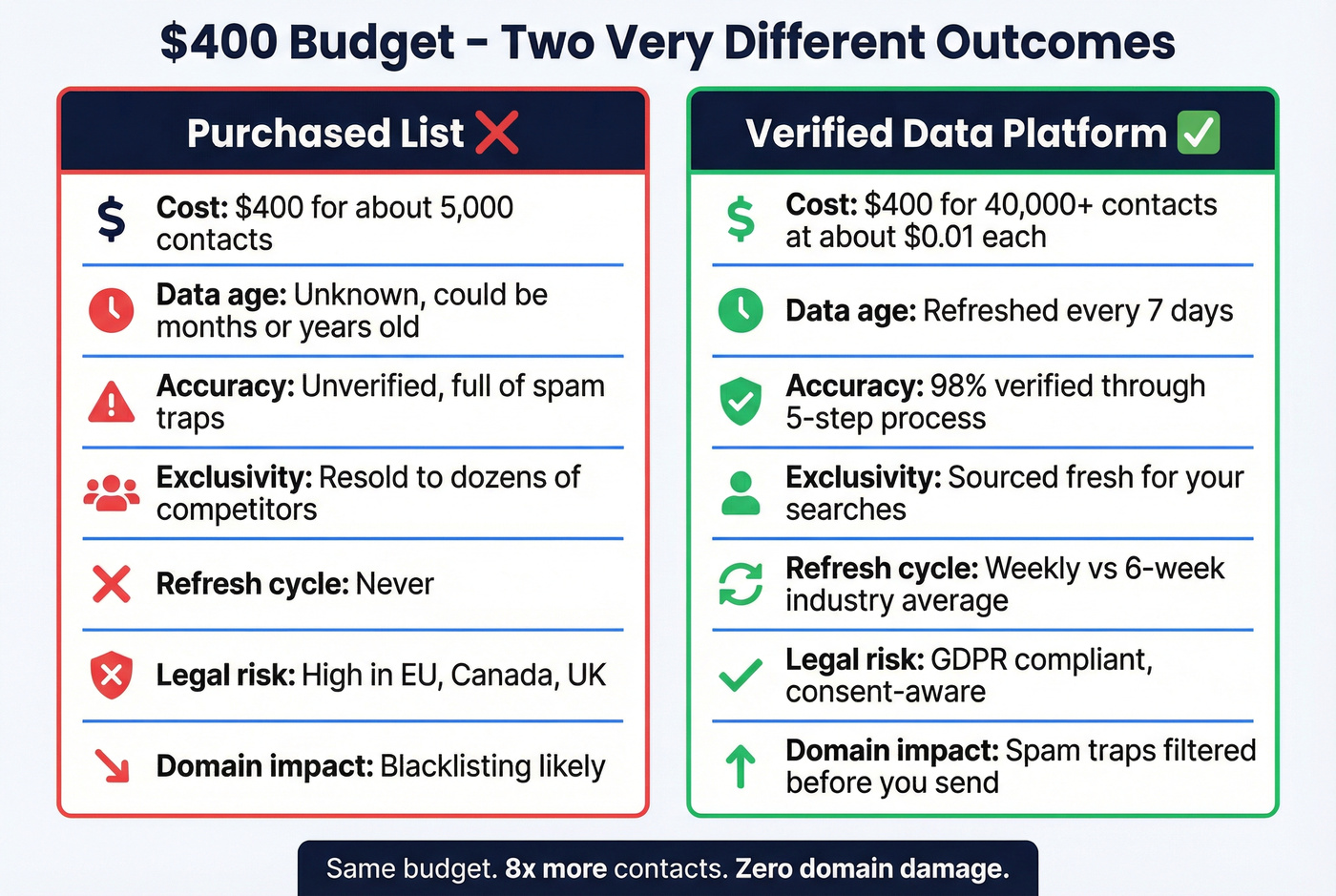
Purchased lists run $100-500 per 1,000 contacts of unknown age, resold to dozens of other buyers all hammering the same inboxes. A verified data platform takes the opposite approach: every email goes through multi-step verification that removes spam traps and honeypots before you ever see them. Prospeo, for example, runs a 5-step verification process with 98% email accuracy and refreshes data every 7 days versus the 6-week industry average - at roughly $0.01 per email with a free tier to test before committing anything. If you're comparing vendors, start with sales prospecting platforms and list building tools.
A $400 purchased list gives you unknown data quality and legal exposure. The same budget on a verified platform gives you thousands of targeted contacts with spam traps already filtered out and your domain reputation intact. Skip the list brokers if you care about deliverability at all.
For teams that want to go deeper on building compliant outbound lists, the FTC's CAN-SPAM compliance guide is worth bookmarking. And if you're targeting EU prospects, the ICO's direct marketing guidance breaks down PECR requirements in plain English. To keep campaigns stable at higher volume, follow How to Scale Outbound Campaigns without wrecking deliverability.
A $400 list gets you stale data resold to dozens of competitors. That same budget on Prospeo gives you 40,000+ verified contacts with 30+ filters to target exactly the right buyers - refreshed weekly, GDPR compliant, and zero spam traps.
Spend less, reach more, and keep your domain off blacklists.
FAQ
Can you buy B2B email lists legally in the US?
Yes. CAN-SPAM doesn't prohibit purchasing email lists. It regulates how you send: include a physical address, honor opt-outs within 10 business days, identify the message as an ad, and avoid deceptive headers. Each violation carries up to $46,517 in penalties. California's CCPA adds opt-out-of-sale requirements for state residents.
Will my ESP ban me for using a purchased list?
Almost certainly. Major ESPs like Mailchimp and Klaviyo explicitly prohibit imported purchased lists. Importing one triggers compliance review, import rejection, or full account suspension - cutting off your entire email infrastructure mid-campaign. There aren't warnings; the ban is often immediate.
Is buying email lists illegal in Europe?
Buying the file itself isn't technically illegal, but sending to it without GDPR-compliant consent is. Consent must be specific to your company at collection time, which purchased lists virtually never provide. Fines reach EUR 20M or 4% of global annual revenue, whichever is higher.
What's a safer alternative to purchased email lists?
Verified B2B data platforms that source and validate contacts in real time. These tools run multi-step verification with spam-trap removal and refresh data on short cycles, delivering high email accuracy at a fraction of what list brokers charge. Most offer free tiers so you can test quality before spending anything.