

The Best Outbound Lead Generation Tools for 2026
Sixty-four percent of B2B marketers outsource some outbound. But if you're building in-house, you need the right outbound lead generation tools - not more of them. The average B2B company runs 87 software tools, and only 23% directly impact revenue. We evaluated Cognism, Lusha, Lemlist, Smartlead, and a dozen others. These six made the cut.
Our Picks at a Glance
| Category | Tool | Why | Starting Price |
|---|---|---|---|
| Data provider | Prospeo | 98% email accuracy, ~$0.01/email | Free tier available |
| Free starting point | Apollo.io | Free plan + built-in sequences | Free / $49/mo paid |
| Cold email sequencer | Instantly | Best deliverability infrastructure | $30/mo (yearly) |
| Enterprise data | ZoomInfo | Deepest US database + intent | ~$15K-$75K/yr |
The 4-Layer Outbound Stack
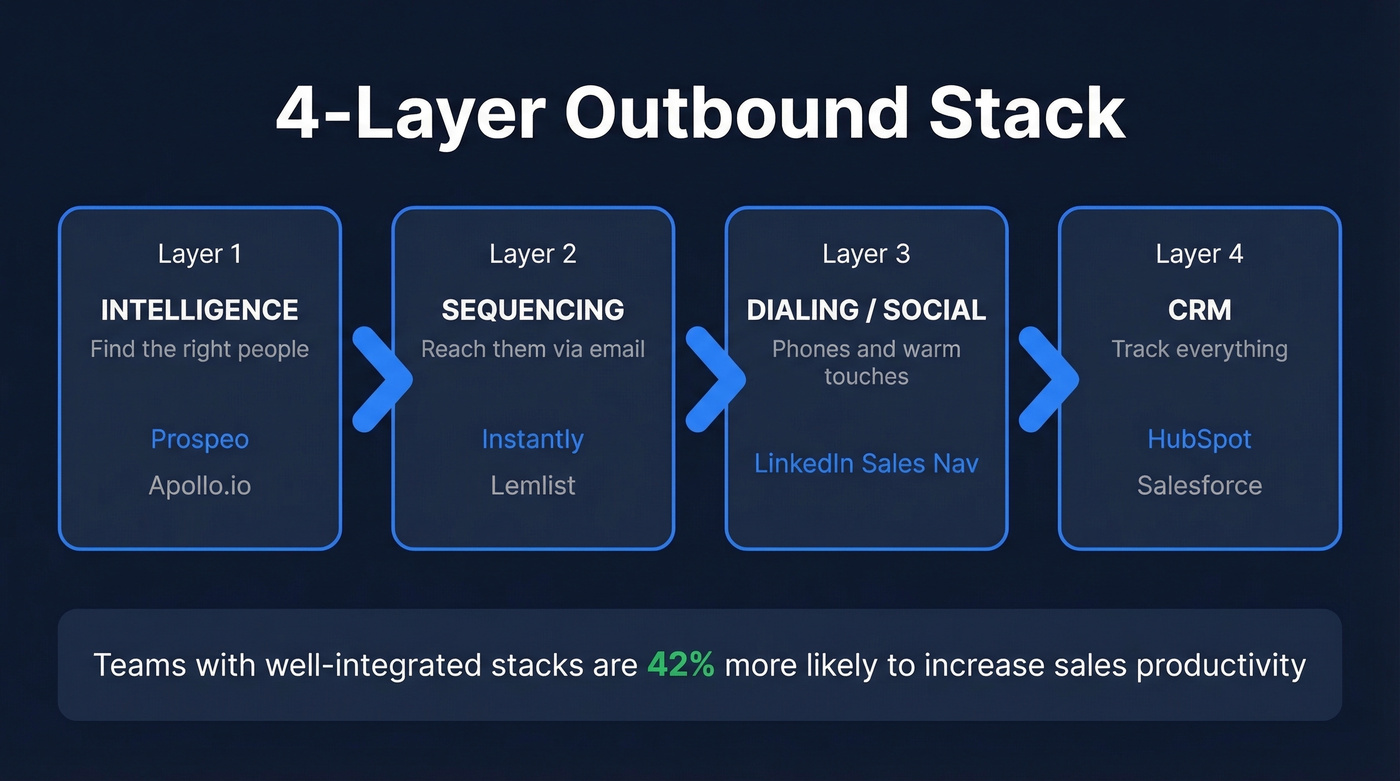
Every outbound operation runs on the same architecture: Intelligence (find the right people) → Sequencing (reach them via email or multichannel) → Dialing/Social (phones and warm touches) → CRM (track everything). Companies with well-integrated stacks are 42% more likely to increase sales productivity and 42% more likely to increase sales productivity. Pick one tool at each layer and you're running.
Here's a hot take we'll stand behind: AI is a feature inside these tools, not a category. Every vendor slaps "AI-powered" on their landing page. Ignore the label. Buy the workflow.
Top Tools for Outbound Prospecting
Prospeo - Best Data Provider
Bounced emails destroy sender reputation, and sender reputation is the foundation of every cold email program. Prospeo's database covers 300M+ professional profiles with 98% email accuracy - built on proprietary email-finding infrastructure with a 5-step verification process that includes catch-all handling, spam-trap removal, and honeypot filtering. The 7-day data refresh cycle is the real differentiator. Most providers refresh around every six weeks, which means you're emailing people who changed jobs a month ago.

The numbers tell the story. Snyk's 50-person AE team switched and saw bounce rates drop from 35-40% to under 5%, generating 200+ new opportunities per month. Teams book 26% more meetings compared to ZoomInfo and 35% more compared to Apollo. At ~$0.01 per email vs. ZoomInfo's $0.20-$0.60 per credit, the cost gap is massive - and that's before you factor in the 125M+ verified mobile numbers with a 30% pickup rate. Native integrations with Instantly, Lemlist, Smartlead, HubSpot, Salesforce, Clay, Zapier, and Make mean your data flows straight into sequences without CSV gymnastics.
For dialing and sequencing, pair it with Instantly or your sequencer of choice. It's built to feed data into those tools, not replace them.
Apollo.io - Best Free Starting Point
Apollo's free tier includes limited search and up to 2 email sequences - enough to validate outbound before spending a dollar. Paid plans run $49-$119/mo per user, with the Organization tier requiring a 3-seat minimum ($357/mo).
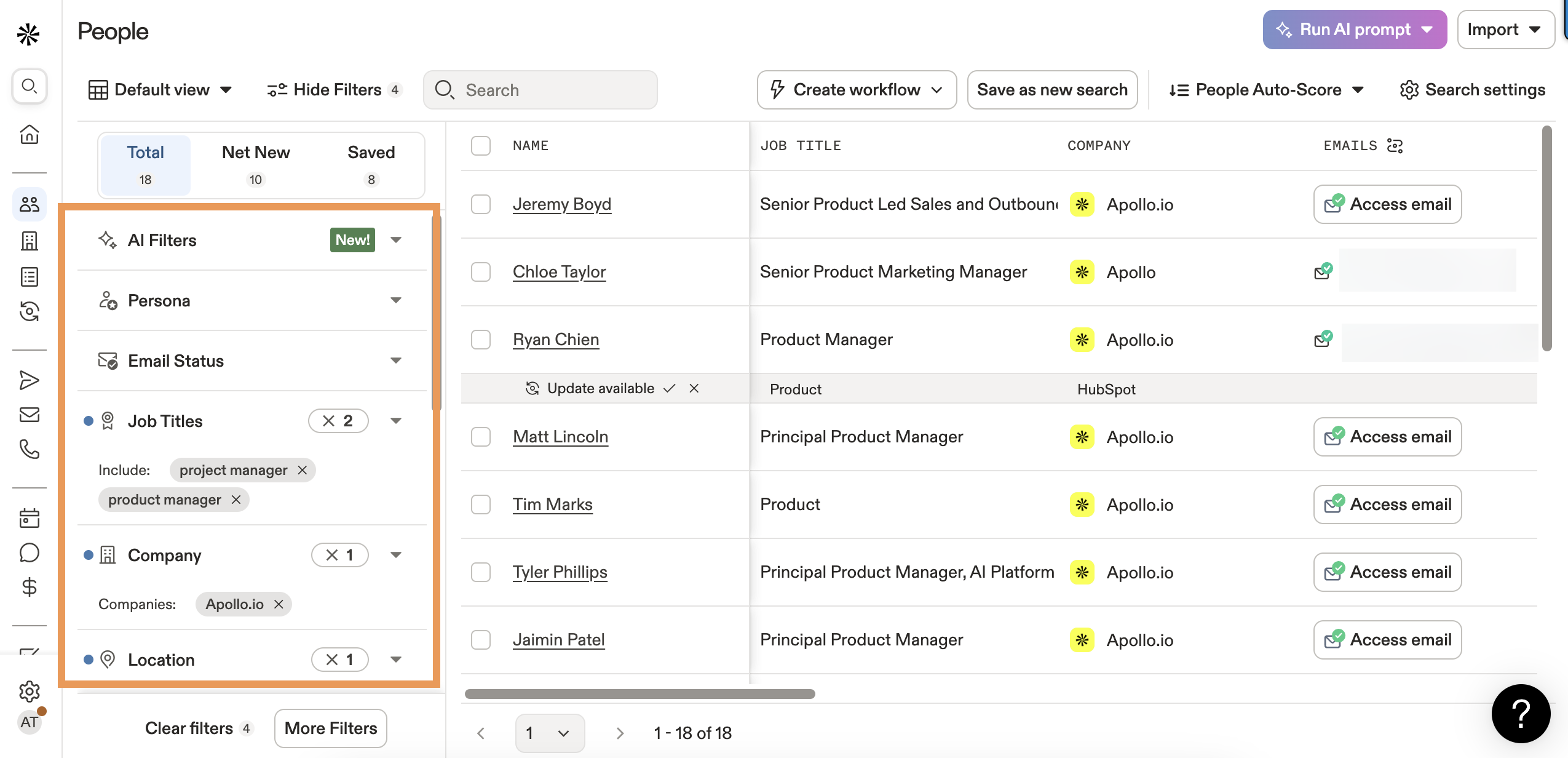
Here's the thing about Apollo: credits don't roll over between billing cycles, and mobile number reveals burn through them fast. The highest plan caps at 125 mobile and 2,000 export credits. If you're running volume outbound, you'll hit those ceilings mid-month. We've seen this happen to multiple teams that started on Apollo and had to scramble for a dedicated data provider once campaigns scaled past the free tier. Skip it if you need high-accuracy mobile numbers or you're sending 500+ emails daily - but for most SMB teams just getting started, it's the obvious first step.
ZoomInfo - The Enterprise Price Tag
Most teams don't pay list price. List prices run $14,995-$35,995/yr, and real-world spend commonly lands in the $30K-$75K+/year range once you add seats, credits, and add-ons. Additional seats cost $2,500 each at list. Negotiate hard - discounts of 30-65% off list are common, and annual contracts are the only option.
For a concrete benchmark, third-party pricing breakdowns put SalesOS spend around ~$24.8K-$44.2K for ~200-headcount orgs, ~$50.2K-$113.8K for ~1,000-headcount orgs, and ~$83.2K-$161.9K for orgs above 1,000. That's a lot of money.
Worth it if you're a 50+ person sales org that needs intent data, engagement tools, and deep US coverage in one contract. Not worth it if your team is under 20 seats - you'll pay for intent, chat, and engagement features your reps never open. At that size, a standalone data provider paired with a sequencer delivers better ROI at a fraction of the cost.
Instantly - Best Cold Email Sequencer
Instantly's killer feature isn't sequences - it's deliverability infrastructure. Unlimited email accounts and warmup come standard. We've tested teams spinning up 20+ sending accounts with automatic rotation, something that runs $100-$165/seat/month on Outreach or Salesloft.
Modular pricing lets you buy only what you need: Outreach starts at $30/mo (yearly) for unlimited accounts and warmup, the Leads database (450M+ B2B contacts) adds $47/mo, and CRM runs another $47/mo. A full stack lands at $124-$243/mo depending on tier. Warm up for 3-4 weeks before sending, start at 10-20 emails per inbox per day, and ramp gradually. Skip this if you need a power dialer or social touches in the same sequence. Instantly is email-first by design.
HubSpot CRM - Best Free CRM
HubSpot's free CRM tier handles contact management, deal tracking, and basic reporting for most early-stage outbound teams. Paid plans start at $15/seat/month. It integrates natively with most sequencers and data providers, so it slots into the stack without extra setup. Not much else to say - it works, it's free to start, and it won't fight with the rest of your tools.
LinkedIn Sales Navigator - Social Selling Layer
Sales Navigator Core runs $89.99/mo (annual) or $119.99/mo monthly, with 50 InMails/month and advanced search filters. Worth it if social selling is part of your multichannel motion. There's a 30-day free trial to test before committing. If cold email and phone are your only channels, skip it entirely - you won't get enough value to justify the spend.

You just saw the 4-layer outbound stack. The intelligence layer makes or breaks everything downstream. Prospeo feeds 98% verified emails and 125M+ mobile numbers directly into Instantly, Lemlist, Smartlead, and your CRM - no CSV exports, no stale data. At ~$0.01/email with a 7-day refresh cycle, your sequences hit real inboxes, not dead ends.
Stop paying enterprise prices for data that bounces. Start free today.
Snyk's 50 AEs cut bounce rates from 35% to under 5% and generated 200+ opportunities per month. Stack Optimize built a $1M agency with zero domain flags. The difference isn't the sequencer - it's the data feeding it. Prospeo's 5-step verification and weekly refresh mean every lead in your outbound campaign is real, current, and reachable.
Teams using Prospeo book 26% more meetings than ZoomInfo users.
What These Tools Actually Cost
| Component | Lean Stack | AI-Powered Stack | Enterprise Stack |
|---|---|---|---|
| Data | ~$39/mo | Clay + providers (~$850/mo) | ZoomInfo (~$3K-$6K/mo) |
| Sequencing | Instantly ($30/mo) | Instantly ($97/mo) | Outreach (~$130/seat/mo) |
| CRM | HubSpot (free) | HubSpot ($15/mo) | Salesforce (~$150/seat/mo) |
| Other | - | Domains/AI (~$850/mo) | SDR salary (~$8K-$12K/mo) |
| Monthly total | ~$70-$100 | ~$1,800 | $18K-$22K |
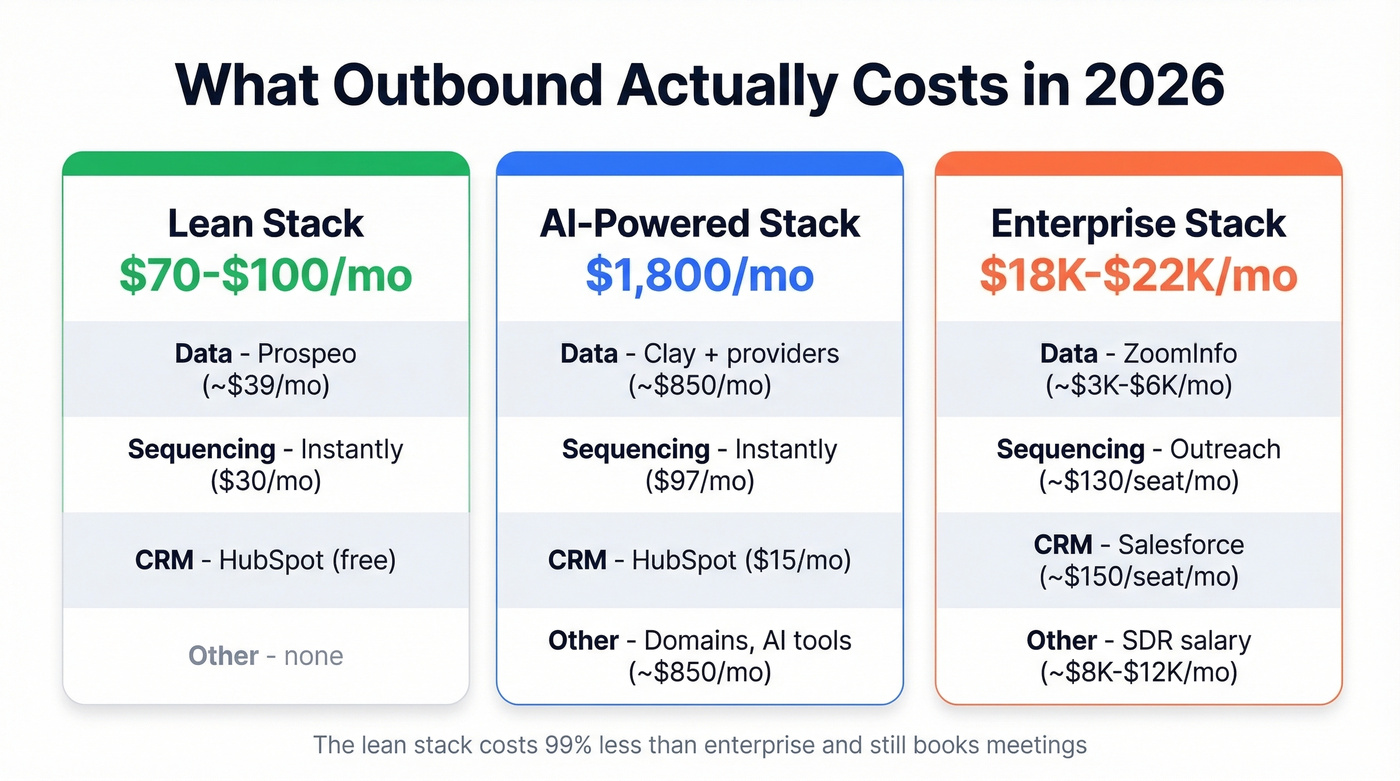
One Reddit practitioner breakdown pegged a full AI-powered outbound stack at ~$1,800/mo producing 20K prospects and 14 meetings monthly. The traditional enterprise stack with an SDR, ZoomInfo, Outreach, and Salesforce pushes $18K-$22K/month before a single meeting is booked.
This is where the services vs. tools debate gets real. Hiring an agency at $5K-$10K/month can actually undercut a full enterprise stack, though you trade control for convenience. Most scaling teams we've talked to start with services to prove the channel, then bring it in-house once volume justifies the investment.
How to Automate Your Outbound Workflow
The biggest efficiency gains come from connecting your stack so data flows without manual intervention. Here's the playbook we recommend:
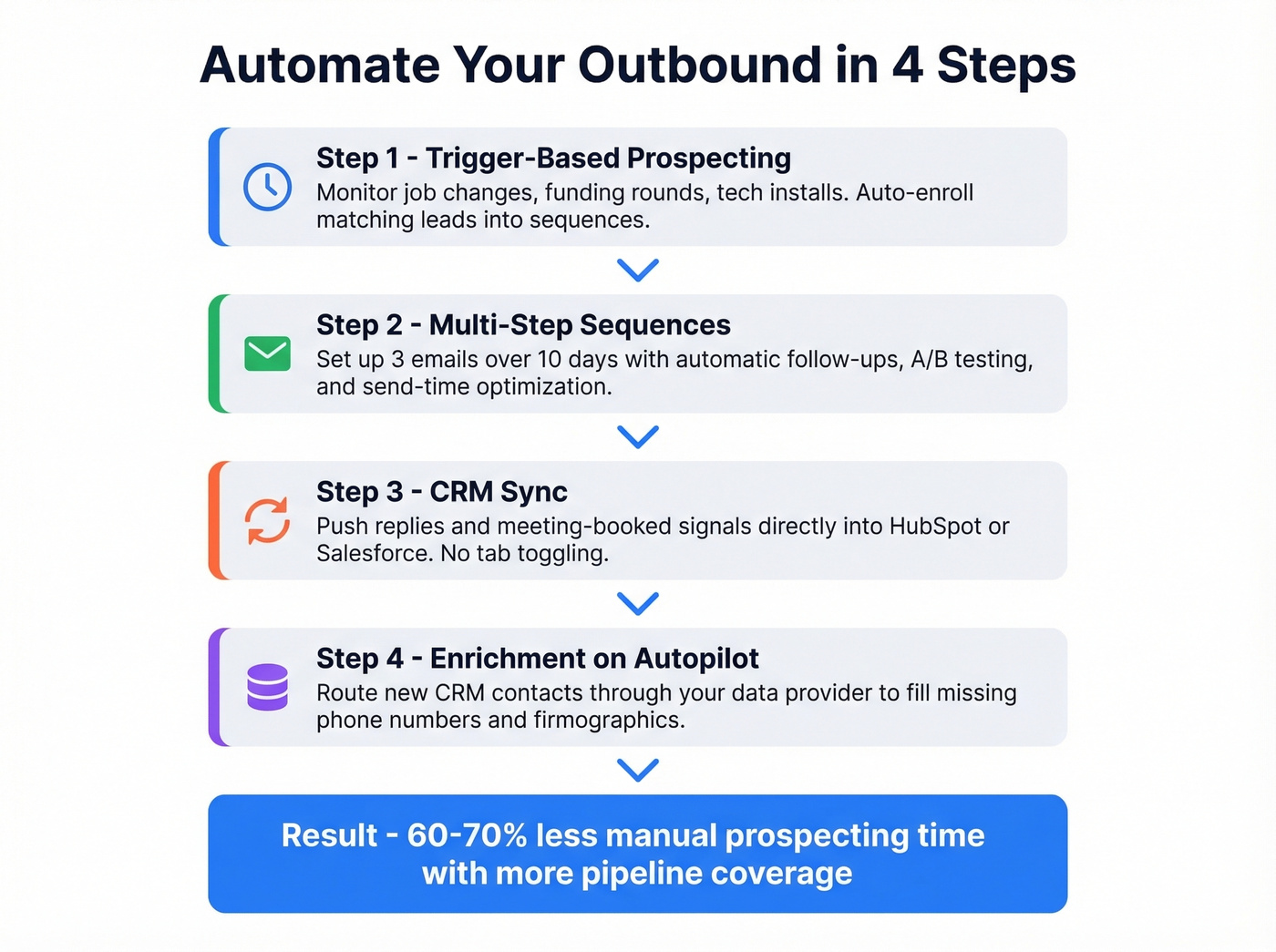
Trigger-based prospecting. Use your data provider to monitor job changes, funding rounds, or tech installs - then auto-enroll matching leads into sequences. This alone eliminates hours of manual list building every week. (If you want a deeper system, see sales triggers.)
Multi-step sequences. Set up Instantly or Lemlist to handle email cadences with automatic follow-ups, A/B testing, and send-time optimization. Don't overthink the first version. Three emails over ten days is enough to start. If you need a baseline structure, use a B2B cold email sequence.
CRM sync. Push replies and meeting-booked signals directly into HubSpot or Salesforce so reps never toggle between tabs. If your CRM data is stale, nothing downstream works. (More on connecting your outreach tool to CRM.)
Enrichment on autopilot. Route new CRM contacts through a data provider to fill in missing phone numbers and firmographics before reps touch them. Teams that automate these four workflows typically cut manual prospecting time by 60-70% while increasing pipeline coverage. For options, compare data enrichment services.
Outbound Benchmarks Worth Knowing
| Metric | Average | Top Performers |
|---|---|---|
| Cold email reply rate | 3-8.5% | 15-25% |
| Cold calls to connect | ~18 dials | - |
| Cold call → meeting | ~2% | - |
Let's be honest about what these numbers mean. If you're below 3% reply rates, it's almost always a data quality or messaging problem - not a volume problem. The teams hitting 15-25% aren't sending more emails. They're sending better emails to tighter lists with verified contact data. Precision beats volume every single time, and we've seen this play out across dozens of outbound teams in our network. If you need a refresher on fundamentals, start with sales prospecting techniques.
FAQ
What's the best free tool for outbound prospecting?
Apollo.io's free tier gives you basic search and 2 email sequences - solid for testing outbound before spending anything. Prospeo also offers a free plan with 75 verified emails per month, which is better if email accuracy is your top priority.
How many tools do I actually need?
Four to five. One data provider, one sequencer, one CRM, and optionally a dialer or social selling tool. Companies with well-integrated stacks are 42% more likely to increase sales productivity. Don't buy six tools that overlap - buy four that connect cleanly.
What's a good cold email reply rate?
Average sits between 3-8.5%. Top teams with tight ICP targeting hit 15-25%. If you're consistently below 3%, audit your data quality first and messaging second.
Should I use outbound lead generation services or build a tool stack?
Agencies ($5K-$10K/mo) make sense if you lack in-house headcount or want to test a new market quickly. Building your own stack with dedicated outbound lead generation tools gives you more control, lower long-term cost, and full data ownership. Most scaling teams start with services to prove the channel, then bring it in-house once volume justifies the investment.