

B2B RevOps: The Operating System 90% of Companies Get Wrong
Marketing says pipeline is up 30%. Sales says it's flat. CS reports churn numbers that contradict both. The CEO looks at three dashboards showing three different realities.
Here's the thing - 90% of B2B companies say they have RevOps, but only 10% are actually mature. That gap between "we have a RevOps person" and "our revenue engine actually works" is where most companies bleed money. This is what working B2B RevOps looks like, what it costs, why it fails, and how to build it - with real numbers.
What Revenue Operations Actually Is
RevOps is the orchestration layer above Sales Ops, Marketing Ops, and CS Ops - ensuring all three work from the same data, the same definitions, and the same revenue model. It's not Sales Ops with a new title. Gartner found that SalesOps teams now spend 68% of their time on non-sales functions, up from 39% in 2019. That drift is exactly why RevOps exists: someone needs to own the full revenue lifecycle, not just the sales slice.
On Reddit, people pivoting into RevOps describe it as "discovering that the cross-functional coordination work they were already doing has a name." The practitioner upskilling path typically runs HubSpot admin, then workflow automation with Make or n8n, then layering in LLMs for forecasting and data cleanup. That progression tells you everything about where the role is headed.
Why It Matters
Organizations with mature revenue operations are 1.4x more likely to exceed revenue targets by 10%+, per Deloitte's survey of 650 U.S. B2B sales executives. Forrester puts the growth gap at 19% faster revenue growth for well-implemented programs versus siloed companies. Industry benchmarks show 18% shorter sales cycles and forecast accuracy improvements up to 28%.
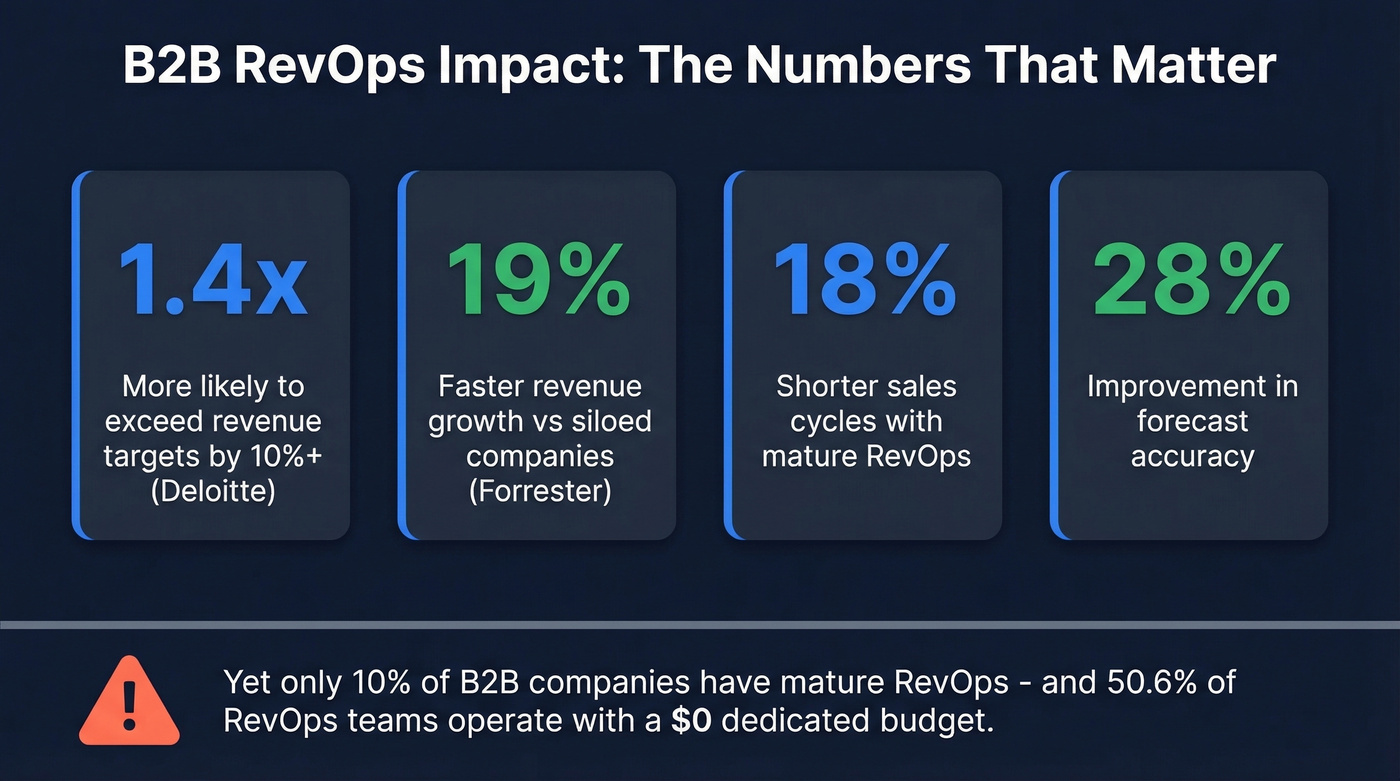
Only 21% of B2B companies use GenAI in "innovative" ways across their revenue operations. Those that do are 2.4x more likely to automate customer follow-ups and 2.2x more likely to streamline contract creation and review. The gap between companies treating this as a strategic function and those treating it as admin support is widening fast - 75% of the highest-growth companies have now adopted a RevOps model. The question isn't whether it works. It's whether yours actually does.
How to Structure a RevOps Team
Three org models dominate. Centralized works for companies under 100 GTM employees - one team owns systems, data, process, and reporting. Hub-and-spoke scales once GTM headcount exceeds 100: a central core sets standards while embedded specialists sit within sales, marketing, and CS. Decentralized is what most large enterprises accidentally end up with, and it's the hardest to make work.
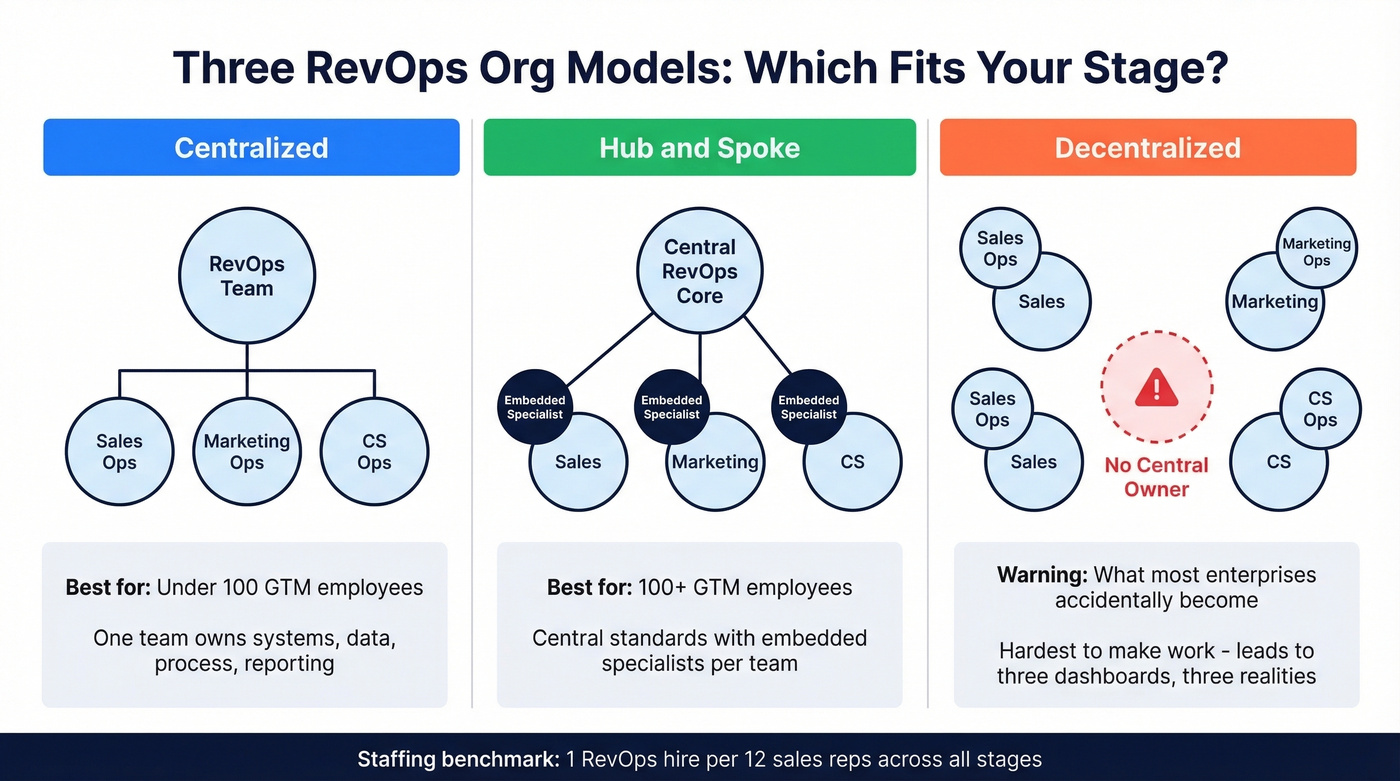
Your first RevOps hire will spend most of their time on CRM admin, deal desk work, workflows, and data integrity. That's correct. The strategic work comes once the plumbing doesn't leak.
PeerSignal's analysis of 2,500 B2B SaaS companies gives staffing benchmarks:
| ARR Stage | RevOps Headcount | Ratio |
|---|---|---|
| $50M | 4-5 | ~12:1 |
| $100M | 7-10 | ~12:1 |
| $200M | 14-19 | ~12:1 |
One stat that should alarm every RevOps leader: 50.6% of teams operate with a $0 dedicated budget. They're expected to optimize the revenue engine with no fuel.
The talent economics are brutal too - professionals at companies with mature operations command a $37,000 salary premium over those at early-stage programs. Hire at the wrong maturity stage and you'll either overpay or understaff. For teams pre-$10M ARR that can't justify a full-time hire, a fractional VP of RevOps at $8K-$12K per month is the smarter move. You get the strategic layer without the overhead, and you can transition to a full-time hire once the foundation is set.

Half of RevOps teams run on a $0 budget. That makes every dollar in your enrichment stack count. Prospeo delivers 98% email accuracy and a 92% API match rate at $0.01 per lead - 90% cheaper than ZoomInfo. One platform replaces the multi-vendor data sprawl bleeding your budget.
Stop paying double for 70% overlap. Consolidate your enrichment layer.
The Tech Stack (Without the Bloat)
89% of surveyed companies use fewer than 11 sales tools, and companies with 11-20 reps spend an average of $1,417 per rep per year on their stack. The gap between what companies buy and what reps actually use is where money goes to die.
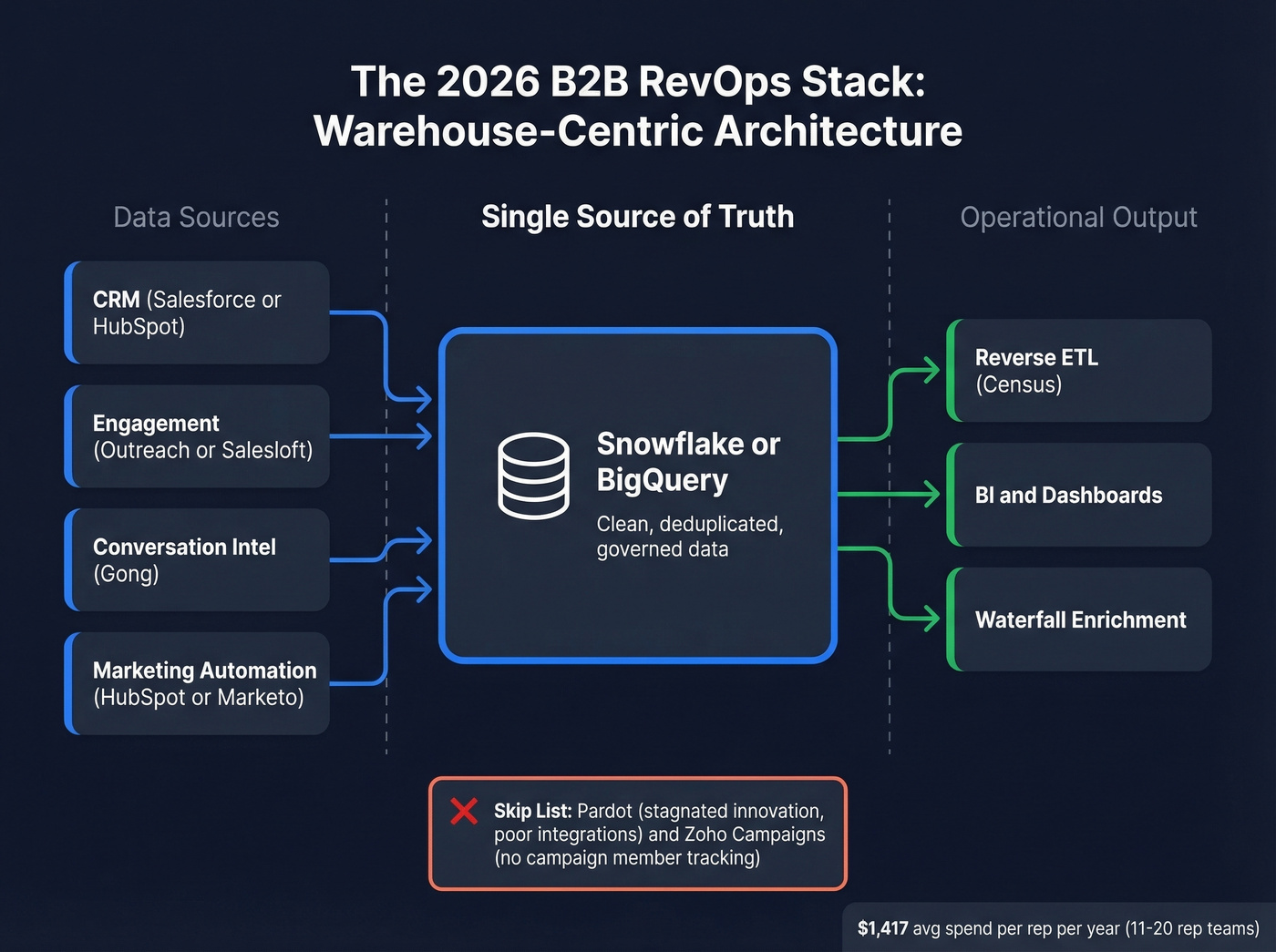
Let's be honest: most B2B RevOps teams don't have a tools problem - they have a consolidation problem. We've seen teams running six separate data tools before collapsing everything into a single CRM plus waterfall enrichment. Their data quality went up and their spend dropped 40%. The biggest consolidation opportunity sits in the enrichment layer, where major providers have roughly 70% coverage overlap on US business contacts. Paying for two gives you marginal lift at double the cost. A smarter approach: waterfall enrichment - querying multiple providers in sequence, deduplicating, and writing one authoritative record back to your CRM.
The architecture that works best in 2026 is warehouse-centric: Snowflake or BigQuery as your single source of truth, with reverse ETL tools pushing clean data back into operational tools.
| Category | Recommended | Skip |
|---|---|---|
| CRM | Salesforce, HubSpot | - |
| Engagement | Outreach, Salesloft | - |
| Conversation Intel | Gong | - |
| Marketing Automation | HubSpot, Marketo | Pardot, Zoho Campaigns |
| Integration | Zapier/Make/n8n (early), Tray.io/Workato (scale) | - |
| BI/Warehouse | Snowflake/BigQuery + Census | - |
Skip Pardot - it's stagnated on innovation and integrates poorly even within the Salesforce ecosystem. Zoho Campaigns lacks campaign member-level tracking and reporting, which is a non-negotiable for any operations team building attribution.
Metrics That Matter
Start with four. Not fourteen.
Lead-to-opportunity conversion rate, average sales cycle length, customer acquisition cost, and MRR growth. If you can't report these accurately and consistently across teams, nothing else matters.
Once those are solid, layer in net revenue retention, pipeline coverage ratio, win rate by segment, and forecast accuracy. Proper governance can improve forecast accuracy up to 28% - the kind of improvement that makes CFOs pay attention.
Why B2B RevOps Fails
47% of companies report siloed, hard-to-access data. That alone explains most failures. But the pattern runs deeper.
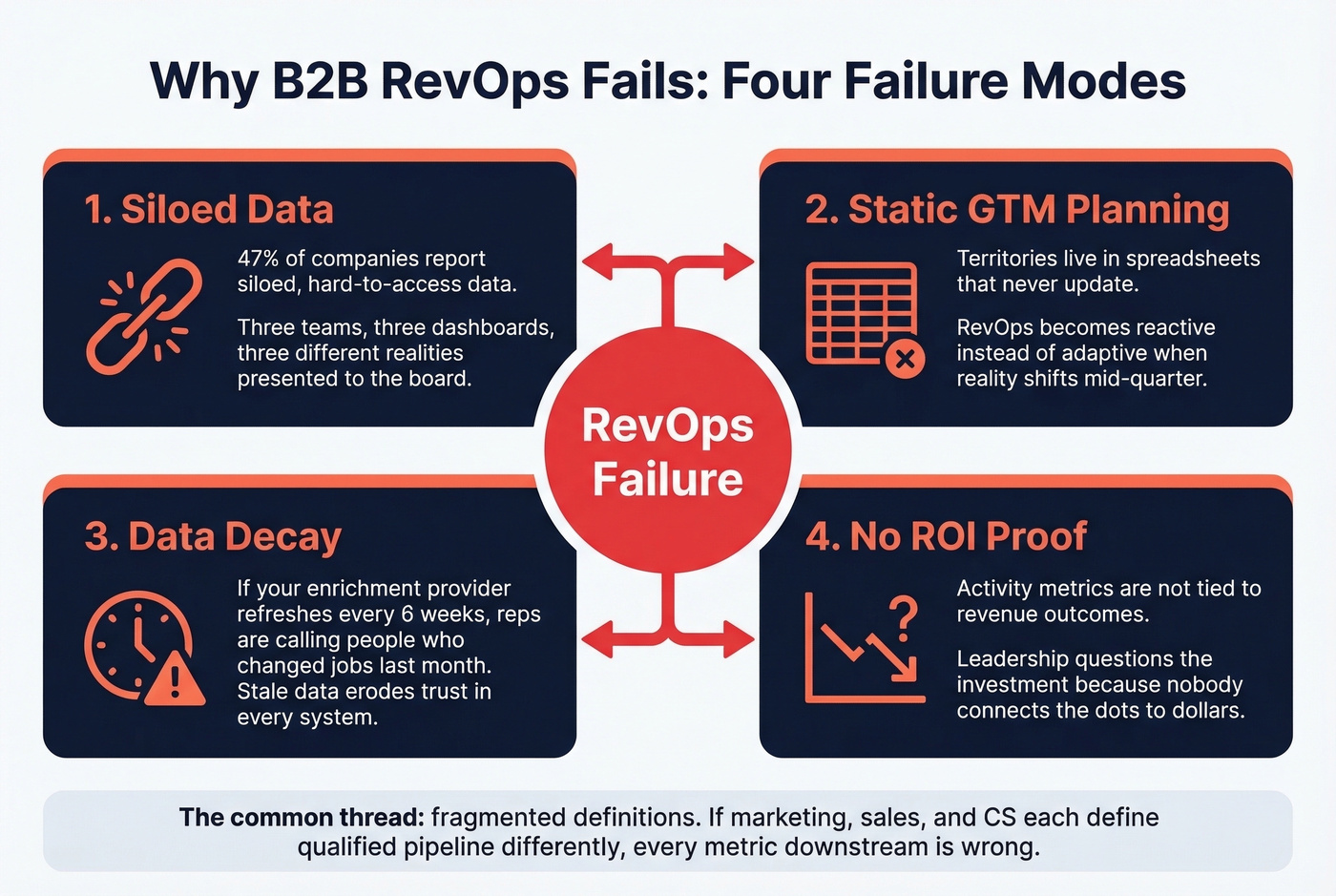
Static GTM planning is the first killer - territories living in spreadsheets that never update when reality shifts mid-quarter. Revenue operations becomes reactive instead of adaptive. The second is fragmented definitions: three teams, three versions of "qualified pipeline," three numbers on the board deck. Nobody owns the full journey because marketing optimizes for MQLs, sales for closed-won, and CS for NPS.
Then there's the data decay problem that amplifies everything else. If your enrichment provider refreshes on a six-week cycle, your reps are calling people who changed jobs last month. Stale data is a silent killer - it erodes rep trust in the system, inflates bounce rates, and makes every downstream metric unreliable. In our experience, this is the single most underestimated failure mode. Teams spend months building dashboards and workflows on top of data that's already rotting. Finally, most teams can't prove ROI because activity metrics aren't tied to revenue outcomes, so leadership questions the investment.
If you want a deeper breakdown of where pipeline breaks, start with these common sales pipeline challenges.
Getting Started: First 90 Days
Days 1-30 (Crawl): Audit your stack. Map every tool to a function. Clean your CRM data - deduplicate, standardize fields, kill dead records. This isn't glamorous. It's essential.
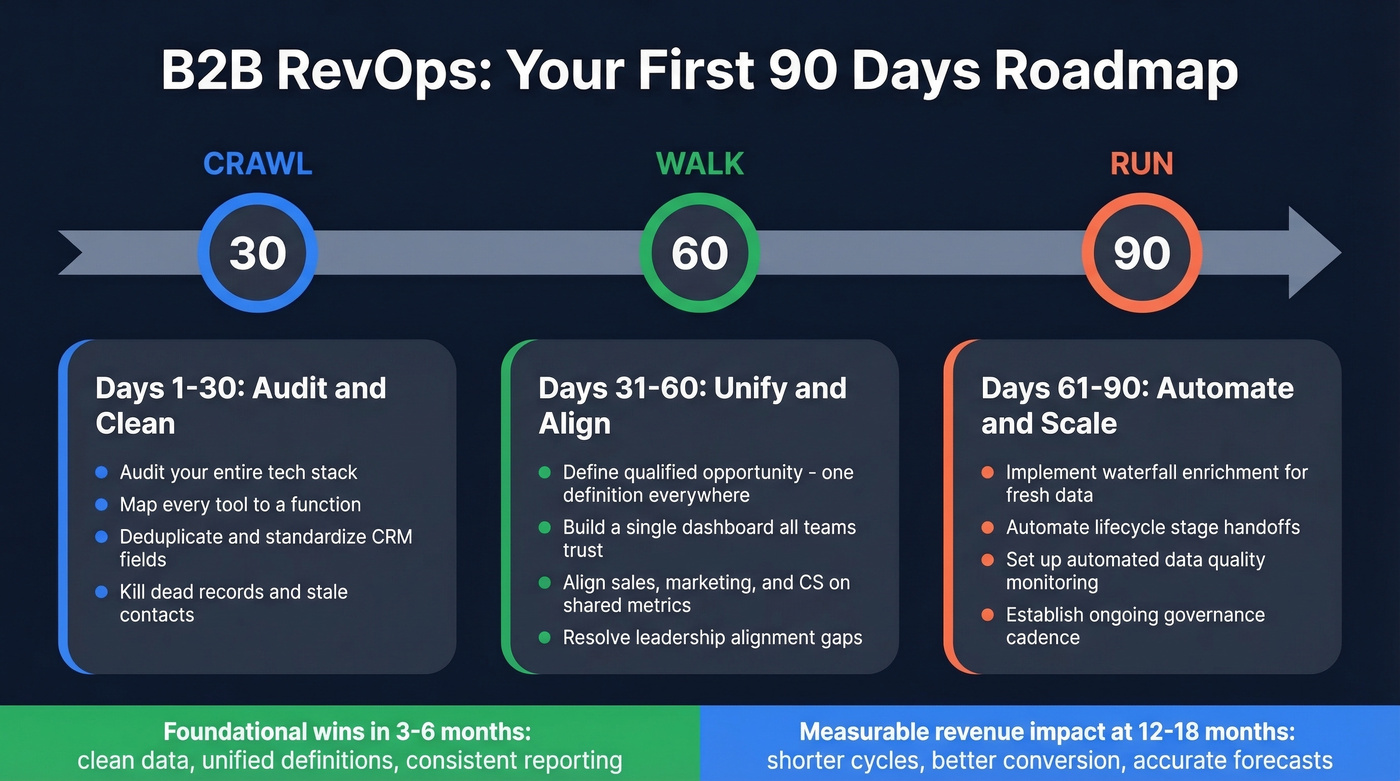
Days 31-60 (Walk): Unify definitions across teams. "Qualified opportunity" means one thing, everywhere. Build a single dashboard that sales, marketing, and CS all trust. If your teams can't agree on what counts as pipeline, you don't have a RevOps problem - you have a leadership alignment problem.
Days 61-90 (Run): Implement waterfall enrichment to keep data fresh automatically. Automate handoffs between lifecycle stages. Expect foundational improvements - cleaner data, unified definitions, consistent reporting - within 3-6 months and measurable revenue impact at 12-18 months.
To keep handoffs clean, standardize your lead status and document your lead generation workflow so every team runs the same playbook.
The article's core point stands: siloed, stale data kills RevOps. Prospeo refreshes 300M+ profiles every 7 days - not the 6-week industry average. CRM enrichment returns 50+ data points per contact with an 83% match rate, so your sales, marketing, and CS teams finally work from one clean record.
Give every team the same source of truth with data that's never more than a week old.
FAQ
What's the difference between RevOps and Sales Ops?
Sales Ops focuses on sales execution - territories, comp plans, pipeline reporting. B2B RevOps unifies Sales, Marketing, and CS Ops under shared data, processes, and metrics to eliminate revenue leaks across the full customer lifecycle. The clearest signal you need RevOps: your teams report different pipeline numbers to the same exec.
When should a company hire its first RevOps person?
The benchmark is one RevOps hire per 12 sales reps, typically between $10M-$25M ARR. Below that threshold, a fractional RevOps consultant at $8K-$12K per month is more cost-effective than a full-time hire and still gives you the strategic orchestration layer.
What tools does a RevOps team need?
At minimum: a CRM (Salesforce or HubSpot), an engagement platform (Outreach or Salesloft), a data enrichment provider with a fast refresh cycle, and a BI layer. Most mature teams run 8-11 tools total. Fewer is better - every additional tool adds integration debt.
How long does it take to see ROI from RevOps?
Expect foundational improvements - cleaner data, unified definitions, consistent reporting - within 3-6 months. Measurable revenue impact like 18% shorter sales cycles and improved conversion rates typically takes 12-18 months to materialize.