

10 Types of Customer Profiling (and How to Actually Use Them)
Most guides on types of customer profiling cover four - demographic, geographic, psychographic, behavioral - and stop there. That's barely half the picture. If you're running B2B outbound, those four alone won't help you build a target list worth emailing.
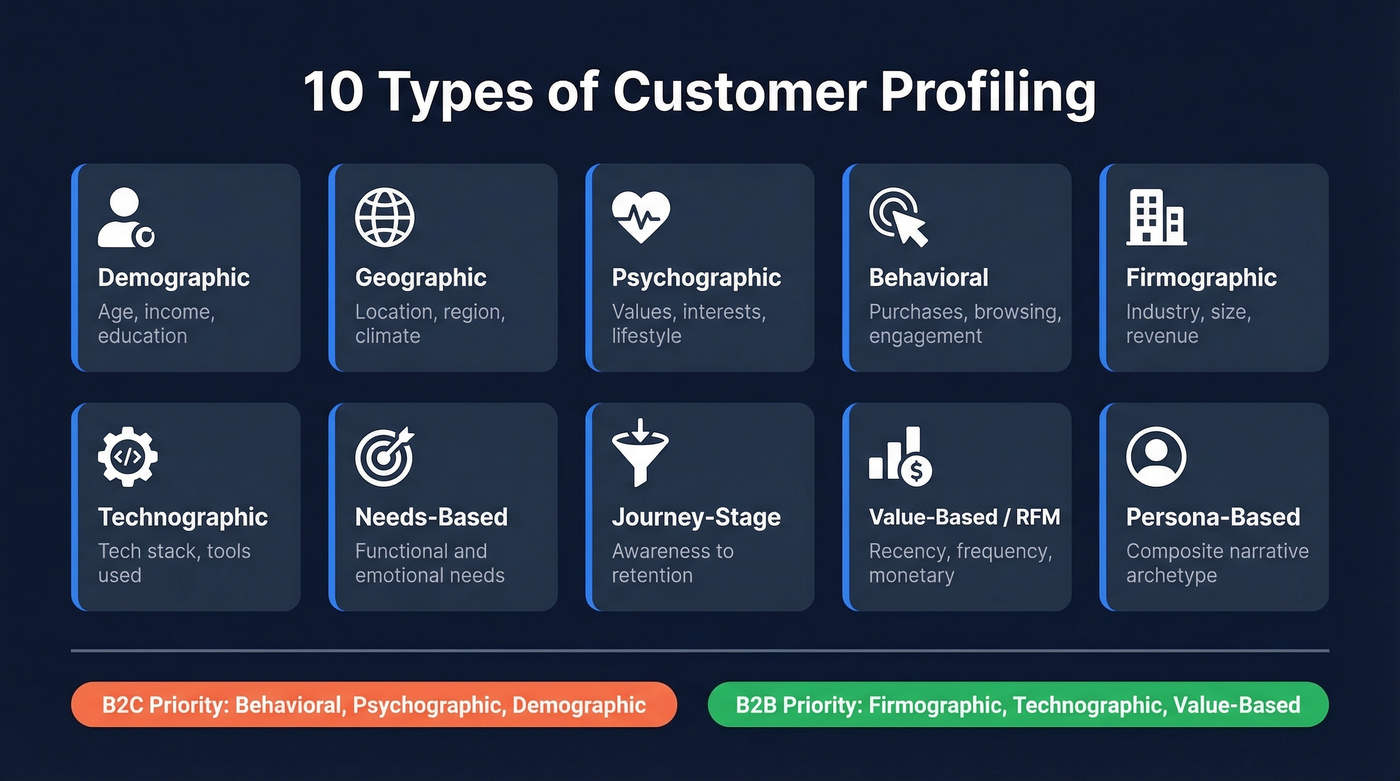
There are 10 profiling methods that matter. B2C teams should prioritize behavioral and psychographic approaches because that's where conversion insights live. B2B teams need firmographic, technographic, and value-based profiling front and center. Below: the full taxonomy, copy-paste templates for both motions, the seven mistakes that make profiles useless, and a compliance checklist for 2026's expanding privacy rules.
What Is Customer Profiling?
Customer profiling is the process of defining the characteristics of the people - or companies - most likely to buy from you and keep buying. It's not segmentation. Segmentation groups your existing audience into buckets based on shared traits. Profiling defines who you should be targeting in the first place.
There's another distinction worth nailing down early. An ICP operates at the company level: industry, headcount, revenue, tech stack. A buyer persona operates at the individual level: job title, goals, frustrations, decision-making style. Build the ICP first, then layer personas on top. Most teams get this backwards, and it shows in their pipeline quality.
Why Profiling Matters in 2026
Third-party cookies are dying, and the fallout is real. In a 2024 HubSpot/SEJ survey, 76% of marketers said cookie deprecation makes their job harder - and the situation has only intensified since. Meanwhile, 51% of teams still struggle to capture meaningful customer insights, and 64% face difficulty unifying data across channels. The old playbook of buying a list, spraying ads, and retargeting with cookies doesn't work anymore.
Without profiling, you're paying a premium for noise. The average B2B cost per acquisition on Google Ads sits at $116.13, and search ads return just $1.43 per dollar spent on average. Tighten your profiles, and those numbers improve because you stop wasting spend on accounts that were never going to close.
First-party profiling isn't optional anymore. It's the foundation of every efficient go-to-market motion in 2026.
The 10 Types of Customer Profiling
Demographic Profiling
Age, gender, income, education, occupation - the baseline. Every B2C team starts here because it's the easiest data to collect and the most widely available. Demographic profiling tells you who your customers are in the broadest sense. Necessary, but never sufficient on its own.
Geographic Profiling
Location-based targeting that accounts for regional preferences, climate, cultural factors, and local regulations. A brand selling winter gear profiles very differently in Minneapolis than in Miami. For B2B, geography matters for compliance - GDPR in the EU, state-level privacy laws in the US - and go-to-market timing, since buying cycles vary by region.
Psychographic Profiling
Values, attitudes, interests, lifestyle. Two customers with identical demographics can have completely different buying motivations. One buys running shoes for fitness; the other buys them for fashion. Patagonia built a major brand by targeting values-driven buyers who'll pay more for sustainability - that's psychographic profiling in action. It separates lookalike customers and lets you tailor messaging that actually resonates.
Behavioral Profiling
What do your customers actually do? Purchase history, browsing patterns, engagement frequency, channel preferences. Behavioral data is the most predictive profiling method for retention and upsell because past behavior is the strongest signal of future behavior.
Spotify's Discover Weekly is a textbook example - listening history drives personalized playlists at massive scale. If you're only collecting demographic data and ignoring behavior, you're leaving the most actionable insights on the table.
Firmographic Profiling
The B2B equivalent of demographics. Industry, company size, revenue, location, ownership type - public, private, non-profit, or government - and growth rate. Ask any RevOps practitioner which profiling approach they'd drop last, and the answer is almost always firmographic. Firmographics define whether a company is even a viable prospect before you spend a minute researching the people inside it.
If you're building an ICP, start with a clear Ideal Customer Profile Template before you add extra layers.
Technographic Profiling
What technology a company uses - their software stack, infrastructure, and tools. Technographic data powers three things: targeted prospecting (filter by companies using a competitor's product), competitive intelligence (spot switching signals), and personalized outreach tailored to stack-specific pain points. Data sources include Wappalyzer scans and live job posting signals. Prospeo includes technographic filters powered by both, so you can filter prospects by the tools they already use.
For a deeper implementation view, see our guide to firmographic and technographic data.
Needs-Based Profiling
Functional needs versus emotional needs. A CFO buying accounting software has a functional need - close the books faster - and an emotional need: stop getting grilled by the board about late financials. Needs-based profiling aligns your product positioning to the specific problem a customer type is trying to solve, which is critical for product-market fit.
Journey-Stage Profiling
Picture this: your SDR sends a pricing comparison to someone who just discovered your category exists. That's what happens without journey-stage profiling. Map your profiles to funnel stages - awareness, consideration, decision, retention - and match content accordingly. A prospect in the awareness stage needs educational content; a prospect in the decision stage needs a pricing comparison and a case study. Get the sequencing wrong, and even great content falls flat.
If you want a clean way to map stages, the AIDA sales funnel framework is a useful starting point.
Value-Based / RFM Profiling
Here's the thing: 20% of your customers generate 80% of your profits. Value-based profiling identifies which 20% that is. The standard method is RFM scoring - Recency (how recently they purchased), Frequency (how often), Monetary (how much). Score each on a 1-5 scale using quintiles, then combine into a profile. A 5-5-5 is a Champion. A 4-5-4 is a Loyalist. A 1-2-2 is At-Risk and needs a win-back campaign.
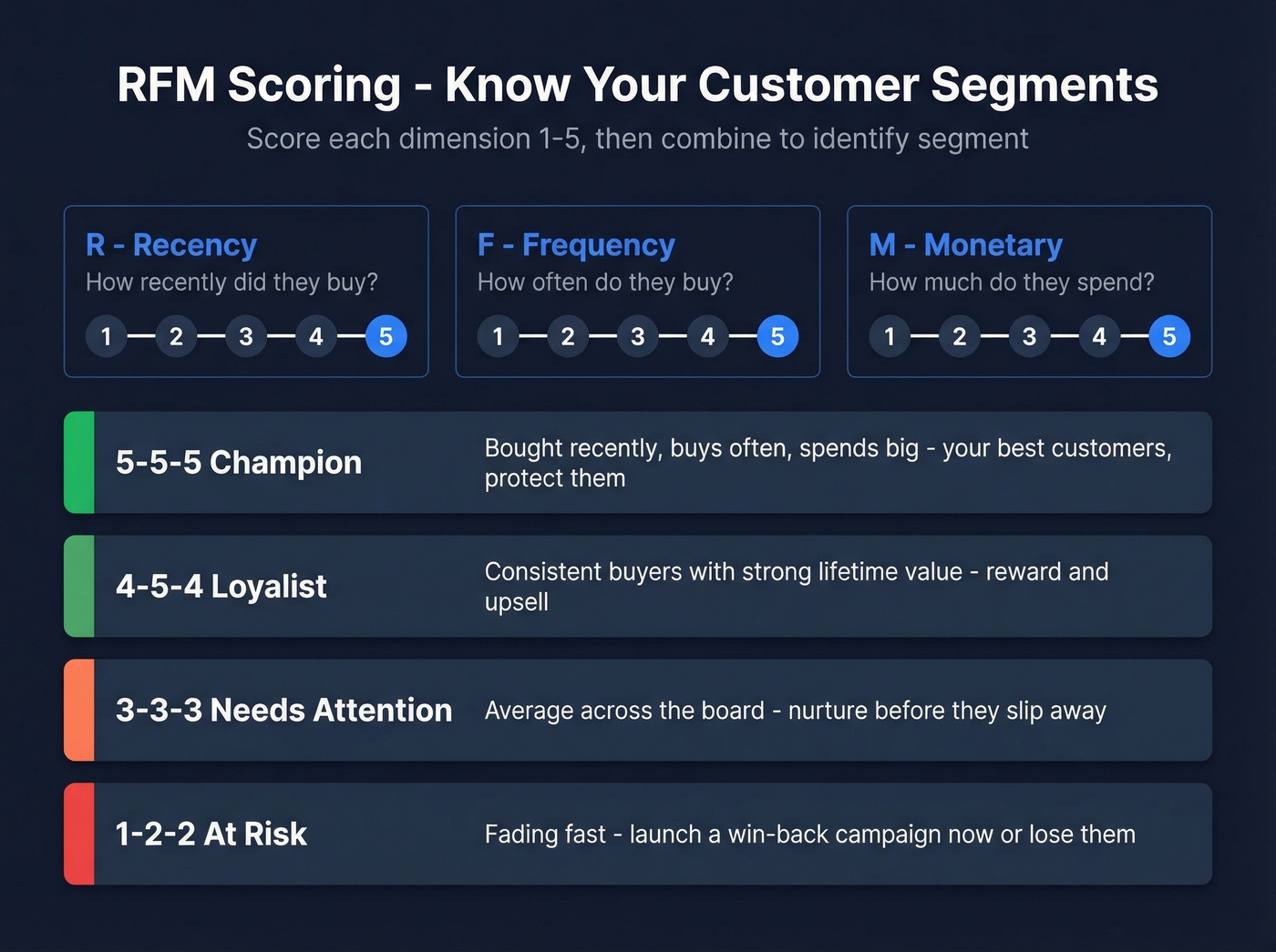
For larger datasets, machine learning clustering outperforms manual quintiles. One walkthrough comparing clustering methods reported silhouette scores of 0.6114 for K-Means and 0.6561 for DBSCAN - worth testing if you've got the volume.
Persona-Based Profiling
The synthesis layer. Persona-based profiling combines multiple approaches above into a narrative profile - a named, described archetype that your team can actually remember and use in daily conversations. Build personas after your ICP and data-driven profiling are in place. Personas built on assumptions instead of data are fiction, not strategy.
Summary Table
| Type | Best For | Key Data Points | Priority |
|---|---|---|---|
| Demographic | B2C | Age, income, education | High (B2C) |
| Geographic | Both | Location, region, climate | Medium |
| Psychographic | B2C | Values, interests, lifestyle | High (B2C) |
| Behavioral | Both | Purchases, browsing, engagement | High |
| Firmographic | B2B | Industry, size, revenue | Critical (B2B) |
| Technographic | B2B | Tech stack, tools used | High (B2B) |
| Needs-Based | Both | Functional/emotional needs | Medium |
| Journey-Stage | Both | Funnel position | Medium |
| Value-Based/RFM | Both | Recency, frequency, monetary | High |
| Persona-Based | Both | Composite narrative | Build last |
B2B vs. B2C Profiling
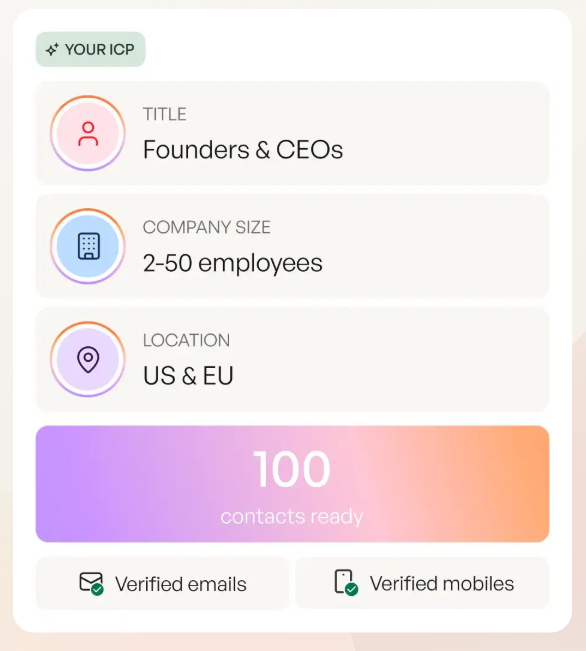
B2B profiling has a complexity layer that B2C doesn't: the customer ecosystem. The person who decides to buy isn't always the person who pays, and neither is the person who actually uses the product. Deciders, payers, and users often have different motivations and objections. Your profiles need to account for all three roles, or your sales team will keep pitching features to someone who only cares about budget.
B2B profiling starts at the company level and works down to individuals. B2C profiling starts and ends with the individual. If your B2B profiles don't include firmographic and technographic data, you're doing it wrong.
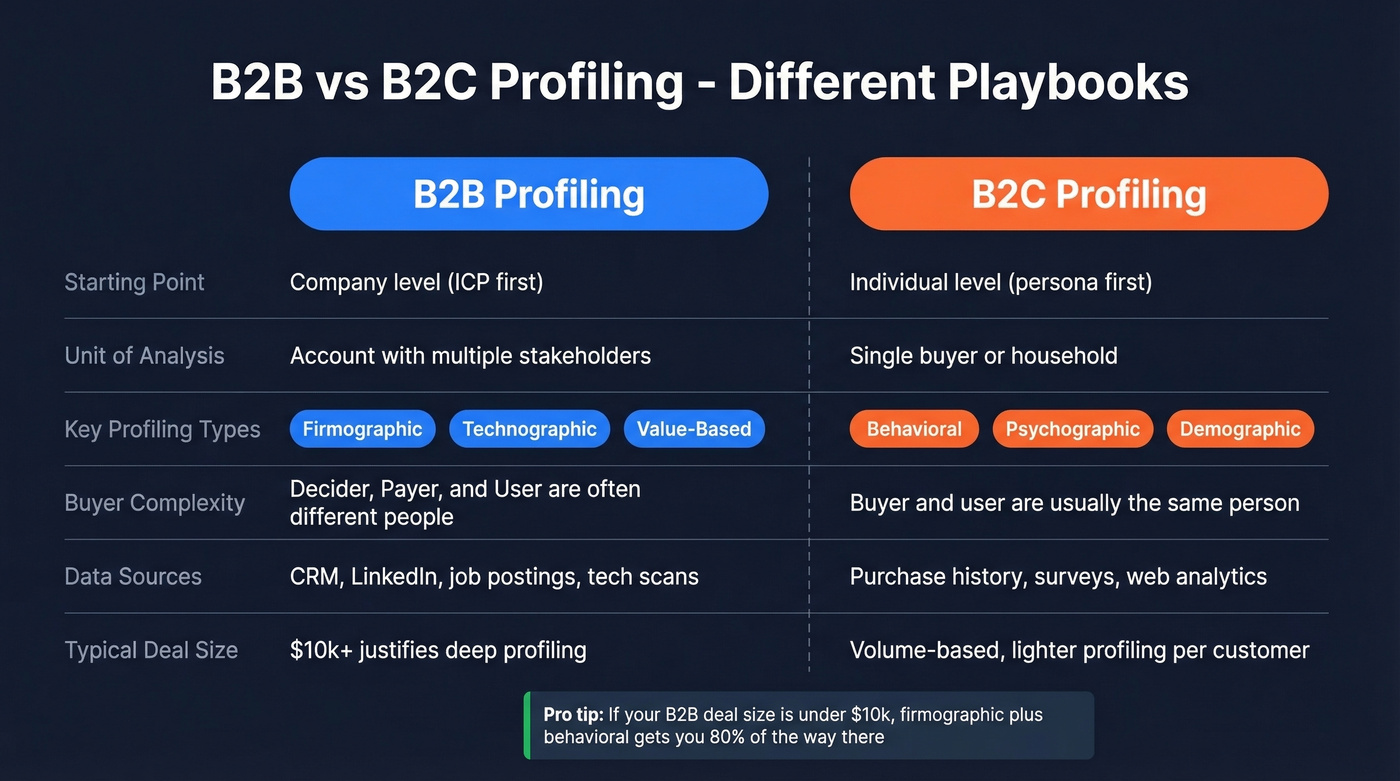
The sequencing matters too. B2B teams should define their ICP first, then build buyer personas for the decision-makers within those companies. B2C teams can go straight to persona work because the buyer and the company are the same entity.
Let's be honest: if your average deal size is under $10k, you probably don't need ten profiling categories. Firmographic + behavioral will get you 80% of the way there. Save the complexity for deals that justify the effort.
B2B priority stack: firmographic, technographic, value-based. B2C priority stack: behavioral, psychographic, demographic.

Firmographic, technographic, and intent-based profiling only works if you can act on it. Prospeo's 30+ search filters let you turn every profile type into a verified prospect list - filter by industry, tech stack, headcount growth, funding, and 15,000 buyer intent topics. 98% email accuracy means your outreach actually lands.
Stop profiling in spreadsheets. Start building lists that convert.
Customer Profile Templates
B2B Profile Template:
- Industry
- Company size (headcount)
- Geography / HQ location
- Annual revenue
- Key decision-makers (titles + roles)
- Pain points
- Business goals
- Buying triggers
- Technology stack
- Budget range
- Value potential (estimated LTV)
B2C Profile Template:
- Demographics (age, gender, income, education)
- Lifestyle / psychographics (values, interests, hobbies)
- Geography
- Pain points
- Personal goals
- Buying triggers
- Purchase behavior (frequency, average order value)
- Preferred channels (email, social, in-store)
- Price sensitivity
- Value potential (estimated LTV)
Put these fields in your CRM's custom fields, not a standalone doc. If it doesn't live in the system your reps use every day, it won't get used.
If you're evaluating systems, here are more examples of a CRM to compare.
How to Build a Customer Profile
Step 1: Analyze your best existing customers. In our experience, this is where most teams cut corners - they build profiles based on who they want to sell to, not who actually buys. Look at your top 20% by revenue or retention and find the patterns. What industries? What size? What triggered the purchase?
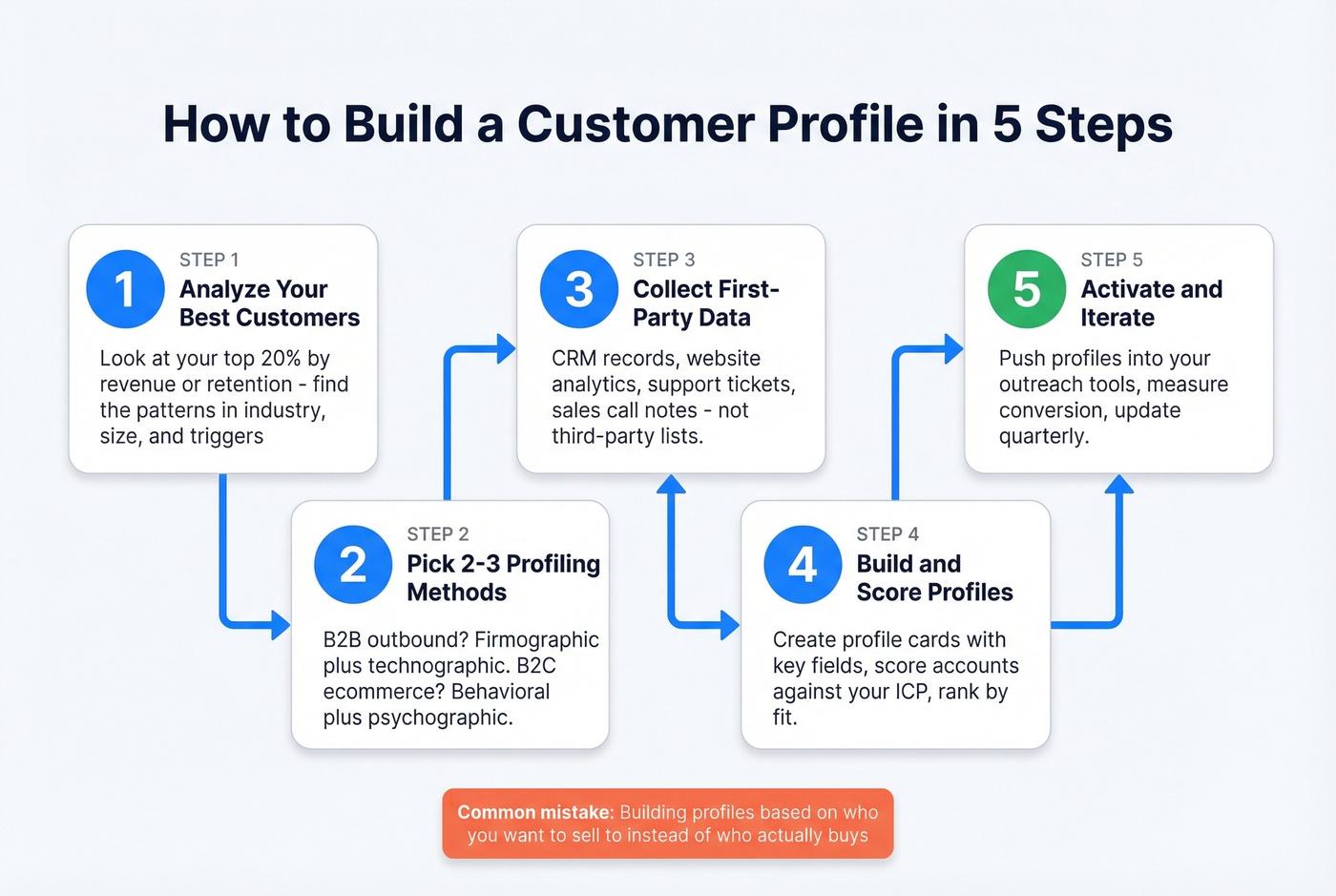
Step 2: Choose 2-3 profiling methods that match your sales motion. B2B outbound? Firmographic + technographic. B2C e-commerce? Behavioral + psychographic. Don't try to fill every field on day one.
If you're running outbound, these sales prospecting techniques help you operationalize the profile into daily activity.
Step 3: Collect first-party data. CRM records, purchase history, support tickets, survey responses, website behavior. This is the data you own and control, and it's the most reliable.
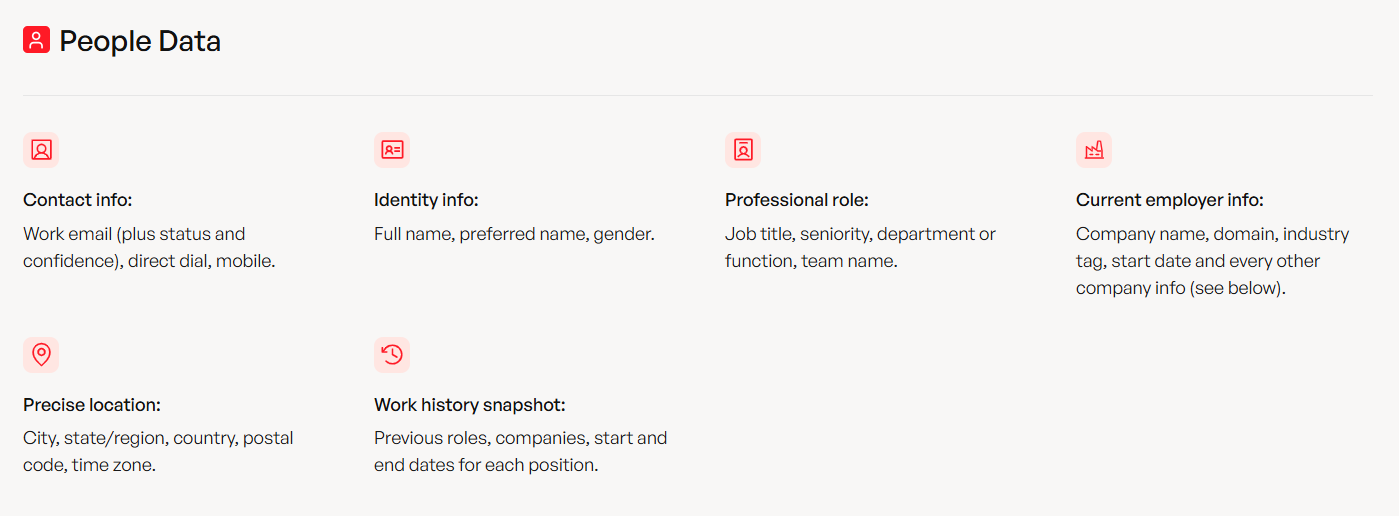
Step 4: Enrich and verify profile data at scale. First-party data has gaps. Job titles change, companies get acquired, emails bounce. To fill missing profile fields at scale, use a data enrichment platform. Prospeo returns 50+ data points per contact, delivers a 92% API match rate, and refreshes records every 7 days - critical because contact data decays fast.
If you're comparing vendors, start with our roundup of data enrichment services.
Step 5: Activate in CRM/campaigns and refresh quarterly. A profile sitting in a spreadsheet is worthless. Push enriched profiles into your CRM, build segments, trigger sequences, and revisit the entire framework at least every quarter.
To keep activation consistent, use a defined lead generation workflow instead of one-off campaigns.
Profiling Mistakes to Avoid
1. Building profiles as a wishlist instead of analyzing your actual best customers. Fantasy ICPs produce fantasy pipeline.
2. Waiting for "enough data" before starting. Use deanonymized site traffic and early customer patterns to begin. Iterate as you close more deals.
3. Relying solely on firmographics. Company size and industry aren't enough. Add technographic and behavioral layers or your targeting stays shallow.
4. Defining too narrowly. Your ICP isn't one person - it's a set of general needs and characteristics shared by your best-fit accounts.
5. Building in a marketing bubble. Involve sales and customer success. They talk to customers daily and know things your analytics dashboard doesn't.
6. Failing to update. Static profiles are dead profiles. Markets shift, products evolve, and the customers who fit last year won't necessarily fit today.
7. Creating profiles and never using them. We've seen teams spend weeks building beautiful ICP documents that never influence a single campaign or sales call. The consensus in RevOps communities on Reddit is that this is the most common and most expensive mistake - the work is done but the value is zero.
Privacy and Compliance in 2026
The compliance picture is expanding fast. By the end of 2025, the US had 20 state-level privacy laws in effect or enacted, with eight new laws taking effect that year alone. The count continues to grow in 2026. Profiling-specific regulations are tightening - several states now require disclosures around automated decision-making and offer opt-outs for profiling activities.
Your 2026 compliance checklist:
- Document your lawful basis for processing each data type (consent, contract, or legitimate interest)
- Ensure consent is freely given, specific, informed, and unambiguous - no pre-checked boxes
- Honor Global Privacy Control (GPC) signals automatically
- Practice data minimization - collect only what's necessary for your stated purpose
- Set retention timeframes and delete or anonymize data you no longer need
- Maintain consent logs and audit trails
- Implement data security measures and anonymization/pseudonymization where possible
- Assign accountability - someone on your team owns compliance, not "everyone"
Skip the compliance checklist at your own risk. Fines are real, and "we didn't know" stopped being an excuse years ago.
Tools for Customer Profiling
CRMs: HubSpot offers a free tier that handles basic profiling fields. Salesforce plans start around $25/user/month and scale up by edition. Either works as your system of record.
CDPs: Segment and Tealium handle data unification and identity resolution - stitching cookies, device IDs, and email into a single unified profile. Expect $1,000-$10,000+/month depending on volume. The market's shifting toward composable, warehouse-native CDPs over packaged ones that create new data silos.
Behavior Analytics: Kissmetrics starts at ~$25/month for basic behavioral tracking. Mixpanel has a free tier. Both connect user actions to conversion and retention metrics.
Survey Tools: SurveyMonkey's free tier covers basic psychographic and needs-based data collection. Paid plans start around $25/month for advanced logic and analysis.
B2B Data Enrichment: For B2B teams that need verified emails, direct dials, and firmographic/technographic data in one platform, Prospeo covers the enrichment layer with 300M+ professional profiles, 98% email accuracy, and intent data tracking 15,000 topics via Bombora. Free tier: 75 emails + 100 Chrome extension credits/month. No contracts.
If you're building your stack from scratch, these free lead generation tools can cover the basics before you scale.
You just mapped 10 profiling methods. Now you need the data to power them. Prospeo combines firmographic, technographic, and intent signals into one platform - refreshed every 7 days, not 6 weeks. Layer job changes, department headcount, and Bombora intent data to find buyers who match your profiles and are actively in-market.
Every profiling method above lives inside one search. Try it free.
FAQ
What's the difference between customer profiling and segmentation?
Profiling builds a detailed picture of individual customer types you want to target. Segmentation groups your existing audience into buckets based on shared traits. Profiling comes first - it defines your ideal buyer - while segmentation organizes the customers you already have.
Which profiling types matter most for B2B?
Firmographic, technographic, and value-based profiling deliver the highest ROI for B2B teams. Start with ICP-level firmographic data, layer technographic signals to personalize outreach, then use RFM scoring to prioritize high-value accounts.
How often should customer profiles be updated?
Quarterly at minimum. Contact data decays fast - job changes, company acquisitions, email bounces. Teams using enrichment tools with 7-day refresh cycles keep profiles accurate without manual effort, compared to the 6-week industry average.
Is customer profiling legal under GDPR?
Yes, with proper consent and a documented lawful basis. Collect only necessary data, honor opt-out requests including Global Privacy Control signals, and maintain consent logs. Several EU member states also require transparency disclosures for automated profiling decisions.
What tools do I need to start?
A CRM (HubSpot or Salesforce), a data enrichment platform for filling profile gaps with verified contact and firmographic data, and an analytics tool for behavioral data. You don't need a CDP on day one - start simple and add complexity as your data matures.