

The Buyer Journey in 2026: Data, Stages, and How to Actually Map It
86% of B2B purchases stall before they close - and the buyer journey frameworks most teams rely on haven't kept pace. That widely-cited "67% of the buyer journey is digital" stat everyone still quotes? It's from 2013. Buying behavior has shifted dramatically since then.
Three things matter right now. The classic 3-stage model (awareness, consideration, decision) is a starting point, not reality - real buying loops through six jobs, and most deals stall somewhere in the messy middle. 95% of the time, the winning vendor was already on the buyer's Day One shortlist, which means early visibility beats late-stage selling every time. And a journey map without operational data behind it is just a wall poster. You need signals that tell you which accounts are actually moving through stages right now.
What Is the Buyer's Journey?
The buyer journey is the complete process a prospect goes through from first recognizing a problem to choosing a vendor and signing a contract - every interaction, every piece of research, every internal conversation that happens before money changes hands. If you've searched "what is the buyer's journey" and gotten a vague answer about funnels, you're not alone. Most definitions oversimplify what's actually a complex, non-linear process.
Don't confuse it with the customer journey. The buyer's journey ends at purchase. The customer journey picks up after - onboarding, adoption, renewal, expansion, advocacy. They're related but distinct, and conflating them muddies your strategy.
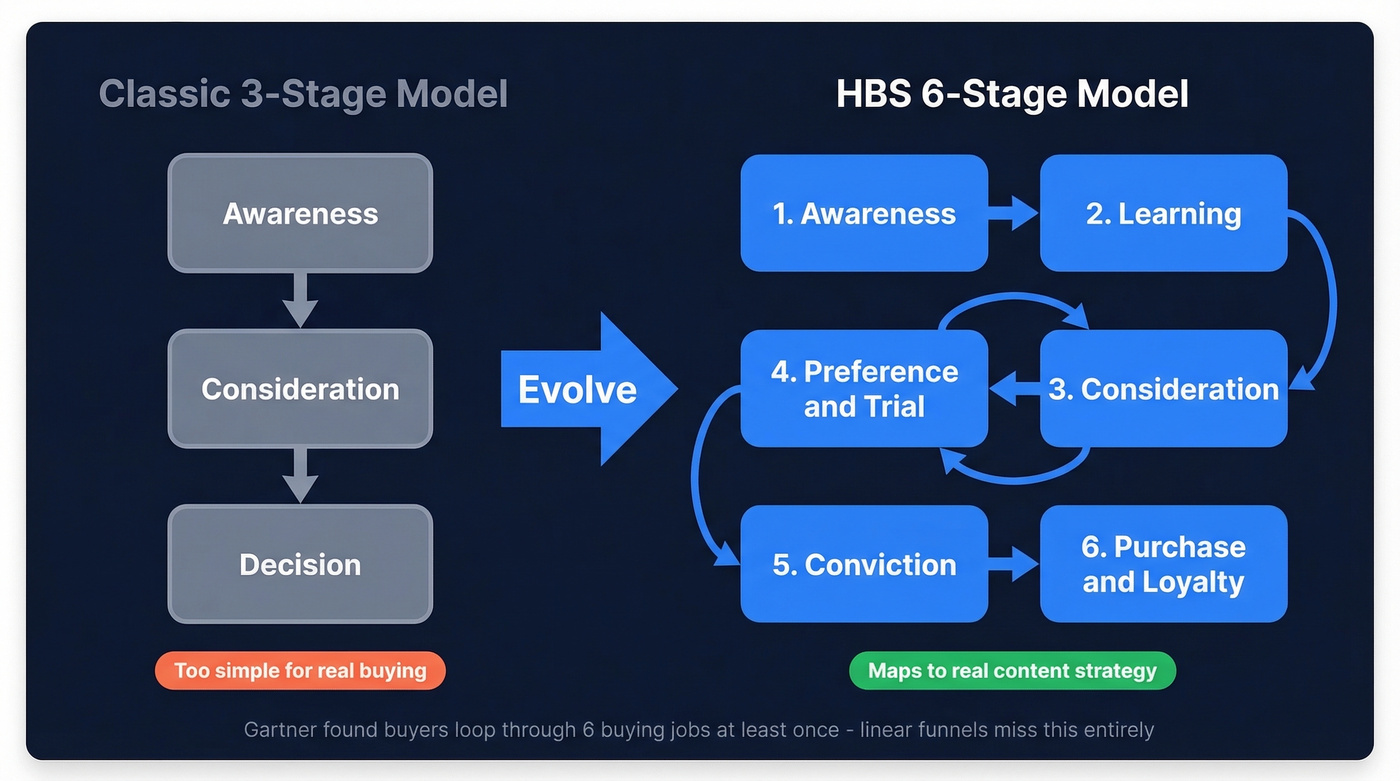
Most guides stop at the classic 3-stage model: awareness, consideration, decision. That's fine as a mental shortcut. It's not fine as an operating framework for a real sales and marketing org. We've seen teams build entire content strategies around three stages and wonder why nothing converts - the model is too blunt to be useful on its own.
Beyond the 3-Stage Model
Awareness
The buyer recognizes they have a problem or an unmet need. They're not shopping yet - they're researching. They're reading blog posts, watching webinars, asking peers on Slack. At this stage, they don't know your product exists, and they might not even have the vocabulary to describe what they need.
Consideration
Now they're evaluating categories of solutions. They've defined the problem and they're comparing approaches - build vs. buy, platform A vs. platform B, doing nothing vs. investing. Content that wins here is comparison-driven: versus pages, analyst reports, case studies.
Decision
The buyer has narrowed to a shortlist and is choosing a vendor. Pricing pages, demos, free trials, and reference calls matter most. This is where most sales teams focus their energy - and that's the problem. If you're not already on the shortlist, no amount of decision-stage content will save you.
Why Three Stages Falls Short
The 3-stage model implies a clean, linear funnel. Buyers move from awareness to consideration to decision like water flowing downhill. That's not how it works.
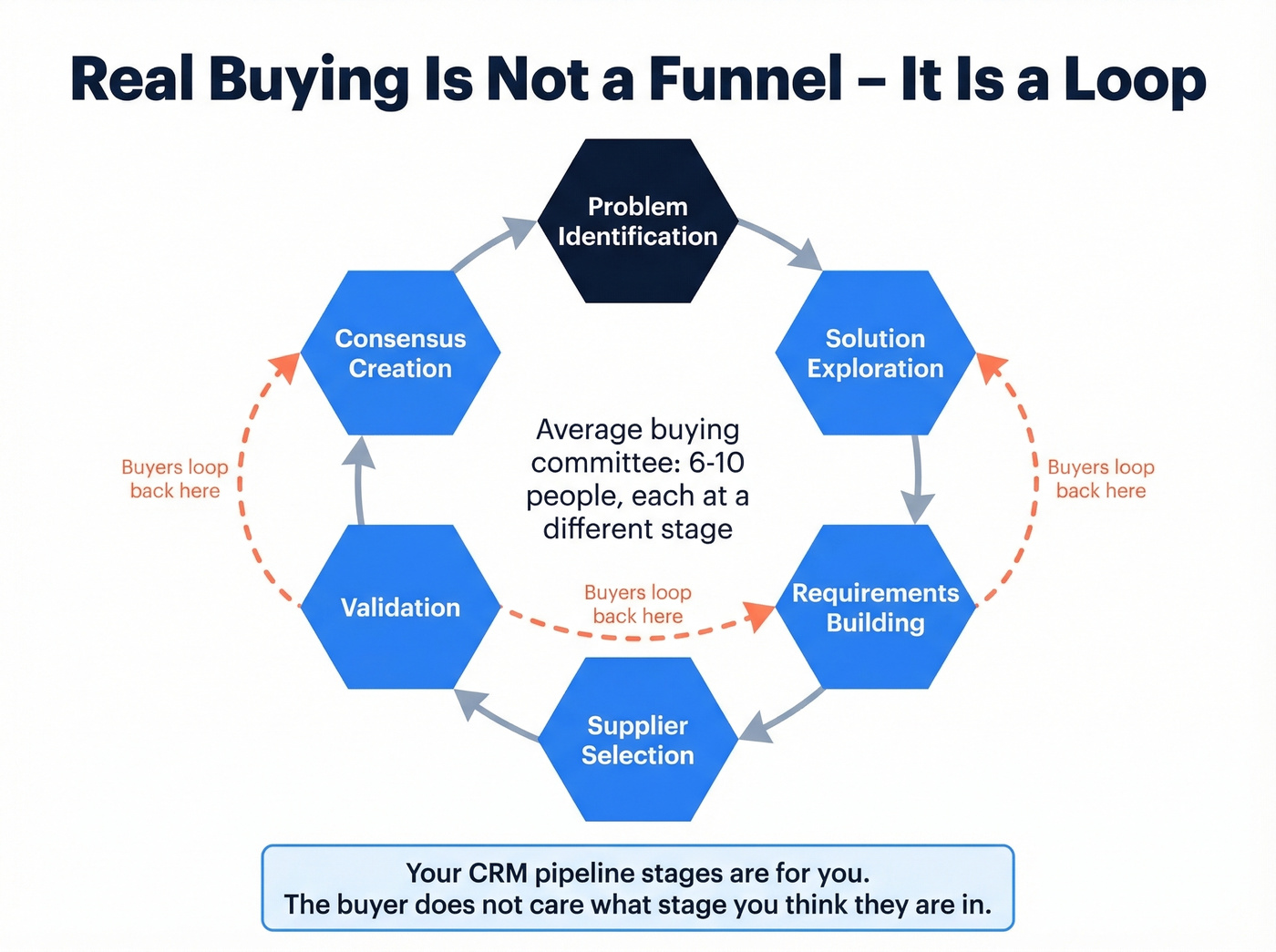
Gartner's research identifies six buying jobs that B2B buyers cycle through - and they loop back through each one at least once: problem identification, solution exploration, requirements building, supplier selection, validation, and consensus creation. A VP might be in "supplier selection" while a procurement lead is still in "requirements building." The journey doesn't move forward in lockstep.
Harvard Business School proposes a 6-stage alternative: Awareness, Learning, Consideration, Preference & Trial, Conviction, Purchase & Loyalty. The HBS model is more practical than Gartner's six buying jobs for most marketing teams because it maps cleanly to content types - you can assign specific assets to each stage without needing a PhD in buying psychology.
Practitioners on Reddit describe the B2B buying process as messier than any framework suggests, with stakeholders joining at different times and buyers constantly looping back. The core point is simple: your pipeline stages are for your CRM. The buyer doesn't care what stage you think they're in.
What 2026 Data Reveals About Buying Behavior
The 6sense Buyer Experience Report surveyed nearly 4,000 B2B buyers across North America, APAC, and EMEA. The findings reshape how we should think about timing, visibility, and engagement.
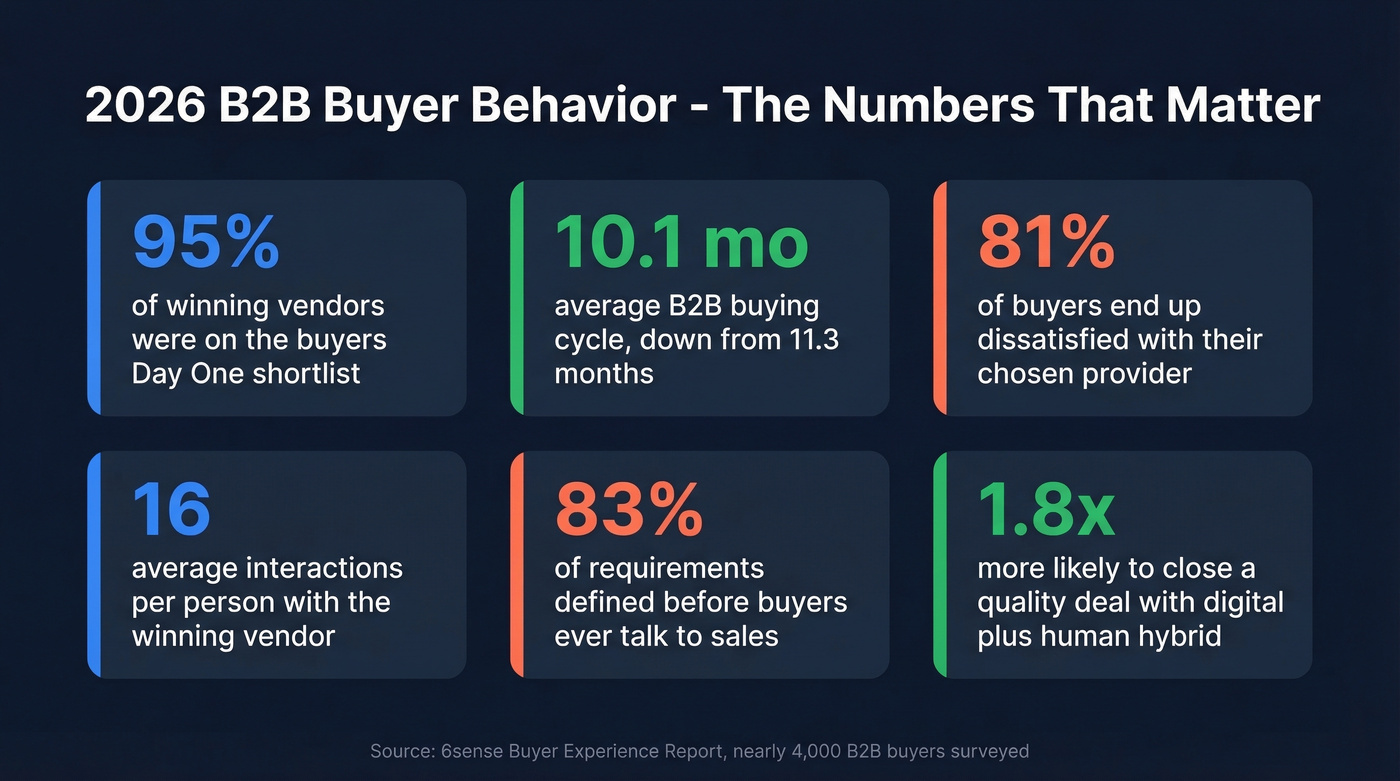
The average B2B buying cycle dropped to 10.1 months, down from 11.3 months the year before. Economic pressure is the driver - roughly half of buyers said it shortened their timelines, and 62% said it pushed them to engage sellers earlier. The point of first contact shifted from 69% to 61% of the journey, meaning sellers are getting in the door about 6-7 weeks sooner than they were.
Here's the thing: if your deal size is under $30k, you probably don't need a 10-month sales cycle. That 10.1-month average is dragged up by enterprise complexity. Mid-market teams running efficient processes should be closing in 3-5 months. If you're not, the problem isn't your market - it's your process.
The number that should rewrite your playbook: the winning vendor sits on the buyer's Day One shortlist 95% of the time. The pre-contact favorite wins approximately 80% of deals. Stop investing in late-stage content if you're invisible at the top of the funnel - that 95% stat means your demo page is irrelevant if buyers don't know you exist. Buyers average 16 interactions per person with the winning vendor before a deal closes. That's a lot of touchpoints to build before anyone fills out a form.
Two more stats that most teams ignore: buyers define their requirements 83% of the way before ever speaking with sales, and 81% end up dissatisfied with the provider they choose. Read that again. Four out of five buyers regret their decision. That's not a sales problem - it's a journey design problem. If you map the buying process correctly and show up with the right content at the right time, you're competing against a field where most vendors fumble the handoff.
The hybrid model is winning. 75% of B2B buyers say they prefer a rep-free experience, but Gartner found that buyers are 1.8x more likely to complete a high-quality deal when they combine digital self-service with a sales rep. Buyers think they want to go solo, but outcomes are better when they don't. Build your journey map accordingly - self-serve research early, human engagement when stakes rise.
AI has become table stakes in evaluation. Nearly 90% of buyers say AI features were part of the solutions they acquired. And 72% encountered Google AI Overviews during their research - of those, 90% clicked at least one cited source. The research phase is being reshaped by AI, but it's not replacing human decision-making. It's compressing it.
B2B vs. B2C: Key Differences
The buyer journey concept applies to both B2B and B2C, but the mechanics are fundamentally different.
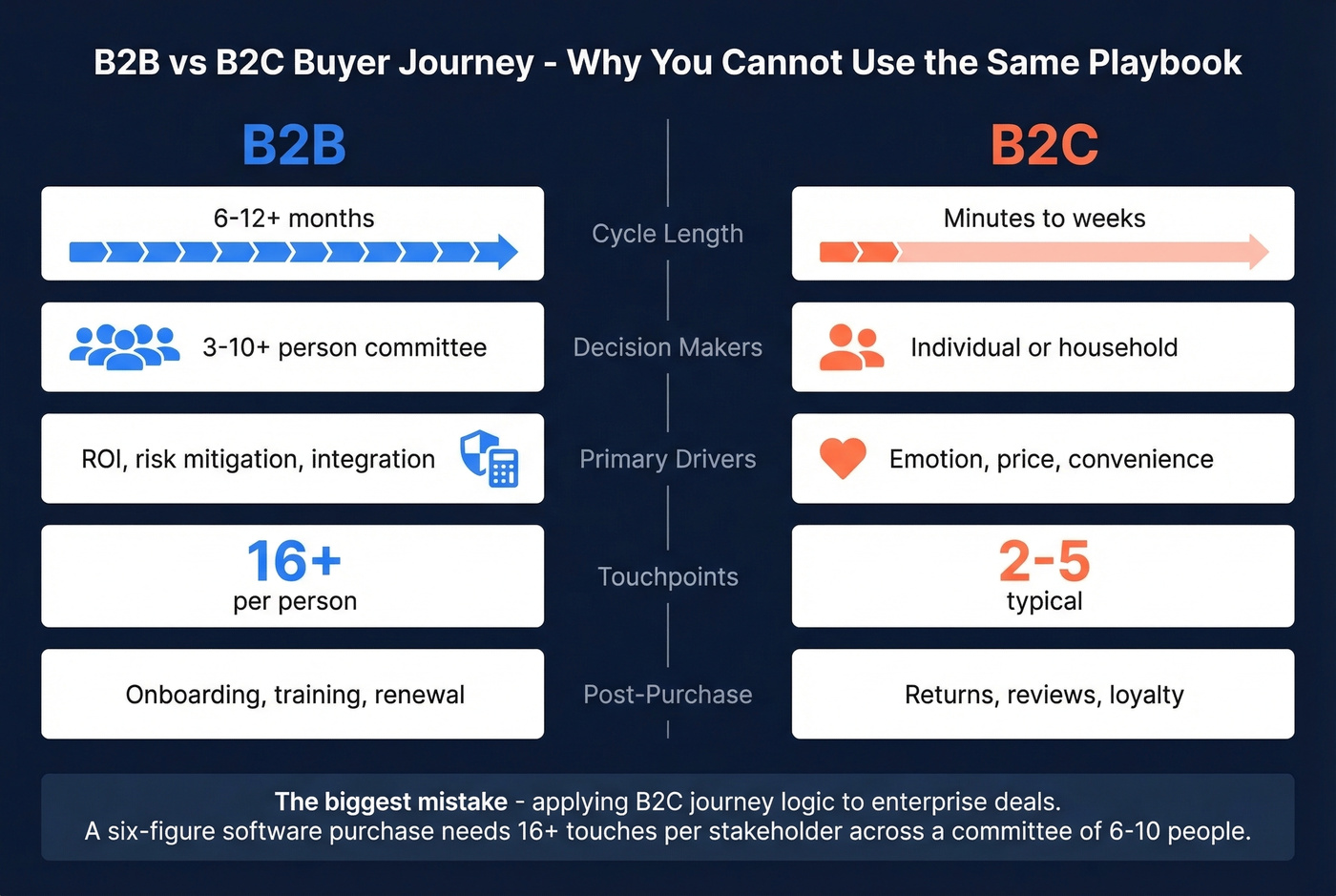
| Dimension | B2B | B2C |
|---|---|---|
| Cycle length | 6-12+ months | Minutes to weeks |
| Decision maker | Buying committee (3-10+) | Individual or household |
| Primary drivers | ROI, risk mitigation, integration | Emotion, price, convenience |
| Touchpoints | 16+ per person | 2-5 typical |
| Post-purchase | Onboarding, training, renewal | Returns, reviews, loyalty |
78% of customers use multiple channels to start and complete a transaction - that's true in both worlds. But in B2B, the multi-channel complexity compounds because you're dealing with a buying committee. The champion researching your product on their phone at 10pm isn't the same person who'll negotiate the contract. Each stakeholder enters the process at a different stage, with different concerns, and consensus-building becomes its own phase.
The biggest mistake B2B teams make is applying B2C journey logic to enterprise deals. A consumer can impulse-buy a $200 product after seeing one ad. A six-figure software purchase requires 16+ touches per stakeholder across a committee of 6-10 people. Map accordingly.

Buyers define 83% of their requirements before talking to sales. If you're not showing up early with the right accounts, you've already lost. Prospeo tracks 15,000 intent topics so you can identify which buyers are actively researching your category - and reach them with 98% accurate emails before competitors even know they're in-market.
Stop selling to buyers who already picked someone else.
How to Map Your Buyer Journey
A journey map that sits in a slide deck and never gets updated is a waste of everyone's time. We've seen teams spend weeks building beautiful maps that never leave the conference room. The goal isn't a pretty diagram - it's a decision-making tool.
Start With a Real Persona
Pick one specific buyer persona - not "marketing leaders" but "VP of Demand Gen at a Series B SaaS company with 50-200 employees, reporting to a CMO, measured on pipeline contribution." The more specific, the more useful the map. UXPressia draws a useful distinction: build an AS-IS map first (how buyers actually behave today) before creating a TO-BE map (how you want them to behave).
Define Your Stages and Rows
Stages run as columns across the top. Use the 6-stage model - Awareness, Learning, Consideration, Preference & Trial, Conviction, Purchase & Loyalty - rather than the basic three. It captures the real complexity without being unwieldy.
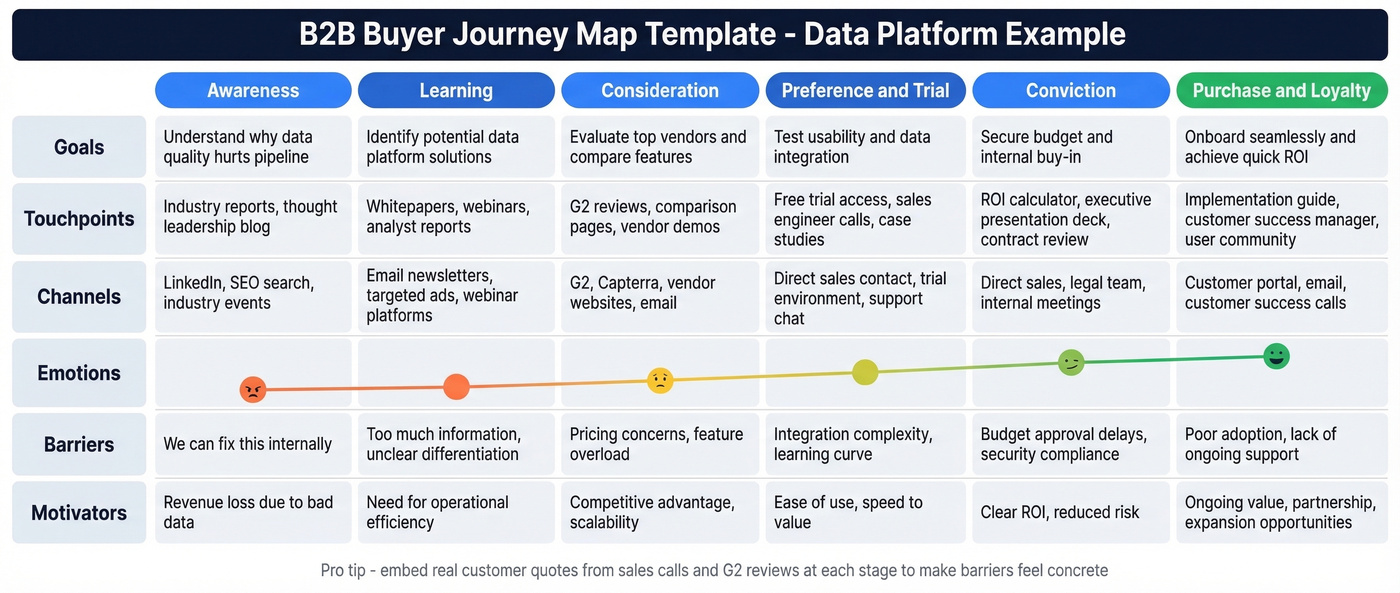
Rows run horizontally and represent the data layers you're tracking at each stage: goals (what the buyer wants), touchpoints (where they interact with you), channels (email, web, events, peer conversations), emotions (confidence level, frustration points), barriers (what stops them from advancing), and motivators (what pushes them forward). Embed real customer quotes in your map. Actual testimonials at each stage make the barriers and motivators feel concrete rather than hypothetical - pull them from sales call recordings, G2 reviews, or post-sale interviews.
A Filled-In Example
Here's a B2B SaaS example for a data platform buyer, walking through all six stages:
Awareness: Goal is to understand why current data quality is hurting pipeline. Touchpoints include industry reports, peer conversations, and blog content. Emotion is frustrated but not yet committed to change. Barrier: "We can probably fix this internally." Motivator: a missed quarter traced to bad contact data.
Learning: The buyer digs deeper into the problem space, consuming educational content - not vendor content - to understand the landscape. Touchpoints are podcasts, community threads, analyst briefings. Barrier: information overload, no clear framework for evaluating options. Motivator: a peer at another company shares what worked for them.
Consideration: Goal shifts to evaluating solution categories. Touchpoints are comparison pages, G2 reviews, analyst reports. Emotion is cautiously optimistic. Barrier: too many options, unclear differentiation. Motivator: a competitor just switched tools and is outperforming.
Preference & Trial: The buyer narrows to 2-3 vendors and wants hands-on experience. This is where pilot programs and free trials win deals. Barrier: internal resistance to running a trial ("we don't have time"). Motivator: the vendor makes the pilot frictionless with a clear success framework.
Conviction: Goal is internal buy-in. Touchpoints are ROI calculators, case studies, reference calls - testimonials and integrated proof designed to push people past hesitation. Emotion is anxious about getting approval. Barrier: procurement wants three quotes. Motivator: the champion's boss saw the demo and liked it.
Purchase & Loyalty: The deal closes, but the journey isn't over for the map's purposes. Touchpoints are contract negotiation, onboarding kickoff, and early success milestones. Barrier: buyer's remorse (remember, 81% end up dissatisfied). Motivator: fast time-to-value that validates the champion's internal advocacy.
Each stage gets this treatment. The map becomes a living document that marketing uses for content planning, sales uses for objection handling, and RevOps uses for lead scoring.
Six Mapping Mistakes to Avoid
No clear goal. "Map the buyer journey" isn't a goal. "Identify the top three drop-off points between demo request and closed-won" is. Without a specific objective, you'll build a pretty diagram that changes nothing.
Not defining the audience. A map for enterprise buyers and a map for SMB self-serve buyers are completely different documents. Trying to combine them produces something too generic to be useful for either.
Missing real data. Maps built entirely from internal assumptions are fiction. Pull CRM data, interview recent customers, review recorded sales calls. If 88% of buyers say experience matters as much as the product itself, your map needs to reflect their actual experience - not what your team imagines it looks like.
No content strategy attached. A map without a content plan for each stage is diagnosis without treatment. Every stage should have specific assets assigned: educational content early, comparison content in the middle, proof content late.
Wrong channels. With 78% of buyers using multiple channels, mapping only your website and email sequences misses most of the journey. Include peer communities, review sites, events, and dark social - the channels you can't easily track but know matter.
Trying to do everything at once. Map one persona through one journey first. Get it right, validate it with data, then expand. Teams that try to map five personas across three product lines simultaneously end up with nothing usable.
From Map to Action: Using Intent Data
A journey map tells you what stages exist. It doesn't tell you which accounts are in which stage right now.
That's the gap that kills most mapping initiatives - you build a beautiful framework, then your SDRs keep blasting the same generic sequences to everyone because they have no way to operationalize the stages. Intent data bridges that gap. When an account starts researching topics related to your category, that's a signal they've moved from passive awareness into active consideration. When they're reading comparison content and visiting pricing pages, they're in decision mode.
Prospeo tracks 15,000 intent topics via Bombora and pairs those buying signals with verified contact data on a 7-day refresh cycle - plus real-time email and mobile verification. You're not just seeing that "Acme Corp is researching data enrichment." You're getting verified emails and direct dials of the right people at Acme Corp, matched to their actual buying stage. Layer intent data onto your existing journey map and it turns a theoretical framework into a pipeline engine.
Buyers average 16 interactions with the winning vendor before a deal closes. Every touchpoint needs to land - and that starts with reaching the right people on the buying committee. Prospeo gives you 30+ filters including job changes, department headcount, and technographics to map every stakeholder, with verified emails at $0.01 each and 125M+ direct dials.
Map the entire buying committee in minutes, not months.
Best Tools for Journey Mapping
You don't need expensive software to build a journey map. A whiteboard works for v1. But when you need to collaborate, iterate, and present to stakeholders, dedicated tools help.
| Tool | Free Tier | Paid From | Best For |
|---|---|---|---|
| UXPressia | Yes | $36/user/mo | Dedicated journey mapping |
| Lucidchart | Yes | ~$9/mo | Diagramming + maps |
| Miro | Yes | ~$8/user/mo | Collaborative workshops |
| Microsoft Visio | No | $5/user/mo | Enterprise/Microsoft shops |
| Gliffy | Yes (10 users or fewer) | $3.80/user/mo | Budget-friendly teams |
| Custellence | Yes | $199/mo | Advanced CX teams |
For most teams just starting out, Miro gets the job done - it's flexible, collaborative, and the free tier is generous enough for a first map. If journey mapping becomes a core discipline, UXPressia is purpose-built for it with dedicated templates, persona integration, and AS-IS/TO-BE comparison views. Visio is the default if your org already lives in the Microsoft ecosystem, and at $5/user/mo it's one of the cheapest paid options on the list. Skip Custellence unless you're a dedicated CX team with budget to spare - $199/mo is steep for what most B2B teams need.
If you’re turning the map into outbound execution, pair it with sales prospecting techniques and stage-specific sales follow-up templates so your touches match where the buyer actually is.
FAQ
What are the three stages of the buyer journey?
Awareness (recognizing a problem), Consideration (evaluating solution categories), and Decision (choosing a specific vendor). Most practitioners now use expanded 5-6 stage models - like Gartner's six buying jobs or the HBS framework - because the classic three don't capture the non-linear reality of B2B purchasing.
How long is the average B2B buying cycle?
10.1 months per the 6sense Buyer Experience Report, down from 11.3 months the prior year. Economic pressure and earlier seller engagement are compressing timelines, though complex enterprise deals still regularly exceed 12 months.
What's the difference between a buyer journey and a customer journey?
The buyer journey covers pre-purchase stages from awareness through decision. The customer journey extends beyond the sale to include onboarding, adoption, renewal, and advocacy. Marketing and sales own the buyer journey; customer success owns what comes after.
How do you identify which stage a buyer is in?
Behavioral scoring in your CRM tracks page visits and email engagement - someone on your pricing page is further along than someone downloading a beginner's guide. For scalable stage identification, intent data platforms surface which accounts are actively researching your category via third-party signals, then pair those insights with verified contact data so outreach matches the buyer's actual position.
Why do most B2B deals stall?
86% of B2B purchases stall, typically due to internal consensus failure, unclear requirements, or misaligned stakeholder priorities across the buying committee. Different stakeholders occupy different stages simultaneously, creating friction that kills deal momentum before a contract ever reaches legal.