

The 2026 GTM Stack Blueprint: Actual Tools, Actual Prices, Actual Opinions
Two-thirds of sales reps missed quota last year. Meanwhile, a representative mid-market scenario shows $45K annually in overlapping tool spend, a quarter of provisioned licenses never get used, and reps lose 40% of their productive time switching between apps. That's not a GTM stack - it's a tax on your pipeline.
"There's a lot of BS out there... startups overpromising and underdelivering," as one practitioner on r/AI_Sales put it. The winning go-to-market tech stack in 2026 isn't bigger. It's 6-8 tightly integrated tools with high adoption, not 15 with shallow usage and overlapping features.
Mid-market stack (~$3-5K/mo): HubSpot Professional or Salesforce + Clay for enrichment workflows + Salesloft, Instantly, or Smartlead for sequencing + Bombora or 6sense for intent + Gong for call intelligence. Skip ZoomInfo at this tier - the $20K+ annual contract isn't justified until you're running 100+ reps.
2026 GTM Stack Architecture
The best framework for thinking about this comes from demandDrive's 2026 blueprint. It breaks the stack into five layers, and every tool you buy should fit cleanly into one:
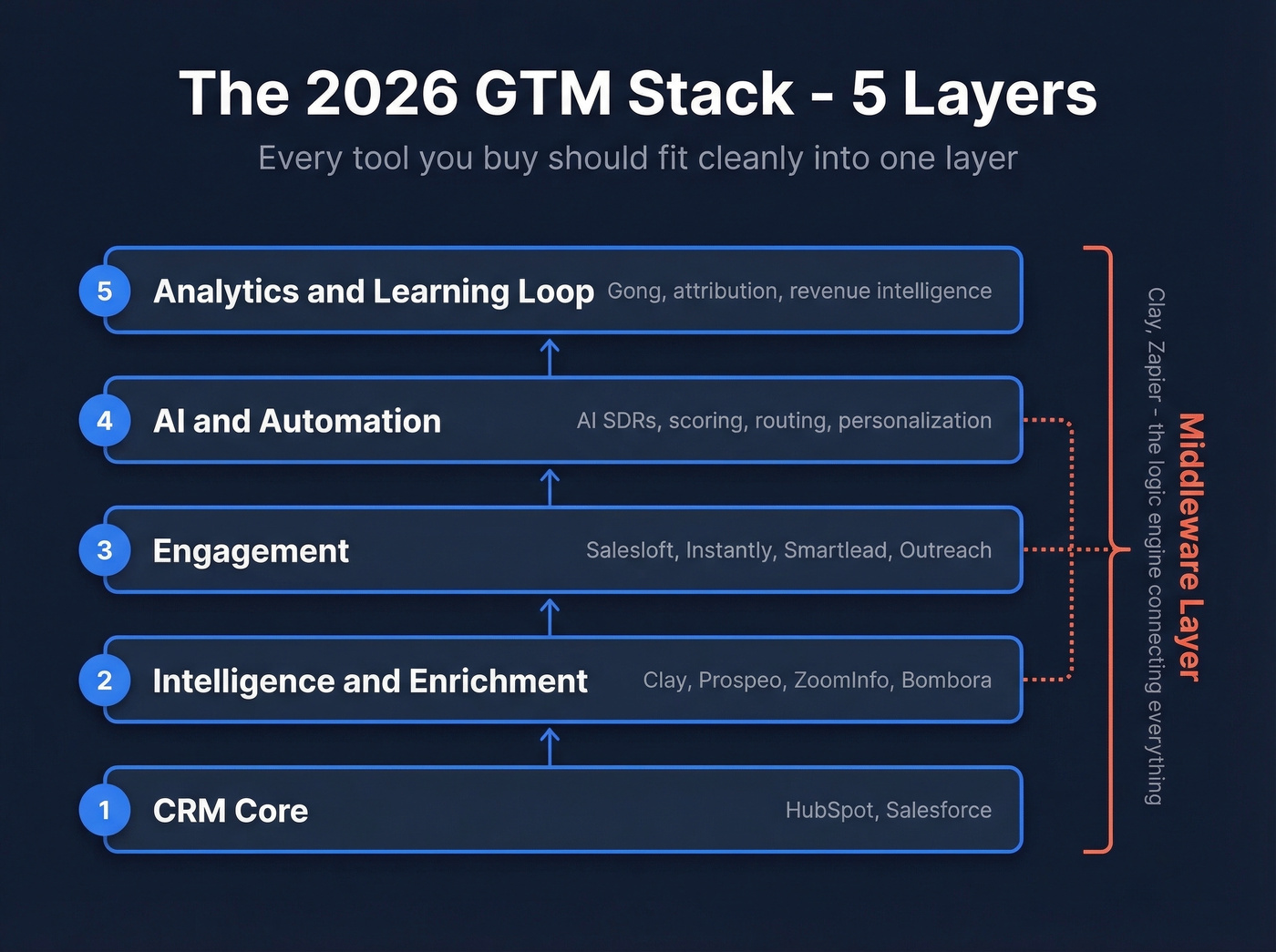
Layer 1 - CRM core. Your central nervous system. HubSpot or Salesforce. If your CRM is messy, nothing downstream works. (If you need a quick gut-check, see CRM options and pricing.)
Layer 2 - Intelligence and enrichment. Contact databases, firmographics, technographics, intent signals. Clay, ZoomInfo, and Bombora live here. (More on data enrichment if you're comparing providers.)
Layer 3 - Engagement. Outbound sequencing, dialers, meeting scheduling. Outreach, Salesloft, Instantly, Smartlead. (If you're evaluating platforms, start with SDR tools.)
Layer 4 - AI and automation. AI agents for research, scoring, routing, and personalization. Evolving fast, still requires heavy human oversight. (Related: generative AI sales tools.)
Layer 5 - Analytics and learning loop. Connecting activities to outcomes. Gong, attribution tools, revenue intelligence.
This model applies whether you're running outbound-led, PLG, or channel motions - PLG stacks just add product analytics and interactive demo tooling on top.
The biggest architectural shift? Middleware. Tools like Clay and Zapier are becoming the logic engines between your CRM and everything else, replacing brittle point-to-point integrations with flexible, signal-driven workflows. This is the layer that turns a collection of tools into a cohesive go-to-market technology stack.
Stacks by Stage and Budget
Startup Stack (~$500/mo)
| Tool | Category | ~Monthly Cost |
|---|---|---|
| HubSpot Free | CRM | $0 |
| Instantly | Cold email | ~$30+ |
| Zapier | Workflow glue | $0+ |
| RB2B | Website visitor signals | $0+ |
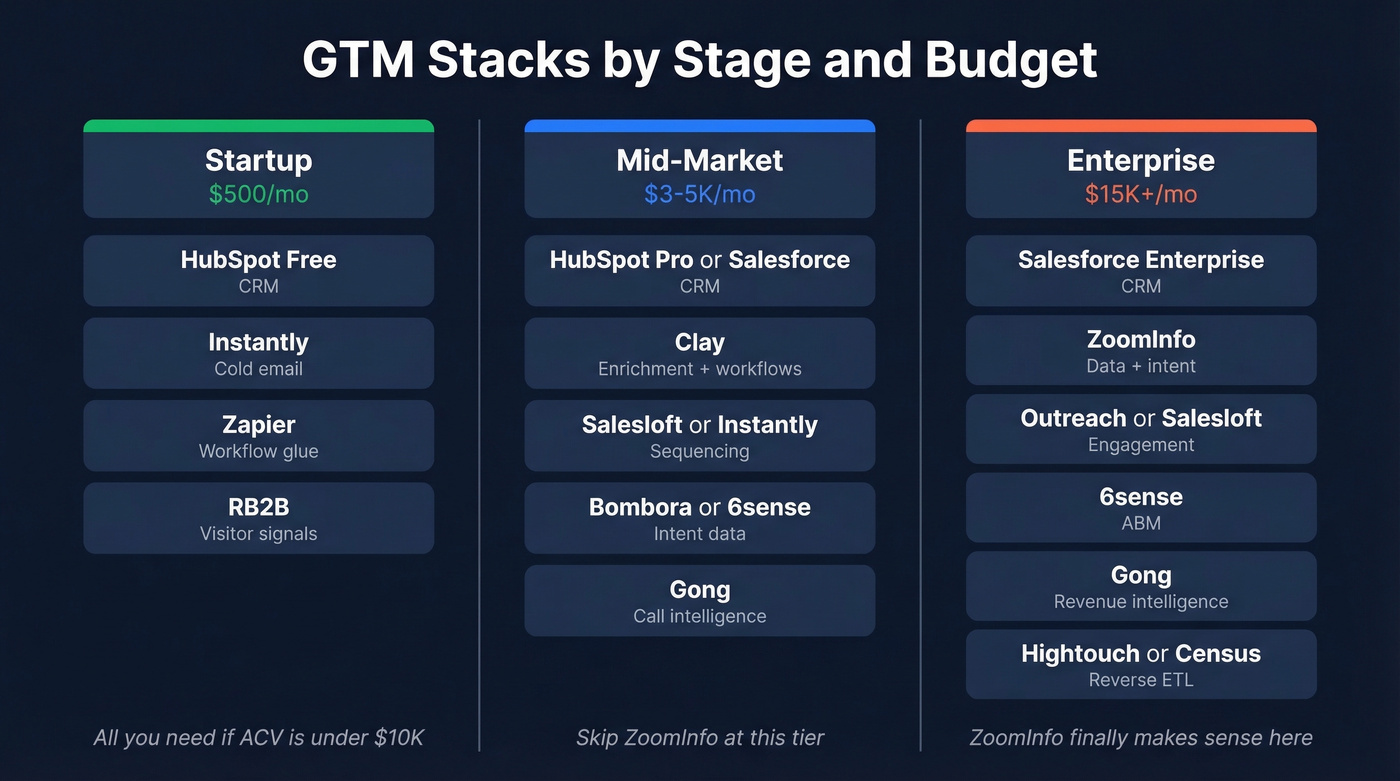
We've seen early-stage teams run this exact combination and book meetings in week one. The consensus on r/AI_Sales backs it up - practitioners consistently recommend Instantly for deliverability and free-tier tools for everything else until you've proven the motion. Add HeyReach (~$79/mo) if social outreach is part of your play.
Hot take: If your average deal size is under $10K, this stack is all you need. Spending more won't fix a weak ICP or bad messaging - it'll just make you lose money faster. (If you're still validating channels, start with free lead generation tools.)
Mid-Market Stack (~$3-5K/mo)
| Tool | Category | ~Monthly Cost |
|---|---|---|
| HubSpot Pro or Salesforce | CRM | ~$800-$2,000+ |
| Clay | Enrichment + workflows | $149-~$720 |
| Salesloft, Instantly, or Smartlead | Sequencing | ~$30-$300+ |
| Bombora or 6sense | Intent data | ~$1,000-$5,000+ |
| Gong | Call intelligence | ~$1,000+ |
This is where most teams overspend on their go-to-market technology. Clay is powerful as a logic engine for building signal-rich lists, but the hidden costs are real: 8-12 credits per fully enriched prospect, plans from $149 to ~$720/mo, and a 20-40 hour learning curve before your team is proficient. Factor in the time investment before you commit. (If you're building in Clay, this Clay list building guide breaks down the real cost math.)
The tool to skip? ZoomInfo. At $20K+ annually, it's the single most common "chopping block" item in every stack audit we've run. The r/SaaS consensus is blunt: "$20k+ annual is wild." Self-serve alternatives deliver comparable data at a fraction of the cost.
Enterprise Stack (~$15K+/mo)
ZoomInfo finally makes sense at this tier. With 100+ reps and dedicated RevOps, the database depth, intent modules, and workflow breadth justify the contract. Salesforce Enterprise anchors the CRM layer, Outreach or Salesloft handles engagement, 6sense drives ABM, Gong powers revenue intelligence, and reverse ETL tools like Hightouch or Census sync warehouse data back into everything else.
The enterprise stack isn't about finding cheaper tools. It's about ensuring every layer integrates deeply and data flows cleanly across all of them.
AI in the Stack: Hype vs. Reality
A HubSpot survey of 500 founders and GTM leaders found that 37% say AI lowered their CAC, 72% say it improved upsell and cross-sell, and 20% report that over half their tools now incorporate AI. Real numbers. But the implementation reality is messier than any vendor will tell you.
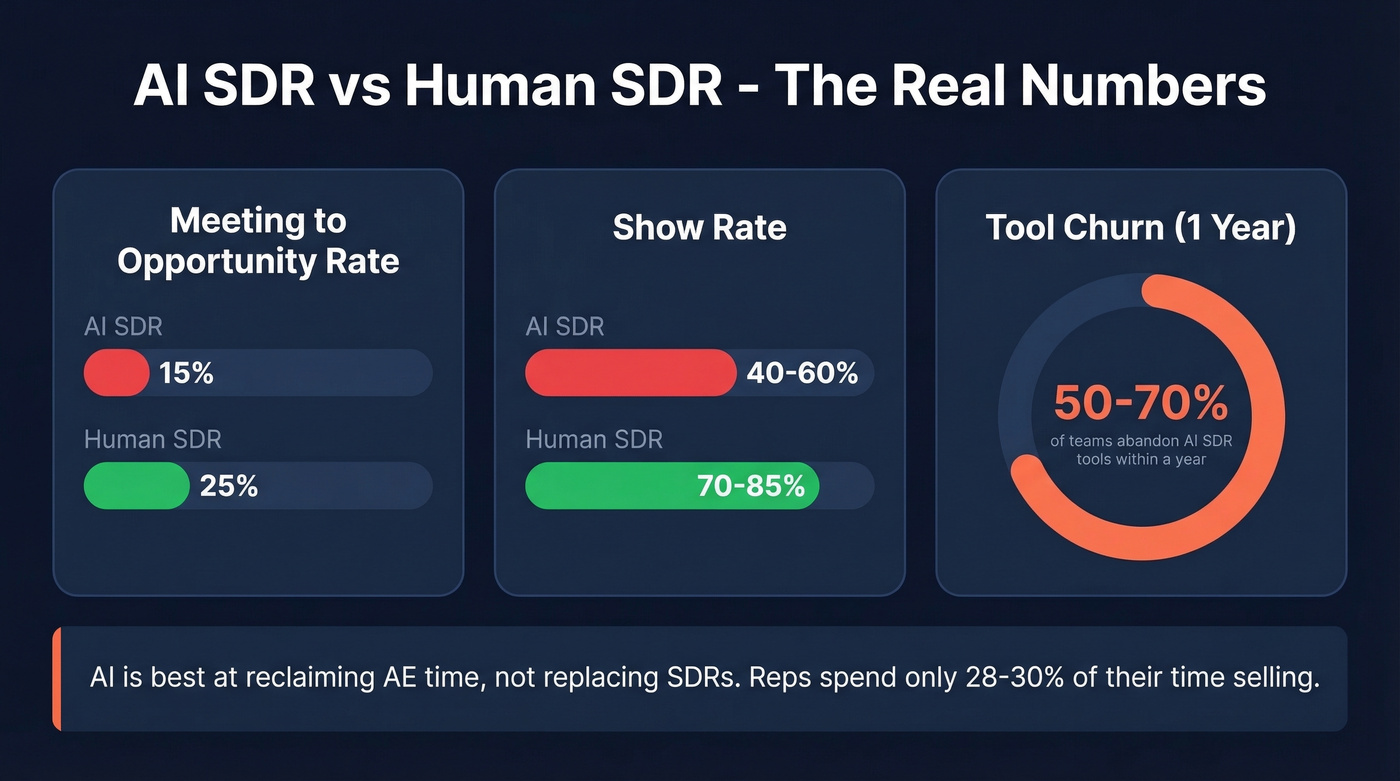
AI SDR benchmarks tell the story:
- AI-sourced meetings convert to opportunities at 15% vs 25% for human-sourced
- AI-booked show rates run 40-60% compared to 70-85% for human-booked
- The AI SDR market has roughly 50-70% tool churn - teams buy, test, and abandon within a year
SaaStr sent 20,000+ AI messages over several months and attributes $2M+ in closed revenue to AI-driven outbound. Impressive - but the first 1,000 emails needed manual review, the team ran 47 iterations to fix tone, and daily oversight runs 20-30 minutes. This isn't "set it and forget it." It's "set it and babysit it daily while hoping the tone doesn't drift."
The Artisan cautionary tale keeps surfacing on r/gtmengineering. Marketed as "never hire another human," practitioners report features that worked poorly and roadmap promises that didn't materialize. Meanwhile, Apollo is quietly becoming a competent AI SDR - one reviewer called it "better than half the stuff on the market."
Here's the thing: AI's highest-value use in your 2026 GTM stack isn't replacing SDRs. It's reclaiming AE time - automating research, CRM updates, meeting prep, and follow-ups. Reps spend only 28-30% of their time actually selling. AI that gives them back even 10% of their week is worth more than an AI agent booking low-quality meetings that no-show at twice the rate. (If you're tightening execution, these sales prospecting techniques still matter more than tool hype.)

You just read that AI-booked meetings no-show at twice the human rate. The fix isn't better AI - it's better data upstream. Prospeo delivers 98% email accuracy on a 7-day refresh cycle, so every tool in your GTM stack works with clean, current contacts instead of poisoned lists.
Stop blaming your sequencer when your data provider is the bottleneck.
The Data Quality Layer Most Teams Ignore
Let's be honest about what actually kills outbound campaigns. A team launches a 500-contact cold email sequence. A chunk of emails bounce. A few hit spam traps. The sending domain's reputation collapses fast. Every tool downstream - the sequencer, the CRM, the analytics - is now working with poisoned data. Nobody blames the data provider. They blame "cold email." (If you're diagnosing this, start with email bounce rate benchmarks and fixes.)
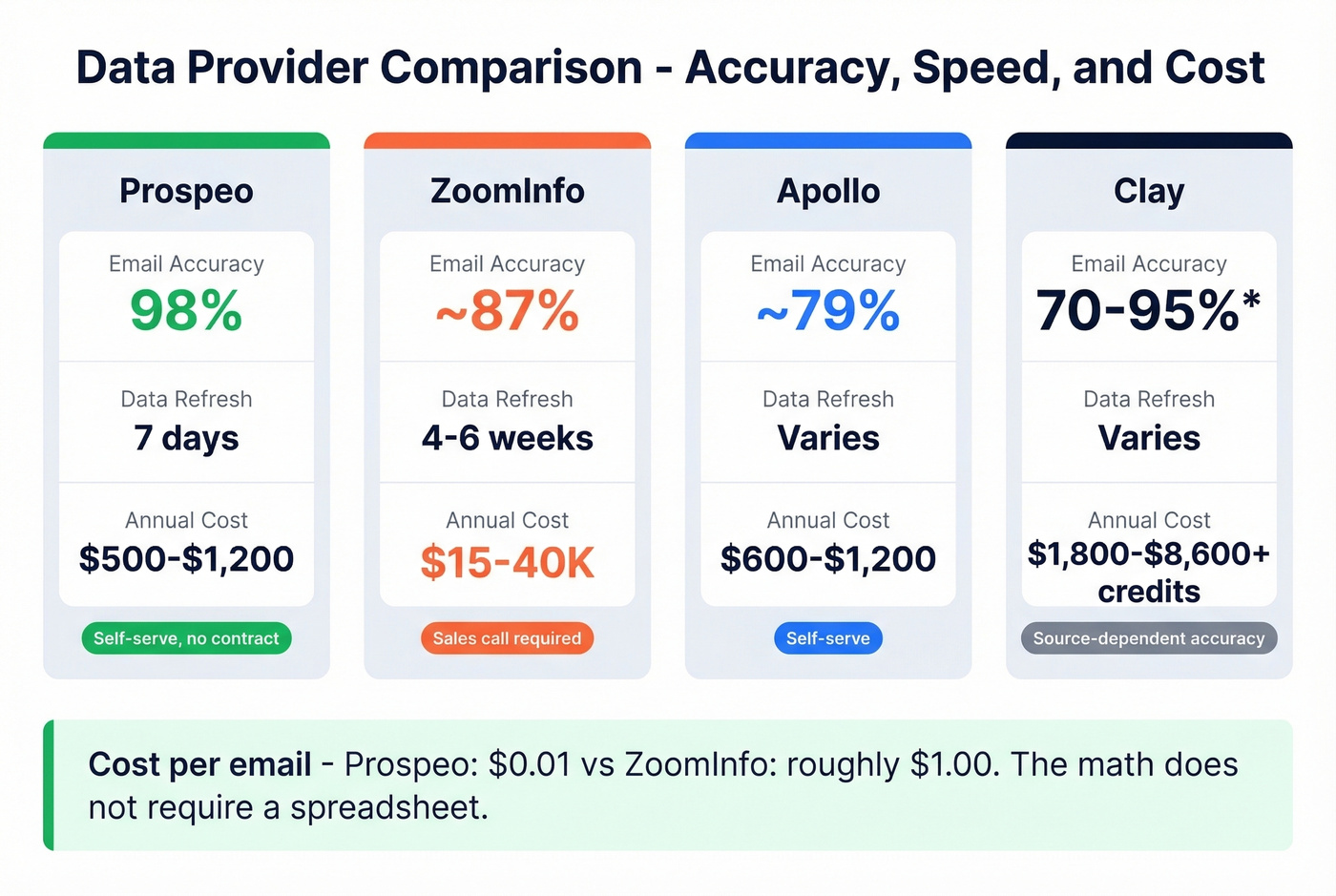
Data quality is the foundation that makes every other tool functional. The accuracy gap between providers is wider than most teams realize.
| Tool | Email Accuracy | Data Refresh | ~Annual Cost | Self-Serve? |
|---|---|---|---|---|
| Prospeo | 98% | 7 days | $500-1,200 | Yes |
| ZoomInfo | ~87% | 4-6 weeks | $15-40K | No |
| Apollo | ~79% | Varies | $600-1,200 | Yes |
| Clay | 70-95% (source-dependent) | Varies | $1,800-~$8,600 + credits | Yes |
Use Prospeo when you need verified, deliverable emails at scale without a sales call or annual contract. The 98% accuracy comes from a 5-step verification process - catch-all handling, spam-trap removal, honeypot filtering - on proprietary infrastructure. The 7-day refresh cycle means you aren't emailing someone who changed jobs six weeks ago. (If you want the deeper mechanics, read the email deliverability guide.)
Skip ZoomInfo when your team is under 100 reps. At $0.01 per email vs roughly $1.00, the math doesn't require a spreadsheet.
Clay is powerful for workflow orchestration, but it's not a verification tool. It pulls from dozens of providers, and accuracy depends entirely on which sources you configure. Pair it with a dedicated verification layer, and you get flexible enrichment logic with deliverable output. (If you're comparing vendors, see B2B company data providers.)
Meritt went from a 35% bounce rate to under 4% after switching their verification layer - and their pipeline tripled from $100K to $300K per week. That's not a data quality improvement. That's a business outcome driven by one layer of the stack that most teams treat as an afterthought.
The article says to skip ZoomInfo until you're running 100+ reps. Prospeo gives you the same intelligence layer - 300M+ profiles, intent data, 30+ filters - at 90% less cost with higher accuracy. Self-serve, no contracts, no $20K annual commitment.
Enterprise-grade data without the enterprise shakedown. Starting at $0.01/email.
How to Audit Your Stack
1. Inventory everything. Pull a complete list of every tool with a login, a contract, or a credit card charge. Most teams discover 3-5 tools they forgot they were paying for. For teams with 50+ tools, SaaS management platforms like Zylo or Productiv can automate this.
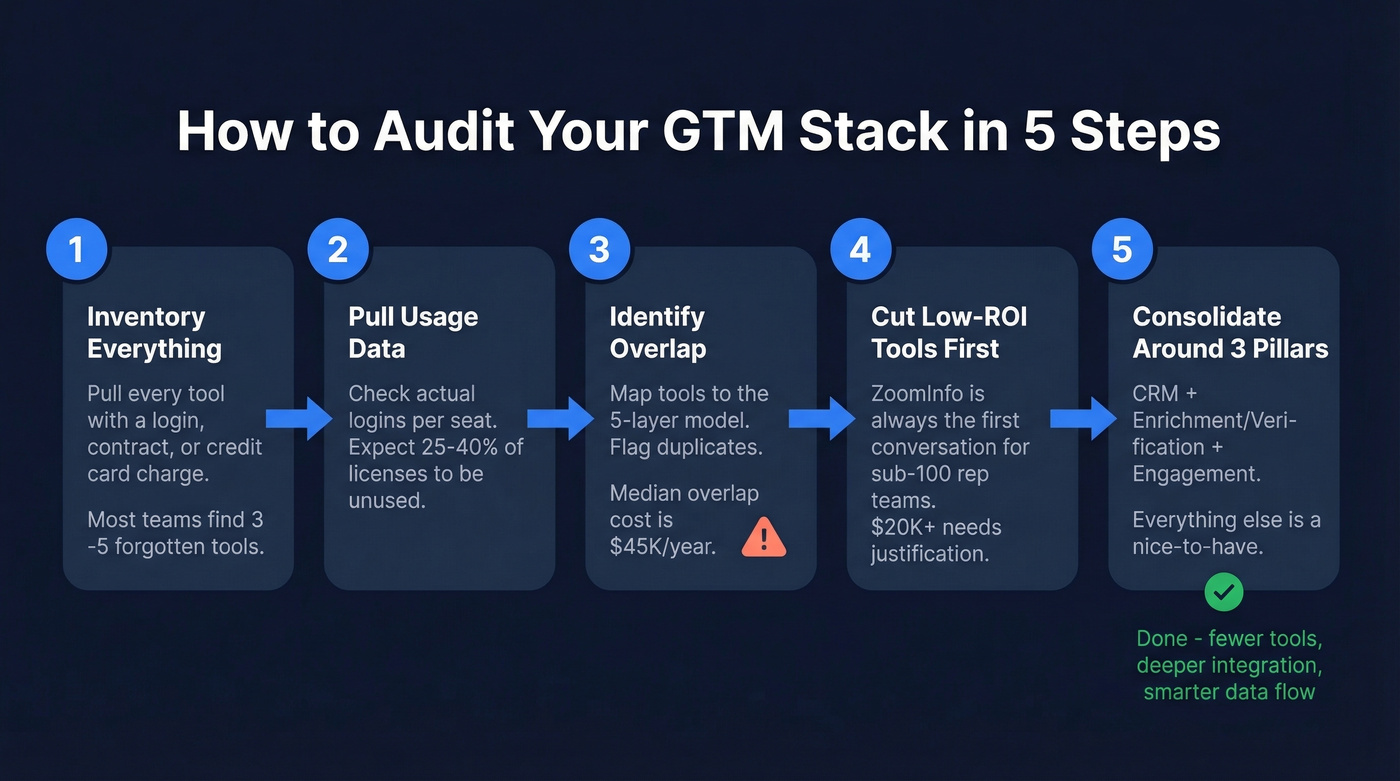
2. Pull usage data. Check actual logins and feature adoption per seat. Gartner's finding that 25% of licenses go unused is conservative - in our experience, it's closer to 40% at mid-market companies that grew fast and bought tools reactively.
3. Identify overlap. Map every tool to the five-layer model above and flag duplicates. That $45K overlapping spend stat isn't hypothetical - it's the median we've seen across dozens of audits.
4. Cut the expensive, low-ROI tools first. ZoomInfo is always the first conversation for sub-100-rep teams. At $20K+ annually, it needs to justify itself against self-serve alternatives that cost 90% less.
5. Consolidate around three pillars: CRM + enrichment/verification + engagement. Everything else is a nice-to-have until these three work in tight integration. Stuck with Salesforce? Build around it rather than fighting it.
Where GTM Stacks Are Heading
Three trends are pulling in the same direction: fewer tools, deeper integration, smarter data flow.
Middleware as the logic layer. Clay and Zapier aren't just connectors anymore - they're orchestration engines replacing brittle integrations. The go-to-market tech stack of the future has a CRM at the center and middleware routing signals between every other layer.
The warehouse as source of truth. Reverse ETL tools like Hightouch (from ~$150/mo) and Census make the data warehouse the canonical record, syncing enriched data back into CRMs and engagement tools. This "data activation" movement replaces the old model where every SaaS app maintained its own copy of the truth.
Agentic workflows, not agentic replacements. AI is augmenting AEs with better research, faster prep, and smarter follow-ups - not replacing SDRs wholesale. The teams getting ROI from AI in 2026 treat it as an amplifier for human sellers, not a headcount reduction strategy. That distinction matters more than any feature comparison.
Fewer tools, higher adoption, cleaner data, and middleware routing the signals between them. That's the 2026 GTM stack.
FAQ
What's the difference between a GTM stack and a sales tech stack?
A GTM stack spans the full go-to-market motion - marketing, sales, customer success, and RevOps. A sales tech stack is one subset focused on prospecting, engagement, and closing. When people say "go-to-market technology stack," they mean the complete toolset powering every revenue-facing function.
How much should a startup spend on GTM tools?
$300-800/mo is realistic for early-stage teams. Free tiers cover CRM (HubSpot), enrichment (Prospeo's 75 free emails/mo), and visitor tracking (RB2B). Add $30-100/mo for cold email sequencing and you've got a functional outbound motion.
Is ZoomInfo worth it in 2026?
Only at enterprise scale with 100+ reps and dedicated RevOps. Below that threshold, self-serve alternatives deliver 98% email accuracy at roughly $0.01/lead vs ZoomInfo's ~$1.00/lead. Most mid-market teams use less than half of what they pay for.
Do AI SDRs actually work?
They augment human reps but don't replace them. Expect roughly 40% lower conversion rates on AI-sourced meetings and plan for 20-30 minutes of daily oversight minimum. The highest ROI comes from using AI to automate research and CRM updates, not full-cycle prospecting.