

Pipeline Attribution Is Broken. Here's How to Fix It
It's the end-of-quarter QBR. Marketing presents $2.4M in influenced pipeline. Sales counters with $2.1M they sourced themselves. The CFO asks, "So which is it?" Nobody has a good answer - because pipeline attribution is still broken for nearly 90% of B2B teams running single-touch or basic multi-touch models that weren't built for modern buying cycles.
This isn't a tooling problem. It's an alignment problem, a data quality problem, and a "nobody agrees on what we're measuring" problem.
The Short Version
Align on the outcome you're attributing. Pipeline created, pipeline influenced, and closed-won revenue are three different things. Pick one before you build anything.
Start with self-reported attribution + UTM discipline + clean CRM data. That gets you 70% of the way for $0.
Fix your data quality before buying tools. A $999/mo attribution platform on a dirty CRM is an expensive lie.
What Pipeline Attribution Actually Measures
Pipeline attribution connects marketing and sales touchpoints to open opportunities - not leads, not closed deals. It answers "what created and influenced this pipeline?" rather than "what drove this conversion?" In other words, it's the discipline of measuring marketing influence on sales pipeline so both teams share a single source of truth.
That distinction matters because B2B buying journeys now involve an average of 266 touchpoints to close an opportunity, up 20% since 2023. Gartner puts buying groups at 5-11 stakeholders across functions, and most attribution models track individual contacts, not buying committees. Single-touch models can't capture either reality.
Why Most B2B Teams Get It Wrong
The core issue isn't the model you pick. It's three upstream problems no model can fix.
Executives define "revenue" differently. The CMO tracks pipeline influenced. The CFO wants bookings. The CRO cares about quota attainment. If you haven't aligned on what outcome you're attributing, every leader interprets the same dashboard differently - and none of them trust it.
Every platform claims credit for the same deal. Google Analytics says paid search. Meta says retargeting. Your CRM says the SDR cold-called it. Each platform's attribution is self-serving by design, and the disagreement makes ROI reporting nearly impossible.
Teams optimize for demand capture and starve demand creation. Attribution over-credits bottom-funnel channels like branded search and retargeting because those touchpoints sit closest to conversion. Here's the thing: the consensus on r/demandgeneration and r/sales is blunt about this. Teams that chase attribution-friendly channels watch their pipeline dry up 6-12 months later because nobody invested in the awareness that feeds the funnel. We've seen this play out firsthand with clients who killed their podcast and event budget because "it didn't show up in attribution" - then spent two quarters wondering why inbound dried up.
Attribution Models With Actual Weights
Most "attribution model" explainers stay vague. Here are real numbers.
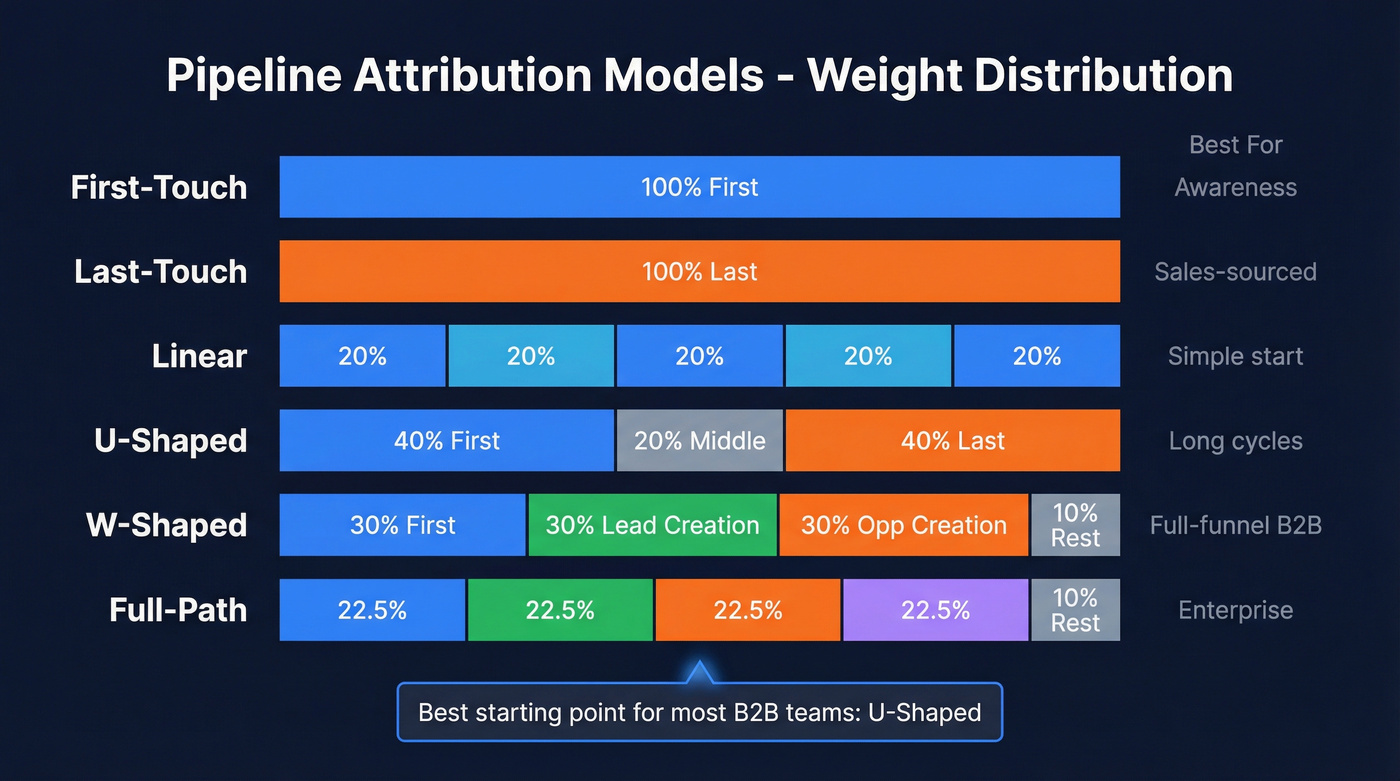
| Model | Weight Distribution | Best For |
|---|---|---|
| First-touch | 100% first | Awareness reporting |
| Last-touch | 100% last | Sales-sourced pipeline |
| Linear | Equal split across all touches | Simple starting point |
| U-shaped | 40% first / 40% last / 20% middle | Long sales cycles |
| W-shaped | 30% first / 30% lead creation / 30% opp creation / 10% rest | Full-funnel B2B |
| Full-path | 22.5% x 4 key stages + 10% rest | Enterprise with defined stages |
| Time-decay | Weighted toward close | Short, urgent cycles |
| Algorithmic | ML-assigned per touchpoint | High conversion volume |
For most B2B teams, U-shaped is the right starting point. It properly credits the first touch and the opportunity-creation touch without ignoring the middle.
If your deal size is under $15k and your sales cycle is under 60 days, you probably don't need an attribution platform at all. Self-reported attribution plus UTM tracking will tell you 80% of what you need to know. Skip the expensive tooling and invest that budget in the channels themselves.

Attribution breaks when your CRM is full of duplicates, stale contacts, and bounced emails. Prospeo enriches every record with 50+ data points at a 92% match rate - refreshed every 7 days, not every 6 weeks. Your model finally tracks real buyers, not ghosts.
Fix the data under your attribution before buying another dashboard.
Six Biases That Wreck Your Data
The average enterprise runs 23 tools in its GTM stack. Each one introduces bias.
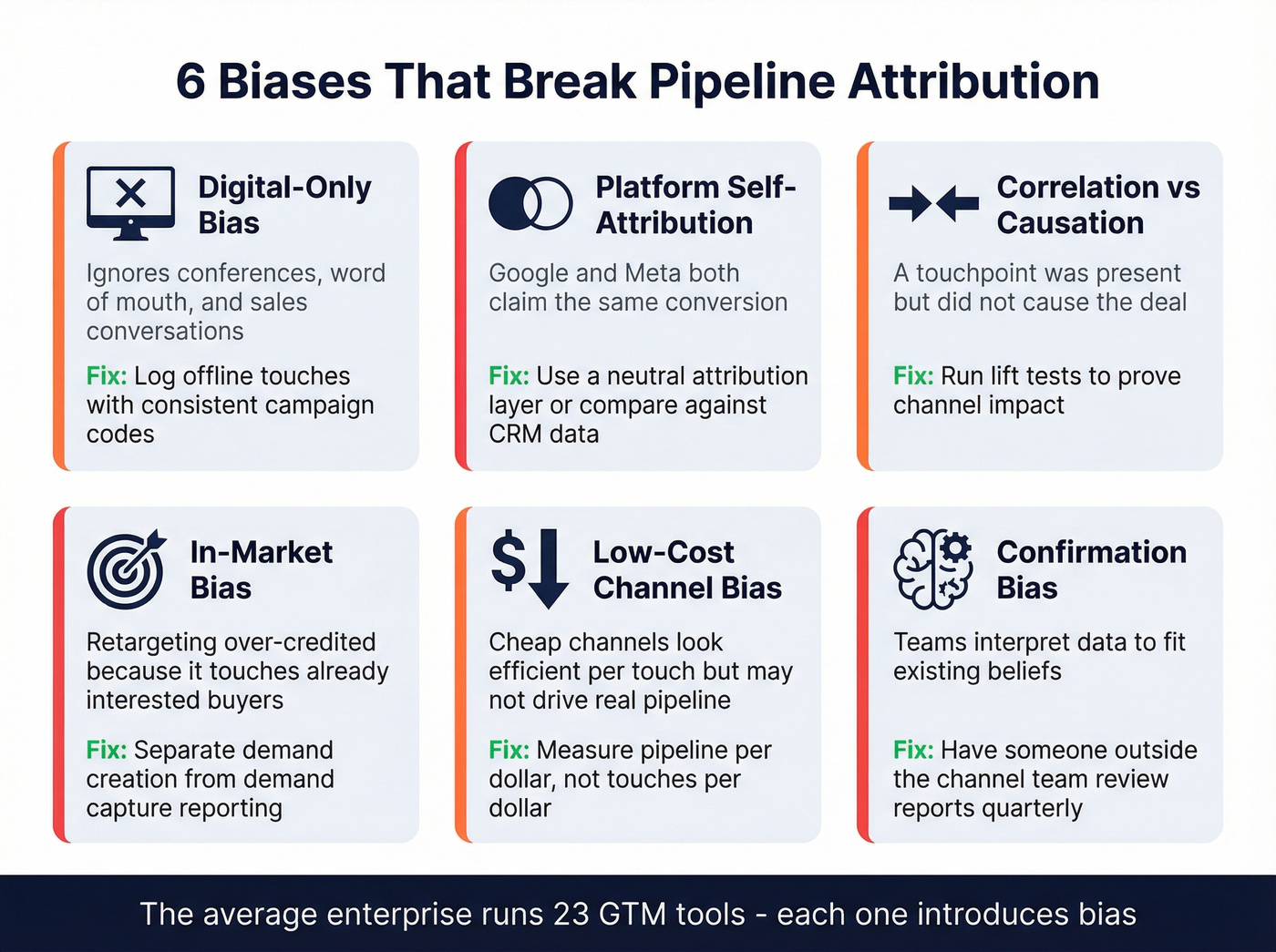
Digital-only bias. Ignores conferences, word-of-mouth, and sales conversations. Fix: log offline touchpoints in your CRM with consistent campaign codes.
Platform self-attribution. Google and Meta both claim the same conversion. Fix: use a neutral attribution layer or, at minimum, compare platform-reported numbers against your CRM's source-of-truth data.
Correlation vs. causation. A touchpoint was present but didn't cause the deal. Fix: run lift tests - they're the only way to prove a channel actually moves pipeline, not just touches buyers who were already going to convert.
In-market bias. Retargeting gets over-credited because it touches already-interested buyers. Fix: separate demand creation from demand capture in your reporting.
Low-cost channel bias. Cheap channels look efficient per-touch but don't always drive real pipeline. Fix: measure pipeline per dollar, not touches per dollar.
Confirmation bias. Teams interpret data to fit existing beliefs. Fix: have someone outside the channel team review reports quarterly.
Connecting Marketing Activity to Sales Pipeline
Forget perfection. Here's what actually moves the needle.
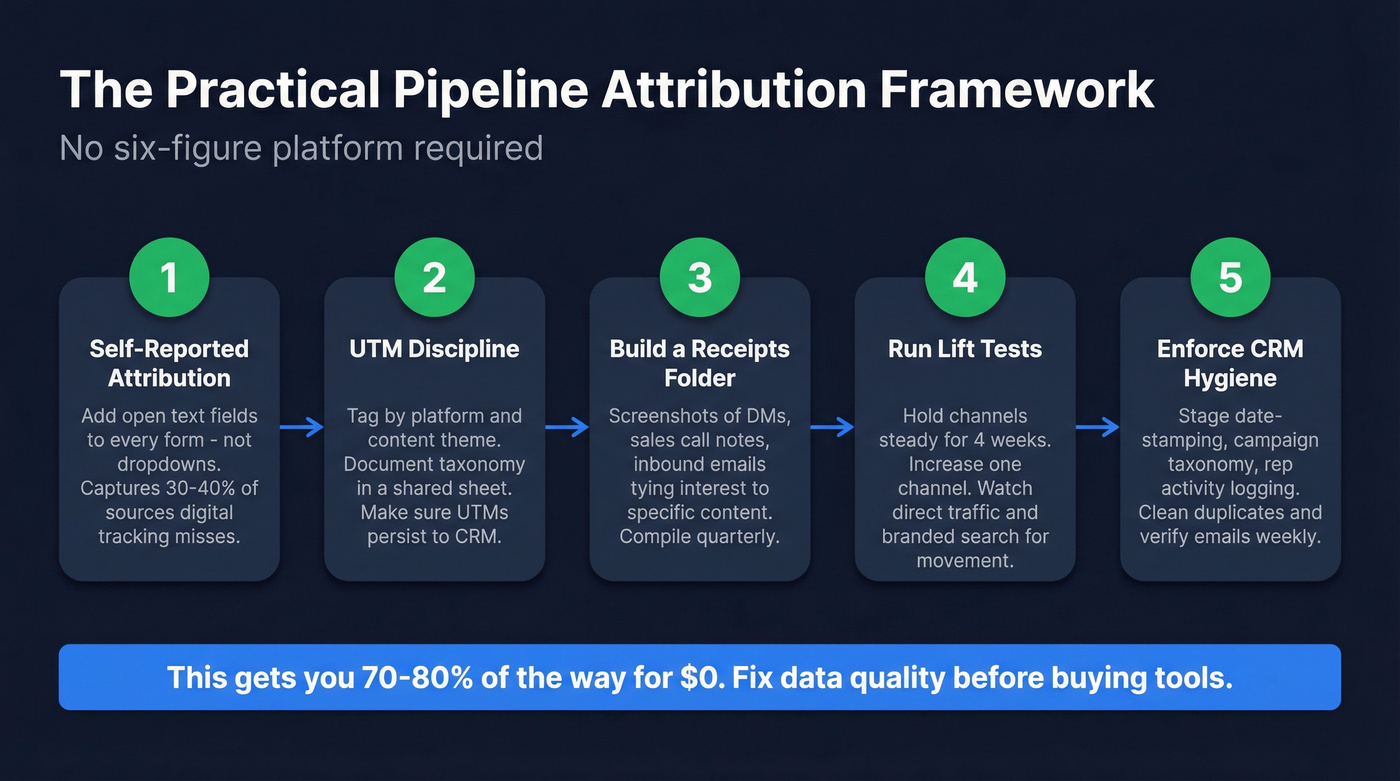
Start by adding self-reported attribution to every form - open text, not dropdowns. Dropdowns force answers into your categories. Open text captures "saw your CEO's post on Reddit" or "my colleague forwarded your newsletter," the kind of signal no tracking pixel will ever see. In our experience, self-reported data catches 30-40% of pipeline sources that digital tracking misses entirely.
Pair this with strict UTM discipline: tag by platform and content theme, document the taxonomy in a shared sheet, and make sure UTMs persist from landing page through to your CRM. Broken UTMs are one of the biggest data leaks in any attribution framework, and we've watched teams spend months debugging attribution models only to discover the root cause was inconsistent tagging.
Build a "receipts folder" - screenshots of DMs, sales-call notes mentioning content, inbound emails tying interest to specific assets. Compile quarterly for leadership. Then run a 4-week lift test: hold other channels steady, increase activity on one, and watch for movement in direct traffic and branded search. Simple, cheap, and more convincing than any model.
Underneath all of this, enforce CRM hygiene. Stage date-stamping, campaign taxonomy standards, rep activity logging. Attribution breaks when your database is full of duplicates, stale contacts, and undeliverable emails. Before investing in attribution software, clean your database. Prospeo refreshes contact data every 7 days and verifies emails at 98% accuracy, so the touchpoints your model tracks connect to real people, not ghosts in your CRM.

You don't need a six-figure attribution platform. You need contact data accurate enough to trust. Prospeo delivers 98% verified emails at $0.01 each - so every touchpoint in your pipeline maps to a real person, not a dead address inflating your numbers.
Stop attributing pipeline to contacts that don't exist.
Tools Worth Evaluating
If your data foundation is solid, these platforms are worth a look. We've ranked them by how well they serve mid-market B2B teams, not enterprise buyers with unlimited budgets.
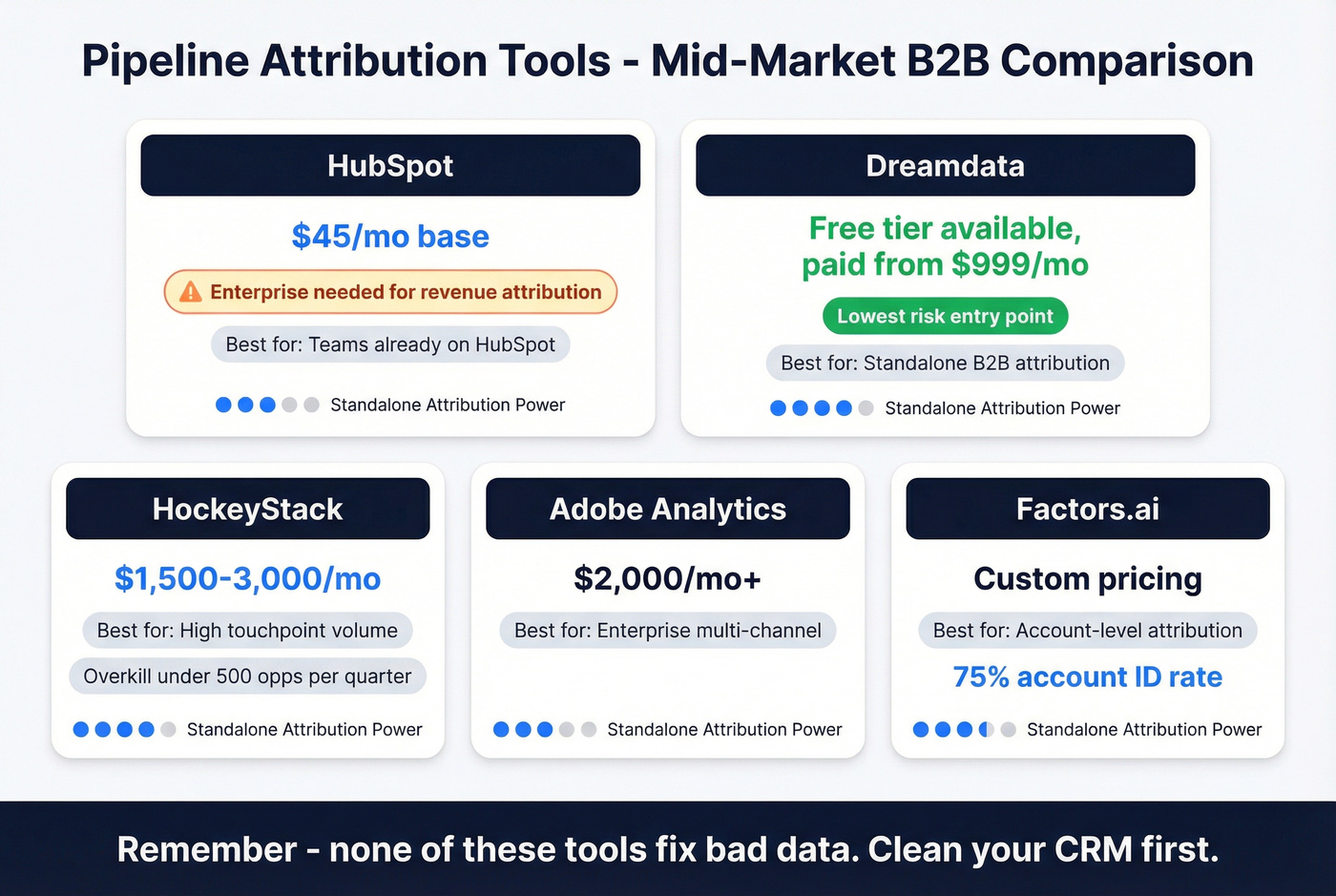
| Tool | Starting Price | Best For |
|---|---|---|
| HubSpot | $45/mo (deal + revenue attribution needs Marketing Hub Enterprise) | Teams already on HubSpot |
| Dreamdata | Free tier; paid from $999/mo | Standalone B2B attribution |
| HockeyStack | Custom, ~$1,500-3,000/mo | High-touchpoint volume |
| Adobe Analytics | ~$2,000/mo+ | Enterprise multi-channel |
| Factors.ai | Custom pricing | Account-level attribution (75% account ID rate) |
Dreamdata has the broadest out-of-the-box integrations and the most generous free tier. If you're just getting started with dedicated attribution tooling, it's the lowest-risk entry point. Their B2B attribution documentation is also genuinely useful for understanding model mechanics.
HubSpot's built-in attribution works as a starting point, but you'll hit walls fast. Deal-level and revenue attribution reporting require Marketing Hub Enterprise, which jumps the price significantly. If you're already paying for Enterprise, use it. Don't buy a second tool.
HockeyStack shines when you have high touchpoint volume and need to stitch together complex journeys across many channels. For teams running fewer than 500 opportunities per quarter, it's probably overkill.
Let's be honest about what these tools can't do: none of them fix bad data. If your CRM has 30% bounce rates and duplicate contacts everywhere, the fanciest attribution platform just gives you confident-looking wrong answers.
From Dashboards to Forecasting
The next frontier isn't better backward-looking attribution - it's attribution forecasting. The idea: use historical touchpoint sequences to predict future pipeline. If deals that close follow a pattern (webinar, then case study download, then demo request), you can forecast pipeline from current engagement signals rather than waiting for opportunities to appear.
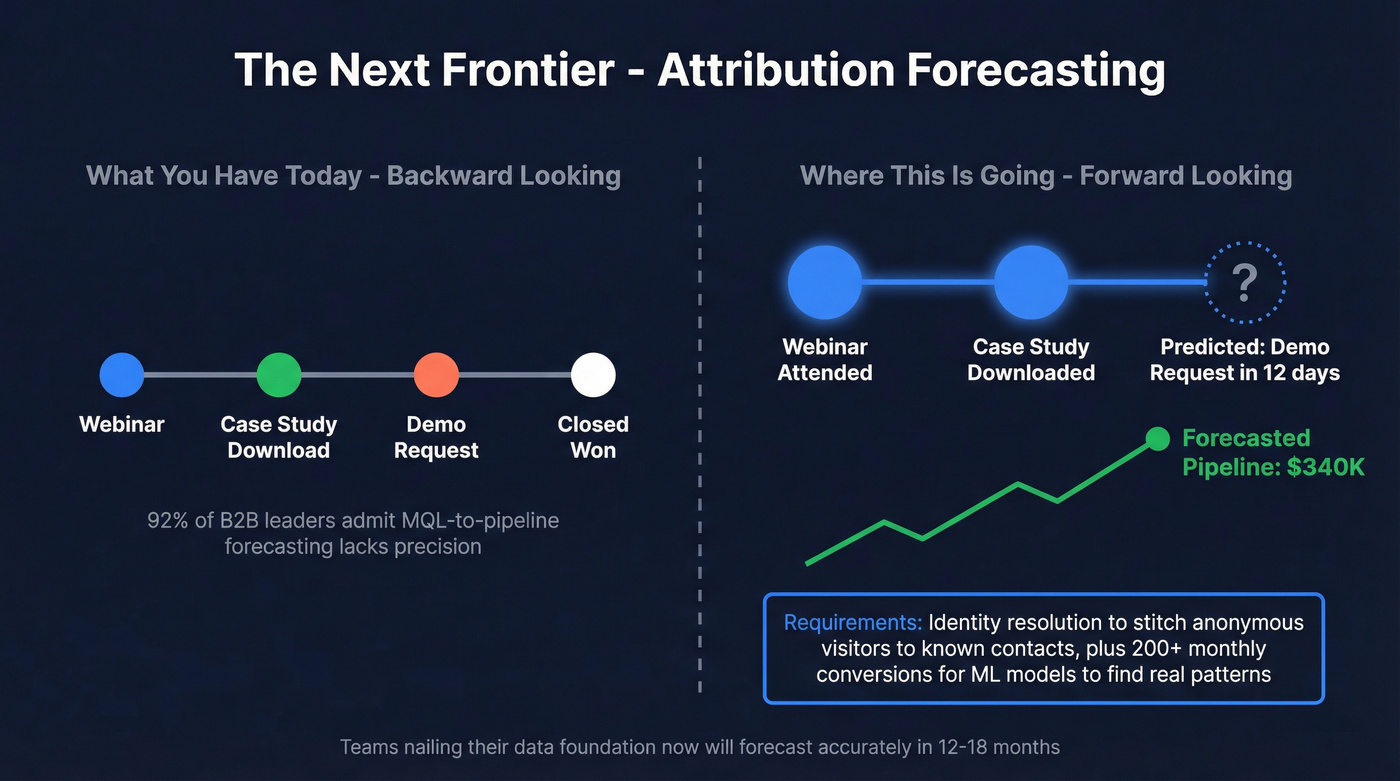
This requires identity resolution to stitch anonymous visitors to known contacts, plus enough conversion volume for ML models to find real patterns. Forrester's B2B marketing research consistently shows that 92% of B2B leaders admit their MQL-to-pipeline forecasting lacks precision. But the teams nailing their data foundation now will be the ones forecasting accurately in 12-18 months. Revenue Collective's community discussions echo this - the gap between teams with clean attribution data and those without is widening fast.
If you're trying to operationalize this, start with pipeline health metrics and a clear view of sales pipeline benchmarks before you add more modeling.
FAQ
What's the difference between pipeline and revenue attribution?
Pipeline attribution credits touchpoints that created or influenced open opportunities. Revenue attribution only credits touchpoints tied to closed-won deals. Track both - pipeline tells you what's working now, revenue tells you what worked months ago.
Which attribution model should I start with?
U-shaped (40/40/20) if your sales cycle exceeds 30 days and involves multiple stakeholders. Linear if you want simplicity and don't have strong opinions yet. Move to algorithmic only when you have 200+ conversions per month for the model to learn real patterns - anything less and you're fitting noise.
How do I fix attribution when my CRM data is messy?
Clean the data first. Deduplicate contacts, enforce stage date-stamping, standardize UTMs, and verify emails before running any model. Attribution on dirty data just gives you confident-looking wrong answers.
Can small teams run pipeline attribution without expensive tools?
Yes. Self-reported attribution fields, disciplined UTM tagging, and a clean CRM get most teams 70-80% of the insight they need at zero software cost. Add Dreamdata's free plan or HubSpot's built-in reports once you outgrow spreadsheets.