Outbound Calling Strategy: A 2026 Operating System for Booking Meetings
If your "best" list connects at 2% and half your calls show up as Spam Likely, you don't have a motivation problem. You've got an operating problem.
A working outbound calling strategy treats calling like an operating system: inputs, deliverability, cadence, talk track, measurement. Fix the system and the meetings follow.
And yes, you can fix a lot of this in a week.
Outbound calling strategy: what you need (quick version)
Outbound calling strategy checklist (minimum viable setup):
A clean target list
- ICP + role filters you trust
- Direct dials prioritized (mobiles if you sell to humans, not switchboards)
- Dedupe rules before anything hits your CRM
A dial plan
- Two daily call blocks (local time): 10-12 and 4-5
- 3-call minimum / 5-call maximum per prospect (then stop or recycle later)
- A simple "who gets called first" rule (top accounts, recent intent, recent email engagement)
Phone deliverability hygiene
- STIR/SHAKEN attestation with your carrier (push for A-level)
- Pacing (no burst dialing), consistent CNAM, and no sketchy number rotation
- Dead air control: connect-to-hello as close to instant as possible (and measurable)
A 25-second opener + one ask
- Permission-based opener
- Reason + relevance
- One micro-commitment ask (not a full discovery on a cold connect)
A weekly scoreboard
- Connect rate, conversation rate, meeting rate
- Spam label rate
- Attempts completed (did reps actually run the cadence?)
- Median lead response time (for warm/inbound leads)
Fix 3 things this week (highest ROI):
- Lock call windows to 10-12 & 4-5 (local time).
- Enforce 3-call min / 5-call max per prospect.
- Clean up deliverability hygiene: attestation + pacing + dead air.
What an outbound calling strategy is (and what it isn't)
Outbound calling isn't confidence. It's data + deliverability + cadence - and then, finally, talk track.
A real strategy answers five operational questions: who you call, when you call, how many times you try, what you say in the first 25 seconds, and how you measure whether it's working. If you can't write those down on one page, you don't have a strategy - you've got vibes.
Across vendor benchmark datasets (SalesHive + Cognism), most teams land in the 3-10% connect-rate band and often need 18+ dials to reach one prospect. That's not a personality issue. That's math.
Use this if you're running outbound in a repeatable motion (SDRs, AEs prospecting, founder-led with a list) and you want meetings booked, not "activity."
Skip this if you're trying to brute-force your way through bad numbers and Spam Likely labels.
Here's the thing: when your average deal is small, you don't need a "perfect" cold call script. You need a list that connects and a dialer setup that doesn't sabotage you. Most teams do the opposite, and it drives me nuts: they workshop words for weeks while their numbers get labeled and their connect rate quietly dies.
What reps complain about (and what's actually happening)
Two complaints show up in every outbound team chat:
"Everyone says 'not interested.'" Usually it's list mismatch + an opener that asks for too much too soon. "Not interested" is the fastest way for a prospect to end an unclear conversation.
"Our stack is shelfware." Tools don't fix bad data or bad deliverability. If your calls don't connect - or connect with dead air - no enablement platform on earth saves you.
The outbound math & benchmarks (so you stop guessing)
If you don't do the math, you'll overreact to noise. One rep has a great Tuesday, another has a dead Thursday, and suddenly you're rewriting scripts instead of fixing the funnel.
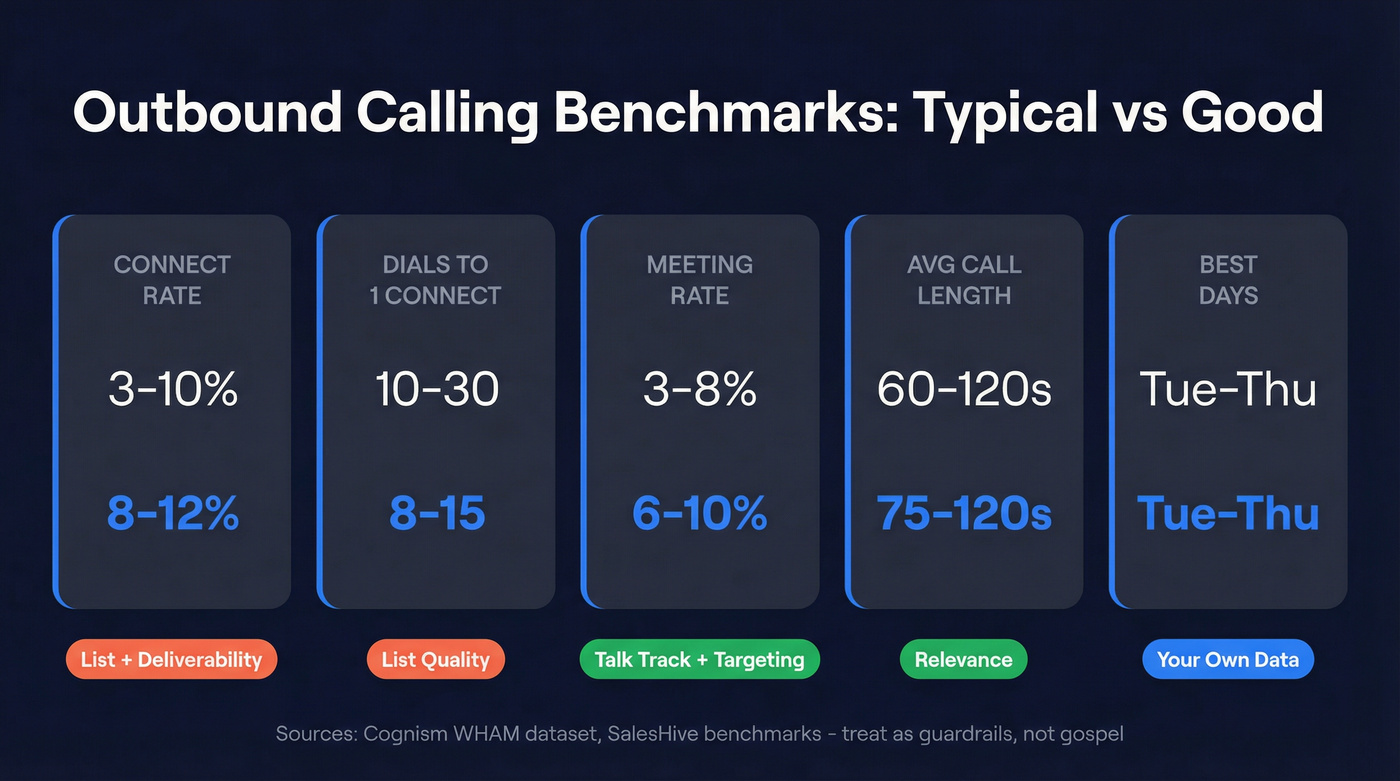
Definition (so the numbers don't lie): in this playbook, meeting rate = meetings booked / connects. It's the cleanest way to compare reps and lists because it avoids the endless "what counts as a conversation?" debate.
Cognism's WHAM (We Have A Meeting) dataset is still useful context: it reports a 4.82% meeting-booked rate using its own denominator, plus average call length 93 seconds, and Tuesday as the best day for booking meetings.
| Metric | Typical range | "Good" target | Winner (what drives it most) | Why it matters |
|---|---|---|---|---|
| Connect rate | 3-10% | 8-12% | List + deliverability | If you don't connect, nothing else matters |
| Dials to 1 connect | 10-30 | 8-15 | List quality | Efficiency and rep morale |
| Meeting rate (meetings / connects) | 3-8% | 6-10% | Talk track + targeting | Converts connects into calendar |
| Avg call length | 60-120 sec | 75-120 sec | Relevance | Too short often means wrong person/labeling |
| Best days to staff heavily | Tue-Thu | Tue-Thu | Your own data | Booking datasets skew Tue; connect-only often favors Wed/Thu |
Benchmarks sources to triangulate: Cognism's cold calling statistics hub and SalesHive's cold calling best practices. They don't always use the same denominators, so treat them like guardrails.
If you want more cold calling benchmarks to triangulate: Cognism's cold calling statistics.
One nuance worth remembering: WHAM (meeting-booked) skews Tuesday; connection-only datasets often favor Wed/Thu. Staff Tue-Thu heavily and test by segment.
Simple funnel math example (use this to set weekly targets)
Let's say an SDR does 250 dials/week.
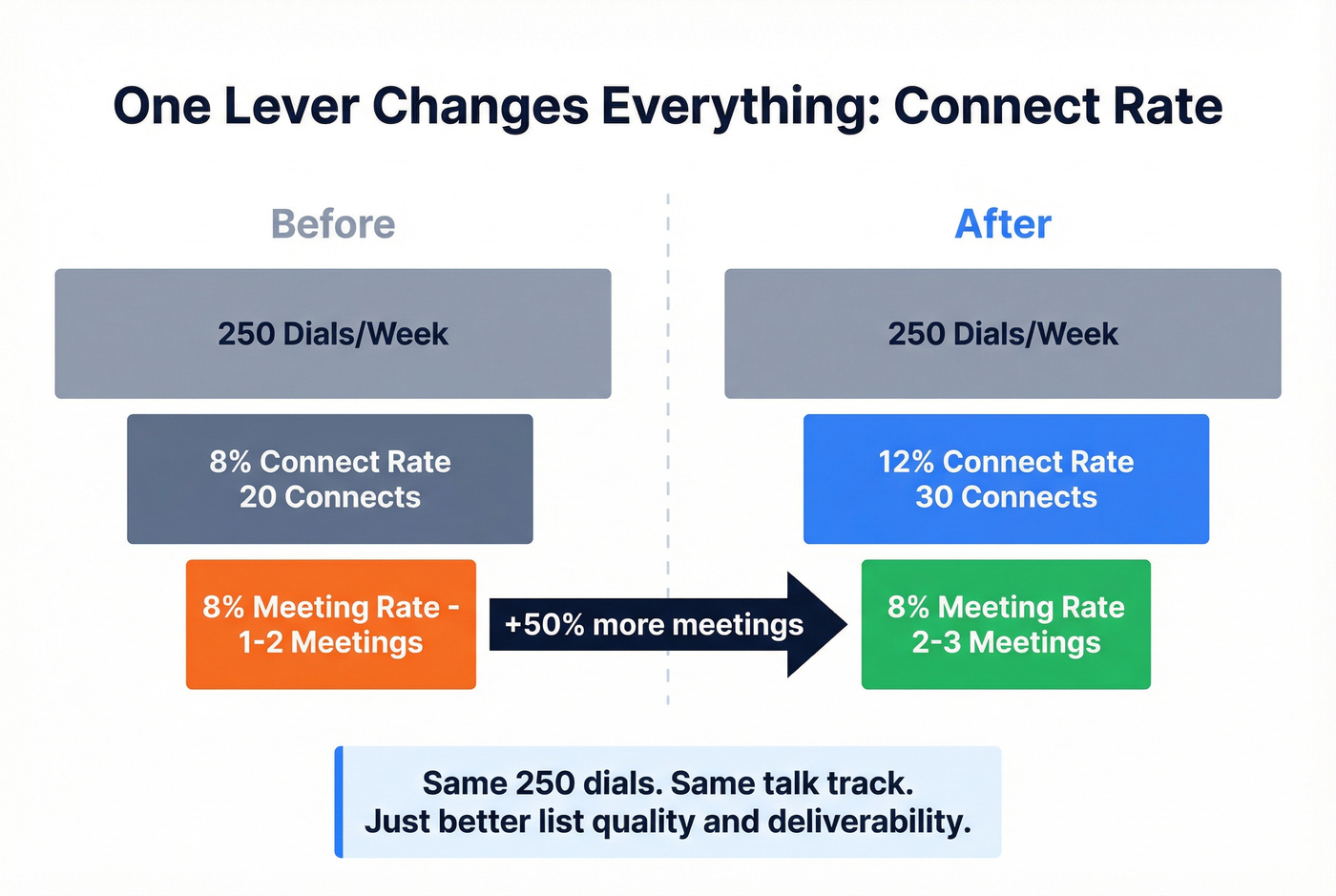
- Connect rate: 8% -> 20 connects
- Meeting rate (meetings / connects): 8% -> 1-2 meetings booked
Now change only one lever: connect rate from 8% to 12% (better list + better deliverability + better timing).
- 250 dials -> 30 connects
- Meeting rate stays 8% -> 2-3 meetings
That's why "work harder" is a lazy answer. The strategy is about moving the levers that multiply.
List quality is the #1 lever for connect rate
When connect rate is low, everything downstream looks broken:
- Calls are shorter (wrong person, wrong number, voicemail loops).
- Reps hesitate, because they don't trust the data.
- You get more hang-ups, more "who are you?" friction, and more spam reports.
- Dialers create dead air when they connect the wrong line or hit carrier weirdness.
Diagnosis tree: is your list the problem?
Start here:
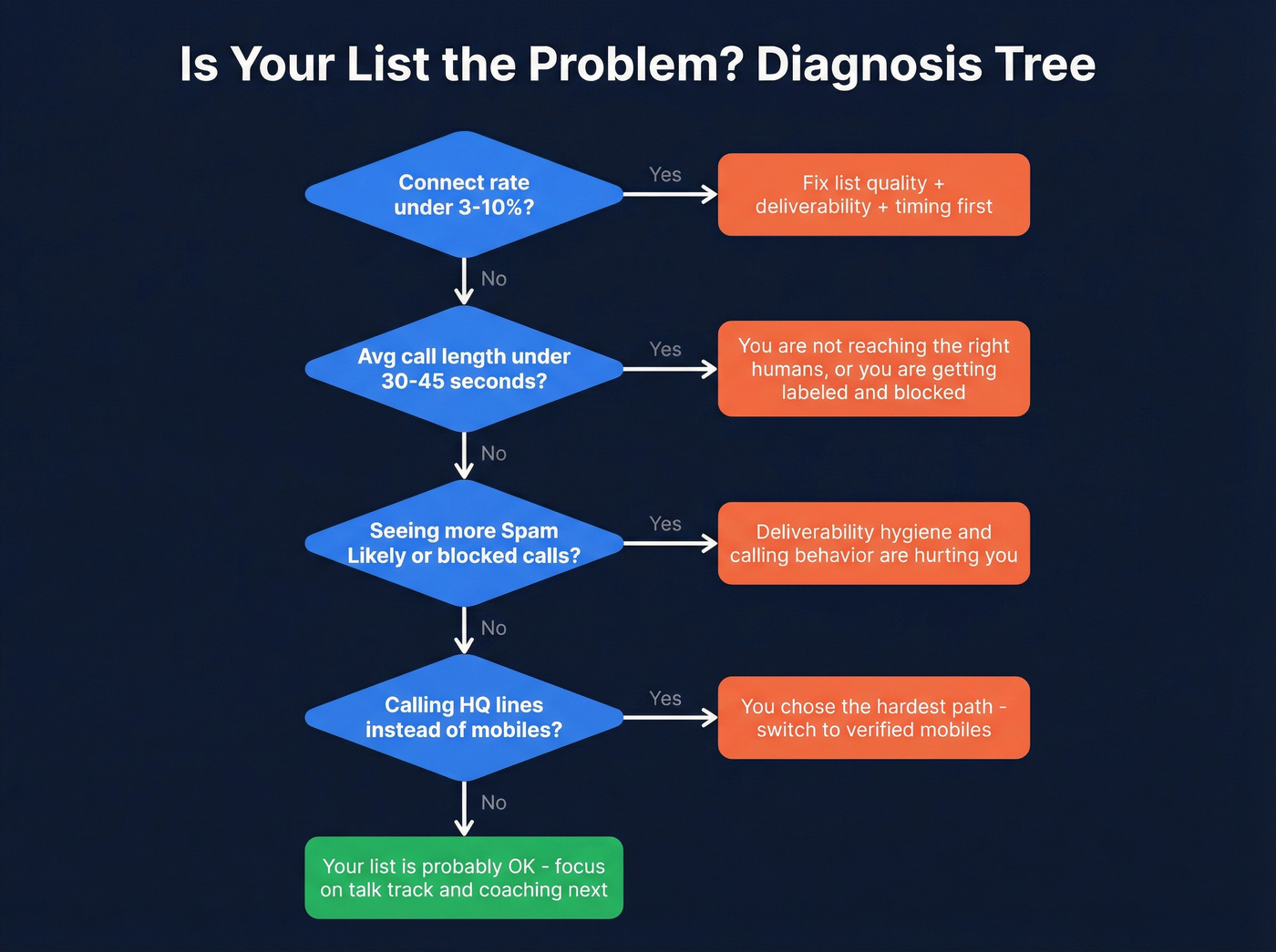
1) Is connect rate under 3-10%?
- Yes -> list quality + deliverability + timing are the bottleneck.
- No -> move to talk track and coaching.
2) Are calls unusually short (under ~30-45 seconds on average)?
- Yes -> you're not reaching the right humans (or you're getting labeled/blocked).
- No -> your opener/ask might be the issue.
3) Are you seeing more Spam Likely / blocked calls lately?
- Yes -> deliverability hygiene + calling behavior are hurting you.
- No -> list targeting and relevance are next.
4) Are you calling HQ lines instead of mobiles?
- Yes -> you're choosing the hardest path.
- No -> good. Now verify the mobiles are real and current.
If your connect rate's below the 3-10% band, your script basically doesn't matter yet.
You can't objection-handle your way out of not reaching people.
Mini-case: what "fix the list" looks like in practice
We saw this exact pattern with a team that had solid reps and a decent offer, but a messy list: lots of old titles, recycled numbers, and way too many HQ lines. Their calls "worked" in the sense that reps were doing the activity, but connects were so rare that every conversation felt high-stakes, which made the opener worse, which made hang-ups worse, which made the team start dialing faster to compensate. It's a dumb loop, and it's common.
Meritt's results show what happens when you break that loop: their connect rate 3x'd to 20-25% after fixing data quality, and bounce rates dropped hard (email + phone work best as one system).
The data-quality fix we'd actually bet on
If you want one lever that reliably lifts connect rate, it's verified mobiles + freshness, not another script workshop.
In our experience, tools like Prospeo are the fastest way to prove (or disprove) that your list is the bottleneck, because you can rebuild a call queue around verified direct dials instead of guessing which numbers are real.
Prospeo is "The B2B data platform built for accuracy": 300M+ professional profiles, 143M+ verified emails at 98% accuracy, and 125M+ verified mobile numbers with a 7-day refresh cycle. If you're prioritizing direct dials, start with their Mobile Finder and build your first call queue from those results.
One more operator note: don't just "add data." Use it to enforce rules - dedupe before import, suppress DNC globally, and tag list sources so you can see which segments are poisoning connect rate.

You just read it: connect rate is the #1 lever. Bad numbers kill everything downstream. Prospeo gives you 125M+ verified mobile numbers with a 30% pickup rate - refreshed every 7 days, not every 6 weeks. At $0.01 per email and 10 credits per mobile, fixing your list costs less than one dead dial block.
Stop workshopping scripts while your connect rate quietly dies.
The 2-3 week outbound calling cadence (copy/paste template)
Most teams don't have a cadence problem. They've got a follow-through problem.
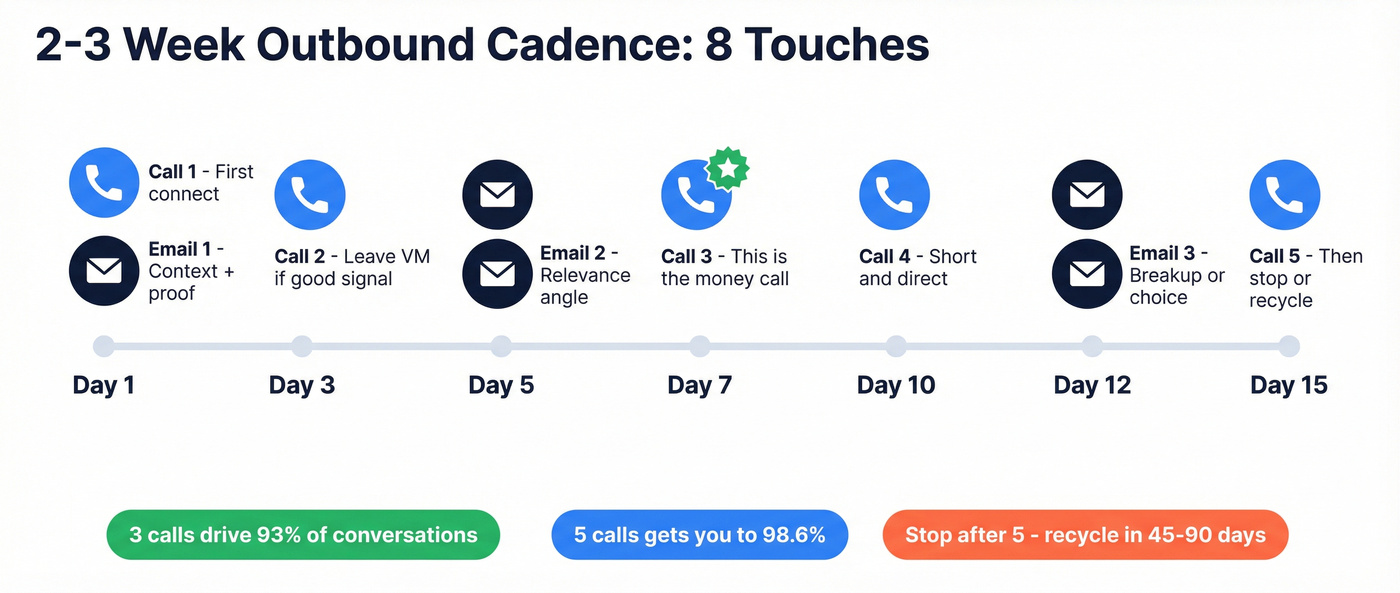
WHAM data nails the uncomfortable truth: 3 calls drive 93% of conversations, and 5 calls gets you to 98.6%. So when reps stop after 1-2 attempts, they're quitting before the odds swing in their favor.
Cadence rules we enforce:
- 6-8 touches over 2-3 weeks (phone is the backbone; email supports it).
- 3-call minimum before you decide "they're not responsive."
- 5-call maximum before you pause and recycle later (don't harass; be systematic).
- Every voicemail points to an email (and every email references the call attempt).
Copy/paste cadence template (2-3 weeks, 6-8 touches)
| Day | Touch | Channel | Goal | Notes |
|---|---|---|---|---|
| Day 1 | Touch 1 | Call | First connect | No VM if no signal |
| Day 1 | Touch 2 | Context + proof | "Tried calling" | |
| Day 3 | Touch 3 | Call | 2nd attempt | Leave VM if good |
| Day 5 | Touch 4 | Relevance angle | 1 tight CTA | |
| Day 7 | Touch 5 | Call | 3rd attempt | This is the money |
| Day 10 | Touch 6 | Call | 4th attempt | Short + direct |
| Day 12 | Touch 7 | Breakup / choice | "Worth closing?" | |
| Day 15 | Touch 8 | Call | 5th attempt | Then stop/recycle |
Execution rules that stop reps from freelancing:
- Before the first call block, sort your list: top accounts first, then intent/job change, then the rest.
- Call attempt #1 is pure permission + relevance. Don't pitch.
- Email #1 is the "why you, why now" in 5 sentences. One CTA.
- Call attempts #2-#3 are where most conversations happen. Keep them short and consistent.
- Voicemail rule: only leave a voicemail when you've got a clean reason and you're immediately sending an email they can reply to.
- Stop rules (important):
- Stop immediately if they ask you to stop, opt out, or you hit a DNC flag.
- Stop after 5 calls in the window. Recycle in 45-90 days with a new angle.
- Stop if the number's wrong after verification attempts. Don't keep hammering bad data.
Voicemail-to-email linkage (simple and effective):
- VM: "Hey [Name], it's [You] at [Company]. I'll send a quick email with context - reply with a 'yes' and I'll stop chasing you."
- Email subject: "Left you a voicemail"
SalesHive's cadence guidance lines up with this approach: SalesHive cold calling best practices.
When to call (time blocks that win)
Calling "whenever you have time" is how outbound dies. You need protected call blocks that match when prospects actually pick up.
LeadsAtScale analyzed 40,000 B2B outbound calls over 90 days, normalized to prospect local time, and the pattern's blunt:
| Local time window | Connect rate | Appt rate |
|---|---|---|
| 10:00 AM-12:00 PM | 18.7% | 7.1% |
| 4:00 PM-5:00 PM | 21.4% | 8.9% |
| After 5:00 PM | 6.1% | 1.7% |
After 5 PM, performance collapses.
Not "slightly worse." Off a cliff.
Checklist: how to operationalize this
- Staff two daily call blocks: 10-12 and 4-5 (prospect local time).
- Run a timezone queue (East first, then Central, then Mountain/Pacific).
- Protect the blocks: no internal meetings, no Slack triage, no "quick admin."
- Use the off-block hours for research, email touches, and follow-ups.
What to say in the first 25 seconds (script framework + examples)
Your goal in the first 25 seconds isn't to convince them. It's to earn permission to ask one good question.
The permission-based opener works because it lowers defenses. It sounds like a human, not a pitch bot.
Script framework (reason + relevance + one ask)
Permission opener "Hey [Name] - caught you out of the blue. You got a minute?"
Reason (why you're calling) "The reason I'm calling is we work with [peer group] on [specific outcome]."
Relevance (why them) "I noticed [trigger: hiring, tool stack, growth, job change, initiative]."
One ask (micro-commitment) "Worth a 30-second question to see if it's even relevant?"
If they say yes, ask a question that qualifies fit fast. If they say no, ask for a better time or the right owner.
Two script variants (SMB vs enterprise)
SMB / mid-market (speed + specificity) "Hey [Name], caught you out of the blue - got a minute?
Reason I'm calling: we help ops teams cut manual reporting time by 30-40% using automated workflows. I saw you're hiring for RevOps and scaling headcount. Worth a quick question - are you already standardizing your pipeline reporting, or is it still rep-by-rep?"
Enterprise (risk + stakeholder reality) "Hey [Name], caught you out of the blue - do you have a minute?
Reason I'm calling: we help enterprise teams reduce forecast variance and clean up CRM data quality across regions. I'm calling you specifically because you own [function] and you're expanding into [region/segment]. Quick question - when you roll out process changes, is the bigger blocker systems alignment or rep adoption?"
Voicemail that doesn't waste everyone's time
Voicemail should do one job: point them to an email they can reply to.
"Hey [Name], it's [You] at [Company]. I'll send a short email with why I called. If it's not relevant, just reply 'no' and I'll close the loop."
Pro: low pressure, gets replies.
Con: if your email deliverability's trash, voicemail won't save you.
Objection handling that keeps calls alive ("yes, and")
The fastest way to kill a cold call is to argue. The best framing is the improv rule: "yes, and." You acknowledge their reality, then narrow the conversation to a smaller, safer next step.
One rule that upgrades objection handling instantly: don't ask "why?" on a cold call. "Why?" sounds like a cross-exam. Ask "timing or fit?" It gives them an easy answer and gives you a real next move.
Roleplay snippets (use these verbatim)
Objection: "We already have a vendor." "Yeah, that makes sense - and you probably should. Quick question: are you happy enough that you wouldn't even look at a backup option, or is there one gap you still fight?"
Objection: "Not interested." "Totally fair - and I'm not trying to force a fit. Quick check so I know whether to disappear for good: is it not interesting because timing's bad, or because this category just isn't a priority?"
Objection: "Send me an email." "Yep, happy to - and I will. So I don't send you something generic, what's the one thing you'd need to see for it to be worth a follow-up?"
Objection: "I'm busy / in a meeting." "I figured. Give me 10 seconds for context, and you can tell me if I should book time or vanish - fair?" (Then deliver a 10-second reason + relevance, and ask for a specific time: "Today at 4:30 or tomorrow at 10?")
Objection: "This isn't a priority." "That's helpful. When it becomes a priority, what usually triggers it - missed number, leadership push, or a tool/process breaking?" (You're not forcing urgency; you're learning the trigger so your follow-up isn't random.)
I've watched reps turn "not interested" into real meetings just by switching from pushback to curiosity. It doesn't feel like a trick. It feels like respect.
Phone deliverability in 2026: STIR/SHAKEN + "Spam Likely" prevention
Phone deliverability is now what email deliverability was 10 years ago: ignore it and you'll get punished quietly and constantly.
Two forces drive this:
- Network trust (STIR/SHAKEN attestation)
- Behavioral reputation (carrier analytics + user spam reports)
STIR/SHAKEN attestation (A/B/C in plain English)
Attestation levels work like a trust badge:
- A (Full attestation): Your provider knows you, issued you the number, and the call originates on their network.
- B (Partial): Provider knows you and the call originates on their network, but they didn't verify the number association.
- C (Gateway): Call came from outside the provider's network; they don't really know the initiator.
If you're stuck at B or C, you're starting every call with a reputation handicap.
Why "Spam Likely" keeps coming back (even after you fix it)
Numeracle's remediation scale shows how persistent this problem is: 1,032,800+ numbers protected, 161,440+ remediations in 2026, and 66.8M branded calls in 2026. Labels reappear because carrier algorithms constantly re-score behavior. You don't "set and forget" reputation.
What triggers spam labeling (the stuff teams accidentally do)
These are the big ones we see in the wild:
- Dead air (dialer connects, rep takes 1-2 seconds to speak)
- High volume + short duration (lots of 10-20 second calls looks like spam)
- Sequential dialing patterns (machine-like behavior)
- Inconsistent CNAM / caller ID name
- New numbers that suddenly spike volume
- Frequent number rotation (looks like evasion)
- Geographic weirdness (calling into NY from a number that looks like it's elsewhere)
- Spam reports (even a small number hurts)
Real talk: the "just buy more numbers and rotate them" advice is how teams dig the hole deeper.
Dialer settings mini-checklist (the stuff that quietly wrecks connect rates)
If your dialer's misconfigured, you can do everything else right and still get labeled.
- Greeting latency (dead air): track agent greeting latency in your dialer and spot-check 10 recordings per rep per week. If the rep can't say "Hi [Name]" immediately, fix routing, headset, and dialer connect behavior before coaching talk tracks.
- Ring time: don't cut rings so short that you create a pattern of ultra-short calls. Give real humans time to answer.
- Abandon rate / dropped connects: keep it conservative. High abandon behavior is a carrier reputation killer and a customer experience disaster.
- Local presence: it can lift pickup short-term, but it also increases "this feels sketchy" reactions if your number looks local and your rep clearly isn't. Use it selectively, not as a blanket hack.
- Voicemail drop: it's efficient, but it can inflate short-duration patterns if you're dropping on every non-answer. Use it only when your list quality's strong and your pacing's sane.
Stack choices that affect outcomes (implementation options + side effects)
You don't need a giant stack, but you do need to understand tradeoffs:
- Power dialers (one line at a time) are safer for deliverability and coaching because they reduce dead air and abandon risk.
- Parallel/predictive dialers can spike volume, but they also spike the two things carriers hate: dead air and short calls. If you use them, monitor greeting latency and abandon behavior weekly.
- Conversation intelligence (call recording + tagging) makes QA real. Without it, coaching becomes vibes again.
- Assist cards / real-time prompts help new reps stay tight on the opener and the ask, but they can make experienced reps sound robotic if over-scripted.
First Orion has a solid overview of how outbound call appearance works and why pacing matters: managing outbound call appearance.
Deliverability checklist (what to do operationally)
Carrier + identity
- Push your provider for A-level attestation where possible.
- Keep CNAM consistent across numbers and campaigns.
- Use stable numbers for stable motions (don't rotate weekly).
Registration + reputation
- Register your numbers with analytics providers: Hiya, First Orion, TNS.
- If you're at scale, consider branded calling / remediation services.
Behavior + pacing
- Avoid burst dialing. Spread volume across business hours.
- Segment numbers by purpose (prospecting vs customer calls).
- Don't run dialers so aggressively that you create dead air.
Call quality
- Monitor average call duration by rep and by list segment.
- Watch for "hello? ... hello?" moments. Fix dialer latency, headset setup, and call routing.
A practical "Spam Likely" triage
- If labeling spikes: pause the worst-performing number, reduce volume, fix dead air, and register/remediate.
- If connect rate drops suddenly: check attestation changes, CNAM changes, and dialing patterns before you rewrite scripts.
Operator rule: we review spam labeling weekly by number, not just "overall." One bad number can poison a whole team's results if reps share pools or rotate carelessly.
Compliance ops (TSR + TCPA) without slowing reps down
You don't need reps memorizing legal text. You need a workflow that makes compliance automatic.
The two rules that matter most operationally
- FTC TSR recordkeeping: keep required records for 2 years. That means your process needs an audit trail, not just "we told reps to behave."
- TCPA revocation: prospects can revoke consent by any reasonable means, and you've got 10 business days to honor it. That's the SLA teams miss.
For the baseline TSR requirements: Complying with the Telemarketing Sales Rule.
Operational risk (why this can't be "later")
TCPA exposure gets expensive fast: $500 per violation is the baseline, and $1,500 per violation applies when it's treated as willful/knowing. That's why "we'll clean up the list later" isn't a strategy.
Also, opt-outs aren't just email anymore. For texts, many teams follow a simple best practice: send one confirmation message within ~5 minutes ("Confirmed - no more messages.") and then stop. Don't use the confirmation as a loophole to keep selling.
Finally, call recording consent is state/country-specific. Pick a policy with counsel and bake it into the dialer (announcement, consent capture, or recording disabled by region). Don't leave it to rep judgment.
Simple internal workflow (capture -> suppress -> confirm -> audit)
Capture
- Any opt-out signal gets captured immediately: "don't call," "take me off your list," angry email reply, support ticket, etc.
- Don't force reps to pick the perfect reason code. One button: "Do Not Contact".
Suppress
- Sync suppression to your CRM + dialer + sequencing tool.
- Suppress at the person level and, when appropriate, the domain/company level (depending on your policy).
Confirm
- Send an internal confirmation (not marketing) that the record's suppressed.
- If the request's ambiguous, default broad. Don't play games.
Audit trail
- Store timestamp, channel, and who processed it.
- Run a weekly audit: new DNC entries, any calls/texts after suppression, and exceptions.
Calling hours + DNC reminders
- Respect calling-hour limits and internal DNC lists.
- Train reps on one sentence: "If you want me to stop calling, tell me and I'll mark it right now."
I've seen teams lose weeks cleaning up compliance messes that could've been prevented with a single suppression workflow and a 10-day SLA timer.
Coaching & QA scorecard (what to review weekly)
Coaching works when it's specific. "Be more confident" isn't coachable. "Your opener's 12 seconds too long and you're talking 70% of the time" is.
Gong's benchmarks are a good anchor: closed-won calls average 57% talk time vs 62% on lost deals, and winning calls ask 15-16 questions while losing calls ask ~20. Reference: Gong talk-to-listen ratio benchmarks.
Weekly QA scorecard (copy/paste)
| Category | What "good" looks like | Score (1-5) |
|---|---|---|
| Opener | Permission + reason in <25s | |
| Relevance | Trigger/why-them is clear | |
| Talk ratio | ~55-60% rep talk | |
| Questions | 15-16 quality Qs max | |
| Dead air | No delays/awkward gaps | |
| Objections | "Yes, and" used | |
| Next step | Clear time-bound ask | |
| Notes hygiene | CRM updated same day |
What we review first (because it predicts outcomes):
- Dead air + awkward starts (often a dialer/setup issue)
- Opener length (rambling kills permission)
- Next-step clarity (reps chat but don't ask)
Outbound calling strategy KPIs: dashboard + troubleshooting
If you only track dials and meetings, you'll misdiagnose everything. You need a small dashboard that tells you where the funnel breaks, plus an operating rhythm that forces you to look at it.
KPI dashboard (minimum set)
- Connect rate (connects / dials)
- Meeting rate (meetings / connects)
- Conversation rate (optional, but define it clearly)
- Attempt completion (avg attempts per prospect; are reps hitting 3-5?)
- Spam label rate / complaints (by number, by rep, by dialer queue)
- Median lead response time (warm/inbound leads)
- Greeting latency (dialer metric or spot-check score)
Speed-to-lead SLA (when the lead is warm)
Cold outbound's a volume game. Warm leads are a speed game.
Hard rule: any inbound form/demo lead gets called in under 5 minutes during business hours. Chili Piper's research is the reason this rule exists: responding within 5 minutes can make teams 100x more likely to connect vs waiting 30 minutes, and 21x more likely to qualify a lead vs waiting 30+ minutes.
If you can't hit <5 minutes consistently, don't "coach urgency." Fix routing: round-robin ownership, instant alerts, and a backup caller when the owner's in a meeting.
Minimum sample size (so you don't thrash)
Don't judge a list, a rep, or a new opener on 20 dials. That's noise.
As a practical floor:
- 200+ dials before you declare a list segment bad
- 30+ connects before you declare a talk track broken
- A full 2-3 week cadence before you declare "this persona doesn't work"
Weekly operating rhythm (the part most teams skip)
This is the cadence that keeps outbound from drifting into chaos:
Monday: List QA + queue building
- Dedupe, suppress DNC, refresh top segments, build call queues for Tue-Thu
- Pick one hypothesis to test (new trigger, new segment, new opener line)
Tuesday-Thursday: Protected call blocks
- Two blocks daily (10-12 and 4-5 local time)
- Midday: follow-ups + email touches + warm lead speed-to-lead coverage
Friday: QA + deliverability review
- Score 5-10 calls per rep
- Review spam labeling by number
- Adjust pacing, retire poisoned numbers, and update next week's queues
This rhythm is boring.
That's why it works.
Troubleshooting tree (fast diagnosis)
If connect rate's low (below 3-10%)
- Fix list quality (bad numbers, wrong roles, stale contacts)
- Fix deliverability (attestation, pacing, dead air, registration)
- Fix timing (move volume into 10-12 and 4-5 local time)
If connect rate's fine but meetings are low
- Fix opener + one ask (permission, reason, relevance)
- Fix targeting (you're reaching humans, but the offer doesn't fit)
- Fix coaching (talk ratio, question quality, next-step clarity)
If spam labeling spikes
- Pause the number, reduce volume, eliminate dead air
- Register/remediate (Hiya/First Orion/TNS)
- Stop sequential/burst dialing patterns
If reps aren't completing attempts
- Make cadence completion visible (leaderboard by attempts completed, not just dials)
- Pre-build call lists and blocks so admin work can't eat the day
Your reps don't need more motivation - they need direct dials that actually connect. Prospeo's 300M+ profiles with 98% email accuracy and 125M+ verified mobiles mean your 250 dials/week hit real buyers, not switchboards. Teams using Prospeo book 35% more meetings than Apollo users.
Move the lever that multiplies - start with better data.
FAQ
How many cold call attempts should you make per prospect?
Make 3 call attempts minimum and cap it at 5 within a 2-3 week cadence, because 3 calls drive 93% of conversations and 5 calls gets you to 98.6% with diminishing returns beyond that. If there's no engagement after 5, pause and recycle later with a new angle.
What are the best times to make outbound sales calls?
The best call windows are 10:00 AM-12:00 PM and 4:00 PM-5:00 PM in the prospect's local time, because those windows show the highest connect and appointment rates in large call analyses. After 5:00 PM, connect and appointment rates drop sharply, so protect earlier blocks.
Why do my outbound calls show up as "Spam Likely," and how do I fix it?
Calls get labeled Spam Likely when carriers see low trust signals (weak STIR/SHAKEN attestation) and spammy behavior patterns like dead air, burst volume, short-duration calls, sequential dialing, and inconsistent caller ID. Fix it by improving attestation, pacing volume, eliminating dead air, keeping CNAM consistent, and registering numbers with Hiya/First Orion/TNS.
What's the TCPA opt-out/revocation rule teams must follow now?
TCPA consent can be revoked by any reasonable means, and your team must honor that revocation within 10 business days. Operationally, you need a one-click "Do Not Contact" capture, automatic suppression across CRM/dialer/sequencer, and an audit trail so you can prove the request was processed on time.
How fast should you call inbound leads?
Call warm inbound leads in under 5 minutes during business hours. If you're training new reps on how to make outbound calls effectively, this is the simplest rule to enforce because it beats most tips and scripts: fast follow-up dramatically increases connect and qualification rates.
Summary: the 2026 outbound calling strategy that actually holds up
A durable outbound calling strategy in 2026 is simple: start with a list that connects, protect two local-time call blocks, run a 3-5 attempt cadence, keep the opener permission-based, and manage phone deliverability like it's a first-class metric.
Do that weekly, not "when things get bad," and meetings become a predictable output - not a lucky streak.