

Closing Email Phrases That Actually Get Replies - Backed by Data
The last line of your email does more heavy lifting than you think. An analysis of 350,000+ email threads by Boomerang found that emails ending with "Thanks in advance" hit a 65.7% response rate - compared to a 47.5% baseline for emails without gratitude closings. That's an 18.2-point swing from a single line. A separate experiment by researchers Grant and Gino showed something even starker: adding a simple "Thank you so much!" to a request doubled the help rate from 32% to 66%.
Your closing email phrases aren't decoration. They're the difference between a reply and radio silence.
The 3 Parts of an Email Ending
Most people treat the email ending as one thing. It's actually three distinct components, and confusing them is where things go sideways.
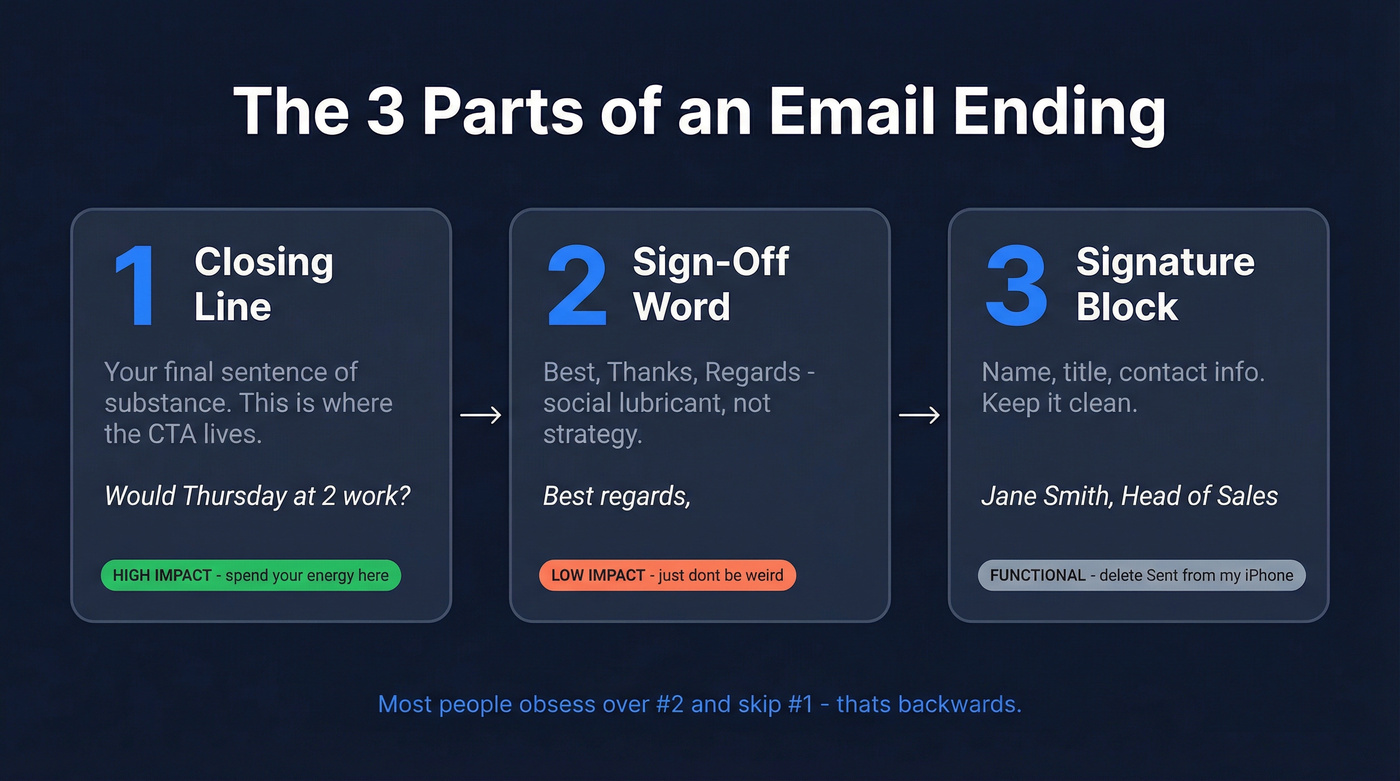
Closing line - your final sentence of substance. This is where the call to action lives. "Would Thursday at 2 work?" or "Looking forward to your thoughts on the proposal." This drives action, and it's the part most people skip.
Sign-off word - "Best," "Thanks," "Regards." Everyone obsesses over this, but it's the least important of the three. It's social lubricant, not strategy.
Signature block - name, title, contact info. Keep it clean. Delete "Sent from my iPhone" unless you're genuinely excusing typos from a taxi.
Spend your energy on the closing line. The sign-off word just needs to not be weird.
Best Email Closing Lines by Scenario
Formal or First Contact
When you're emailing someone for the first time - or writing up the chain - err toward warmth without familiarity. The right closing sentence sets a professional tone while still inviting a response.
- "Looking forward to your thoughts." - Works for proposals, introductions, and any email where you want a considered reply. Respectful without being stiff.
- "I appreciate your time on this." - Acknowledges you're asking for something. Good when you need a favor.
- "Thank you for your consideration." - Best reserved for job applications or formal requests. Too stiff for sales.
Friendly or Ongoing
Once you've exchanged a few emails, you can loosen up. But "Best" has become the sweatpants of email closings - comfortable, forgettable, and everyone defaults to it when they stop thinking. Ask anyone who sends more than 20 emails a day and they'll tell you: "Best regards" is muscle memory, not a choice.
- "Talk soon." - Casual, forward-looking. Works when you actually will talk soon.
- "Appreciate you." - Warmer than "Thanks" without being over the top.
- "Excited to see this come together." - Collaborative energy. Great for project threads.
Gratitude-Based (The Data Winners)
This is where the numbers get interesting. The 350,000-thread study showed gratitude closings consistently outperform neutral ones - and the differences aren't subtle. "Thanks in advance" topped the chart at 65.7%, with "Thanks" at about 63% and "Thank you" at 57.9%. The slightly more formal "Thank you" paradoxically feels a touch less warm than the casual "Thanks," which explains the gap.
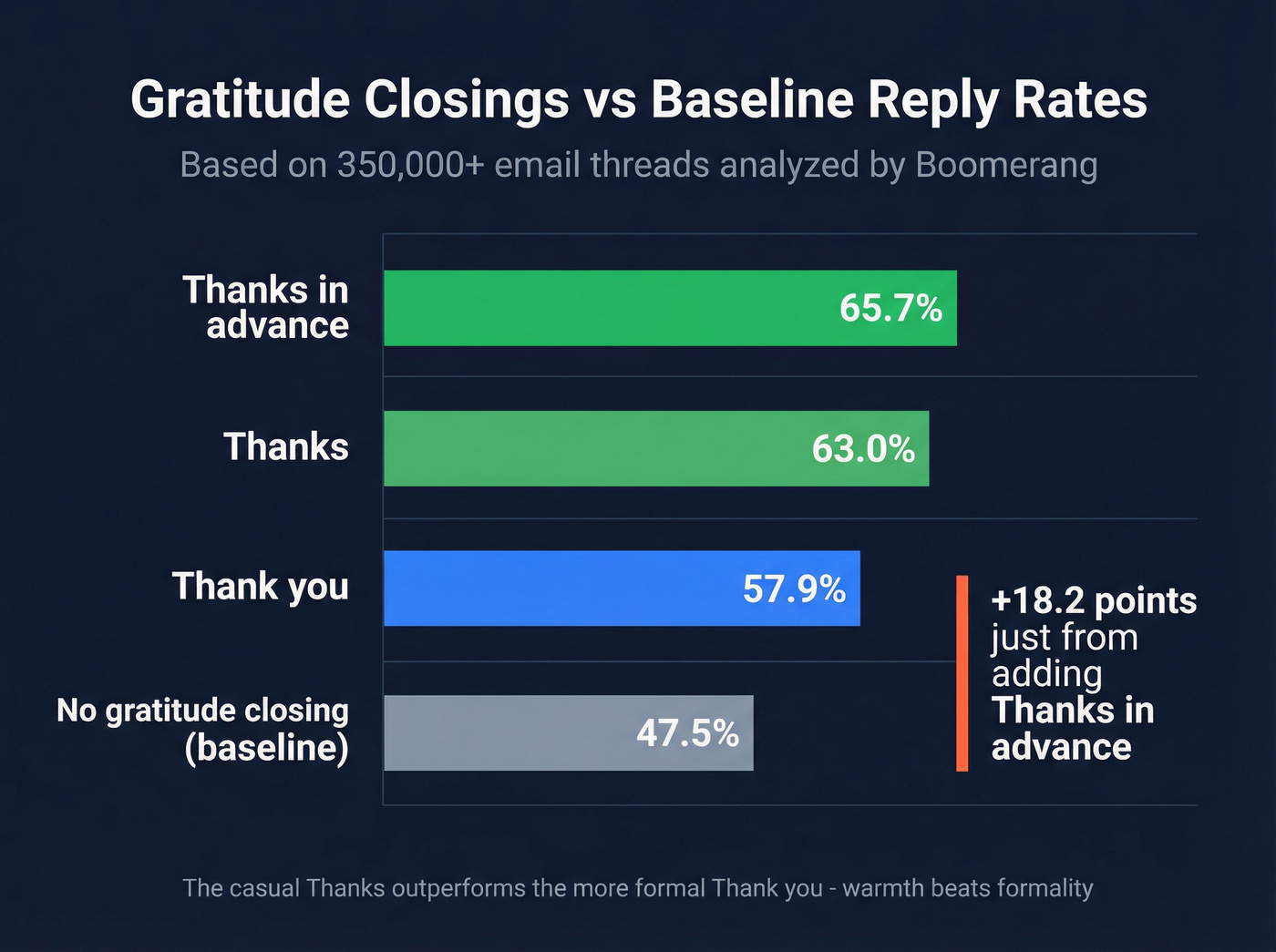
We've seen "Thanks in advance" backfire with C-suite prospects who didn't ask for your email - it presumes action, which can feel pushy. But for warm contacts and internal emails, it's a clear winner. If you're looking for a closing sentence that reliably drives replies, gratitude is your safest bet.
Action-Oriented / CTA Closings
If you need someone to do something, your closing line should make that action effortless. Question-based CTAs lower cognitive load - the recipient doesn't have to figure out what you want.
- "Would Tuesday at 2 work for a quick call?" - Specific, low-friction. The recipient just says yes or suggests an alternative.
- "Can I send over a short summary?" - Permission-based. Feels collaborative rather than demanding.
- "If this looks good, I'll send the contract over tomorrow." - Assumes positive intent and creates momentum.
Follow-Up Emails
Follow-ups are where your sign-off matters most, because you're fighting diminishing returns. Belkins' analysis of 16.5 million cold emails found that the first follow-up can lift reply rates by up to 49% - and spam complaints rise sharply by the fourth email. Every closing line in a follow-up sequence needs to earn its keep.
"Totally understand if the timing isn't right. Worth revisiting in Q3?" gives the recipient an exit while keeping the door open. "If this isn't a priority right now, just let me know and I'll stop following up" is disarming - in our experience, people often reply to this one just to be polite. And "Just circling back - would a quick summary help move this forward?" offers value instead of just asking again. These work because they respect the recipient's time while still keeping the conversation alive.
Cold Outreach Closings That Drive Replies
Cold email is a different animal. You're writing to someone who didn't ask to hear from you, and the latest large-scale benchmark puts the average reply rate at just 5.8%. The margin for error is razor-thin.
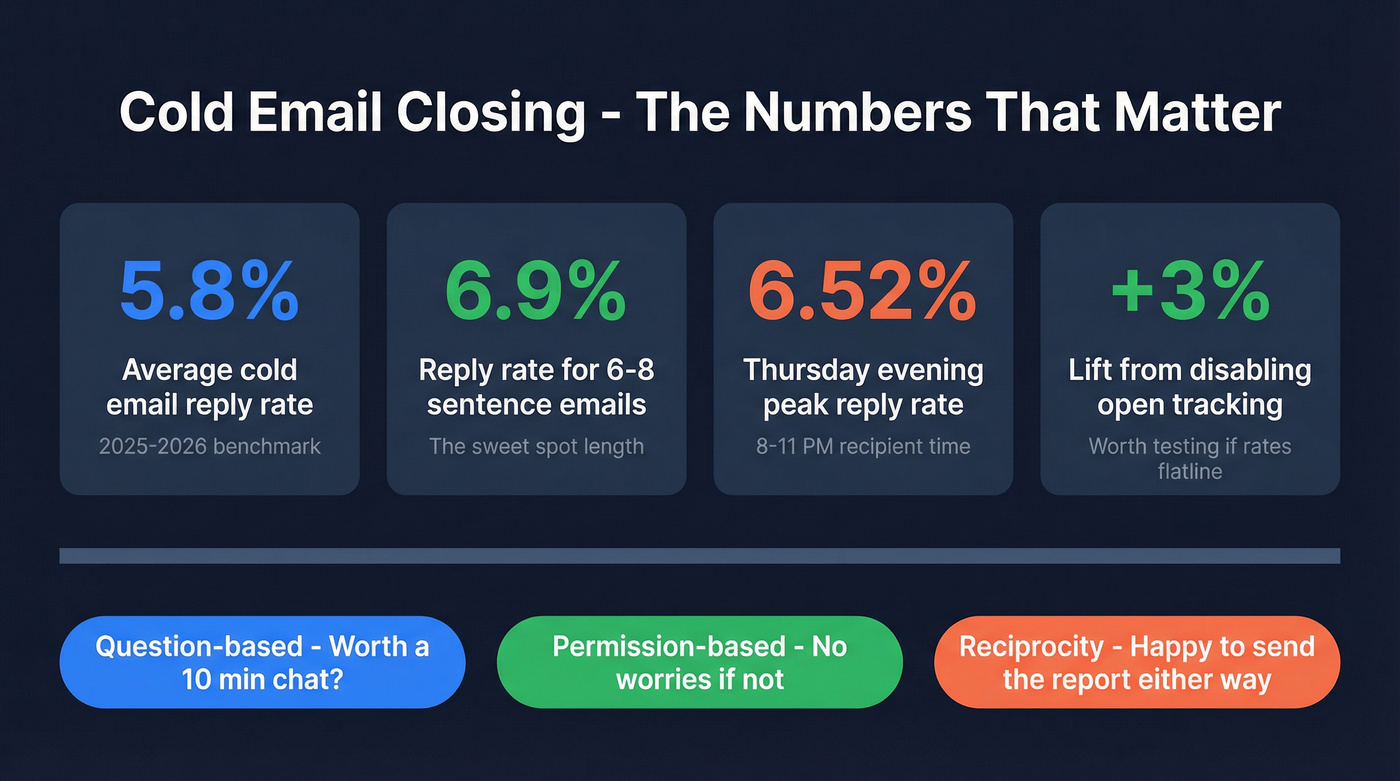
A few numbers worth knowing: emails between 6-8 sentences hit a 6.9% reply rate - the sweet spot. Thursday evenings (8-11 PM recipient time) peak at 6.52%. Under 200 words outperforms longer emails consistently. One counterintuitive finding: disabling open-tracking pixels produced roughly 3% higher response rates, which is worth testing if your reply rates have flatlined (and worth comparing with does open-tracking hurt deliverability guidance).
Your closing statements need to do one of three things:
| CTA Type | Example | Why It Works |
|---|---|---|
| Question-based | "Worth a 10-min chat?" | Easy yes/no answer |
| Permission-based | "No worries if not - happy to reconnect next quarter" | Removes pressure |
| Reciprocity-based | "Happy to send the benchmark report either way" | Makes the recipient feel they owe a reply |
| Specific time | "Does Thursday at 3 work?" | One-word answer required |

Here's the thing: your closing line only matters if the email reaches a real inbox. Prospeo verifies emails in real time with 98% accuracy on a 7-day refresh cycle, so you're not wasting a perfect closing on a dead address (see email verification for outreach and hard bounce basics).
Let's be honest - most teams obsess over subject lines and opening hooks while treating the closing as an afterthought. That's backwards. The subject line gets the open; the closing line gets the reply. Run each closing variant across at least 500 sends before drawing conclusions (use a proper A/B test setup). Anything less is noise.

A 65.7% reply rate means nothing if 35% of your emails bounce. Prospeo's 5-step verification and 7-day data refresh ensure your carefully crafted closing lines reach real inboxes - not dead addresses. At $0.01 per verified email, bad data is no longer an excuse for low reply rates.
Stop perfecting closings for emails that never arrive.
Why These Email Endings Work
The psychology maps directly to Robert Cialdini's persuasion principles.
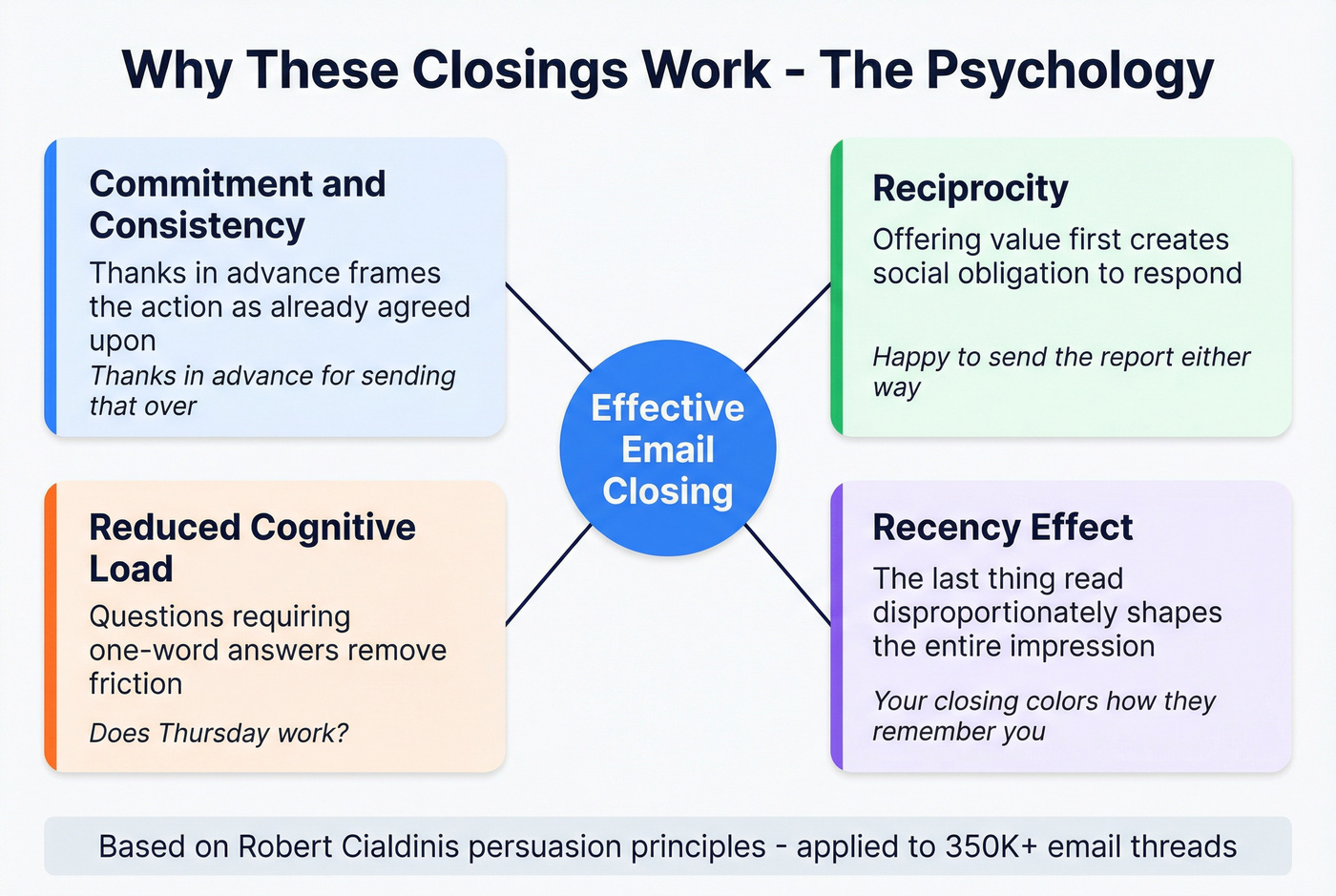
Commitment and consistency explain "Thanks in advance." By thanking someone for something they haven't done yet, you frame the action as already agreed upon. The recipient feels a pull toward following through - the same reason small initial commitments like "open to a 2-minute video?" lead to larger ones.
Reciprocity is why offering value before asking works. "Happy to send over the report either way" gives something first. The recipient now feels a social obligation to respond.
Question-based CTAs work because they do the thinking for the recipient. "Does Thursday work?" requires a one-word answer. "Let me know your thoughts" requires actual thought. That friction kills replies (this is also why strong sales email structure matters).
And the recency effect means the last thing someone reads disproportionately shapes their impression of the entire message. A strong closing doesn't just drive action - it colors how the recipient remembers your email.
Sign-Offs That Backfire Internationally
If you're emailing across borders, your safe default might be someone else's red flag. In the UK, "Regards" alone reads as curt or cold. "Kind regards" or "Best wishes" is the expected minimum. A study comparing Korean and Australian academics found that 40% of Korean respondents found the Australian emails impolite - formality expectations vary enormously, and your closing is where those differences surface first.
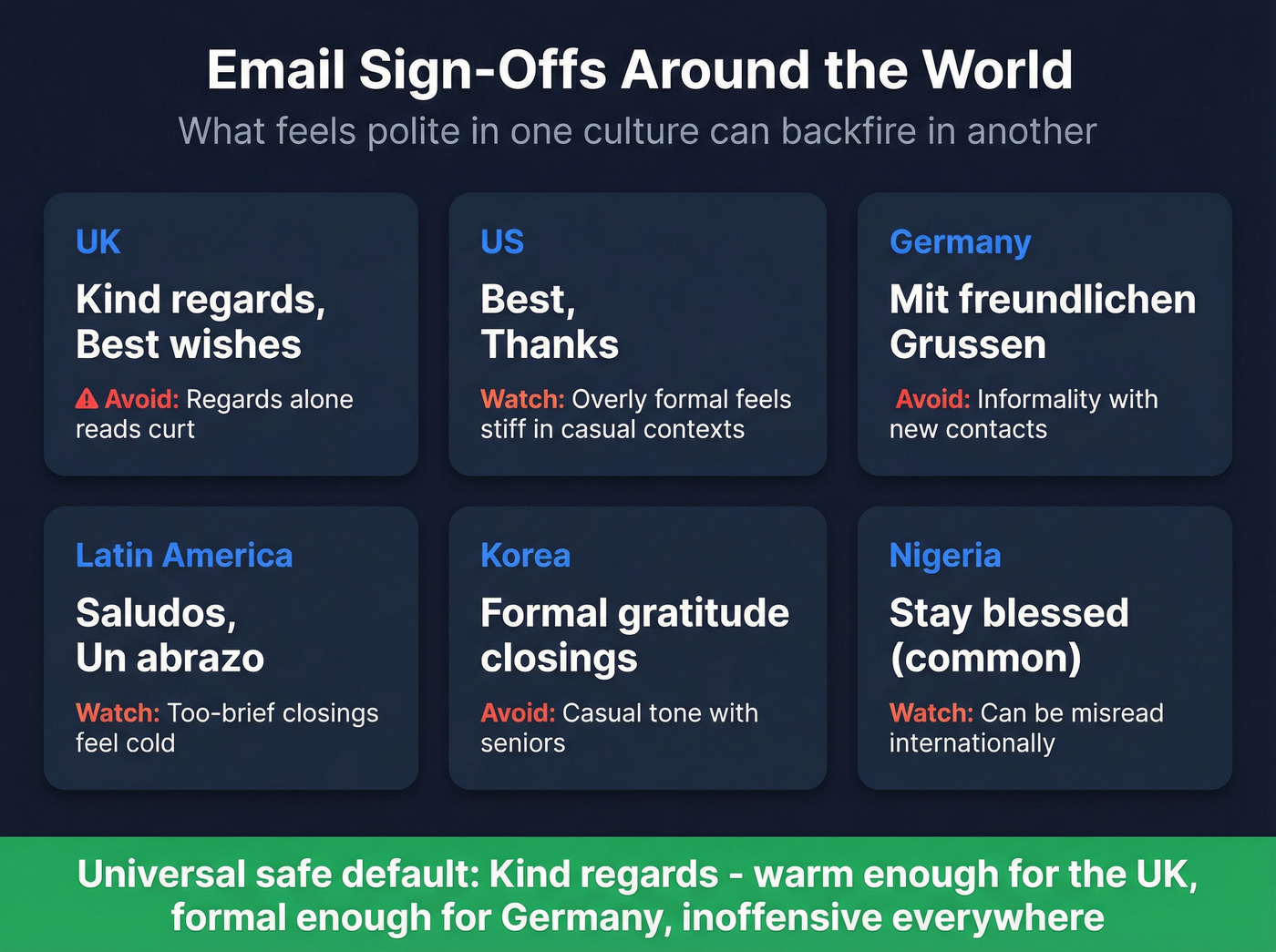
| Region | Safe Default | Watch Out For |
|---|---|---|
| UK | Kind regards, Best wishes | "Regards" alone reads curt |
| US | Best, Thanks | Overly formal in casual contexts |
| Germany | Mit freundlichen Grussen | Informality with new contacts |
| Latin America | Saludos, Un abrazo | Too-brief closings feel cold |
| Korea | Formal gratitude closings | Casual tone with seniors |
| Nigeria | Stay blessed (common) | Phrases misread internationally |
In Nigeria, religious closings like "Stay blessed" are standard professional courtesy, though some phrases can trigger unfair assumptions from international recipients. In Latin America, "Un abrazo" (a hug) is perfectly acceptable in semi-formal business contexts. In Germany, that level of warmth with a new contact would feel bizarre.
When in doubt, "Kind regards" is the closest thing to a universal safe default. It's warm enough for the UK, formal enough for Germany, and inoffensive everywhere else.
Email Closings to Avoid
Some closings don't just fail to help - they actively hurt.
- "Please advise" - passive-aggressive in virtually every English-speaking culture. The email equivalent of "per my last email."
- "Cheers" - fine if you're British or Australian. Confusing if you're not.
- "Thx" / "Ty" - in professional contexts, these signal you couldn't be bothered to type six more characters.
- No closing at all - the 350,000-thread dataset shows emails without gratitude closings sit at a baseline response rate of 47.5%. Skipping the sign-off doesn't save time; it costs replies.
Skip the clever stuff. A weak closing that recipients barely notice is still better than no closing at all - but the goal is a line that earns a response, not one that simply fills space (pair this with better cold email tactics and a tighter outbound email campaign).
You just learned that the right closing phrase can swing reply rates by 18+ points. Now multiply that by sending to 98% accurate, verified contacts instead of stale lists. Prospeo gives you 300M+ profiles refreshed every 7 days - so every closing line you write has a real person on the other end.
Great copy deserves great data. Start with 75 free emails.
FAQ
What's the most professional way to end an email?
"Thanks in advance" or "Looking forward to your thoughts" are the strongest professional closings. Gratitude-based sign-offs hit a 65.7% response rate in a 350,000-thread study - 18.2 points above the 47.5% baseline. Match formality to your relationship with the recipient.
Is "Best" a good email sign-off?
It's not wrong - it's just forgettable. "Best" is the default when you've stopped thinking about your closing line. "Appreciate your time" or "Looking forward to connecting" signal more effort and intention without adding formality.
How do you end a cold outreach email?
Use a low-friction question like "Would Thursday work for a quick call?" or a permission-based close like "No worries if the timing isn't right." Emails of 6-8 sentences with clear CTAs get the highest reply rates at 6.9%. Verify addresses before sending - Prospeo's 98% email accuracy ensures your closing line reaches a real inbox instead of bouncing.
Do email closing lines actually affect reply rates?
Yes - significantly. Gratitude-based closings beat neutral endings by a wide margin: 65.7% for "Thanks in advance" versus a 47.5% baseline. The closing line - not just the sign-off word - drives action. It's the last thing the recipient reads, and the recency effect means it shapes their impression of your entire message.