Sales Call Effectiveness: What the Data Actually Says
84% of reps missed quota last year. Buyers spend just 17% of their buying time meeting with potential suppliers, and with buying committees now averaging seven people, every conversation has to earn its place. Most teams are optimizing sales call effectiveness in the wrong order, and it's costing them pipeline they'll never get back.
Why Every Call Carries More Weight Now
Gartner projects 80% of B2B sales interactions will happen through digital channels by 2026. McKinsey's data shows companies running hybrid sales models generate up to 50% higher revenue than single-channel teams. The math is simple: fewer at-bats means each call matters more.
Meanwhile, 89% of B2B buyers report deals stalling due to internal buying complexity. Your reps aren't just selling - they're navigating a committee of people who all have veto power but rarely agree on anything. That demands sharper calls, not more dials.
The Short Version
If you're pressed for time, here's what actually moves the needle:
Fix your data first. 72% of cold calls never reach a human, and reps lose 27.3% of selling time to bad contact info. Verify contacts before you dial (and keep CRM hygiene tight so it stays clean).
Pick a qualification framework and measure consistency. MEDDIC lifts win rates 18% for organizations that fully adopt it. SPIN drives 57% higher prospect talk time during discovery. The framework matters less than whether reps actually use it every single call (a simple lead qualification framework scorecard helps).
Use conversation intelligence to coach, not just record. 43% of sales leaders don't know their reps want more coaching. Call recordings nobody reviews are expensive noise (here’s a deeper system for cold call coaching).
How to Measure Call Performance
Most teams track dials per day and stop there. That's an activity metric, not an effectiveness metric. You need a mix of leading indicators - dials, conversations, connection rate - and coaching signals like call duration, talk ratio, and disposition. When average call duration sits under two minutes, it consistently flags reps who can't hold a prospect's attention past the opener (use a lightweight sales management dashboard to keep these visible).
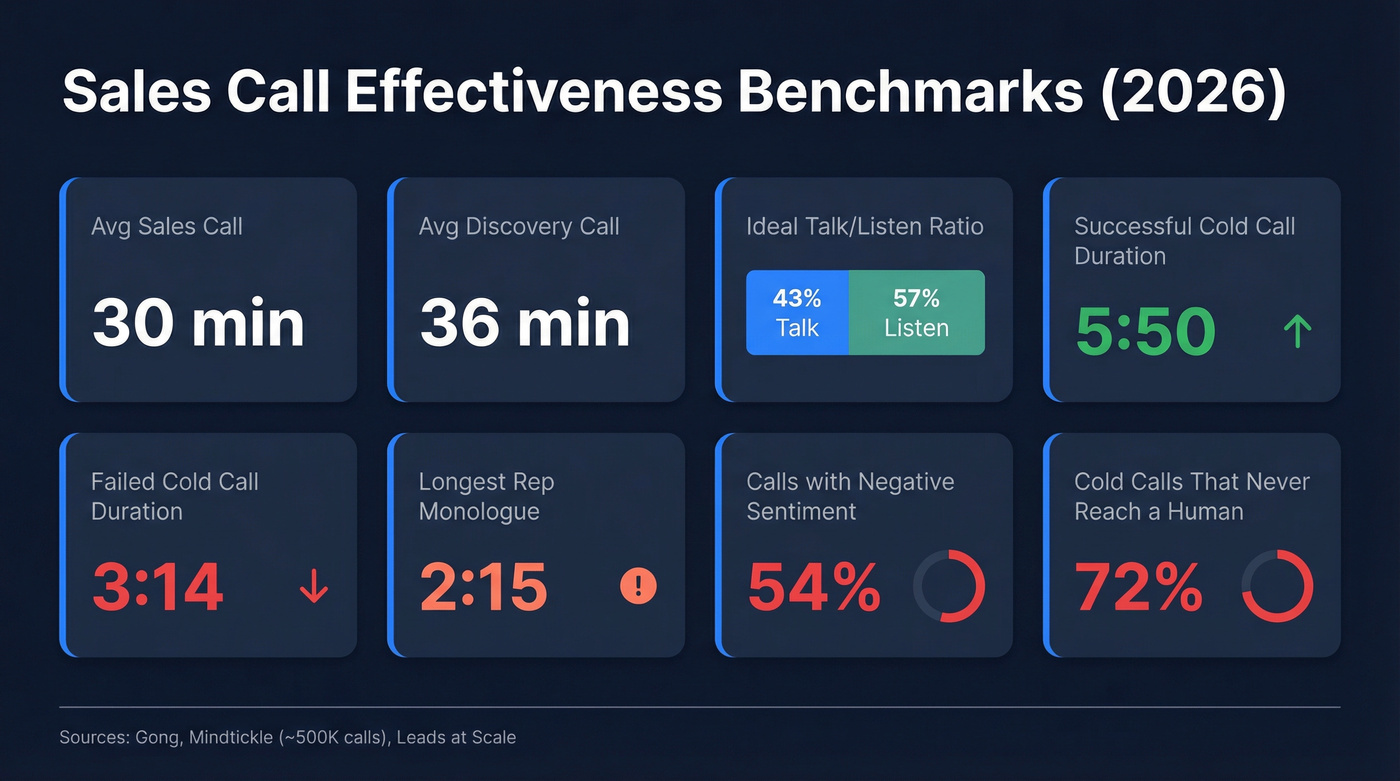
Here's what "good" looks like across the benchmarks we've pulled together:
| Metric | Benchmark | Source |
|---|---|---|
| Avg sales call | 30 min | Mindtickle |
| Avg discovery call | 36 min | Mindtickle |
| Talk-to-listen ratio | 43% talk / 57% listen | Gong |
| Talk-to-listen ratio | 63% rep / 37% buyer | Mindtickle (~500K calls) |
| Successful cold call | 5:50 | Gong |
| Failed cold call | 3:14 | Gong |
| Longest rep monologue | 2:15 | Mindtickle |
| Calls with negative sentiment | 54% | Mindtickle |
The talk-ratio gap between Gong and Mindtickle is real and worth understanding. Discovery calls skew toward the buyer talking; general sales calls skew toward the rep. Mindtickle's dataset of roughly 500K cold calls is one of the larger benchmarks available, so use it as a directional guide while tracking your own baseline first.
Here's the number that should worry you: more than half of analyzed sales calls skew negative in sentiment. If you're not measuring this, you're flying blind on how prospects actually feel during your conversations.

54% of sales calls skew negative in sentiment - but that assumes you even reach a human. With 72% of dials going nowhere, your reps are coaching against voicemails. Prospeo's 125M+ verified mobile numbers deliver a 30% pickup rate, turning dead dials into real conversations worth optimizing.
Give your reps someone to actually talk to.
Five Behaviors That Improve Call Outcomes
1. State why you're calling - immediately. Reps who explain the reason for their call within the first 30 seconds see a 2.1x higher success rate. Mentioning a mutual connection boosts meeting chances by 70%. These aren't soft skills. They're measurable conversion levers (and they map cleanly to better sales pitch opening lines).
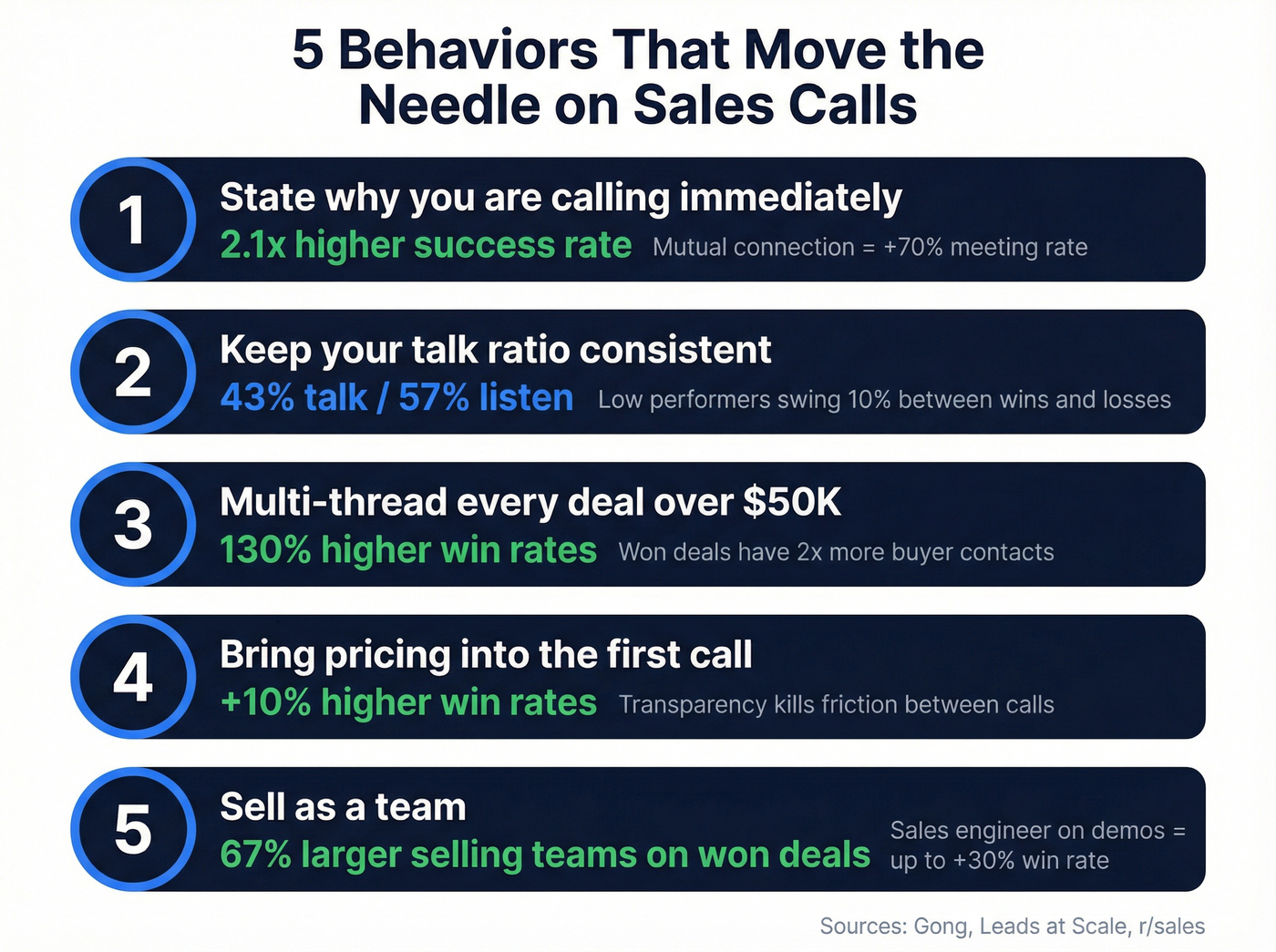
2. Keep your talk ratio steady. The benchmark is 43/57, but the exact number matters less than consistency. Low performers swing 10% between won and lost deals - they talk 54% on wins and 64% on losses. High performers stay flat. Consistency signals control, and prospects can feel it.
3. Multi-thread every deal over $50K. Closed-won deals have 2x as many buyer contacts as closed-lost. For deals above that threshold, multi-threading boosts win rates by 130%. Let's be honest: if your rep is single-threaded on a six-figure deal, that deal is already dead. They just don't know it yet (see what is multithreading in sales).
4. Bring pricing into the first call. The consensus on r/sales leans toward early pricing transparency, and the data backs it up: discussing pricing on the first call correlates with +10% higher win rates. Hiding the number doesn't create intrigue - it creates friction that kills momentum between calls.
5. Sell as a team. Won deals have selling teams that are 67% larger than lost deals. Bringing a sales engineer into enterprise demos increases win rates up to 30%. Solo-hero selling is a liability at scale, and it burns out your best reps in the process (this is a core part of enterprise software sales).
The Upstream Fix Most Teams Skip
Here's the thing: the industry spends millions optimizing what reps say on calls while ignoring that most calls never connect. B2B data decays 22.5% per year. Reps lose 27.3% of their selling time to bad contact data. You can't coach a voicemail (this is exactly what B2B contact data decay looks like in practice).
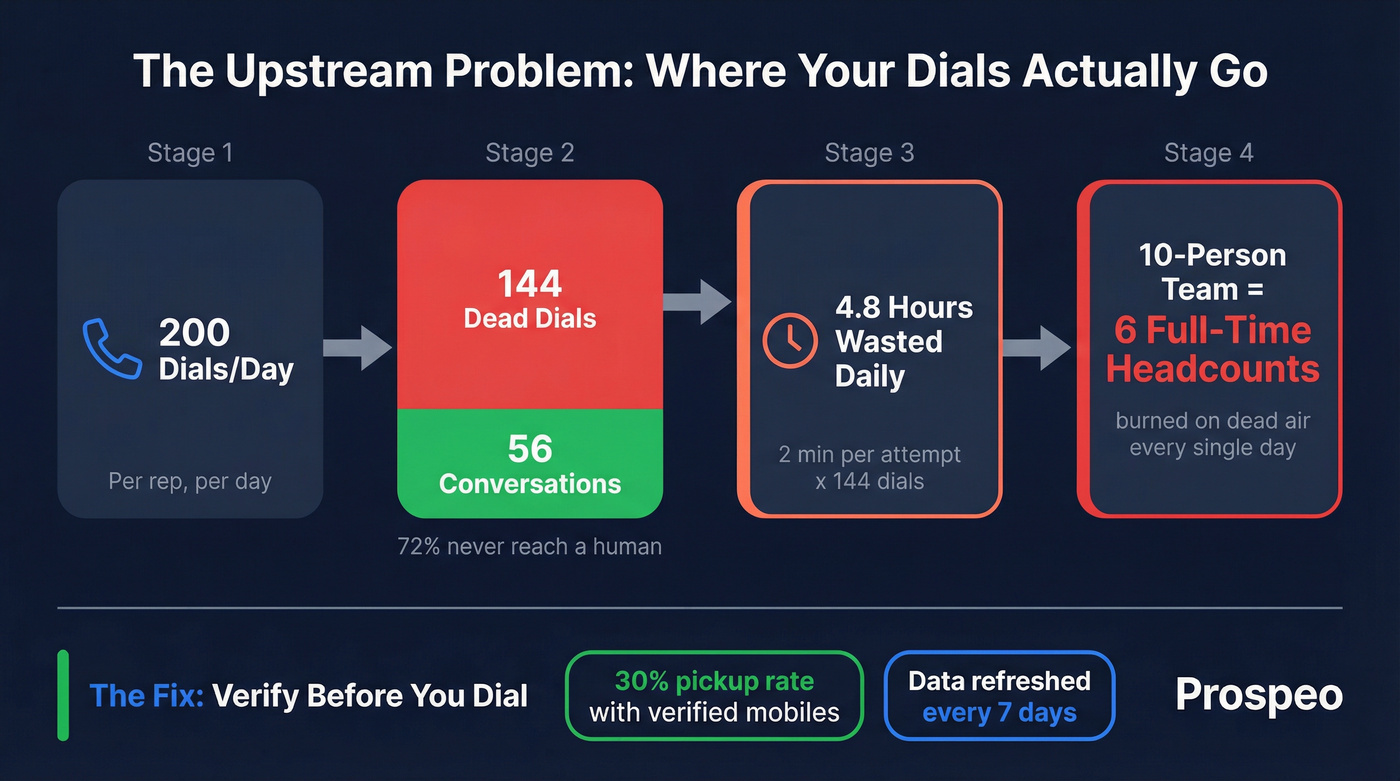
Let me put it concretely. If your team makes 200 dials per day and 72% never connect, that's 144 wasted dials. At two minutes per attempt, that's 4.8 hours of dead time daily - per rep. Multiply across a 10-person team and you're burning the equivalent of six full-time headcounts on dead air, time that should be generating pipeline.
Before you optimize talk ratios, make sure you're reaching the right person at a working number. Prospeo's Mobile Finder covers 125M+ verified mobile numbers with a 30% pickup rate, compared to the 5-15% connect rates most teams see dialing stale CRM exports. Emails verify at 98% accuracy, and the database refreshes every seven days versus the six-week industry average. When GreyScout switched, they cut rep ramp time from 8-10 weeks down to four. Meritt tripled their pipeline from $100K to $300K per week and pushed connect rates to 20-25%.
We've seen this pattern repeatedly: teams buy conversation intelligence, then a coaching platform, then realize their reps are practicing on voicemails. Start with the data (and run a proper CRM verify pass before you load lists into sequences).
Your team burns 4.8 hours per rep per day on calls that never connect. Prospeo refreshes 300M+ contacts every 7 days - not 6 weeks - so reps dial working numbers and verified emails at 98% accuracy. Meritt tripled pipeline to $300K/week. GreyScout cut ramp time in half.
Stop optimizing talk ratios on voicemails. Start with clean data.
Closing the Coaching Gap
43% of sales leaders don't know their reps want more coaching. 39% of sellers say the coaching they get is too generic. And 44% of managers say they simply don't have time.
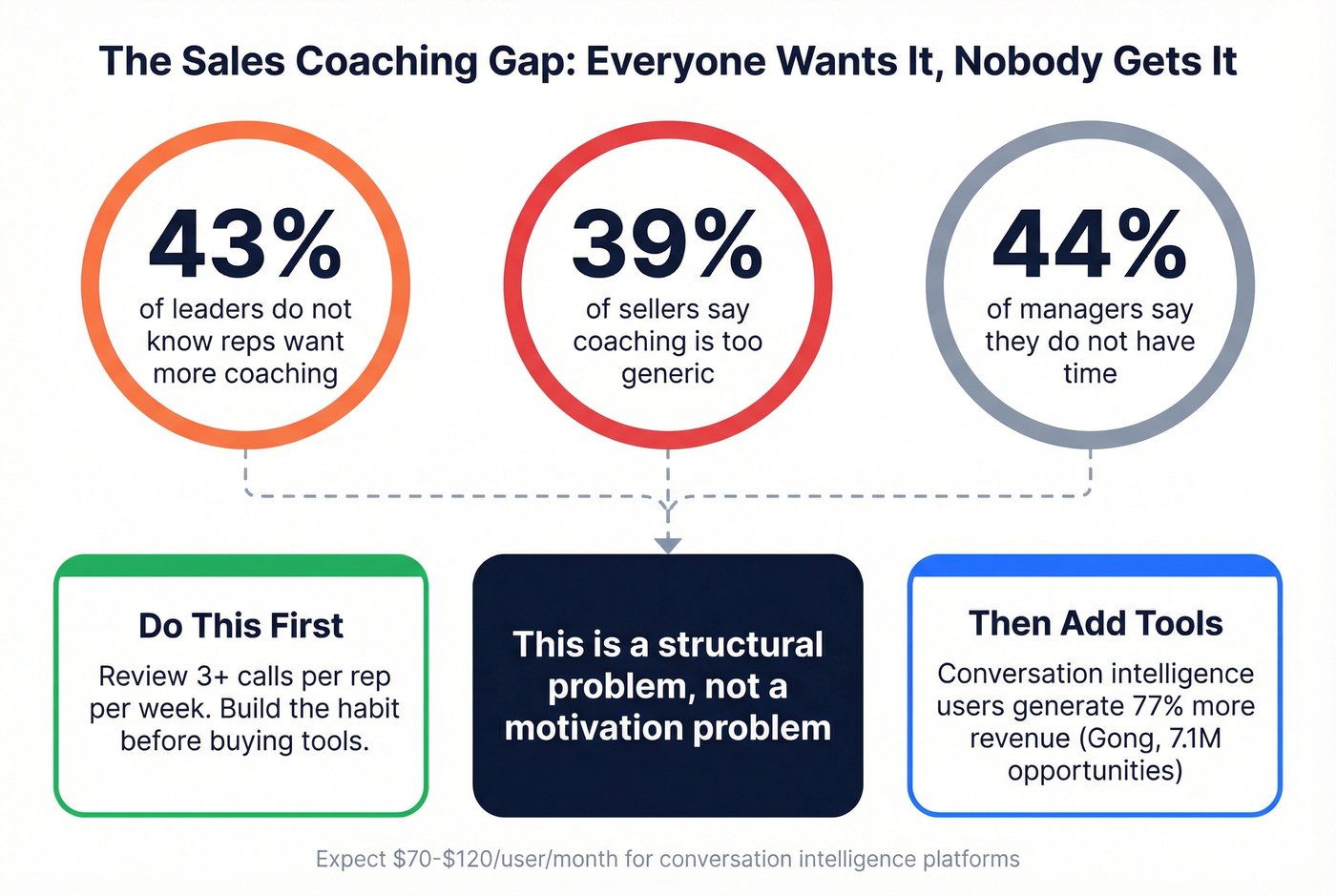
That's a structural problem, not a motivation problem.
Conversation intelligence tools help. Frequent AI users generate 77% more revenue based on Gong's analysis of 7.1M opportunities. Expect to pay $70-$100/user/month for starter tiers, $100-$120+ for growth plans with real-time call recording and CRM integration.
But tools don't fix culture. If managers aren't blocking time to review calls and deliver specific, framework-aligned feedback, the software is just an expensive archive. In our experience, the teams that get ROI from conversation intelligence are the ones that were already doing weekly call reviews on a whiteboard - the tool accelerated a habit that already existed. Skip the $100/seat platform if your managers aren't already reviewing at least three calls per rep per week. Buy the tool after you've committed to the habit, not before (use these sales coaching best practices to operationalize it).
FAQ
What's a good talk-to-listen ratio?
Gong's benchmark is 43% talk / 57% listen, but consistency matters more than the exact split. Top performers maintain similar ratios across won and lost deals. Low performers swing by 10%. Track the variance, not just the average.
How many dials does it take to book a meeting?
Bridge Group data shows roughly 209 dials per appointment. Baylor University research puts it at 59 answered calls per appointment. These numbers drop significantly with verified, fresh contact data - Meritt reports 20-25% connect rates after switching providers, cutting required dials by more than half.
Which qualification framework works best?
For enterprise deals above $100K ARR, MEDDIC - used by 73% of SaaS companies at that level, with 18% higher win rates. For mid-market or consultative sales, SPIN Selling drives 57% higher prospect talk time. BANT works for simpler cycles when modernized to ANUM or FAINT.
Sales call effectiveness isn't a skills problem. It's a system problem. Fix the inputs - data quality, pipeline velocity, coaching cadence - and the outputs follow.