Best Verified Email Checkers in 2026: Accuracy, Pricing & Real Benchmarks
You send 10,000 cold emails. Your verified email checker said the list was clean. Then your ESP flags an 8% bounce rate and throttles your domain. That's not a hypothetical - it's the most common story in outbound right now, and it happens because "verified" doesn't mean what most tools want you to think it means.
Across 5 billion+ emails processed by EmailListVerify alone, 23% turned out to be bad. When two independent benchmarks tested the same verification tools, accuracy ranged from 31% to 99% depending on the provider and email mix. Every tool's marketing page says "98%+ accuracy." The tests tell a very different story.
We analyzed and compared 10 email checkers on what actually matters: real-world accuracy, cost at scale, and how they handle the catch-all problem that quietly wrecks your deliverability (more on that in our guide to email verification for outreach).
Our Picks (TL;DR)
Best for finding AND verifying emails in one workflow: Prospeo. 98% email accuracy, 5-step verification with catch-all handling, and you don't need a separate finder tool. Starts free.
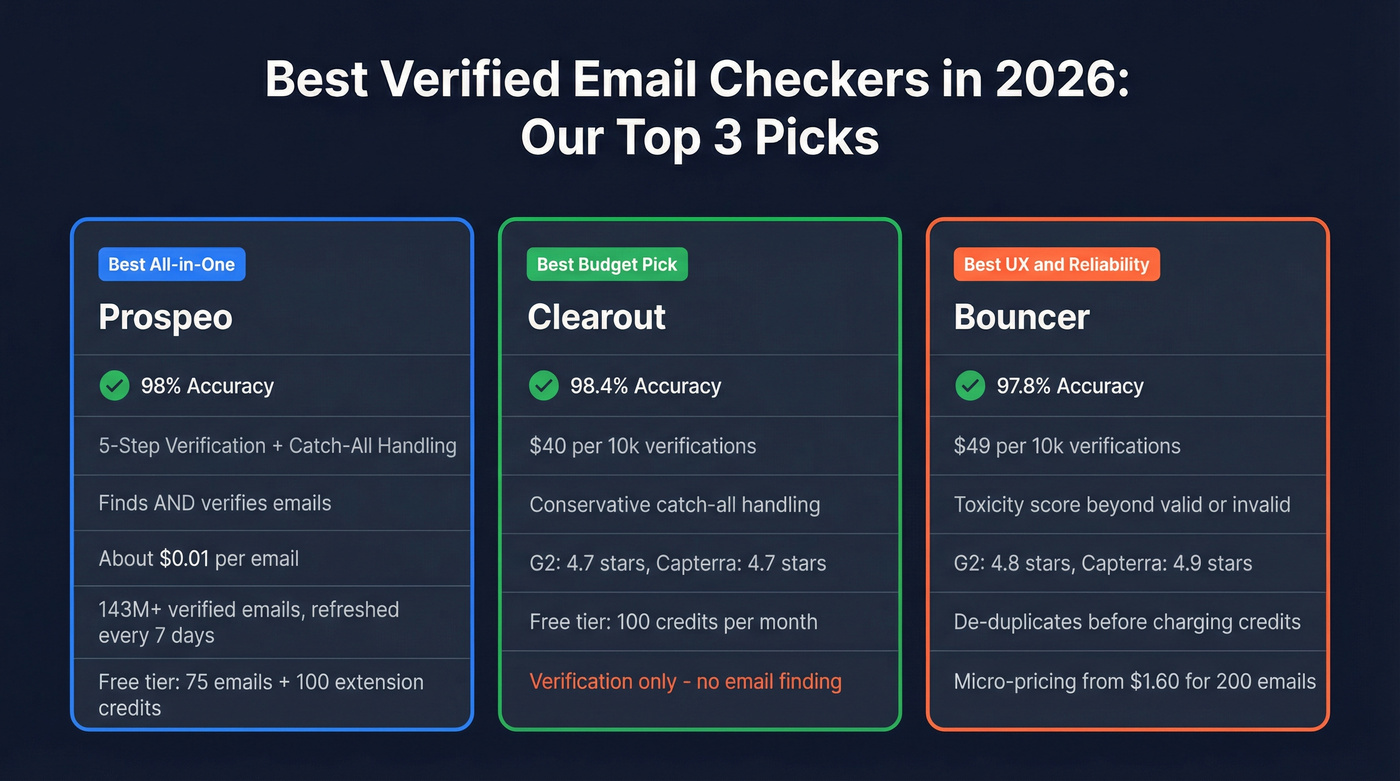
Best standalone verifier for budget-conscious teams: Clearout. 98.4% accuracy in independent testing, $40 per 10k verifications, and a free tier of 100 credits/month.
Best for reliability and user experience: Bouncer. G2 4.8, Capterra 4.9 - one of the highest-rated standalone verifiers on the market. 97.8% accuracy with a toxicity score feature that goes beyond simple valid/invalid.
How Email Verification Works
Every legitimate verifier runs some version of the same five-step pipeline. Understanding it helps you spot which tools are cutting corners (and how it impacts email deliverability).
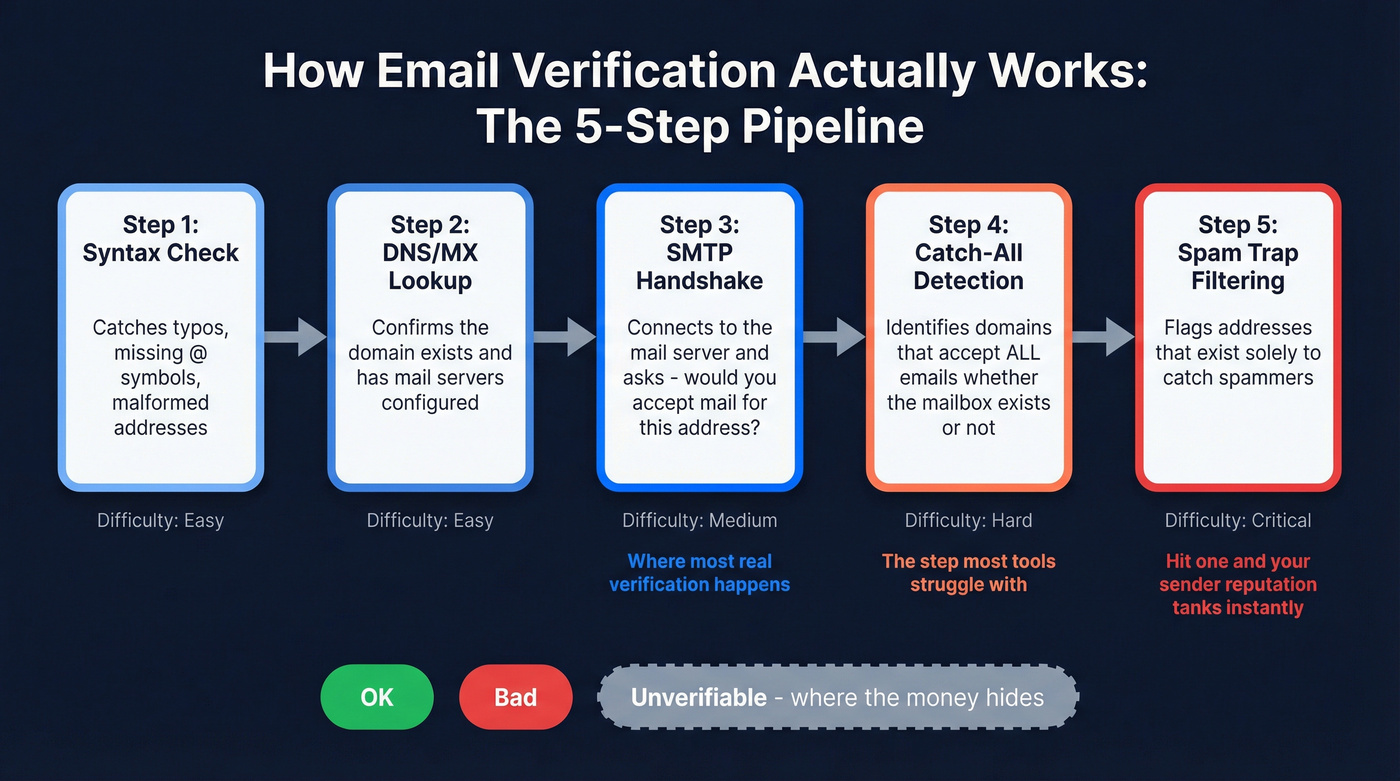
- Syntax check - catches typos, missing @ symbols, and malformed addresses. The easy stuff.
- DNS/MX lookup - confirms the domain exists and has mail servers configured to receive email.
- SMTP handshake - connects to the mail server and asks "would you accept mail for this address?" without actually sending anything. This is where most of the real verification happens.
- Catch-all detection - identifies domains that accept all emails regardless of whether the specific mailbox exists. The step most tools struggle with.
- Spam-trap and honeypot filtering - flags addresses that exist solely to catch spammers. Hit one of these and your sender reputation tanks instantly.
Some tools group results into three buckets: OK, Bad, and Unverifiable. That "unverifiable" category is where the money hides - tools charge you a credit for it and shrug.

Accuracy Benchmarks
Every tool claims 98%+ accuracy. Two independent tests tell very different stories.
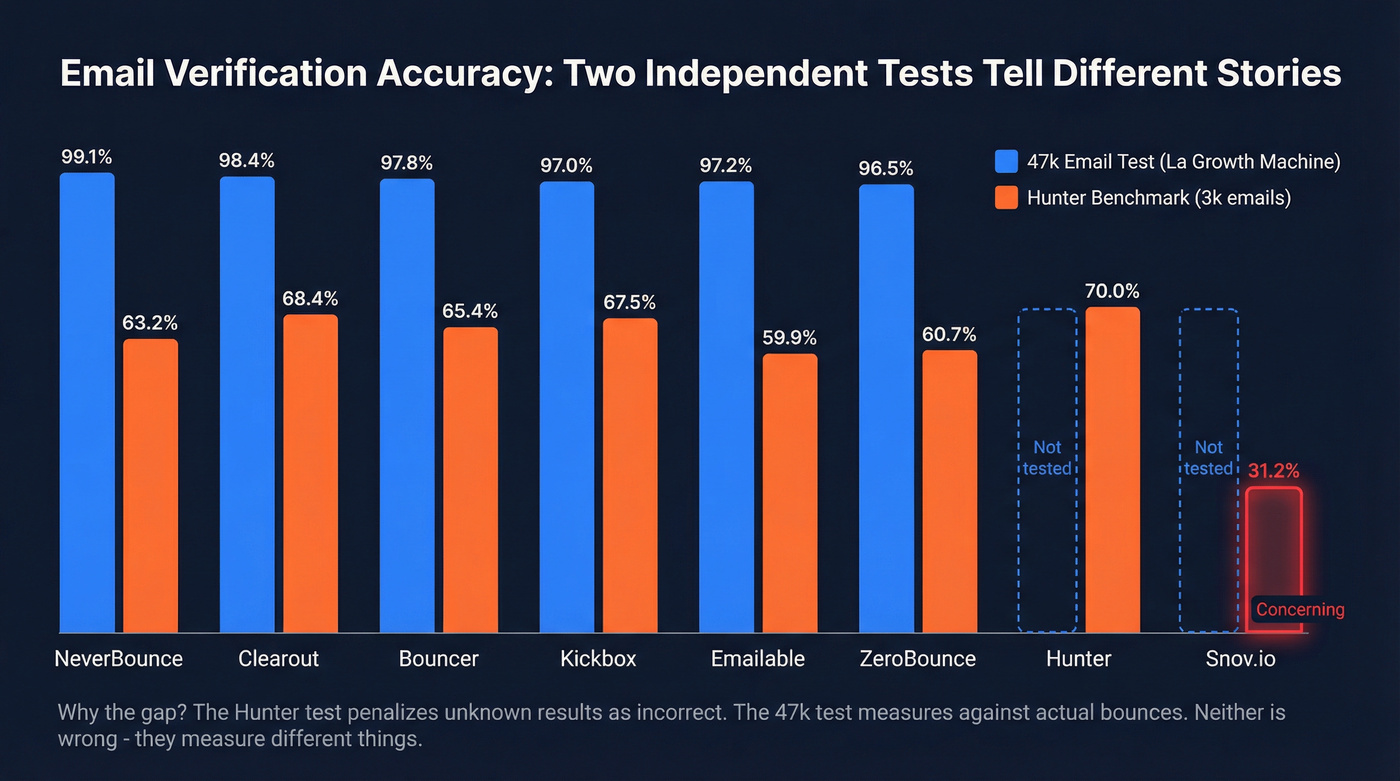
A La Growth Machine test processed 47,000 emails over 90 days - purchased lists, scraped data, aged CRM records - and measured accuracy against actual bounce data. A Hunter benchmark tested 15 verifiers against 3,000 real business emails segmented by company size.
| Tool | 47k-Email Test | Hunter Benchmark (3k) | Notes |
|---|---|---|---|
| NeverBounce | 99.1% | 63.2% | Top large-scale; drops on unknowns |
| Clearout | 98.4% | 68.4% | Consistent across both |
| Bouncer | 97.8% | 65.4% | Strong large-scale showing |
| Kickbox | 97.0% | 67.5% | Compliance-first positioning |
| Emailable | 97.2% | 59.9% | Mid-pack in both |
| ZeroBounce | 96.5% | 60.7% | 49 integrations, average accuracy |
| Hunter | - | 70.0% | Only in their own test |
| Snov.io | - | 31.2% | Concerning |
Why the massive gap? The Hunter benchmark penalizes "unknown" results as incorrect, which tanks scores for tools that conservatively flag catch-all domains. The 47k-email test measures against actual bounces, rewarding tools that let borderline emails through if they don't bounce. Neither is wrong - they're measuring different things.
The takeaway: don't trust any single accuracy number. Look at how a tool handles the gray area between "valid" and "invalid." (If you want a deeper breakdown, see our guide to AI email verification.)

Most verified email checkers only verify - you still need a separate finder, enrichment tool, and sequencer integration. Prospeo runs all five verification steps (syntax, DNS, SMTP, catch-all, spam-trap) on 143M+ emails refreshed every 7 days, not every 6 weeks. At ~$0.01/email, that's 90% cheaper than stacking standalone tools.
Find, verify, and enrich in one workflow - starting with 75 free emails.
What Verification Costs at Scale
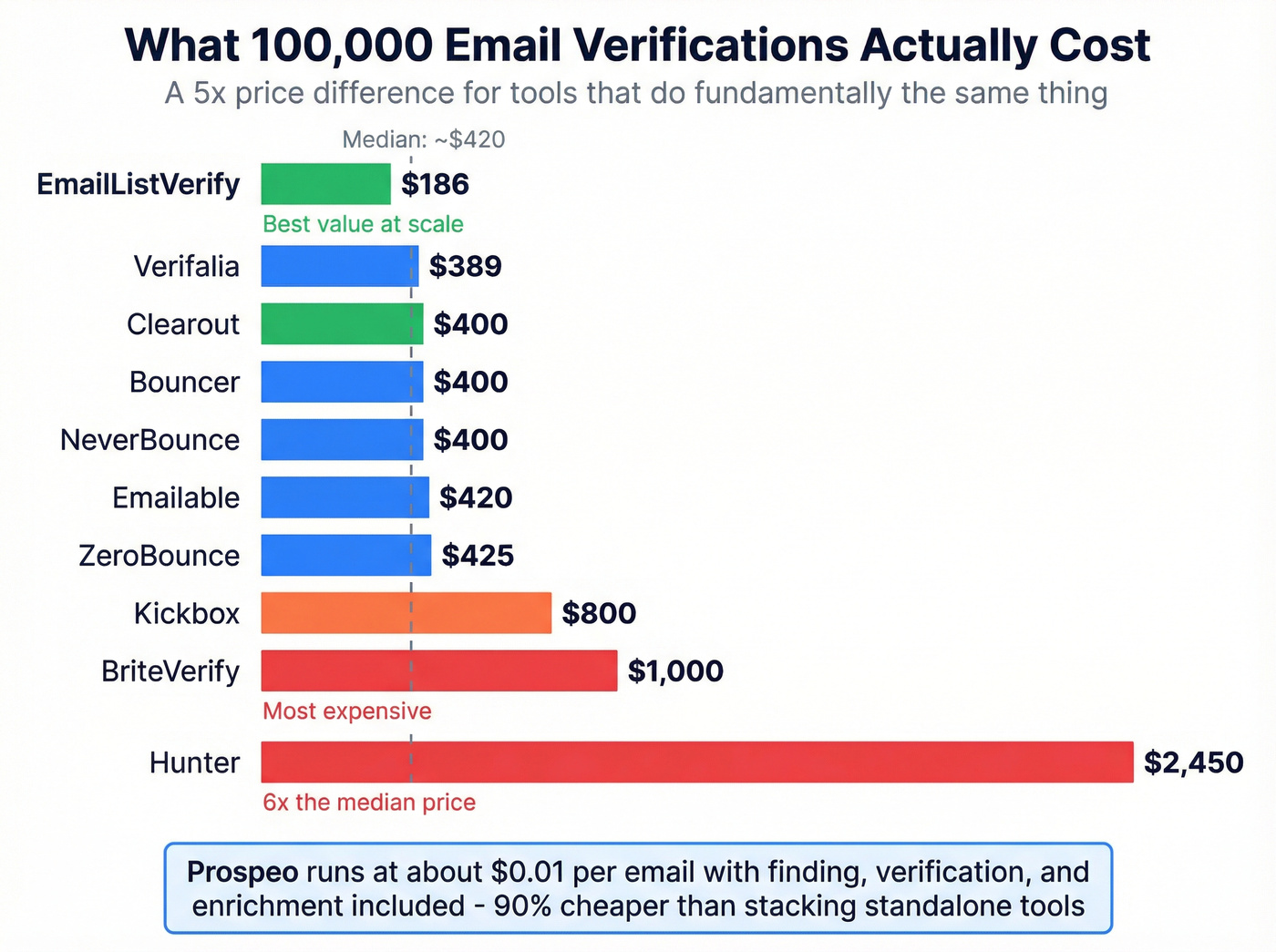
Pricing follows a predictable pattern: cheap per email at low volume, cheaper per email at high volume, but the total bill scales linearly while the value doesn't. In cold email communities on Reddit, people call this the "growth tax" of per-verification pricing - and it's the reason teams with 100k+ lists obsess over cost-per-check (and why cost of sales tech stack discussions get heated).
| Tool | Cost / 10k | Cost / 100k | Free Tier |
|---|---|---|---|
| EmailListVerify | ~$19 | $186 | 100 emails |
| Clearout | $40 | ~$400 | 100/mo |
| Bouncer | $49 | $400 | 100 credits |
| Emailable | $69 | $420 | 250 emails |
| Kickbox | $70 | $800 | - |
| NeverBounce | $80 | $400 | 10 credits |
| ZeroBounce | $80 | $425 | 100/mo |
| Verifalia | ~$80 | $389 | - |
| BriteVerify | ~$100 | $1,000 | - |
| Hunter | ~$245 | ~$2,450 | 50/mo |
The spread is enormous. EmailListVerify at $186 for 100k emails versus BriteVerify at $1,000 for the same volume - a 5x difference for tools that do fundamentally the same thing. But cheapest doesn't always mean best. Accuracy matters more than saving $0.002 per email if bad data torches your domain.
Here's the thing: if your average deal size is under $5k, you probably don't need a premium verifier. Clearout or EmailListVerify will get you 95%+ of the way there. Save the NeverBounce budget for teams selling six-figure deals where a single bounced email to a VP costs real pipeline.
The 10 Best Email Verification Tools
Prospeo
Most verification tools only verify. You still need a separate tool to find the email, another to enrich the contact, and a third to push it into your sequencer. Prospeo collapses that entire workflow into one platform - and in our experience, that consolidation is where the real time savings live (especially if you're building a modern B2B sales stack).
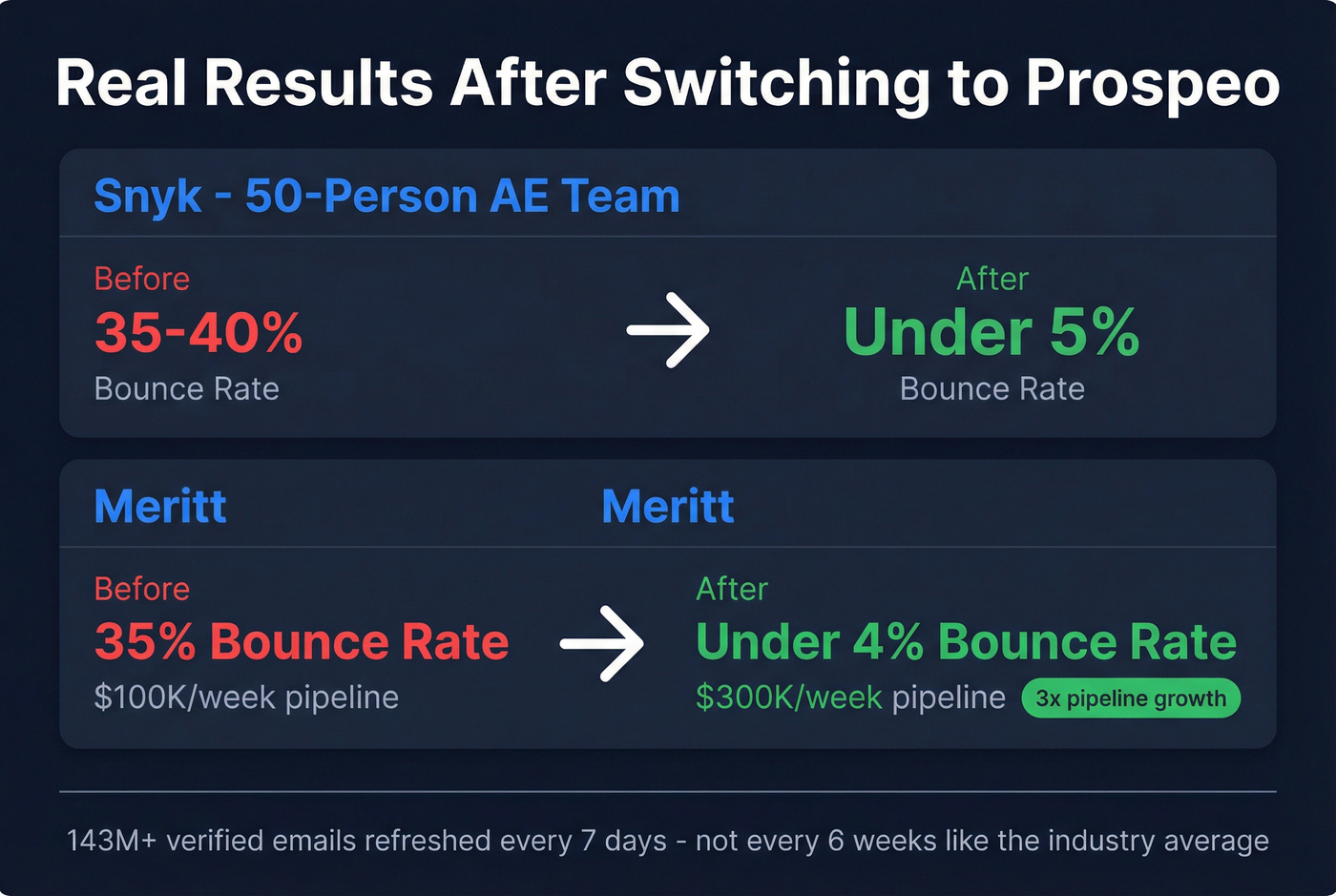
The database covers 143M+ verified emails across 300M+ professional profiles, with 98% email accuracy powered by a proprietary 5-step verification process that includes catch-all handling, spam-trap removal, and honeypot filtering. Every record refreshes on a 7-day cycle, while the industry average sits at six weeks. That freshness gap matters more than most teams realize, because an email that was valid last month can bounce today after a job change or domain migration (see: B2B contact data decay).
Real results back this up. Snyk's 50-person AE team went from a 35-40% bounce rate to under 5% after switching. Meritt saw bounces drop from 35% to under 4%, with pipeline tripling from $100K to $300K per week.
Use this if you want prospecting, verification, and enrichment in one platform without stitching together three tools. Pricing runs ~$0.01/email with a free tier of 75 emails and 100 Chrome extension credits per month.
Clearout
At $40 per 10k verifications, Clearout delivered 98.4% accuracy in independent testing - second only to NeverBounce. G2 rating sits at 4.7 across 211 reviews, and Capterra matches at 4.7 with 82 reviews.
The free tier gives you 100 credits per month, enough to test the tool on a real list before committing. Reviews flag a higher "unknown" share compared to competitors, meaning Clearout is conservative with catch-all domains. That's a feature, not a bug - it protects your sender reputation - but your "verified" list will be smaller than what some competitors return.
Use this if you need a standalone verifier that punches above its price point. Skip this if you need email finding bundled with verification - Clearout is verification-only.
Bouncer
We watched a RevOps team evaluate six verifiers last year. They picked Bouncer - not because it was cheapest or most accurate, but because the UX made it the only tool their marketing ops person could run without hand-holding.
G2 4.8 with 228 reviews. Capterra 4.9 with 230 reviews. Independent testing clocked it at 97.8% accuracy, and it includes a toxicity score that flags risky addresses beyond simple valid/invalid. Bouncer also de-duplicates your list before charging credits - a small thing that saves real money on messy CRM exports (and ties directly into CRM hygiene).
At $49/10k, it's not the cheapest, but micro-pricing (200 emails for $1.60) makes it accessible for small tests. Skip it if you're processing 100k+ emails monthly and need the absolute lowest cost per verification.
NeverBounce
The accuracy king. NeverBounce topped the 47k-email benchmark at 99.1% and delivers 94% catch-all detection accuracy - one of the only widely cited published numbers on that metric. At $80/10k and $400/100k, it's pricier than Clearout or Bouncer for comparable results, but the accuracy premium is real.
The tradeoff is straightforward: Clearout gets you to 98.4% for half the price. NeverBounce gets you that extra 0.7%, which matters when you're sending 500k emails a month and every tenth of a percent translates to hundreds of bounces.
ZeroBounce
Forty-nine native integrations. That's ZeroBounce's pitch, and it's a legitimate one if your stack is complex. G2 4.6 with 449 reviews shows broad adoption. Accuracy landed at 96.5% in independent testing - solid but not exceptional.
The problem: $80/10k when Clearout delivers comparable accuracy for $40 is a tough sell. The 2,000-credit minimum purchase also means you can't dip a toe in cheaply. ZeroBounce is a fine tool, but it's overpriced for what it delivers on pure verification. The integration library is the only reason to pay the premium.
EmailListVerify
$186 for 100k emails. Read that again.
EmailListVerify is the cheapest option at scale by a margin so wide it's almost suspicious. The feature set covers everything you'd expect: spam trap detection, disposable email filtering, catch-all checking, syntax validation, and MX verification. Five billion emails processed gives them serious pattern-matching data on common bad addresses.
Skip this if you need high-touch support or polished UX. This is a volume play, not a premium experience.
Kickbox
Compliance teams will recognize the stack: SOC 2 Type II certification plus GDPR, CCPA, and HIPAA compliance, with a zero data retention policy. That combination matters in healthcare, finance, and government contracting where verification tools touching PII creates audit risk.
Accuracy hit 97.0% in independent testing. At $70/10k and $800/100k, you're paying a compliance premium - but if you need those certifications, cheaper alternatives won't pass your security review.
Hunter
Hunter's email finder is excellent. Its verification is a costly add-on. At ~$24.50 per 1k verifications, you're paying 3-6x what standalone verifiers charge. G2 4.4 with 545 reviews reflects the finder, not the verifier. Free tier includes 50 verifications/month. If you're already paying for Hunter's finder, the built-in verification is convenient. If you're not, there's no reason to start here.
Emailable
Emailable landed at 97.2% accuracy in independent testing and charges $69/10k - squarely mid-range on both metrics. The speed claim of 0.012 seconds per email makes it one of the fastest options for bulk processing. A solid pick if your primary verifier is down and you need a reliable backup, but nothing about it stands out enough to make it your first choice.
Email Hippo
Email Hippo offers a free verification tool capped at 100 checks per day - genuinely useful for quick one-off lookups when you don't want to log into anything. Their paid tiers scale from bulk verification to fraud-prevention-grade email risk assessment. Best for occasional free checks or teams that need email intelligence beyond simple valid/invalid.
The Catch-All Problem
Here's the scenario that burns SDR teams: you verify a list of 5,000 emails, 800 come back as "unknown," and you send to them anyway because you already paid for the credits. Half bounce. Your domain reputation drops. Your next three campaigns land in spam.
Catch-all domains are the culprit. These mail servers accept every email sent to any address at their domain, whether the specific mailbox exists or not. Most verification tools can't distinguish a real inbox from a black hole on these domains, so they return "unknown" and charge you a credit anyway.
The consensus on r/coldemail is that the most common complaint isn't accuracy on standard domains - it's this "unknown" bucket that eats credits without giving answers. NeverBounce's 94% catch-all detection accuracy is the best published number in the space. Prospeo's 5-step verification process also includes catch-all handling, which is why teams like Snyk saw bounce rates drop from 35-40% to under 5%. The fact that most tools still punt on this problem is genuinely frustrating, because catch-all domains represent a significant chunk of B2B email addresses - especially at enterprise companies running Exchange or Google Workspace with catch-all rules enabled.
When to Verify Your List
Use these bounce-rate thresholds as your guide:
- Excellent: under 1% total bounce rate
- Good: 1-2%
- Acceptable: 2-3%
- Concerning: 3-5%
- Critical: above 5% - stop sending and clean your list immediately (and follow an email deliverability checklist)
Industry baselines vary. B2B and SaaS teams typically run 0.5-1.5% bounce rates. E-commerce sits higher at 1.5-3%. If you're above your industry norm, verification isn't optional - it's urgent.
Let's break down the cadence: run verification before every outbound campaign, every two weeks for lists over 10k contacts, and monthly for smaller lists. For teams with real-time API access, verify at the point of capture - it's cheaper to reject a bad email on intake than to clean it later (and it helps prevent hard bounce issues).
Snyk's 50 AEs went from 35-40% bounce rates to under 5%. Meritt cut bounces from 35% to under 4% and tripled pipeline. The difference wasn't a better standalone verifier - it was Prospeo's proprietary 5-step verification with catch-all handling and spam-trap removal baked into every email found.
Stop paying twice to find and then verify - get 98% accuracy in a single platform.
FAQ
What does a verified email checker do?
It runs syntax, DNS/MX, SMTP, catch-all, and spam-trap checks to confirm whether an email address can receive mail. Results return as valid, invalid, or unknown. The goal is removing bad addresses before they bounce and damage your sender reputation.
How accurate are email verification tools?
Independent tests show real-world accuracy ranges from 31% to 99% depending on the tool, email mix, and how "unknown" results are counted. Marketing pages claim 97-99%, but always check third-party benchmarks - the La Growth Machine 47k-email test and Hunter's 3k-email benchmark are the most cited.
What's a catch-all email and why does it matter?
A catch-all domain accepts all emails regardless of whether the specific mailbox exists, so verification tools return "unknown" and still charge you a credit. Sending to unverified catch-all addresses is the fastest way to spike your bounce rate. NeverBounce (94% catch-all detection) and Prospeo (5-step verification with catch-all handling) are among the few tools that address this directly.
How much does bulk email verification cost?
Expect $0.002-$0.025 per email depending on the provider and volume. EmailListVerify is cheapest at ~$0.0019/email at scale; Hunter is most expensive at ~$0.0245/email. Most mid-tier tools fall in the $0.004-$0.008 range for 10k-100k lists. Free tiers typically offer 50-100 monthly verifications.
Can I find and verify emails in one step?
Yes. Platforms like Prospeo combine email finding, verification, and enrichment in a single workflow - you upload a list or search by criteria and get back only deliverable addresses. This eliminates the need for separate finder and verifier subscriptions and usually costs less than running two tools.