

How to Leave a Sales Voicemail That Gets Your Email Opened
It's 2pm on a Tuesday. You've made 60 dials, connected with four people, and left 30 voicemails that'll never get returned. That's not a bad day - that's a normal day. But here's what Gong's analysis of 300M+ cold calls found: those voicemails aren't supposed to generate callbacks. Learning how to leave a sales voicemail means optimizing for the inbox, not the phone.
The Quick Version
- Voicemails more than double email reply rates but actually reduce callback and connect rates. Optimize for the inbox.
- Leave a maximum of 1-2 voicemails per prospect. Keep each under 30 seconds.
- With iOS 26 Live Voicemail transcription on iOS 26, prospects read your message in real time. Lead with relevance, not your name.
Do Voicemails Actually Work?
Yes - but not how most reps think.
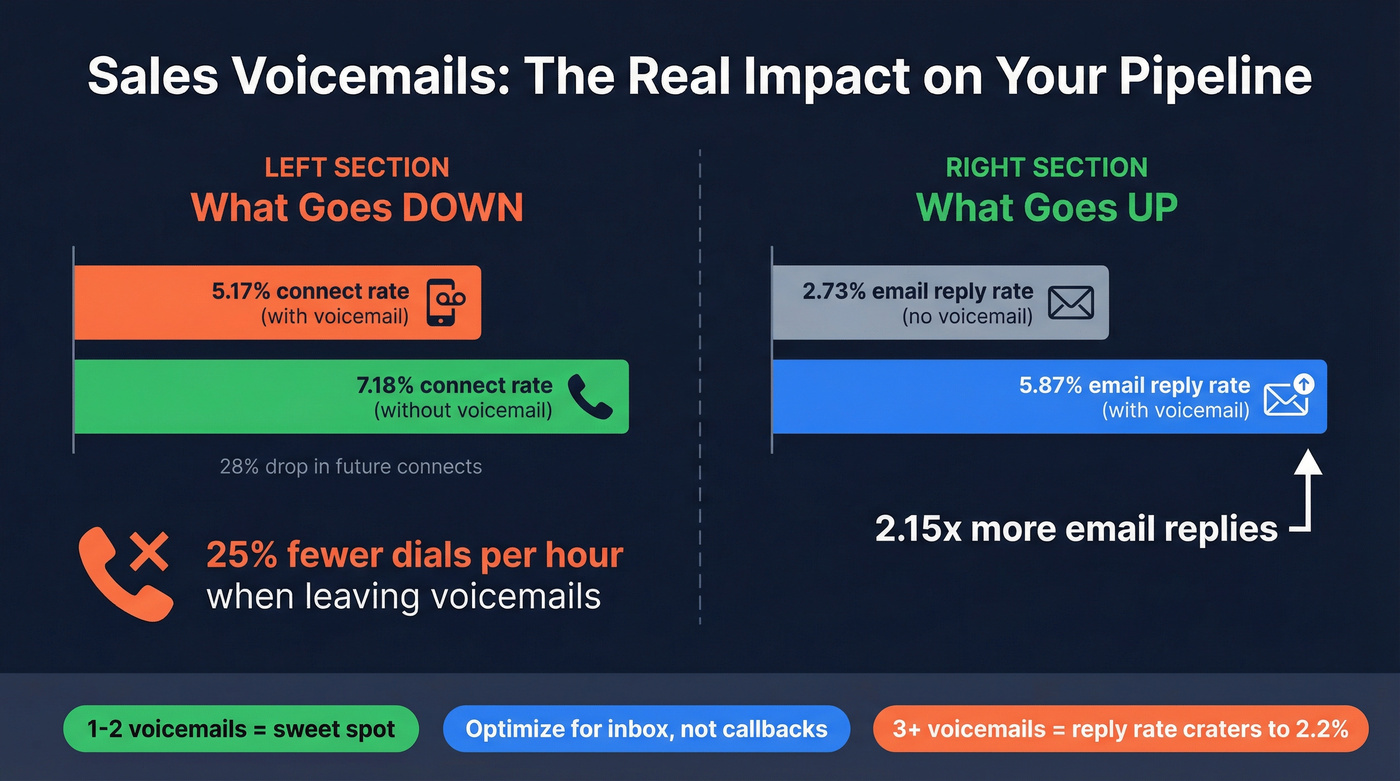
Leaving a voicemail drops your future connect rate by 28% (5.17% vs. 7.18% without voicemails). And in the time it takes to leave one, you could make 25% more dials. On the surface, voicemails look like a net negative.
The flip side is what happens in the inbox. Prospects who received a voicemail replied to follow-up emails at 5.87% vs. 2.73% - more than double the reply rate. That's the real function of a well-placed message: it primes the prospect to engage with your email, not to call you back. Think of the voicemail as a subject line that arrives through a different channel, one that creates just enough familiarity to make your email feel expected rather than cold.
The sweet spot is 1-2 voicemails per prospect. After three or more, email reply rates crater to 2.2% - worse than leaving none at all. The cliff comes fast.
How to Structure a Message That Lands
Stay in the 20-30 second window. Past 30 seconds, your message gets deleted. Aim for 20-25 seconds. If you can't say it that fast, you're saying too much.
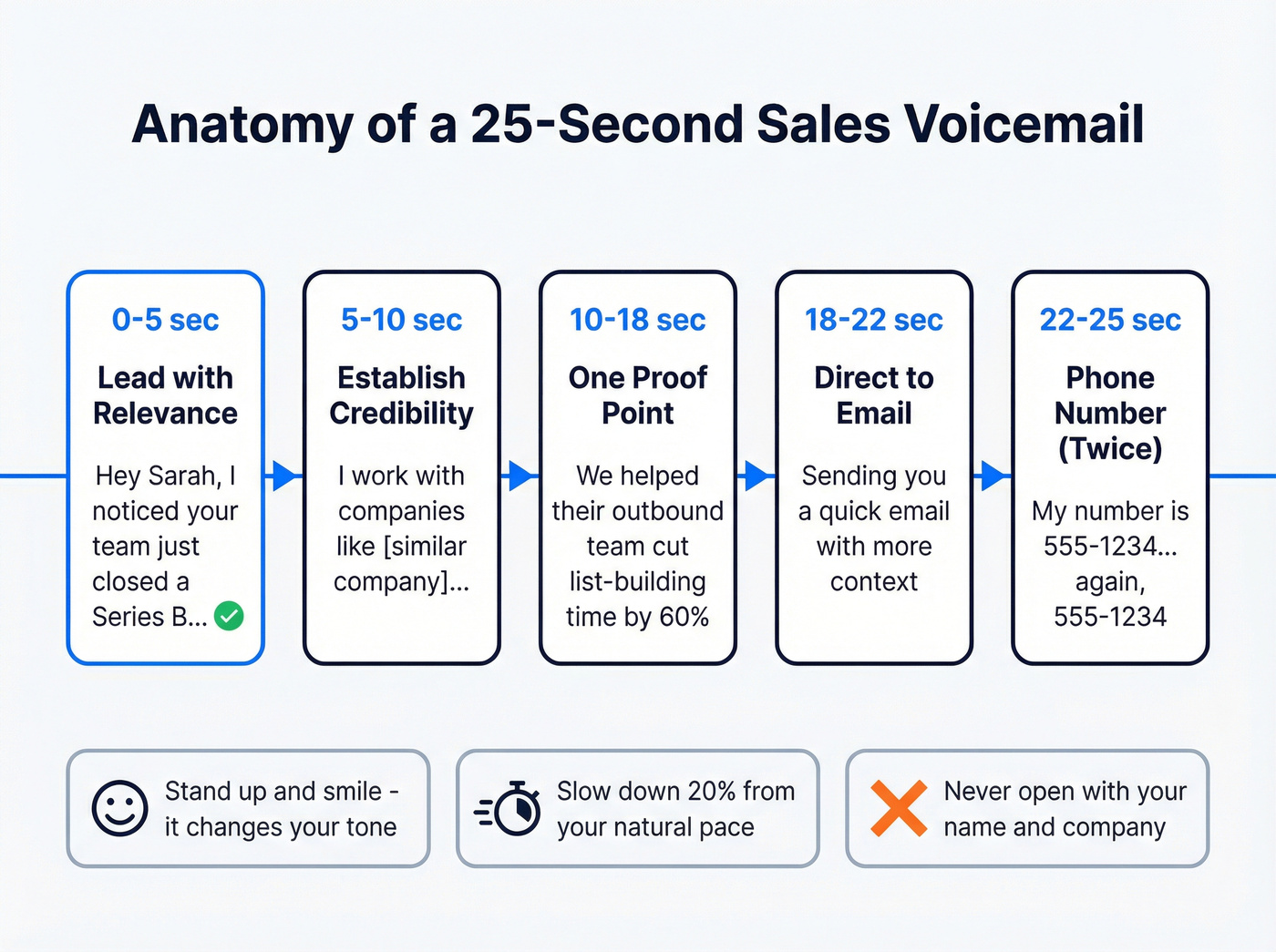
Lead with relevance, not your name. "Hey, I noticed your team just closed a Series B" beats "Hi, this is Jake from Acme Software." Your name goes at the end - that's what keeps them listening (or reading) through the whole message.
Talk like a human. I've listened to hundreds of sales voicemails, and the ones that work sound like they weren't scripted. Stand up when you record. Smile - it changes your vocal tone. Slow down about 20% from your natural pace, and drop the "sales voice." A slightly informal tone signals you're a peer, not a vendor trying to hit quota.
End with your phone number - slowly. Say it once at normal speed, pause, then repeat it slower. This is the one part of your message that needs to survive a quick scan of the transcript.
Direct them to your email. "I'm sending you a quick email with more context" gives them a low-friction next step. The voicemail's job is to make that email feel expected, not cold.
Three Scripts You Can Steal
Cold Outreach
"Hey [First Name], quick message - I work with [similar company] and helped their outbound team cut list-building time by 60%. Sending you a short email with the details. My number's [number]... again, [number slower]."
No pitch, no feature dump. One relevant proof point and a redirect to email. If you want more options, pull from these cold call voicemail scripts and adapt the proof point to your ICP.
Trigger-Based (Job Change or Funding)
"Hey [First Name], congrats on the new role at [Company]. When people move into [title], they usually inherit a pipeline problem in the first 90 days. I've got a quick idea - check the email I'm sending over. [Number]... [number slower]."
Trigger-based voicemails work because the relevance is obvious in the first five seconds. A clever, well-timed message tied to a real event can lift callbacks by roughly 22%. (If you're building this into a system, use a job change outreach angle in the email you reference.)
The Split Voicemail (Jeff Hoffman Technique)
This one's clever. Leave a 20-second voicemail with context and a question - but don't say your name or number. Then immediately call back and leave a 10-second follow-up:
VM 1: "Hey [First Name], quick question - your team's hiring three SDRs right now, and I'm curious whether you've solved the data problem that usually comes with scaling outbound. I'll explain what I mean..."
VM 2: "Hey, sorry - got cut off. This is [Your Name] at [Company]. My number is [number]... again, [number]. Looking forward to connecting."
The curiosity gap between the two messages drives callbacks because the first voicemail feels unresolved. Credit to Jeff Hoffman for this technique, which we've seen discussed extensively on r/sales as one of the few voicemail tactics reps actually swear by.

Trigger-based voicemails only work when you know who just changed jobs, raised funding, or started hiring. Prospeo tracks all three - plus 30+ filters including buyer intent and headcount growth - across 300M+ profiles refreshed every 7 days.
Find the trigger. Nail the timing. Leave a voicemail they actually read.
Your Voicemail Is Now a Subject Line
Apple's call screening and Live Voicemail transcription on iOS 26 mean prospects can read your message in real time rather than listening. They can even pick up mid-message if something catches their eye.
If you're leaning into this, treat the first line like a sales pitch opening and the follow-up like a tight sales email structure.
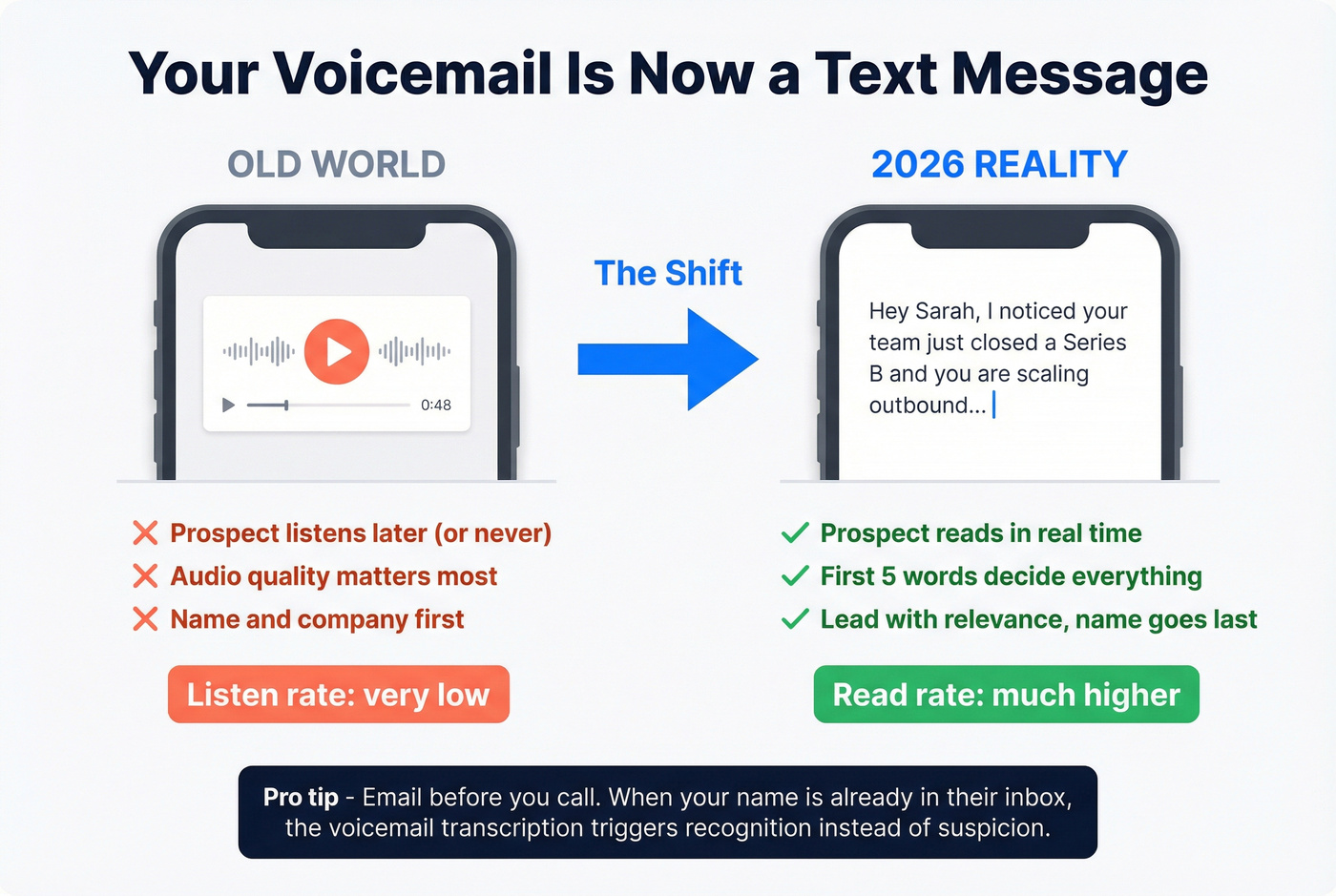
That changes everything about your first five seconds. If your opener is "Hi, this is Jake from Acme Software, I'm calling because..." - they've already swiped away. Lead with the reason they should care, not who you are.
Here's the thing: this is also why emailing before you call matters so much now. When your name already appears in their inbox, the voicemail transcription triggers recognition instead of suspicion. The two channels reinforce each other in a way that neither does alone.
Where Voicemails Fit in Your Cadence
Most high-performing B2B outbound teams run 8-12 touchpoints per prospect. A voicemail doesn't belong on every call attempt. Here's a practical cadence (and if you want more templates, start with a sales cadence example):
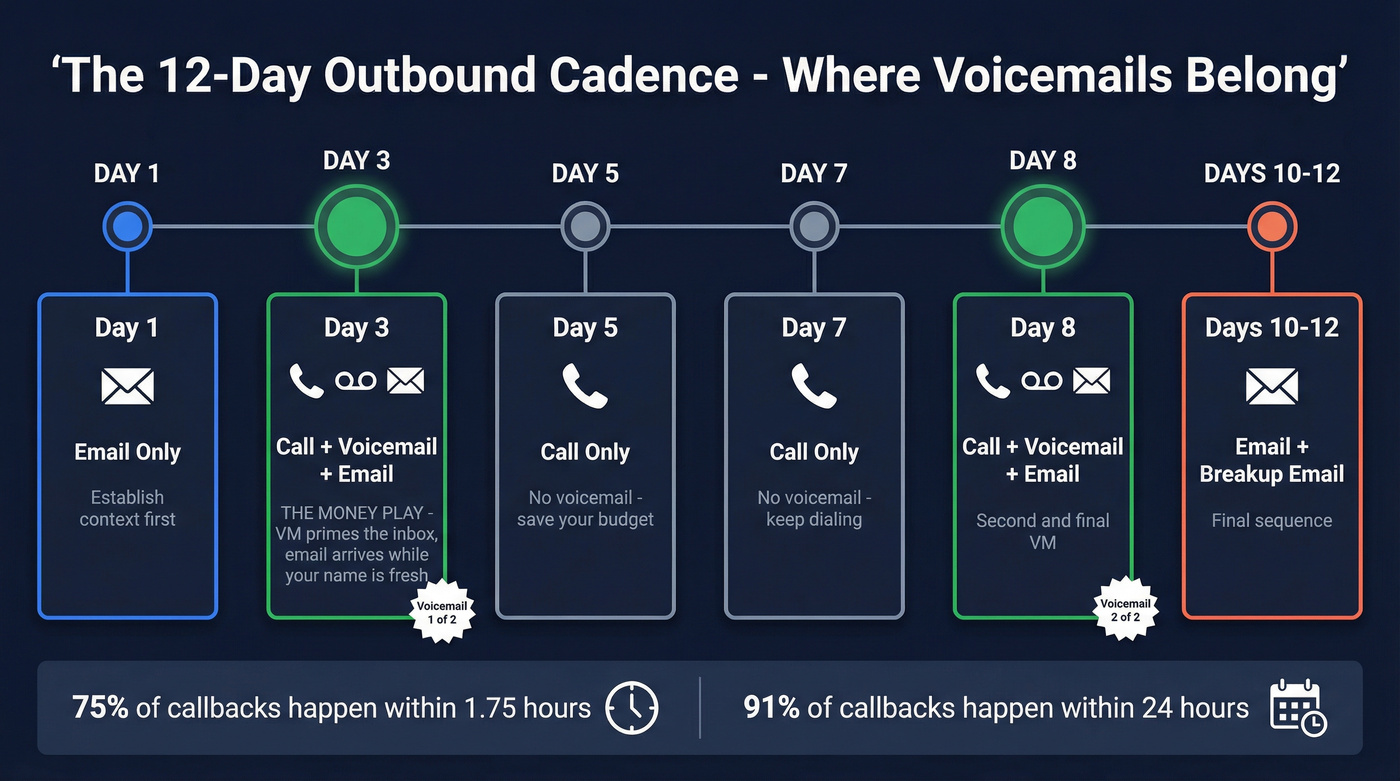
- Day 1 - Email only (establish context)
- Day 3 - Call + voicemail + follow-up email within minutes
- Day 5 - Call only, no voicemail
- Day 7 - Call only, no voicemail
- Day 8 - Call + voicemail + email (second and final VM)
- Days 10-12 - Email, breakup email
The Day 3 combo is the money play. The voicemail primes the inbox, and the email arrives while your name is still fresh. On Days 5 and 7, just call and move on - no voicemail keeps you from burning through your 1-2 message budget.
75% of callbacks happen within 1.75 hours, and 91% within 24 hours. If a prospect's going to call back, it'll be fast. Don't wait around - move to the next dial.
Before You Dial - Fix Your Data
None of this matters if you're leaving voicemails for someone who left the company six months ago.
We've watched SDR teams burn entire two-hour call blocks dialing dead numbers - not because the scripts were bad, but because the data was stale. One team we spoke with estimated they were wasting 40% of their dials on disconnected lines or wrong contacts before they switched to a verified mobile database. That's not a script problem. That's a data problem (and it's exactly what B2B contact data decay looks like in the wild).
Let's be honest: the single highest-leverage fix for cold calling isn't a better voicemail. It's better numbers. Prospeo's mobile database covers 125M+ verified numbers with a 30% pickup rate, refreshed every seven days. When you sit down for a call block, you're actually reaching humans instead of shouting into the void. If you're rebuilding your motion end-to-end, use a B2B cold calling guide to benchmark the rest of your workflow.
Compliance and Caller Reputation
TCPA litigation surged roughly 95% in recent years, and the FCC classified AI-generated voices as "artificial or prerecorded" - requiring prior express written consent. If you're using voicemail drop software (typically $50-$200/seat/month on top of your dialer), get a legal review. Live, human voicemails are the safest path. (If you're evaluating tooling, this AI cold calling guide breaks down costs and legal risk.)
Most reps obsess over scripts while ignoring caller ID reputation. Check your number's spam score regularly and use a STIR/SHAKEN-compliant dialer. A perfect voicemail means nothing if it's flagged as "Spam Likely" before the prospect ever sees the transcription. Skip voicemail drop tools entirely if you don't have explicit legal sign-off - the risk-reward ratio just isn't there in the current regulatory climate.
You just read that 40% of dials hit disconnected lines or wrong contacts. Prospeo's 125M+ verified mobile numbers deliver a 30% pickup rate - nearly 3x the industry average. At $0.10 per mobile, one good conversation pays for a thousand credits.
Stop burning call blocks on dead numbers.
FAQ
How long should a sales voicemail be?
Keep it between 20 and 30 seconds. Past 30 seconds, most prospects delete - and with live transcription on iOS 26, they've decided in the first five seconds whether to keep reading. Shorter messages force you to cut filler and lead with value.
Should I leave a voicemail on every unanswered call?
No. Limit voicemails to one or two strategic touchpoints per prospect, typically Day 3 and Day 8 in your cadence. On other attempts, just call and move on. This prevents you from burning through your message budget and tanking email reply rates.
How many voicemails should I leave one prospect?
Two maximum. After three or more voicemails, email reply rates drop to 2.2% - below the 2.73% baseline of leaving none at all. Two well-timed messages inside a structured cadence is the ceiling.
What's the best way to get accurate phone numbers for cold calling?
Use a verified mobile database with frequent refresh cycles. Stale data is the silent killer of cold calling productivity - you can have the best script in the world and it won't matter if the number's disconnected. Look for providers that refresh weekly rather than monthly, and that verify numbers before you pay for them.