

Sales Call Keyword Tracking: What It Actually Means and How to Set It Up
"Sales call keyword tracking" means two completely different things depending on who you ask. A marketer hears it and thinks dynamic number insertion - which Google Ads keyword drove this inbound call. A sales leader hears it and thinks conversation intelligence - which words did the prospect actually say on the call. The two get conflated constantly, which makes finding the right tool unnecessarily confusing.
Here's the split, then how to set up both.
What You Need (Quick Version)
- Marketing attribution tracking (which ad keyword drove the call): CallRail
- Conversation intelligence tracking (what was said on the call): Gong for enterprise, Avoma if you're budget-conscious
- Upstream data quality (making sure you're calling the right people): Prospeo - 98% email accuracy and verified mobiles so your dials actually connect
Which type you need depends on the question you're trying to answer. Most mature teams need both.
Why Tracking Keywords on Calls Matters
Without AI, teams review about 3% of sales calls. With automation, that jumps to 95%. That gap is staggering - and it's why conversation intelligence went from nice-to-have to table stakes in the span of about two years.
Managers review less than 1% of calls manually. Competitor mentions, pricing objections, buying signals - they all evaporate on 99% of your conversations. Without reliable keyword detection, your team flies blind on what the market is actually saying about your rivals.
Salesforce's State of Sales data shows 80% of reps using AI say it's easier to get the insights they need to close, compared to 54% of reps who don't. Keyword tracking is the simplest entry point into that gap. Most enterprise CI platforms support both keyword and concept-level tracking - the question isn't whether to adopt it, but how fast you can get it running.
How Attribution Keyword Tracking Works
This is the marketing side. Tools like CallRail assign unique phone numbers to different campaigns, ad groups, or even individual keywords using dynamic number insertion (DNI). When a prospect calls, the system matches the number to the source.
So you know your Google Ads campaign for "commercial roof repair" generated 47 calls last month, while "roof replacement cost" generated 12. That's keyword-level attribution for phone calls - the same granularity you'd expect from form fills, applied to voice.
CallRail takes this further by transcribing those inbound calls and spotting keywords you've defined. A roofing company might set an alert for "hail damage" to flag urgent leads. That's where attribution tracking starts bleeding into conversation intelligence.
How Conversation Intelligence Works
This is the sales side, and it's more nuanced. The pipeline looks like this: AI transcribes the call (often in real time), scans the transcript for keywords or concepts you've defined, tags the relevant moments, and surfaces them in dashboards, alerts, or CRM fields.
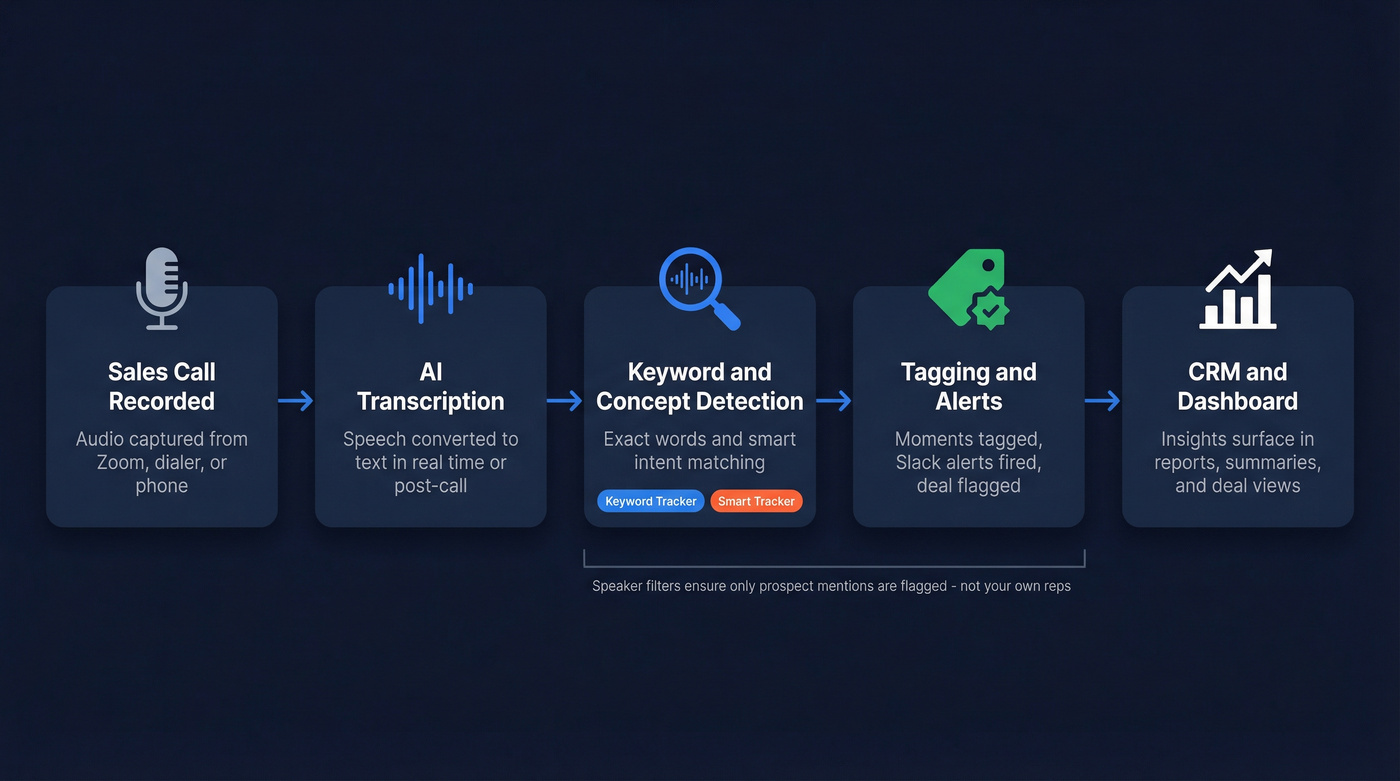
There's an important distinction between keyword trackers and smart trackers. A keyword tracker catches exact words - "discount," "competitor," "renewal." A smart tracker catches concepts even when the exact word isn't used. Gong's classic example: a smart tracker for "asking for a discount" flags "Is that the best you can do?" even though nobody said "discount."
Speaker filtering matters too. You want competitor-mention trackers to fire only when the prospect says a competitor name, not when your rep does. And timing filters let you narrow detection to specific call segments - objections in the last five minutes of a discovery call hit different than objections in the first two.
Real-time detection is the other frontier. Outreach's Kaia listens for keywords during live calls and surfaces battle cards and objection-handling scripts mid-conversation, so reps get help during the objection, not in a post-mortem. Across 40,000 deals, Outreach found teams using Kaia made 82% more calls and sent 26% fewer emails, suggesting live intelligence shifts reps toward higher-value conversations.

Conversation intelligence only works when your reps are actually connecting with prospects. Prospeo gives you 125M+ verified mobile numbers with a 30% pickup rate - 3x the industry average. Stop tracking keywords on calls that never happen.
Fix the data upstream so every tracked call counts.
Setting Up Trackers in Gong
Here's the exact path: Admin center > Agent Studio > AI Tracker > Settings > Trackers > +Create tracker > Keyword tracker.
Enter your terms comma-separated. If you need to track a number with commas (like "10,000"), wrap it in quotes so Gong doesn't split the digits. Toggle "Include related word forms" if you want "renew" to also catch "renewal" and "renewing."
Set your speaker filter: company (your reps), non-company (prospects/customers), or anyone. For competitor trackers, non-company is almost always the right choice.
Call timing filters let you restrict matches to questions, specific call segments (first or last X minutes), or particular topics like Discovery. Tracker results show up on the call page, in summary emails, in Insights, and can be exported via CSV or pushed to your CRM. For large teams, Gong supports bulk CSV upload of keyword trackers - define columns for keywords, speaker filters, and timing rules, then import the whole taxonomy at once.
What Keywords to Track
| Category | Example Terms |
|---|---|
| Competitor mentions | "HubSpot," "Salesforce," "Outreach," "switched from," "also looking at" |
| Pricing/discount | "discount," "budget," "too expensive," "best price," "negotiate" |
| Buying signals | "timeline," "next steps," "decision maker," "sign off," "go live" |
| Objections/stalls | "not ready," "need to think," "check with," "maybe next quarter" |
| Product/feature | "single sign-on," "Slack integration," "API," "migration," "SSO" |
| Compliance | "GDPR," "SOC 2," "security review," "DPA," "data processing" |
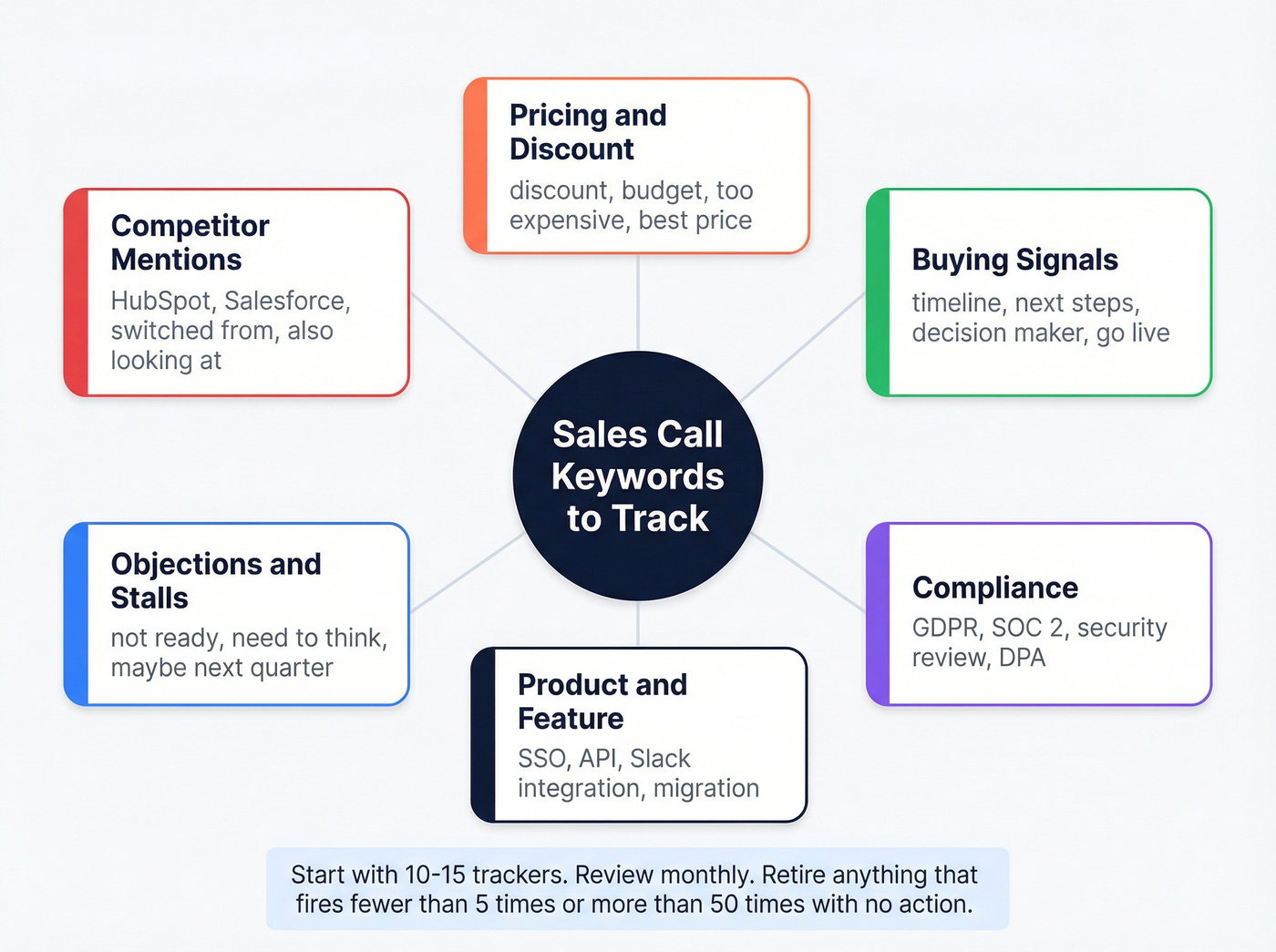
Start with 10-15 trackers across these categories. You can always add more, but only when you have a workflow to act on what each tracker surfaces.
Monthly tracker audit rule: review each tracker at the end of the month. If it fired fewer than 5 times, retire it - you're tracking something that doesn't come up. If it fired more than 50 times with no action taken, it's noise. The sweet spot is trackers that fire often enough to matter and trigger a real workflow every time.
Best Tools Compared
Gong - Best for Enterprise CI
Use this if you run a 20+ rep team and need both keyword and concept-level tracking with granular filters. Smart trackers catch intent that keyword-only tools miss entirely. CSV bulk management makes maintaining 50+ trackers practical. Speaker and timing filters are best-in-class.
Skip this if your team is under 10 reps or you don't have a RevOps person to configure and maintain trackers. Gong typically runs ~$100-200/user/month on annual contracts, with many teams landing around the $30-60k/year range depending on seats and package. That's a serious commitment, and we've seen smaller teams burn budget on it only to use 20% of the feature set.
CallRail - Best Bridge Between Attribution and CI
Use this if you need both sides - which ad keyword drove the call and what was said on it. CallRail's DNI handles attribution, and its conversation intelligence tier transcribes calls and spots keywords you've defined. The "hail damage" alert workflow is a perfect example: flag high-intent inbound calls automatically and route them to your best closer.
Skip this if you're purely outbound. CallRail's strength is inbound call attribution. Plans start around $45/month for basic tracking; expect ~$95-200/month for conversation intelligence and keyword spotting depending on minutes, numbers, and add-ons.
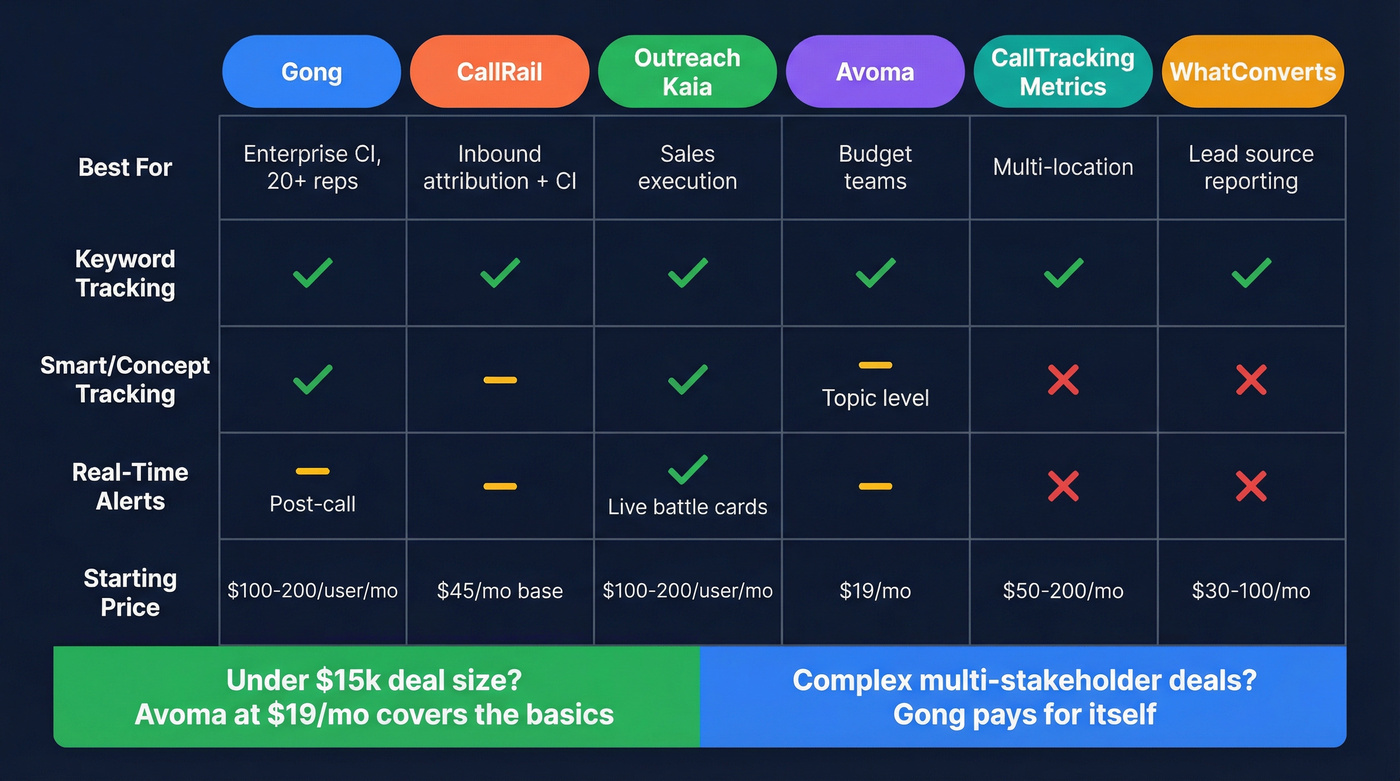
All Tools at a Glance
| Tool | Best For | Key Feature | Starting Price |
|---|---|---|---|
| Gong | Enterprise CI (20+ reps) | Keyword + smart trackers | ~$100-200/user/mo |
| CallRail | Inbound-heavy businesses | DNI + keyword spotting | $45/mo (CI: ~$95-200/mo) |
| Outreach (Kaia) | Sales execution teams | Real-time keyword alerts | ~$100-200/user/mo |
| Avoma | Budget teams (<$30k CI spend) | Topic detection, AI notes | From $19/mo |
| CallTrackingMetrics | Multi-location attribution | DNI + basic transcription | ~$50-200/mo |
| WhatConverts | Lead source reporting | Call source tracking | ~$30-100/mo |
Here's the thing: if your average deal size is under $15k, you don't need Gong-level tracking. Avoma at $19/month covers topic analysis and AI-generated notes. Save the $30k+ for headcount or better upstream data. The teams we've seen get the most from Gong are running complex, multi-stakeholder deals where a single missed competitor mention can cost a six-figure contract.
Five Keyword Tracking Mistakes
1. Over-tracking. A recurring theme on r/sales and sales ops communities: teams set up 50 trackers in a burst of enthusiasm, then never check the dashboard after week two. Ten trackers you review weekly beat fifty you forget about. Start lean.
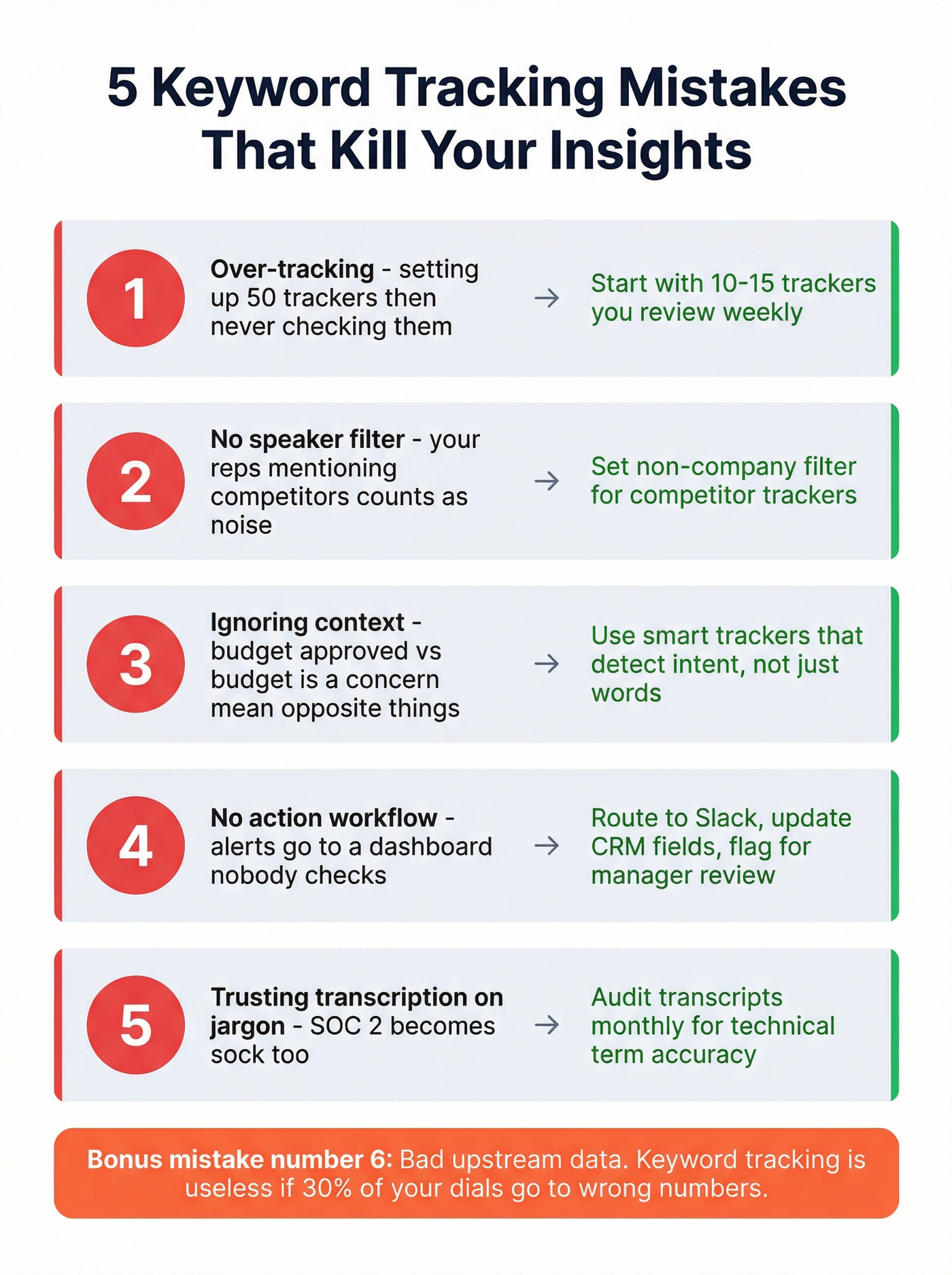
2. Not filtering by speaker. A competitor mention from your rep during a pitch deck walkthrough is noise. A competitor mention from the prospect is signal. Always set speaker filters.
3. Ignoring context around the keyword. "Budget" in "we have budget approved" and "budget is a concern" mean opposite things. Smart trackers help here; keyword-only trackers don't. In our experience, teams that skip smart trackers end up with misleading dashboards that overcount objections and undercount buying signals.
4. No action workflow after detection. A tracker that fires and goes to a dashboard nobody checks is a vanity metric. Route alerts to Slack, trigger a CRM field update, or flag the deal for manager review. If nobody's acting on the data, you're just generating reports for the sake of generating reports.
5. Trusting transcription blindly on technical terms. If your product has jargon - proprietary feature names, acronyms, industry-specific language - audit your transcripts before trusting keyword counts. CI tools can struggle with niche terminology, and a tracker that miscounts because the AI transcribed "SOC 2" as "sock too" is worse than no tracker at all.
There's a sixth mistake that sits underneath all of these: bad upstream data. Keyword tracking is only as good as your call volume. If 30% of your dials go to wrong numbers or dead-end contacts, you're analyzing a fraction of the conversations you should be having.
Fix the Upstream Problem First
Let's be honest - your keyword trackers need conversations to analyze. No conversations, no data, no insights. The most sophisticated Gong setup in the world is useless if your reps spend half their day dialing wrong numbers.
This is where data quality becomes the foundation. Snyk's sales team of 50 AEs was dealing with bounce rates of 35-40% before switching to Prospeo. After the switch, bounces dropped under 5% and the team generated 200+ new opportunities per month, with AE-sourced pipeline up 180%. More connections means more calls means more data for your keyword tracking to actually work with.
You're investing in Gong, Avoma, or CallRail to track what prospects say. But 38% bounce rates and dead numbers mean your best keyword trackers sit idle. Prospeo delivers 98% email accuracy and verified direct dials at $0.01/lead - so your CI tools have real conversations to analyze.
More live conversations. More keywords captured. Better data in, better insights out.
FAQ
What does sales call keyword tracking mean?
It covers two distinct functions. Call attribution tracking uses dynamic number insertion to match phone calls to the marketing campaign or keyword that drove them. Conversation intelligence uses AI transcription to detect specific words spoken during the call. Some tools like CallRail handle both, but most specialize in one side.
How many keyword trackers should I set up?
Start with 10-15 across core categories: competitor names, pricing language, and buying signals. Add more only when you have a clear workflow to act on each tracker's output. Ten trackers you review weekly beat fifty you forget about.
Can I track keywords without Gong?
Absolutely. Avoma starts at $19/month with topic detection and AI-generated notes. CallRail includes keyword spotting in its conversation intelligence tier at ~$95-200/month depending on usage. For the upstream problem - making sure your dials actually connect - tools like Prospeo handle contact verification so your reps aren't wasting calls on bad numbers.
How do I search call transcripts for specific moments?
Most CI platforms let you search across your entire call library by keyword, speaker, date range, or deal stage. In Gong, this pulls up every instance where a prospect mentioned a competitor or raised a pricing objection - especially useful for coaching, since managers can find real examples of how top reps handle objections and share those clips with the team.