

Follow-Up Call Scripts That Get Callbacks (2026)
It's Tuesday morning. You ran a solid demo last Thursday, the prospect was nodding along, and then - silence. No reply to your recap email. No calendar hold for next steps. You're staring at your phone wondering what to say that doesn't sound like "just checking in."
That moment is where deals die or get saved. The difference isn't talent - it's having a follow up call script that gives you something better to say than nothing.
You don't need 21 scripts. You need three great ones and the discipline to actually use them. Below you'll find eight scenario-specific scripts, voicemail templates, objection talk tracks, and the cadence data to time it all correctly. Pick the three that match your pipeline right now and ignore the rest until you need them.
Quick Reference Table
80% of your calls will hit voicemail - jump to the voicemail section if that's why you're here. For everyone else, here are the five highest-impact follow-up scenarios at a glance:
| Scenario | Opening Line | Key Move |
|---|---|---|
| Post-demo | "I've been thinking about [specific pain point] you mentioned..." | Tie back to their words |
| Haven't heard back | "I know things get buried - wanted to float one idea..." | Lead with new value |
| Voicemail | "Quick 15-second message about [result]..." | Create curiosity, not a pitch |
| Objection reframe | "Totally fair - can I ask what's driving that?" | Acknowledge, then question |
| Trigger event | "Saw [Company] just [event] - congrats..." | Relevance earns the call |
Why Follow-Up Calls Still Work
The data is unambiguous. An analysis of 300M+ sales calls by Gong found that top-quartile reps hit a 13.3% connect rate versus 5.4% for average reps. That's roughly 8 dials per conversation versus 19. On set rate - meetings booked per conversation - top reps land at 16.7% compared to 4.6%.
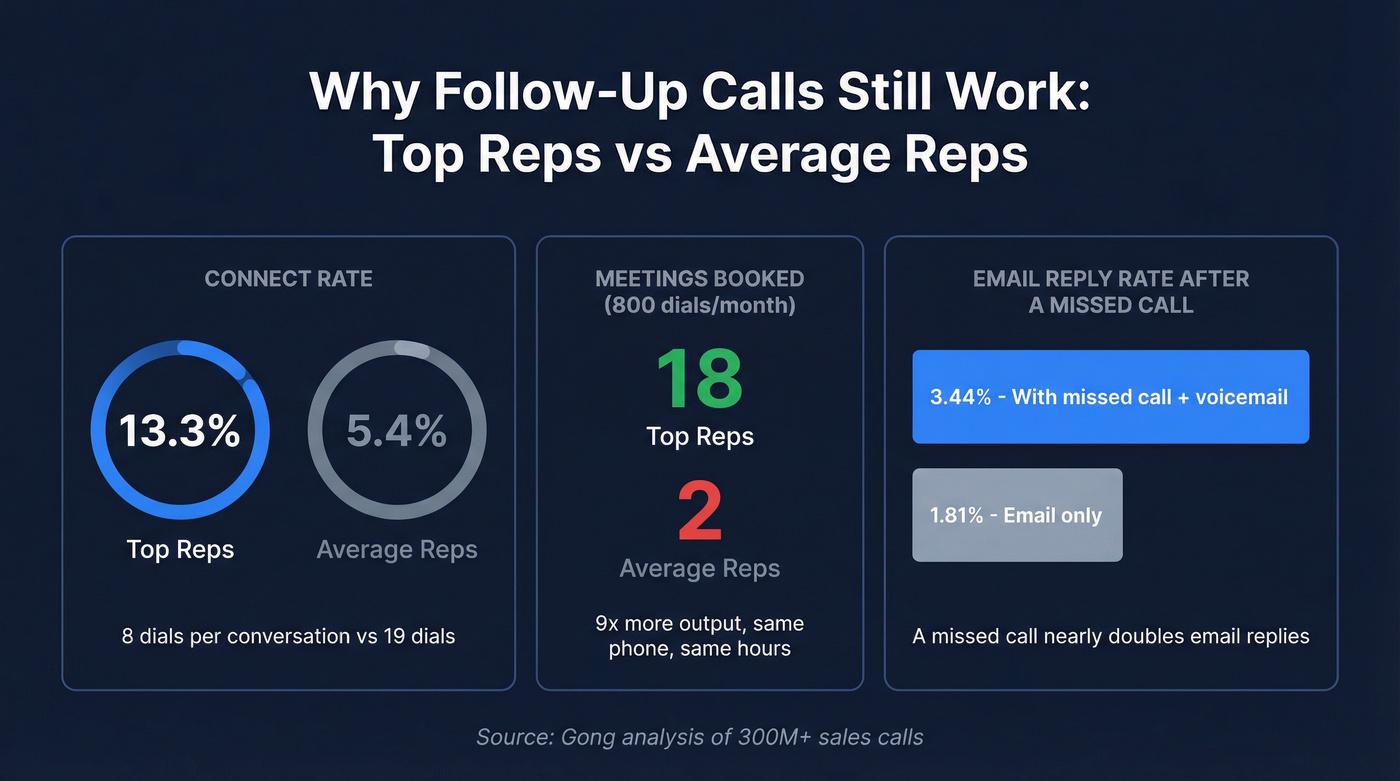
Here's what that looks like at scale: at 800 dials per month, the average rep books about 2 meetings. The top rep books 18. Same phone, same hours, 9x the output.
Even when a call doesn't connect, it nearly doubles email reply rates - 3.44% versus 1.81%. A missed call with a voicemail primes the prospect to open your next email. The phone and inbox aren't separate channels; they're a system.
Persistence isn't optional either. Only 2% of deals close on first contact. 80% require 5-12 follow-up attempts. Yet 48% of salespeople never follow up after the first contact. Having a reliable script for sales follow-ups removes the guesswork that causes most reps to quit early.
Before You Dial
There's a difference between formal follow-ups - moving a deal through stages - and tactical follow-ups like chasing action items or reviving stalled conversations. Both need prep, but the prep is different. A formal follow-up requires reviewing the full account context. A tactical one just needs a clear reason to call and a specific ask.
Either way, run through these four steps before you pick up the phone:
- Research the prospect. Spend 90 seconds scanning their recent activity - job changes, company news, anything they've posted. One specific detail in your opener changes the entire tone of the call. (If you want a tighter system, use this pre-call research workflow.)
- Verify your contact data. If 40% of your numbers are dead, you're burning half your call block on dial tones. We've found that verified direct dials make or break a follow-up cadence - Prospeo's Mobile Finder delivers a 30% pickup rate with numbers refreshed every 7 days. (More on contact data decay if your lists go stale fast.)
- Set your agenda. Know the one thing you want to accomplish. Not three things. One.
- Know your ask. Every call should end with a concrete next step. "I'll send you some info" isn't a next step. "Can we lock in 20 minutes Thursday at 2?" is.
8 Scripts for Every Scenario
1. After Initial Interest (Inbound Lead)
"Hi [Prospect Name], this is [Your Name] from [Company]. You [downloaded our guide / requested a demo / signed up for a trial] on [day] - I wanted to make sure you got what you needed and see if there's a specific challenge I can help with. What prompted you to reach out?"
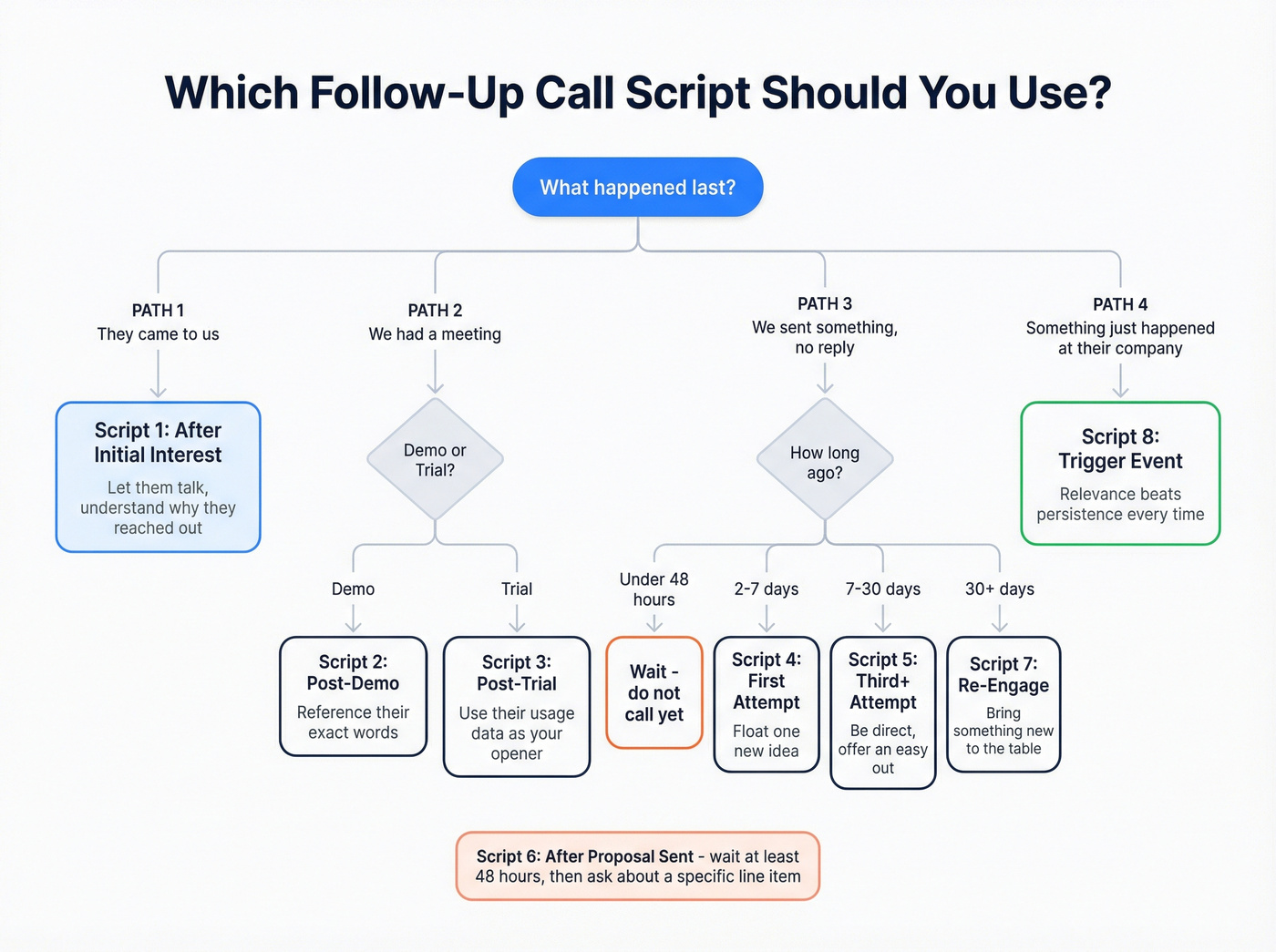
Key move: Let them talk. The prospect already raised their hand - your job is to understand why, not to pitch. (If you need a framework, this inbound lead qualification guide helps.)
2. Post-Demo Follow-Up
"Hey [Prospect Name], it's [Your Name]. I've been thinking about what you said about [specific pain point from demo]. We actually just helped [similar company] cut that problem by [result]. I'd love to walk through how that'd look for [Company] - do you have 15 minutes this week?"
What NOT to say: "Just following up on our demo." That tells them nothing and gives them zero reason to engage. Always reference their exact words from the conversation - it proves you listened and makes the call feel personal, not procedural. (For a full workflow, see the post-demo playbook.)
3. Post-Trial Follow-Up
Most reps treat the trial follow-up like a check-in call. It's not. It's a diagnostic call. You already have usage data - use it.
"[Prospect Name], it's [Your Name] from [Company]. I noticed you've been [using feature X / exploring the dashboard] during your trial. Most teams at your stage find [specific insight] really clicks once they see it in action. What's been your experience so far?"
Show you've tracked their usage. It signals attentiveness and opens a natural conversation about what's working and what's not.
4. "Haven't Heard Back" - First Attempt
"Hi [Prospect Name], it's [Your Name]. I know things get buried - totally get it. I wanted to float one quick idea: [specific value prop tied to their situation]. If that's relevant, I'd love 10 minutes. If not, no hard feelings. What do you think?"
Acknowledge the silence without guilt-tripping. Lead with a new piece of value, not a reminder of your last email. (If you want matching copy, borrow a follow-up email after no response template.)
5. "Haven't Heard Back" - Third+ Attempt
"[Prospect Name], [Your Name] here. I've reached out a couple times and I know you're slammed. I'll keep this to 15 seconds: [one-sentence value statement]. If the timing's off, just say the word and I'll circle back in [timeframe]. Otherwise, I think [specific outcome] is worth a quick conversation."
Here's the thing: most reps soften their language on the third attempt because they feel awkward. Do the opposite. Be direct about the multiple attempts - transparency builds trust. Giving them an easy out paradoxically makes them more likely to engage.
6. After Pricing / Proposal Sent
Skip this script if you sent the proposal less than 48 hours ago. Calling the next morning signals anxiety, not professionalism.
"Hey [Prospect Name], it's [Your Name]. I wanted to check in on the proposal I sent over on [date]. Specifically, I'm curious whether the [specific line item or package] makes sense for how your team's structured. Any questions I can clear up before you take it to [decision maker / the team]?"
Don't ask "did you get my proposal?" Ask about a specific element. It shows you're thinking about their decision process, not just chasing a signature.
7. Re-Engaging After Going Dark (30+ Days)
This is the script that separates pipeline builders from pipeline watchers. After 30 days of silence, you need a new reason to call - the old pitch is dead.
"[Prospect Name], it's [Your Name] from [Company]. It's been a while since we connected, and I didn't want to assume the timing was wrong forever. Since we last spoke, we've [new feature / new case study / new result]. Does it make sense to revisit the conversation, or has your situation changed?"
Bring something new. If you're calling with the same pitch from 30 days ago, you've already lost. A strong follow up cold call script gives you a reason to re-engage that goes beyond "circling back." (You can pair this with re-engagement email subject lines to revive the thread.)
8. Trigger Event Follow-Up
"Hi [Prospect Name], congrats on [the new role / the Series B / the expansion]. I work with a lot of [similar role] teams going through exactly this kind of transition, and [specific challenge] usually comes up fast. Worth a quick call to see if we can help, or is it too early?"
The trigger event is your permission slip. It makes the call timely and relevant instead of random. In our experience, this script outperforms generic follow-ups by a wide margin - relevance beats persistence every time. (If you want to operationalize this, use a sales triggers process.)

40% of follow-up calls fail before the prospect even picks up - because the number is wrong. Prospeo's Mobile Finder gives you 125M+ verified direct dials refreshed every 7 days, so your carefully crafted script actually reaches a human.
Stop rehearsing scripts into dead dial tones.
Voicemail Scripts That Get Callbacks
80% of your calls will hit voicemail. That's not a problem - it's a channel. Research shows a well-crafted voicemail lifts callbacks by up to 22%. The sweet spot is 18-30 seconds.
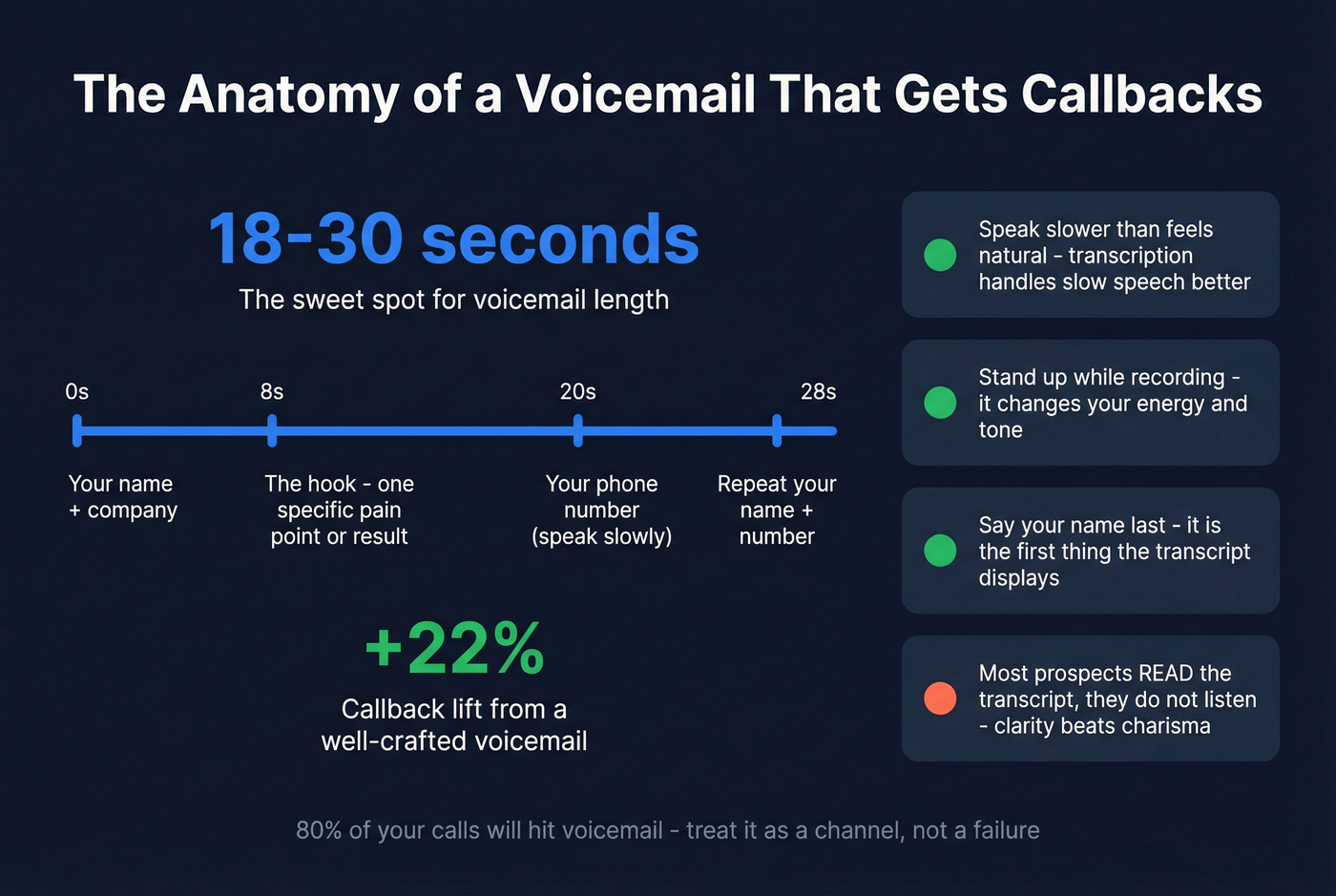
The insight most reps miss: many prospects read voicemail transcriptions rather than listening. This changes everything about how you should leave a message. Clarity and pacing matter more than vocal charisma. Mumble your name and number, and the transcript turns to gibberish - your callback rate drops to zero regardless of how good your hook was.
Five voicemail templates that work:
Pain-point voicemail: "Hi [Prospect Name], it's [Your Name] from [Company]. Quick message - I help [role] teams solve [specific pain]. Helped [similar company] [result]. Worth a 5-minute call? My number is [number]. Again, [Your Name], [number]."
Social proof voicemail: "[Prospect Name], [Your Name] at [Company]. [Competitor or peer company] just [achieved result] using our approach to [problem]. Thought you'd want to hear how. Call me at [number]."
Ultra-short voicemail: "Hey [Prospect Name], [Your Name], [Company]. Got a quick idea about [one-line hook]. Call me back at [number] or I'll try you again [day]."
Referral-based voicemail: "[Prospect Name], [Your Name] here. [Mutual connection] suggested I reach out - said you're dealing with [challenge]. I'd love 5 minutes. [Number]."
"Sent you an email" redirect: "Hi [Prospect Name], [Your Name] from [Company]. I just sent you an email with [subject line]. Take a look when you get a chance - I think [specific detail] will be relevant. I'll follow up [day]."
Delivery tips: Speak slower than feels natural - voicemail transcription handles slow speech much better. Stand up while you leave the message; it changes your energy. Say your name at the end, not just the beginning - it's the last thing they hear and the first thing the transcript displays. (More sales voicemail tips here.)
Objection Talk Tracks
Objections on follow-up calls are different from cold call objections. The prospect already knows who you are. They're not confused - they're stalling, evaluating, or genuinely blocked.
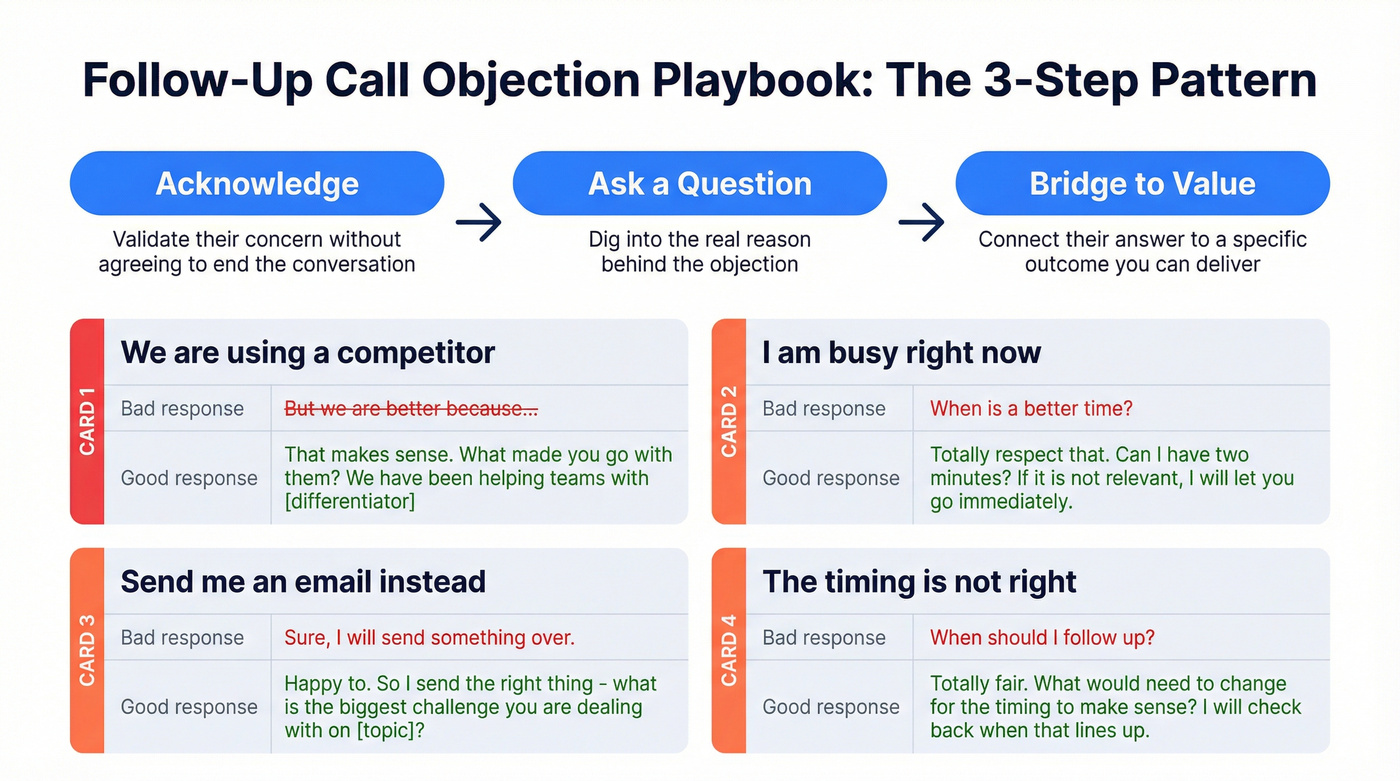
"We're using a competitor." "That makes sense - most teams I talk to are. What made you go with them? We've been helping teams like [peer company] with [specific differentiator], and I'd love to see if there's a gap worth exploring."
"I'm busy." "Totally respect that. Can I have two minutes? If what I share isn't relevant, I'll stop calling. Deal?"
"Call me back next quarter." "Happy to. Quick question so I come back prepared - is next quarter when budget opens up, or is something else driving the timing?"
"I'm not interested." "Fair enough. Before I go - is it the timing, or is [problem] just not a priority right now?"
"Send me an email instead." "Absolutely. So I don't waste your time - what specifically would be most useful to see?"
"I need to talk to my team." "Makes total sense. Would it help if I joined that conversation? I can answer technical questions in real time so your team doesn't have to guess." Gong's analysis of 1.8M opportunities shows multi-threading - engaging multiple stakeholders - boosts win rates by 130% on deals over $50K. Getting into that internal meeting is worth pushing for.
"Now's not a good time." "No worries. When would be better - later this week, or should I circle back in two weeks?"
Optimal Follow-Up Cadence
A great script means nothing if you're calling at the wrong time or giving up too early. Here's an 8-touch, 12-day cadence that balances persistence with professionalism:
| Day | Channel | Action |
|---|---|---|
| 1 | Personalized intro or recap | |
| 2 | Phone | Call + 15-second voicemail |
| 3 | Value-add (case study, insight) | |
| 5 | Social | Connect or engage with content |
| 7 | Share relevant asset | |
| 9 | Phone | Second call attempt |
| 11 | Objection-handling angle | |
| 12 | Breakup / graceful close |
On timing, Tuesday through Thursday between 10-11 AM local time delivers roughly 30% higher connect rates. Wednesday at 10 AM specifically outperforms other windows by about 16%. Avoid Monday mornings - connect rates drop 34% - and the 12-2 PM dead zone where answer rates fall about 35%. (If you want more templates, start with a sales cadence example.)
This cadence falls apart if half your numbers are disconnected. We've watched teams burn entire call blocks dialing bad numbers - it's the fastest way to kill rep morale and waste pipeline. (Here’s a deeper dive on prospect data accuracy.)
How to Sound Like a Top Rep
The historically optimal talk-to-listen ratio is 43% talking, 57% listening. But the real insight from the latest analysis of 7.1M opportunities isn't the ratio itself - it's consistency. Low performers swing wildly: 54% talk time on won deals, 64% on lost ones. Top performers stay steady regardless of outcome.
Let's be honest: most follow-up call training focuses on what to say. That's backwards. The reps who consistently close are the ones who've mastered when to shut up. Think of yourself as a consultant diagnosing a problem, not a closer running a pitch. That framing naturally keeps you in listening mode. (If you want to go deeper, this sales conversation science breakdown is worth reading.)
One non-negotiable from the Dialpad framework: never end a call without scheduling the next step. Not "I'll follow up next week." An actual calendar invite, sent before you hang up.
5 Mistakes That Kill Your Pipeline
- Never following up. 48% of salespeople never follow up after the first contact. 80% of sales require 5-12 touches. The math is brutal for quitters.
- Waiting too long. Inbound leads are 9x more likely to convert when contacted within 5 minutes. Every hour you wait lowers your odds dramatically.
- Skipping voicemail. 80% of calls go to voicemail. Hang up without leaving one and you wasted the dial entirely. A voicemail plus a follow-up email is a two-touch combo from one call block.
- Saying "just checking in." Zero value, zero curiosity, zero reason to call back. The consensus on r/sales is that this phrase is the single fastest way to get ignored - and they're right. (Use these follow-up email greetings instead.)
- Giving up after three attempts. 93% of conversions happen after six or more touches. Three attempts isn't persistence - it's a warm-up.
A missed call doubles email reply rates - but only if your follow-up email lands. Prospeo's 98% email accuracy and verified mobile numbers turn your multi-channel cadence into a system that actually connects.
Pair every follow-up call with a verified email for $0.01.
FAQ
How many times should you follow up with a prospect?
Five to twelve attempts across multiple channels over two to three weeks. 80% of sales require at least five follow-ups, yet 48% of reps stop after one attempt - that gap is where pipeline goes to die.
What's the best time to make a follow-up call?
Tuesday through Thursday, 10-11 AM in the prospect's local time zone. Wednesday at 10 AM outperforms other slots by roughly 16%. Avoid Monday mornings (34% lower connect rates) and the 12-2 PM lunch dead zone.
What do you say in a follow-up voicemail?
Keep it under 20 seconds. State your name, one specific reason they should call back, and your phone number - twice. Many prospects read the transcription rather than listen, so speak clearly and slowly.
How do you follow up without sounding desperate?
Lead with value, not "just checking in." Reference a trigger event, shared content, or a pain point they mentioned - and propose a concrete next step. A well-prepared follow up phone call script keeps you focused on the prospect's needs rather than your own anxiety about the silence.
What tools help improve follow-up call connect rates?
Verified contact data is the biggest lever. Pair a reliable data source with a dialer like Kixie or Orum and a sequencing tool like Salesloft or Outreach for maximum efficiency.