

How to Word a Follow-Up Email After No Response
You've retyped "Just checking in" three times and deleted it each time. Good instinct - that phrase is a dead end.
Around 40% of people have 50+ unread emails sitting in their inbox right now. Your message didn't get rejected. It got buried. The fix isn't sending louder - it's sending smarter, with a fresh angle each time you reach out so every follow-up earns its place in someone's inbox instead of training them to ignore you.
The Quick Version
- Wait 3 days, then follow up with a new angle. The first follow-up is 40% more effective than the initial email.
- Aim for 50-125 words. Use a 2-4 word personalized subject line (46% open rate across a 5.5M email study).
- Cap at 3 follow-ups total. After that, send a breakup email - they convert at 10-30%.
When to Follow Up (and When to Stop)
Timing matters more than wording. Send too early and you look desperate. Wait too long and they've forgotten you entirely.
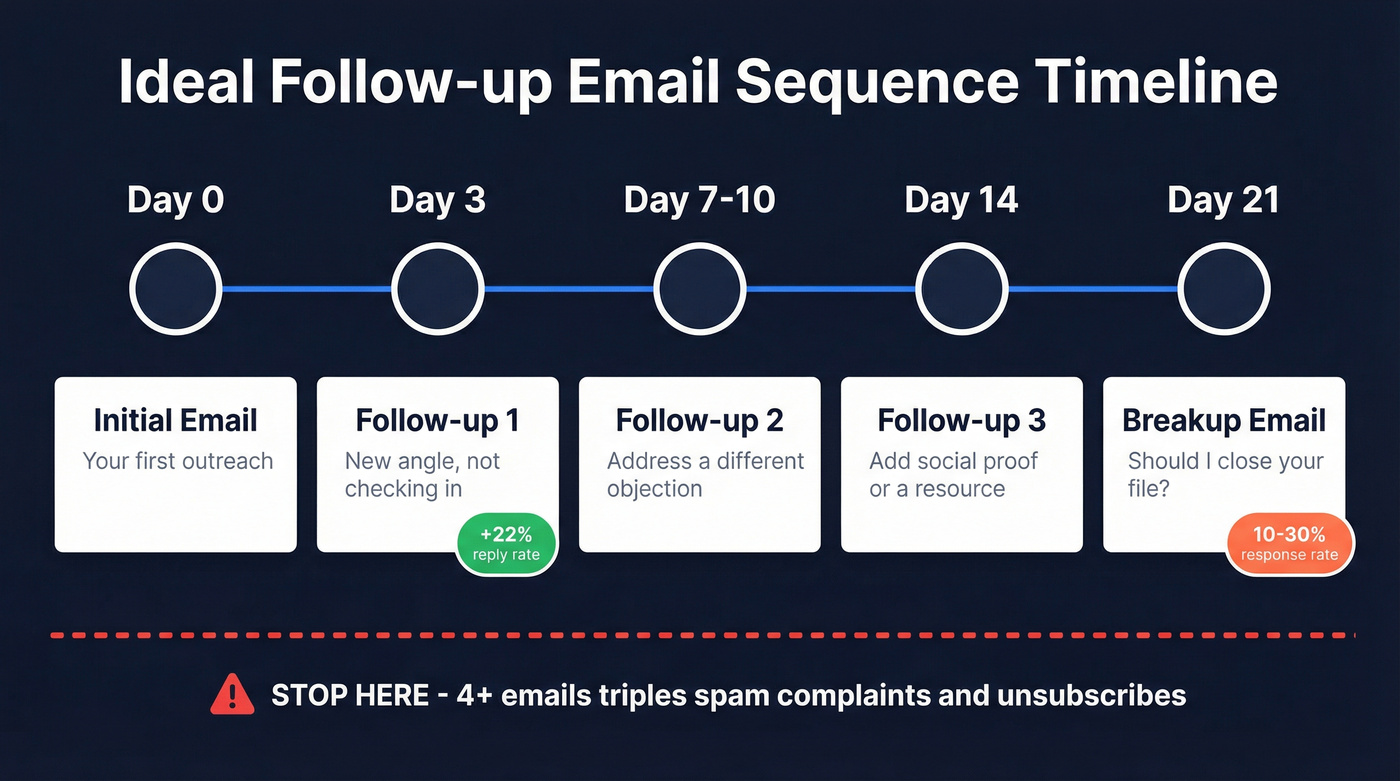
| Day | Action | Key Rule |
|---|---|---|
| Day 0 | Initial email | - |
| Day 3 | Follow-up 1 | New angle, not "checking in" |
| Day 7-10 | Follow-up 2 | Different objection |
| Day 14 | Follow-up 3 | Add social proof or a resource |
| Day 21 | Breakup email | "Should I close your file?" |
One follow-up boosts reply rates by 22%. But there's a hard ceiling - a Belkins study of 16.5M cold emails found that 4+ emails in a sequence more than triples unsubscribe and spam complaint rates. Three follow-ups plus a breakup is the sweet spot.
Subject Lines That Get Opened
That same 5.5M-email dataset makes the rules clear:
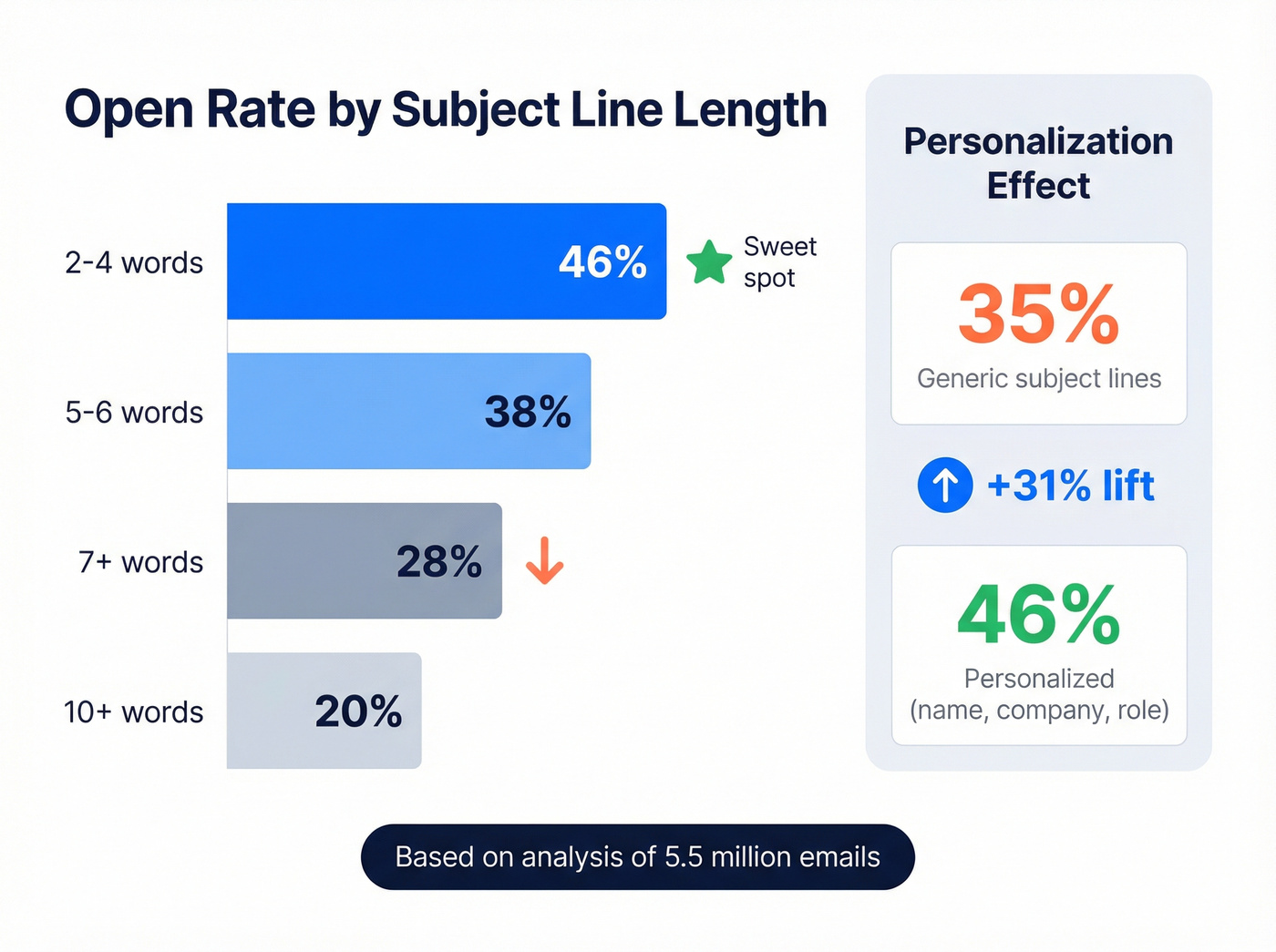
- 2-4 words hit a 46% open rate. Past 7 words, opens drop fast.
- Personalization (name, company, role) lifts opens from 35% to 46%.
- Questions outperform statements. "Quick question about [project]" beats "Following up on our conversation."
Don't put "Follow-up" in your subject line. It's the email equivalent of announcing "this is an ad." Give them a reason to open, not a label.

You just crafted the perfect follow-up sequence - but none of it matters if the email address is dead. A single bounce tanks your sender reputation and buries every future message. Prospeo verifies emails at 98% accuracy across 143M+ addresses, so every follow-up actually reaches a real inbox.
Verify your list at ~$0.01/email before your next follow-up sequence.
How to Word Each Follow-Up
Here's the thing: each follow-up should address a different reason they haven't replied. Not more volume - more angles. The GMass framework spells this out well, and NetHunt's breakdown confirms it: "touching base," "circling back," and "checking in" all signal you have nothing new to say.
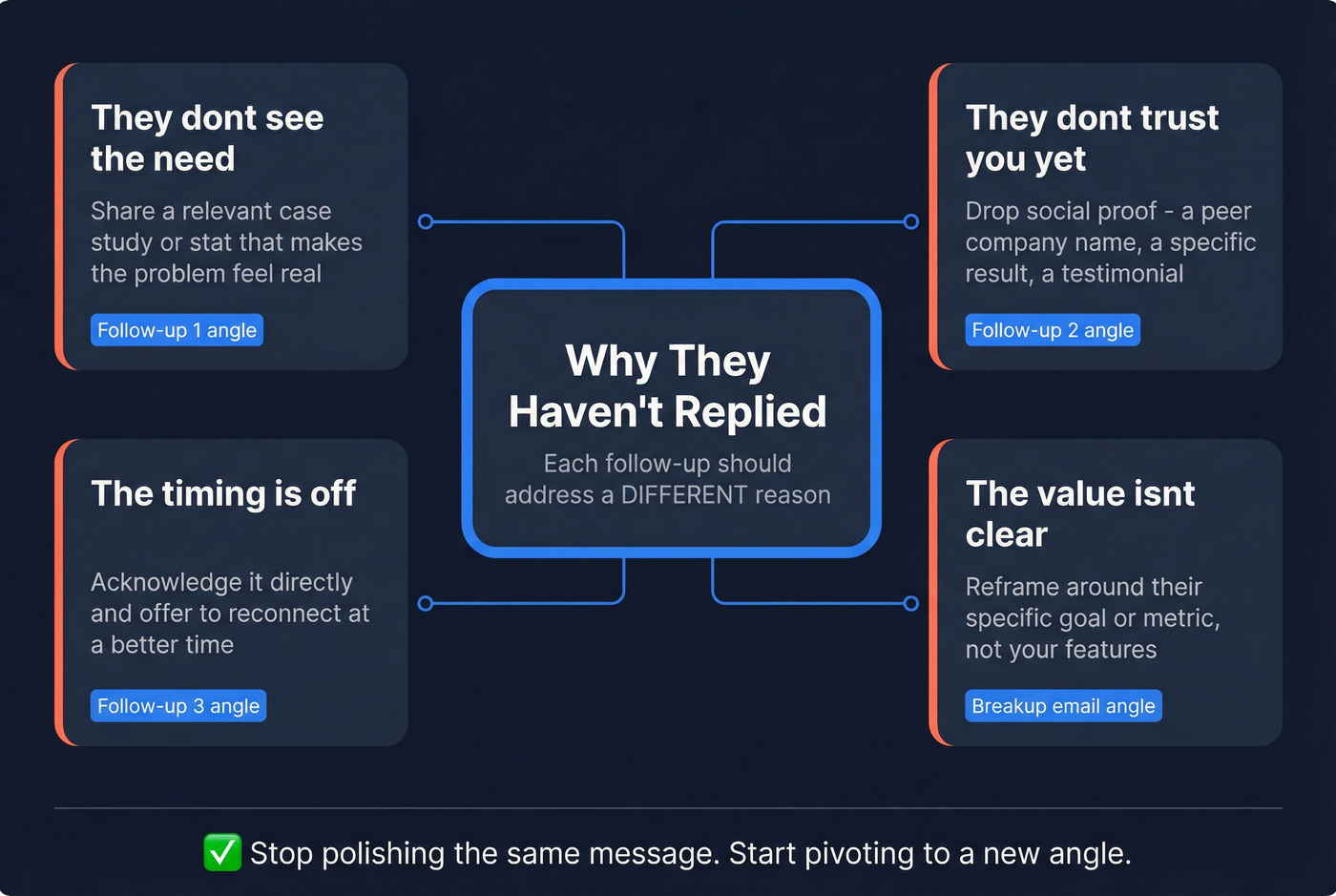
One rule governs everything: give them a reason to reply that they didn't have before.
After a Proposal or Pitch
Hi [Name],
Wanted to share a quick case study - [similar company] saw [specific result] after implementing what we discussed. Thought it might help as you're evaluating options.
Worth a 10-minute call this week?
After a Job Interview
Hi [Name],
Thanks again for the conversation about [role]. I've been thinking about [specific topic from interview] and wanted to share [brief insight or article].
Looking forward to hearing about next steps whenever the timing's right.
Wait 5-7 business days for job applications. This isn't sales - patience signals professionalism here.
Client Who's Gone Silent
Hi [Name],
I know things get busy. To keep [project] on track for [deadline], I just need [specific thing - approval, feedback, a signature].
Would a quick call be easier than email?
Anchor to their deadline, not yours. It reframes the follow-up as helpful, not nagging.
Cold Outreach Follow-Up
Hi [Name],
Different angle - [industry peer] just cut their [metric] by [X%] using [approach]. Given [company]'s growth in [area], thought this might be relevant.
Open to a 15-minute look?
The Breakup Email
Hi [Name],
I haven't heard back, so I'll assume the timing isn't right. I'm going to close out your file on my end.
If anything changes, I'm here.
Breakup emails are often the highest-converting touch in the entire sequence. Subject lines like "Should I close your file?" generate 10-30% response rates - sometimes higher than the initial outreach. Loss aversion is a powerful thing.
Mistakes That Kill Your Reply Rate
Bad: "Just bumping this to the top of your inbox." Better: "Thought this [resource/case study] might be useful as you're thinking about [topic]."
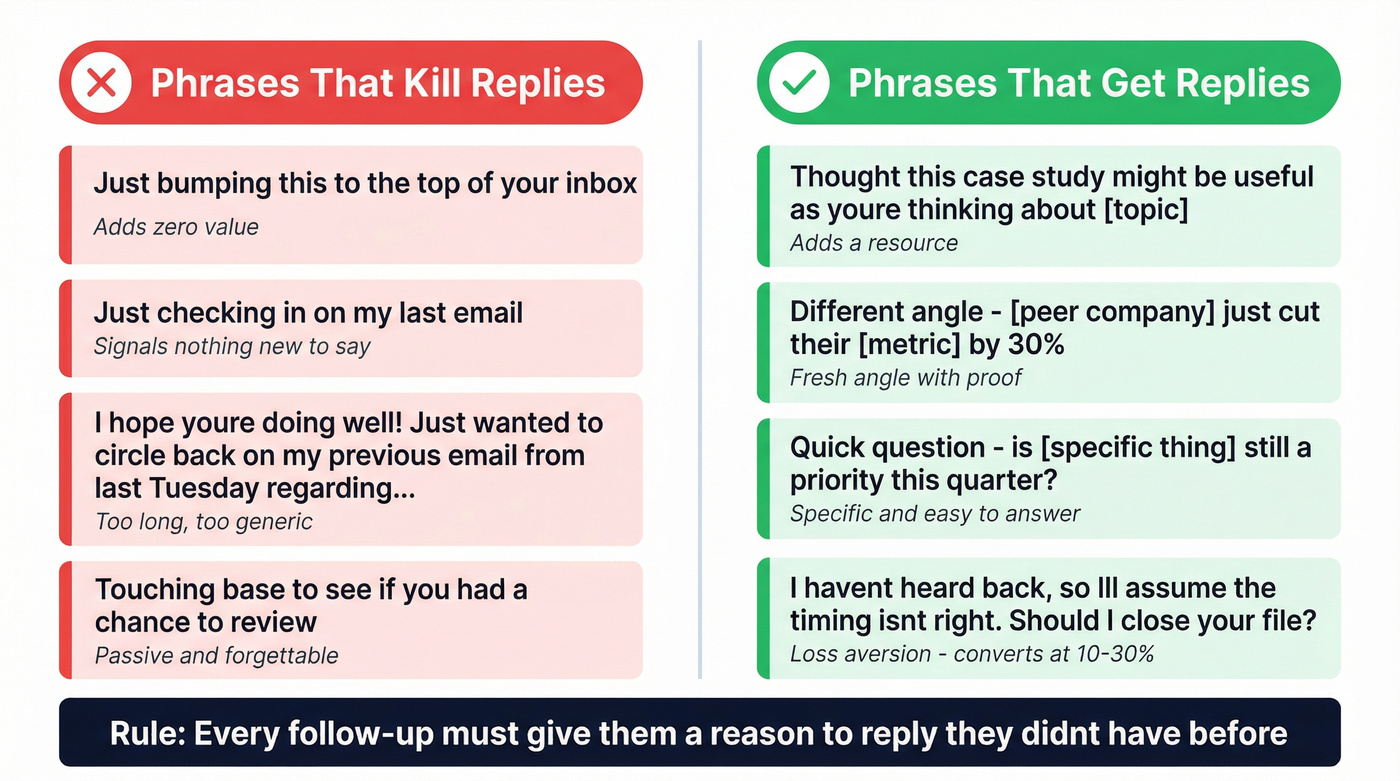
Bad: "I hope you're doing well! Just wanted to circle back on my previous email from last Tuesday regarding..." Better: "Quick question - is [specific thing] still a priority this quarter?"
Every follow-up that restates the last email without adding anything new is wasted. Each message should address a different potential objection: they don't see the need, they don't trust you yet, the timing's off, or the value isn't clear. Pick one and write to it.
Let's be honest - most people agonize over the wording when the real problem is they're sending the same message four times. We've reviewed hundreds of outbound sequences, and the pattern is always the same: a beautifully written email repeated with minor tweaks, going nowhere. A mediocre email with a fresh angle will outperform a polished email that says nothing new. Stop polishing. Start pivoting.
Make Sure Your Email Actually Arrives
We've seen this play out over and over: someone crafts the perfect follow-up sequence, sends it to a list that's months old, and watches good prospects vanish because the address is dead. A bounced email doesn't just waste that send - it tanks your sender reputation and makes every future message less likely to land in anyone's inbox.
Before you send any sequence, verify your list. Prospeo handles this with 98% email accuracy across 143M+ verified addresses - paste in an address, get a result in seconds. The free tier covers 75 verifications per month, enough to clean a small campaign before you hit send.

Writing better follow-ups is half the battle. The other half is reaching real people. Prospeo's 7-day data refresh means you're never sending to stale addresses - while competitors refresh every 6 weeks, leaving you with bounces that destroy your domain reputation mid-sequence.
Clean your list in seconds and send follow-ups that actually arrive.
FAQ
How long should I wait before following up after no response?
Three business days is the standard for sales, networking, and most professional contexts. For job applications, wait 5-7 business days - hiring timelines move slower, and patience signals professionalism rather than disinterest.
How many follow-up emails is too many?
Cap at three follow-ups plus one breakup email (four total touches after the original). Beyond that, unsubscribe and spam complaint rates more than triple according to a 16.5M-email study. Quality of angles matters more than quantity of sends.
What if my follow-up emails keep getting no response?
The address might be invalid, or your emails are landing in spam. Verify addresses before sending - a bounced email tanks your sender reputation and makes every future message less likely to arrive. If deliverability checks out, your messaging likely needs a new angle, not more volume.
Should I reply to the same thread or start a new one?
Reply to the same thread for warm contacts (clients, interviewers, existing conversations) so they see the context. Start a fresh thread for cold outreach follow-ups - a new subject line gives you another shot at an open, and 2-4 word personalized subjects hit a 46% open rate.