Follow-Up Email Greetings That Actually Get Replies
You're drafting follow-up number three to a VP who hasn't replied. You've rewritten the opening line twice. But the real bottleneck? The greeting. Choosing the right follow-up email greetings matters more than most reps think - an analysis of 5.5 million emails by Belkins found personalized subject lines hit a 46% open rate versus 35% without, while subject lines stuffed with generic greeting-style phrasing pulled opens below 36%. Your greeting isn't decoration. It's the first filter between "read" and "archive."
Most greeting guides hand you 40+ options. That's the opposite of helpful. You need three greetings and the judgment to pick the right one.
The Only Formality Ladder You Need
Think of professional email greetings on a four-rung ladder. You're almost always on one of the middle two.
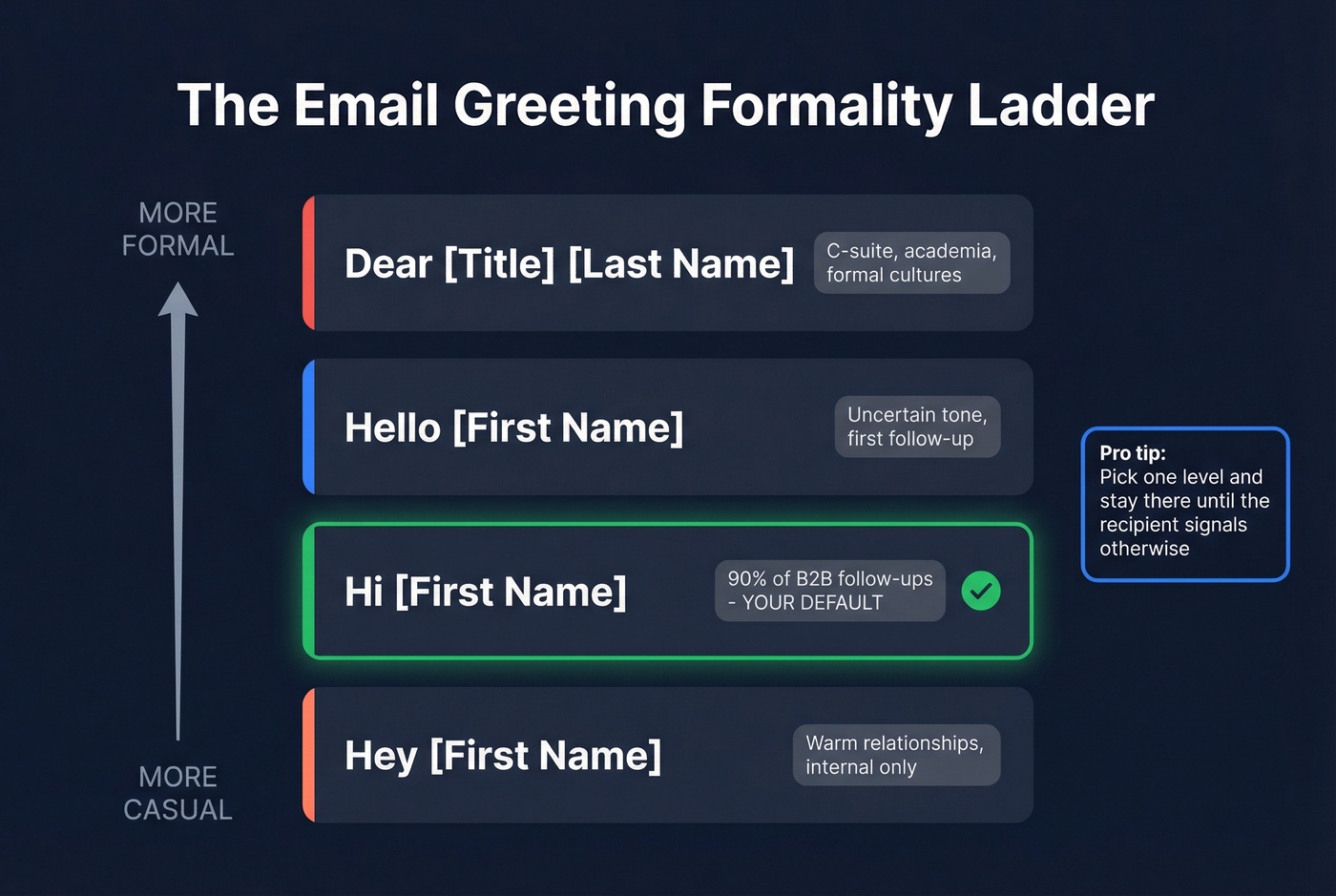
| Greeting | Formality | Best For | Example |
|---|---|---|---|
| Dear [Title] [Last] | High | C-suite, academic, formal | Dear Dr. Patel, |
| Hello [First Name] | Medium-high | Uncertain tone, 1st follow-up | Hello Sarah, |
| Hi [First Name] | Medium | 90% of B2B follow-ups | Hi Marcus, |
| Hey [First Name] | Low | Warm relationships, internal | Hey Jess, |
"Hi [First Name]" is the right default for the vast majority of professional follow-ups. It's warm without being presumptuous. "Hello" works when you're unsure - emailing a prospect in a formal industry for the first time. "Dear" is reserved for seniority, academia, or cultures where formality signals respect. "Hey" is for people you've already grabbed coffee with.
We've seen sequences where switching from "Dear" to "Hi" between emails made the sender look confused, not friendly. Pick one level and stay there until the recipient signals otherwise. And here's a detail most guides miss: continuing "Dear Mr Smith" after the other person has switched to first names can come across as cold, not polite.
How to Address a Follow-Up Email by Scenario
The greeting and the first 15 words after it function as a single unit. Nobody reads "Hi Sarah," then decides whether to keep going - they read the greeting plus the opener as one thought.
| Scenario | Greeting + Opener |
|---|---|
| Post-meeting | Hi [First Name], Great speaking on [day] - here's the deck we discussed. |
| Post-interview | Hello [First Name], Thank you for the conversation about the [role] position. |
| Sales follow-up | Hi [First Name], Quick thought on [pain point] since our last call. |
| Networking event | Hello [First Name], Enjoyed our chat at [event] - your point about [topic] stuck with me. |
| Cold outreach (no reply) | Hi [First Name], Found a [stat/case study] relevant to [their challenge]. |
| Customer support | Hi [First Name], Wanted to confirm [issue] is fully resolved on your end. |
The greeting barely changes across scenarios. The opening line does the heavy lifting. In our experience, the greeting accounts for maybe 5% of whether someone replies. The opener and the value you bring account for the rest.

The best follow-up greeting in the world won't get a reply if your email bounces. Prospeo verifies every address through a 5-step process - 98% accuracy, refreshed every 7 days - so your carefully crafted follow-ups actually land in real inboxes.
Fix the data before you fix the greeting.
Openers That Kill Your Reply Rate
Let's be honest: ask any sales rep what follow-up opener they hate receiving most, and "just checking in" wins by a landslide. Here are the greetings and pseudo-greetings that actively hurt you.
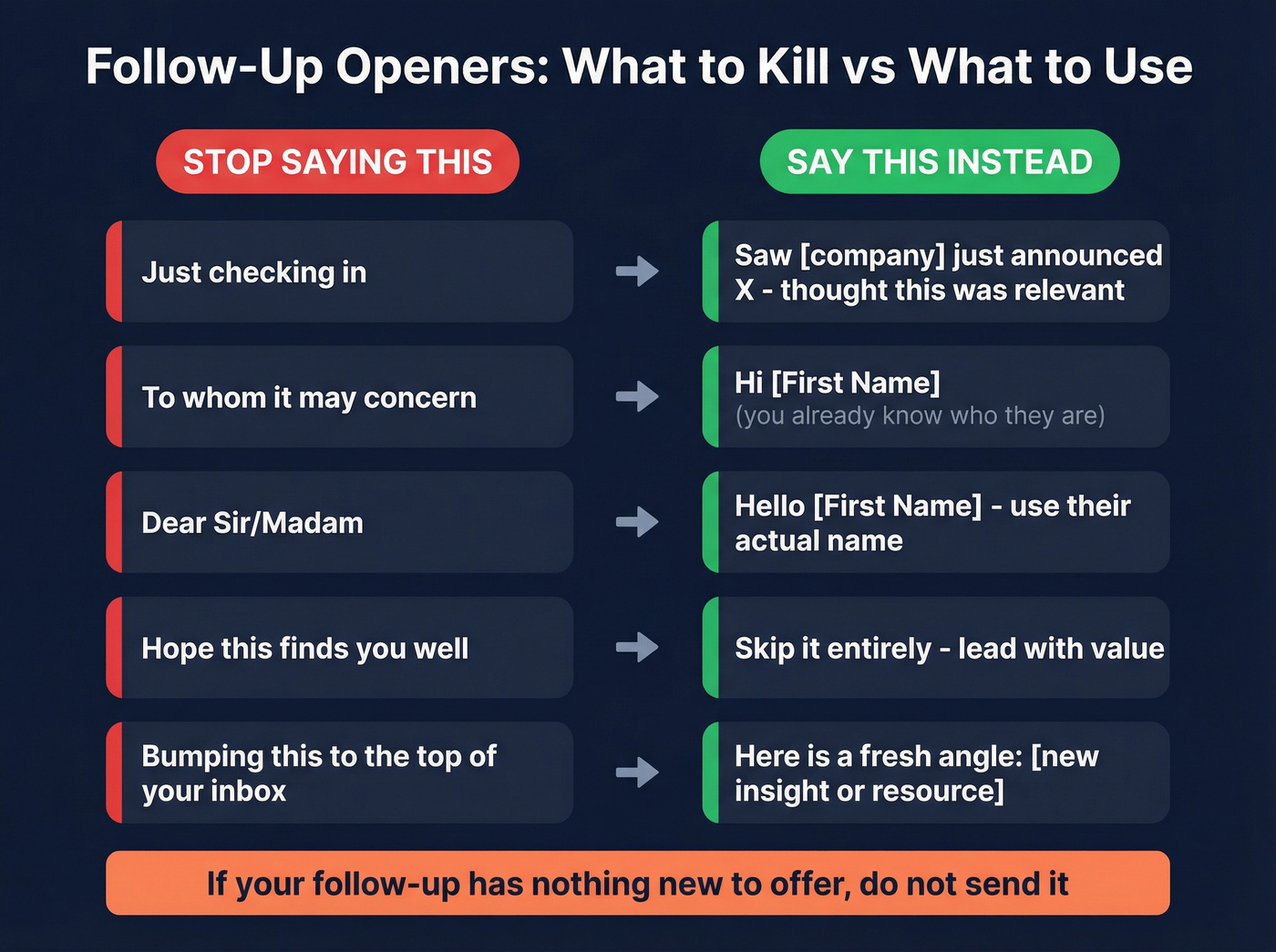
"Just checking in" / "Just following up" - Signals you have nothing new to say. Replace with a specific reason: "Saw [company] just announced X - thought this was relevant."
"To whom it may concern" - In a follow-up, you already know who you're emailing. Use their name.
"Dear Sir/Madam" - If you've already exchanged emails, this feels weirdly distant.
"Hope this finds you well" - The most skipped sentence in professional email. Cut it entirely and lead with value. (If you want better options, see our alternatives.)
"Bumping this to the top of your inbox" - Adding no new information is the fastest way to get ignored. Every follow-up needs a fresh angle.
Here's the thing: if your follow-up has nothing new to offer beyond the greeting, don't send it. A well-timed silence beats a hollow "just circling back" every time.
International Follow-Up Defaults
A few rules save you from awkward missteps across borders.
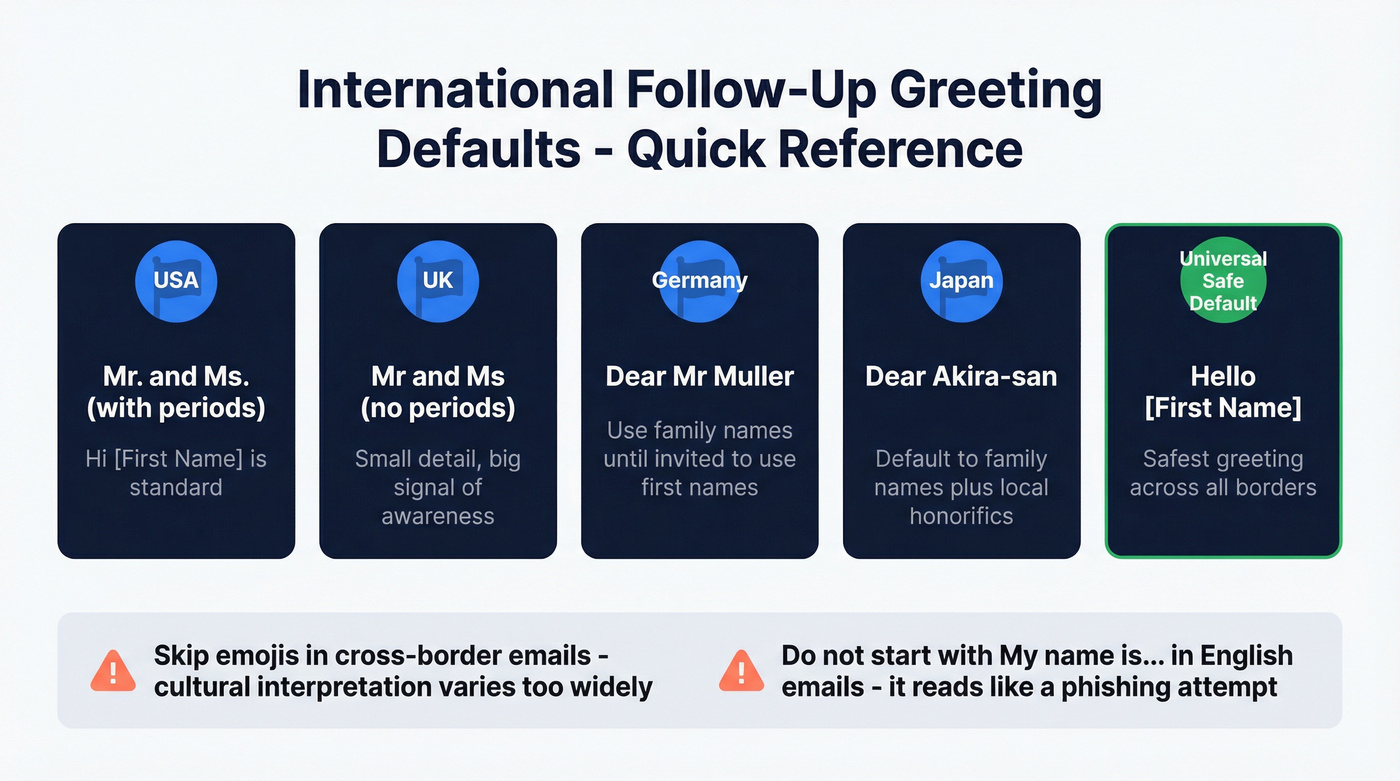
Americans write "Mr." and "Ms." with periods. British English drops them - "Mr" and "Ms". Small detail, but it signals awareness. In Germany and Japan, default to family names until explicitly invited to use first names. If you're writing in English, that often looks like "Dear Mr Muller" or using a local honorific like "Dear Akira-san" in Japan.
Starting with "My name is..." in English-language emails can read like a phishing attempt; lead with why you're writing instead. Skip emojis in cross-border follow-ups - cultural interpretation varies too widely. When in doubt, "Hello [First Name]" is the safest international default.
Thread Etiquette - Re-Greet or Not?
If you're replying within an existing thread, drop the formal greeting. A simple "[First Name] --" or jumping straight into the message mirrors how real conversations work. Plain-text, reply-threaded follow-ups look more human than polished standalone emails.
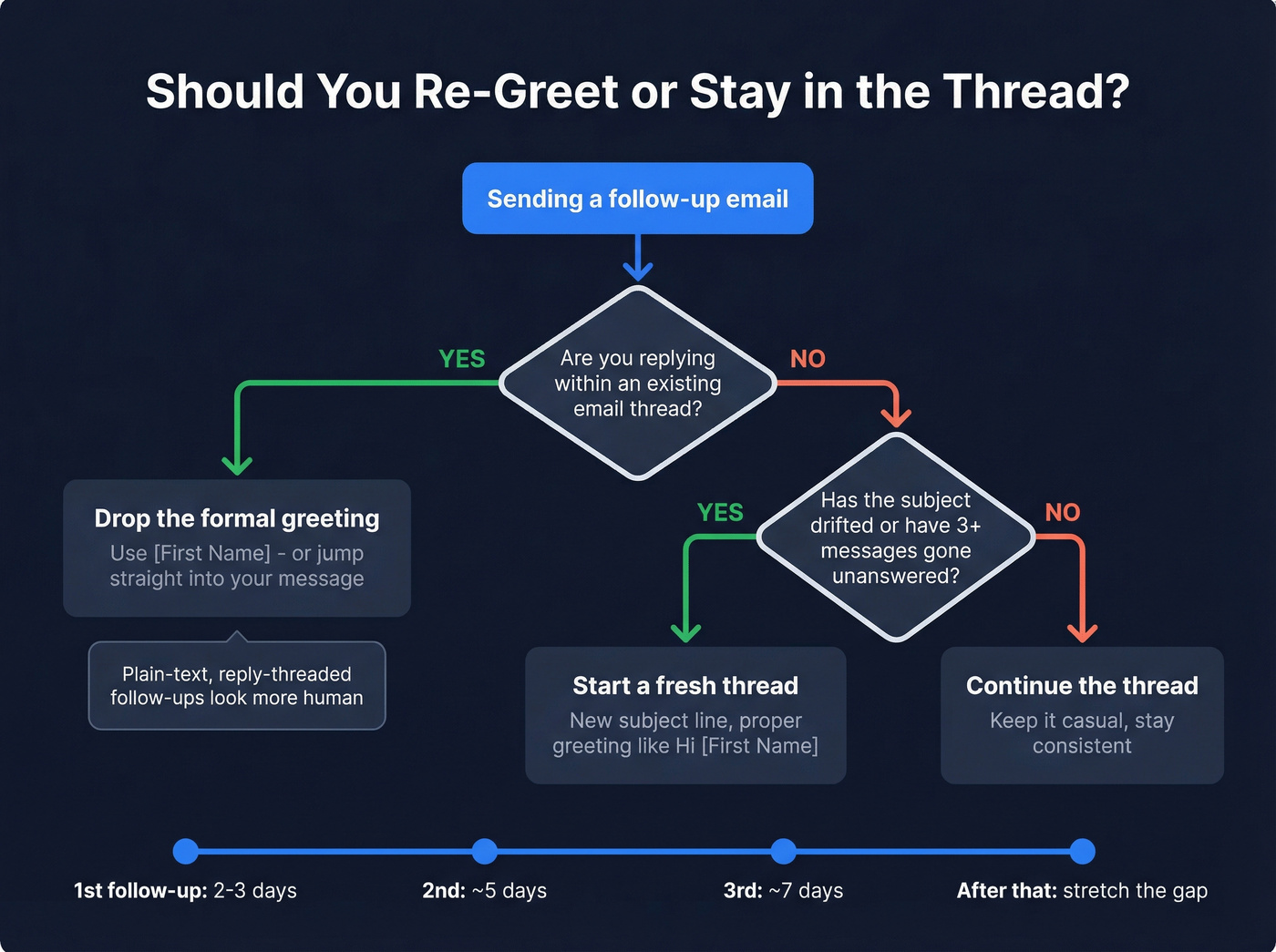
Break the thread and start fresh when the subject line no longer matches the conversation, or when your previous three messages have gone unanswered. A new subject line resets context and gives you a reason to re-greet properly. Timing matters too - send the first follow-up after 2-3 days, the second after about 5 days, and the third after about 7 days, then stretch the gap after that. (For more timing rules, see when should i send the first follow-up.)
Before you send, make sure the address is still valid. A perfectly crafted greeting means nothing if it bounces. We run our outbound lists through Prospeo's verification before every sequence - 98% email accuracy on a 7-day refresh cycle catches stale addresses that other tools miss. If you're comparing options, start with an email validator or a full email deliverability checklist.
You've nailed the greeting. You've written a killer opener. Now make sure you're sending it to the right person. Prospeo gives you verified emails for 300M+ professionals at ~$0.01 each - no contracts, no stale data.
Stop following up with dead inboxes. Start reaching real buyers.
FAQ
What's the safest follow-up email greeting for any situation?
"Hi [First Name]" covers roughly 90% of B2B follow-ups. Switch to "Dear [Title] [Last Name]" for C-suite, academic, or formal cross-cultural contexts where first-name usage hasn't been established.
Should I use a different greeting for each follow-up in a sequence?
Keep the greeting consistent if the recipient hasn't replied - switching from "Dear" to "Hey" across a sequence feels erratic. If they have replied, mirror their tone. Match their energy, don't escalate past it.
Why do my follow-up emails get no replies even with a good greeting?
The email address might be invalid so the message never arrives, the opener adds no new value beyond "checking in," or the timing is off. Fix the data problem first - verify your list so messages actually reach active inboxes. Then make sure every follow-up offers something fresh.
What greeting works best for cold follow-ups to senior executives?
Use "Hello [First Name]" for your first follow-up and "Hi [First Name]" for subsequent ones. Avoid "Dear Sir/Madam" - if you don't know their name, you haven't done enough research. A quick search on the company's website or a tool like Prospeo's Chrome extension can surface verified contact details in seconds. For more structure, use an outreach email template and follow cold email tactics that improve reply rates.