Multi-Source Company Data API: How It Works (2026)
You pull 5,000 target accounts from your CRM, enrich them through your data provider, and 40% of the fields come back empty. No direct dial, no verified email, revenue listed as "unknown." Gartner estimates poor data quality costs businesses $12.9M per year, and most of that damage starts right here: a single data source that can't cover your full ICP.
A multi-source company data API solves this by aggregating independent pipelines into one unified record. Here's how they work, what they cost, and which ones deserve your API key.
What You Need (Quick Version)
- Verified contact data (emails + mobiles): Prospeo - 98% email accuracy, 125M+ verified mobiles, 92% API match rate, 7-day refresh, ~$0.01/lead.
- Raw firmographic scale: Coresignal - 75M+ company profiles, 500+ data fields, Elasticsearch Query DSL queries.
- Multi-source orchestration: Databar - 90+ sources, waterfall enrichment, deduplicated results.
Most teams need contact accuracy more than they need another firmographic database. Pick based on what's actually missing from your pipeline.
What Is a Multi-Source Company Data API?
A single-source data API pulls from one dataset. That dataset has blind spots - geographic gaps, stale records, missing fields for certain company sizes or industries.
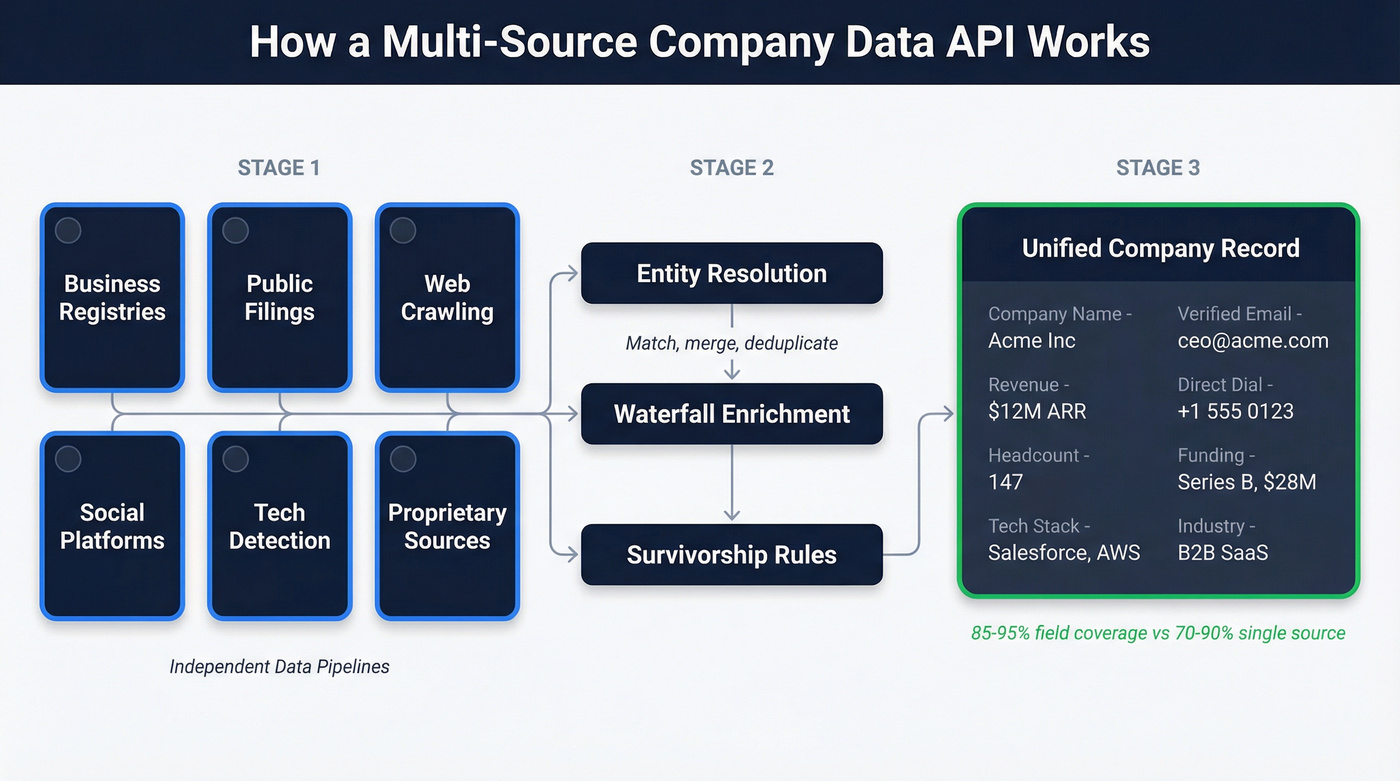
A multi-source company API aggregates data from independent pipelines: business registries, public filings, web crawling, social platforms, tech detection, and proprietary sources. The key distinction is that "multi-source" means genuinely independent data pipelines feeding into one unified record, not a single scraped dataset with supplementary fields bolted on.
This unified enrichment architecture ensures that when one source misses a company's headcount, another fills it. When a third source has a more recent funding round, that value wins. No single provider covers every geography, every company size, and every data point with equal depth. Try pulling verified contacts for a 50-person SaaS company in the Nordics from a single source - you'll get gaps every time.
How Multi-Source Enrichment Works
Waterfall Enrichment
Waterfall enrichment is the sequential querying logic that makes multi-source APIs useful. The API hits its primary data source first. If a field comes back empty - say, the company's phone number or employee count - it falls through to a second source, then a third, until the field is filled or all sources are exhausted.
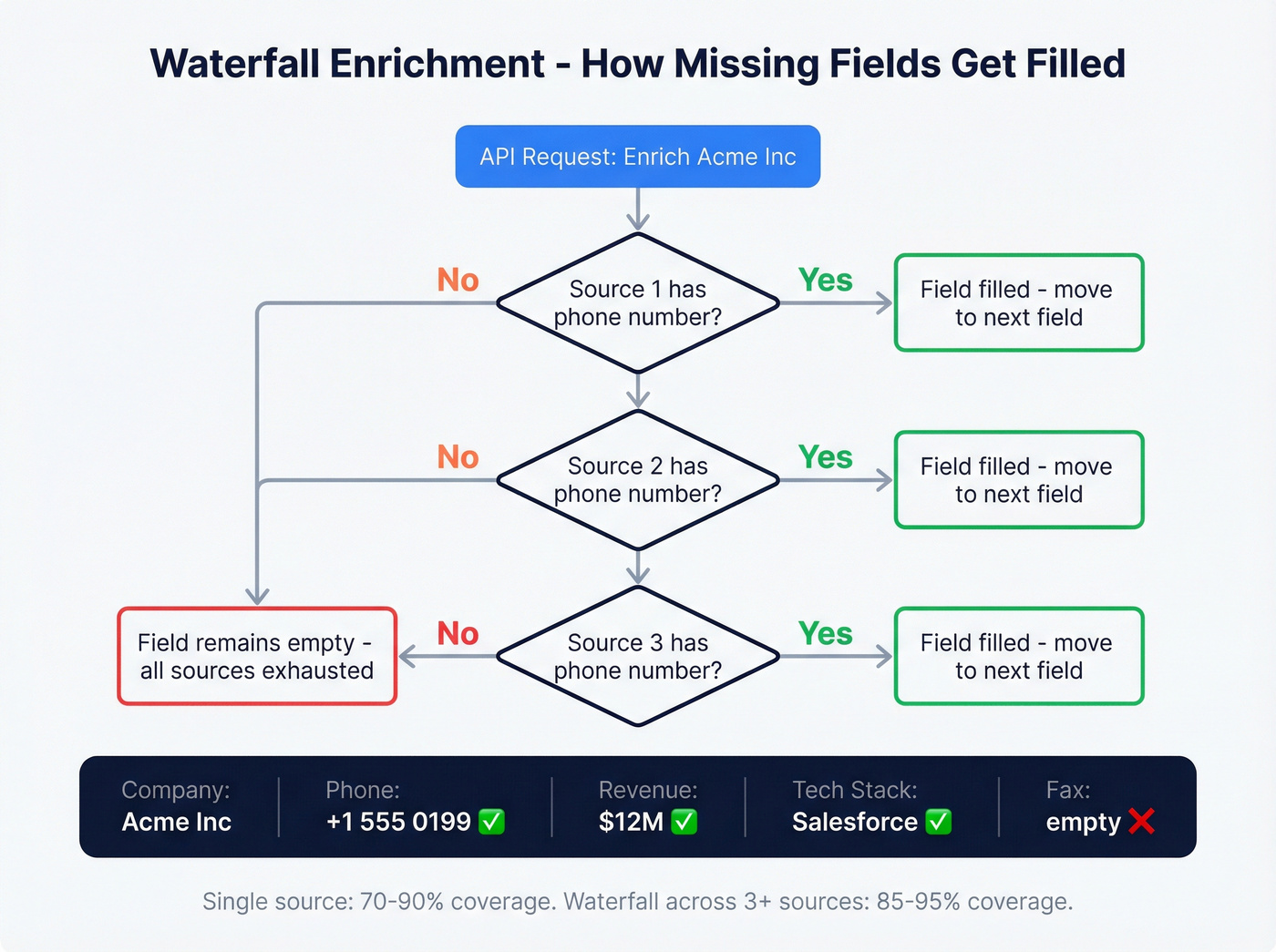
Databar is a solid example of the model: it provides unified access to 90+ data sources through one interface, and waterfall enrichment fills missing fields across providers. The result is a single normalized, deduplicated record that's often more complete than what you'd get from any single provider. Based on typical production benchmarks, single-source providers achieve 70-90% usable field coverage depending on geography, while a well-configured waterfall pushes that to 85-95% on key fields.
Entity Resolution
When you're merging data from multiple sources, you inevitably end up with three records for the same company: "Acme Inc," "Acme, Inc.," and "ACME Incorporated." Experian research shows 94% of businesses suspect their customer and prospect data is inaccurate, and duplicate records are a major reason why.
Entity resolution uses two approaches. Deterministic matching links records by exact identifiers like domain, tax ID, or email address. Probabilistic matching handles fuzzier cases using algorithms such as Levenshtein distance and Jaro-Winkler similarity, then assigns a confidence score to each match. The API then applies survivorship rules to decide which source's value wins for each field: most recent? Most complete? Highest confidence?
The quality of these rules separates good multi-source APIs from ones that just create more mess.

Waterfall enrichment only works when the contact layer is accurate. Prospeo's enrichment API returns 50+ data points per record at a 92% match rate - with 98% email accuracy and a 7-day refresh cycle that's 6x faster than the industry average.
Stop patching gaps with stale data. Start with contacts that connect.
What to Evaluate Before You Buy
Here's the thing: the biggest pain points we hear from practitioners are entity resolution failures, freshness drift between sources, and hidden minimum commits from vendors. Keep these six criteria front and center:
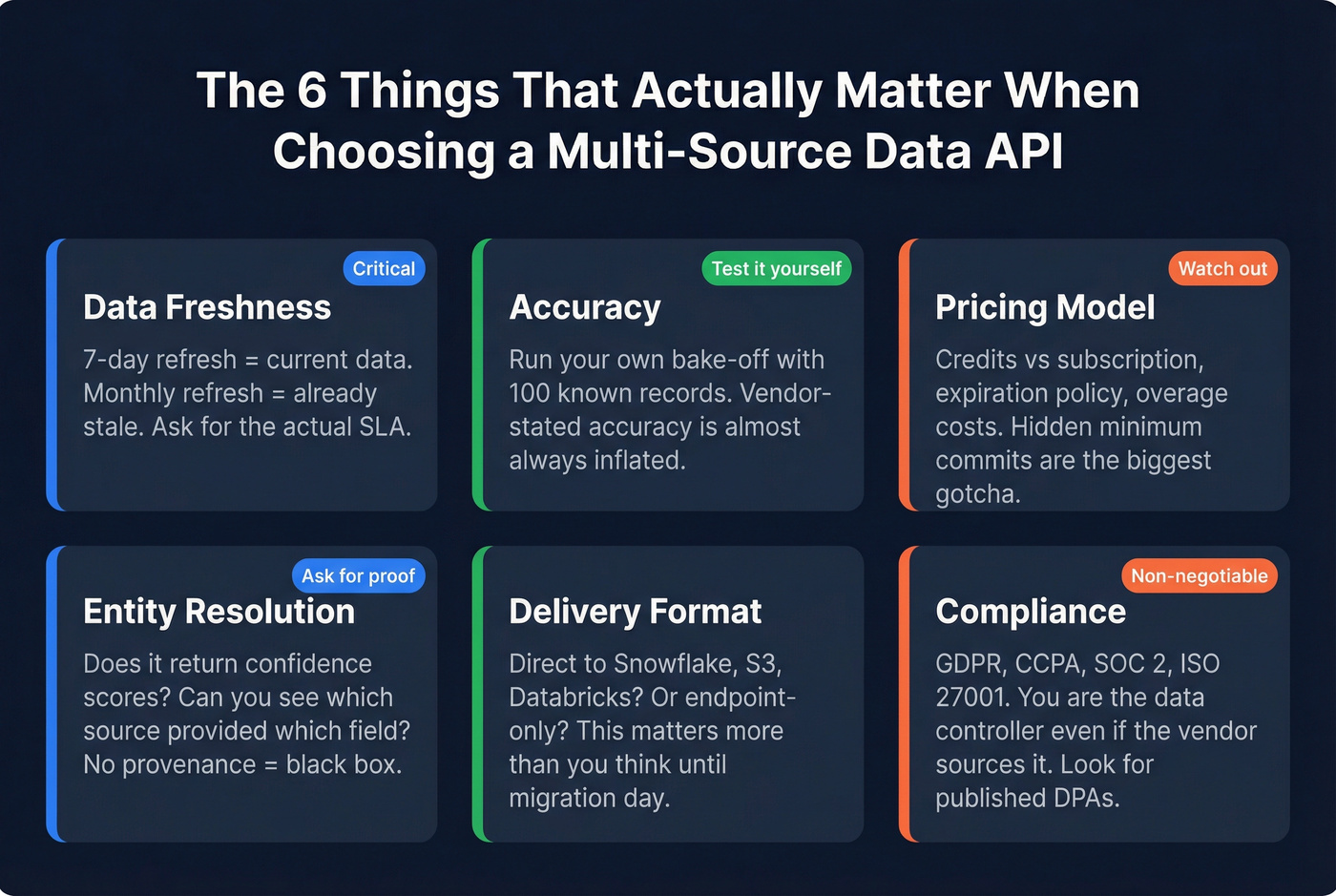
- Data freshness: A 7-day refresh cycle means records are current when you pull them. Monthly or quarterly refresh means they're already stale.
- Accuracy: Email deliverability rates and field coverage by geography are the metrics that matter. Run your own bake-off with 100 known records - vendor-stated accuracy is almost always inflated. (If you need a framework, start with prospect data accuracy.)
- Pricing model: Credit-based vs. subscription, whether credits expire monthly, overage costs, and minimum commits. Hidden minimums are the biggest gotcha in this space.
- Entity resolution quality: Does the API return confidence scores? Can you see field-level provenance showing which source provided which value? Without this, you're trusting a black box.
- Delivery format: Does the API support direct delivery to your data warehouse - Snowflake, S3, Databricks - or only endpoint-level pulls? This matters more than most teams realize until migration day.
- Compliance: GDPR, CCPA, SOC 2, ISO 27001. The API vendor sources the data, but you're still the data controller. Look for published DPAs. (For outbound-specific guidance, see GDPR for Sales and Marketing.)
Best Providers Compared
Tier 1: Contact + Firmographic Leaders
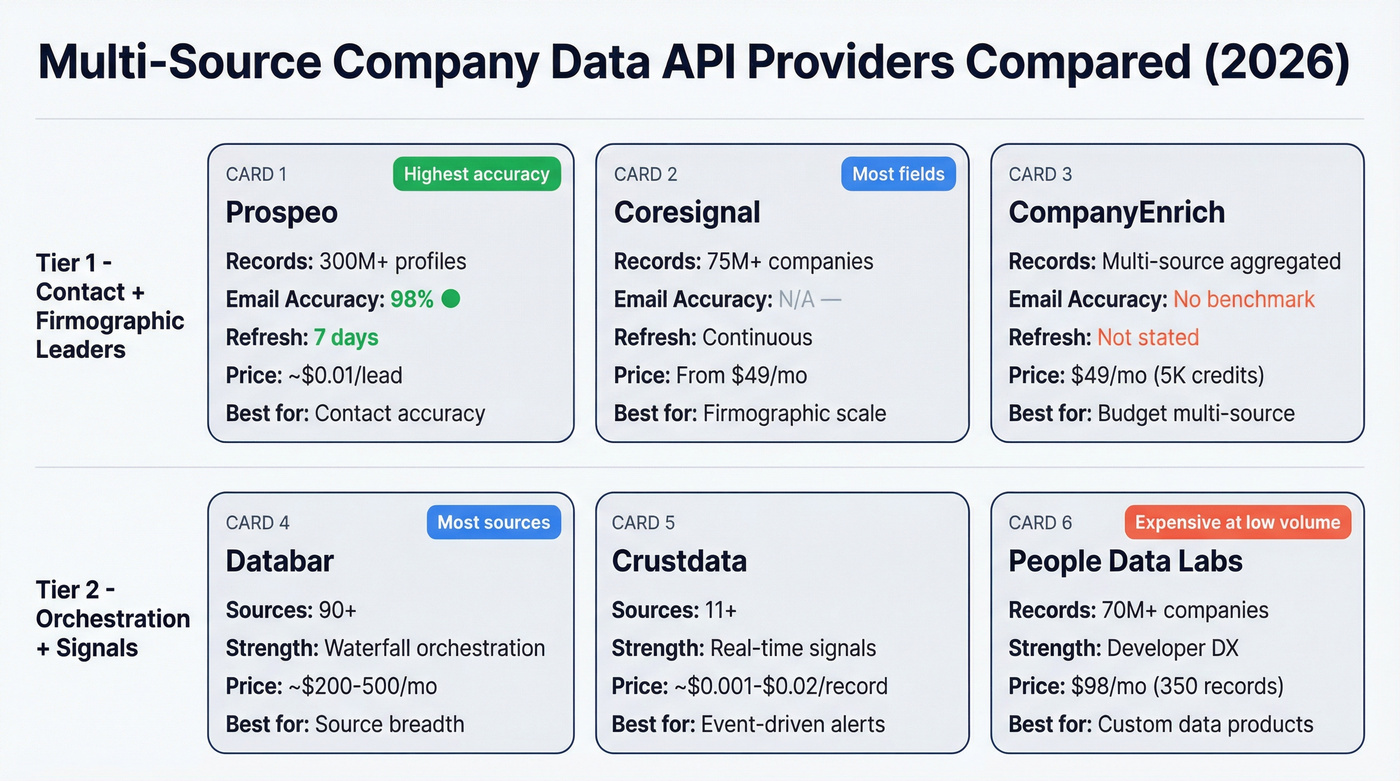
| Feature | Prospeo | Coresignal | CompanyEnrich |
|---|---|---|---|
| Records | 300M+ profiles | 75M+ companies | Multi-source aggregated |
| Email accuracy | 98% | N/A | Verified (no benchmark) |
| Refresh cycle | 7 days | Continuous | Not stated |
| Starting price | ~$0.01/lead | $49/mo | $49/mo (5K credits) |
| Best for | Contact accuracy | Firmographic scale | Budget multi-source |
Tier 2: Orchestration + Signals
| Feature | Databar | Crustdata | People Data Labs |
|---|---|---|---|
| Sources | 90+ | 11+ | Proprietary |
| Key strength | Waterfall orchestration | Real-time signals | Developer DX |
| Starting price | ~$200-500/mo est. | ~$0.001-$0.02/record | $98/mo (350 records) |
| Best for | Source breadth | Event-driven alerts | Custom data products |
Prospeo
Use this if your primary API need is verified contact data - emails and direct dials - not raw firmographic scale. Prospeo's enrichment API covers 300M+ professional profiles with 98% email accuracy, 125M+ verified mobiles, and a 92% match rate returning 50+ data points per enrichment. The 7-day refresh cycle is the fastest in the category, where the industry average sits around 6 weeks.
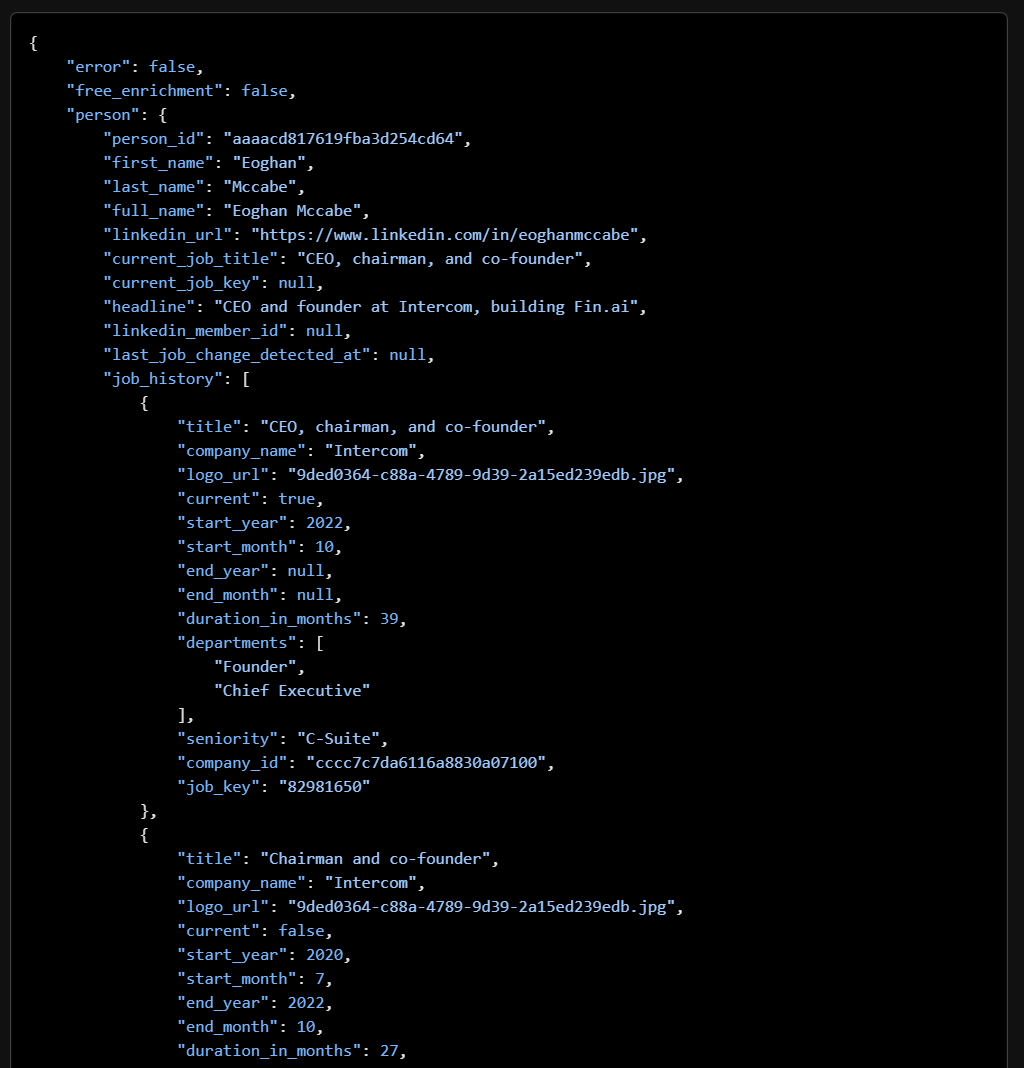
For context, independent bake-off testing found ZoomInfo at 85%, Apollo at 80%, and Cognism at 90% email deliverability - Prospeo's 98% is a category outlier. Pricing runs ~$0.01 per lead, credit-based, no annual contracts. A free tier includes 75 emails and 100 Chrome extension credits per month. Native integrations with Salesforce, HubSpot, Clay, and Zapier mean enriched data flows directly into your existing stack without custom middleware. If you're building outbound sequences, pair this with an email deliverability checklist so the data you buy actually lands.
For deep firmographic data like employee count trends or tech stack changes, pair Prospeo with a firmographic API like Coresignal.
Coresignal
Coresignal is the raw-data powerhouse. Their multi-source company dataset gives you instant access to 75M+ unique company records via API, delivered in JSON format. Each company record contains 500+ data fields, and the API supports Elasticsearch Query DSL for advanced querying - which means you can build extremely specific filters without hitting multiple endpoints.
Pricing starts at $49/mo on a credit-based model, with higher-volume plans scaling into $200-500+/mo. Data refreshes continuously, with daily updates available. We've found Coresignal particularly strong for investment research and market-mapping use cases where you need breadth of firmographic fields over contact accuracy.
Skip this if you need verified contact data. Coresignal doesn't have a contact verification layer.
CompanyEnrich
The most transparent pricing in the category. CompanyEnrich starts at $49/mo for 5,000 credits, with every endpoint's credit cost published clearly: 1 credit per company enrichment, 5 credits for reverse email lookup, 30 credits for a mobile number. Pro ($149/mo, 50K credits) and Scale ($549/mo, 500K credits) tiers include credit rollover - unused credits don't evaporate at month-end. A 500-credit free trial lets you test before committing.
They aggregate from public and proprietary sources including business registries, public filings, web crawling, social platforms, and technology detection. The weakness: no published accuracy benchmarks. You're trusting their aggregation without independent validation.
Skip this if you need proven accuracy numbers before committing. Run a bake-off with your own ground-truth data first.
Databar
The tradeoff with Databar is visibility for breadth. They pull from 90+ data sources and handle waterfall enrichment and deduplication internally, which makes them the closest thing to a single endpoint for multi-source data. For teams that don't want to manage multiple API integrations, that's genuinely appealing.
But you're trusting black-box aggregation and survivorship rules without much insight into which source provided which field. Pricing is custom and consumption-based - expect $200-500/mo for moderate volumes based on comparable orchestration platforms.
Skip this if you need field-level provenance or want to control source priority.
Crustdata
Real-time signals are Crustdata's game - hiring surges, funding events, company changes delivered via webhooks. Their flat-file dataset is unified from 11+ sources and fully refreshed monthly. ProductHunt reviewers give it 4.4/5 across 13 reviews, praising clean API documentation and easy integration.
The caution: signal noise without good filtering can bury your team in alerts that don't convert. Expect developer-tier API costs in the $0.001-$0.02 per record range depending on endpoint and volume.
Skip this if you need large-scale batch enrichment rather than event-driven signals.
People Data Labs
Developer-friendly with 70M+ company profiles. But at $98/mo for just 350 enrichments - roughly $0.28 per record - PDL gets expensive fast at low volumes. Better suited for engineering teams building custom data products than for sales enrichment workflows. For batch enrichment, look elsewhere.
The Two-API Stack
Look, you don't need one API that tries to do everything. You need two APIs and a dedup layer.
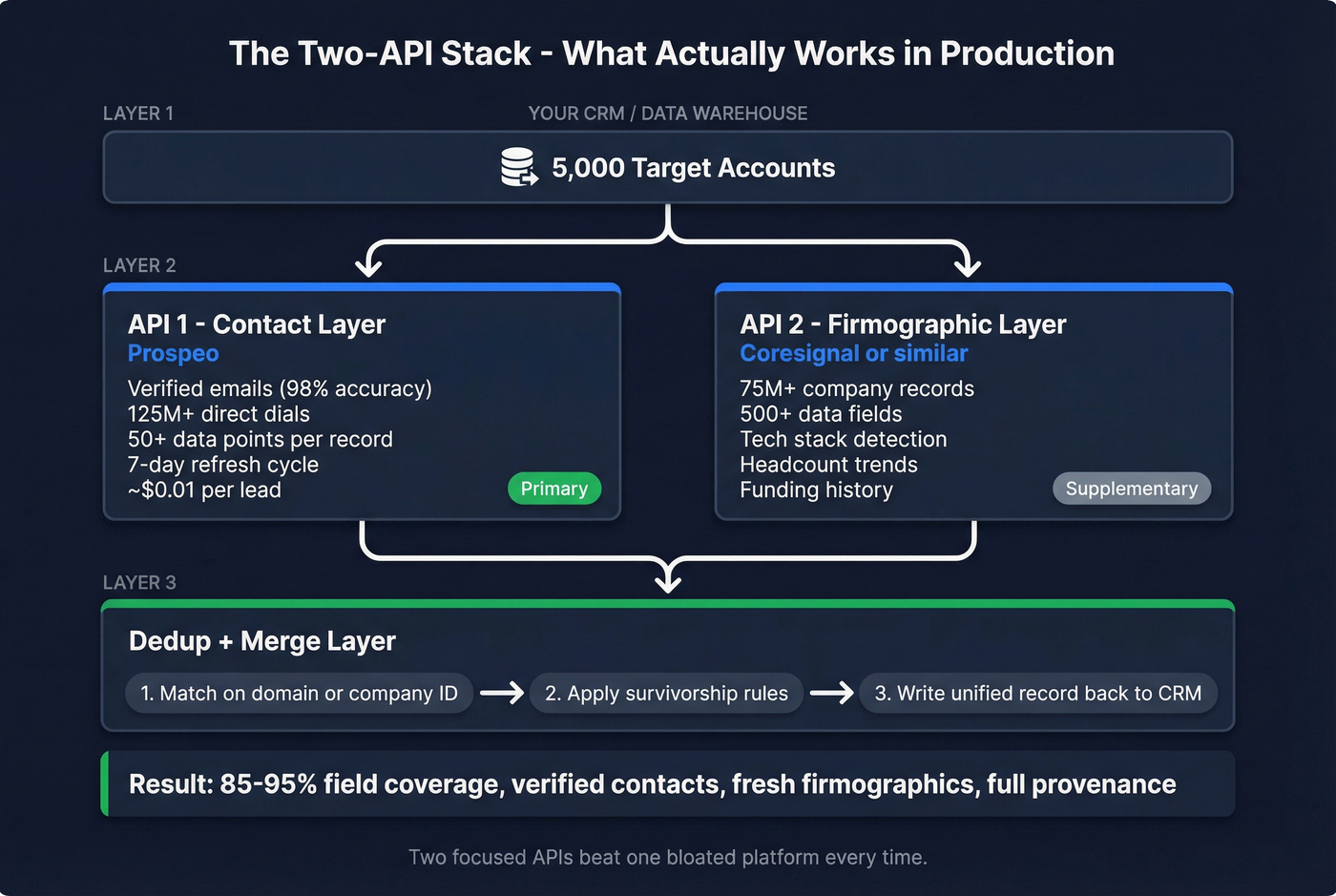
The "unified platform" pitch sounds great in a demo, but in production it means trusting someone else's survivorship rules and having zero visibility into which source provided which field. We've seen teams waste months trying to find the one provider that covers everything, and the consensus on r/sales and r/dataengineering threads echoes this frustration - the all-in-one dream rarely delivers.
Pair a contact-accuracy API with a firmographic or signal API. Handle entity resolution in your CRM or data warehouse using domain as the deterministic key. This gives you full control over data provenance - you know exactly which source provided which field, and you set your own survivorship rules instead of trusting a black-box aggregator. If your average deal size is under $10k, you almost certainly don't need an enterprise-grade all-in-one platform. You need accurate contact data and a clean firmographic feed. That's it. (If your CRM is already messy, start with CRM hygiene before you add more sources.)
Most multi-source stacks solve for firmographic breadth but miss on the data that actually drives pipeline: verified emails and direct dials. Prospeo covers 300M+ profiles, 125M+ verified mobiles, and costs ~$0.01 per lead - no contracts, no minimums.
Add the contact accuracy layer your API stack is missing.
FAQ
What's the difference between multi-source and waterfall enrichment?
Multi-source describes the architecture - multiple independent providers feeding one unified record. Waterfall enrichment is the sequential process of querying those sources until each field is filled. Together they maximize field coverage while minimizing redundant API calls.
How often should company data be refreshed?
For outbound sales, a 7-day refresh cycle is ideal. Monthly refresh means records are weeks stale before you pull them. Always ask vendors for exact cadence per field type, because some providers refresh firmographics quarterly while updating contact data monthly - or vice versa.
Do multi-source APIs handle GDPR compliance?
The vendor sources data compliantly, but you remain the data controller under GDPR. Before signing, confirm SOC 2 Type II certification, ISO 27001 compliance, and published Data Processing Agreements from every provider in your stack. The ICO's guidance on data controllers is worth bookmarking.
What's a good API match rate?
Above 85% is solid for firmographic enrichment. For contact data, 92%+ is top-tier. Always validate against your own ICP, not the vendor's global average - a provider that's strong in North America might fall flat in APAC.