Professional Email Greetings: How to Pick the Right One Every Time
You type "Hey Sarah" - then delete it. Try "Dear Ms. Chen" - too stiff. Settle on "Hello Sarah" and wonder if that's weird. This dance takes 30 seconds, but it feels like five minutes because recipients spend about 5-7 seconds scanning before they decide to keep reading or hit delete. Your professional email greeting is the first thing they process, and in a hybrid workplace where your first impression is often an email - not a handshake - it carries more weight than it used to.
Here's the thing: the greeting matters, but it matters less than you think. The right one takes two seconds to pick once you have a framework. Let's build that framework, then move on to what actually drives replies.
Four Greetings You Need
Four situations, four greetings. Memorize these and stop second-guessing:
- Senior executive, first contact - "Dear [Title + Last Name],"
- Colleague or warm contact - "Hi [First Name],"
- Unsure of formality level - "Hello [First Name],"
- Cold outreach - "Hi [First Name]," plus a strong opening line
Now stop agonizing over the greeting and spend your energy on the opening line. That's where deals are won or lost. If you want plug-and-play options, start with these outreach email templates.
The Decision Framework
The core principle is tone-matching: your greeting should reflect the relationship, the recipient's expectations, and the context. Business Insider's etiquette guidance puts it simply - if someone writes "Dear," respond with "Dear." If they write "Hi," mirror it.
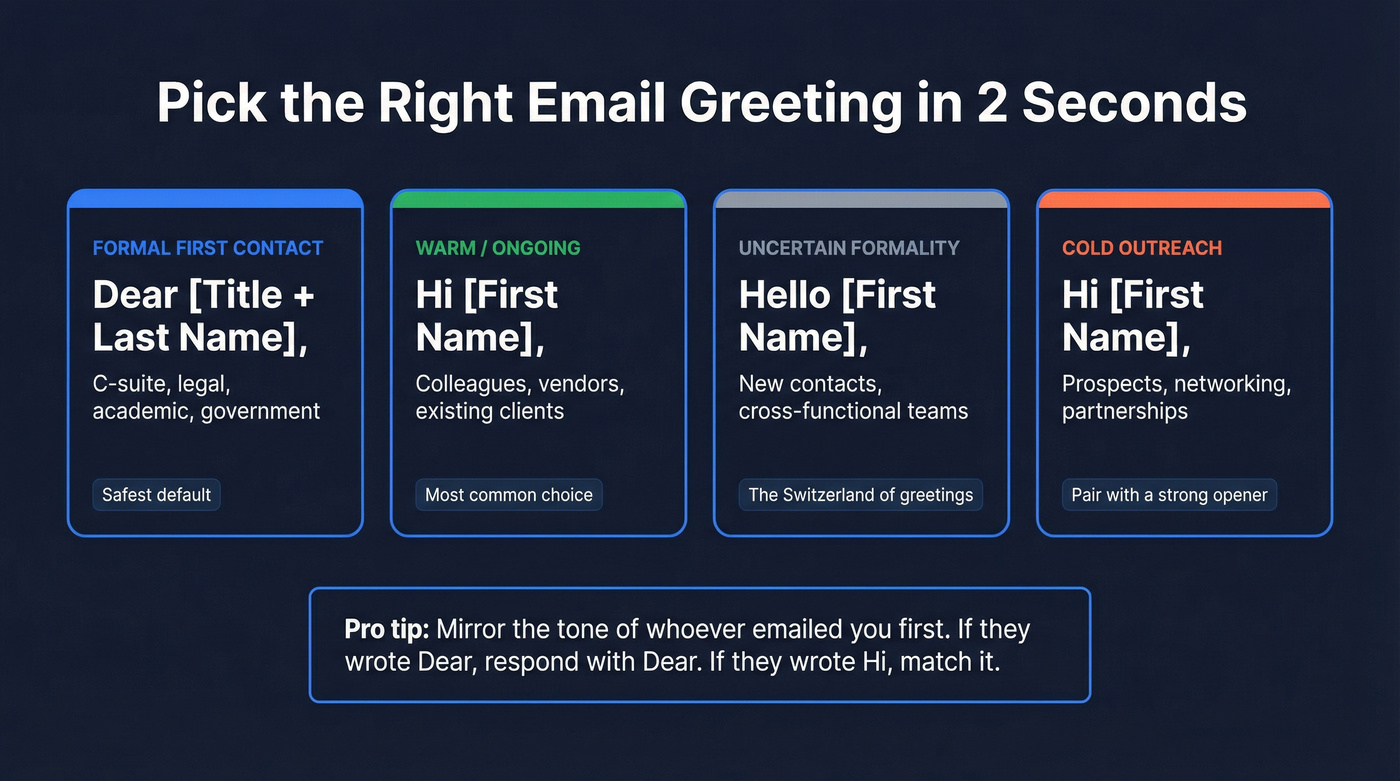
| Situation | Greeting | Why It Works |
|---|---|---|
| First contact, formal | Dear [Title + Last] | Signals respect, safe default |
| Warm / ongoing | Hi [First Name] | Friendly, professional, fast |
| Uncertain formality | Hello [First Name] | Neutral - rarely offends |
| Cold outreach | Hi [First Name] | Approachable, not stiff |
"Hello" is the Switzerland of greetings. Never too casual, never too formal. When in doubt, it's your answer.
Greeting Examples by Scenario
A greeting in isolation is half a job. What follows it - the opening line - determines whether the recipient keeps reading. Below are examples organized by the situations you'll hit most often.
Formal and First Contact
Use "Dear [Title + Last Name]," when emailing a C-suite executive you've never met, a government official, or anyone in legal or academic settings.
Example: "Dear Dr. Patel, I read your keynote remarks at SaaStr and wanted to follow up on your point about pipeline efficiency."
"Good morning [Name]," works when you want warmth without full formality - think a first email to a VP you've been introduced to. Just make sure it's actually morning in their time zone (or use a cold email time zone workflow).
Everyday Professional
"Hi [First Name]," handles most professional emails. It's the default for colleagues, vendors, clients you've already spoken with, and most cross-functional communication.
Example: "Hi Marcus, quick update on the Q3 pipeline numbers - we're tracking 12% ahead of target."
On Slack or Teams, greetings compress further - a quick "Hi Marcus" or even jumping straight to the question is normal. Email still expects the greeting. If you need more examples, see how to start an email.
Group Emails
"Hi Team," for your direct team. "Hello Everyone," for cross-functional groups. "Dear All," for company-wide updates or groups that include senior leadership.
Skip "Hey guys," "Hey all," or anything with "guys" in a group that includes people you don't know well. It reads as careless, not friendly.
Job Applications
"Dear [Title + Last Name]," is the only safe choice when you know the hiring manager's name. "Dear Hiring Manager," works when you don't. Never use "To Whom It May Concern" - it signals you didn't bother to research the company.
Follow-Ups and Replies
The rule: mirror the tone of the previous email. If they signed off with "Cheers, Tom," open your reply with "Hi Tom." In longer threads, greetings naturally drop off after the second or third exchange. That's fine - forcing "Dear Mr. Johnson" into reply number six feels robotic. For more nuance, use these follow-up email greetings.
One exception: if the thread adds a new senior stakeholder, reset to a slightly more formal greeting for that first message they'll see.
Greetings to Avoid (and Why)
"Hey [Name]" - Polarizing. For international contexts, ALA's cross-cultural email etiquette guidance recommends avoiding "Hi" or "Hey" and using "Dear" or "Greetings" instead.
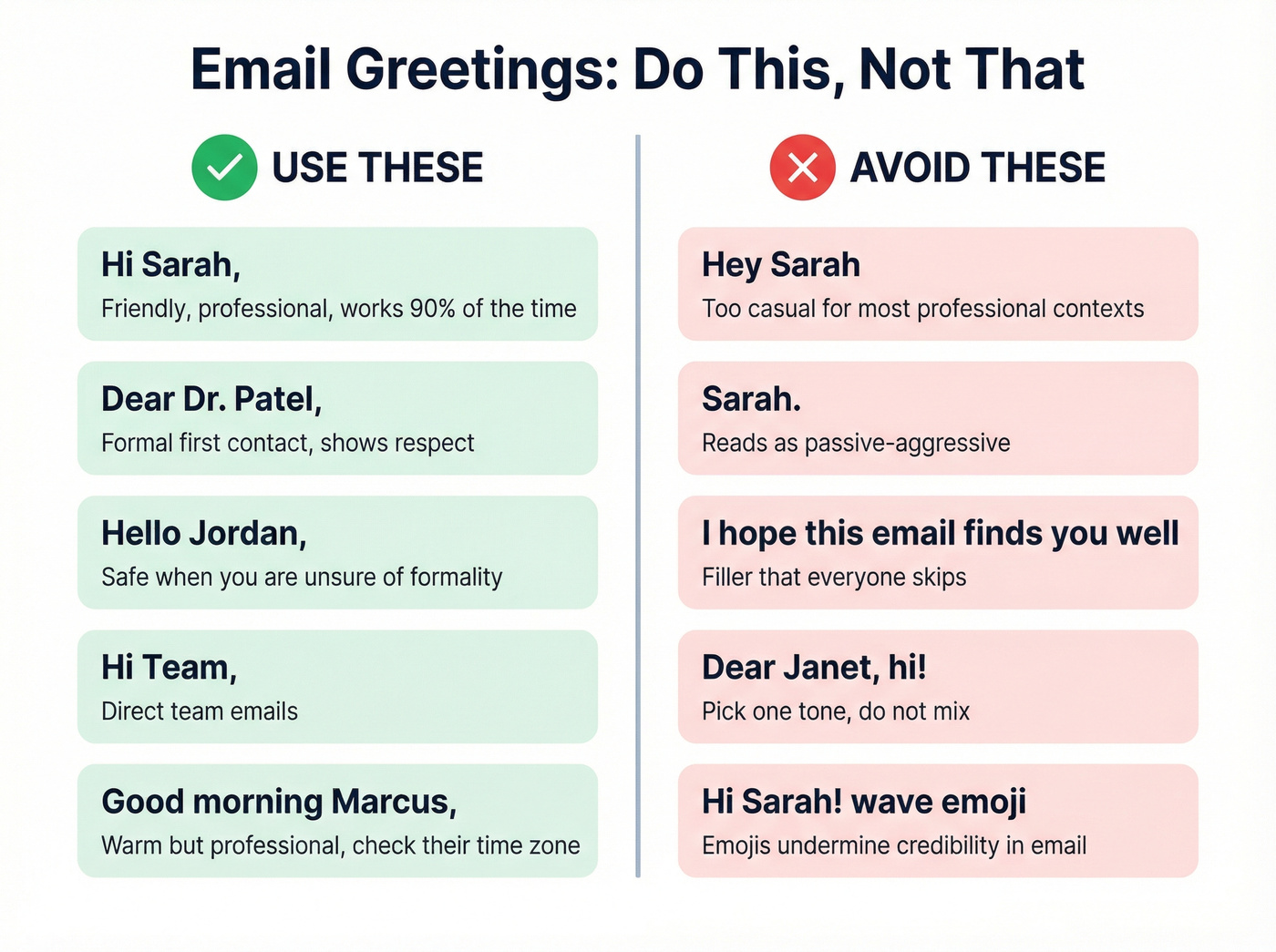
Just the name ("Sarah.") - Starting with just a name and a period reads as passive-aggressive, not efficient. It takes zero extra effort to add "Hi" in front of it.
"I hope this email finds you well" - Filler. Everyone writes it, nobody means it. Lead with substance instead (use these "I Hope This Email Finds You Well" alternatives).
Mixing greetings - Don't write "Dear Janet, hi!" in the same line. Pick one tone and commit.
Emojis in greetings - "Hi Sarah! 👋" works in Slack. In a professional email, it undermines your credibility before you've said anything of substance.

You just nailed the greeting. Now make sure it actually reaches someone. Prospeo gives you 98% verified email addresses from 300M+ professional profiles - so your carefully crafted opening line lands in a real inbox, not a bounce report.
Stop perfecting greetings for emails that never arrive.
International Email Etiquette
With more than 250 billion emails sent daily across every time zone and culture, your greeting norms aren't universal. The direct, first-name American style that feels friendly in Chicago can land as abrupt in Tokyo or presumptuous in Frankfurt.
In Japan, professional emails often open with pleasantries about the weather or the season before getting to business. Skipping this feels rude - like walking into someone's office and immediately making demands. In France, "Mademoiselle" has been phased out in favor of "Madame" for all women, regardless of marital status. Getting this wrong signals you haven't done your homework.
Germany and Switzerland tend to be time-conscious cultures where flagging urgency in the subject line is appreciated rather than seen as pushy. When you're unsure, default to "Dear [Title + Last Name]," and close with "Kind regards." Those are safe across virtually every culture and professional context.
Inclusive Greeting Practices
Don't guess someone's gender or pronouns. If you're unsure whether to use "Mr.," "Ms.," or another honorific, use the person's first name instead. "Hello Jordan," is always safer than guessing wrong with "Dear Mr. Taylor" when Jordan uses she/her pronouns.
"Mx." exists as a gender-neutral honorific. If someone's preferred title is listed on their professional profile or email signature, use it.
The simplest rule: check before you email. Look at their signature block, their company bio, or their professional profile. Two minutes of research prevents an awkward correction email - or worse, no reply at all.
Cold Email Greetings That Get Replies
Look - 71% of cold emails get ignored because they lack relevance, not because the greeting was wrong. And 20% of decision-makers say they've never received a cold email that's actually relevant. That's the bar you're competing against, and it has nothing to do with whether you wrote "Hi" or "Hello." (If you're building a system, start with these cold email tactics.)
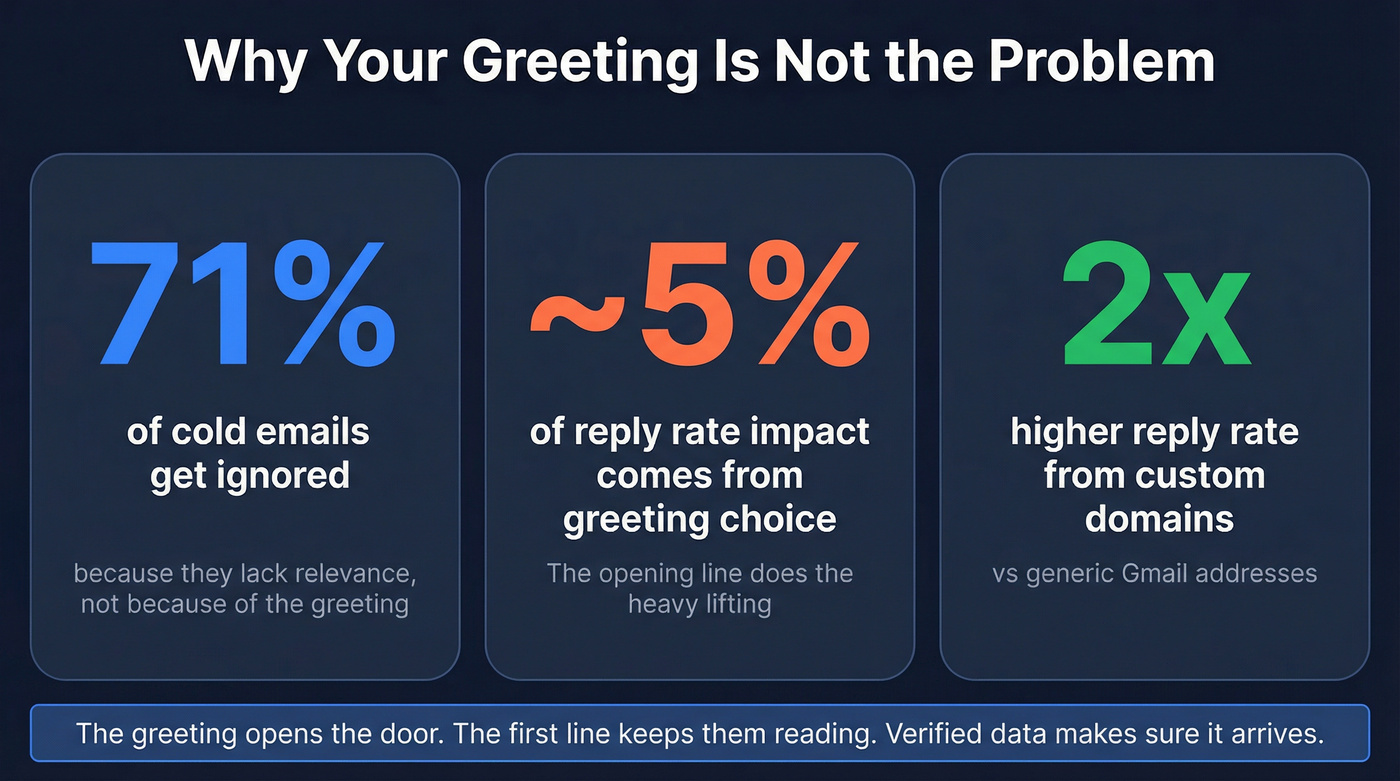
"Hi [First Name]," is the right greeting for cold outreach. It's approachable without being sloppy. "Dear" feels overly formal for someone who didn't ask to hear from you, and "Hey" is too casual for a stranger.
But the greeting opens the door - the first line keeps them reading. You've got that 5-7 second window. Don't waste it on pleasantries. Lead with a trigger event, a mutual connection, or a concrete observation about their business.
We've A/B tested greeting variations across thousands of cold email sequences, and here's what we found: greeting choice has never been the variable that moved reply rates. The greeting accounts for maybe 5% of whether an email gets a response - the opening line does the heavy lifting. Before you obsess over "Hi" vs. "Hello," make sure you're emailing the right person at a verified address. Bad data kills cold outreach before the greeting ever matters, and emails from custom domains get nearly twice the reply rate compared to generic Gmail addresses (here’s a practical email deliverability checklist).
Memorable Openings That Stand Out
Most advice tells you to play it safe. That's fine for formal contexts, but in competitive inboxes - sales outreach, networking, partnership requests - a memorable opening can set the tone before your first line even lands. The trick is standing out without being gimmicky.
A few approaches that work: reference a shared experience ("Hi Sarah - fellow SaaStr survivor here,"), acknowledge the context directly ("Hi Marcus - I know cold emails are a gamble, so I'll keep this short,"), or use a time-specific greeting like "Good afternoon" when you know the recipient's time zone. These small touches signal effort without crossing into unprofessional territory. If you want bolder options, borrow from these funny email openers (used carefully).
Skip the "creative" greetings you see in listicles - things like "Greetings and salutations!" or "Top of the morning!" They're memorable for the wrong reasons. Your goal is to feel human, not performative.
Your Greeting Doesn't Work Alone
The subject line drives the open, the greeting drives the read, and the opening line drives the reply. They're a system, not independent parts. A Mailchimp analysis of 6 million subject lines confirmed what most of us already know - the subject line is the gatekeeper. Your perfect "Dear Dr. Patel" is worthless if the subject line reads "Quick question." (If you’re tuning this part, start with words to avoid in email subject lines.)
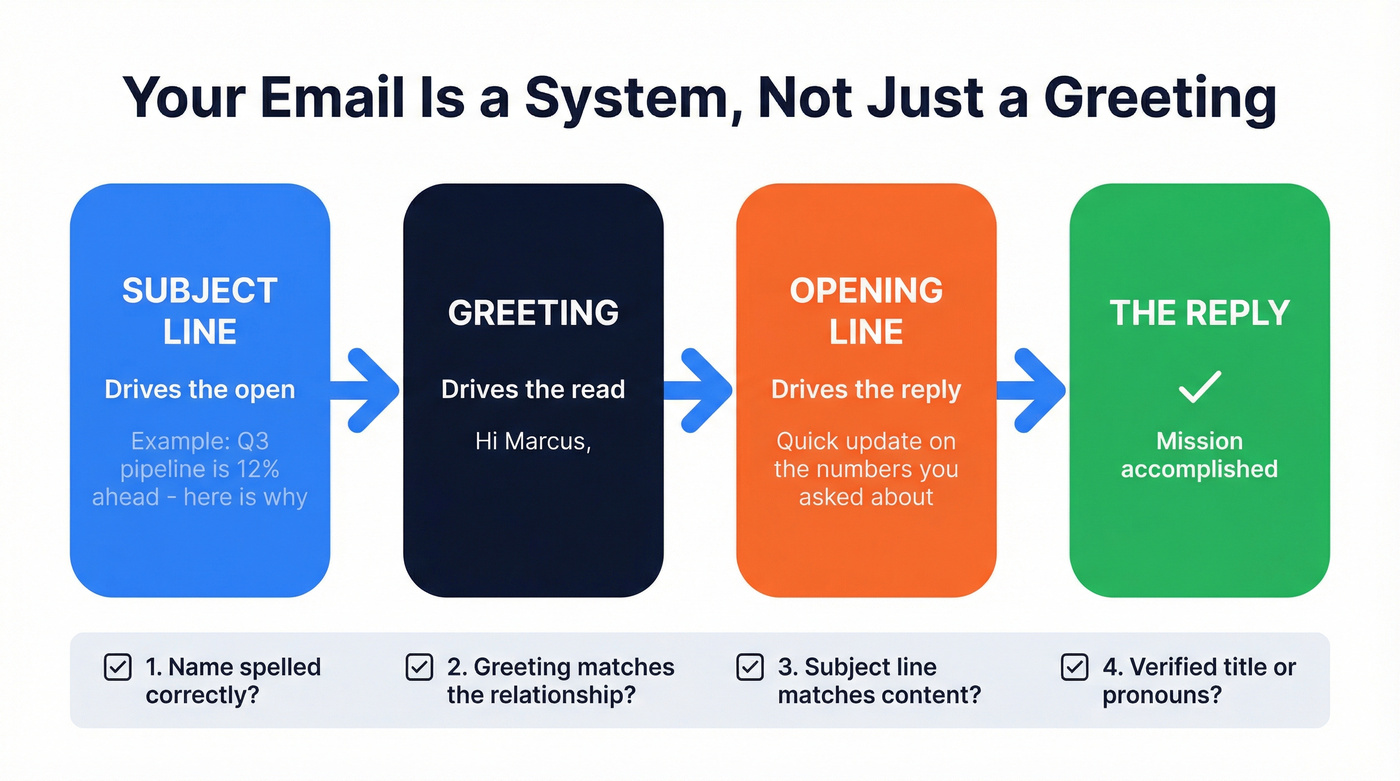
Before you hit send, run through this:
- Is the name spelled correctly?
- Does the greeting match the tone of the relationship?
- Does the subject line align with the email's actual content?
- Have you verified the recipient's preferred title or pronouns?
These four checks take seconds and prevent the kind of mistakes that get you filtered straight to trash.
Stop perfecting the professional email greeting. Start perfecting the system around it.
Cold outreach fails because of bad data, not bad greetings. Prospeo's 7-day data refresh means you're emailing the right person at the right company - with verified contact info that keeps bounce rates under 4%.
Your greeting is ready. Make sure the email address is too.
FAQ
Is "Hi" too casual for professional emails?
No - "Hi [First Name]" is the standard professional email greeting in 2026. Reserve "Dear" for formal first contact with senior executives, legal correspondence, or academic outreach. For everything else, "Hi" is perfectly appropriate and widely expected.
Should I still use "Dear" in 2026?
Yes, but only for first contact with C-suite executives, formal industries like law and government, or cross-cultural emails where formality is the safer default. In everyday professional communication, it reads as overly stiff.
How do I greet someone when I don't know their name?
"Dear [Department] Team" or "Dear Hiring Manager" always beats "To Whom It May Concern." But the better move is to find the name - Prospeo's Email Finder can surface verified contacts from a company URL in seconds. Addressing someone by name measurably improves reply rates.
What's the safest all-purpose email greeting?
"Hello [First Name]," works in virtually every professional context - warm contacts, uncertain formality, cross-cultural emails, and first introductions. It's neutral enough to avoid offending anyone while still sounding personable. When you genuinely can't gauge the relationship, default to "Hello."