How to Start an Email: The Only Guide You Actually Need
You've typed "Hi" and deleted it three times. The cursor's blinking. You know what you want to say - you just can't figure out how to start an email without sounding stiff, lazy, or forgettable. The average professional receives 120-130 emails a day, which means your opener has about two seconds to earn a read. "Hope this email finds you well" isn't going to cut it. You already knew that.
The Quick Version
- Default professional greeting: "Hi [First Name]," followed by one sentence that states why you're writing.
- Cold email: Lead with a specific observation about the recipient - their company, their role, something they published. Generic openers get deleted.
- Apology: Open with the apology itself. Not the backstory, not the context. The apology.
- Unknown recipient: "Hello [Job Title/Team]," - never "To Whom It May Concern." That phrase signals you didn't try.
- International email: Formality varies dramatically by region. See our country-by-country table below.
If that's all you needed, go write your email. For everyone else, let's break down each scenario.
Start With the Subject Line
Your email doesn't start with "Hi." It starts with the subject line - the first thing anyone sees, the thing that determines whether your carefully crafted opener ever gets read at all.
Attentive analyzed over 91 billion subject lines and published their findings in January 2026. The data splits cleanly by what you're optimizing for:
| Goal | Recommended Length | Example |
|---|---|---|
| Maximize opens | Under 25 characters | "Quick question" |
| Maximize conversions | 25-35 characters | "Following up on [topic]" |
A few things surprised us in the data. Emojis hurt performance - no-emoji subject lines outperformed emoji versions across both triggered and campaign emails. Personalization (inserting a first name or product name) only moved the needle on triggered emails, not campaigns. For one-to-one professional emails, keep it short, specific, and emoji-free.
There's a deliverability angle here too. Mailbox providers start treating recipients as "not interested" after roughly six months of no engagement, and if more than about 10% of your send volume goes to that unengaged segment, spam placement becomes much more likely. Worth remembering for follow-up sequences.
Choosing Your Greeting
The greeting sets the tone for everything that follows. Get it wrong and you're either too stiff or too familiar - both create friction.
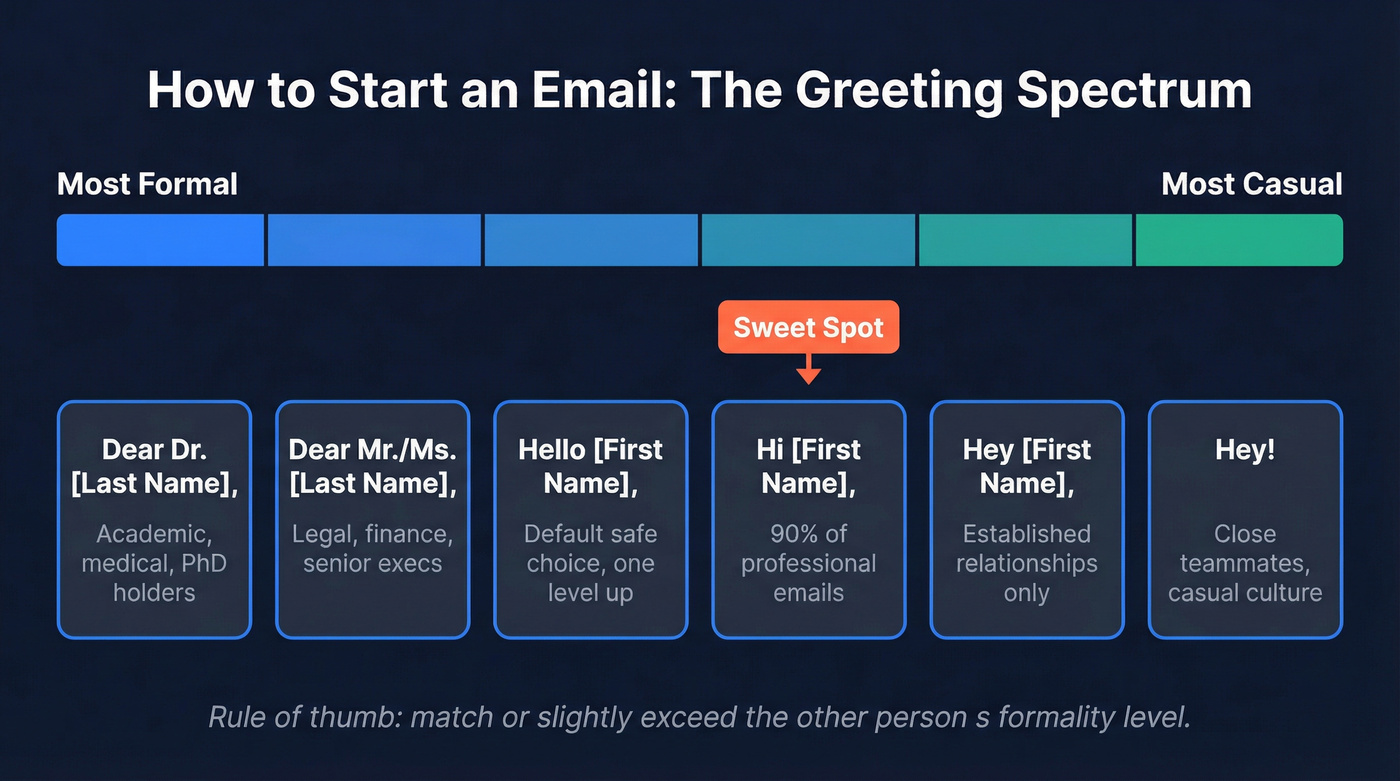
Formal Greetings
Use these for first contact with executives, academic or legal professionals, and international correspondence where you're unsure of cultural norms.
| Greeting | When to Use |
|---|---|
| "Dear Dr. [Last Name]," | Medical, academic, PhD holders |
| "Dear Mr./Ms. [Last Name]," | Legal, finance, first outreach to senior leaders |
| "Dear Professor [Last Name]," | University correspondence |
Formal greetings signal respect, but they also create distance. If you default to formal when the situation calls for semi-formal, you'll come across as cold or out of touch - especially in US tech culture where "Dear Mr. Johnson" reads like a letter from 1997.
Semi-Formal Greetings
This is the 90% default. "Hi [First Name]," or "Hello [First Name]," works for the vast majority of professional emails - warm without being presumptuous, expected without being boring.
"Hello [First Name]," sits slightly more formal than "Hi." Useful when you're writing to someone one or two levels above you, or when you're not sure how casual the culture is. When in doubt, start here and match their energy in subsequent replies.
Informal Greetings
"Hey [First Name]," works when you've got an established relationship, you're writing to a teammate, or the other person has already set an informal tone. The key rule: match or slightly exceed the other person's formality. If they write "Hey," you can write "Hey" back. If they write "Hello," don't jump to "Yo."
Inclusive Language
Skip honorifics like Mr./Mrs. when you're unsure - they can misgender recipients or assume marital status. "Dear Jordan Chen," works perfectly without requiring you to guess.
For group emails, avoid gendered addresses. "Hi guys," "Hi ladies," and "Gentlemen" all exclude someone. "Hi everyone," "Hi team," or "Hi [department] team" are cleaner alternatives that don't make anyone feel invisible. Small change, big signal.
Opening Lines by Intent
The greeting gets you in the door. The opening line determines whether they keep reading.
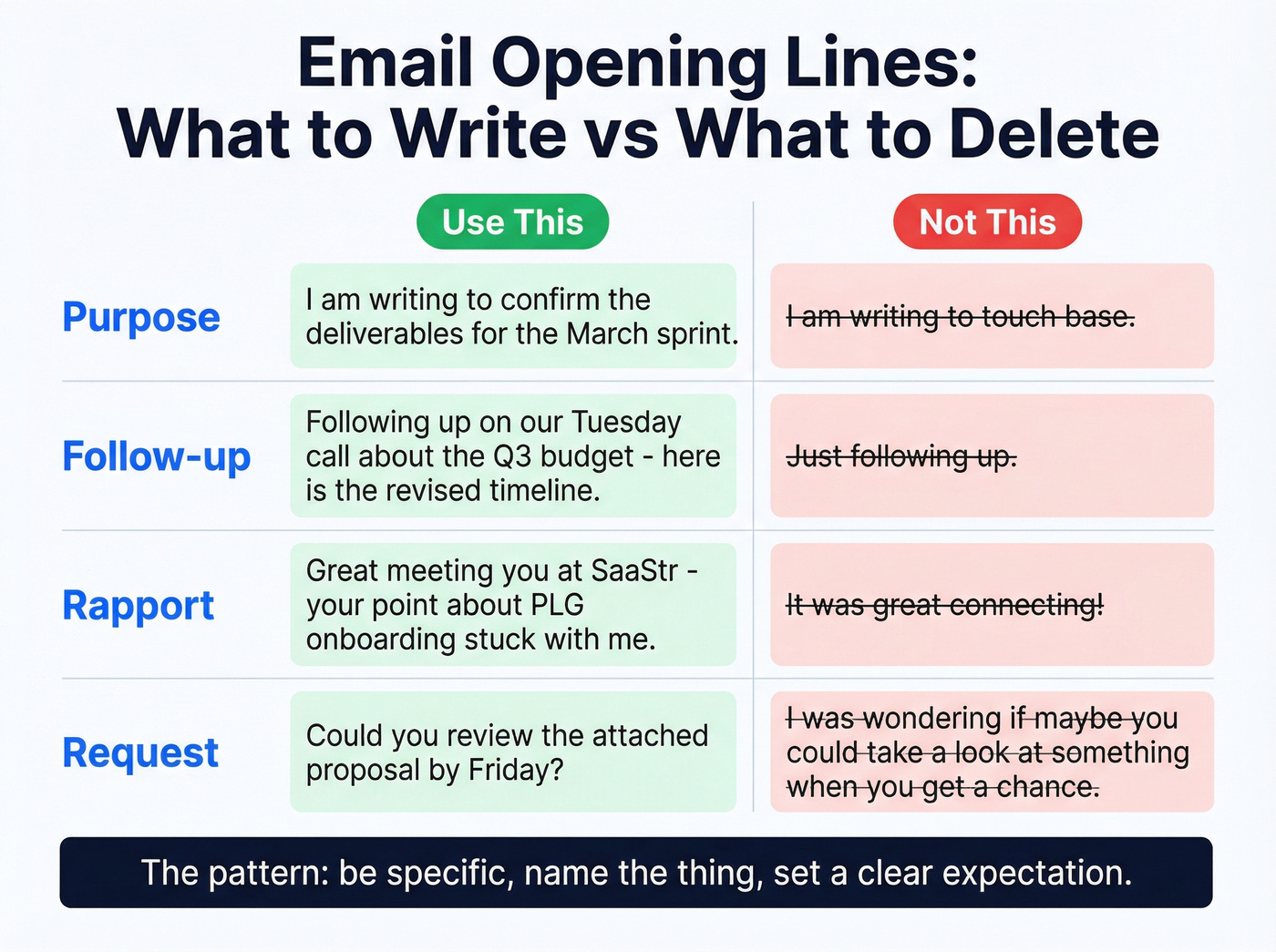
Purpose-driven opener
Use: "I'm writing to confirm the deliverables for the March sprint." Skip: "I'm writing to touch base." Touch base about what? If you can't finish the sentence with something specific, rewrite it.
Follow-up opener
Use: "Following up on our Tuesday call about the Q3 budget - here's the revised timeline." Skip: "Just following up." This forces the reader to remember what you're following up on, and they won't. Always anchor to a date, topic, or document.
Rapport opener
Use: "Great meeting you at SaaStr - your point about PLG onboarding stuck with me." Skip: "It was great connecting!" Connecting where? About what? Rapport openers only work when they reference something real and recent.
Request opener
Use: "Could you review the attached proposal by Friday?" Skip: "I was wondering if maybe you could take a look at something when you get a chance." Direct requests get faster responses. Hedged requests get ignored.
Beyond these pairings, three phrases deserve permanent retirement:
- "Sorry to bother you" - undermines your credibility before you've said anything of substance. If your email is worth sending, don't apologize for sending it.
- "I just wanted to..." - the word "just" minimizes whatever follows. You didn't "just" want something. You want it. Say so.
- "Hope all is well!" - the email equivalent of a limp handshake. Everyone writes it, nobody reads it. The consensus on r/sales is pretty unanimous: it's filler, and recipients can smell it. If you want a better option, see our breakdown of “Hope this email finds you well” alternatives.

Your cold email opener only matters if it reaches a real inbox. Prospeo delivers 98% verified email accuracy across 300M+ professional profiles - so every carefully crafted first line actually gets read. At $0.01 per email, bad data stops killing your outreach.
Stop perfecting openers that bounce. Start reaching real inboxes.
Cold Email Openers That Work
Cold email is a different animal. You're writing to someone who didn't ask to hear from you, doesn't know you, and will decide in roughly two seconds whether to keep reading or hit delete. The opening line isn't just important - it's the entire game.
If you're building a repeatable outbound motion, these cold email tactics will help you turn good openers into consistent replies.
The Four Opener Types
Cold email openers fall into four categories. Each one below includes two copy-paste examples you can adapt.
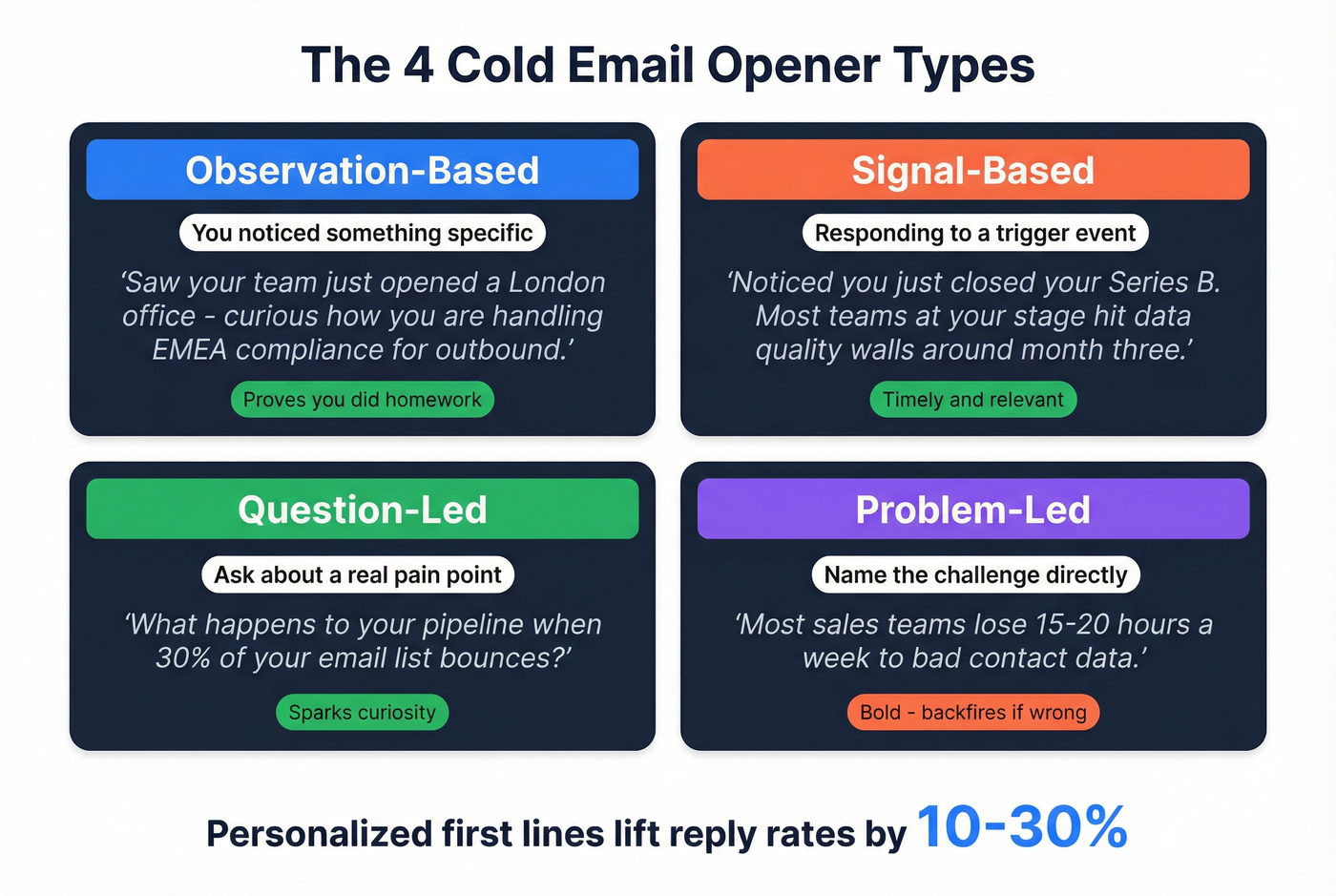
Observation-based: You noticed something specific about the recipient.
"Saw your team just opened a London office - congrats. Curious how you're handling EMEA compliance for outbound."
"Your recent blog post on product-led onboarding nailed a problem we hear from every mid-market SaaS team. Quick thought on scaling that."
This works because it proves you did your homework. The more specific the observation, the harder it is to ignore.
Signal-based: You're responding to a trigger event - a funding round, a new hire, a product launch.
"Noticed you just closed your Series B. Most teams at your stage start hitting data quality walls around month three."
"Congrats on the new VP of Sales hire - saw the announcement this morning. Usually that means outbound is about to ramp. Happy to share what's working for similar teams."
Timely and relevant. Trigger events give you a natural reason to reach out that doesn't feel manufactured.
Question-led: You ask a thought-provoking question tied to a real pain point.
"What happens to your pipeline when 30% of your email list bounces?"
"How is your team handling the shift from MQL-based to signal-based prospecting?"
This works when the question is genuinely interesting, not rhetorical fluff. If the reader's answer is "I don't care," you picked the wrong question.
Problem-led: You name the challenge directly.
"Scaling outbound past 500 emails/week usually breaks deliverability. Here's what we've seen work."
"Most sales teams lose 15-20 hours a week to bad contact data. That number gets worse after Series A when headcount doubles."
Bold, but effective when you've correctly identified the problem. If you're wrong about the pain point, this opener backfires hard.
Personalized first lines lift reply rates by roughly 10-30% compared to generic openers. That's not a small edge - it's the difference between a campaign that generates pipeline and one that generates spam complaints. Your first line also appears in Gmail, Outlook, and Apple Mail preview text, so it's doing double duty as both opener and subject line extension.
Here's the thing about cold email that most guides won't tell you: the opener matters less than the targeting. A mediocre opener sent to the right person at the right time will outperform a brilliant opener sent to someone who doesn't have the problem you solve. Spend 70% of your effort on list quality and timing, 30% on copy.
If you want plug-and-play copy, start with an outreach email template and customize the first line.
Verify Before You Send
A personalized first line only works if it reaches the right inbox. We've seen teams spend hours crafting perfect cold openers, only to watch 25% of their list bounce because the email addresses were stale. That's not just wasted effort - it tanks your sender reputation. If you're troubleshooting bounces, start with the basics of a hard bounce.
Signal-based openers need real-time data. Prospeo refreshes every 7 days - not 6 weeks like competitors - so your trigger events, job changes, and funding signals are actually current when you hit send. 30+ filters help you find exactly who to write to.
Write the perfect opener to the right person with fresh data.
High-Stakes Email Openers
Some emails carry more weight than others. When the stakes are high, the wrong tone in the first sentence can make a bad situation worse.
Apology Emails
Let's say a client is upset because you missed a deadline. The instinct is to explain what happened - the vendor was late, the scope changed, the team was stretched thin. Resist that instinct. Lead with the apology.
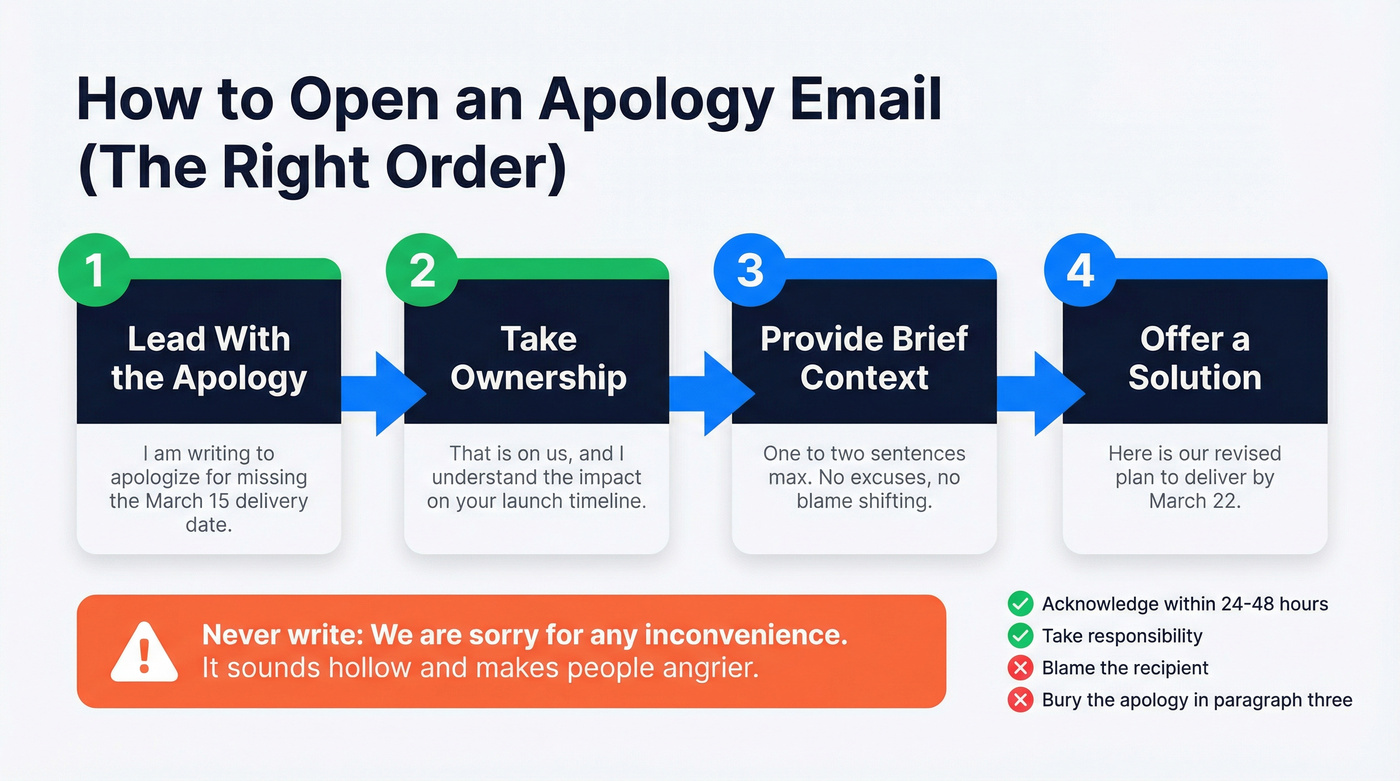
"I'm writing to apologize for missing the March 15 delivery date. That's on us, and I understand the impact it's had on your launch timeline."
Ownership first, context second. Zendesk's guidance on customer apology emails reinforces this: acknowledge within 24-48 hours, take responsibility, and offer a concrete solution. Don't blame the recipient. Don't make excuses. And never use "we're sorry for any inconvenience" - that phrase is so hollow it actually makes people angrier.
Delivering Bad News
Budget cuts, project cancellations, timeline changes - these emails require directness paired with empathy. Don't bury the bad news in paragraph three.
"I need to let you know that we're reducing the Q3 project budget by 20%. I know this affects your team's plans, and I want to walk through what this means for deliverables."
Open with the news, acknowledge the impact, then immediately pivot to next steps. The worst thing you can do is make the reader wade through three paragraphs of context before they find out what actually happened.
Cross-Cultural Email Greetings
Cultural missteps in email don't just create awkward moments - they slow decision-making and damage trust in international business relationships. The three core principles are respect, consideration, and honesty, but how those principles show up varies dramatically by region.
| Region | Default Greeting | Formality | Common Mistake |
|---|---|---|---|
| US | "Hi [First Name]," | Semi-formal | Too formal reads as cold |
| UK | "Hi [First Name]," | Semi-formal | Overly casual too soon |
| Germany | "Dear Mr./Ms. [Last Name]," | Formal | Using first names early |
| Japan | "Dear [Last Name]-san," | Very formal | Skipping titles |
| India | "Dear [Mr./Ms. Last Name]," | Formal first, relaxes | Assuming informality |
| Middle East | "Dear [Title] [Last Name]," | Formal | Rushing past pleasantries |
| Latin America | "Dear [First Name]," | Warm formal | Being too transactional |
When you're unsure, err on the side of formality. You can always dial it back once the other person sets a more casual tone. Going the other direction - too casual on first contact - is much harder to recover from. A German executive who receives "Hey Klaus!" from a stranger isn't going to be charmed by your informality. They're going to question your professionalism. Harvard Business Review's guide to cross-cultural communication covers this dynamic in more depth.
Greetings and Openers to Avoid
Let's be direct about what doesn't work, why, and what to use instead.
"Hope this email finds you well" - This phrase is on autopilot. It signals you couldn't think of anything real to say, so you defaulted to filler. → Use instead: Jump straight to your reason for writing. "I'm reaching out about..." respects their time more than fake pleasantries.
"To Whom It May Concern" - In 2026, with every professional profile a search away, this reads as lazy. It tells the reader you didn't spend 30 seconds finding a name. → Use instead: "Hello [Job Title] team," or "Hello [Department] team."
"Sorry to bother you" - You're telling the reader your own email isn't worth their time. If that's true, don't send it. → Use instead: "Quick question about [topic]" or simply start with your purpose.
"Dear Sir or Madam" - Dated and non-inclusive. It assumes a binary that doesn't reflect modern workplaces. → Use instead: "Dear [Full Name]," or "Hello [Full Name]," - no honorific needed.
"Dear [Enter Name Here]" - This happens more than you'd think. Template errors are instant credibility killers. → Use instead: Literally anything that proves a human wrote this email. Triple-check your merge fields.
Pre-Send Checklist
Before you hit send, run through these five checks:
- ✅ Recipient's name spelled correctly?
- ✅ Greeting matches the relationship and context?
- ✅ First line states your purpose clearly?
- ✅ Subject line under 35 characters?
If you're sending sequences, use an email deliverability checklist to avoid silent spam-folder failures.
FAQ
How do you start an email to someone you don't know?
Use "Hello [Full Name]" or "Hello [Job Title]" when you can't find a name. Skip "To Whom It May Concern" - it signals zero effort. Lead your opening line with why you're reaching out and how you found them. A brief, specific reason for writing earns more goodwill than any generic greeting.
How do you start a formal email?
"Dear [Mr./Ms./Dr. Last Name]," followed by a purpose-driven opening line like "I'm writing regarding..." Reserve this level of formality for first contact with executives, legal or medical professionals, or international correspondence where cultural norms are unclear. Over-formalizing a casual relationship creates unnecessary distance.
How do you start an email after no response?
Reference your previous email specifically: "Following up on my March 10 email about the vendor proposal." Then add new value - a relevant insight, an updated timeline, or a refined ask. A follow-up that just says "bumping this" gives the reader no new reason to respond. Make the second email worth opening on its own.
What's the best cold email opening line?
Lead with something specific about the recipient - a recent company milestone, content they published, or a challenge common to their role. Personalized first lines outperform generic ones by 10-30% in reply rates. Before sending, verify addresses with a tool like Prospeo so your opener actually reaches the inbox.
What's the best way to start a professional email?
"Hi [First Name]," followed by a clear statement of purpose works across nearly every professional context. It balances warmth with directness. If you're unsure about formality, default to "Hello [First Name]," - it's slightly more polished and gives you room to adjust in later replies.