Dolibarr vs Odoo in 2026: The First Comparison Not Written by Someone Selling You One of Them
You Google "dolibarr vs odoo" and the first five results are written by Odoo implementation partners or Dolibarr module vendors. The Odoo partner says Odoo is "clearly the superior choice." The Dolibarr module shop says Dolibarr is "the smart pick for SMEs." Shocking.
We don't sell or implement either platform. We've run invoicing workflows in both dashboards, dug through G2, Capterra, and GetApp review data, and pulled real pricing numbers - including the price hike Odoo quietly pushed in January 2026. Here's what we found.
30-Second Verdict
Choose Dolibarr if: You're under 10 people, want zero software cost, and can tolerate a UI that looks like it was designed in 2012. Self-hosted setup takes days, not months.
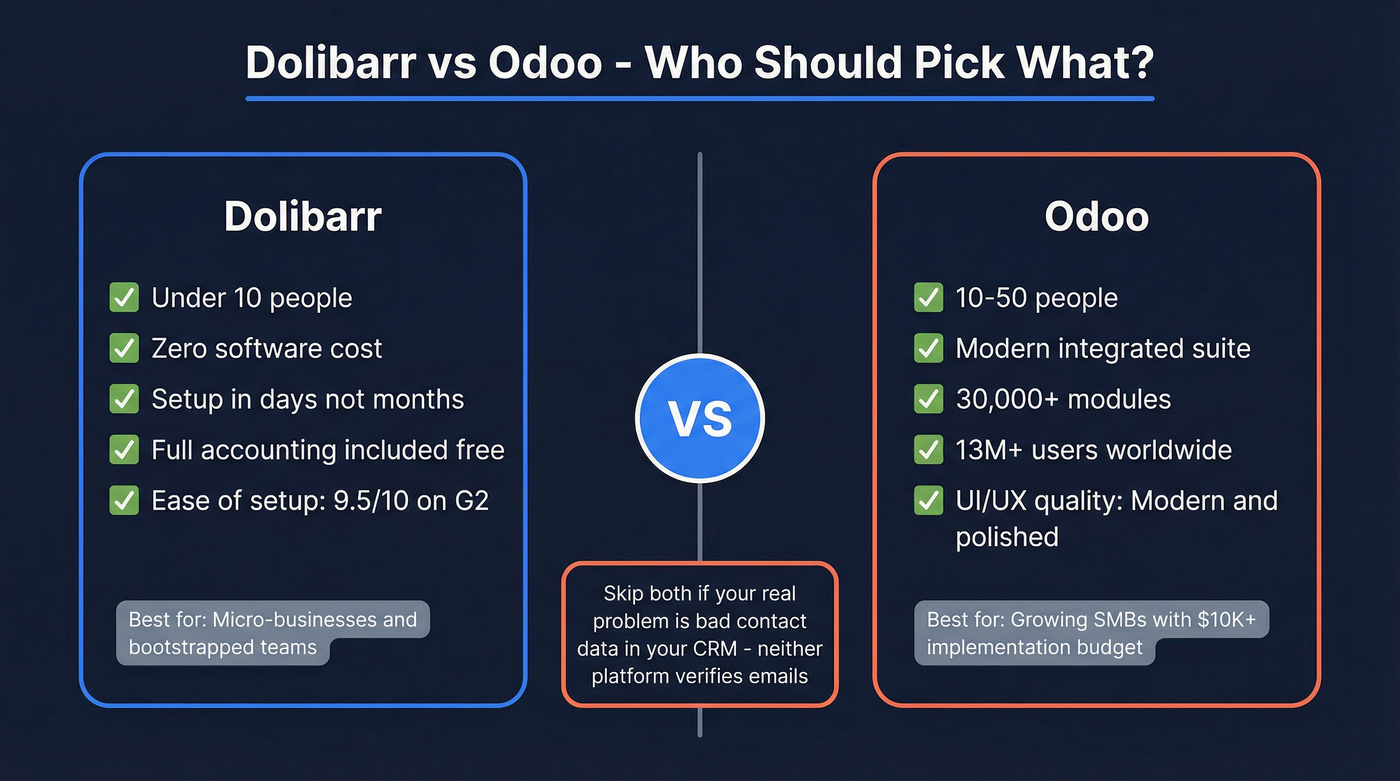
Choose Odoo if: You're 10-50 people, need a modern integrated suite (accounting + CRM + inventory + eCommerce), and have $10K+ budgeted for implementation. The product is genuinely good - the price tag is the problem.
Skip both if: You need robust manufacturing with a modern interface (look at ERPNext). Or if your real problem isn't ERP at all - it's that your CRM contacts are garbage. Neither Dolibarr nor Odoo verifies whether the email addresses in your contact database actually work.
The 60-Second Comparison Table
Here's the side-by-side snapshot. I've picked a winner per row where there's a clear one.
| Dimension | Dolibarr | Odoo | Edge |
|---|---|---|---|
| Price (self-hosted) | $0 | $0 (Community) | Tie |
| Price (cloud) | ~€14-15/user/mo | ~$24-37/user/mo | Dolibarr |
| Ease of setup (G2) | 9.5/10 | 7.8/10 | Dolibarr |
| User base | ~1M users | 13M+ users | Odoo |
| Module count | 1,000+ | 30,000+ | Odoo |
| Deploy time | Days | Months | Dolibarr |
| Mobile app | Basic | Modern (Enterprise) | Odoo |
| Included accounting | Free, full module | Enterprise only | Dolibarr |
| Open-source license | GPL v3+ | LGPL (Community) | Tie |
| UI/UX quality | Dated | Modern | Odoo |
| Product direction (G2) | 8.6/10 | 9.0/10 | Odoo |
The table tells the core story: Dolibarr wins on cost and simplicity. Odoo wins on breadth and polish. Everything else is nuance - and the nuance matters a lot.
Odoo's user base is 13x larger, which means more modules, more partners, more Stack Overflow answers. But Dolibarr's ease-of-setup score is a full 1.7 points higher on G2, and that gap tells you everything about the complexity difference. You can have Dolibarr running invoices by Friday. An Odoo Enterprise deployment with a partner? That's a quarter-long project.
The Product Direction score is worth watching: Odoo at 9.0 vs Dolibarr's 8.6 reflects a larger R&D team and faster feature cadence. Odoo is moving faster. Whether that speed benefits you depends entirely on whether you're paying for Enterprise.

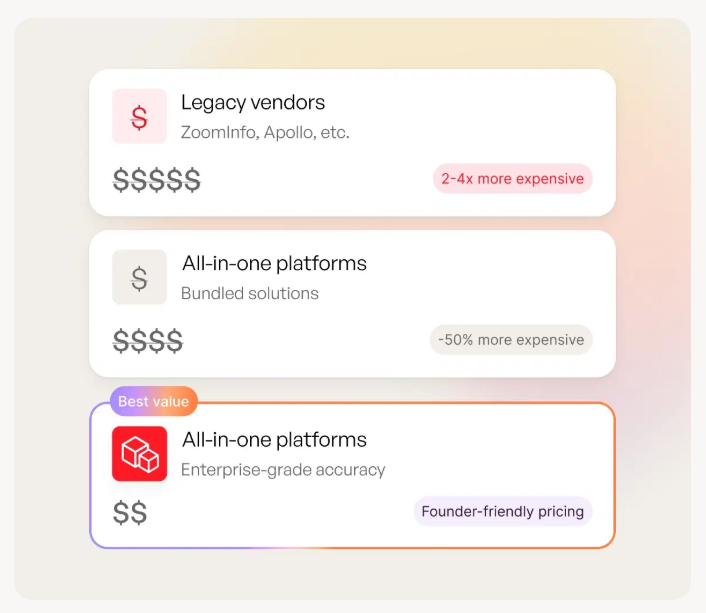
You're comparing ERPs to manage contacts, invoices, and pipelines - but neither Dolibarr nor Odoo verifies whether the emails in your database actually work. Prospeo gives you 98% verified emails across 300M+ profiles, with a 7-day refresh cycle. That's data your ERP can actually use.
Stop feeding bad contacts into a good ERP. Start with verified data.
The "Free Odoo" Trap - Community vs Enterprise
Here's the thing: when someone says "Odoo is free," they're technically correct and practically misleading. Odoo Community Edition exists. It's open-source. You can self-host it. But the feature gaps between Community and Enterprise are enormous - and they're designed to be.

What's locked behind the Enterprise paywall:
| Feature | Community | Enterprise |
|---|---|---|
| Full accounting | ❌ Basic invoicing | ✅ |
| AI bill scanning (OCR) | ❌ | ✅ |
| Barcode scanning | ❌ | ✅ |
| Helpdesk w/ SLAs | ❌ | ✅ |
| Marketing automation | ❌ | ✅ |
| Mobile apps | ❌ | ✅ |
| Odoo Studio | ❌ | ✅ |
| VoIP / IoT | ❌ | ✅ |
| PLM / Quality | ❌ | ✅ |
Accounting is the dealbreaker for most businesses. Community only offers basic invoicing - no balance sheet, no P&L, no bank reconciliation, no analytical accounting. If you need to produce financial statements (and if you're running a real business, you do), you're either paying for Enterprise or bolting on third-party extensions that break with every upgrade.
Contrast that with Dolibarr, where every feature is free. All of them. You enable or disable modules from a settings page - no paywalls, no "upgrade to unlock" prompts. The full accounting module, inventory management, CRM, project tracking - it's all included in the self-hosted package. Dolibarr's accounting is complete and functional, though it lacks the OCR and multi-entity consolidation depth of Odoo Enterprise.
One Reddit user evaluating both platforms for a 2-person video business put it bluntly: Odoo's "necessary features locked behind subscription" was a dealbreaker. I've seen that sentiment repeated across forums for years.
This doesn't mean Odoo Community is useless. It includes CRM, basic sales, basic inventory, website/eCommerce, and basic MRP. For a business that genuinely only needs those things, it works. But the moment you need real accounting - and you will - you're looking at Enterprise pricing.
An Odoo consultant with 200+ implementations summed it up: "For any serious business, Enterprise almost always has a lower TCO than Community because you aren't paying a developer to reinvent the wheel." True. But it also means "free Odoo" is a marketing funnel, not a product strategy.
What You'll Actually Pay - Real Pricing and TCO
This is the section every other comparison article gets wrong. They either list the sticker price without context or skip pricing entirely.
Odoo Pricing Breakdown
| Plan | Price | What's included |
|---|---|---|
| One App Free | $0/mo | 1 app, unlimited users |
| Standard | ~$24/user/mo | All apps, cloud hosting |
| Custom | ~$37/user/mo | All apps + Studio + API |
Standard and Custom include all apps for a single per-user fee - no per-module charges. External users (customers, suppliers using the portal) are free. What's not included: implementation services, In-App-Purchase credits (SMS, AI scanning), and maintenance of custom code.
Odoo pushed a price increase in January 2026. One Reddit user reported a 30.5% jump to $76.20/user/month on their account. That figure likely reflects a specific plan tier or region, but the direction is clear - Odoo's pricing is climbing, not dropping.
Dolibarr Pricing Breakdown
| Option | Price | Notes |
|---|---|---|
| Self-hosted | $0 + $5-20/mo VPS | Full features, you manage |
| DoliCloud Basic | ~€14/user/mo | 4GB storage, ticket support |
| DoliCloud Premium | ~€30/mo + €15/user/mo | 20GB, priority support |
Self-hosted Dolibarr is genuinely free. Not "free with asterisks" - free. Grab a $10/month VPS, install via Docker or auto-installer, and you're running. DoliCloud is the managed hosting option for teams that don't want to touch a server. Both plans include SSH access, daily backups, and the ability to deploy custom modules.
Dolibarr implementation cost for a 5-10 person team: $0-2,000, since most teams deploy without a consultant.
3-Year Total Cost of Ownership
Here's where the comparison gets real. For a 10-person team over three years:
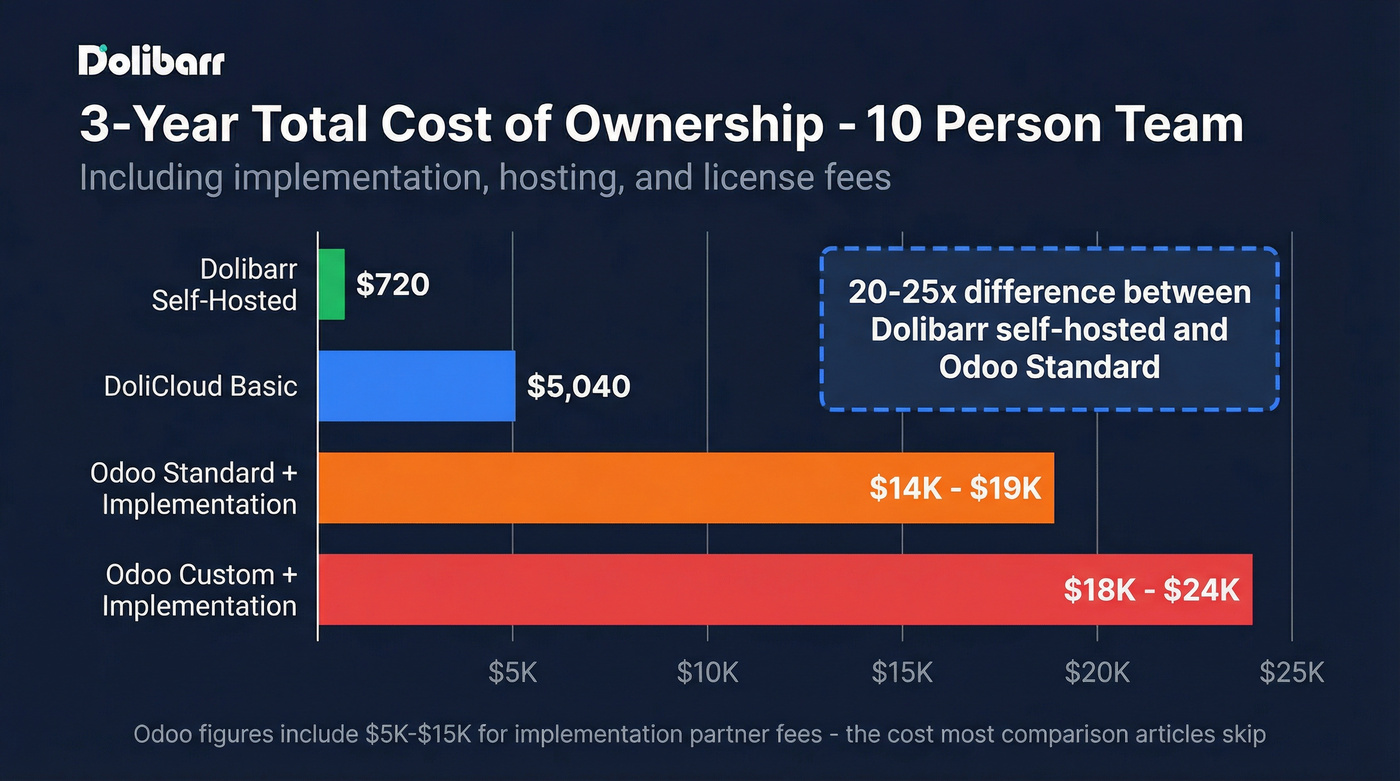
| Scenario | Year 1 | Years 2-3 | 3-Year Total |
|---|---|---|---|
| Dolibarr self-hosted | ~$240 (VPS) | ~$480 | ~$720 |
| DoliCloud Basic | ~€1,680 | ~€3,360 | ~€5,040 |
| Odoo Standard | ~$2,880 + impl. | ~$5,760 | ~$14-19K |
| Odoo Custom | ~$4,440 + impl. | ~$8,880 | ~$18-24K |
The Odoo figures include $5-15K for implementation with a partner. That's the number most comparison articles conveniently omit. The same Odoo consultant put it this way: "The license fee is maybe 10% of total first-year cost. The implementation partner fee is 50-70% of your budget."
A 20-25x difference. Dolibarr self-hosted for a 10-person team over three years: ~$720. Odoo Standard with implementation: $14-19K. Even DoliCloud Basic at ~€5,040 is a fraction of Odoo's total cost.
Hot take: If your annual revenue is under $500K, Odoo Enterprise is almost certainly overkill. The product is excellent, but you're paying enterprise prices for a platform you'll use at 20% capacity. Start with Dolibarr, and migrate when the pain of its limitations exceeds the cost of Odoo's implementation.
Feature-by-Feature Breakdown
CRM and Contact Management
Both platforms include CRM modules. Odoo's is slicker - pipeline views, activity scheduling, lead scoring. Dolibarr's is functional but bare-bones: contacts, opportunities, and basic pipeline tracking.

Both let you store 10,000 contacts. Neither tells you which ones are fake.
Accounting and Invoicing
This is the single biggest functional gap between the two platforms. Dolibarr includes full accounting - general ledger, bank reconciliation, financial reports - for free. Odoo locks all of that behind Enterprise.
If you're a micro-business that only needs to send invoices, Odoo Community works. The moment you need a balance sheet, you're paying $24+/user/month. For a 10-person team, that's $2,880/year just to see your own P&L. Dolibarr gives you that for $0.

Inventory and Manufacturing
Odoo Enterprise's inventory module is genuinely impressive - barcode scanning, multi-warehouse, automated replenishment, full MRP with work centers and scheduling. But again: Enterprise only. Community gets basic inventory and basic MRP.
Dolibarr's inventory module handles stock management, warehouses, and basic manufacturing. It's not as sophisticated as Odoo Enterprise, but it's free and functional for businesses that aren't running complex production lines.
HR and Payroll
Odoo Enterprise includes a full HR suite: recruitment, appraisals, time off management, payroll, and fleet management. Community gets basic employee records and time off - no payroll.
Dolibarr has HR/leave management modules for tracking employees and absences, but no native payroll processing. Most Dolibarr users pair it with a dedicated payroll service. If HR is a core requirement, Odoo Enterprise wins this category outright.
Integrations, eCommerce, and APIs
Odoo's ecosystem is massive: 30+ core apps and 30,000+ community modules. It has native Shopify and Amazon connectors, Stripe integration, and marketing tools. If you need it, someone's built it. Odoo exposes XML-RPC and JSON-RPC APIs for custom integrations.
Dolibarr's ecosystem is smaller but growing: 1,000+ modules on DoliStore, with WooCommerce and PrestaShop connectors being the most popular. Dolibarr also has a built-in low-code Module Builder, which lets you create custom modules without writing PHP - a genuine differentiator for teams that need something specific but don't want to hire a developer. Dolibarr exposes a REST API for external integrations.
A logistics firm reduced manual reconciliation by 70% and improved project delivery time by 30% using Dolibarr modules - proof that the smaller ecosystem still delivers real results when the modules you need exist.
AI and Automation (The 2026 Angle)
This is where the platforms are diverging fast.
Odoo Enterprise now includes AI-powered bill scanning (OCR), AI-assisted content generation for marketing, and smart scheduling suggestions. These features are Enterprise-only and represent Odoo's bet that AI is the next competitive moat.
Dolibarr's community is developing AI-based reporting and analytics modules, but nothing ships natively yet. If AI-driven automation is on your roadmap, Odoo Enterprise is the only choice between these two today.
What Real Users Say - G2, Capterra, and GetApp Data
Numbers don't lie, but sample sizes matter.
| Metric | Dolibarr | Odoo |
|---|---|---|
| G2 rating | 4.6/5 (30 reviews) | 4.3/5 (324 reviews) |
| Capterra rating | 4.5/5 (105 reviews) | 4.2/5 (1,283 reviews) |
| Ease of setup (G2) | 9.5/10 | 7.8/10 |
| Value for money | 4.7/5 | 4.1/5 |
| Product direction (G2) | 8.6/10 | 9.0/10 |
| Negative reviews | 0 (Capterra) | 81 one-star (GetApp) |
Dolibarr has zero negative reviews on Capterra. Zero. Out of 105 reviews. That's remarkable - and it's not because nobody uses it. It's because the people who use it know exactly what they're getting: a free, modular, no-frills ERP that does what it says.
Odoo's 81 one-star reviews on GetApp tell a different story. The #1 complaint? Pricing and the Community-to-Enterprise bait-and-switch. One Capterra reviewer reported their database was deleted without notice by an authorized Odoo partner. That's an extreme case, but it signals a real risk with the partner ecosystem.
The value-for-money gap is the most telling metric: Dolibarr at 4.7/5 vs Odoo at 4.1/5. When you're paying $0 for full features, satisfaction is easy. When you're paying $24/user/month and discovering that implementation costs 5-10x the license, frustration builds fast.
One Reddit user running a 2-person video business captured the sentiment perfectly: they loved Dolibarr's modular approach but noted the UI "is not great" and the platform "seems more setup for EU vs NA." Honest assessment - and it leads us to the limitations.
Where Each Platform Falls Short
Dolibarr's weak spots:
- The UI looks dated. If your team expects Notion-level design, they'll complain.
- EU-centric by design. Tax templates, payment plugins, and localization all skew French/European. North American users report gaps in tax handling and payment integrations.
- Module compatibility breaks after core updates. The API changes, and third-party modules stop working. That's the tax you pay for a community-driven ecosystem.
- Support is community-only. No phone line, no SLA. You're relying on forums and documentation.
- Mobile experience is basic - you'll need a third-party connector module for anything beyond web access.
Odoo's weak spots:
- The Community-to-Enterprise feature lockout is the most common source of frustration. You start free, hit a wall, and suddenly you're budgeting $15K+ for implementation.
- Price increases are real and unpredictable. The 30.5% hike reported in January 2026 caught users off guard.
- Partner lock-in is a genuine risk. Your implementation partner holds the keys to your customizations. Switch partners, and you're starting over.
- Implementation cost shock. The license is 10% of the first-year cost. Nobody tells you that upfront.
Both platforms are solid open-source ERPs. The question isn't which one is "better" - it's which set of tradeoffs you can live with.
Who Should Choose Which - and When to Skip Both
The Micro-Business (1-5 People, Under $100K Revenue)
Dolibarr self-hosted. Full stop.
You'll spend $10/month on a VPS, have it running in a weekend, and get invoicing, CRM, basic accounting, and inventory for free. The UI isn't pretty, but at this stage, you need functional, not beautiful. If you're in North America, budget a few hours to configure tax settings - the defaults are EU-focused.
Dolibarr V22.0.4 shipped in January 2026, and V23 is in beta - the project is actively maintained.
If you're a nonprofit or NGO, Dolibarr has specific modules for association management that Odoo lacks in Community.
The Growing SMB (10-50 People, Need an Integrated Suite)
Odoo Enterprise with a carefully vetted implementation partner. The UI is modern, the module library is deep, and the ecosystem is the largest in open-source ERP. But go in with eyes open: budget $10-20K for implementation, expect 2-4 months before you're fully live, and negotiate your contract carefully. Ask your partner point-blank: "Is that standard configuration, or custom development?" The answer determines your ongoing costs.
The "Neither Fits" Profile
If you're manufacturing-heavy and need robust production planning with a modern interface, ERPNext is worth evaluating. It's free, open-source, Python-based, and stronger than both Dolibarr and Odoo Community on manufacturing workflows. The learning curve is steeper, but the 7,000+ member community is active.
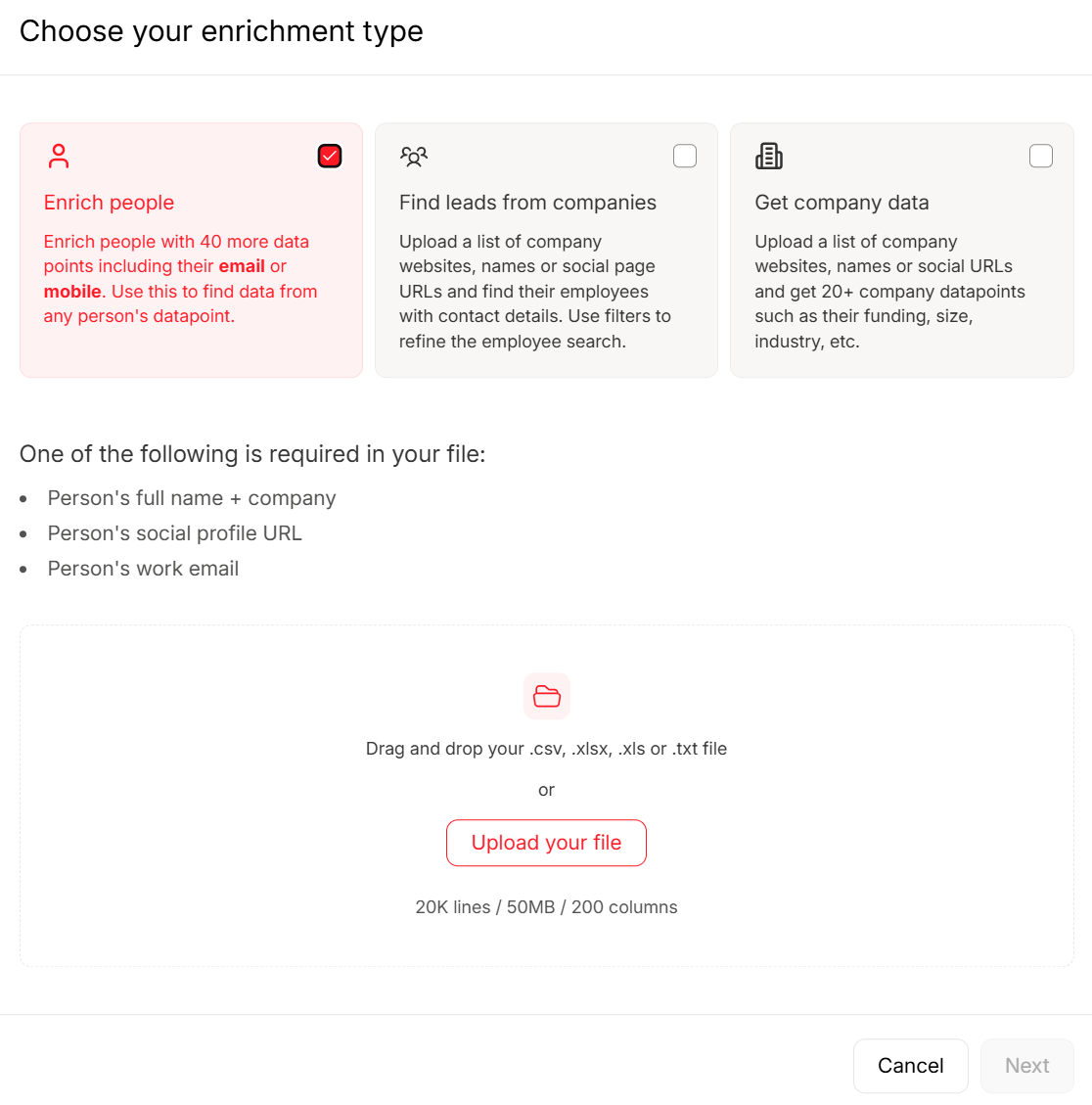
You just saw how Odoo can cost $14-24K over three years for 10 users. Prospeo fills your CRM with verified decision-maker emails at $0.01 each - 90% cheaper than ZoomInfo. No implementation partner needed, no annual contracts.
Your ERP budget shouldn't be wasted on contacts that bounce.
FAQ
Is Odoo really free?
Odoo Community Edition is free but missing full accounting, barcode scanning, mobile apps, marketing automation, and helpdesk SLAs. For most businesses, Enterprise at $24+/user/month is the real product. Dolibarr is fully free - every module included in the self-hosted version.
Can I migrate from Dolibarr to Odoo (or vice versa)?
No standard migration tools exist between the two platforms. You'll export data via CSV and reimport manually, with 1-4 weeks of effort depending on data complexity. Field mappings won't be one-to-one, and expect duplicates during the process.
Which ERP is better for a North American business?
Odoo has stronger NA localization - US/Canadian tax templates, Stripe integration, and a large North American partner network. Dolibarr skews EU/France by design. NA users consistently report gaps in tax handling and payment plugins, giving Odoo the edge for US-based teams.
How long does implementation take for each platform?
Dolibarr takes 1-3 days for basic setup and 1-2 weeks for full configuration. Odoo Enterprise with a partner runs 2-6 months. The gap directly reflects the complexity difference - teams routinely underestimate Odoo timelines by 3-4x.
How do I get accurate contact data into my ERP's CRM?
Neither Dolibarr nor Odoo verifies contact data natively. Export your CRM contacts as CSV, run them through Prospeo (98% email accuracy, 50+ data points per contact), and reimport clean records - or connect via API for automated verification on every new entry.