

slug: buying-triggers
Buying Triggers: How to Spot Them, Prioritize Them, and Actually Close Deals
Your SDR spots a Series B announcement on Crunchbase. She pulls the VP of Engineering's email from your database, fires off a personalized sequence within 48 hours - and the first email bounces. The contact left the company two months ago. By the time she finds the right person, three competitors have already booked discovery calls.
That's the buying trigger gap: you detected the signal, but your data couldn't keep up. It's not a rare scenario, either. 84% of reps missed quota last year per Salesforce data, and buyers spend just 17% of their total buying time meeting with potential suppliers. The window is small. If you're not reaching the right person within days of a trigger event, you're not in the conversation at all.
The Short Version
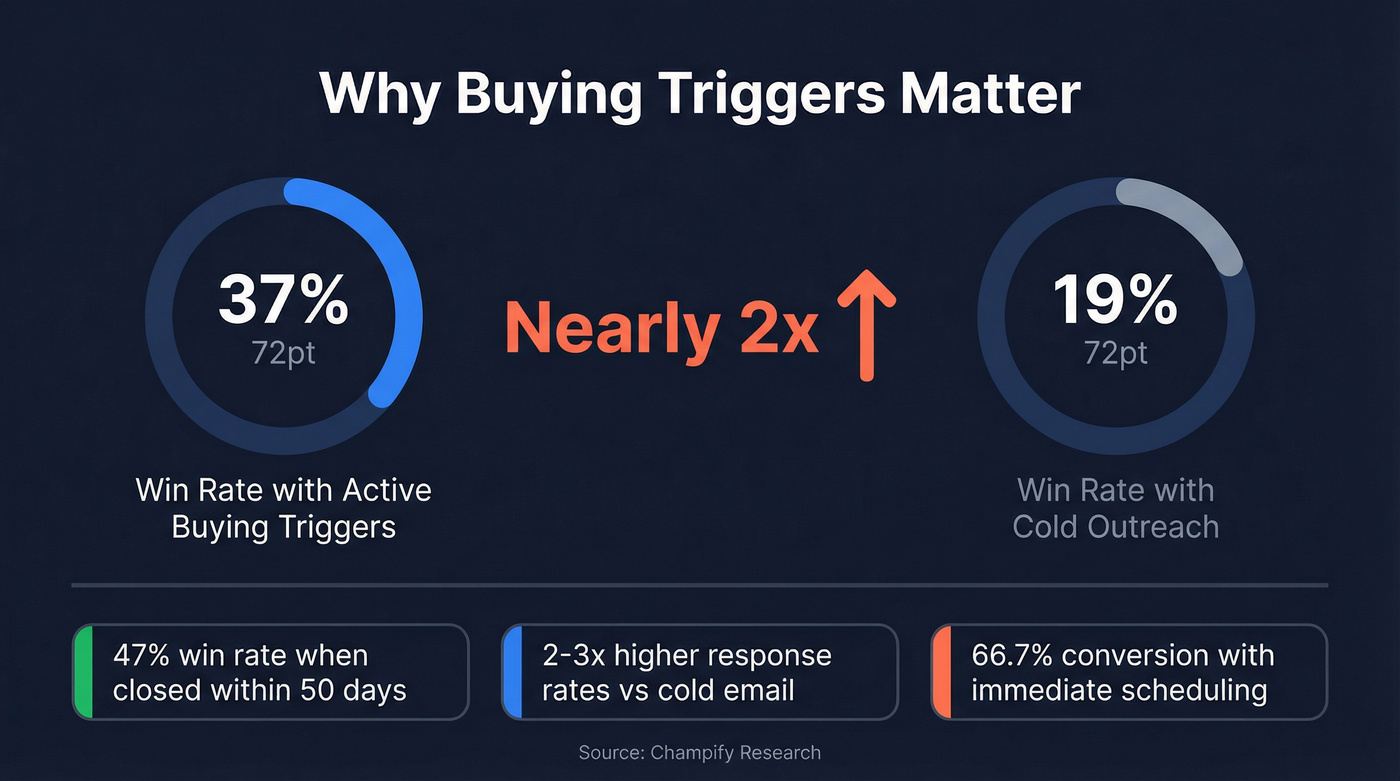
- The number that matters: Accounts with active buying triggers convert at a 37% win rate vs. 19% for cold outreach, per Champify's research. Nearly double.
- Start with three triggers: New executive hires, funding rounds, and company expansion announcements. These create immediate vendor review windows and are the easiest to detect.
- The gap most teams miss: Detection isn't the problem - data freshness is. The industry average refresh cycle is six weeks. By then, your "verified" contact has changed roles and your email bounces.
Pick 3-5 triggers. Master those. Ignore the rest.
What Are Buying Triggers?
A buying trigger is a specific, observable event that creates a window where a company is more likely to purchase. Not a vague signal. Not a content download. An actual event - a funding round, a new CTO hire, a regulatory change - that shifts the status quo and makes your solution relevant right now.
Most teams confuse four distinct concepts, and the confusion costs them pipeline:
| Level | What It Is | Example |
|---|---|---|
| Signal | Any observable behavior | A page view, a download |
| Intent | Pattern of signals over time | Multiple employees researching a topic |
| Buying signal | Intent + fit + readiness | Buyer downloads pricing guide |
| Trigger | Verified event that justifies activation | Series B closes, new VP hired |
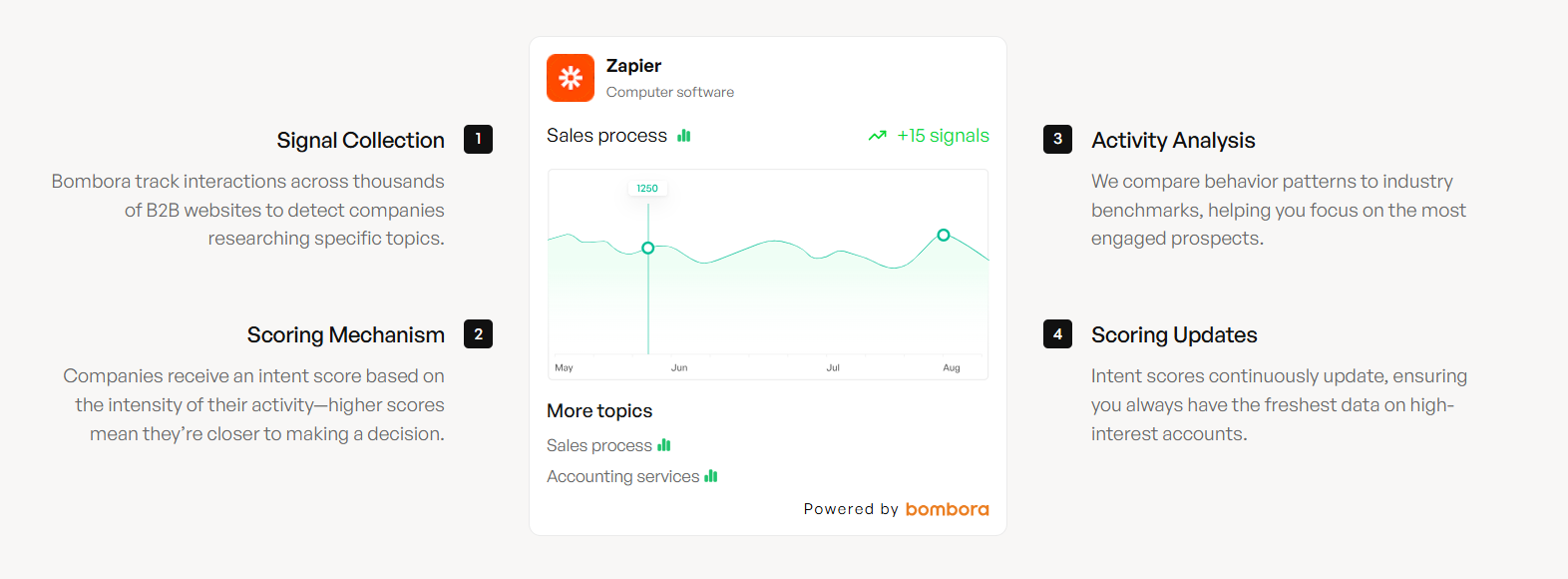
The "Marketing Data Mirage" is real: dashboards light up with signals, teams get excited, but nothing converts because the signals are shallow and unverified. Until someone with budget authority takes a concrete action, you don't have a trigger - you have noise.
Only 18% of B2B organizations have a measurable intent strategy. That means 82% are either ignoring intent entirely or drowning in unstructured signals they can't act on. Here's the thing: intent data is overrated when it's treated as a trigger. Real trigger events are concrete, not probabilistic scores. If your "intent signal" is three anonymous page views from an IP range, that's not actionable - that's a guess.
Does Trigger-Based Selling Actually Work?
Yes. Dramatically.
Champify's research shows selling to accounts with active purchase triggers delivers a 37% win rate compared to 19% for cold outreach. Outreach's platform data tells a complementary story: opportunities closed within 50 days hit a 47% win rate, while deals that drag past that threshold drop to 20% or lower. Chili Piper's analysis of ~4M form submissions found that immediate scheduling doubles inbound conversion from 30% to 66.7% - further proof that speed is the mechanism, not just a nice-to-have.
Boomerang's analysis puts trigger-based outreach response rates at 20-35% vs. 5-10% for cold. Even discounting those numbers by half, you're looking at a 2-3x lift over spray-and-pray prospecting. The math is clear. The execution is where teams fall apart.

You spotted the trigger. Now what? If your contact data is 6 weeks old, you're emailing ghosts. Prospeo refreshes 300M+ profiles every 7 days - so when a new VP gets hired or a Series B closes, you reach the actual decision-maker with 98% email accuracy.
Close the trigger gap before your competitors book the meeting.
The Complete Trigger List
Most guides list 20+ triggers and tell you to track all of them. That's analysis paralysis. We've found the best approach is picking the 3-5 that align with your ICP and building a repeatable motion around those.
Organizational Triggers
These are the highest-signal events because they disrupt the status quo directly. M&A activity forces technology consolidation - the acquiring company rarely keeps both CRMs. Product launches create demand for supporting tools and services. Facility expansions signal capital allocation and new operational needs.
When a company reorganizes, the first 90 days are a wide-open buying window. New leadership means new priorities, new vendor evaluations, and a willingness to spend that evaporates once the dust settles.
Financial Triggers
Funding rounds are the most visible trigger in B2B, but they're not the only financial signal worth tracking. CapEx announcements in earnings calls signal where money is going next quarter. Fiscal year-end creates predictable "use it or lose it" budget windows. Earnings guidance that mentions investment in specific areas - security, AI, infrastructure - tells you exactly what they're buying.
Personnel Triggers
Job changes are the single most reliable B2B buying trigger. A new VP of Sales doesn't keep the old VP's tech stack. They bring their own playbook.
Champion job changes, where your existing customer moves to a new company, are gold: they already trust your product. If you're building a motion around this, automated champion tracking is one of the highest-ROI workflows you can implement. Hiring surges in specific departments reveal where a company is investing before any press release goes out. If a company posts 15 DevOps roles in a month, they're scaling infrastructure - and they'll need tools to match.
Market & Industry Triggers
New regulations create compliance-driven urgency that's nearly impossible to ignore. Competitive moves - a rival launches a feature, gets acquired, or raises a round - force reactive purchasing. Technology shifts like AI adoption mandates ripple through entire industries, creating buying windows that stay open for months rather than days.
How to Score and Prioritize
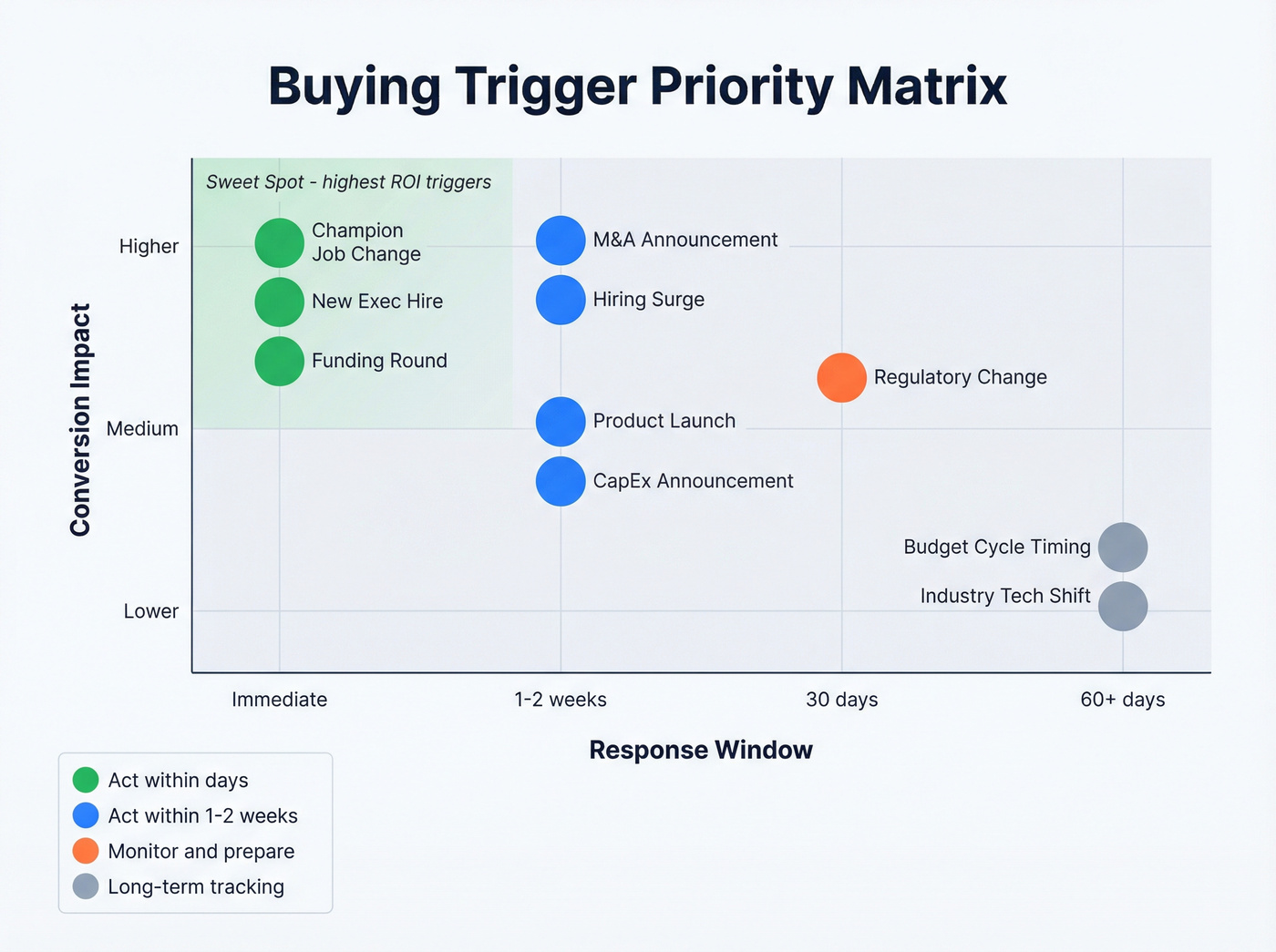
| Trigger | Urgency | Response Window |
|---|---|---|
| New exec hire | High | 1-5 days |
| Funding round | High | 1 week |
| Champion job change | High | Immediate |
| M&A announcement | High | 1 week |
| Hiring surge | Medium | 1-2 weeks |
| Product launch | Medium | 1-2 weeks |
| CapEx announcement | Medium | 30 days |
| Regulatory change | Medium | 30 days |
| Budget cycle timing | Low | 60+ days |
| Industry tech shift | Low | 60+ days |
Triggers by Industry
SaaS
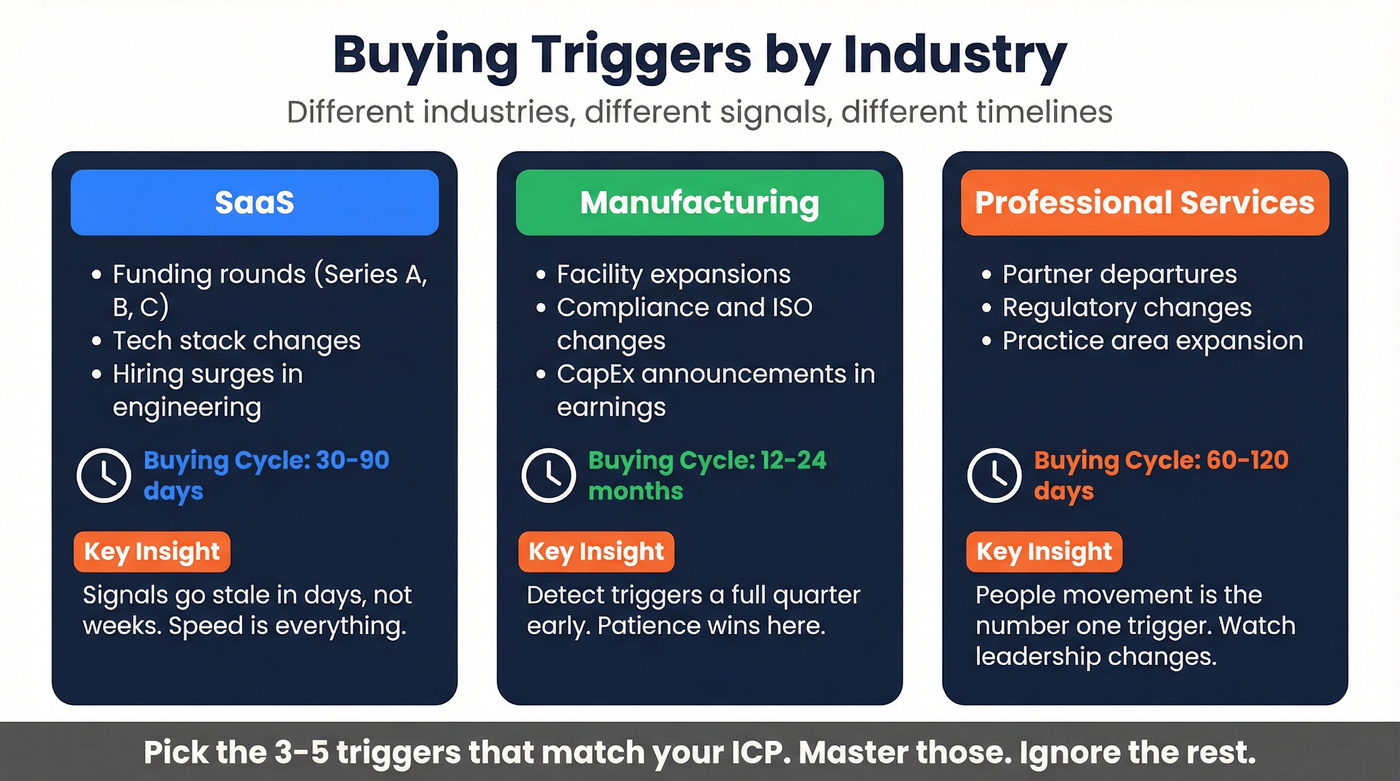
SaaS triggers have the shortest shelf life of any industry. Industry forecasts project global SaaS spending surpassing $300B by 2026, which means the market is liquid and competitive - signals go stale fast. A week-old funding announcement is ancient history because three other vendors reached out on day one.
Match your pitch to the funding stage. Series A companies build their initial stack from scratch. Series B companies replace the duct-tape tools they outgrew. Later-stage companies consolidate and standardize. The message should reflect where they are, not just that they raised money.
Example outreach for a Series B trigger:
"Congrats on the B raise - saw the announcement this morning. When [similar company] hit this stage, they replaced three point solutions with [your product] and cut onboarding time by 40%. Worth a 15-minute look?"
Manufacturing
Manufacturing operates on a completely different clock. Buying cycles run 12-24 months, so trigger detection needs to happen early - sometimes a full quarter before the purchase decision even enters committee. U.S. manufacturing construction spending surpassed $230B in 2024 per the U.S. Census Bureau, and facility expansions are the highest-signal trigger in this vertical.
Compliance triggers are uniquely powerful here. Skip this vertical if your sales cycle depends on fast closes - manufacturing rewards patience and relationship-building over speed.
Professional Services
Professional services firms buy reactively. Partner departures trigger technology and process reviews. Regulatory changes create immediate consulting and tooling needs. The key trigger is people movement: when a managing partner leaves, everything is on the table. We've seen teams close six-figure deals within 60 days of a senior partner departure simply because they were the first vendor to reach out with a relevant message.
How to Detect and Act on Triggers
Detection is only half the problem. Ask any SDR community about intent data and you'll hear the same refrain: "It's noisy." The consensus on r/sales threads is that most intent platforms have a brutal signal-to-noise ratio unless you're filtering aggressively. And even when you nail the detection, the whole thing falls apart if you can't get a verified email for the decision-maker.
The Execution Layer
Let's be honest about where most trigger programs die. You detect the event, pull a contact from a stale database, the email bounces, and your domain reputation takes the hit. That's not a trigger program - that's a domain reputation destruction program. If you're seeing this, start with B2B contact data decay and hard bounces before you scale volume.
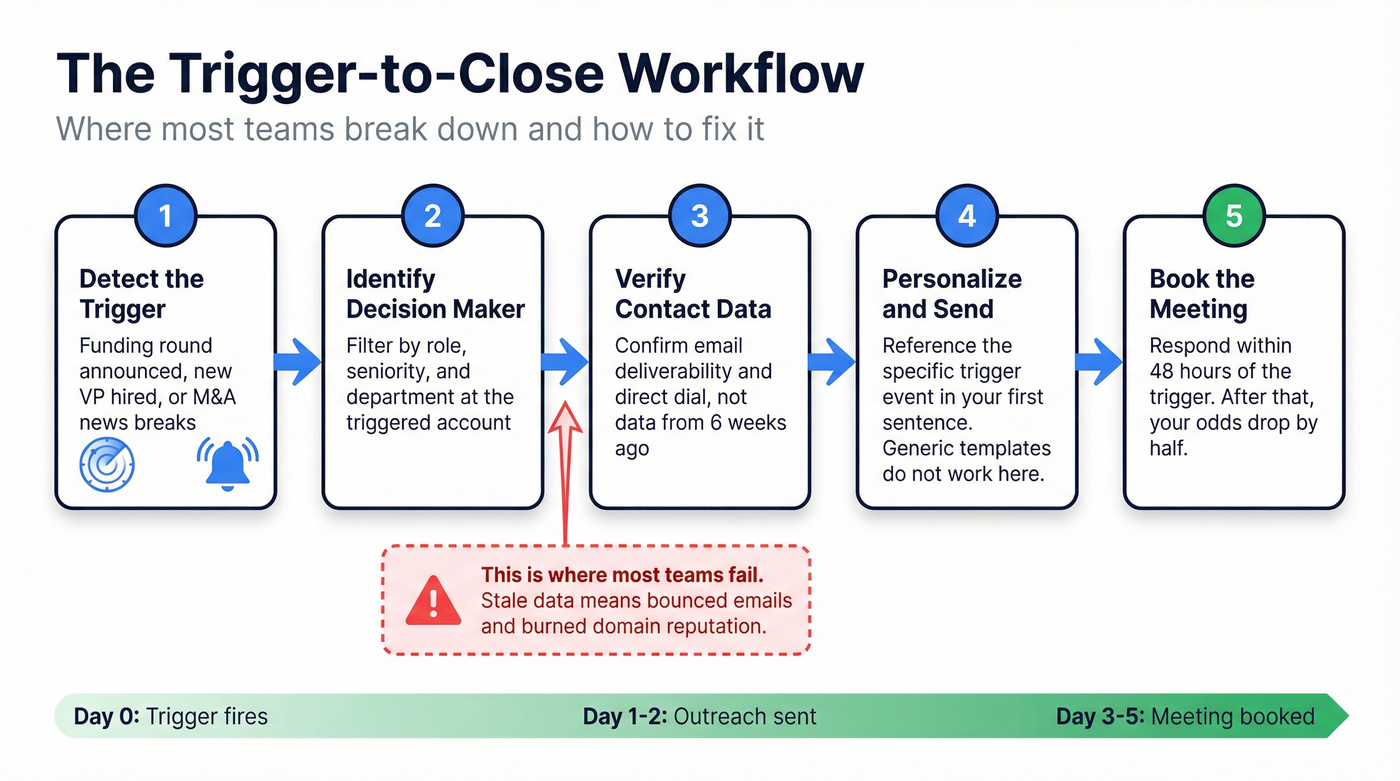
Prospeo closes this gap with 300M+ professional profiles at 98% email accuracy and 125M+ verified mobile numbers, all refreshed on a 7-day cycle. For trigger-based selling specifically, the filter stack is what matters: 30+ search filters including buyer intent powered by Bombora across 15,000 topics, job change detection, funding signals, and headcount growth. You're not just finding contacts at triggered accounts - you're finding contacts who are themselves showing purchase behavior.

The workflow: a trigger fires, you search the account with role and seniority filters, pull verified emails and direct dials, and push them to your sequencer via native integrations with Salesforce, HubSpot, Lemlist, Instantly, or Outreach. At ~$0.01 per email with a free tier to start, the barrier to testing is essentially zero. If you want the ops blueprint, use this prospecting workflow and adapt it to your trigger list.
Detection Tools
Google Alerts is free and catches funding announcements and leadership changes if you set up the right queries. Imperfect, but immediate.
Crunchbase is the best single source for funding rounds and company growth signals, with paid plans starting around $49/mo. Worth it for any team tracking financial triggers.
Clay connects 150+ premium data sources and runs waterfall enrichment, with a free tier and paid plans from ~$149/mo. It's the strongest option for teams building automated trigger workflows - if you're technical enough to set up the automations.
The Enterprise Alternative
ZoomInfo runs $15,000-$40,000+/year and remains the incumbent. 235M+ professional profiles, intent data, and "Scoops" trigger events give you broad coverage. But many incumbent databases refresh on 4-6 week cycles. For trigger-based selling where timing is everything, that lag is a real problem. If you're a 500-person sales org with the budget, ZoomInfo's workflow breadth is hard to beat. For teams under 50 reps, the ROI math rarely works out.
The Data Quality Problem
Your trigger program is only as good as your contact data. And most contact data is worse than teams realize.
Think about what happens in six weeks at a fast-growing SaaS company. People get promoted, change roles, leave entirely. That "verified" VP of Engineering email you pulled has a meaningful chance of bouncing. Every bounce damages your domain reputation, which tanks deliverability for every subsequent email you send. It compounds. If you need a practical fix, start with CRM hygiene and a lightweight email validity check before every outbound push.
This is the Marketing Data Mirage applied to execution. You did everything right - detected the trigger, crafted the message, timed the outreach - and it all falls apart because the underlying data is stale. The difference between 98% email accuracy and 79% isn't academic. It's the difference between landing in an inbox and landing in a bounce log, and over thousands of sends, that gap determines whether your outbound channel lives or dies.
Hiring surges, funding rounds, champion job changes - none of it matters if your data can't keep up. Prospeo tracks 300M+ profiles with a 7-day refresh cycle and 30+ filters including job change signals, so you act on triggers with contacts that are current, not stale.
Stop losing deals to bounced emails. Start at $0.01 per verified lead.
FAQ
What's the difference between buying triggers and intent signals?
Buying triggers are specific, observable events - a funding round, a new hire, an acquisition - while intent signals are behavioral patterns like content consumption or search activity. Triggers are concrete and actionable; intent is probabilistic. Both matter for pipeline generation, but triggers give you a specific reason to reach out and a natural conversation opener.
What are the most reliable B2B buying triggers?
New executive hires, funding rounds, and champion job changes deliver the highest correlation with near-term purchasing decisions. These three create immediate vendor review windows - Champify data shows a 37% win rate on triggered accounts vs. 19% cold. Company expansion announcements are a close fourth.
How quickly should I respond to a trigger event?
Within 24-48 hours for high-urgency triggers like exec hires and funding rounds. Outreach data shows deals closed within 50 days hit a 47% win rate. For SaaS triggers specifically, a week-old signal is already stale. Build your workflow so detection automatically queues outreach the same day.
What tools help track buying triggers affordably?
Google Alerts handles detection for free, and Crunchbase covers funding rounds and growth signals for ~$49/mo. For execution, Prospeo's free tier gives you 75 verified emails per month with 98% accuracy and 7-day data refresh - enough to test trigger-based outreach without budget commitment. Add Clay for automated enrichment workflows as you scale.
Do buying triggers work in B2C?
Yes, but they're psychological rather than organizational. The Fresh Start Effect around New Year's, birthdays, and moving - plus life events like having a child or starting a job - all increase purchase receptivity. The core principle is identical: timing your message to a moment of change.