SQL vs MQL: The Operational Guide Most Articles Won't Give You
90% of MQLs never become SQLs. That's not a scare stat - it's the documented reality of most B2B funnels. The VP of Marketing celebrates hitting MQL targets while the VP of Sales stares at a pipeline that hasn't moved in three quarters.
The SQL vs MQL distinction isn't academic. It's the operational fault line where revenue either accelerates or dies. Both sides are technically hitting their numbers, neither is wrong, and the problem sits squarely in the handoff between them - the definitions, data quality, and speed that govern it.
The Short Version
If your MQL-to-SQL rate is below 10%, your MQL definition is too loose. If it's above 20%, your sales team is probably still complaining about quality - tighten your SLA and verify your contact data before handoff. Running a PLG motion? Skip MQLs entirely and switch to PQLs.
Definitions That Actually Matter
The real confusion isn't between marketing qualified leads and sales qualified leads. It's the stages in between that nobody standardizes.
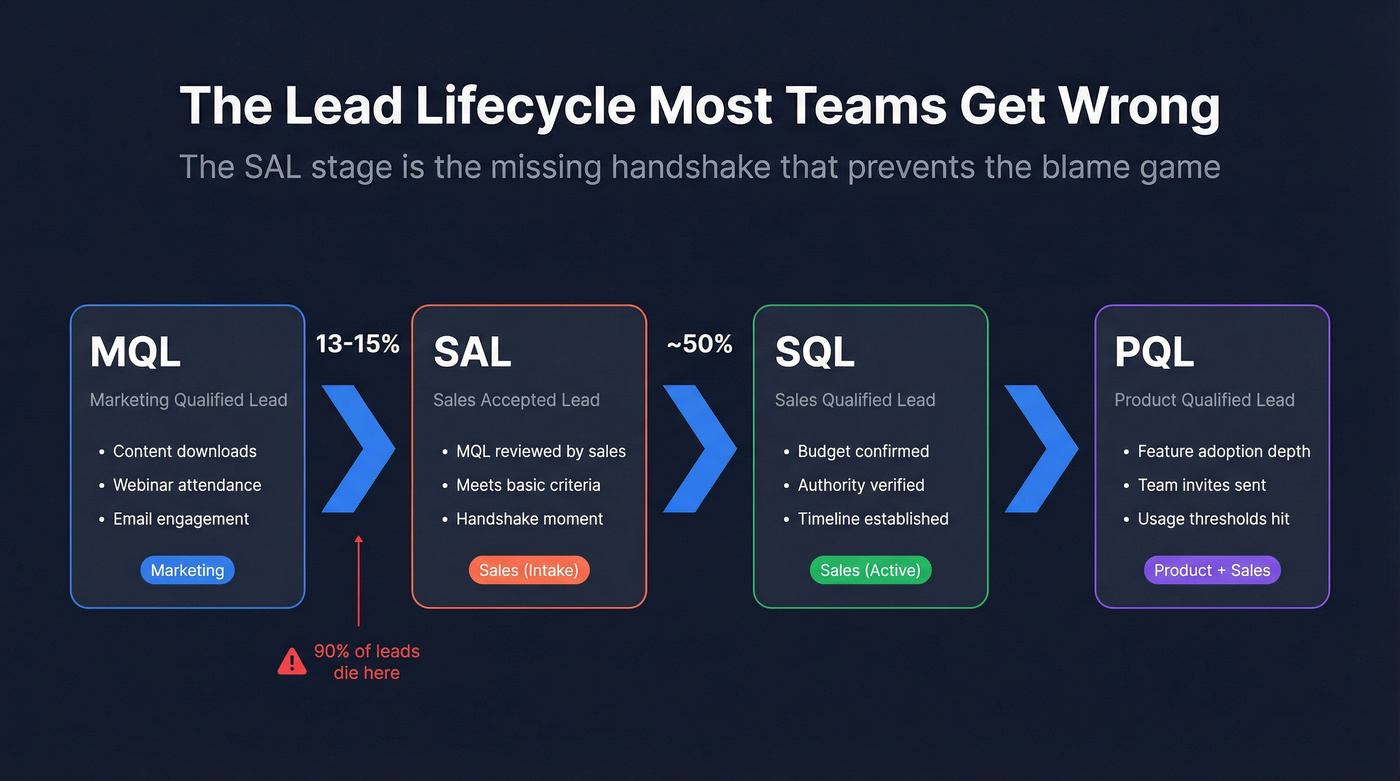
An MQL is a lead that marketing has deemed worth passing to sales based on engagement signals: downloaded content, visited pricing pages, attended a webinar. An SQL is a lead that sales has actively qualified using a framework like BANT or MEDDIC and confirmed has real buying potential. The gap between those two stages is where deals go to die.
There's a middle step most teams skip: the SAL, or Sales Accepted Lead. This is the handshake moment - sales has reviewed the MQL and agreed to work it, but hasn't yet qualified it. Without this stage, you get the classic blame game. Walk into any RevOps Slack channel and you'll hear the same refrain: "Marketing sent us 500 MQLs and they were all garbage." Meanwhile marketing can't prove otherwise because nobody tracked the acceptance step.
| Stage | Definition | Owner | Typical Signals | Qualification Method |
|---|---|---|---|---|
| MQL | Marketing-qualified | Marketing | Content downloads, webinar attendance, email engagement | Lead scoring threshold |
| SAL | Sales-accepted | Sales (intake) | MQL reviewed, meets basic criteria | SLA acceptance |
| SQL | Sales-qualified | Sales (active) | Budget, authority, need, timeline confirmed | BANT, MEDDIC, etc. |
| PQL | Product-qualified | Product + Sales | Feature adoption, usage depth, team invites | Product usage thresholds |
Conversion Benchmarks by Model, Channel & Industry
"What's a good conversion rate?" depends entirely on your business model, channels, and industry. A 13% rate might be excellent for cybersecurity and terrible for CRM software.
By Business Model
| Model | MQL-to-SQL Rate |
|---|---|
| B2B (general) | 12-21% |
| B2C / D2C | 18-22% |
| Hybrid B2B2C | ~20% |
| PLG (as PQLs) | 15-30% |
The B2B median sits around 13-15%. Below 10%, the problem almost certainly isn't your sales team - it's your MQL definition.
By Channel
Not all leads are created equal. The channel they come through predicts conversion better than almost any other variable.
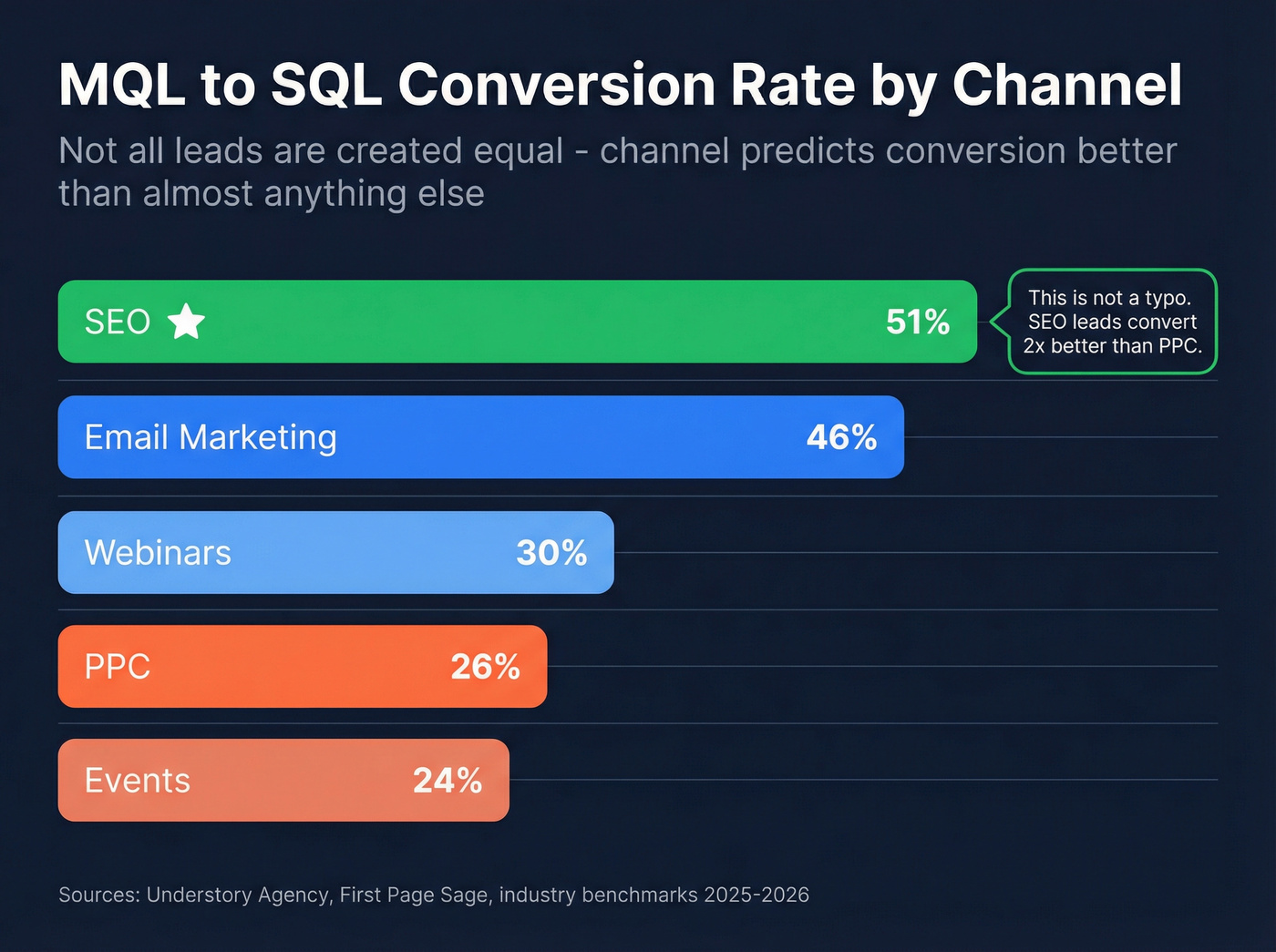
| Channel | MQL-to-SQL Rate |
|---|---|
| SEO | 51% |
| Email marketing | 46% |
| Webinars | 30% |
| PPC | 26% |
| Events | 24% |
SEO leads convert at 51%. That's not a typo. Someone who searches for a problem, finds your content, and fills out a form is fundamentally different from someone who clicked a display ad. If you're pouring budget into PPC while neglecting organic, these numbers should make you uncomfortable.
By Industry
Your vertical matters more than your funnel design. CRM and sales tech MQLs convert to SQL at 42% because buyers in that category often self-qualify aggressively - they know what they want and they're comparison shopping. Cybersecurity and fintech sit lower because buying cycles stretch longer, compliance adds friction, and more stakeholders pile into the decision.
| Industry | MQL-to-SQL Rate |
|---|---|
| CRM & Sales Tech | 42% |
| Cybersecurity (SMB) | 15-18% |
| Fintech | 11-19% |
| IT & Managed Services | 13% |
| Software Development | 14% |
| Financial Services | 13% |
| Healthcare & Medtech | 13-14% |
First Page Sage also publishes industry conversion benchmarks if you want another dataset to compare against.
Qualifying SQLs Beyond BANT
BANT is fine for SMB. It's dangerously simplistic for enterprise. When you're selling into organizations with 6-10+ stakeholders, knowing someone has "budget" and "authority" tells you almost nothing about whether the deal will close.
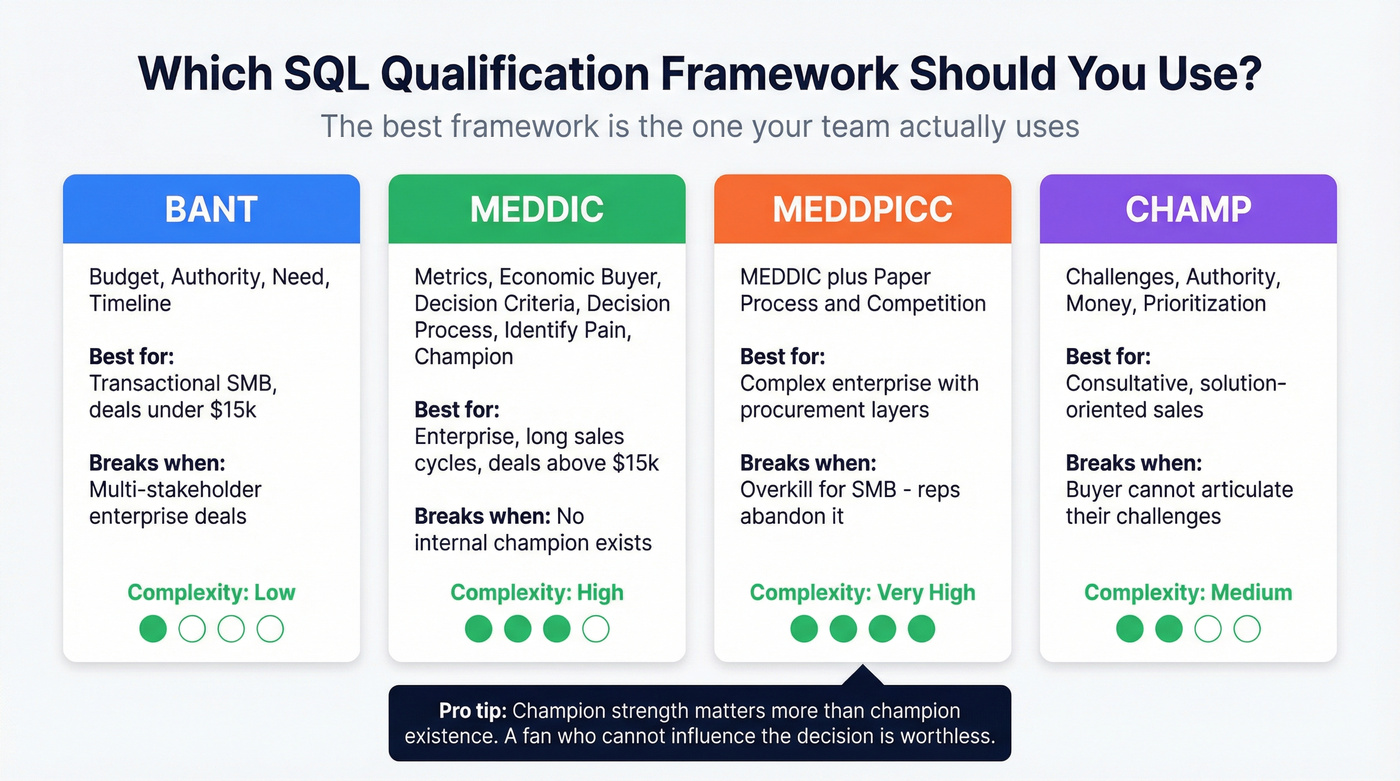
| Framework | Best For | Breaks When |
|---|---|---|
| BANT | Transactional SMB | Multi-stakeholder enterprise |
| MEDDIC | Enterprise, long cycles | No internal champion exists |
| MEDDPICC | Complex enterprise with procurement | Overkill for SMB |
| CHAMP | Consultative sales | Buyer can't articulate challenges |
We've seen teams adopt MEDDIC because it sounds sophisticated, then abandon it within a quarter because reps won't fill out the fields. The best framework is the one your team actually uses. For most B2B SaaS companies selling deals above $15k, MEDDIC hits the sweet spot. For sub-$15k transactional deals, BANT still works - just don't pretend it's doing more than basic filtering.
Here's the thing: if your average deal size is under five figures, you probably don't need a qualification framework at all. You need faster response times and better contact data. The deal economics don't justify a 45-minute discovery call with a 12-field CRM update.
The critical piece most frameworks miss is champion strength. A champion isn't just someone who likes your product. They're someone with political capital who'll spend it on your behalf. A "fan" who can't influence the decision is worthless - qualify for champion strength, not just champion existence.

90% of MQLs die before becoming SQLs - and bad contact data is the #1 silent killer. When sales can't reach the lead, they reject it. Prospeo's 98% verified emails and 125M+ direct dials mean your MQLs actually connect to real buyers.
Stop losing SQLs to bounced emails and wrong numbers.
Build a Lead Scoring Model That Works
Most lead scoring models are stale within six months. Teams build them, celebrate the launch, and never recalibrate. A well-maintained scoring model is the engine that separates marketing qualified leads from sales qualified leads with precision - but it requires ongoing attention.
Explicit vs. Implicit Signals
Explicit signals are what the lead tells you: job title, company size, industry, revenue. Implicit signals are what they show you through behavior: pages visited, emails opened, content downloaded, time on site.
You need both. A VP of Sales at a 200-person SaaS company who visited your pricing page twice is fundamentally different from a marketing intern who downloaded an eBook.
Sample Scoring Model
Behavioral signals (implicit):
- Pricing page visit: +15 points
- Demo request form: +25 points
- Case study download: +10 points
- eBook download: +5 points
- Blog visit (3+ pages): +5 points
- Webinar attendance: +10 points
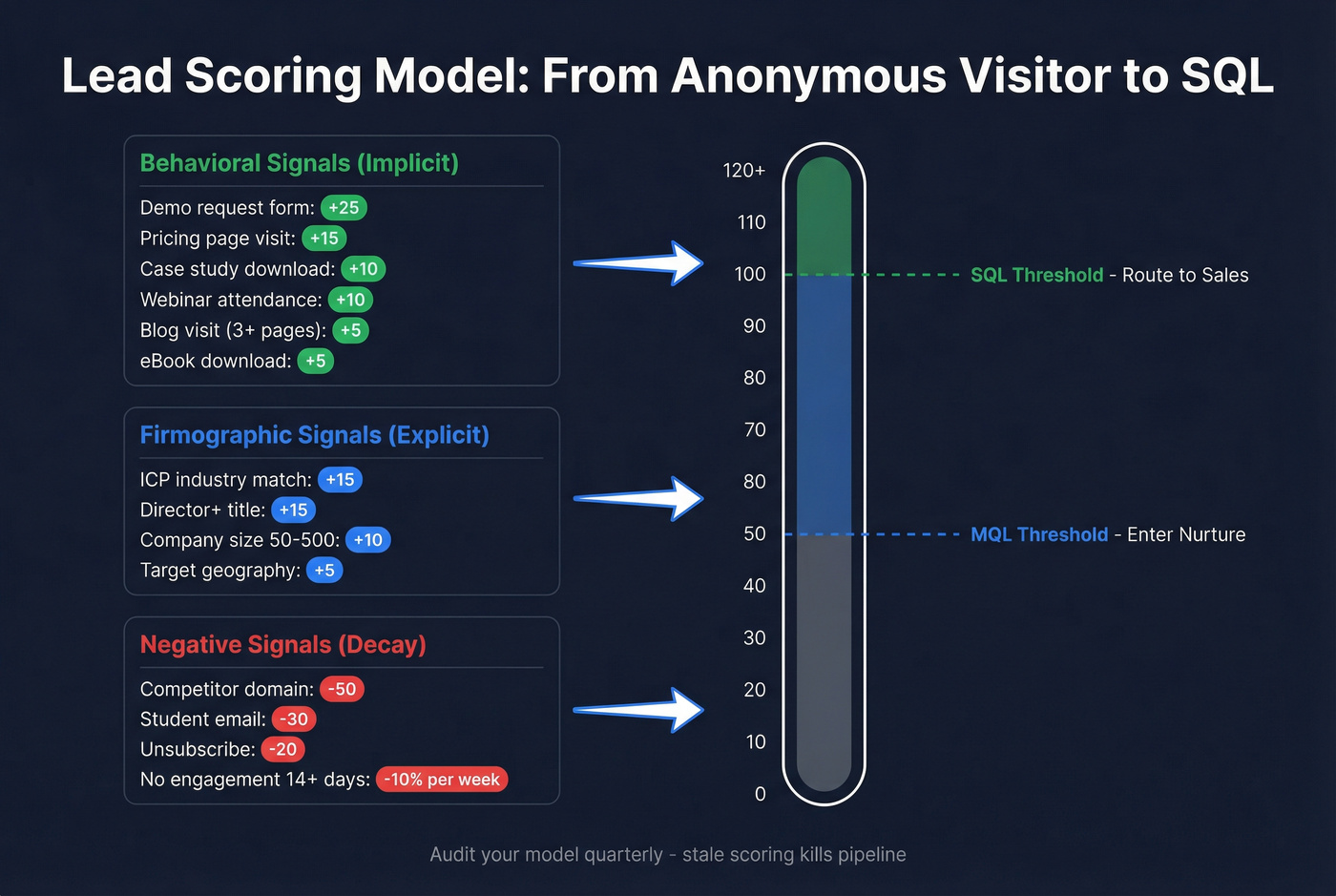
Firmographic signals (explicit):
- ICP industry match: +15 points
- Company size 50-500: +10 points
- Director+ title: +15 points
- Target geography: +5 points
Negative signals:
- Unsubscribe: -20 points
- Competitor domain: -50 points
- Student email: -30 points
- No engagement 14+ days: -10% per week (decay)
Thresholds: 50 points = MQL (enter nurture). 100+ points = SQL (route to sales).
Effective lead scoring models increase close rates by up to 30%, but only when they're maintained. Set a calendar reminder to audit your model quarterly. Decay rules are non-negotiable - a lead who was hot six months ago and went silent isn't sales-ready anymore.
One thing most scoring models miss: data quality as a scoring input. A lead with a verified direct dial and confirmed work email should score higher than one with only a generic company address. Run contacts through Prospeo's email verification before scoring - a lead you can't actually reach isn't worth the points you've assigned it.
The Marketing-Sales SLA
According to Forecastio, 95% of salespeople say they receive low-quality leads from marketing. According to marketing, sales doesn't follow up fast enough. Both are usually right.
The fix is an SLA that makes expectations explicit.
Six Components Every SLA Needs
- Shared definitions. Marketing and sales agree on exactly what constitutes an MQL, SAL, and SQL. Written down. No ambiguity.
- Handoff process. Which leads get passed, when, and through what system. "I'll Slack you" isn't a process.
- Responsibilities. Marketing provides enriched contact data, engagement history, and company context. Sales responds within the agreed timeframe.
- Feedback loop. Sales reports back on lead quality weekly. Not quarterly. Weekly.
- Shared goals. Both teams own pipeline and revenue targets, not just their stage-specific metrics.
- Continuous improvement. Monthly SLA review meeting where definitions get updated and scoring models get recalibrated.
Organizations with strong sales-marketing alignment see 20% annual growth rates. Misaligned organizations decline by 4%. That's not a marginal difference - it's the gap between growth and contraction.
Recommended timing standards: first response within 5 minutes for demo requests and high-intent form fills. For lower-intent MQLs, 5-7 touches over 7-10 days.
Speed-to-Lead: The Variable Nobody Optimizes
Buyers choose the first vendor that responds 78% of the time. Leads contacted within five minutes are 20x more likely to convert than those contacted after 30 minutes. Best-in-class teams respond within 90 minutes. The industry average? Five hours. The worst offenders take six days.
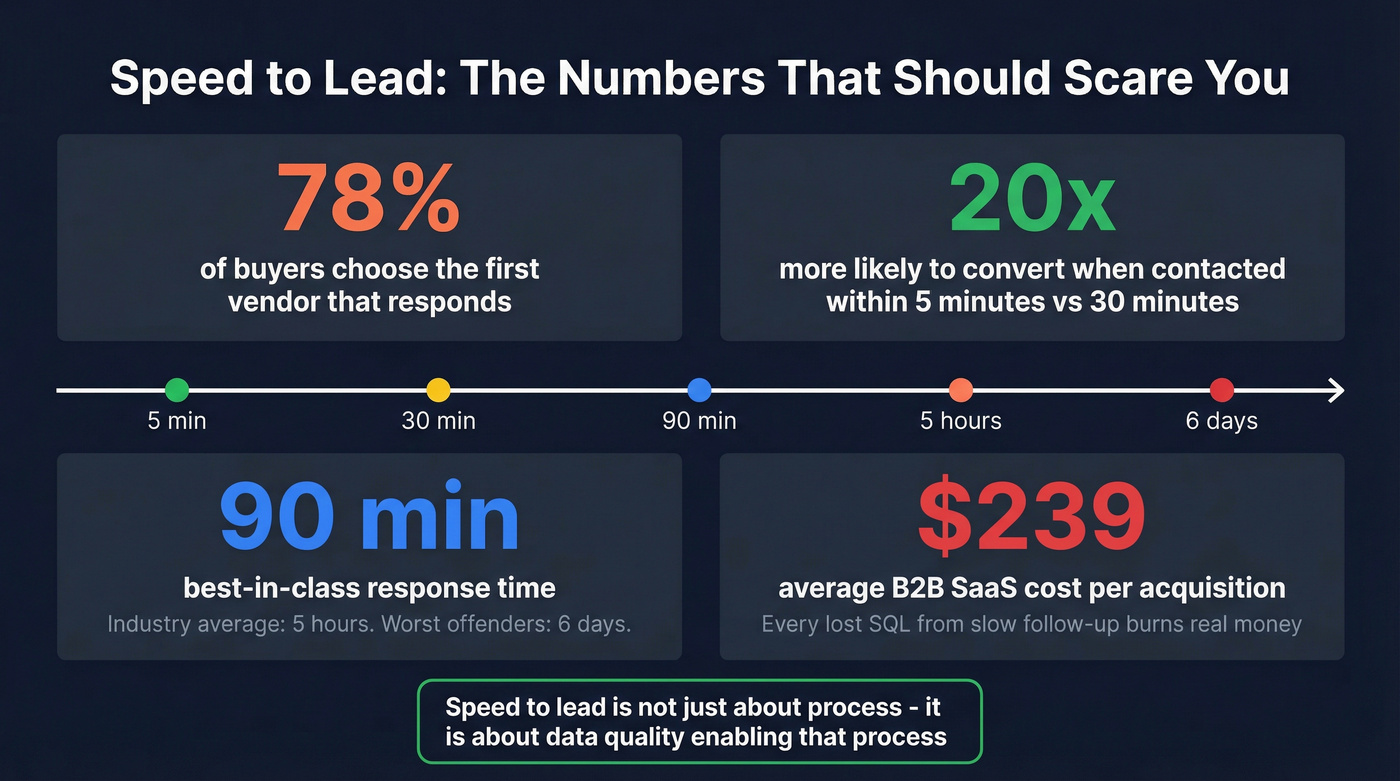
Average B2B cost per lead is $84, and B2B SaaS average CAC is $239, so every lost SQL is expensive. Your scoring model correctly identified a buyer, and then the SDR didn't call for two days because they were working through a backlog. By then, a competitor had already booked the demo.
Here's the scenario we see constantly: an SDR gets 50 leads routed to them on Monday morning. Half the phone numbers are wrong. A third of the emails bounce. By the time they've sorted through the bad data and reached the real prospects, a competitor responded four hours ago. Speed-to-lead isn't just about process - it's about data quality enabling that process.
How to Improve MQL-to-SQL Conversion
Three moves deliver the highest ROI, and none of them require a new tech stack.
1. Tighten your MQL definition. If your MQL-to-SQL rate is below 10%, you're passing leads too early. An eBook download isn't an MQL. A pricing page visit plus a case study download plus an ICP firmographic match - that's getting closer. Raise the bar and watch your conversion rate climb while your total MQL count drops. That's the right tradeoff.
2. Cut response time to under five minutes. This means routing, not just alerting. The lead hits the threshold, gets assigned to a specific rep, and that rep gets a push notification with full context. If your current process involves a daily CSV export, you're losing deals every single day.
3. Verify contact data before handoff. This is the hidden variable in every conversion rate. Your scoring model can be perfect, your SLA airtight, and your reps world-class - but if they're calling disconnected numbers and emailing into the void, none of it matters. Run every MQL through Prospeo's verification before it hits the sales queue. With 98% email accuracy and 125M+ verified mobile numbers, reps reach real people on the first attempt instead of burning time on bounced emails and dead numbers.
Your lead scoring model is only as good as the data behind it. Prospeo enriches every contact with 50+ data points - job title, company size, intent signals - refreshed every 7 days. That's the firmographic and behavioral fuel your MQL-to-SQL engine needs.
Enrich your leads with data that qualifies itself.
Is the MQL Dead? Modern Alternatives
Buying journeys loop back, involve 6-10 stakeholders, and often include weeks of product usage before anyone picks up the phone. The MQL was designed for a linear world that doesn't exist anymore.
MQL isn't dead - but it's on life support. Let's look at what's replacing it.
Product-Qualified Leads (PQLs)
A PQL is a user who's demonstrated real product value - not just created an account. For an email marketing tool, a PQL isn't someone who signed up. It's someone who connected their domain, imported contacts, and sent their first campaign. That sequence tells you more about buying intent than any whitepaper download ever could.
For PLG companies: stop using MQLs entirely. PQLs are more predictive, more actionable, and more aligned with how your buyers actually evaluate software.
Product-Qualified Accounts (PQAs)
PQAs extend the PQL concept to B2B multi-user products. The signal isn't one user hitting a threshold - it's multiple users in the same account showing adoption patterns: three or more active users, at least one integration connected, and repeat sessions across roles over the last 14 days. That's an account ready for an expansion conversation.
Signal-Based Qualification
The most forward-thinking teams are moving beyond lead-level qualification entirely. Instead of scoring individual contacts, they track buying signals at the account level using three layers: first-party behavioral data from your own site and product analytics, intent data across thousands of topics, and historical ICP patterns from closed-won deals.
Here's what this looks like in practice: Account X shows intent spikes across three topics related to your category, just hired two SDRs, and their CTO visited your pricing page. That's sales-ready regardless of whether anyone filled out a form. The traditional distinction between marketing and sales qualification starts to blur when intent signals are this strong.
You don't delete your MQL stage from Salesforce. You add signal layers on top so the label actually means something. The shift isn't from MQL to no-MQL - it's from static scoring to dynamic, multi-signal qualification.
FAQ
What's the real difference between SQL and MQL?
An MQL is marketing's best guess based on engagement signals like content downloads and page visits. An SQL is sales-confirmed with real buying potential validated through a framework like BANT or MEDDIC. The gap between them - where leads are accepted but not yet qualified - is where most pipeline leaks happen.
What's a good MQL to SQL conversion rate?
The B2B median is 13-15%. Above 20% is strong. Below 10% means your MQL definition is too loose. Rates vary dramatically by channel (SEO leads convert at 51%) and industry (CRM & Sales Tech at 42%, healthcare around 13%).
What's the difference between SAL and SQL?
A Sales Accepted Lead is an MQL that sales has reviewed and agreed to work. An SQL is a lead sales has actively qualified and confirmed has buying potential. SAL is acceptance; SQL is qualification. Skipping the SAL stage is why marketing and sales can never agree on lead quality.
How do I improve MQL to SQL conversion fast?
Tighten your MQL definition, cut sales response time to under five minutes, and verify contact data before handoff. We've found that the data quality step alone - making sure reps aren't calling dead numbers - moves the needle more than most process changes.
Which qualification framework should I use?
BANT for transactional SMB deals under $15k. MEDDIC for enterprise with 6-10+ stakeholders and long sales cycles. CHAMP for consultative sales where the buyer's challenge drives the conversation. Pick the one your reps will actually fill out - an unused framework is worse than none at all.