10 Networking Email Templates That Actually Get Replies
You spent 20 minutes crafting what you thought was a great networking email. Proofread it twice, agonized over the subject line, hit send with a burst of optimism. That was three weeks ago. Nothing.
The problem isn't your ambition or your target - it's the email itself. 85% of jobs are filled through networking, so getting this right matters more than perfecting your resume. A single networking email template, done well, can be the difference between silence and a career-changing conversation.
What You Need (Quick Version)
- Keep your email body under 80 words. Shorter emails consistently outperform longer ones.
- Use a 3-4 word subject line. Longer ones get truncated and ignored.
- Personalize beyond [First Name] - reference a specific article, talk, or shared affiliation.
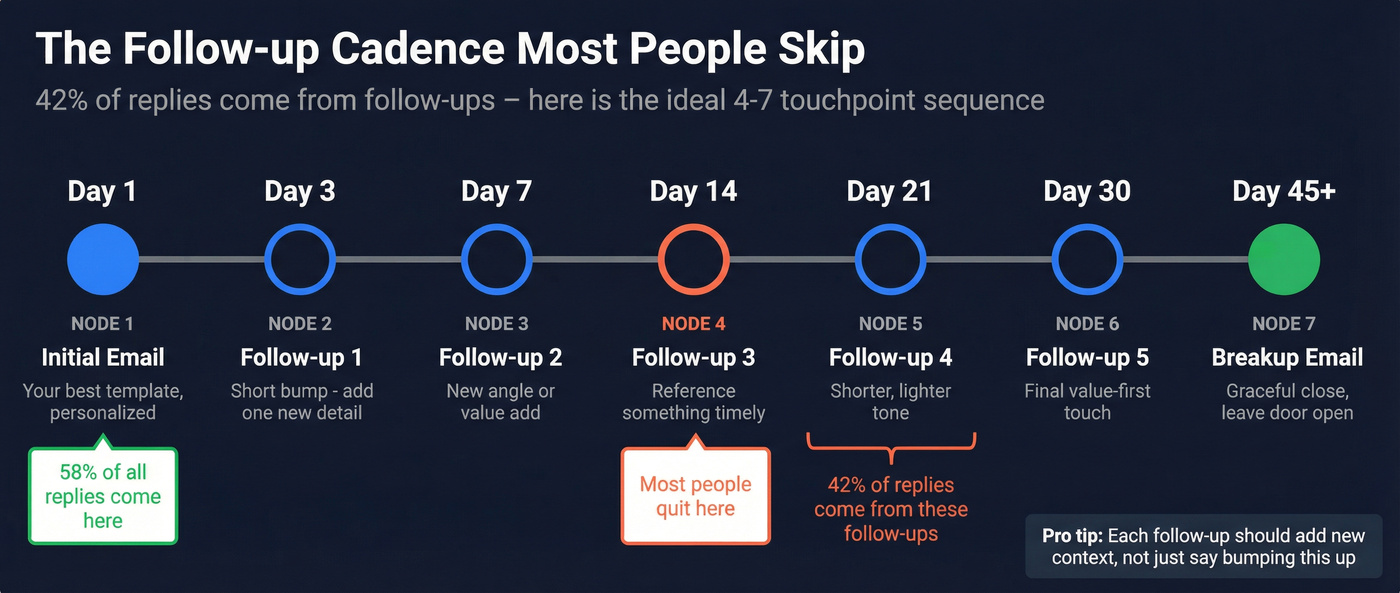
- Use 4-7 touchpoints total. 42% of replies come from follow-ups, not the first email.
- Verify the email address before you hit send. A bounce wastes your one shot and damages your sender reputation.
What Response Rate to Expect
Instantly's 2026 benchmark report - which analyzed billions of cold email interactions - puts the average reply rate at 3.43%. Top-quartile campaigns hit 5.5%+, and the elite top 10% reach 10.7% or higher.
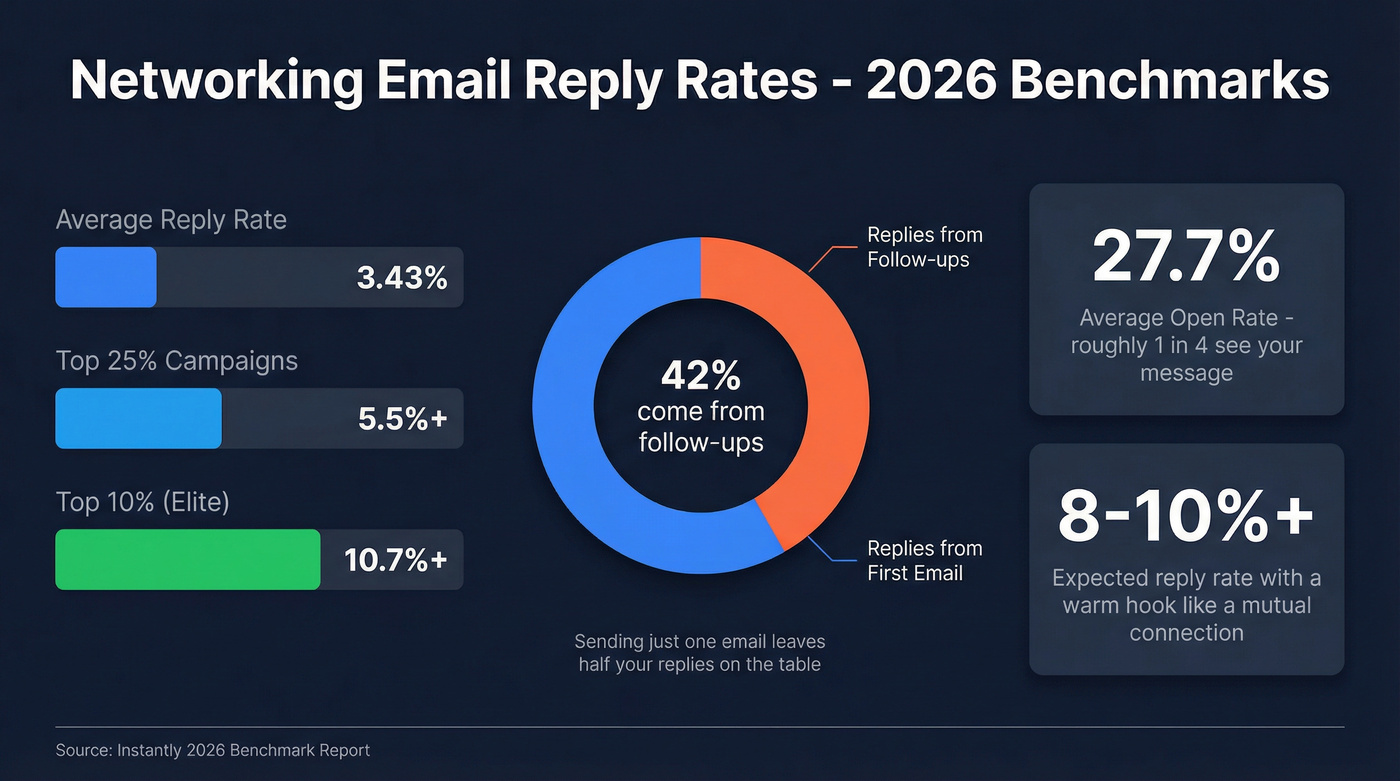
The average B2B cold email open rate is 27.7%, meaning roughly 1 in 4 people even see your message. Of those, only a fraction reply. One reply per 20 emails is normal. The goal is to push yourself into that top quartile through specificity, timing, and persistence - not volume.
Here's the encouraging part: 58% of replies come from the first email, but 42% come from follow-ups. If you're sending one email and giving up, you're leaving almost half your potential replies on the table. Networking-specific outreach - where you have a genuine connection or shared context - tends to outperform generic cold email by a wide margin. Expect low single digits when reaching out cold, and 8-10%+ when you've got a warm hook like a mutual connection or shared event.
Why Most Templates Fail
Here's a real example. This is adapted from a Wall Street Oasis thread where someone shared their outreach message and couldn't figure out why nobody was responding.
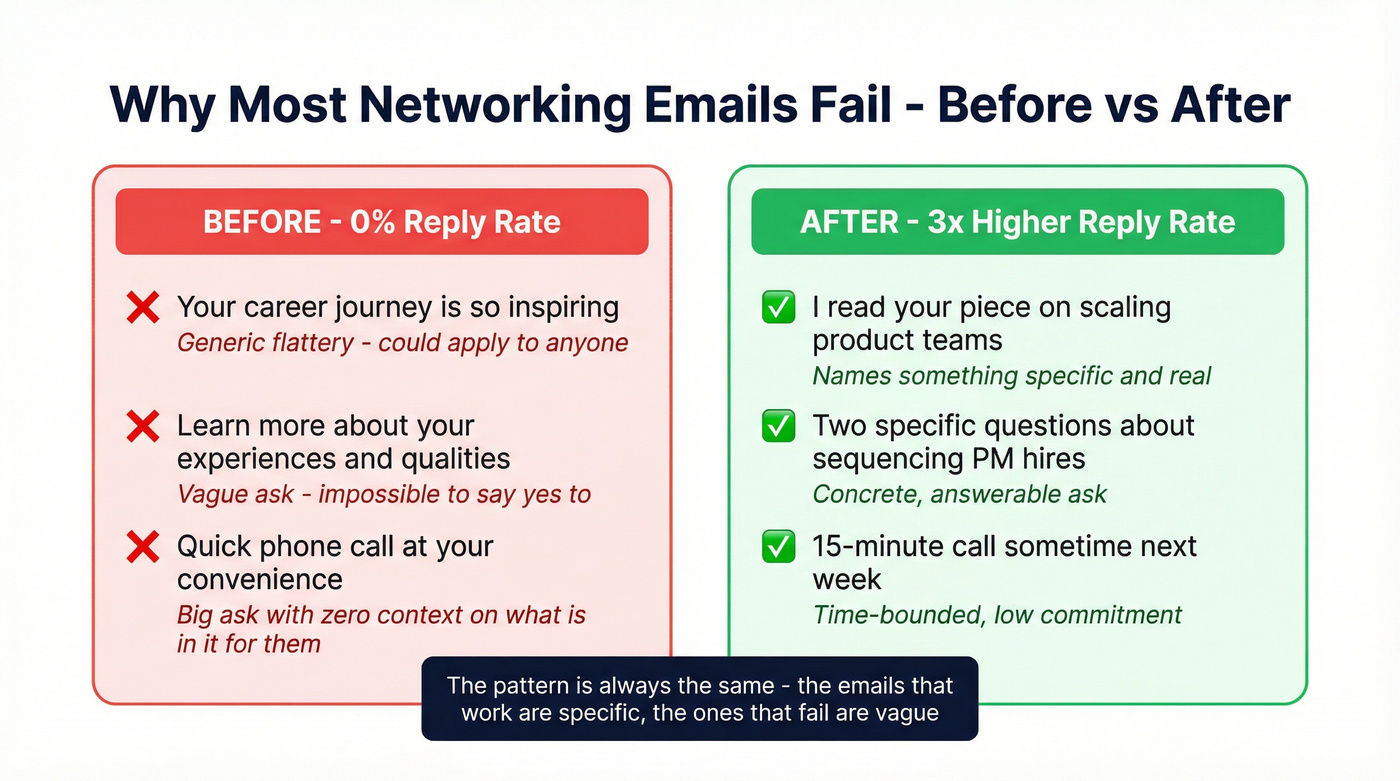
The "before" email:
Hi [Name], I came across your profile and your career journey is so inspiring. I'd love to learn more about your experiences and the qualities that have made you successful. Would you be open to a quick phone call at your convenience?
Three fatal problems. "Your career journey is so inspiring" is generic flattery that could apply to anyone - it signals you didn't research them. "Learn more about your experiences and qualities" is so vague it's impossible to say yes to. And you're asking a stranger for a phone call with zero context on what's in it for them.
The "after" rewrite:
Hi [Name], I read your piece on scaling product teams in the Journal of Product Management - your framework for hiring the first 10 PMs was exactly the challenge I'm facing at [Company]. I'm leading our first product hiring sprint and would love to ask you two specific questions about sequencing PM hires. Would a 15-minute call work sometime next week?
The difference is specificity. You've named something real. You've made a concrete, time-bounded ask. And you've shown why this person and why now. We've reviewed hundreds of networking email examples over the years, and the pattern is always the same: the ones that work are specific, the ones that don't are vague.
As 4Degrees notes, "can I pick your brain?" is one of the worst asks in networking. It's vague, it's a cliche, and it puts all the burden on the recipient. A specific question is always easier to say yes to than an open-ended request.
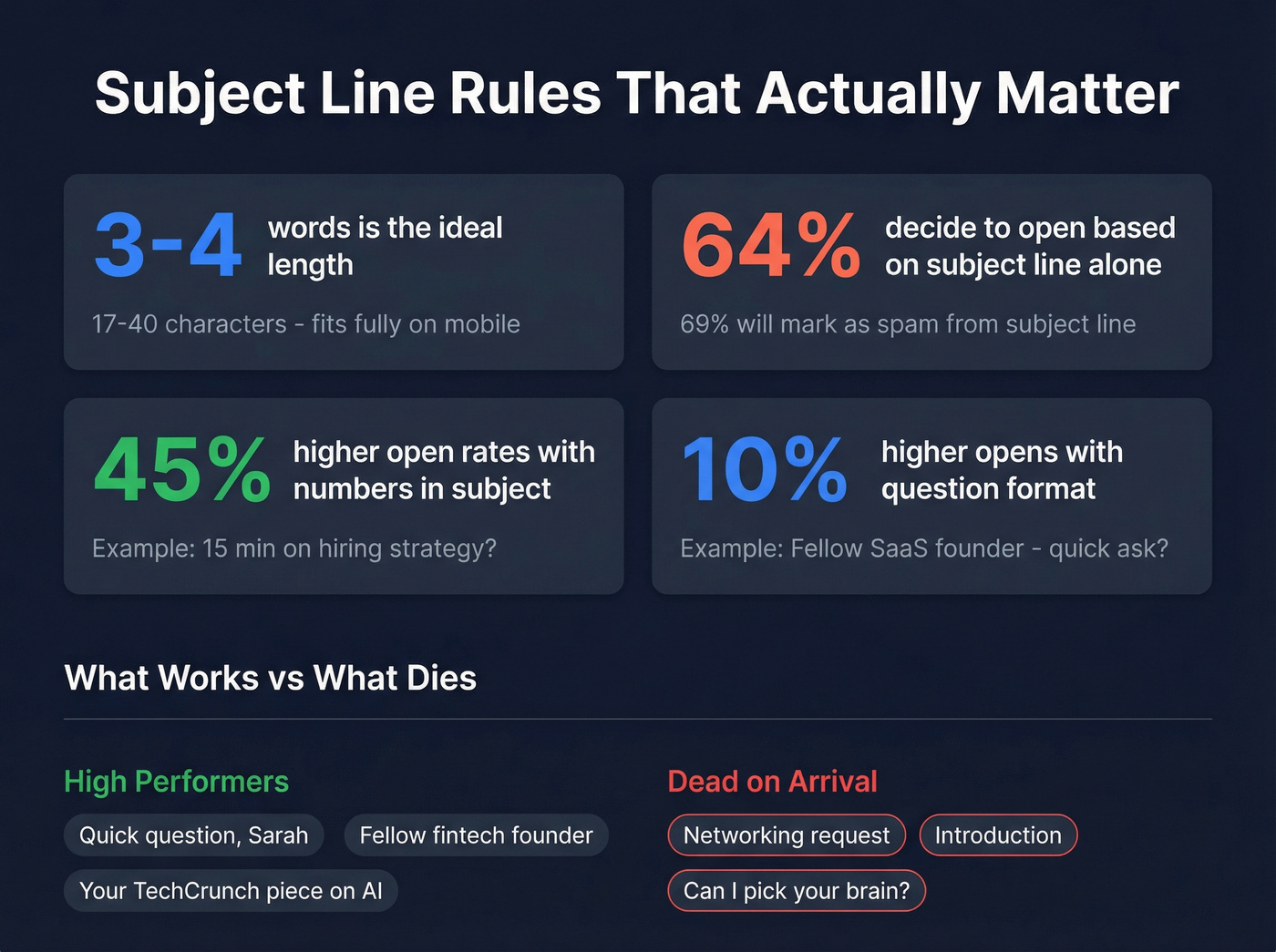
64% of recipients decide whether to open based on the subject line alone, and 69% will mark an email as spam based on the subject line. So even a perfect email body won't matter if your subject line reads like a connection request from 2014.
Subject Lines That Get Opened
The ideal networking subject line is 3-4 words long - roughly 17-40 characters. Short enough to display fully on mobile, specific enough to signal relevance. Numbers in subject lines drive 45% higher open rates, and question-format subject lines see about 10% higher opens.
Here are subject lines organized by scenario:
Cold intro: "Quick question, [Name]" - "Fellow [industry] founder" - "[Mutual contact] suggested connecting"
Alumni/shared affiliation: "[University] alum - quick ask" - "Go [mascot] - 2 questions"
Post-event: "Great meeting at [Event]" - "Your [Event] talk on [topic]"
"I read your work": "Loved your [publication] piece" - "Your [topic] framework"
Follow-up: "Bumping this up" - "Still curious about [topic]" - "One more thought on [topic]"
Informational interview: "15 min on [specific topic]?" - "[Role] career path question"
Every strong subject line contains either a name, a shared context, or a specific reference. Generic subject lines like "Networking request" or "Introduction" are dead on arrival.

You only get one shot with a networking email. A bounce kills it permanently. Prospeo verifies emails with 98% accuracy through 5-step verification - including catch-all handling and spam-trap removal - so your perfectly crafted template actually reaches the inbox.
Don't waste a great email on a bad address. Verify first.
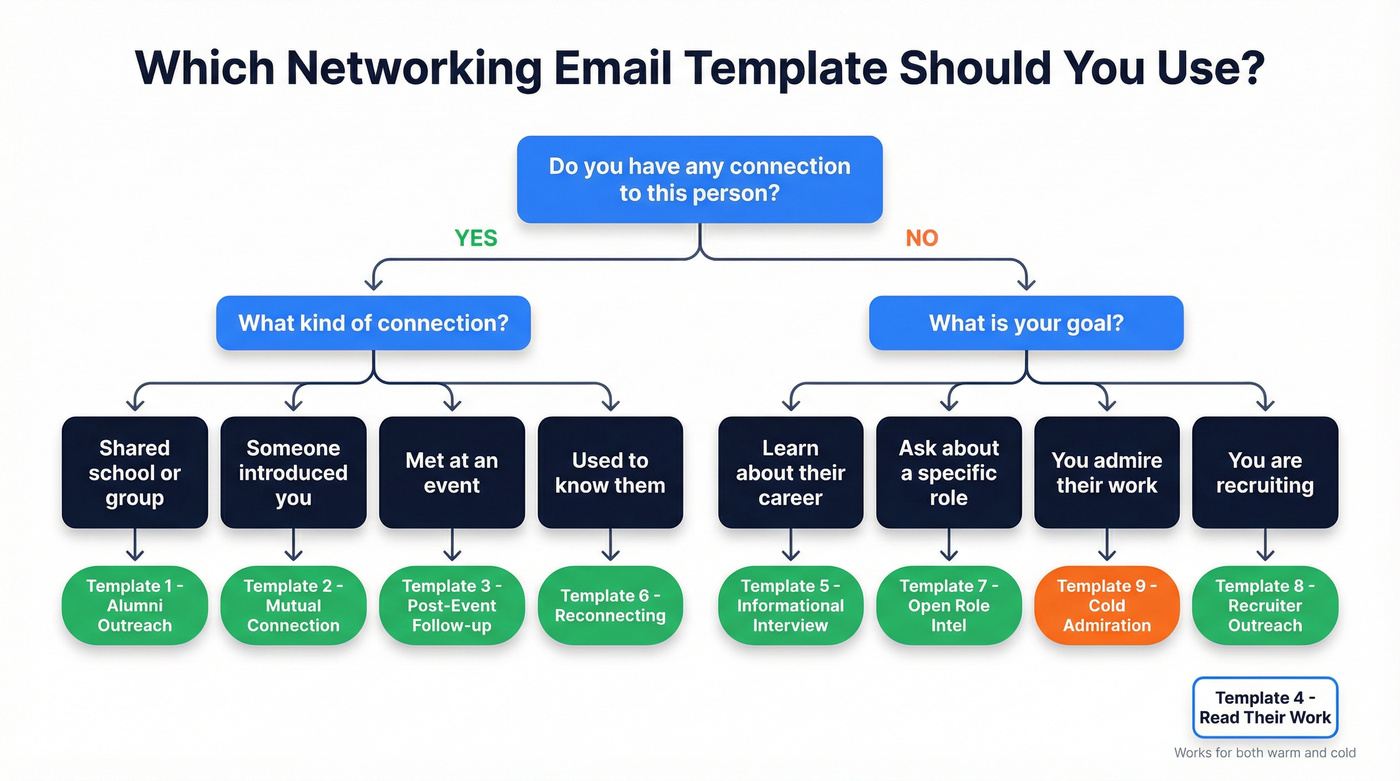
10 Professional Networking Email Examples
1. Alumni or Shared Affiliation
Subject: [University] alum - quick question
Hi [Name], I'm a [year] [University] grad currently working in [field] at [Company]. I saw you've been leading [specific initiative] at [Their Company] - that's exactly the direction I'm exploring for my next move. Would you have 15 minutes this month to share how you made the transition from [previous role] to [current role]? Happy to work around your schedule.
Shared affiliation creates instant trust. The ask is specific - one transition story - and time-bounded: 15 minutes, this month. In our experience, alumni emails outperform every other cold outreach approach. The shared identity does half the work for you, and the consensus on r/jobs backs this up - alumni networks are the single most underused networking channel.
2. Mutual Connection Introduction
Subject: [Mutual contact] suggested I reach out
Hi [Name], [Mutual contact] mentioned you'd be a great person to talk to about [specific topic]. I'm currently [one sentence on your situation] and trying to understand [specific challenge]. Would you be open to a 15-minute call? I'd love to hear how you approached [specific thing they did].
The mutual connection does the heavy lifting on credibility. You're not cold - you're warm by association.
3. Post-Event or Conference Follow-Up
This template also works for career fairs, meetups, and webinar Q&A sessions - any context where you've already exchanged a few words.
Subject: Great meeting at [Event]
Hi [Name], I enjoyed our conversation at [Event] about [specific topic you discussed]. Your point about [specific insight] stuck with me - I've been thinking about how to apply it to [your context]. Would you be up for continuing the conversation over a 20-minute call? I have a couple of follow-up questions on [specific area].
You're referencing a real interaction with a specific detail. This isn't a mass email - it's a continuation.
4. "I Read Your Article / Saw Your Talk"
Subject: Your [publication] piece on [topic]
Hi [Name], your recent article on [specific topic] in [publication] changed how I'm thinking about [specific aspect]. I'm working on [related challenge] at [Company] and your framework for [specific element] is directly relevant. Would you have 15 minutes to discuss how you've seen [specific concept] play out in practice? I'd come with two focused questions.
Don't just say "great article!" Name a specific framework or insight from the piece. That's the difference between flattery and genuine engagement.
5. Informational Interview Request
Subject: 15 min on [specific career topic]?
Hi [Name], I'm a [role] at [Company] exploring a move into [target field/role]. Your path from [previous role] to [current role] at [Company] is exactly the trajectory I'm researching. Could I ask you two specific questions about [concrete topic - e.g., "how hiring managers evaluate candidates without direct experience"]? A 15-minute call or even a quick email reply would be incredibly helpful.
"Two specific questions" is a much easier yes than "tell me about your career." You've also given them the option to reply by email, which lowers the commitment bar. This professional networking email works especially well when you can reference a specific career milestone from their profile.
6. Reconnecting After a Long Gap
Subject: Been a while - quick update
Hi [Name], it's been [timeframe] since we [last interaction - e.g., "worked together at Company" or "met at Event"]. I saw [something recent about them - new role, article, company news] - congrats. I've since moved into [your current situation] and would love to reconnect. Any chance you're free for a 15-minute catch-up in the next couple weeks?
You've acknowledged the gap honestly, shown you're paying attention to their career, and kept the ask light. No guilt trip, no over-explanation.
7. Asking a Contact About an Open Role
Subject: [Role title] at [Their Company]
Hi [Name], I noticed [Their Company] has an open [Role] position. Given your experience on the [relevant team], I'd love to hear what the team culture and priorities look like right now. I've been doing [relevant experience] at [Company] for [timeframe] and the role looks like a strong fit. Would you have 10 minutes to share your perspective before I apply?
Here's the thing: you're not asking them to refer you yet. You're asking for intel, which is a much smaller ask that often leads to a referral anyway.
8. Recruiter Outreach
HR specialists reply at 8.5% in cold email benchmarks, so if you're reaching out to talent or HR professionals, your odds are better than average.
Subject: [Role] opportunity - [one compelling detail]
Hi [Name], I'm working with [Company/client] on a [Role] search. Your background in [specific skill/experience] caught my attention - particularly [specific accomplishment or credential]. The role involves [one sentence on the opportunity]. Would you be open to a 10-minute call to see if there's a fit? No pressure either way.
The key move is being specific about why them, not just what the role is.
9. Cold Outreach to Someone You Admire
Subject: Your work on [specific topic]
Hi [Name], I've followed your work on [specific topic] since [specific piece/talk/project]. I'm building [your project or career direction] and your approach to [specific element] has directly influenced how I think about [related challenge]. I don't have a big ask - I'd just love to hear your current thinking on [one specific question]. Even a two-line email reply would make my week.
The "even a two-line reply" framing dramatically lowers the bar. C-level contacts reply at about 4.2% vs 5.6% for non-C-level in cold benchmarks, so keeping the ask minimal matters even more when you're reaching up. Skip this approach if you can't name something specific about their work - a vague "I admire you" email from a stranger reads as fan mail, not networking.
10. Thank-You After a Networking Call
Subject: Thanks - and one follow-up
Hi [Name], thanks for taking the time today. Your advice on [specific takeaway] was exactly what I needed to hear - I'm going to [specific action you'll take based on their advice]. I also wanted to share [relevant resource, article, or introduction] that connects to what we discussed about [topic]. I'll keep you posted on how [specific next step] goes.
You've shown you listened, you're taking action, and you're giving something back. This is how you turn a one-time call into an ongoing relationship.
The Follow-Up Framework
Most people send one email, get no reply, and assume the person isn't interested. That's a mistake. Instantly's 2026 benchmark data shows 4-7 touchpoints is the sweet spot: fewer than 4 quits too early, and more than 7 has diminishing returns unless each touch adds new value.
Timing cadence:
- Follow-up 1: 3-4 days after initial email
- Follow-up 2: 3-4 days later
- Follow-up 3: 3-4 days later
- Follow-up 4+: Weekly, as long as each touch adds something new
Follow-ups that feel like replies - not reminders - outperform formal follow-ups by about 30%. Your follow-up should read like you're continuing a conversation, not nagging.
Short nudge template:
Hi [Name], just bumping this up - I know inboxes get buried. Still very interested in hearing your take on [specific topic from original email]. Happy to keep it to 10 minutes whenever works.
Value-add template:
Hi [Name], wanted to share [relevant article/resource/data point] that connects to [topic from original email]. Thought you'd find it interesting regardless of whether we connect. The offer for a quick call still stands if you're up for it.
The value-add follow-up works because it gives before it asks. You're demonstrating that you're not just extracting - you're contributing.
Find the Email Before You Send
Every networking guide gives you templates. Almost none address the step that comes first: actually finding a verified email address. Guessing formats like firstname.lastname@company.com works sometimes, but when it doesn't, you bounce - and a bounced email wastes your one shot while damaging your sender reputation.
Prospeo's Email Finder handles this. Paste a professional profile URL or search by name and company, and you get a verified email address with 98% accuracy. The Chrome extension makes it even faster - one click on any professional profile or company website. The free tier gives you 75 verified emails per month, which is plenty for networking outreach.
One deliverability tip worth knowing: a Snov.io experiment across 44 million emails found that disabling open tracking more than doubled reply rates (2.36% vs 1.08%). Open tracking pixels trigger spam filters, so for networking emails where every send counts, turn it off.
Finding the right person to network with is half the battle. Prospeo's database of 300M+ profiles with 30+ filters lets you pinpoint decision-makers by role, company, industry, and even job changes - then gives you their verified email at $0.01 each.
Stop guessing email addresses. Start connecting with the right people.
Timing, Length, and Deliverability
Tuesday and Wednesday consistently outperform other days for outreach emails, with Wednesday producing the single highest reply rates in 2026 benchmarks. The 7-11 a.m. window on Wednesday is your best bet.
Keep the email body under 80 words. Every template above stays within this range for a reason - the best-performing campaigns in 2026 are short and specific. Send to fewer than 100 recipients per campaign for the highest reply rates (up to 5.5%), and A/B test subject lines weekly. Even small changes - question vs. statement, name included vs. not - shift open rates meaningfully.
Let's be honest: if your networking email is longer than a text message, it's too long. The people you're trying to reach are busy. Respect their time with brevity, and they'll respect your ask with a reply.
When you can't find someone's email, a message on a professional platform with the same structure works - just keep it under 300 characters.
FAQ
How long should a networking email be?
Under 80 words in the body. State your connection, make a concrete ask, and stop. Every word beyond 80 has to earn its place, and most don't. The 2026 benchmarks confirm that shorter outreach consistently earns higher reply rates.
How many follow-ups should I send?
Plan on 4-7 touchpoints total, spaced 3-4 days apart at first, then weekly. 42% of replies come from follow-ups, not the initial email, so a one-and-done approach leaves nearly half your potential responses on the table.
What makes a networking email template effective?
Specificity. The best templates reference something real - an article, a shared affiliation, a mutual connection - and make a concrete, time-bounded ask. Generic messages that could apply to anyone get treated like spam. Notice how each example above names a specific detail. That's the pattern that earns replies.
What if I can't find their email address?
Don't guess - bounced emails waste your one shot and hurt your sender reputation. Use Prospeo to find and verify professional emails before sending. The free tier covers 75 verified emails per month, more than enough for targeted networking.