7 B2B Sales Trends for 2026 (With Data to Prove It)
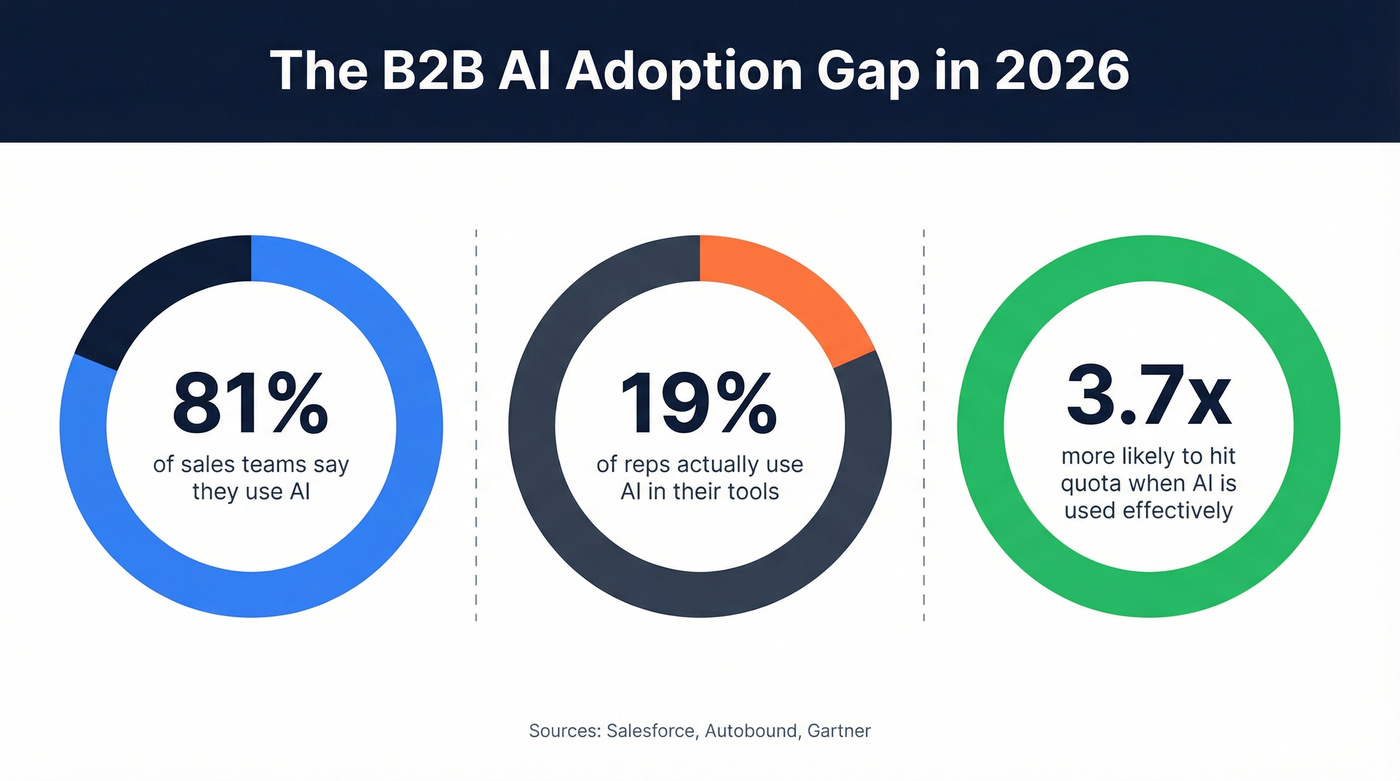
81% of sales teams say they've implemented or are experimenting with AI. But only 19% of reps actually use AI features built into their sales tools. The rest are copy-pasting into ChatGPT and calling it a strategy. That gap - between what companies claim and what reps actually do - defines the most important B2B sales trends in 2026 more than any single technology or tactic.
What You Need (Quick Version)
Three trends will actually move pipeline this year. Everything else is noise until these are right:
- Signal-based selling - timing outreach to real triggers instead of blasting static lists
- Data freshness - stale contacts tank deliverability, and most databases refresh every six weeks
- AI-assisted, not AI-replaced - Gartner found reps who partner with AI effectively are 3.7x more likely to hit quota, while reps replaced by AI are generating spam
The 7 Trends That Matter in 2026
Digital-First Buying Is the Default
The in-person sales call isn't dead, but it's been demoted. In-person interactions now account for 17% of B2B revenue, down from 22% just two years ago. Meanwhile, 34% of total B2B sales revenue comes from self-service ecommerce and remote online interactions, and 39% of buyers are spending over $500K per order through those channels - up from 28%. Even more telling: 73% of buyers are now comfortable spending $50K+ in a single online transaction, up from 59% in 2022.
That's not a trend. That's a structural shift.
75% of B2B organizations will close their highest-revenue deals via digital channels by 2028, according to Gartner. Phone still matters for multi-threading into buying committees, but it's declining as a primary channel. If your go-to-market motion still depends on getting a meeting in a conference room, you're optimizing for a shrinking slice of revenue.
AI Adoption Is Wide but Shallow
Here's the thing: the headline stat - Salesforce data showing 81% of sales teams experimenting with AI - sounds impressive until you look underneath. Only 41% have full implementation. The other 40% are "experimenting," which usually means a few reps tried a tool for a week.
The real gap is at the rep level. Only 19% of salespeople use AI features built into their sales tools, whether that's Salesforce Einstein, HubSpot's AI assistants, or anything else native to their stack. The rest default to generic chatbots for email drafts. Sellers who effectively partner with AI are 3.7x more likely to meet quota - but "effectively" is doing heavy lifting in that sentence. It means AI embedded into lead scoring, account research, and proposal generation, not just "write me a cold email."
The loudest complaint in 2026 isn't about AI replacing jobs. It's about AI-generated outreach creating more noise for everyone. In our experience, the teams getting real ROI from AI are the ones who fixed their data quality first. AI amplifies whatever you feed it, including garbage.
Signal-Based Selling Replaces Spray-and-Pray
If you're running outbound and your reply rates are stuck below 5%, this is where to focus. Signal-based selling means prioritizing outreach based on real-time triggers - funding rounds, hiring surges, job changes, competitor complaints - instead of working down a static list. With 61% of buyers now preferring a completely rep-free experience, timing and relevance aren't nice-to-haves. They're the only reason a buyer will engage with outbound at all.
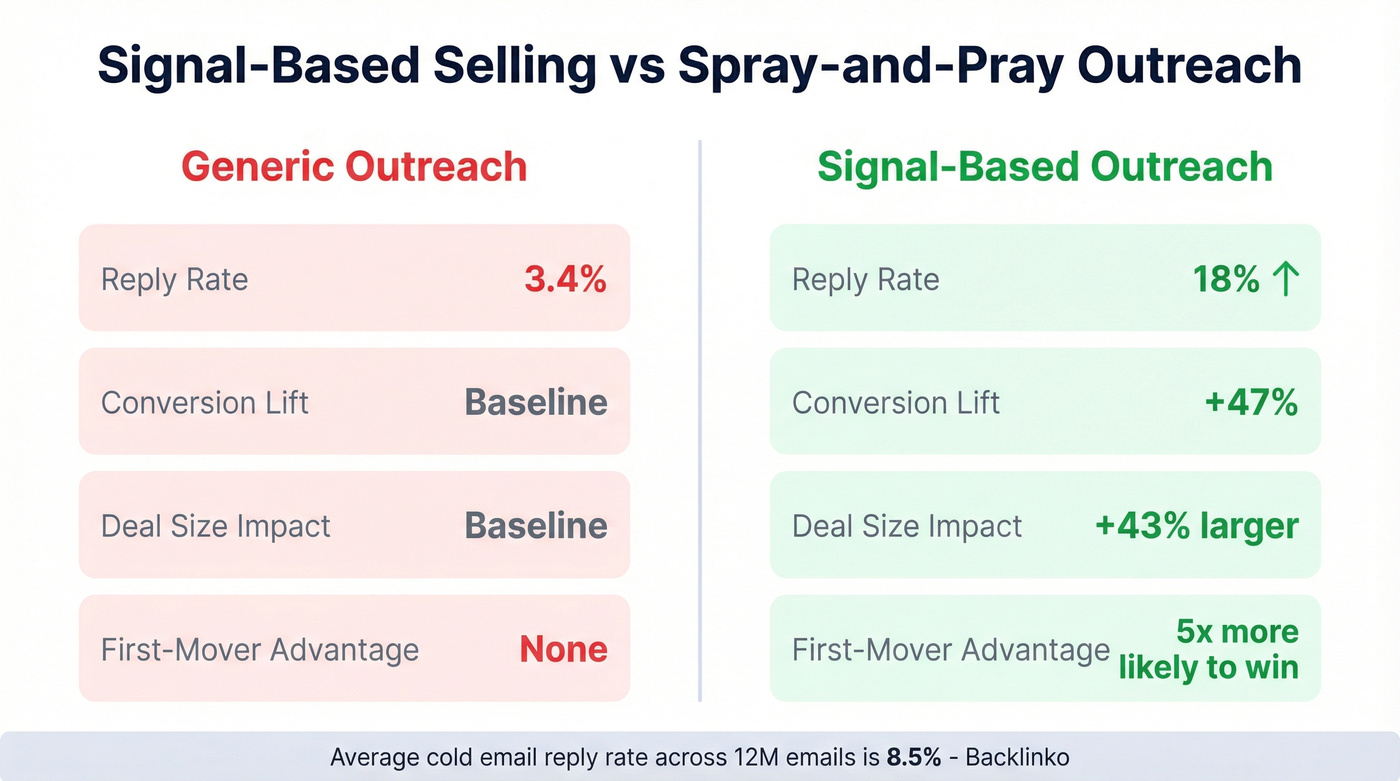
The numbers are unambiguous. The average cold email reply rate is 8.5% across 12M emails according to Backlinko, but that average masks a huge spread. Generic outreach without signal-based personalization lands around 3.4%. Signal-personalized outreach - where the email references a specific trigger - hits 18%. And the first seller to reach out after a trigger event is 5x more likely to win the deal.
It's not just reply rates, either. Signal-qualified leads drive 47% better conversion rates, 43% larger deal sizes, and 38% more closed deals. That's the difference between a demand generation engine and a spam cannon.
Skip this if you're selling a commodity product where timing doesn't matter. But for most B2B teams, signal-based selling is the single highest-leverage change you can make this year.
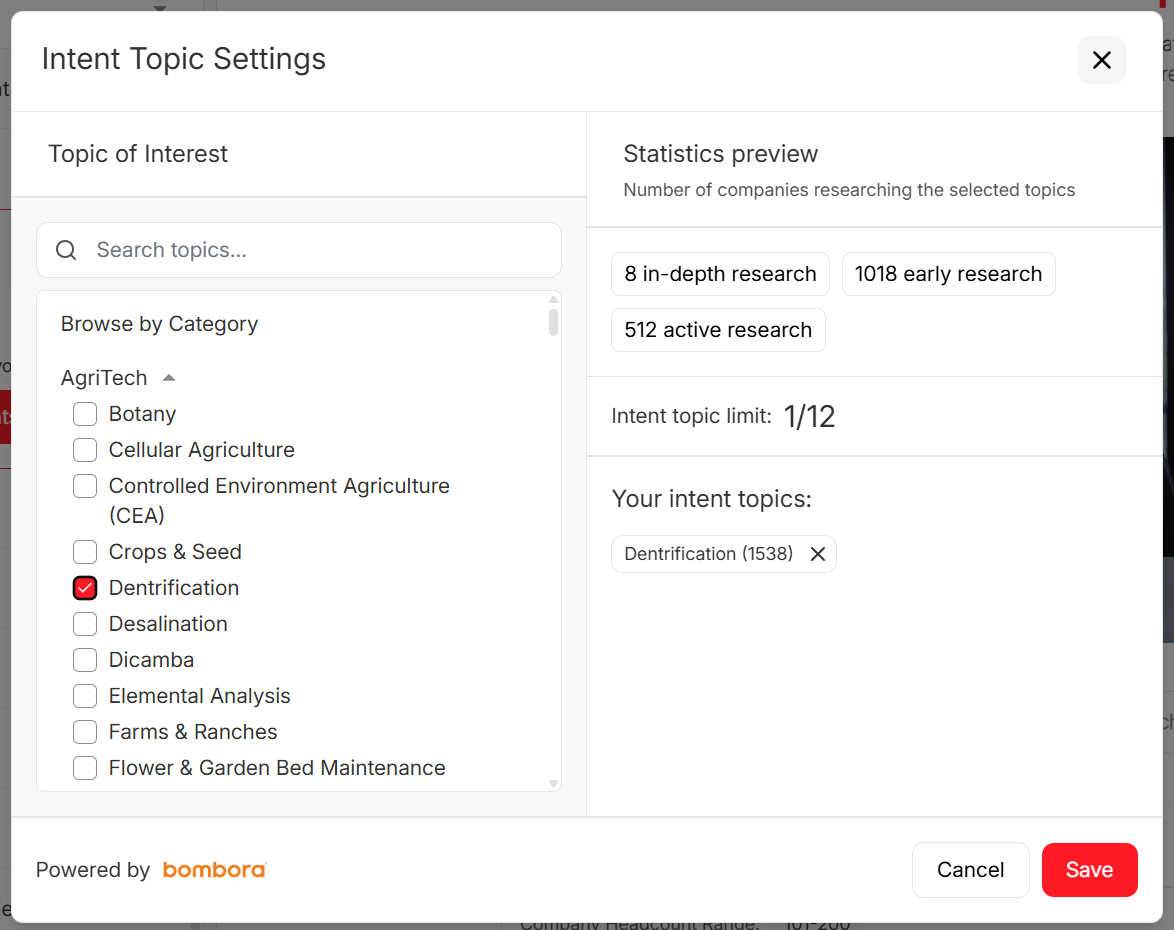
The infrastructure requirement is real, though. You need a data platform that surfaces intent signals and gives you verified contacts to act on them. Prospeo tracks 15,000 intent topics through Bombora and pairs that with 143M+ verified emails, so you're not just seeing the signal but reaching the right person fast.
Data Quality Is the Real AI Moat
72% of suppliers say their sales processes are mostly automated. Only 47% of buyers agree. That perception gap explains why so much B2B automation feels like spam to the people receiving it - the problem isn't the technology, it's the data underneath.
The industry average data refresh cycle is six weeks. In six weeks, people change jobs, companies get acquired, and email addresses go dark. We've seen teams running 35-40% bounce rates before switching to verified data - that's not just wasted outreach, it's active domain reputation damage that takes months to repair.
Look, most teams don't have an AI problem or an outbound problem. They have a data problem they've been ignoring because buying a new tool is more exciting than auditing the data feeding the tools they already own.
Prospeo runs a 7-day refresh cycle with 98% email accuracy. One customer, Snyk, had a team of 50 AEs who dropped from 35-40% bounce rates to under 5% after switching, and their AE-sourced pipeline jumped 180%. Data freshness isn't a nice-to-have. It's the foundation that makes every other trend on this list actually work.


Signal-based selling only works if you can reach the right person before the window closes. Prospeo tracks 15,000 intent topics and pairs them with 143M+ verified emails refreshed every 7 days - so you act on signals, not stale lists.
Stop blasting static lists. Start selling on real-time signals.
Agentic AI Enters Both Sides of the Deal
Agentic AI - autonomous agents that execute multi-step tasks - is showing up on both sides of the table. 24% of suppliers already use agentic AI, while 38% of buyers do. Buyers are actually ahead here, which should concern every sales leader reading this.
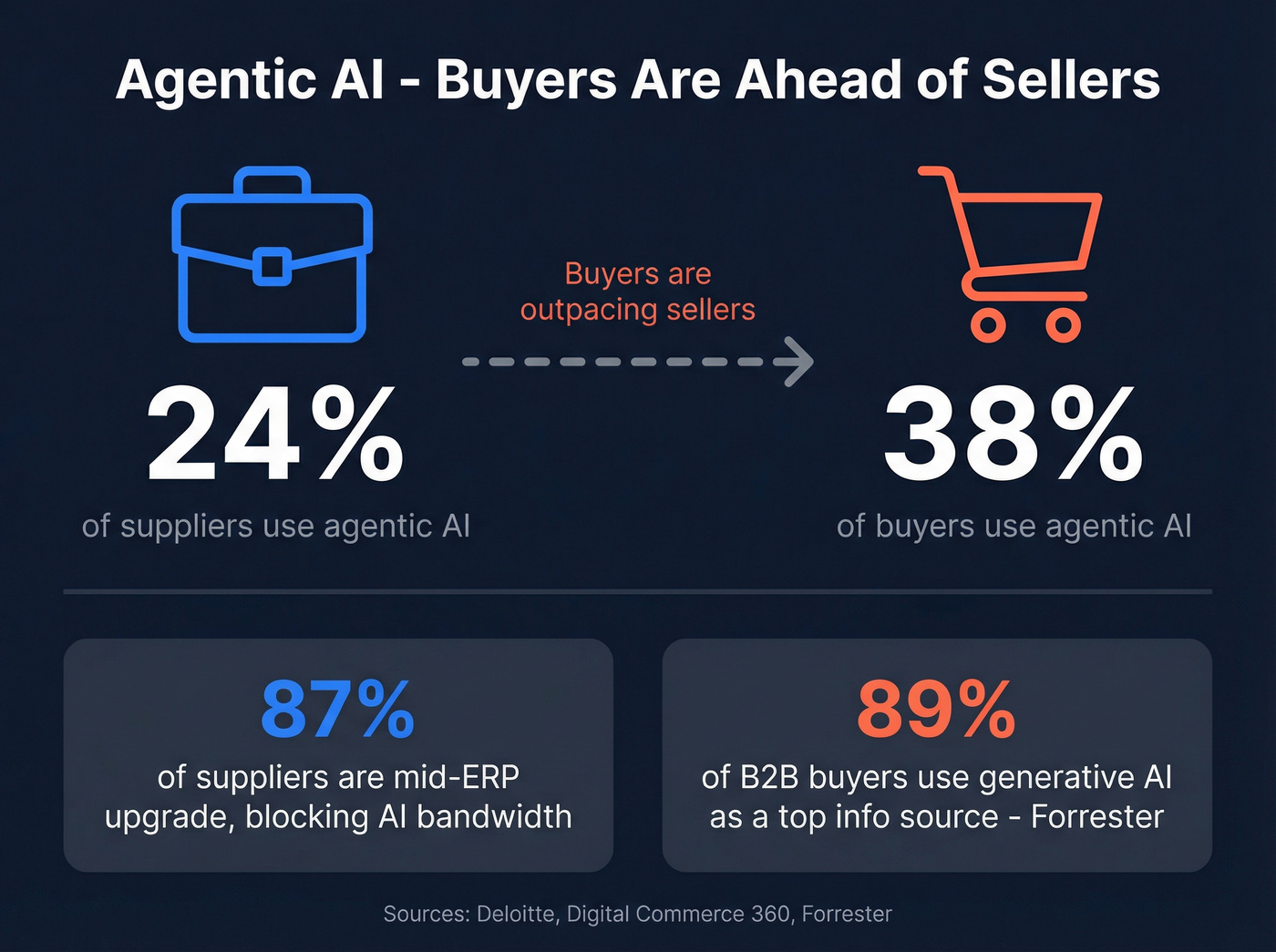
The constraint isn't willingness. It's capacity. 87% of suppliers are mid-ERP upgrade, which absorbs the IT bandwidth that agentic AI projects need. Meanwhile, 89% of B2B buyers use generative AI as a top information source across buying phases, according to Forrester. Your prospects are using AI to evaluate you before you even know they're in-market. The question isn't whether to deploy autonomous agents - it's whether you'll deploy them before your buyers outpace you.
Digital Maturity Drives Revenue
Deloitte surveyed 530 suppliers and 530 buyers. High digital maturity suppliers reported 6.1% average revenue growth vs 2.9% for low-maturity competitors. Fully integrated companies exceeded annual sales goals by roughly 6.3% - nearly double their less-integrated peers. B2B leaders focused on buyer experience also close deals 31% faster, according to Dentsu research.
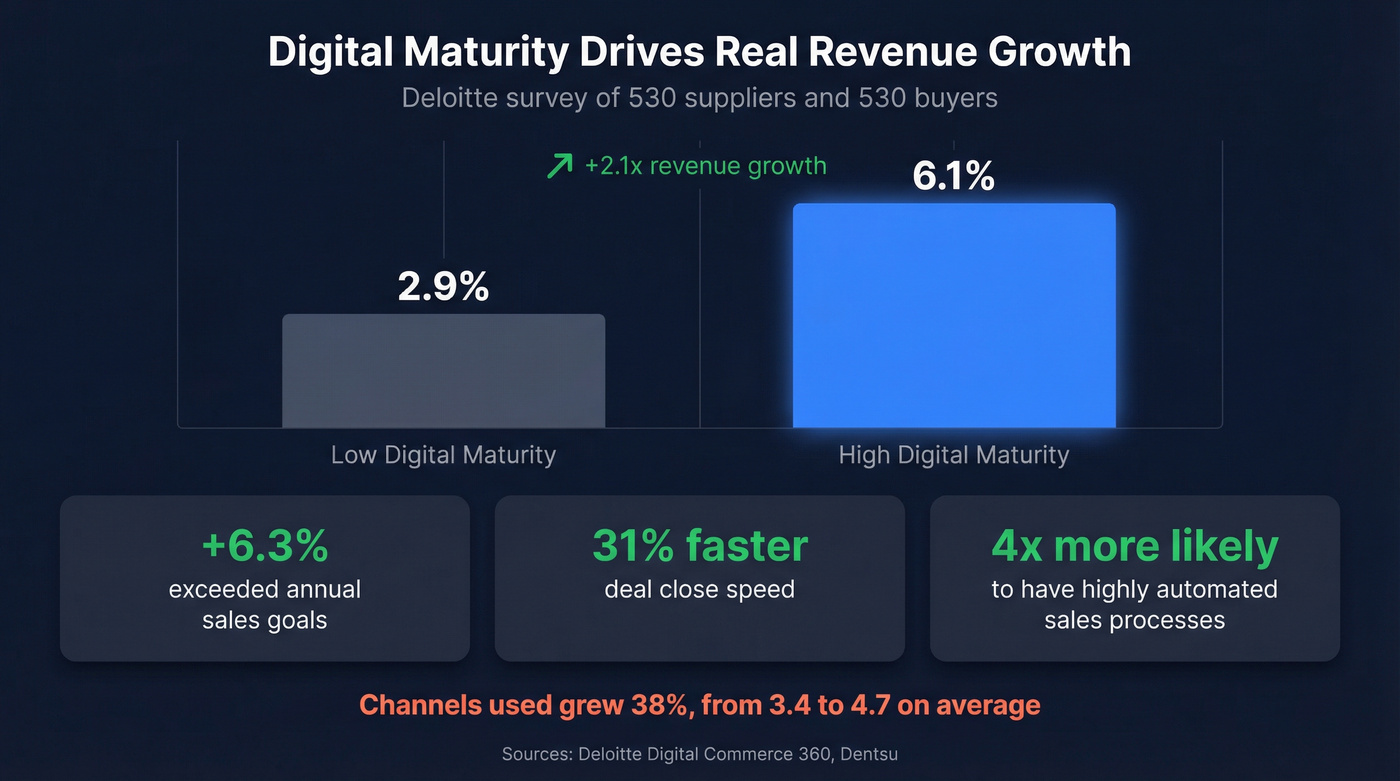
These firms are 4x as likely to have highly automated sales processes and 4x as likely to have customers who say doing business with them is "quite easy." The number of enabled channels they use increased 38%, from 3.4 to 4.7 on average. The gap isn't about having more tools. It's about connecting the tools you have so data flows without manual re-entry and handoffs - your CRM, enrichment platform, and outreach tools actually talking to each other instead of living in silos.
The Buying Committee Keeps Growing
The average B2B deal now involves 13 decision-makers, and 80% of those interactions happen through digital channels. If you're single-threading deals - relying on one champion to sell internally - you're leaving pipeline on the table.
Multi-threading isn't optional anymore. Buyers spend roughly 29% more with suppliers who deliver consistently positive experiences across every touchpoint, according to Deloitte. On the flip side, suppliers estimate losing 13% of sales bids due to negative buyer experiences. That means every stakeholder in the committee needs to feel like the buying process was built for them, not just for the person who took the first demo. Account-based selling - mapping and engaging the full committee through verified contacts and personalized outreach - is the only reliable way to navigate a 13-person buying group without losing momentum.
Every trend on this list - AI, agentic workflows, digital-first buying - collapses without clean data underneath. Snyk's 50 AEs went from 35% bounce rates to under 5% and grew AE-sourced pipeline 180%. Prospeo's 7-day refresh and 98% accuracy make the rest of your stack actually work.
Fix the data. Everything else follows.
2026 Funnel Benchmarks Worth Bookmarking
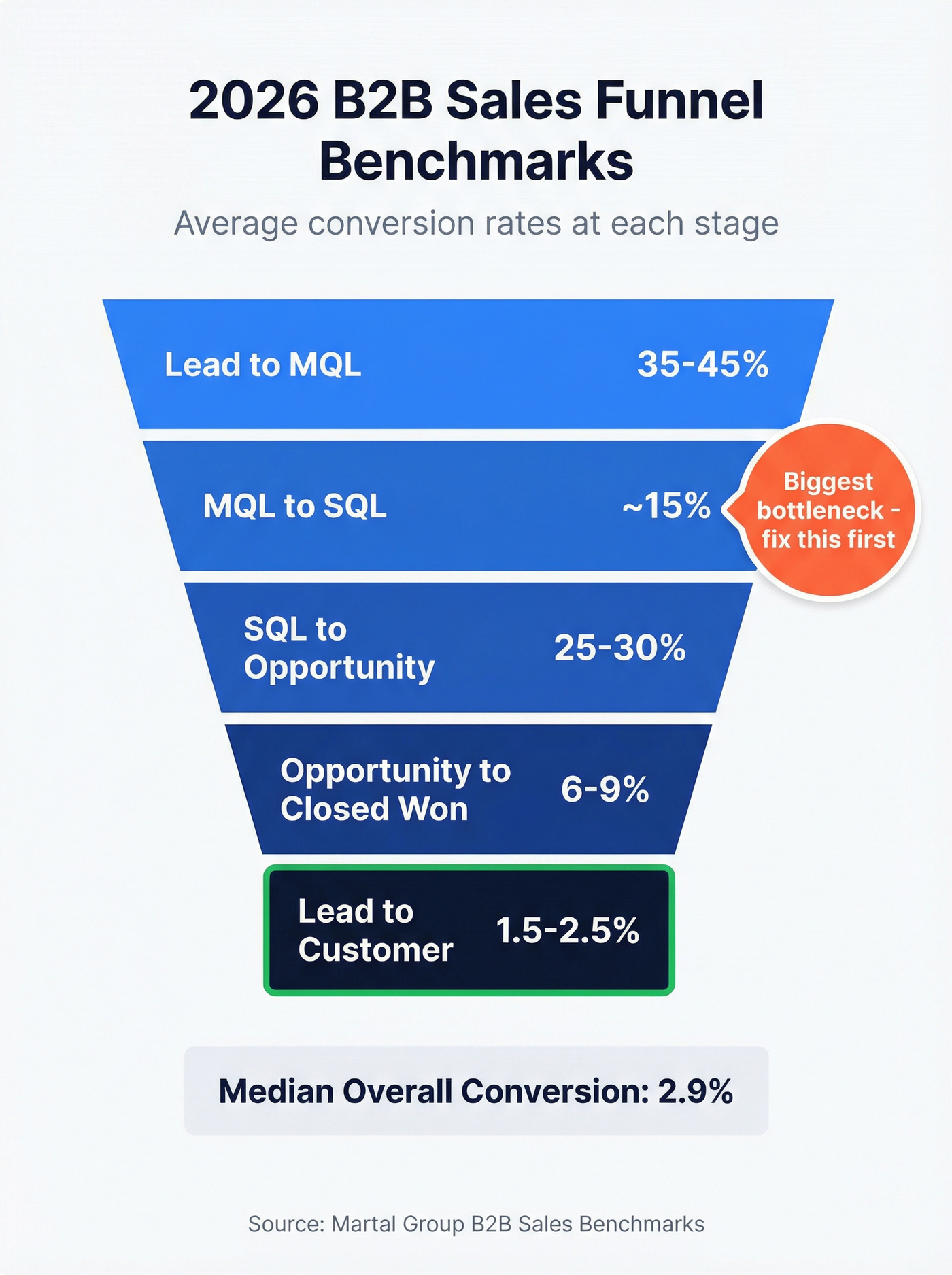
These funnel-stage benchmarks are worth saving. The MQL-to-SQL drop-off is where most teams hemorrhage pipeline, and the data now shows that conversion quality at each stage matters far more than top-of-funnel volume.
| Stage | Rate |
|---|---|
| Lead to MQL | 35-45% |
| MQL to SQL | ~15% |
| SQL to Opportunity | 25-30% |
| Opportunity to Closed-Won | 6-9% |
| Lead to Customer | 1.5-2.5% |
| Median Conversion | 2.9% |
That 15% MQL-to-SQL conversion is the biggest bottleneck in most funnels. It's where unclear ICP definitions and weak qualification criteria destroy pipeline quality. If you're only fixing one stage, fix that one.
B2B Sales Trends to Avoid in 2026
Over-automating without personalizing. Automation at scale without signal-based personalization increases unsubscribes and kills reply rates. More volume with bad targeting is just faster failure. We've watched teams triple their send volume and see reply rates drop by half - the math doesn't work. (If you want a tighter playbook, start with personalization.)
Running outbound without a sharp ICP. An unclear ideal customer profile wastes pipeline at every stage. If your MQL-to-SQL rate is below 10%, your ICP is probably too broad. Tighten it before you scale anything. Use a simple account qualification framework so reps stop guessing.
Neglecting mid-funnel nurture. Most teams obsess over top-of-funnel lead gen and bottom-of-funnel closing. The middle - where prospects go quiet for weeks - is where deals actually die. Let's be honest: nobody wants to build nurture sequences, but the teams that do are the ones closing at 8-9% instead of 4%. A lightweight lead nurturing strategy fixes this fast.
FAQ
What's the biggest B2B sales trend in 2026?
Signal-based selling is the highest-leverage shift. Teams using real-time triggers like funding rounds, hiring surges, and intent signals to time outreach see 18% reply rates vs 3.4% for generic cold email. Signal-qualified leads also convert 47% better and produce 43% larger deals.
Why do most B2B sales AI implementations fail?
81% of sales teams experiment with AI, but only 19% of reps use AI built into their tools - most copy-paste into ChatGPT instead. Teams seeing results embed AI into lead scoring, account research, and proposals, and they fix underlying data quality first. AI on stale contacts just generates spam faster.
How do you improve B2B outbound reply rates?
Start with verified, fresh contact data - bounce rates above 5% kill domain reputation. Layer in intent signals to time outreach, and personalize based on the specific trigger. A 7-day data refresh cycle and 98%+ email accuracy give signal-based selling the clean foundation it needs to work.
What tools support signal-based selling in 2026?
You need a platform combining intent data with verified contact information. Look for 30+ search filters covering technographics, funding, and headcount growth, paired with intent data tracking thousands of topics. Free tiers let you test before committing budget.