


Overloop Pricing (2026): What You'll Really Pay for Credits & Seats
Overloop pricing looks simple at first: $69/user/month. Then you realize the real meter isn't seats - it's credits.
That's where teams get surprised.
We've seen this exact movie: a team signs up, builds a few slick sequences, and two weeks later the SDR manager's asking why prospecting "stopped working." Nothing broke. They just ran out of credits.
Here's the clean breakdown of Overloop plans, credit math, rollover rules, refunds, and the true software cost per prospect you can actually message.
Overloop pricing snapshot (checked Feb 17, 2026)
Official pricing page: Overloop's pricing page (checked on 2026-02-17)
Quick snapshot
- Starter: $69/user/mo
- Growth: $99/user/mo
- Enterprise: Custom
- Free trial: 14 days, no credit card
Overloop AI positions itself as a combined outbound platform + database, with access to a 450M+ B2B contacts database. Nice headline. But your month-to-month output is set by credits, not the database size, and that's the part most teams don't model before they buy.
Who each plan is for (realistically):
- Starter ($69): You're validating ICP + messaging and don't need big volume. Great for founders and small teams... until credits run out.
- Growth ($99): The practical starting point for most outbound teams because it unlocks HubSpot + Pipedrive and gives you enough credits to run consistently.
- Enterprise (custom): You need Salesforce, stronger admin/support (like a dedicated CSM and priority support), and deliverability infrastructure like a private setup for secondary domains (dedicated IP).
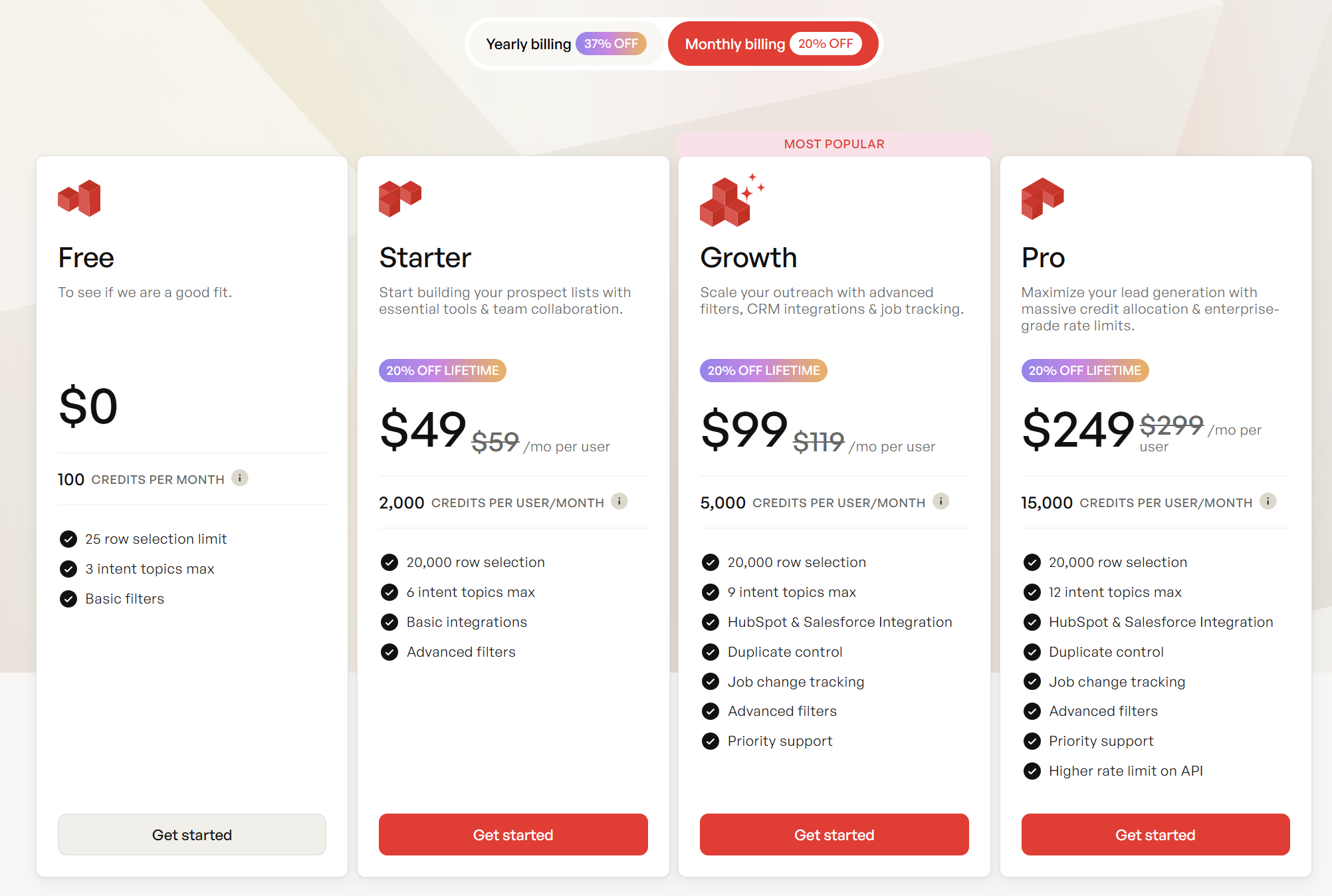
Overloop plans and pricing: Starter vs Growth vs Enterprise
Overloop's packaging is straightforward: you pay per user, and each user comes with a monthly credit allowance. The gating that matters isn't "AI" features - it's integrations and how many new prospects you can create with emails each month, because that's what decides whether reps can keep feeding sequences without rationing.

| Plan | Price (per user) | Credits/user/mo | Key CRM/integration gating |
|---|---|---|---|
| Starter | $69/mo | 250 | Entry-level integrations (best for basic workflows) |
| Growth | $99/mo | 500 | HubSpot + Pipedrive access (common upgrade trigger) |
| Enterprise | Custom | 1,000 | Salesforce access (the Enterprise trigger) |
Overloop supports more integrations; these are the plan-gated items that usually force the decision.
And here are the limits that shape day-to-day operations:
| Plan | Email accts/user | Campaigns | Deliverability infrastructure |
|---|---|---|---|
| Starter | 1 | 3 | - |
| Growth | 3 | 10 | - |
| Enterprise | Unlimited | Unlimited | Private setup for secondary domains (dedicated IP) |
Decision rule (use this and stop overthinking it):
- Need HubSpot or Pipedrive? Buy Growth
- Need Salesforce? You're in Enterprise
- Need more than ~250 new prospects/user/month? You're probably in Growth (or Enterprise if Salesforce is non-negotiable)
Here's the thing: the plan name doesn't matter. Your CRM does.
What I'd pay attention to (not the marketing bullets):
- Credits per user/month: 250 vs 500 vs 1,000 is the difference between "we can prospect" and "we're constantly rationing."
- Email accounts per user: Growth's 3 accounts is a real operational unlock if you rotate domains or separate personas.
- Integrations gating: CRM fit decides the plan faster than any feature list.
- Enterprise deliverability setup: If you care about infrastructure (not just copy), this is the only tier that even talks your language.
How Overloop credits work (and what you're actually paying for)
Credits power prospecting. Everything else - sequencing steps, touchpoints, follow-ups - doesn't consume credits.

Credits are spent on:
- 1 credit to source a prospect from Overloop's database
- 1 credit to find an email for a prospect (whether that prospect is sourced inside Overloop or imported)
Credits aren't spent on:
- Campaign steps (email steps, multichannel steps, follow-ups)
Refund behavior that matters:
- Hard bounce = automatic credit refund. That's genuinely buyer-friendly, and it makes the credit model feel less like a toll booth. (If bounces are a recurring issue, fix it with an email verification step before sending.)
Edge cases you'll run into:
- If Overloop can't find an email, you can either:
- still create the prospect (you pay the sourcing credit only), or
- skip the prospect (no email credit is charged because no email was found)
The key idea: credits are a prospect creation meter, not an email sending meter. That's good. It also means you're often paying two credits (source + email) for each net-new contact you want to message, which is where the "wait, why are we capped?" moment comes from.
Credit mini-calculator (monthly throughput by plan)
Assuming you both source the prospect and find an email inside Overloop, that's 2 credits per usable prospect.
| Plan | Credits/user/mo | Credits per prospect | Prospects w/ emails |
|---|---|---|---|
| Starter | 250 | 2 | ~125 |
| Growth | 500 | 2 | ~250 |
| Enterprise | 1,000 | 2 | ~500 |
If you import prospects and only use Overloop to find emails, your math changes (1 credit per prospect). But if you're buying Overloop for its database, most teams live in the 2-credit world.
Three real credit scenarios (so you don't get surprised)
Scenario A: "All-in on Overloop database" (most common) You source + find email in Overloop: 2 credits per prospect. A Growth user gets 500 credits -> ~250 new prospects/month. It's the cleanest workflow, and it's also the fastest way to hit a ceiling if your reps expect 1,000+ new contacts per month.
Scenario B: "Bring your own leads, use Overloop for email finding" (cheaper per prospect) You import a list (CSV/CRM) and run email finding: 1 credit per prospect. A Growth user gets ~500 prospects/month. If you already have lead sources (events, inbound, partners, intent tools), this is how you make the unit economics feel sane. (If you need a clean SOP for list loads, see import leads.)
Scenario C: "Mixed workflow" (what actually happens mid-quarter) 60% sourced in Overloop (2 credits each) + 40% imported (1 credit each) = 1.6 credits/prospect on average, so a Growth user lands around 500 / 1.6 ≈ 312 prospects/month. Track this blended number if your volume swings week to week.
True cost per prospect created (software-only)
This is the number most pricing pages avoid because it makes the tradeoff obvious.

Assumptions: 1 user, you use Overloop to source + find email (2 credits per prospect). This is software cost per prospect created, not CPL, and it doesn't include inboxes, domains, or any other tooling.
- Starter: $69 / ~125 prospects ≈ $0.55 per prospect
- Growth: $99 / ~250 prospects ≈ $0.40 per prospect
Real talk: Starter is the "cheap plan" that often costs more per prospect.

Overloop caps you at ~125 prospects/month on Starter for $0.55 each. Prospeo gives you verified emails at $0.01 - with 98% accuracy and a 7-day data refresh cycle. No credit rationing, no surprise ceilings.
Stop rationing credits and start filling your pipeline for real.
What happens when you run out of credits (and rollover/expiry rules)
When credits hit zero, Overloop doesn't "partially work." It stops the two things credits pay for.

What stops immediately at 0 credits:
- Prospect sourcing stops
- Email finding stops
What keeps running:
- Sequences continue for existing prospects already enrolled (your outreach sequences keep executing)
Your options when you hit the wall:
- Wait for the next billing cycle (credits reset then)
- Upgrade (more credits and higher limits)
- Renew early to receive credits immediately (useful mid-sprint)
Rollover/expiry rules (where people get burned):
- Monthly plans: no rollover. Unused credits disappear at the reset.
- Annual upfront: credits are granted upfront and expire after 12 months.
If your outbound volume is lumpy, monthly is the safer operational choice. Annual wins when you're steady enough to actually consume what you prepay, and your finance team cares more about predictability than flexibility.
Common mistakes that waste money (and how to avoid them)
- Buying seats to buy credits. If your constraint is credits, adding users just to increase allowance is the most expensive way to solve it. Fix the workflow first (import leads; reserve credits for email finding).
- Treating the trial like a feature tour. The only thing that matters is: how many credits does it take you to produce one messageable prospect in your exact ICP?
- Ignoring CRM gating until rollout. If you're a Salesforce org, don't start on Starter "to test." You'll redo setup, permissions, and reporting later, and you'll hate yourself for it.
Skip Starter if you're already running a real SDR motion and you know you need volume.
Trial, refunds, cancellation, upgrades (buyer-protection details)
Overloop's buyer-protection policies are better than most sales tools, but there are a couple of gotchas.
Trial
- 14-day trial
- No credit card required
Refunds
- 30-day money-back guarantee for the first user only on the account.
- After that window, refunds aren't a thing - treat month 2 like production.
Cancellation
- Cancel anytime (admin-only).
- You keep access until the end of the billing cycle.
Upgrades/downgrades
- Upgrade: immediate, with prorated cost adjustments inside the current cycle.
- Downgrade: takes effect at the end of the current period.
If you're rolling out to a team, start with one seat during the trial, prove the workflow, then add seats. That "first user only" refund policy is easy to miss, and I've watched teams assume they could unwind a 5-seat rollout after a month of messy setup.
Why pricing looks different on G2, GetApp, Salesforge (and what to trust)
If you searched for pricing, you've probably seen three different stories. That's not you - it's the ecosystem.
Trust the official pricing page and the help docs that explain credits. Marketplaces lag, mix SKUs, and sometimes mash legacy packaging with current plans.
| Site | What it shows | Why it conflicts |
|---|---|---|
| G2 | "1 edition", "unlimited users" | Listing's stale and doesn't match current packaging |
| GetApp | $79 + "free version" | Old packaging/category drift |
| Salesforge | $299-$399, max 3 users | Wrong SKU or outdated listing |
People like the easy UI and guardrails. People also complain it feels expensive when they try to run high volume. That's exactly what a seat + credit model does: it punishes "spray and pray" and rewards tight targeting.
Overloop Classic / legacy credits (why "credits" used to mean something else)
A lot of the confusion comes from Overloop's older product era.
On legacy plans, credits weren't just for data - they could be tied to sending. You'll still find pages floating around that talk about:
- "1 credit = 1 sent email"
- plan names like "5k Credits Yearly"
- an "additional credits subscription" path inside Settings -> Subscriptions
So if a random directory page describes credits like they're email sends, it's probably Classic-era language bleeding into the current model.
What you should budget in practice (true cost scenarios)
The sticker price is per seat. Your real cost is seat price + how many usable prospects with emails you can produce each month.
A few budgeting assumptions (industry norms, not Overloop promises): annual prepay discounts often land around 10-20%, credit top-ups in this category often price in the $0.10-$0.30 per credit range depending on volume, and enterprise quotes sometimes bundle onboarding, so it's smart to hold a small one-time line item if your team wants hands-on implementation.
Scenario 1: 1 founder seat, validating outbound (Starter)
- 1 seat on Starter: $69/mo
- Throughput: ~125 prospects/month (2 credits each)
- Software cost per prospect created: ~$0.55
Fine for testing messaging and list quality. Not fine for "we need pipeline this month."
Scenario 2: 3 SDRs doing steady outbound (Growth)
- 3 seats on Growth: 3 x $99 = $297/mo
- Credits: 3 x 500 = 1,500 credits/mo
- Throughput: ~750 prospects/month (2 credits each)
- Software cost per prospect created: $297 / 750 ≈ $0.40
This is the first setup that feels like a real outbound engine without constant rationing.
Scenario 3: 5 reps, mixed sourcing (Growth, blended credits)
Assume each rep:
- sources 200 prospects in Overloop (2 credits each = 400 credits)
- imports 100 prospects and finds emails (1 credit each = 100 credits)
Total per rep: 500 credits -> 300 prospects
Team math:
- 5 seats: 5 x $99 = $495/mo
- Total prospects created: 5 x 300 = 1,500/mo
- Software cost per prospect created: $495 / 1,500 = $0.33
This is how you make the credit model work for you: use it where it's strongest, and don't pay "source + email" for everything.
Is Overloop worth it? (when it's a good deal vs when it feels expensive)
Overloop's value is strongest when you want one place to source leads, find emails, and run multichannel sequences with AI personalization.
Overloop sits at 4.4/5 across 132 reviews on G2. The recurring negative tags are consistent: expensive, slow performance, limited customization.
I'm opinionated here: Growth is the practical starting tier. Starter's fine for validating ICP and messaging, but it hits the credit ceiling fast once you're doing real outbound.
Best for
- Small-to-mid teams that want prospecting + sequencing in one tool
- Teams that prefer guardrails over infinite configuration
- Agencies that need repeatable outbound workflows (as long as credits map cleanly to client volume)
Avoid if
- You already have lead sources and just need sequencing (you'll resent paying for sourcing credits)
- Your RevOps team needs deep customization and complex routing
- Your #1 priority is the lowest $/verified contact at high volume - seat + credit models get expensive fast
If Overloop feels expensive for your use case (data-first alternatives)
If the cost feels high, don't compare it on $/seat. Compare it on $/verified contact and monthly throughput.
Overloop bundles automation plus data plus sequencing. If you mainly need accurate emails/mobiles (and you already have a sequencer), a data-first platform usually wins on unit economics.
(If you're shopping around, start with our list of Overloop alternatives and benchmark against broader B2B data providers.)
Prospeo (best for verified contact data without contracts)
Prospeo ("The B2B data platform built for accuracy") is the cleanest pick when you want verified contact data without paying for a full outbound suite. It's self-serve, GDPR compliant, and built around outcomes: 98% email accuracy with a 7-day refresh cycle (industry average: 6 weeks).
You get 300M+ professional profiles, 143M+ verified emails, and 125M+ verified mobile numbers, plus a Chrome extension used by 40,000+ people across 15,000+ companies. If your workflow is "build lists fast, protect deliverability, enrich cleanly," this is the most direct way to buy throughput without getting boxed in by seat-based credit ceilings.
Free tier's actually useful: 75 emails + 100 extension credits/month. (If you want to compare verification options, see email verifier websites.)
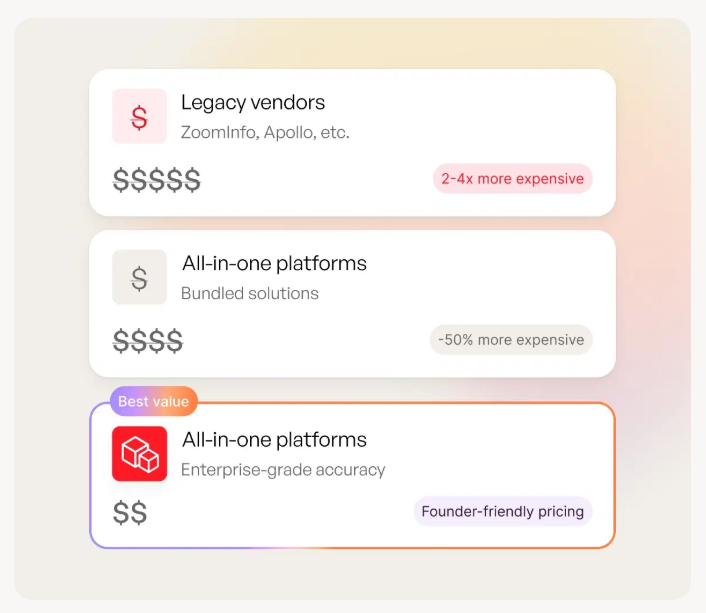
At 2 credits per prospect, Overloop's Growth plan maxes out at ~250 contacts/month. Prospeo's 300M+ database with 30+ filters and 143M+ verified emails means your team never hits a prospecting ceiling - at 90% lower cost.
Get enterprise-grade data without enterprise pricing or credit walls.
Apollo.io (when you want an all-in-one outbound suite)
Apollo.io is the marketplace-default alternative: database + sequences + basic enrichment. Pricing is seat-based tiers + add-ons, and it often starts around $49-$99/user/month, with higher tiers pushing into the low hundreds per seat.
If you're choosing between Apollo and Overloop, make it a data + workflow decision: which one gives you better verified coverage in your region and the least painful day-to-day execution?
Snov.io (when budget matters and you want email-finding + outreach)
Snov.io is the budget-friendly path for email finding plus outreach. It runs on monthly plans with credit-based limits, so your job is translating the plan into "verified contacts per month" before you buy. Expect roughly $39-$149/month depending on volume and feature tier.
Lemlist (when you already have leads and just need sequencing)
Good if:
- You already have leads (inbound, events, partners, another database) and want a clean per-user/month sequencing plan.
- You care more about deliverability workflows and personalization than buying data inside the same tool.
Not if:
- Your bottleneck is "we don't have verified emails/mobiles." You'll still need a data provider.
Lemlist pricing typically lands around $59-$99/user/month depending on plan. (If you're modeling total cost, compare against Lemlist pricing.)
Final take: Starter vs Growth vs Enterprise (validate the credit math)
Choose Starter if you're proving ICP and messaging and you can live with ~125 sourced+emailed prospects per user per month. Choose Growth if outbound's real for you and you need integrations plus ~250 prospects/user/month throughput. Choose Enterprise if you need Salesforce, private deliverability setup for secondary domains (dedicated IP), and you're scaling enough that admin + support matter.
If you're unsure, start Growth with one seat during the trial, measure credits-to-messageable-prospect for your exact workflow, then scale seats. That one metric tells you what you'll really pay, and it's the fastest way to sanity-check Overloop pricing before you commit.