

The 10 Best Email Verifier Websites - Ranked by Accuracy, Speed, and Price
You cleaned your list, sent a 5,000-email campaign, and your bounce rate came back at 3.8%. Your ESP is threatening suspension. You're staring at a "verified" list from an email verifier website wondering what verified even means.
Here's the thing: roughly 1 in 6 legitimate marketing emails never reach the inbox. The global inbox placement rate sits around 83.5%, and that was before Google and Yahoo's bulk sender rules made SPF, DKIM, and DMARC mandatory - with a hard 0.3% spam complaint ceiling. Email verification isn't optional anymore. It's infrastructure.
Every tool on this list claims 98-99% accuracy. They all say it. But when an independent test ran 10,000 emails through 15 tools, the actual spread was 95.9% to 98.9%. That 3-point gap is the difference between a clean send and an ESP suspension notice. So we dug into the data - independent benchmarks, real pricing, processing speeds, and the catch-all problem nobody wants to talk about - to rank the 10 email verifier websites actually worth your time in 2026.
Our Picks (TL;DR)
- Best overall: Prospeo - 98% accuracy across 143M+ verified emails with a 7-day data refresh cycle.
- Best standalone accuracy: Bouncer - 98.9% in independent testing, highest observed score of any tool.
- Best deliverability suite: ZeroBounce - verification + inbox placement testing + DMARC monitoring under one roof.
- Best for speed: NeverBounce / Emailable - both process 10K emails in roughly 3 minutes.
- Best budget option: MillionVerifier - $0.00149/email at 100K volume. Nothing else comes close on price.
- Best all-in-one prospecting: Hunter.io - find, verify, and outreach from a single platform.

Now let's get into why.
How Email Verification Actually Works
The Three-Step Process
Every verification tool runs the same fundamental sequence - some just do it better than others.

Step 1: Syntax check. The tool confirms the address follows a valid format - there's an @ symbol, a domain, no illegal characters. This catches typos, missing dots, accidental spaces. Milliseconds.
Step 2: DNS/MX record lookup. The tool queries the domain's DNS records to confirm it exists and has mail exchange (MX) servers configured. No MX record means the domain can't receive email. Dead end.
Step 3: SMTP mailbox verification. The tool initiates an SMTP handshake with the mail server - essentially knocking on the door and asking "does this mailbox exist?" - then disconnects before actually sending anything. No email is delivered. It's a safe, non-intrusive check.
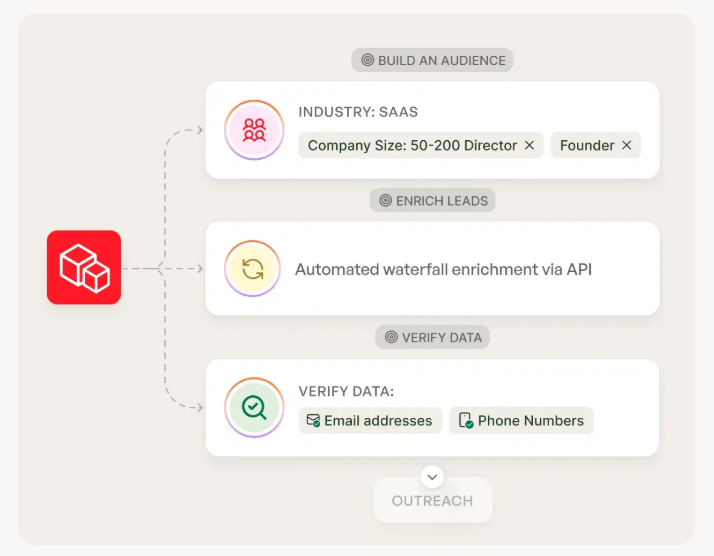
The whole process takes milliseconds per email. At scale, the bottleneck is server response times, not the verification logic itself.
One stat that should keep you up at night: email lists decay at 2-3% per month. That's 25-30% annually. A list you verified in January is already degraded by March. (If you want the benchmarks behind this, see data decay.)
The Catch-All Problem (And Why It Matters)
Here's where most "verified" lists still fail you.
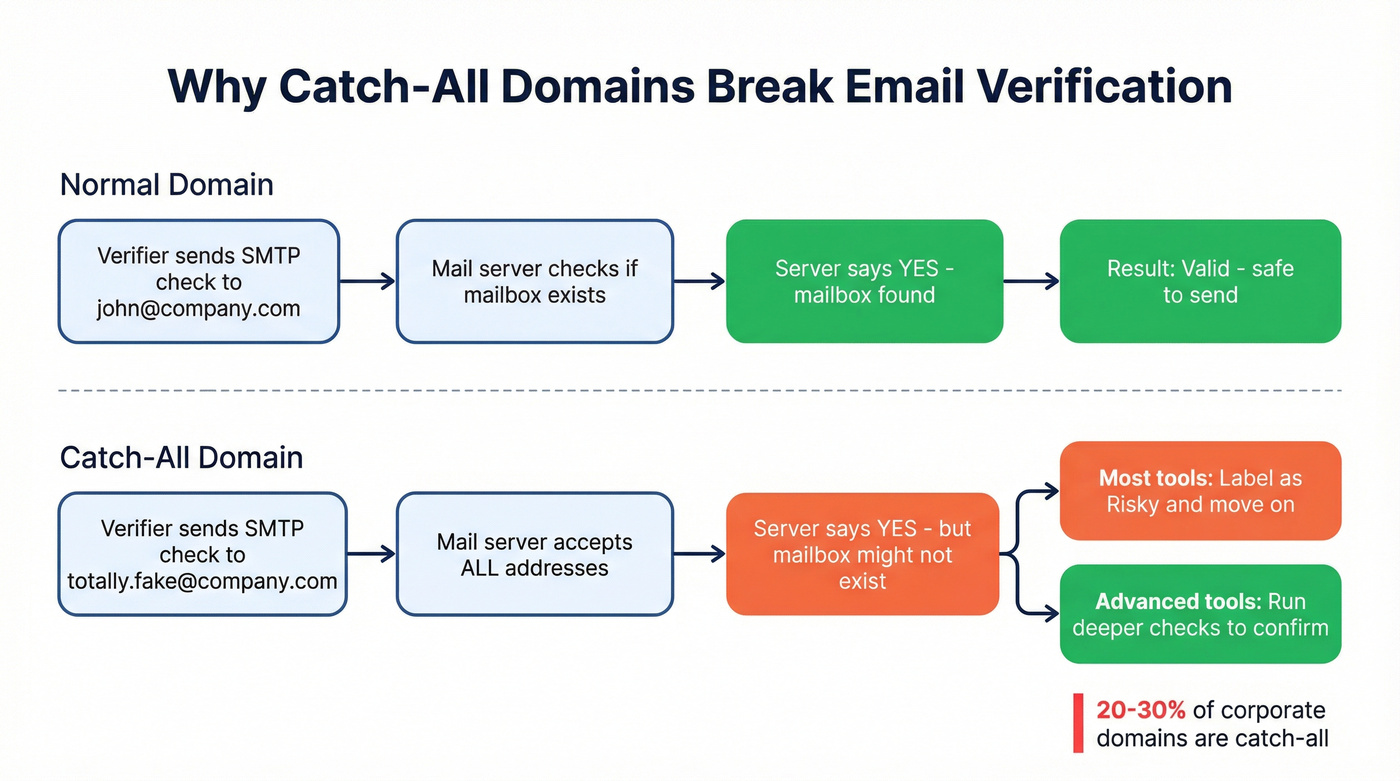
A catch-all domain accepts every email sent to it - even to addresses that don't exist. Send to totally.fake.person@company.com and the server says "sure, I'll take it." About 20-30% of corporate domains use catch-all configurations.
Most verification tools hit a catch-all server, get an "accept" response, and label the address as "risky" or "accept-all." They can't tell you whether the specific mailbox exists. They just shrug and move on.
This is the #1 reason "verified" lists still bounce at 3-4%. One cold email agency owner on Reddit found that catch-all verification tools were returning false positives, increasing bounce rates after "verification." The tools that handle catch-all properly - with advanced resolution, not just labeling - are the ones worth paying for.

Most verifiers label catch-all domains as "risky" and move on. Prospeo's 5-step verification handles catch-alls, removes spam traps, and filters honeypots - across 143M+ emails refreshed every 7 days. Meritt dropped their bounce rate from 35% to under 4%.
75 free verifications per month. No credit card. No stale data.
The Best Email Verifier Websites in 2026
Prospeo - Best Overall for Accuracy and Data Freshness
Prospeo runs a 5-step verification process that goes beyond the standard syntax-DNS-SMTP sequence. It includes catch-all handling, spam-trap removal, and honeypot filtering - the kind of deep cleaning that prevents the "verified but still bounced" problem.

The numbers: 98% email accuracy across 143M+ verified emails, with a 7-day data refresh cycle. That refresh cycle is the real differentiator. The industry average is 6 weeks. Prospeo refreshes its entire database weekly, which means the data you pull is already current - you're not verifying against records that went stale a month ago.
Real-world proof: Meritt cut their bounce rate from 35% to under 4% after switching to Prospeo. That's not a marginal improvement - that's the difference between domain damage and a healthy sender reputation (more on the mechanics of domain reputation).
Pricing runs ~$0.01/email, with a free tier of 75 verifications per month. No contracts, no annual commitments.

Use this if: You need verified emails backed by fresh data and can't afford bounces from stale records. Especially strong for outbound sales teams and agencies running high-volume campaigns.
Skip this if: You only need basic syntax validation for a web form - a simpler tool will do.
Your list decays 2-3% every month. A 6-week refresh cycle means you're verifying against records that are already dead. Prospeo refreshes its entire 300M+ database every 7 days - so verification starts with data that's actually current.
Stop paying to verify emails that went stale three weeks ago.
Bouncer - Best Standalone Verification Accuracy
I watched a team run a three-tool bake-off last year. Bouncer won on raw accuracy every single time - and the margins weren't close.
In the Warmup Inbox 10,000-email benchmark test, Bouncer hit 98.9% observed accuracy - the highest of any tool tested. G2 rates it 4.8/5. Capterra gives it 4.9/5. Woodpecker chose Bouncer as their integrated verification partner after running their own internal testing. That's not a marketing partnership - that's an engineering team picking the tool they trust.
Pricing is pure pay-as-you-go: $8/1K emails at entry, dropping to $2/1K at the million-email tier. Credits never expire. You don't get charged for duplicates or unknowns. 100 free credits to start.
Use this if: Verification accuracy is your single highest priority and you want PAYG flexibility without subscriptions.
Skip this if: You need an all-in-one prospecting platform. Bouncer is verification only - pair it with a separate finder tool (see email lookup tools).
ZeroBounce - Best Full Deliverability Suite
Most email verifier websites do one thing: verify. ZeroBounce does that - 98.8% observed accuracy, second-highest in independent testing - but it also wraps verification inside a full deliverability platform.
The Deliverability Suite includes inbox placement testing, DMARC monitoring, and email warmup. These are separate subscriptions (Starter $49/mo, Team $99/mo, Pro $249/mo), but having them under one vendor simplifies the stack. 60+ integrations, Capterra 4.7/5 from 461 reviews, and it processes 100K emails in about 45 minutes. (If DMARC is a big part of your workflow, see DMARC monitoring.)
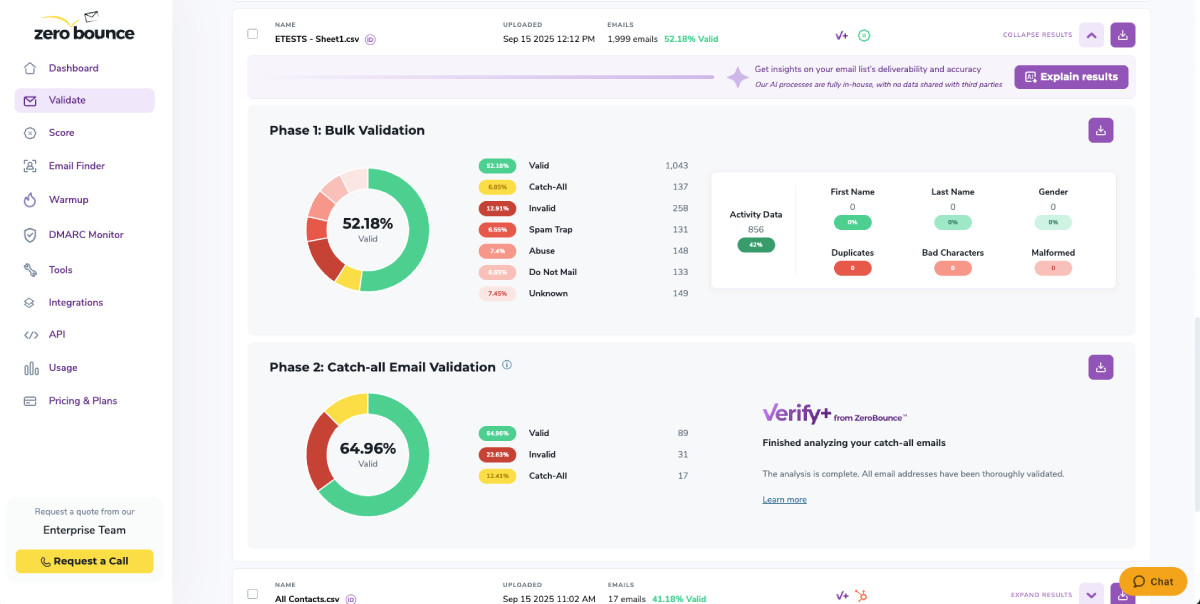
Verification pricing: $18 for 2,000 credits, scaling down to $2,250 for 1M. 100 free credits per month. The catch: there's a 2,000-credit minimum purchase, and advanced features like inbox reports consume extra credits. That credit bleed adds up if you're not watching.
Use this if: You want verification + inbox placement testing + DMARC monitoring from one vendor and don't mind paying for the suite.
Skip this if: You just need list cleaning. The deliverability suite adds cost and complexity you won't use.
Emailable - Best for Processing Speed
Emailable's headline stat isn't accuracy (though 98.7% observed is excellent). It's speed. This tool processes 10K emails in roughly 3 minutes and 250K in about 10 minutes. For teams running daily list imports, that speed difference compounds fast.
The free tier is the most generous among PAYG tools: 250 credits on signup. Pricing starts at ~$0.007/email (5K min purchase), dropping to $0.0042 at 100K. Credits never expire, and unknowns get refunded - you only pay for definitive results. G2 rating: 4.8/5.
Use this if: You process large lists frequently and can't afford to wait.
Skip this if: You need advanced catch-all resolution or a broader prospecting toolkit. Emailable is fast and accurate, but it's a focused verification tool.
NeverBounce - Best for CRM Integration and Automation
NeverBounce ties Emailable for speed (~3 minutes for 10K emails) but wins on integrations. With 80+ native connections - HubSpot, Mailchimp, Zapier, n8n, and more - it's the obvious pick for teams that want verification running automatically inside their CRM (more on CRM integration for sales automation).
Observed accuracy: 98.6%. The Growth plan at $49/mo adds AI scoring, auto-sync with your CRM, and automated bad-email flagging. PAYG runs $8/1K credits.
Real talk: credits expire after 12 months. That's a genuine drawback for seasonal senders or teams with variable volume. Accuracy on catch-all domains is noticeably weaker than the overall number suggests - something the 99.9% self-reported claim conveniently glosses over. And the API is limited to 100 rows per request, which creates friction for developers building custom integrations.
Use this if: You want automated verification synced directly to your CRM and you're sending consistently enough to burn through credits within a year.
Skip this if: You're cost-sensitive or send in bursts. Expiring credits are a tax on infrequent senders.
MillionVerifier - Best Budget Option
MillionVerifier is the cheapest verifier by a wide margin: $149 for 100K emails ($0.00149/email), $449 for 1M. It doesn't charge for catch-all or unknown results - a unique advantage that makes the effective cost even lower. There's a 100% money-back guarantee if hard bounces exceed 4%.

The tradeoffs are real. Processing is the slowest tested (~20 minutes for 10K), reporting is limited, and G2 reviews consistently flag inconsistent customer support. Observed accuracy: 97.9% - solid but not top-tier. No free credits to test before buying.
| Pros | Cons |
|---|---|
| Lowest per-email cost on the market | Slowest processing of any tool tested |
| No charge for catch-all/unknown results | No free tier to test before buying |
| Money-back guarantee on bounces | Customer support is hit-or-miss |
Use this if: Budget is your primary constraint and you're willing to trade speed and support for the lowest per-email cost available.
Skip this if: You need fast turnaround or responsive customer support.
Hunter.io - Best for Prospecting + Verification in One
Hunter has 6M+ users, and the appeal is obvious: find emails, verify them, and run outreach sequences without switching tools. The email verifier lookup scored 96.4% in independent testing - lower than dedicated verifiers, but acceptable if you're already using Hunter for email finding and outreach. Free plan: 100 verifications/month. Starter: $49/mo with 4,000 verifications.
The frustrating part: credits are shared across finder, verifier, and domain search. Your "2,000 credits" might yield only 500 verifications if you're also running searches. That shared pool burns fast. If you only need verification, Hunter is one of the most expensive options on this list per actual verification.
Use this if: You want to find emails, verify them, and run outreach sequences without switching tools.
Skip this if: You only need verification. Hunter's shared credit system makes standalone verification expensive.
Clearout - Best for Advanced Catch-All Resolution
Clearout is the only tool in its own 30-tool comparison matrix with an advanced catch-all resolver - not just detection, but actual resolution using AI verification. Observed accuracy: 98.1%. It also offers a Google Sheets add-on for inline verification, which is genuinely useful for teams that live in spreadsheets.
Free tier: 100 credits. PAYG starts at ~$21 for 5,000 credits, scaling to ~$0.004/email at volume.
Use this if: Catch-all domains are your biggest bounce source and you need a tool that actually resolves them instead of just labeling them "risky."
Skip this if: Catch-all isn't a major issue for your list profile. You're paying a premium for a feature you won't use.
Snov.io - All-in-One Prospecting with Verification
All-in-one prospecting, outreach, and CRM platform with 7-tier email verification baked in. Observed accuracy: 97.2%. Credits are shared across all tools - Starter at $29.25/mo gives you 1,000 credits total, not 1,000 verifications. Free tier: 50 credits. Solid if you're already in the Snov.io ecosystem, but the shared credit pool makes standalone verification expensive.
Verifalia - Granular Quality Control for Verification Depth
Daily credit model (25 free/day) with multiple quality levels: Standard, High, and Extreme at 1x, 2x, and 4x credits respectively. ML-powered typo detection and support for files up to 100MB. PAYG runs $389 for 100K emails. Good for teams that want granular control over verification depth - you choose how thorough each check is, and pay accordingly.
Most teams don't need Verifalia's granularity. But if you're running compliance-sensitive campaigns in regulated industries, the ability to dial verification depth up to "Extreme" is worth the premium.
Independent Accuracy Testing - What the Benchmarks Actually Show
Self-reported accuracy claims are marketing, not data.
Every tool on this list says it delivers 98-99%+ accuracy. The Warmup Inbox test ran 10,000 real emails through 15 tools and found the actual range is 95.9% to 98.9%. That 3-percentage-point spread doesn't sound like much until you do the math: on a 100K-email campaign, it's the difference between a 1% bounce rate and a 4% bounce rate. One keeps your sender reputation clean. The other gets you flagged. (If you're troubleshooting rejections, see 550 recipient rejected.)

| Tool | Self-Reported | Observed (10K) | Gap |
|---|---|---|---|
| Bouncer | 99.5% | 98.9% | -0.6% |
| ZeroBounce | 99% | 98.8% | -0.2% |
| Emailable | 99%+ | 98.7% | -0.3%+ |
| NeverBounce | 99.9% | 98.6% | -1.3% |
| EmailListVerify | 99% | 98.5% | -0.5% |
| Kickbox | 99%+ | 98.4% | -0.6%+ |
| Clearout | 99% | 98.1% | -0.9% |
| MillionVerifier | 99%+ | 97.9% | -1.1%+ |
| Snov.io | 98% | 97.2% | -0.8% |
| Hunter | - | 96.4% | - |
| GetProspect | - | 95.9% | - |
* Measured across 143M+ verified emails, not the 10K Warmup Inbox test.
NeverBounce's gap is the most telling: they claim 99.9% and delivered 98.6%. That's a 1.3-point miss - the widest gap between promise and reality in the top tier.
Pricing Comparison - What Email Verification Actually Costs
Pricing in this space is deceptively simple until you read the fine print. Credit expiration, shared credit pools, and minimum purchases all change the real cost. Whether you're evaluating an online email verification tool for a startup or an enterprise platform, the math below tells the real story.
| Tool | Free Tier | Cost/1K (Entry) | $/Email at 100K | Credits Expire? |
|---|---|---|---|---|
| MillionVerifier | None | $2.45 | $0.00149 | No |
| ZeroBounce | 100/mo | $9 | $0.0039 | No |
| Verifalia | 25/day | ~$3.90 | $0.0039 | Daily yes; PAYG no |
| Bouncer | 100 | $8 | $0.004 | No |
| NeverBounce | Test credits | $8 | $0.004 | Yes (12 mo) |
| Emailable | 250 | ~$7 (5K min) | $0.0042 | No |
| Hunter.io | 100 verif. | ~$12.25 (shared) | ~$0.006 (shared) | Monthly reset |
| Snov.io | 50 | ~$29.25 (shared) | ~$0.015 (shared) | Monthly reset |
Three things to watch:
Shared credits are a trap. Hunter and Snov.io credits are shared across finder, verifier, and outreach. Your "2,000 credits" might yield only 500 verifications after you've used the rest for email finding and domain searches. The per-verification cost is effectively 2-4x what it looks like.
Expiring credits punish inconsistency. NeverBounce credits expire after 12 months. If you're a seasonal sender or an agency with variable volume, you're paying for credits you'll never use.
Cheapest isn't always cheapest. MillionVerifier wins on raw price, but you trade speed and support. Prospeo's ~$0.01/email includes the broader data platform - email finding, verification, enrichment, and a 7-day refresh cycle. You're not just paying for verification; you're paying for data that's already current when you pull it. (If you're comparing plans, see Prospeo pricing.)
Processing Speed - How Long Bulk Verification Takes
| Tool | Time for 10K Emails |
|---|---|
| NeverBounce | ~3 min |
| Emailable | ~3 min |
| Kickbox | ~6 min |
| Bouncer | ~7 min |
| ZeroBounce | ~10 min |
| MillionVerifier | ~20 min |
Emailable scales impressively: 250K emails in about 10 minutes. ZeroBounce handles 100K in roughly 45 minutes.
Speed matters most if you're processing lists daily - importing from events, scraping new prospects, running weekly campaigns. For monthly list cleaning, even 20 minutes is fine. Don't let speed be the deciding factor unless your workflow genuinely demands it.
How to Choose the Right Tool for Your Workflow
You don't need 10 tools. You need one good one and a re-verification schedule.
Before picking a tool, know what actually matters. Six criteria separate a reliable email verifier website from a mediocre one:
- Observed accuracy (not self-reported) - the benchmark table above is your cheat sheet
- Catch-all handling - labeling catch-all as "risky" is lazy; resolving it is useful
- Pricing model - PAYG vs. subscription, shared vs. dedicated credits, expiration policies
- Processing speed - only matters if you're verifying lists daily
- Integrations - CRM auto-sync saves hours; manual uploads don't scale
- Free tier - always test accuracy on your own list before committing money (more options in email verification free)
Here's my scenario-by-scenario breakdown:
- High-volume outbound sales: Prospeo (accuracy + freshness) or Bouncer (standalone accuracy king)
- Marketing list cleaning on a budget: MillionVerifier - nothing else touches $0.00149/email
- CRM automation: NeverBounce - 80+ integrations, auto-sync, AI scoring on the Growth plan
- All-in-one prospecting: Hunter.io - find + verify + outreach in one platform
- Recruiters and PR teams: Hunter.io or Snov.io - the all-in-one workflow matters more than marginal accuracy differences when you're researching individual contacts
- Maximum accuracy, no compromises: Stack two providers. We've seen teams run Bouncer alongside a second verifier for mission-critical sends. The cost of a double-verify is trivial compared to the cost of a domain blacklisting.
That stacking approach comes straight from Reddit practitioners, and it works. No single tool catches everything. Two good tools with different verification engines will catch more than one great tool alone.
One more thing: Instantly.ai gets strong practitioner recommendations for verification within its outreach platform. But it's primarily a sending tool - verification is a feature, not the product. If you're already using Instantly for outreach, its built-in verification is convenient. If you need standalone verification, use a dedicated tool. (If you're building a full outbound stack, start with cold email outreach tools.)
Here's my honest take on this market: If your average deal size is under $5K, MillionVerifier's accuracy is good enough and the savings are real. But the moment you're sending to enterprise prospects where a single bounced email to a VP can burn a domain - that's when you need 98%+ accuracy and fresh data. Cheap verification is fine for newsletters. It's not fine for pipeline.
Email Verification Best Practices
1. Re-verify before every major send. After 4 weeks, roughly 2% of a "clean" list is already invalid. People change jobs, domains expire, inboxes fill up. If you verified in January and send in March, you're sending to a degraded list.
2. Don't conflate "valid" with "catch-all." A "valid" result means the mailbox exists. A "catch-all" result means the server accepted the email - which it does for every address, real or fake. Treat catch-all addresses separately. Send to them in small batches and monitor bounces.
3. Automate verification in your CRM or signup forms. Manual list uploads are fine for one-off cleans, but if you're adding contacts daily, you need API-level verification on ingest. Most tools on this list offer real-time API verification - a domain-health check layer that validates both the address and its mail server before a record enters your database.
4. Filter obvious junk before uploading. Role-based addresses (info@, support@), disposable domains, and obvious typos should be removed before you spend credits verifying them. A 30-second filter pass can save 10-15% of your verification budget.
5. Stack two providers for mission-critical sends. In our experience, teams that double-verify before product launches, investor outreach, or anything where deliverability is non-negotiable see dramatically fewer surprises. The cost is trivial compared to a domain blacklisting.
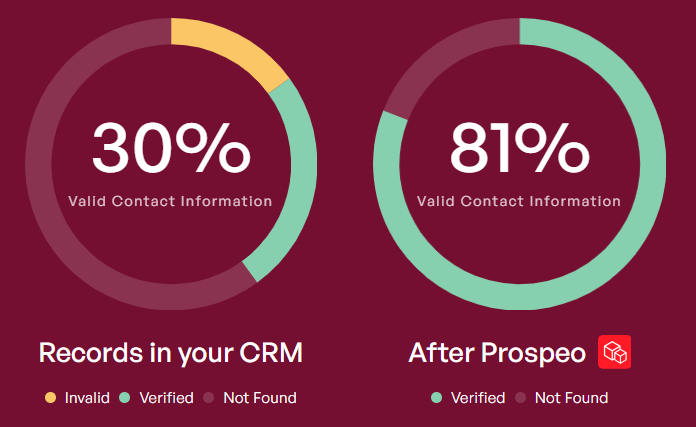
6. Set a re-verification schedule. Every 30 days for active outbound lists. Every 60-90 days for dormant lists and catch-all addresses.
FAQ
Is email verification legal?
Yes. Email verification checks whether an address exists without sending any messages. It's a technical DNS/SMTP lookup, not surveillance. GDPR-compliant tools process data under legitimate interest and offer DPAs. Verification is standard practice for any business sending bulk email.
How often should I re-verify my email list?
Every 30 days for active outbound lists. Email addresses decay at roughly 2-3% per month - people change jobs, domains expire, mailboxes fill up. After 4 weeks, about 2% of a "clean" list is already invalid. For dormant lists, re-verify before any send.
What's a catch-all domain and why does it matter?
A catch-all domain accepts every email sent to it, even to non-existent addresses. About 20-30% of corporate domains use this configuration. Most verification tools label catch-all addresses as "risky" because they can't confirm the specific mailbox exists - which means your "verified" list can still bounce at 3-4%.
Can I verify emails for free?
Yes, but with limits. Emailable gives 250 free credits, Bouncer and ZeroBounce offer 100, Prospeo provides 75/month, and Verifalia gives 25/day. Free tiers are enough to test accuracy on your own list before committing to a paid plan. No reputable tool offers truly unlimited free verification, but MillionVerifier at $0.00149/email is close enough to feel unlimited for most budgets.
What bounce rate should I aim for?
Below 2% for long-term sender health, ideally under 1%. Google and Yahoo's bulk sender rules cap spam complaint rates at 0.3% - a separate but related metric. High bounce rates degrade sender reputation, which indirectly increases spam filtering. If your bounce rate consistently exceeds 2%, your ESP will throttle or suspend your account.