

The ABM Outreach Playbook: Cadences, Tools, and Tactics That Actually Work
A RevOps team ran a 12-week ABM pilot targeting 50 accounts with three BDRs. They booked two meetings. Two. Because 180 of their first 500 emails bounced and torched their sender domain before the sequence even hit stride. 62% of marketers rely on prospect data that's 40% incorrect, and that stat tracks with what we've seen firsthand.
ABM outreach doesn't fail because of strategy. It fails because of execution gaps nobody addresses until the pipeline report comes back empty.
Teams that get it right - like Vymo, which generated $21M in marketing-sourced pipeline from 50 accounts - don't have a secret playbook. They have clean data, multi-channel cadences, and intent-driven timing.
What Separates a Working ABM Strategy From Wasted Budget
Three things:
- Verified data - every contact email-verified before it touches a sequencer.
- Multi-channel cadence - coordinated touches across email, phone, and professional networks.
- Intent timing - reaching accounts when they're actively researching, not when your calendar says it's time to prospect.
That's it. The rest is discipline.
Fix Your Data First
That 180-bounce scenario above? It's the most common failure mode we see across teams running ABM programs. The fix is non-negotiable: verify every contact before it enters your sequencer. (If you need a shortlist, start with these email validators.)

Prospeo runs 300M+ professional profiles through a 5-step verification process - catching spam traps and honeypots - with 98% email accuracy and a 7-day data refresh cycle versus the six-week industry average. No cadence design survives a 20% bounce rate. One of our customers, Snyk, dropped their bounce rate from 35-40% to under 5% and saw AE-sourced pipeline jump 180% after switching to verified data.
Channel-by-Channel Cadences
LinkedIn: Building Warm Paths Into Target Accounts
Cold messages on professional networks average 7-15% reply rates, but highly personalized sequences push past 25%. The key is warming before you pitch: engage with a prospect's content before sending a connection request. Keep it to 15-20 requests per day, then follow up at +1, +2, and +5 days after connecting.
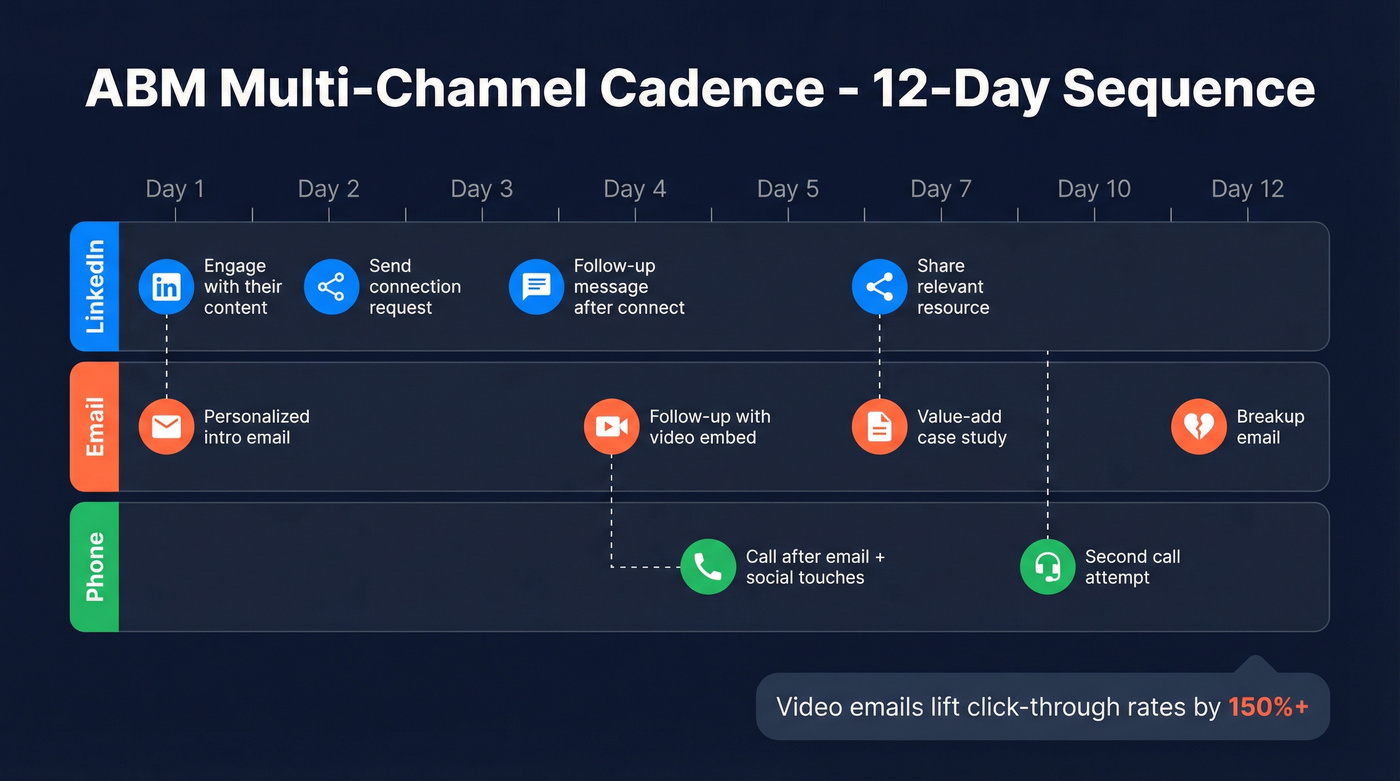
Account-based referrals also work well here. Ask existing connections to introduce you to stakeholders at target accounts, turning cold touches into warm conversations. This sounds obvious, but the consensus on r/sales is that most reps skip this step entirely because it feels slower than blasting connection requests.
Email: The Backbone of Account-Based Outreach
Here's the thing: if you're sending the same template to 500 people and calling it "ABM," you're doing outbound with extra steps. True account-based messaging means account-specific pain points in the first line - a reference to their recent funding round, a tech stack change, a competitor win. Something that proves you did the homework (or use AI personalized email sequences to scale the research without losing relevance).
Use a 4-step cold sequence: intro on Day 1, follow-up at Day 4, value-add at Day 7, breakup at Day 12. Personalized subject lines boost open rates by 26%, and personalized body copy increases engagement by 39%. If you want examples you can copy, start with these outreach email templates.
One tactic almost nobody uses: embed a short video in your second touch. Video emails lift open rates by 35% and click-through rates by over 150%. It's a genuine edge that most ABM guides ignore because it's harder to templatize (a solid starting point is a video follow-up workflow).
Phone: High-Effort, High-Conversion
Phone is the highest-converting channel and the most time-intensive. Don't run it standalone. Pair calls with email and social touches so the prospect recognizes your name before you dial - the multi-channel pressure converts, not any single channel in isolation. Skip phone-only cadences entirely unless your team has verified direct dials; calling switchboards in 2026 is a waste of everyone's time. If you need a baseline, use this B2B cold calling guide to set scripts and KPIs.

Snyk dropped their bounce rate from 35-40% to under 5% and grew AE-sourced pipeline 180% - with the same team. Prospeo's 5-step verification, 7-day data refresh, and 125M+ verified mobile numbers mean your ABM cadences actually reach the buying committee.
Stop torching your sender domain. Start with verified data at $0.01/email.
Time It With Intent Data
B2B buyers spend only 17% of their time meeting with potential suppliers. You're fighting for a sliver of attention, so timing matters more than volume.
Intent data breaks into three tiers:
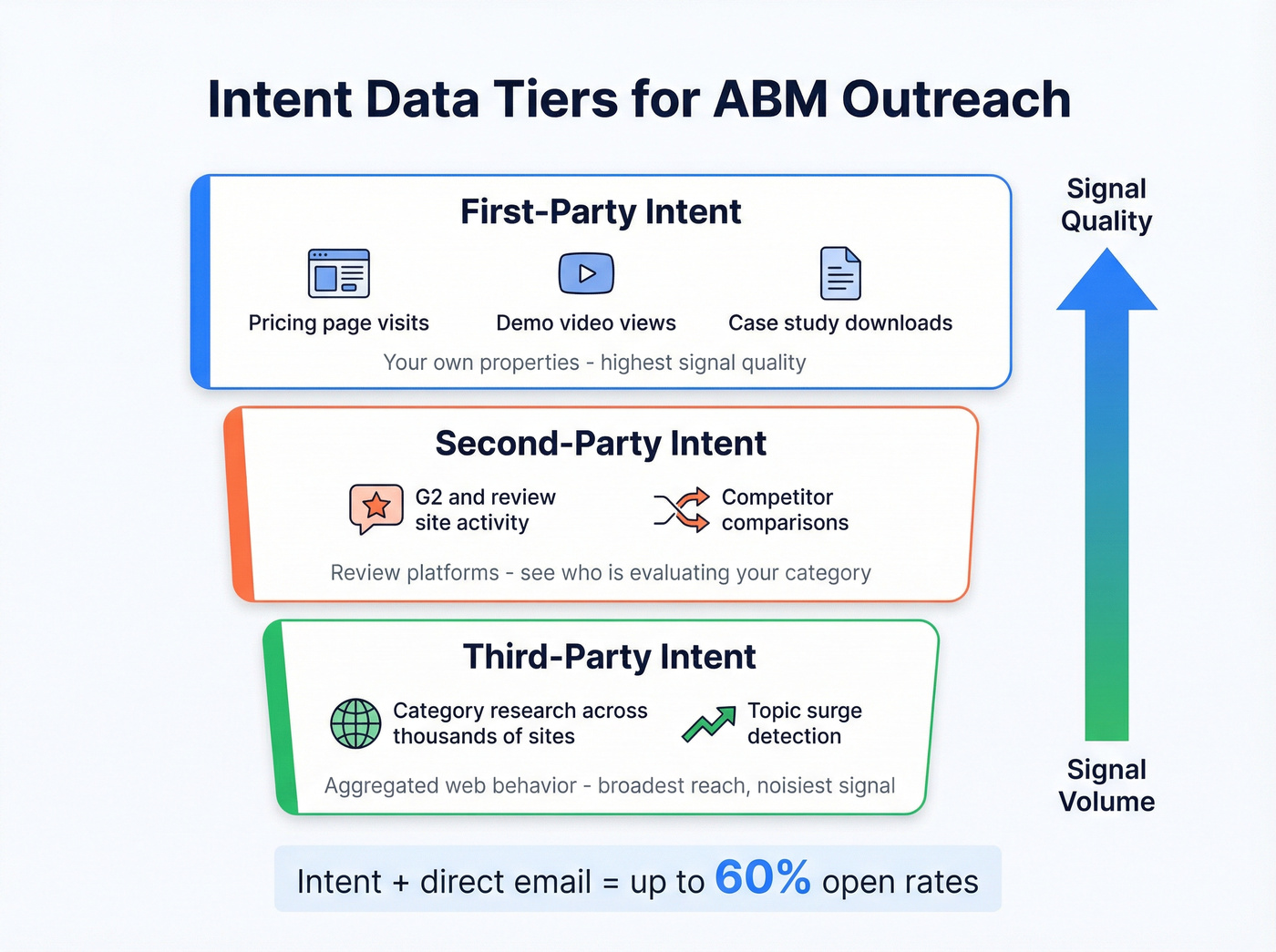
- First-party: behavior on your own properties - pricing page visits, demo video views, case study downloads.
- Second-party: review platforms like G2, where you can see which accounts are comparing you against competitors.
- Third-party: aggregated web behavior showing which accounts are researching your category across thousands of sites.
Build a weekly "hot accounts" list based on real-time intent spikes. Teams combining intent data with direct email achieve up to 60% open rates because they're reaching people mid-evaluation, not cold. We've found that layering buyer intent with job role and company growth signals - filtering by department headcount changes, recent funding, or tech stack shifts - dramatically improves targeting precision over intent data alone. (If you want a tighter definition and examples, see intent signals.)
Multithread or Die
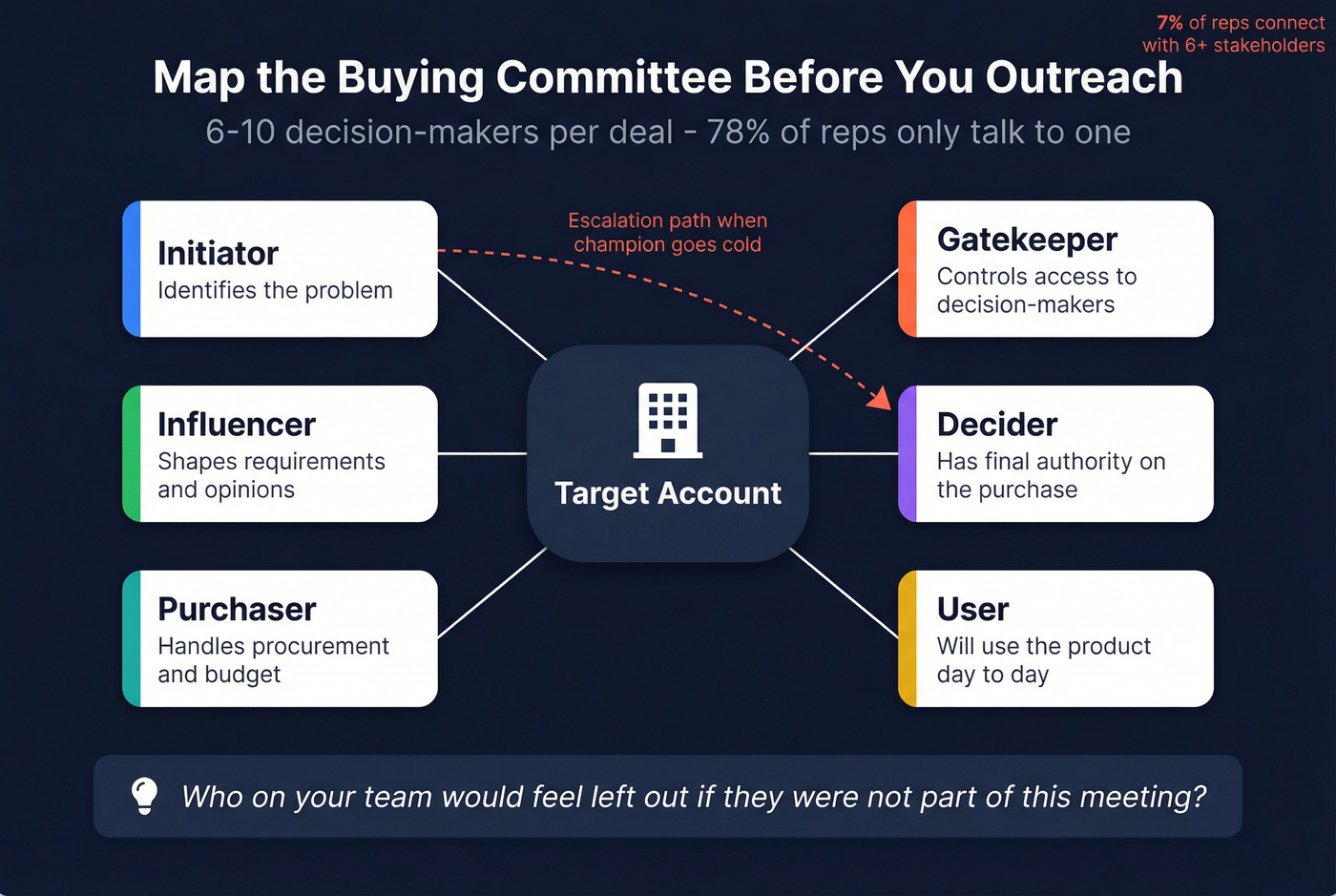
Complex B2B deals involve 6-10 decision-makers. Yet 78% of reps single-thread, and only 7% connect with six or more people at an account.
That gap is where deals go to die.
Map the buying committee using the HBR framework: Initiators, Gatekeepers, Influencers, Deciders, Purchasers, and Users. When your champion goes cold, escalate to their director or VP, then move to an adjacent department. Tailored messaging - referencing each stakeholder's specific priorities rather than copy-pasting the same pitch - is what makes multithreading effective rather than annoying. For a deeper breakdown, use this guide on multithreading in sales.
The discovery question that unlocks this: "Who on your team would feel left out if they weren't part of this meeting?" It sounds simple, but it surfaces names that org charts won't show you.
ABM Outreach Tool Stack for 2026
| Tool | Best For | Starting Price |
|---|---|---|
| Prospeo | Verified data + intent signals | Free tier; ~$0.01/email |
| Apollo.io | Prospecting + sequencing | ~$49/user/mo |
| Outreach.io | Enterprise sales engagement | ~$100-150/user/mo |
| Cognism | EMEA-focused data | ~$1K-3K/mo |
| 6sense | Enterprise intent + orchestration | ~$60K/yr |
| Salesforce | CRM | ~$25/user/mo starter |
Think of your stack in four categories: audience building, engagement and orchestration, reporting and attribution, and automation and integration. Most teams under 50 people only need the first two. If you're building from scratch, start with a lean B2B sales stack and add tools only when the motion is proven.
Let's be honest about 6sense and Demandbase: they're powerful, but implementation fees alone push costs 30-40% above the initial quote. For teams just starting ABM, a verified data source, a sequencing tool, and your CRM is a functional stack for under $200/mo per rep. Scale up when your account list grows past 200 targets and you've proven the motion works. (If you're pressure-testing scoring and prioritization, use an ABM account prioritization model.)
Multithreading 6-10 stakeholders per account requires verified direct dials and emails for every contact on the buying committee. Prospeo gives you 300M+ profiles with 30+ filters - intent signals, department headcount, funding, tech stack - so you reach the right people at the right time.
Layer intent data with verified contacts. Book 26% more meetings than ZoomInfo users.
Mistakes That Kill Your Campaigns
Sequencing on unverified data. Your sender domain is an asset. One bad sequence with a 20%+ bounce rate takes weeks to recover. Verify every contact first - no exceptions. (If you're cleaning lists across systems, follow a CRM hygiene process so bad data doesn’t creep back in.)
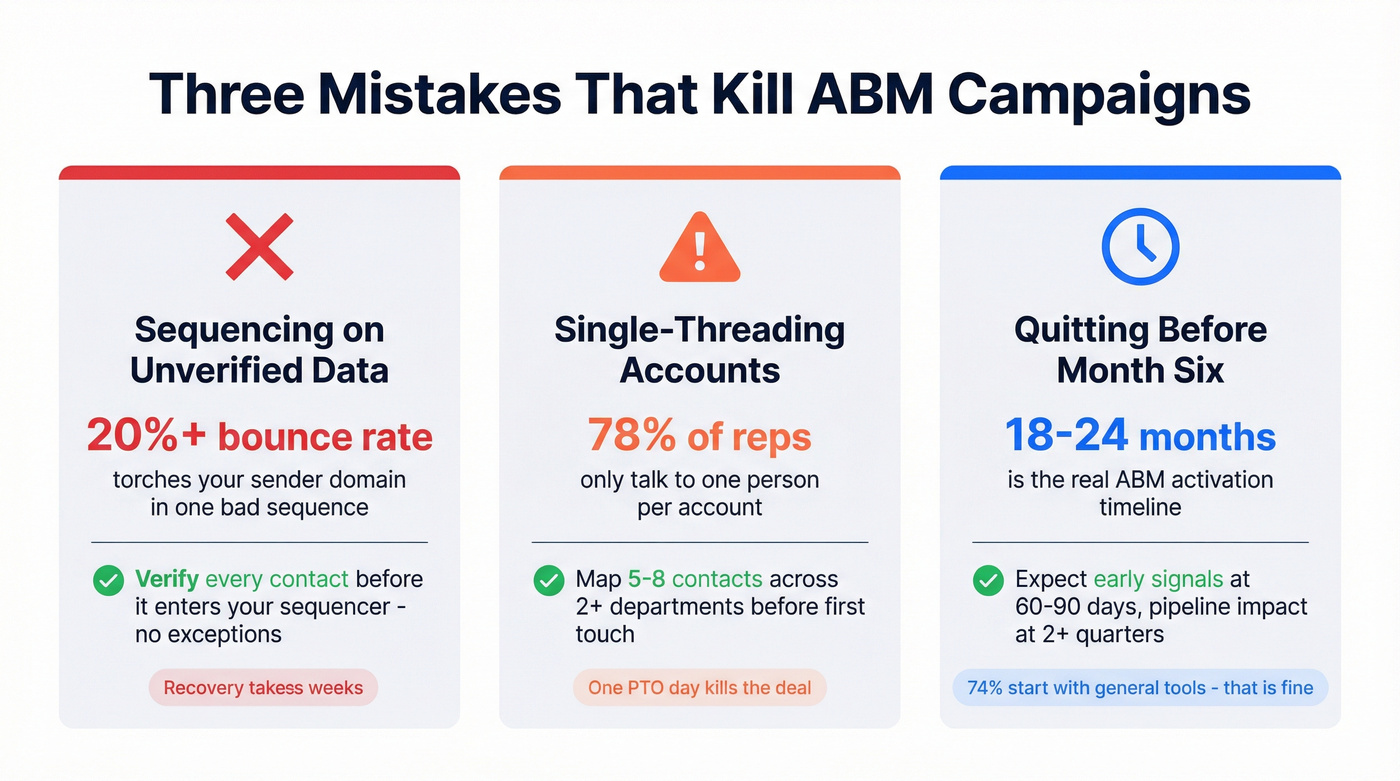
Single-threading accounts. If you're talking to one person, you're one PTO day from a dead deal. Map the buying committee before you start outreach, not after your champion ghosts you.
Quitting at six months. ABM is 18-24 months of continuous activation. Early signals appear within 60-90 days, but pipeline impact takes two or more quarters. 74% of companies start ABM with general tools before moving to dedicated platforms - that's fine. Just commit to the timeline. The teams that abandon ABM at month five and declare it "doesn't work for us" are almost always the ones who never fixed their data quality in the first place.
FAQ
How long does ABM outreach take to show results?
Plan for 18-24 months of continuous activation. Reply rates and meetings surface within 60-90 days, but measurable pipeline impact compounds over two or more quarters. Companies that quit before month six never see the payoff.
What's a good reply rate for personalized ABM emails?
On professional networks, averages sit at 7-15%, with highly personalized sequences exceeding 25%. For email, aim above 8% on cold sends. Below 5% means your data quality or first-line personalization needs work.
What tools do I need to start an ABM program?
Three essentials: a verified data source for clean contacts and intent signals, a sequencing tool like Apollo.io or Outreach.io, and a CRM. Layer in dedicated intent platforms as your account list grows past 200 targets.
How many stakeholders should I contact per account?
Target 5-8 contacts across at least two departments. Deals where reps engage six or more stakeholders close at significantly higher rates than single-threaded ones. Map the buying committee before your first touch.