Sales Pitch Best Practices That Actually Move Numbers
It's Tuesday morning. You've got 12 cold emails queued, a demo at 2pm, and your manager pinging about pipeline. Here's the reality: 57% of the buying journey is done before a prospect talks to you. Your pitch might not be the problem - your fundamentals are.
The 4 Highest-ROI Changes
Short on time? These are the changes we've seen make the biggest difference:
- Fix your talk-to-listen ratio. Top closers talk 43% of the time and listen 57%. Most reps do the opposite.
- Map the buying committee. The average B2B deal involves 7.4 decision-makers. Pitching one person isn't a strategy.
- Use a named framework. SPIN, Challenger, or Andy Raskin's narrative structure. Pick one and commit.
- Verify your contact data before you pitch. 91% of cold emails get zero response - and bad data is the silent killer.
Start with these four areas. They account for the biggest performance gaps between average and top-performing reps.
Mistakes That Kill Pitches
Don't fake urgency. One sales leader at LinkBuilder.io replaced urgency-based CTAs with data-backed proposals and saw win rates jump 20% over two quarters. Buying committees see through pressure tactics fast.
Don't pitch before you listen. In lost deals, reps talk 62% of the time. That's not a conversation - it's a monologue nobody asked for.
Don't "handle" objections - sit with them. Rushing to rebut signals you're not listening. The best reps let silence do the work, then respond with a question, not a rebuttal. This is one of the most overlooked pitch habits, yet it separates closers from quota-missers consistently. (If you want a deeper system, see Handling Sales Objections with Curiosity.)
The 43/57 Rule
Gong analyzed 326,000 sales calls of 10+ minutes each. The finding that keeps holding up: top performers talk 43% and listen 57%. The average rep? They're at 60/40 in the wrong direction.
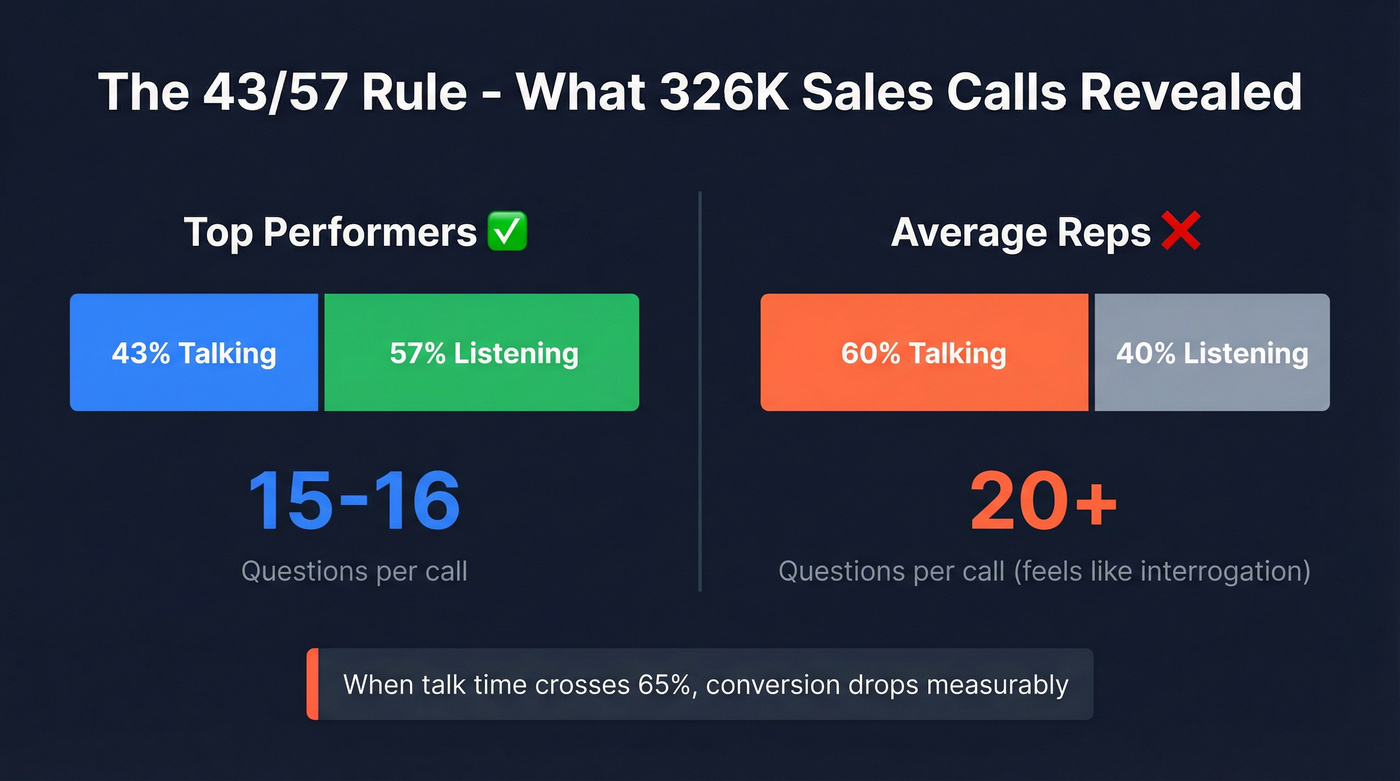
Question volume matters too. Winning reps asked 15-16 questions per call, while losing reps asked around 20. Past a threshold, more questions feels like an interrogation - the goal is fewer, sharper questions that open real conversation. When talk time crosses 65%, conversion drops measurably. Audit that number before you change anything else. For question ideas, pull from these open-ended sales questions.
Stop practicing your pitch. Start practicing your questions.
Map the Buying Committee
A typical B2B purchase involves 7.4 decision-makers, and 61% prefer a completely rep-free experience. The one person who took your call? They're not buying alone.
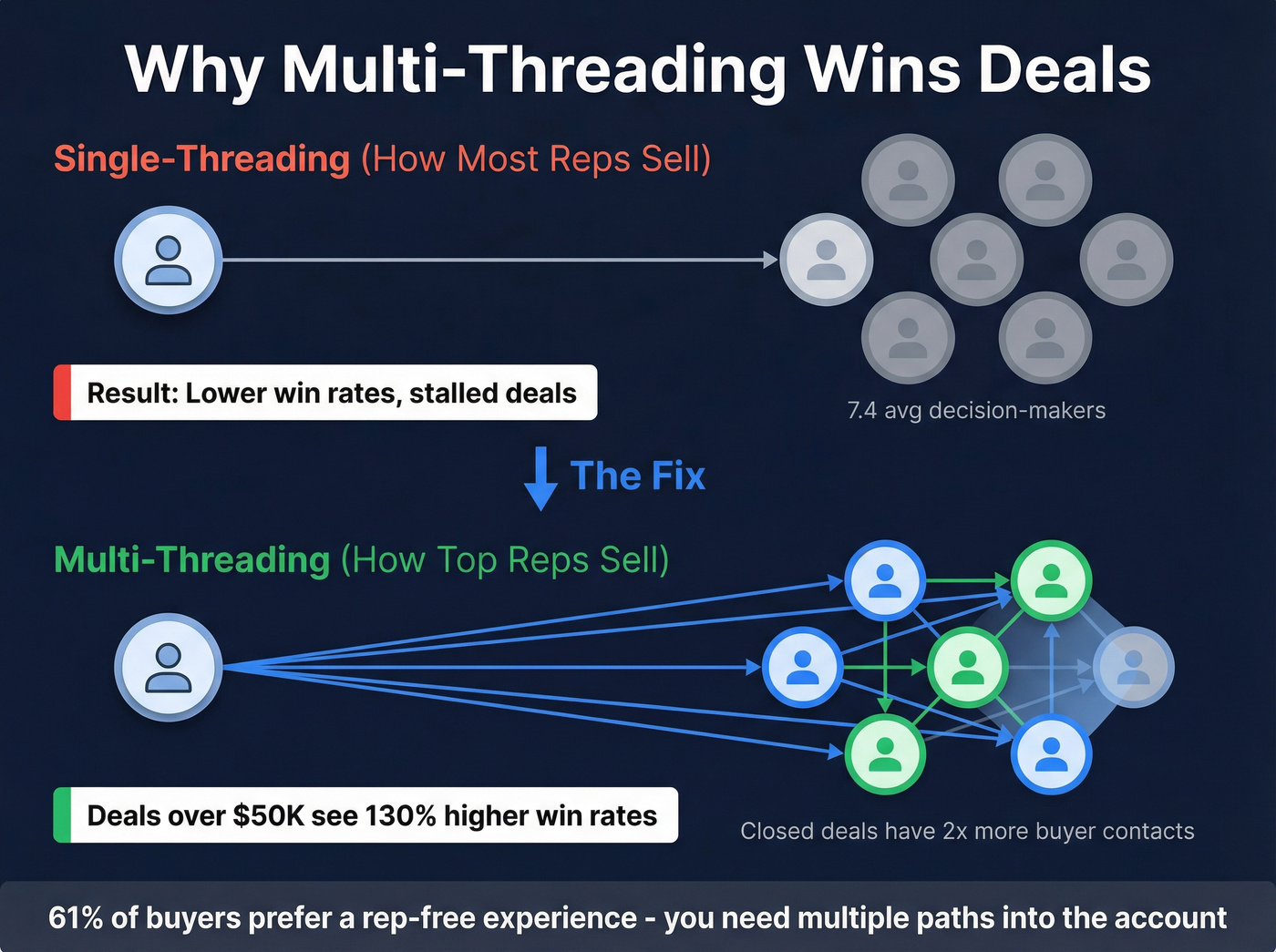
Multi-threading changes everything. Analysis of 1.8 million opportunities found that closed deals have 2x as many buyer contacts as lost ones. For deals over $50K, multi-threading boosts win rates by 130%. Building a clean, multi-threaded prospect list matters more than perfecting your opening line - and it's where we've seen teams get the fastest lift. (If you need the definition + playbook, start with multithreading in sales.)
Here's the thing: if your average deal size is under $25K and you're still single-threading, you're leaving money on the table that no amount of pitch polish will recover. Prioritize committee mapping over slide design every time.

Multi-threading wins deals, but only if you can reach the full buying committee. Prospeo gives you verified emails and direct dials for all 7+ decision-makers - 300M+ profiles, 30+ filters, 98% email accuracy. Build your committee list in minutes, not days.
Stop single-threading with bad data. Map the whole committee now.
Pick a Framework and Use It
SPIN Selling comes from Neil Rackham's study of 35,000+ sales calls across 20+ countries (and it pairs well with a strong discovery call motion). The sequence - Situation, Problem, Implication, Need-payoff - works because the last two stages force the buyer to articulate why they need to act. Best for complex, consultative sales where the prospect doesn't yet see the full cost of inaction.
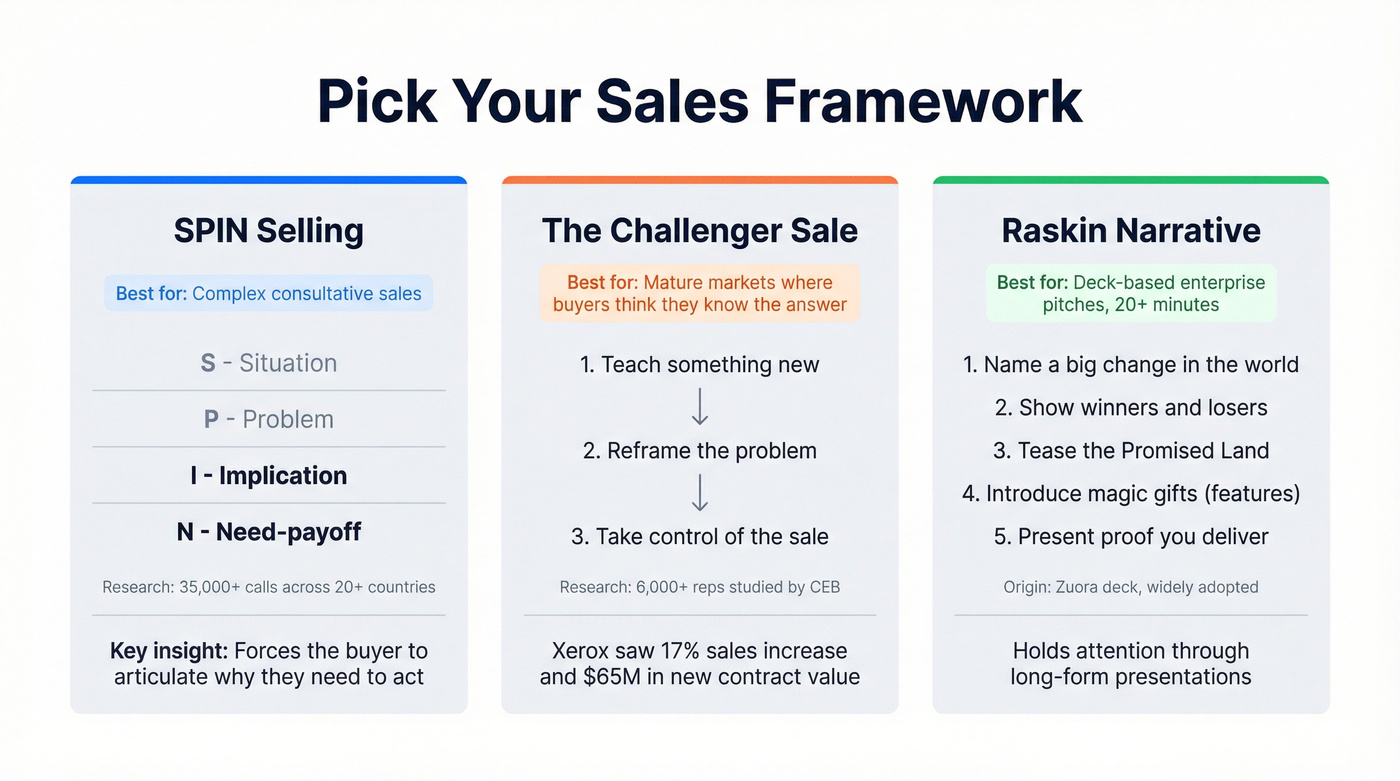
The Challenger Sale is built on CEB research involving 6,000+ reps. You're not asking what the buyer needs - you're reframing how they think about their problem. Xerox saw a 17% sales increase and $65M in contract value after implementing it. If your team sells into mature markets where buyers think they already know the answer, this is the framework to study. (Related: the 5 Challenger sales profiles.)
Then there's Andy Raskin's narrative framework, popularized via the Zuora deck. Instead of leading with the problem, you name a big, relevant change in the world, show there'll be winners and losers, tease the Promised Land, introduce your features as "magic gifts," then present evidence you can deliver. It's a strong structure for deck-based enterprise pitches where you need to hold attention for 20+ minutes. If you're rebuilding your deck, use this sales presentation guide.
These frameworks work because they're grounded in large-scale research, not anecdotes. Our advice: pick one, internalize it, and stop improvising.
Fix Your Email Pitch
Cold email reply rates sit at 1-5%. About 17% are blocked or land in spam. Before you rewrite your subject line again, ask a harder question: did your email even arrive? (If you want a deliverability-first approach, start with this email deliverability checklist.)

Top-performing cold emails use "camouflaged" subjects - four words or fewer, lowercase, priority-based language that looks like an internal thread. "New sales trainer hire" outperforms "Reducing Outbound Squad's Hiring Time" every time. And go multichannel: email + phone + social lifts response rates 287% vs single-channel. For more patterns that consistently work, use these cold email tactics.
But none of that matters if your bounce rate is above 5%. When Snyk rolled Prospeo out across 50 AEs, their bounce rate dropped from 35-40% to under 5%, and AE-sourced pipeline jumped 180%. The 5-step verification process - catch-all handling, spam-trap removal, honeypot filtering - keeps deliverability high so your pitch actually lands. Your pitch is only as good as your data. (More on the mechanics: email verification for outreach.)
Snyk's 50 AEs dropped bounce rates from 35% to under 5% and grew AE-sourced pipeline 180% - because every pitch actually landed. Prospeo's 5-step verification with catch-all handling and spam-trap removal protects your domain so your best pitch reaches real inboxes.
Verify 75 emails free every month. No contracts, no sales calls.
Use AI to Sharpen Pitch Practice
Sellers who frequently use AI generate 77% more revenue than those who don't - based on analysis of 7.1 million opportunities. The gap isn't about AI writing your emails. It's about AI coaching your calls, flagging talk-time drift, and simulating objection handling before the real conversation. If you're building this into your workflow, start with AI in sales cadences.
Let's be practical: run your last three recorded calls through an AI coaching tool. You'll surface blind spots in 20 minutes that would take a manager weeks to catch in ride-alongs.
Quick-Reference Checklist
- Hit the 43/57 talk-to-listen benchmark. Pace at 120-150 WPM.
- Ask 15-16 sharp questions, not 20 scattered ones.
- Map the full buying committee. Multi-thread every deal over $50K.
- Pick one framework and use it consistently.
- Verify your email list before every campaign - bad addresses torch domain reputation faster than anything else.
- Use AI coaching to review calls and practice objections.
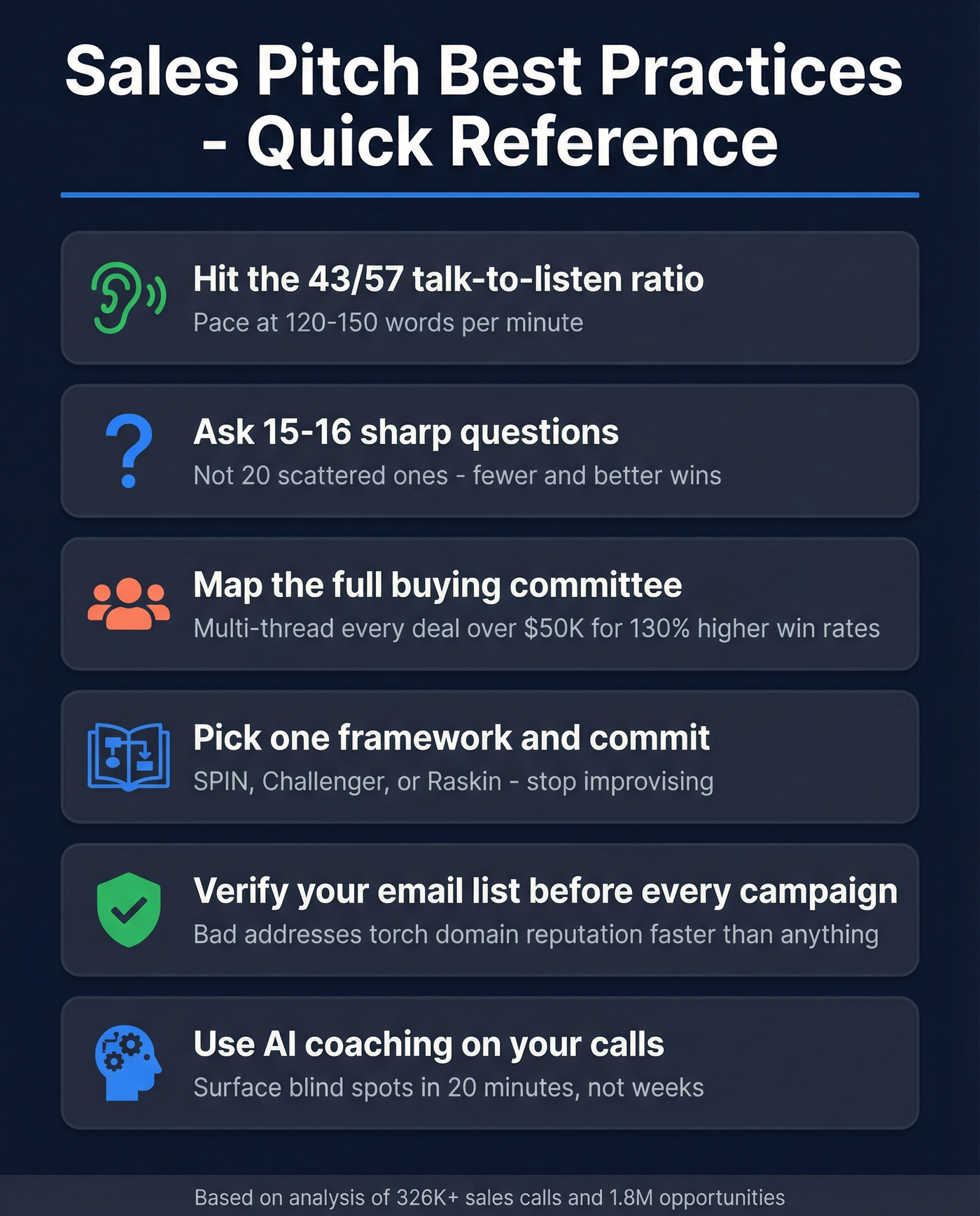
The best pitch strategies aren't about charisma or clever wordplay. They're about preparation, data hygiene, and disciplined listening. Nail the fundamentals on this checklist and the closing takes care of itself.