

The 5 Challenger Sales Profiles: What They Are and Which One You Are
Your VP just came back from a conference raving about "Challenger Selling." Now the whole team's supposed to adopt it, but nobody can actually explain the five challenger sales profiles beyond "Challengers are the best ones." Here's the thing: the original research from Dixon and Adamson studied 6,000+ reps, and the findings are more nuanced than the conference keynote version. Buyers spend roughly 17% of the buying journey talking to sales. That sliver of time is where your profile matters most.
Which Profile Wins?
Challengers make up 54% of star performers in complex B2B deals. Relationship Builders - the profile most sales orgs default to hiring - account for just 7%. That's not a rounding error. It's a fundamental mismatch between how most teams sell and what actually closes revenue.
The Five Challenger Sale Personas
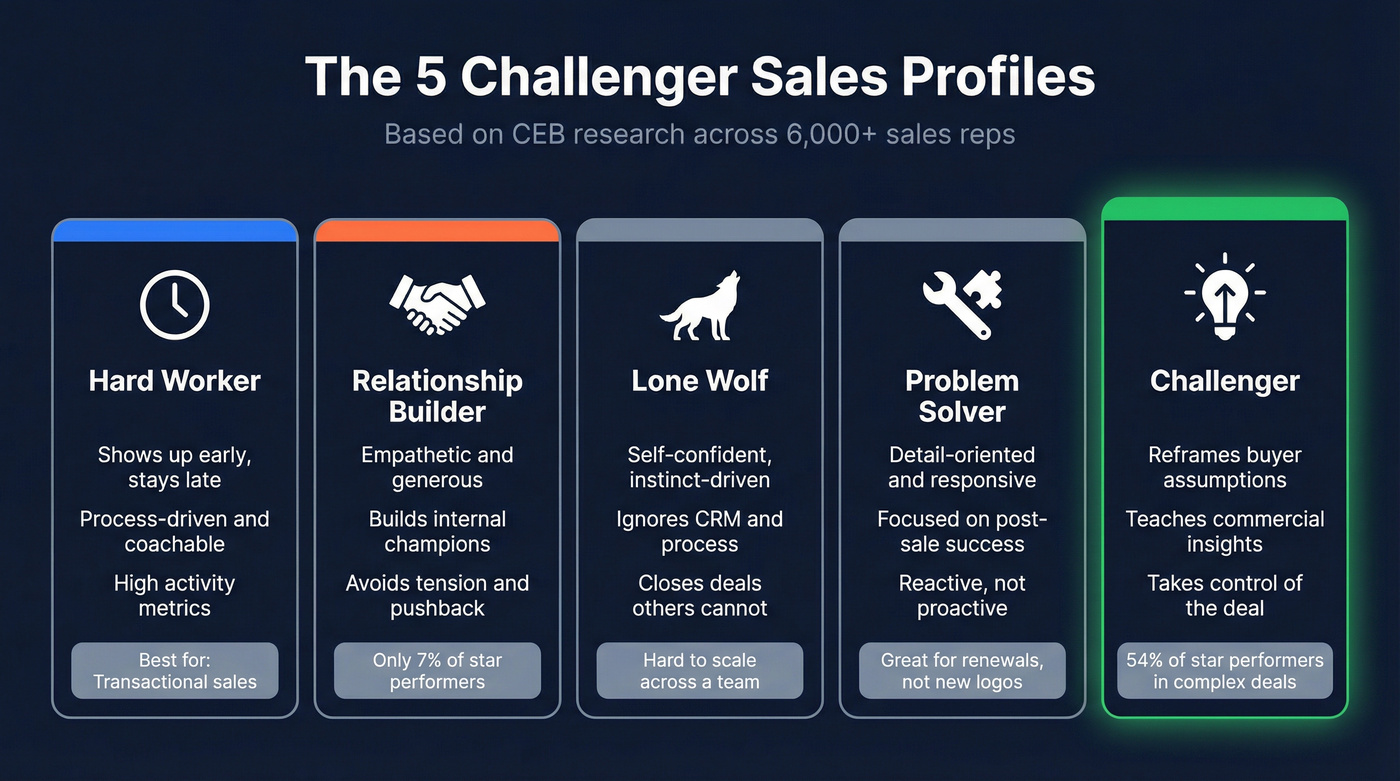
The CEB research (now part of Gartner) identified five distinct selling behaviors. These aren't personality types carved in stone. Most reps blend two or three profiles, with one dominant default. Think of them as behavioral tendencies, not horoscope signs.
The Hard Worker
Hard Workers show up early, stay late, and make more calls than anyone on the floor. They're process-driven, coachable, and will never ghost a follow-up. The weakness? They don't challenge the buyer's thinking. They execute the playbook faithfully but rarely push a prospect to reconsider assumptions. In transactional sales, Hard Workers thrive - in complex deals, effort alone isn't enough.
You're probably this if: your manager loves your activity metrics but your close rate on enterprise deals lags behind.
The Relationship Builder
Seven percent. That's the share of star performers who default to Relationship Builder behaviors, and it's the most damning stat in the entire study. It surprises almost every sales leader we've shared it with.
Relationship Builders are empathetic, generous with their time, and skilled at building internal champions. But they avoid tension, rarely push back on stated needs, and over-invest in a single champion rather than working the full buying committee. Comfort doesn't close complex deals. It stalls them.
The Lone Wolf
Picture the rep who ignores the CRM, skips the team meeting, and still closes the biggest deal of the quarter. That's the Lone Wolf - self-confident, instinct-driven, deeply allergic to process. They close deals others can't through sheer force of personality and creative deal-making, but you can't build a sales org around five of them. Most managers tolerate Lone Wolves until the culture cost outweighs the revenue.
You're probably this if: your pipeline is a mystery to everyone including your manager, but your number speaks for itself.
The Problem Solver
Problem Solvers are detail-oriented, responsive, and focused on post-sale follow-through. Customer satisfaction scores love them. The tradeoff: they're reactive rather than proactive. They excel at solving problems buyers already know they have but don't reframe conversations or surface blind spots.
You're probably this if: your renewal rates are stellar but new-logo acquisition lags behind peers.
The Challenger Seller
Here's the stat that launched a thousand sales kickoffs: Challengers represent roughly 40% of star performers overall and 54% in complex environments. They win because they reframe buyer assumptions rather than responding to them.
A Challenger rep selling cybersecurity doesn't pitch features - they show the CISO that their current incident response time costs $4M annually in regulatory exposure. When a CFO says "we need to cut costs," a Challenger doesn't offer a cheaper solution. They reframe around revenue the CFO didn't realize they were leaving on the table. Prospects sometimes push back on the directness, but this profile wins because it makes buyers think differently about problems they thought they already understood.
Performance by Profile
The headline performance gap is straightforward:
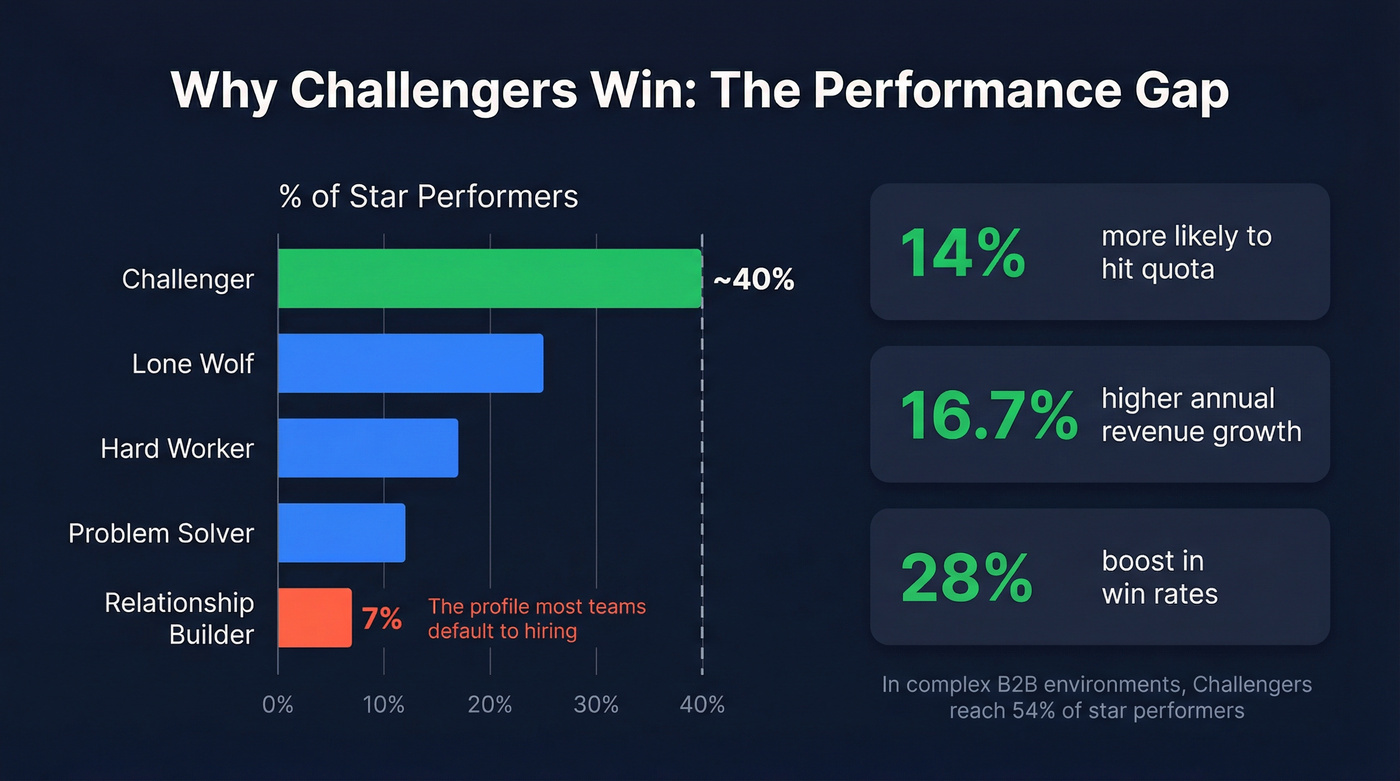
- Challengers: ~40% of star performers overall, 54% in complex deals
- Relationship Builders: ~7% of star performers
That's why "being helpful" and "being liked" can still lose to a rep who teaches something the buying committee didn't see coming.
The downstream numbers tell the same story. Challenger reps hit quota 14% more often, structured coaching around these behaviors is associated with 16.7% higher annual revenue growth, and teams that implement the methodology see a 28% boost in win rates.

Challengers tailor insights for 6-10 stakeholders per deal. That means you need verified emails and direct dials for every decision-maker on the buying committee - not just your champion. Prospeo gives you 300M+ profiles with 98% email accuracy and 125M+ verified mobiles, so you can go multi-threaded the way the Challenger model demands.
Stop relying on one champion. Reach the full buying committee.
What Makes Challengers Different: The Three T's
The Challenger methodology boils down to three capabilities. Today's buyers are informed but not aligned - they've done the research but can't agree internally on what to do. The Three T's exist to break that gridlock.
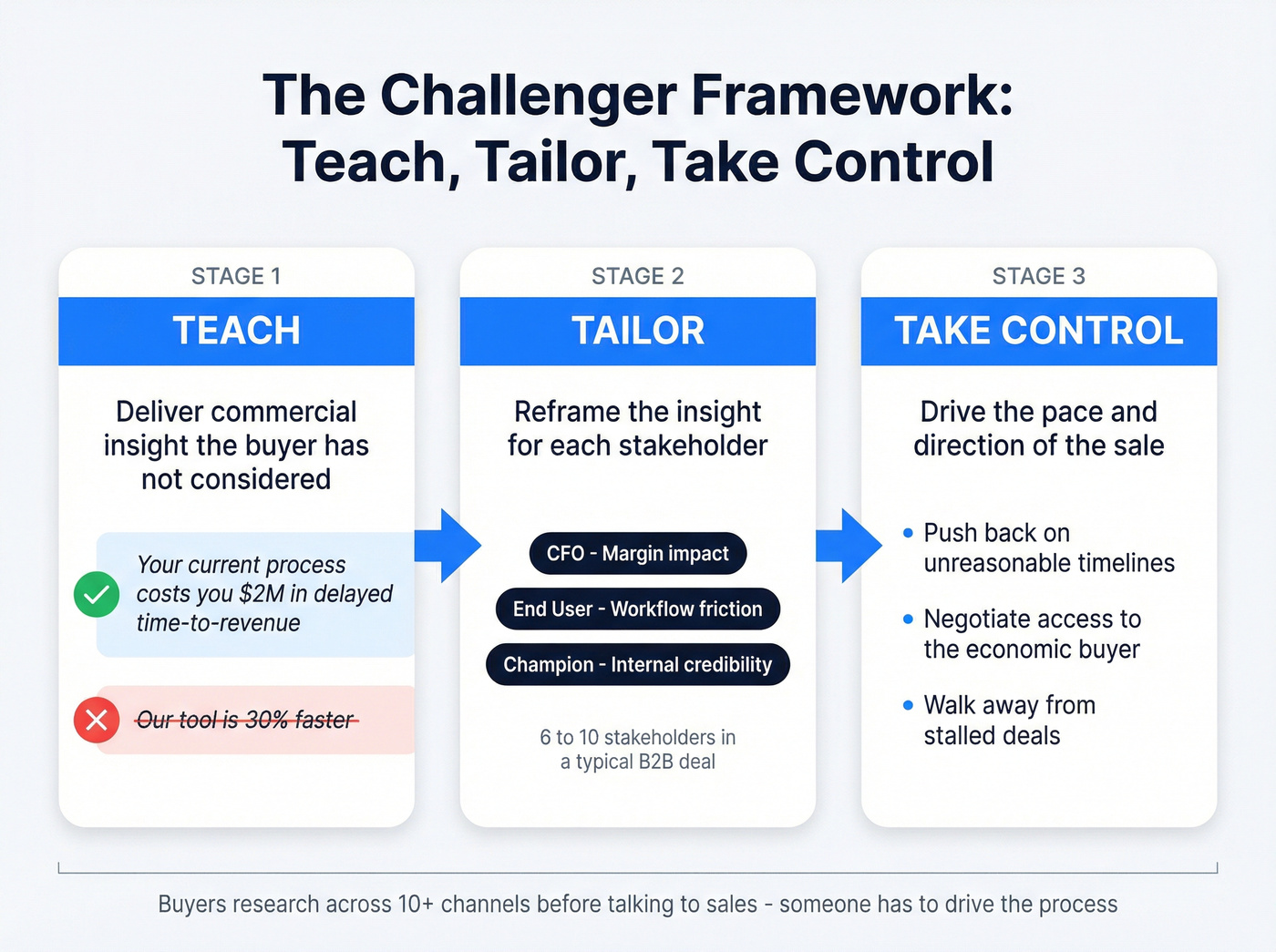
Teach means delivering commercial insight the buyer hasn't considered. "Your current process costs you $2M in delayed time-to-revenue" hits differently than "our tool is 30% faster." The best Challengers follow an emotional arc: warm up with agreement, reframe with data that creates discomfort, then resolve with a clear path forward. This is the core of the Challenger mindset - leading with insight rather than agreement.
Tailor means reframing that insight for different stakeholders. The CFO cares about margin impact. The end user cares about daily workflow friction. The champion cares about looking smart for bringing you in. Same deal, three different conversations, and understanding the customer's internal politics is what makes tailoring effective.
Take Control means managing the pace and direction of the sale. With 6-10 stakeholders in a typical B2B purchase and buyers researching across an average of 10+ channels before talking to sales, someone has to drive the process. Challengers volunteer for that role. They push back on unreasonable timelines, negotiate access to the economic buyer, and aren't afraid to walk away from a deal that's going nowhere.
How to Identify Your Selling Profile
Profiles aren't destiny - they're defaults. Knowing yours helps you coach against it. Run through these honestly:
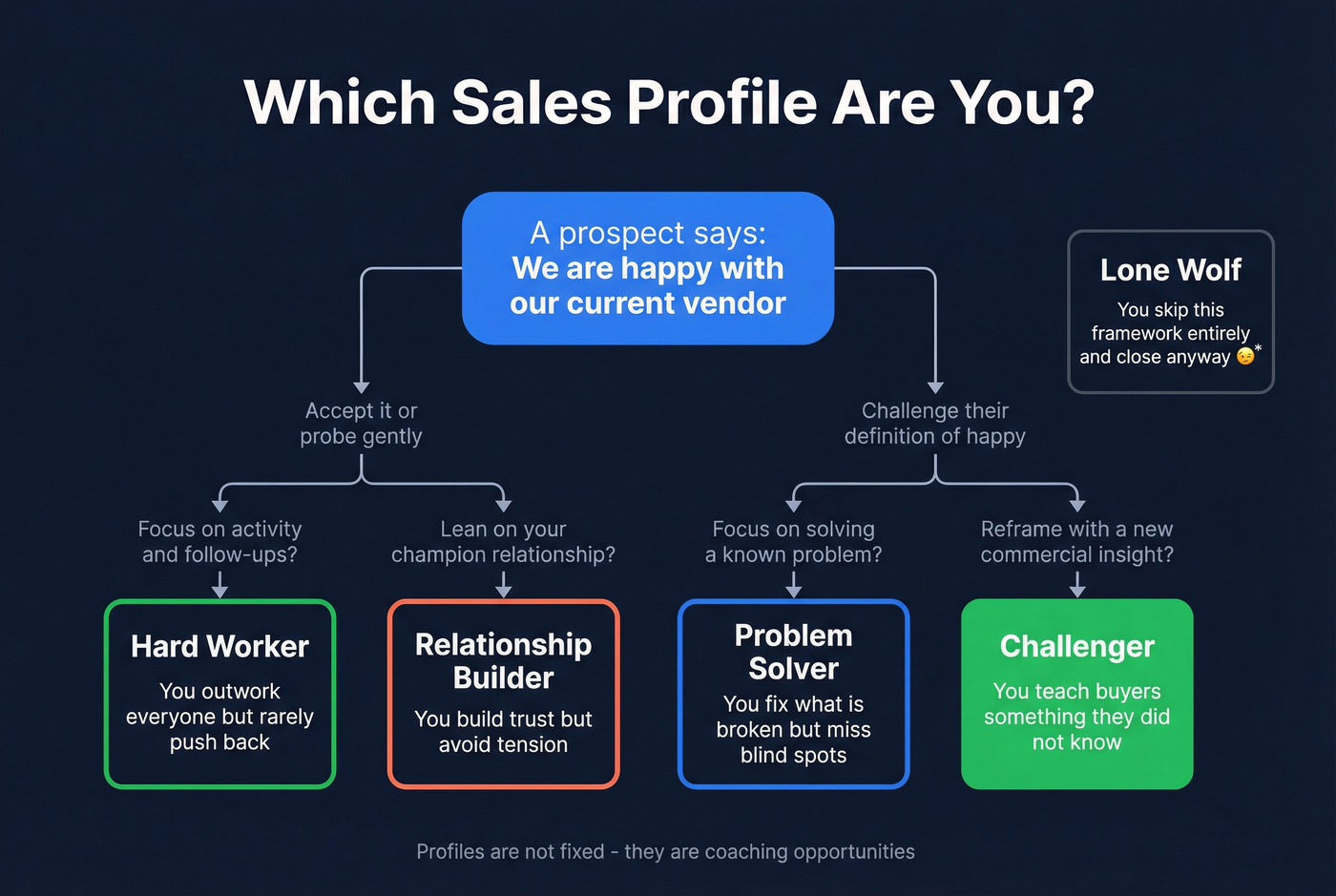
- When a prospect says "we're happy with our current vendor," do you accept it, probe deeper, or actively challenge their definition of "happy"?
- Do you spend more prep time on relationship-building or on building a commercial insight that reframes the buyer's thinking?
- When a deal stalls, do you add more touchpoints (Hard Worker), lean on your champion (Relationship Builder), or go directly to the economic buyer with a new angle (Challenger)?
- Are you comfortable naming a problem the prospect hasn't acknowledged - even if it creates tension?
- After a lost deal, do you blame timing and budget, or analyze whether you failed to teach something new?
If most of your instincts lean toward comfort and consensus, you're defaulting to Relationship Builder or Problem Solver behaviors. That's not a character flaw - it's a coaching opportunity. The key Challenger rep characteristics - constructive tension, commercial teaching, and deal control - can all be developed with the right system.
Coaching Your Team Toward Challenger Behaviors
Let's be honest: trying to turn every rep into a Challenger through sheer willpower doesn't work. We've seen teams attempt this through motivational workshops and it fizzles within weeks. The better play is building a system that gives any profile access to Challenger-quality insights.
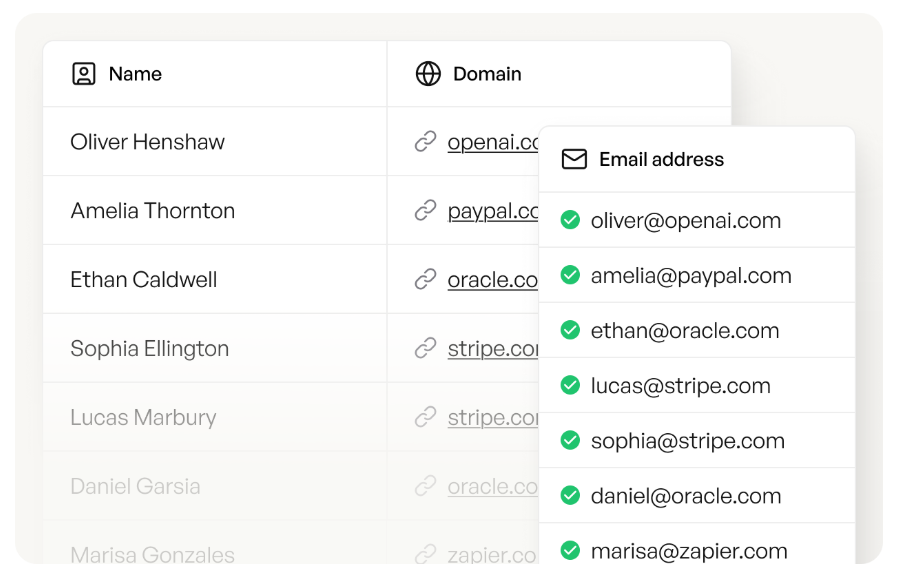
The "teach" step is where most teams fall apart, and it's almost always a data problem. Reps can't deliver a reframe about a prospect's business challenges if they don't know the prospect's tech stack, recent funding round, or headcount trajectory. This is where preparation infrastructure matters - tools like Prospeo surface 50+ data points per contact, including technographics, funding signals, headcount changes, and buyer intent across 15,000 topics, so reps walk into conversations with the raw material to teach rather than just pitch. A Hard Worker with the right commercial insight can teach just as effectively as a natural Challenger. They just need the preparation scaffolding.
Track two metrics to measure progress: how many calls include a genuine reframe versus pure discovery, and how often reps reference prospect-specific data in their opening minutes. Those numbers tell you whether the coaching is landing.
When the Challenger Approach Backfires
The Challenger model isn't universal. Here's where it breaks down.
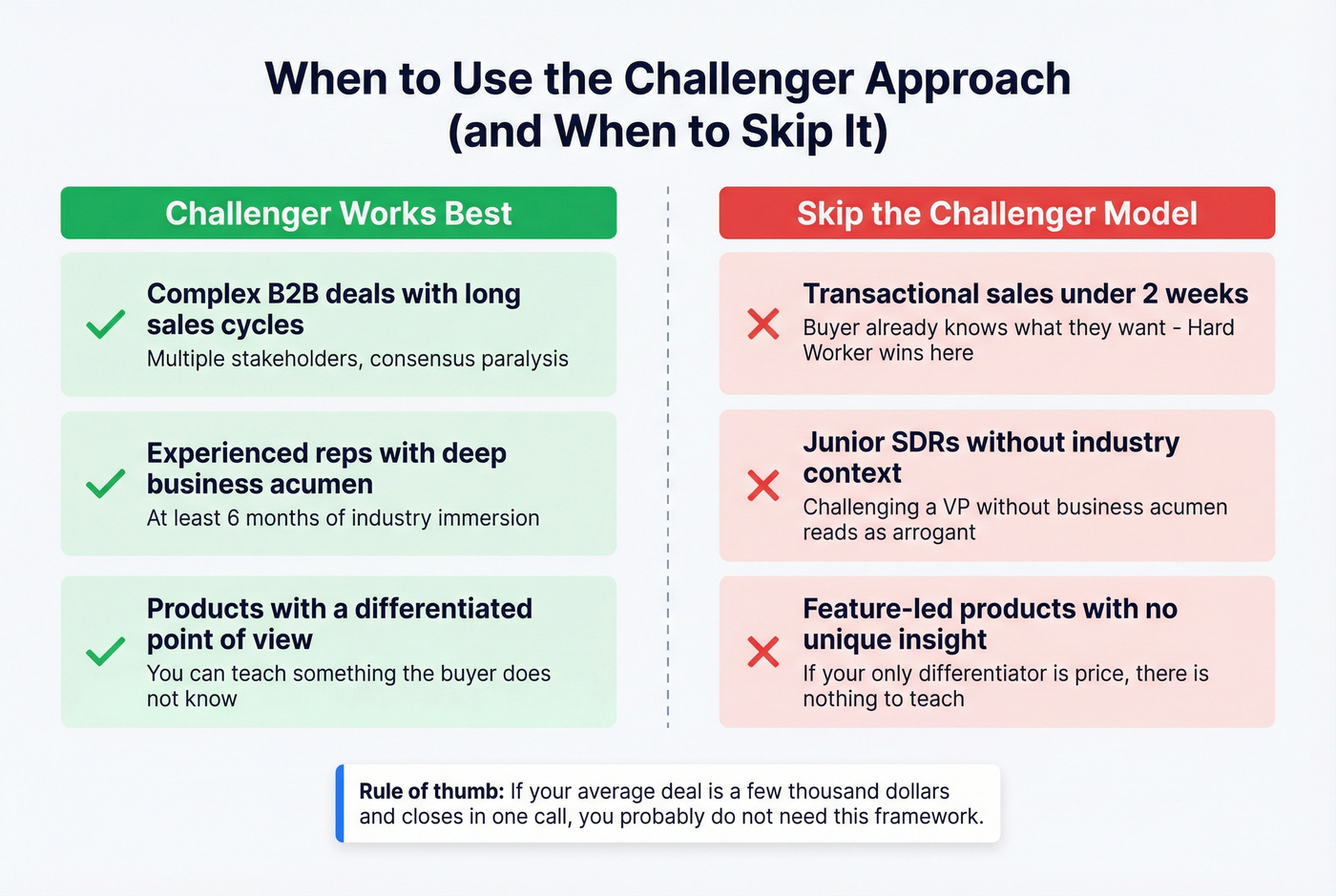
Skip it for transactional sales. If your deal cycle is under two weeks and the buyer already knows what they want, teaching and reframing just slows things down. A Hard Worker profile will outperform here.
Skip it with inexperienced reps. Challenger behaviors require genuine business acumen. In our experience, a junior SDR who tries to "challenge" a VP's assumptions without understanding the industry comes across as arrogant, not insightful. Build the business context first - give them six months of industry immersion before asking them to reframe a CFO's worldview.
Skip it for feature-led products. If your product doesn't support a differentiated point of view - if the only real differentiator is price or speed - there's nothing meaningful to teach.
The original research is over a decade old now. The B2B buying landscape has shifted dramatically, but the core insight hasn't changed. Buyers don't need another friendly rep who agrees with everything they say. They need someone who makes them think differently. A common critique on r/sales is that Challenger behaviors require a level of business acumen that takes years to develop - which is exactly why the coaching infrastructure matters more than the label. If your average deal size is a few thousand dollars and the cycle is a single call, you probably don't need this framework at all. Save it for the deals where consensus paralysis is the real competitor.
Challengers take control by going directly to the economic buyer with a new angle. But you can't do that if your data provider gives you bounced emails and dead phone numbers. Prospeo refreshes every record on a 7-day cycle - not the 6-week industry average - so your outreach actually lands when you make that bold move.
Your Challenger pitch deserves data that doesn't bounce.
FAQ
Are the five sales personas fixed personality types?
No. They describe default selling behaviors, not permanent traits. Most reps blend two or three profiles, and anyone can develop Challenger behaviors with deliberate coaching and solid prospect data. Think of them as starting points, not ceilings.
Why do Relationship Builders underperform in complex deals?
Complex B2B purchases involve 6-10 stakeholders. Building rapport with one champion isn't enough when the buying committee needs different messages tailored to different priorities. Challengers win by reframing assumptions across the entire committee rather than relying on a single advocate who may not have the political capital to push the deal through.
What's the fastest way to start selling like a Challenger?
Start with preparation. Research the prospect's business challenges, industry trends, and competitive position before every call. Use enrichment tools that surface technographics, funding events, and intent signals so you can teach from the first conversation instead of burning it on basic discovery. The "teach" step falls flat without data behind it.