

The MEDDIC Champion: How to Find, Test, and Arm Your Internal Seller
A $3.7M deal closed in six weeks because one champion texted from a board meeting. The seller had armed them with competitive intel, and two well-placed questions neutralized the objection in real time. We watched another deal die slowly - the seller had a motivated contact who loved the product but lacked standing with the CIO. The CIO delegated the project to an internal team, and the deal evaporated.
That's the difference a real champion makes.
In MEDDIC, a champion has three things: power or influence inside the organization, the willingness to sell internally when you're not in the room, and a personal win tied to your solution succeeding. If you can't verify all three, you have a coach - not a champion.
What Is a Champion in MEDDIC?
The MEDDIC framework - developed at PTC in the 1990s, with Jack Napoli as a key architect - defines a champion as the person who sells on your behalf when you're not there.
Three traits are non-negotiable:
- Power or influence - they move decisions, not just observe them
- Sells internally - they advocate in rooms you'll never enter
- Personal win - their career or goals are tied to your deal succeeding
MEDDIC and MEDDPICC use the same champion concept. MEDDPICC adds Paper Process and Competition as separate qualification elements, but the champion definition is identical.
Why Champions Matter More in 2026
Buying groups have gotten dramatically larger. Forrester's latest data shows an average of 13 internal stakeholders and 9 external participants influencing a single B2B purchase - and when generative AI features are involved, that group doubles. Navigating 22+ people without someone on the inside pulling for you is nearly impossible.
No champion, no deal. That's not a slogan - it's a pattern we see in enterprise cycles over and over again.
Champion vs. Coach
Force Management uses a diagnostic that cuts through the noise: does this person make the news or report the news?
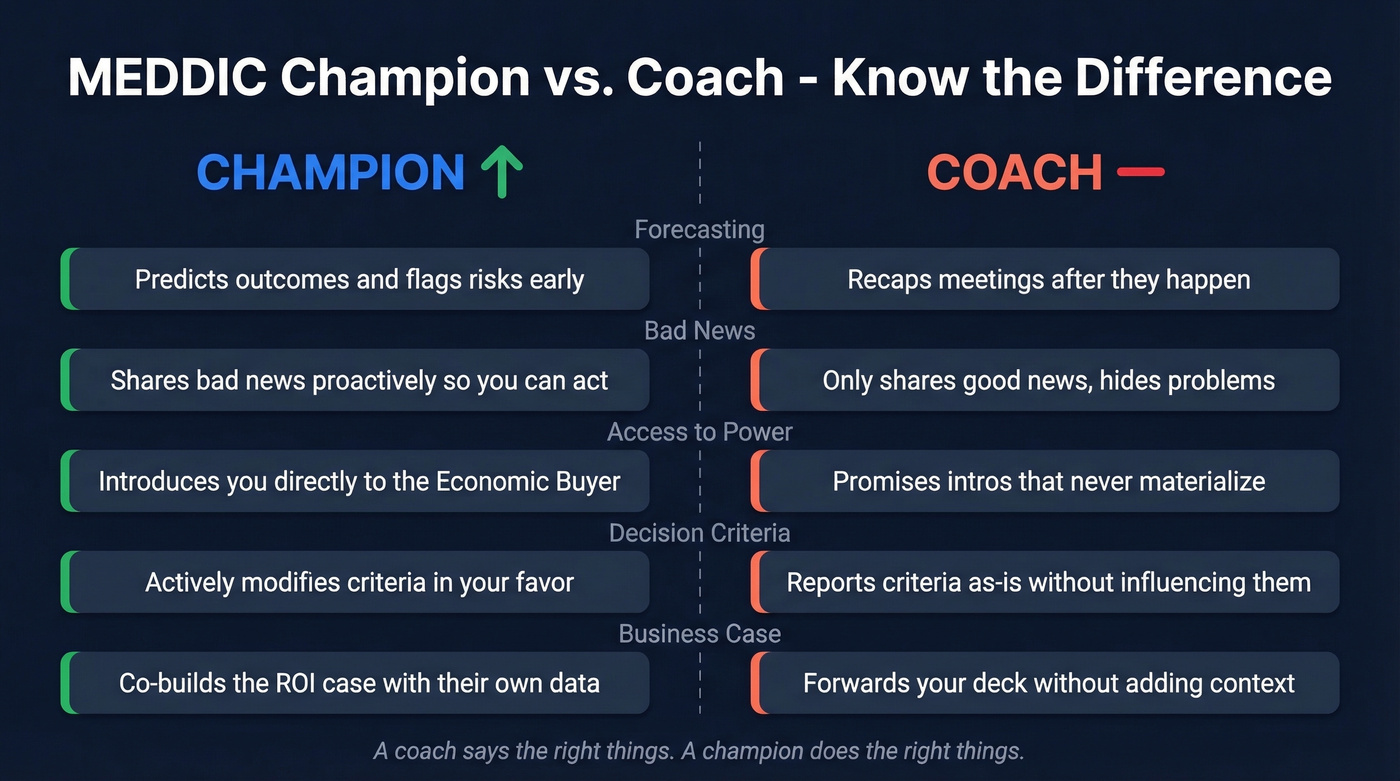
| Signal | Champion | Coach |
|---|---|---|
| Forecasting | Predicts outcomes | Recaps meetings |
| Bad news | Shares it early | Shares good news only |
| Access | Introduces you to EB | Promises intros that stall |
| Decision criteria | Modifies them in your favor | Reports them as-is |
| Business case | Co-builds it with you | Forwards your deck |
We've seen deals die because a seller confused a friendly coach for a champion. The coach said all the right things, attended every call, and seemed genuinely enthusiastic - but when the economic buyer asked "why this vendor?", the coach couldn't answer with conviction. That gap kills deals.

A friendly coach can't close your deal - and neither can stale contact data. When you need to multi-thread past a fake champion, Prospeo gives you 98% accurate emails and 125M+ verified mobile numbers refreshed every 7 days. Reach every stakeholder in the buying group, not just the one who returns your calls.
Stop relying on one contact. Map the entire buying committee now.
7 Tests to Validate Your Champion
Run these before you mark anyone "Green" in your CRM. Pass/fail - no partial credit.
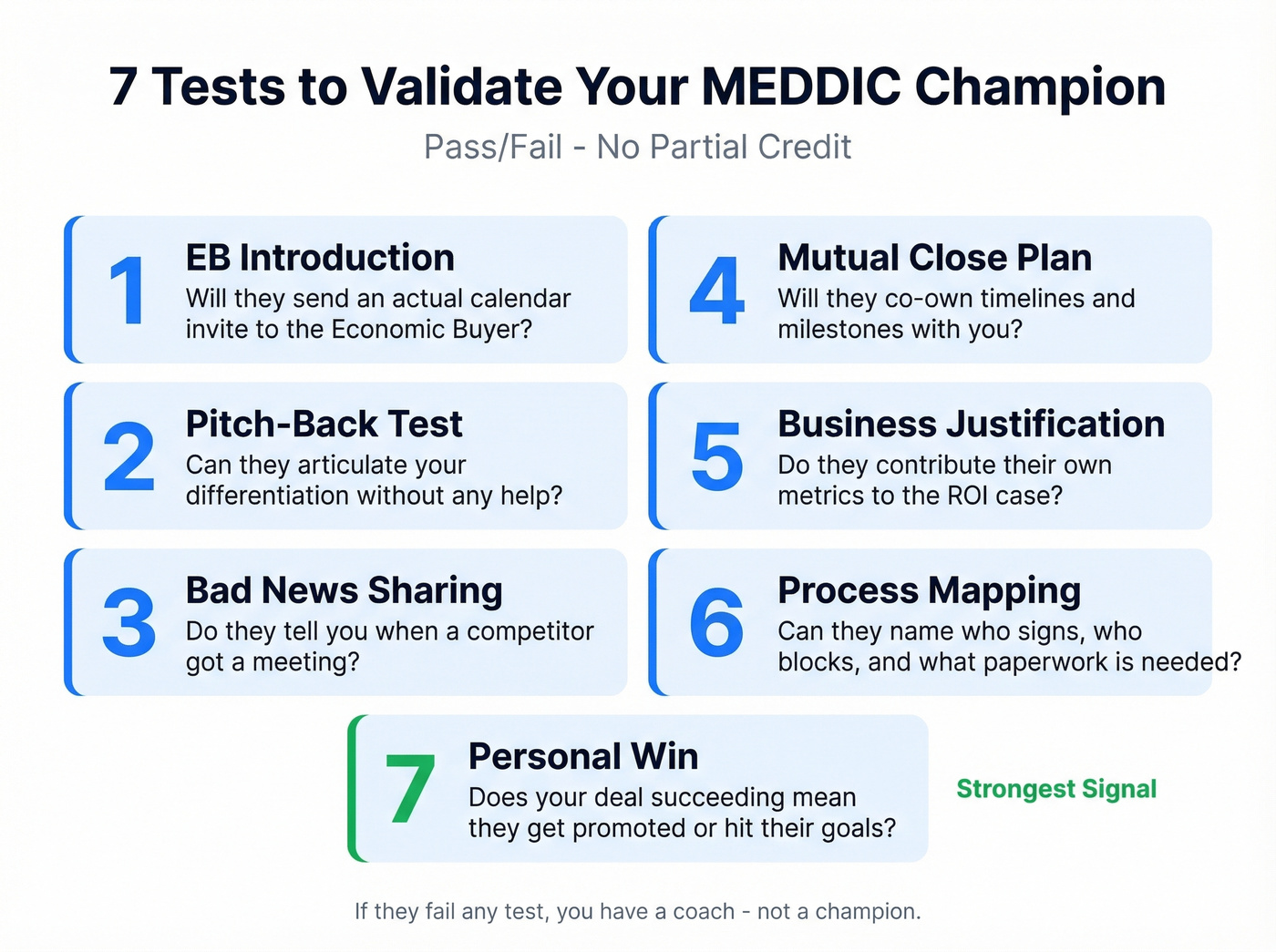
- Will they introduce you to the Economic Buyer? Not "I'll try" - an actual calendar invite. (If you need a deeper playbook, see Economic Buyer.)
- Can they articulate your differentiation without help? Ask them to pitch you back. If they fumble, they're not ready for the internal meeting either.
- Do they share bad news proactively? A real champion tells you when a competitor got a meeting. Silence is a fail.
- Will they co-create a mutual close plan? Champions own timelines alongside you.
- Will they help build the business justification? They contribute their own metrics - not just rubber-stamp yours.
- Can they map the decision and procurement process? They know who signs, who blocks, and what paperwork is required.
- Do they link their personal success to your solution? The strongest signal. If your deal winning means they get promoted, that's a champion.
You don't need 137 discovery questions. You need these 7 tests and the honesty to read the answers straight.
Score Your Champion in CRM
Turn this into a CRM field today. Three values, no ambiguity.
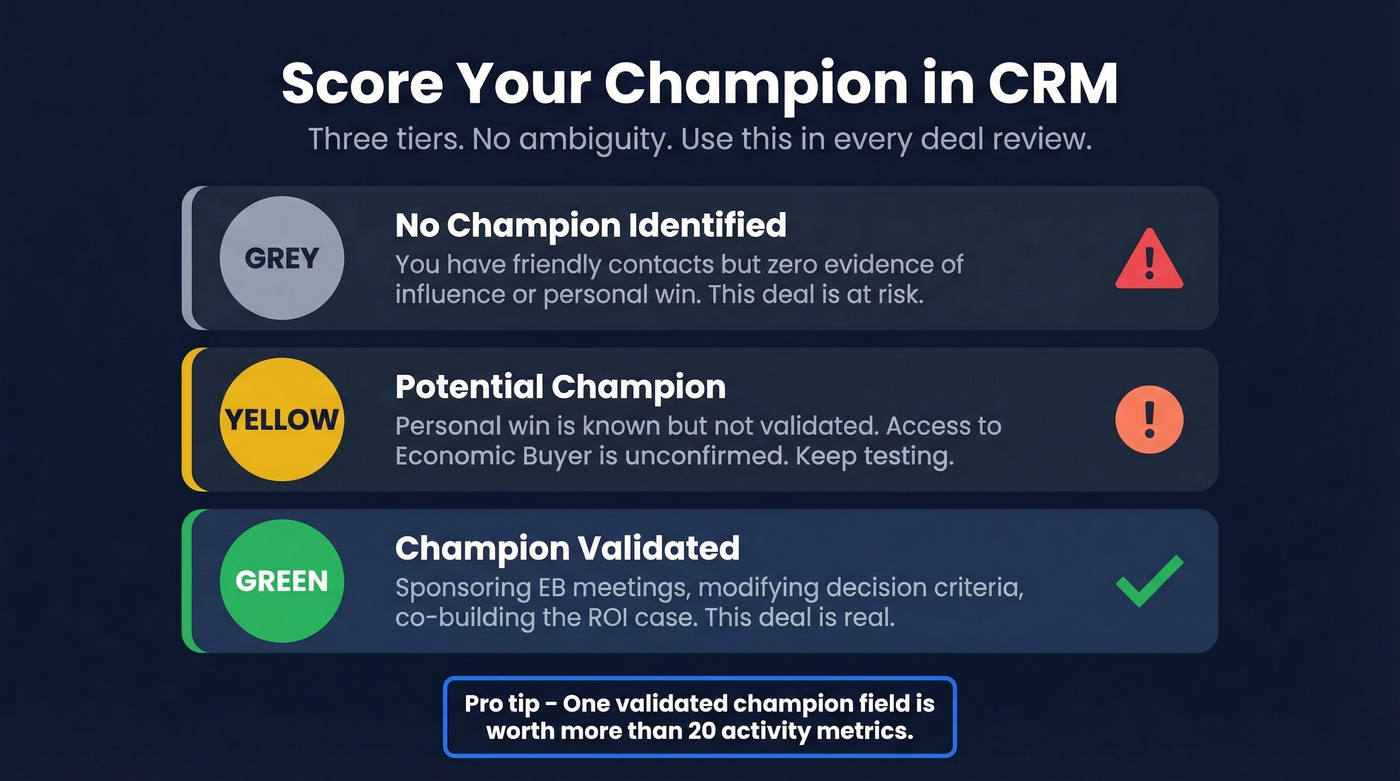
| Score | Criteria |
|---|---|
| Grey | No champion identified. You have "friends" but no evidence of influence or personal win. |
| Yellow | Potential champion. Personal win known but not validated. Access to EB unconfirmed. |
| Green | Champion validated - sponsoring EB meetings, modifying decision criteria, co-building the ROI case. |
For teams that want more granularity, sales forecasting solutions and Ebsta's 1-10 scoring model work well. But for most orgs, the three-tier system forces honest pipeline conversations in deal reviews. Reps on r/sales consistently gripe that MEDDIC documentation feels like busywork - but one validated champion field is worth more than 20 sales activities metrics.
Discovery Questions That Reveal Champions
Five good questions, woven into natural conversation - not fired like a deposition.
- "Who else needs to sign off, and what do they care about?"
- "If this project succeeds, what does that mean for you personally?"
- "What's happened with initiatives like this in the past - who drove them?"
- "If we hit a procurement roadblock, who would you go to?"
- "Walk me through what happens between a verbal yes and a signed contract."
Each question tests a different trait: influence, personal win, organizational knowledge, access, process mastery. Listen for specificity. Vague answers mean you're talking to a coach.
How to Arm Your Champion
Here's the thing: 95% of the sale happens when you're not in the room. Your champion needs ammunition, not enthusiasm.
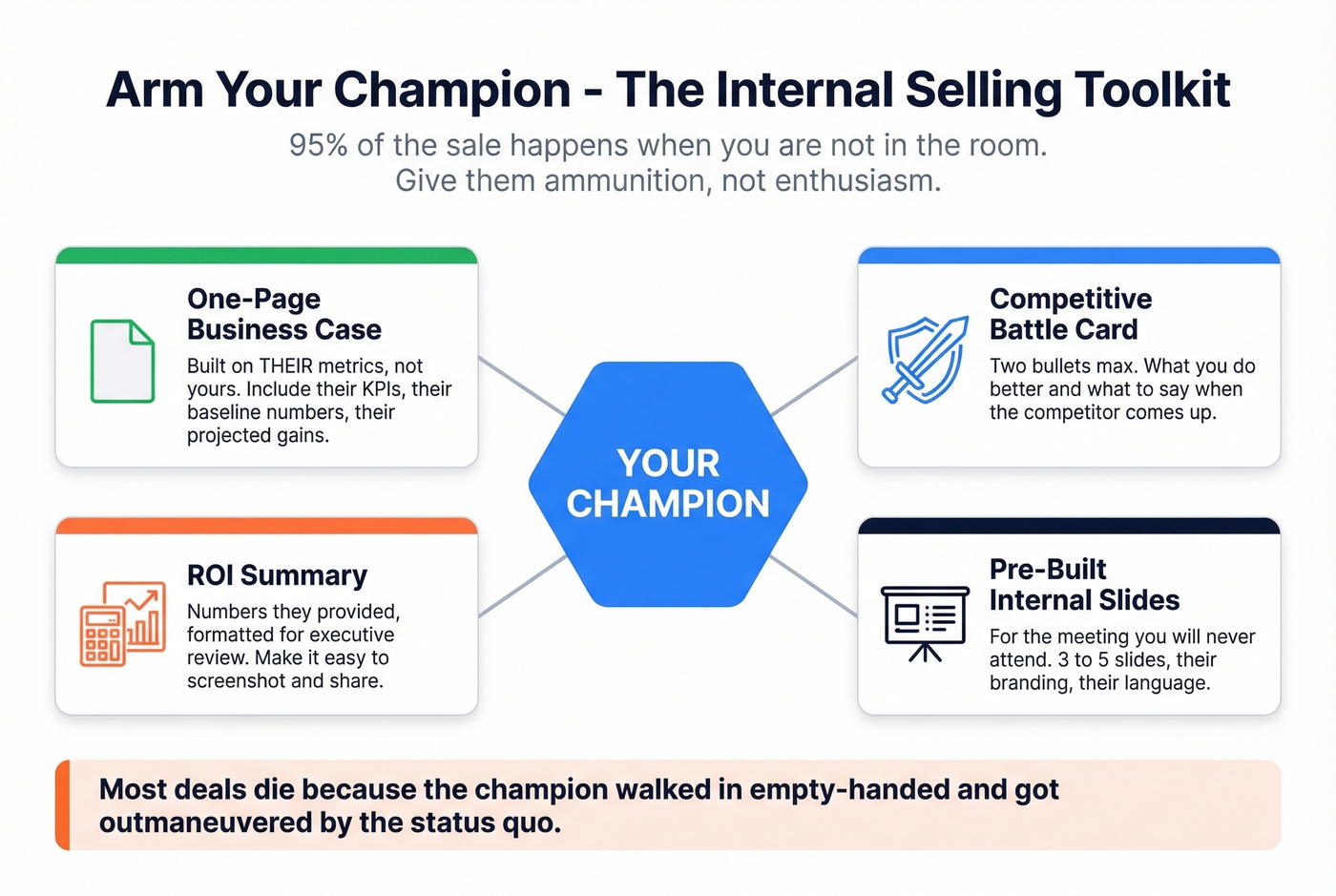
Give them a one-page business case built on their metrics. A two-bullet competitive battle card. An ROI summary from numbers they provided. Pre-built slides for the internal meeting you won't attend. That's the kit.
Most deals don't die from weak products. They die because the champion walked into the internal meeting empty-handed, improvised, and got outmaneuvered by the status quo. Arm them like you'd arm yourself.
Multi-Thread as Insurance
When your champion goes dark - or leaves the company entirely - you need to reach the rest of the buying group fast. That means accurate contact data, not stale records from six months ago. Prospeo's 98% email accuracy and 7-day data refresh cycle mean you're reaching real people when the clock is ticking, and with 300M+ professional profiles and 125M+ verified mobile numbers, you can rebuild a contact map for the entire buying committee in minutes rather than days. (If you're tightening your outbound motion, start with sales prospecting techniques and a clean contact management process.)
FAQ
What's the difference between MEDDIC and MEDDPICC champions?
Identical. MEDDPICC adds Paper Process and Competition as separate qualification elements, but the three-trait test - power, internal selling, personal win - applies equally to both.
Can a coach become a champion?
Yes, if they gain organizational influence or develop a personal stake in the outcome. A coach who gets promoted into a decision-making role, or who ties their next performance review to your project's success, can graduate. Re-run the 7 validation tests before upgrading their status.
What if my champion leaves mid-deal?
Multi-thread immediately. Reach two or three other stakeholders you've already mapped. Having current, verified contact data is the difference between a one-day recovery and a lost quarter.
How many champions do I need per deal?
One strong, validated champion is the minimum. For enterprise deals with $250K+ contract values and multiple business units involved, aim for two - one technical and one executive. More than three usually means none of them have real ownership.
When your champion leaves mid-deal or goes silent, you have days - not weeks - to rebuild relationships across the account. Prospeo's 300M+ profiles with 30+ filters let you identify and reach the economic buyer, blockers, and new allies before the deal dies.
Rebuild your contact map in minutes for about $0.01 per email.