

The MEDDPICC Economic Buyer: A Practitioner's Playbook for 2026
It's week 11 of a deal you forecasted to close in week 8. Your champion's gone quiet, procurement wants a third security review, and somewhere in the org chart a person you've never spoken to is about to kill the deal over a budget line you didn't know existed.
That's what happens when you don't nail the MEDDPICC economic buyer. 67% of lost sales trace back to poor qualification, and only 43.5% of reps hit quota. The EB is where both problems intersect.
The Short Version
- The Economic Buyer can say yes when everyone else says no - and kill the deal when everyone else says yes. They're not the budget holder, champion, or technical evaluator.
- Test your champion: if they can't get you 15 minutes with the EB, they're not really a champion.
- If you haven't met the EB by mid-deal, your forecast is fiction.
What Is the Economic Buyer in MEDDPICC?
The Economic Buyer holds final authority to approve spending. They can green-light a deal every other stakeholder doubts, and kill one everyone else loves. Whether you use the full MEDDPICC framework or the earlier MEDDIC variant, the EB serves the same function - they're the person whose signature releases the money.
Here's the thing: modern enterprise deals rarely have a single EB. The average B2B deal now involves 13 stakeholders, 89% span multiple departments, and 86% of purchases stall during the buying process - the EB is usually the reason they restart or die. EB authority often splits: a CFO controls the budget, a CRO owns strategic alignment, a board member has veto power above a certain threshold. Treating the EB as one name on your deal sheet will burn you. Map the authority network.
How to Spot the Real EB
EB vs. Champion vs. Budget Holder vs. Technical Buyer
| Role | Function | Can Kill Deal? | Can Approve Spend? | Example |
|---|---|---|---|---|
| Economic Buyer | Final spending authority | Yes | Yes | CFO approves $200K |
| Champion | Advocates internally | Rarely | No | Sales Dir sells it up |
| Budget Holder | Controls dept. budget | Sometimes | Up to threshold | VP Ops, $500K limit |
| Technical Buyer | Evaluates fit | Yes (veto) | No | CTO validates stack |
| Procurement | Manages terms | Can delay | No | Procurement runs MSA |
In a cybersecurity platform sale, the CISO champions it, the CFO is the economic buyer, the CTO evaluates technical fit, and the CEO weighs strategic alignment - four people, four distinct roles, one deal.
Phrases That Signal You Haven't Reached the EB
Listen for "I'll need to check with...," "This would go to...," "I don't control that budget," or any variation of "someone else decides." Any of these means you're still one or more levels away from final authority. Ask any AE on r/sales what kills their deals, and "never met the EB" comes up constantly.
The EB Identification Diagnostic
Rank these four signals. If your contact has #1, you've found the economic buyer. If they only have #4, keep looking.
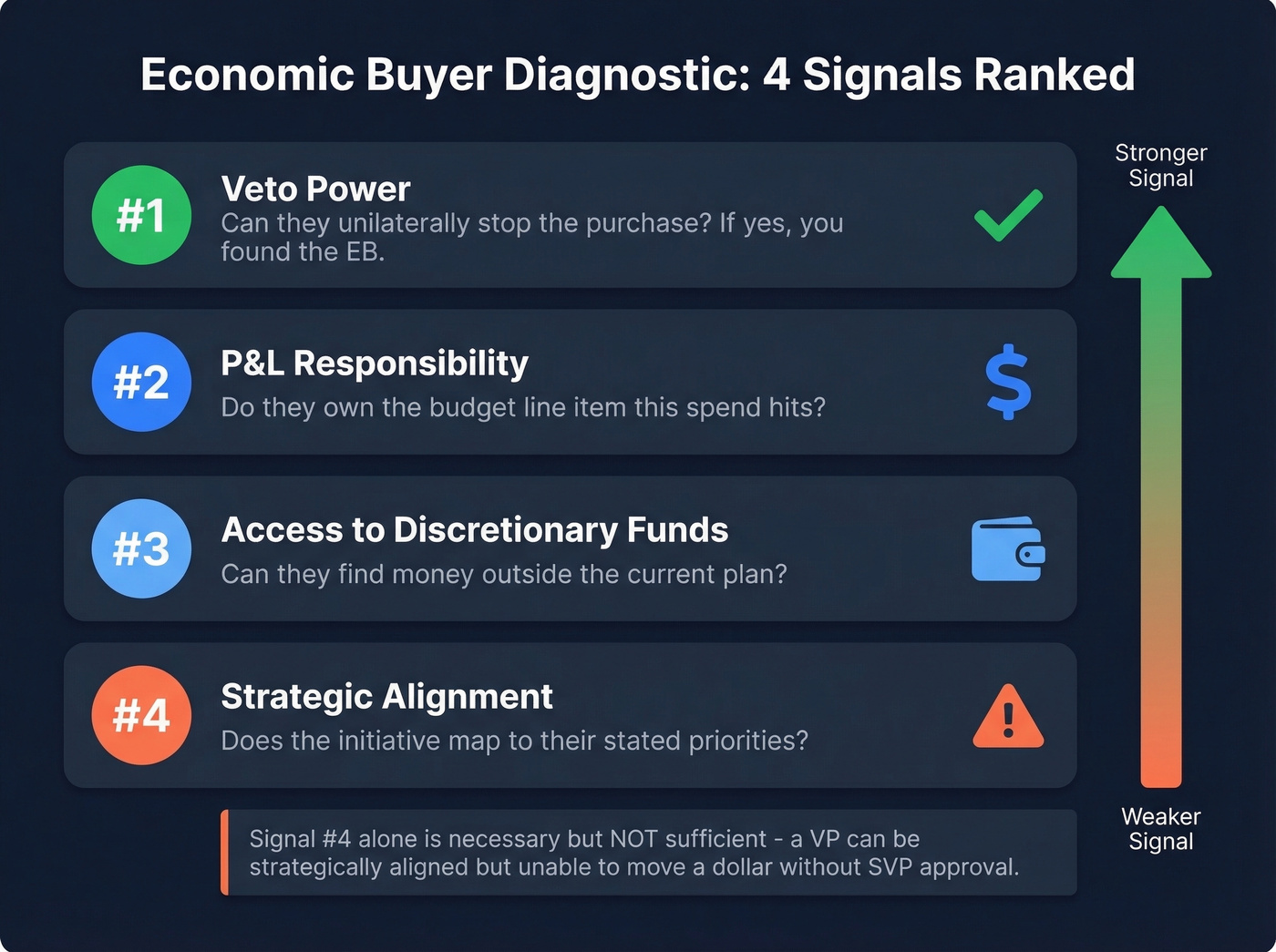
- Veto power - Can they unilaterally stop the purchase?
- P&L responsibility - Do they own the line item this spend hits?
- Access to discretionary funds - Can they find money outside the current plan?
- Strategic alignment - Does the initiative map to their stated priorities?
Signal #4 alone is necessary but not sufficient. We've seen deals where a VP was strategically aligned but couldn't move a dollar without their SVP's signature.

You just mapped the buying committee. Now you need the Economic Buyer's direct line - not a generic info@ address. Prospeo gives you 98% accurate emails and verified mobile numbers across 300M+ profiles, so you can bypass gatekeepers and reach the person who signs the check.
Stop emailing champions and hoping they forward it up.
Discovery Questions That Qualify the EB
These should work like an internal compass - the buyer should never feel "qualified at." If you want a broader bank of prompts, use these discovery questions to pressure-test authority, urgency, and risk.
- "Who ultimately approves the budget for a solution like this?" - The most direct path. Ask it early.
- "Who would be the final decision-maker if your team recommends moving forward?" - Softer framing that still surfaces the EB.
- "How does [the EB] typically measure ROI on new investments?" - Tells you what language to use when you get the meeting.
- "What challenges have you faced getting leadership buy-in on projects like this?" and "Who could kill this deal that I haven't met?" - Together, these two reveal the political landscape and unknown stakeholders fast.
- "How does the economic buyer prefer to receive information - detailed reports, executive summaries, or a live demo?" - Practical intel for when you get access.
When You're Blocked from the EB
Not engaging with a decision maker decreases win rate by 80% in SMB and 233% in Enterprise. If the EB raises ROI concerns after your solution is already presented, your close rate drops 79%. You need access before the proposal stage.
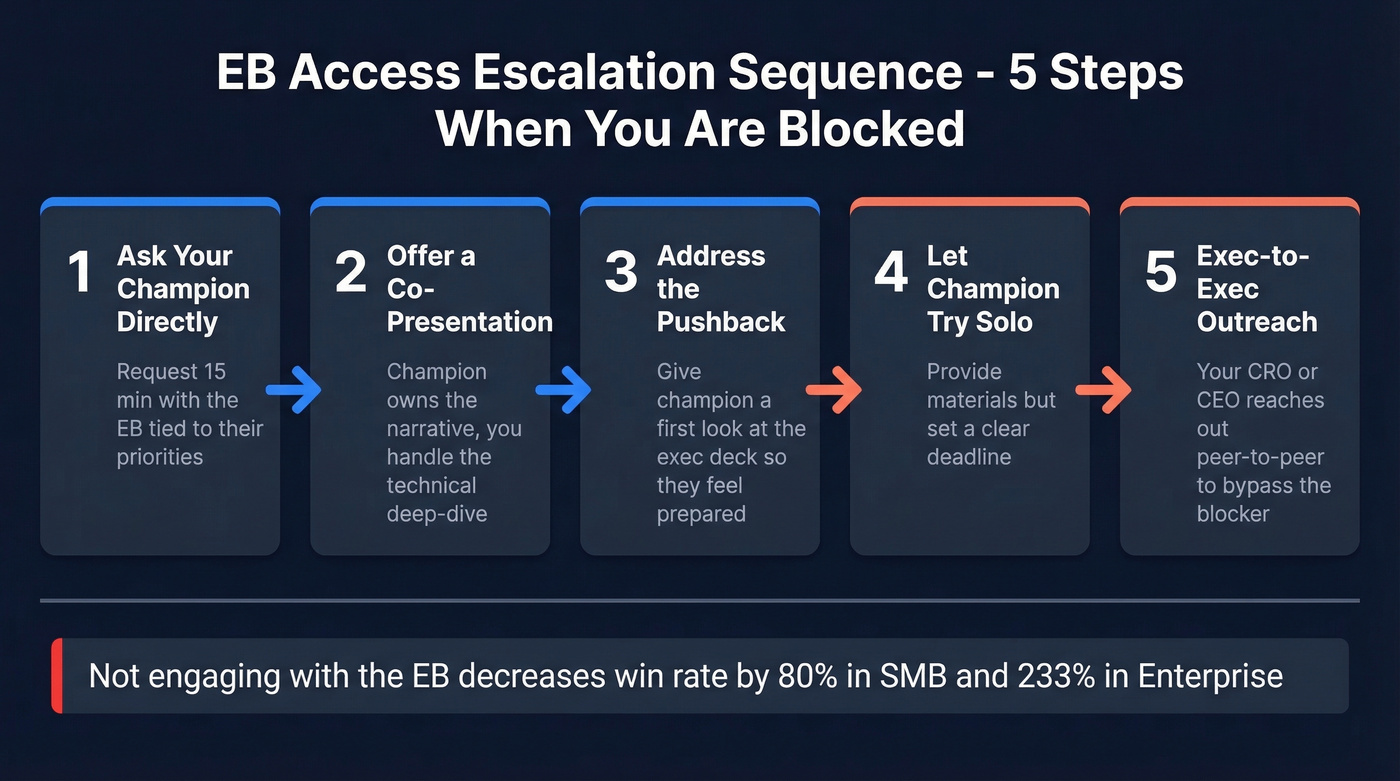
Here's the escalation sequence we recommend:
1. Ask your champion directly. "I want to make sure [EB name] sees alignment to their priorities before procurement. Can we get 15 minutes?" If your champion can't move this forward, revisit your MEDDIC sales qualification and re-score the deal.
2. Offer a co-presentation. Your champion presents the business case, you handle the technical deep-dive. This gives them ownership of the narrative, which matters. Use a tight sales deck storytelling structure so the exec meeting stays outcome-first.
3. Address the pushback. In our experience, the champion who resists introducing you to the EB is usually protecting their own access, not blocking yours. Ask why, then give them a first look at the exec presentation so they feel prepared.
4. Let the champion try solo. Give them materials and a window. Don't assume bad intent - but set a deadline.
5. Use exec-to-exec outreach. If you have executive sponsors on your side, a peer-level outreach from your CEO or CRO to theirs can bypass the blocker entirely. Gartner's research on buying groups confirms that executive alignment early in the process dramatically improves deal velocity. If you need a repeatable motion here, borrow from account-based selling best practices to coordinate multi-threading.
Don't just put "meet EB by April 15" on your deal plan. That's a task, not a strategy. Your strategy should answer why the EB won't meet you and what alternate path exists through the org.
Engaging the EB - What to Say and When
Do this: Lead with business outcomes - ROI, total cost of ownership, time to value, risk reduction. The EB doesn't care about features. If you need a clean structure for the conversation, use these talk track examples to keep it executive-level.
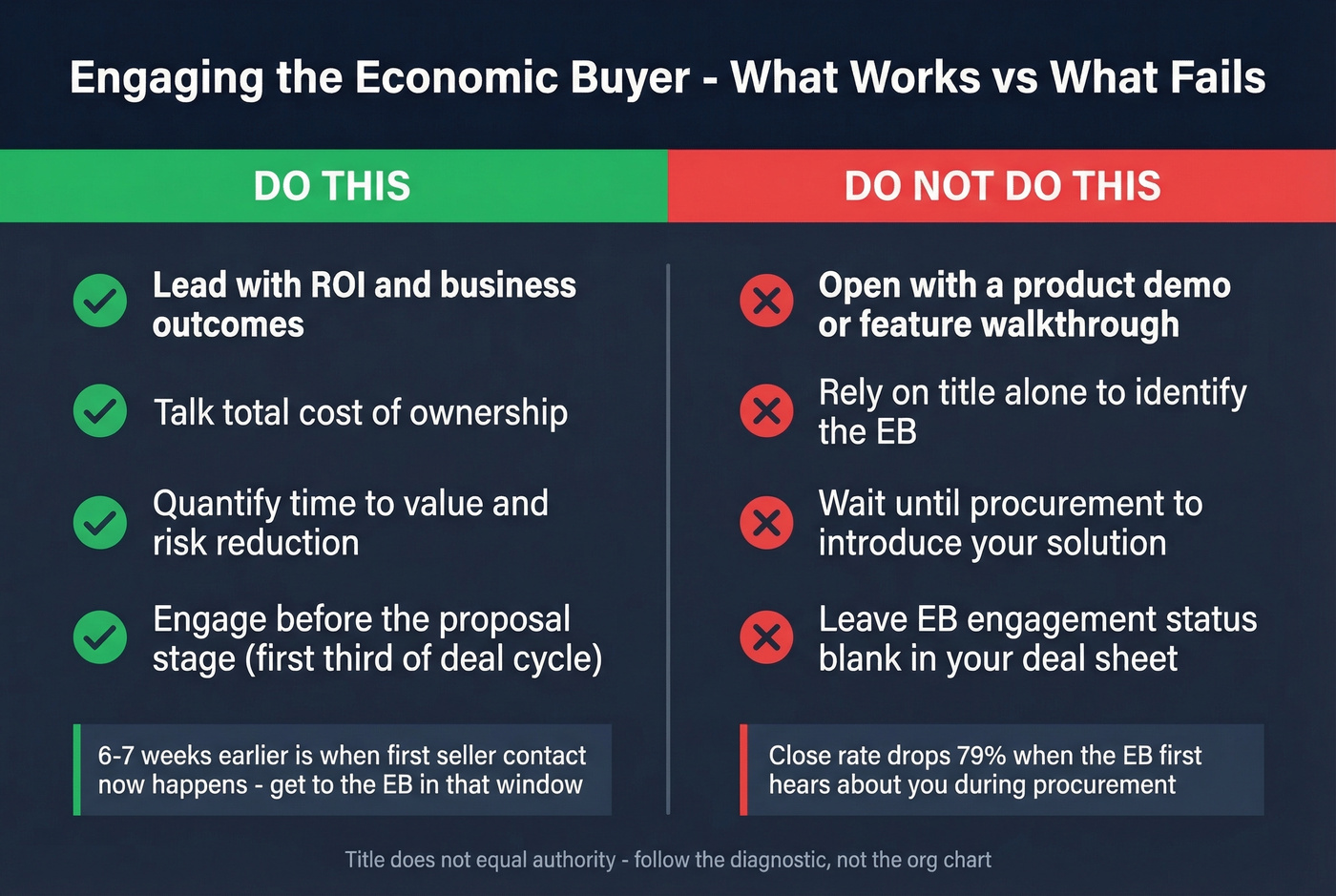
Don't do this: Open with a product demo or feature comparison. That's what the technical buyer meeting was for. If you must demo, follow a product demo checklist so you don't drift into feature soup.
6sense data shows the point of first seller contact has moved from 69% to 61% of the buyer's journey - roughly 6-7 weeks earlier than a few years ago. Get to the EB during that window, not after procurement has anchored on price.
Let's be honest about something most playbooks skip: title doesn't equal authority. A VP at a 50-person company might be the EB. A C-suite exec at a 5,000-person company might not be. Follow the diagnostic, not the org chart. And document EB engagement status in your deal qualification template - who they are, whether you've met them, and their stated success criteria. If that field is blank past the discovery stage, the deal isn't qualified. Full stop. If you're trying to operationalize this across the team, track it as part of pipeline health instead of a one-off note.
Deals die when you can't get 15 minutes with the EB. Prospeo's 125M+ verified mobile numbers have a 30% pickup rate - 3x the industry average. Skip the exec assistant, skip the blocked calendar, and get the conversation that saves your deal.
Direct dials close deals. Generic emails don't.
FAQ
What's the difference between an Economic Buyer and a decision maker?
The EB is the specific decision maker with final spending authority - the person who signs off on the budget. Other decision makers influence direction or hold technical veto power, but only the EB can approve the purchase.
Can there be more than one Economic Buyer?
Yes. In consensus-driven enterprises, EB authority often splits across a CFO, CRO, and board member depending on deal size and strategic impact. Map all of them using the diagnostic above.
How do I find the Economic Buyer's contact information?
Start with your champion for a warm introduction - that's always the highest-conversion path. If you're blocked, use a B2B data platform like Prospeo to find direct contact details before making your one outreach attempt.
When should I engage the Economic Buyer in the sales cycle?
Engage the EB before the proposal stage - ideally during discovery or early evaluation. Deals where the EB first hears about your solution during procurement negotiation see close rates drop 79%. Aim for a 15-minute alignment call in the first third of the deal cycle.