

The Challenger Sales Model: What Works, What Breaks, and How to Actually Use It in 2026
Your VP just came back from a conference with a new mandate: "We're rolling out Challenger." The deck is already circulating. The training vendor is already booked. And half your reps are already Googling whether this is the real deal or just another methodology-of-the-quarter.
It's both. The challenger sales model is arguably the most important sales framework of the last 15 years, and also the most misimplemented.
What You Need (Quick Version)
The challenger sales model is a research-backed methodology where reps lead with insight, create constructive tension, and guide the buyer toward a decision - rather than building rapport and waiting for needs to emerge.
It matters in 2026 because 94% of buyers now use LLMs during their research process, which means your reps can't win by being the "helpful information source" anymore. The framework boils down to three moves: Teach (deliver an insight the buyer didn't have), Tailor (customize that insight to the stakeholder's world), and Take Control (guide the buying process with assertive confidence).
It's best for complex B2B sales - multi-stakeholder deals north of $50K ACV with long cycles. If you're running transactional sales, or your org has broken fundamentals like bad product, bad territories, or no enablement, Challenger won't save you.
What Is the Challenger Sale?
The methodology comes from Matthew Dixon and Brent Adamson's research at CEB (now Gartner), published in their 2011 book The Challenger Sale. The study covered more than 6,000 sales reps across multiple industries and geographies, and the headline finding was striking: 53% of what drives B2B customer loyalty isn't your product, your brand, or your pricing - it's the sales experience itself.
The core premise is simple. Instead of asking questions to uncover pain or building deep relationships first, a challenger seller leads with a commercial insight that reframes how the buyer thinks about their problem. Then they tailor that insight to the specific stakeholder. Then they take control of the buying process.
If you've spent time with SPIN, MEDDIC, or Sandler, you're probably thinking: "These all sound the same." The sentiment on r/sales echoes that - one popular thread argues every methodology boils down to need, budget, stakeholders, and timeline. There's truth in that. But Challenger's specific contribution isn't a new set of discovery questions. It's a sequence and a posture: you don't diagnose first and prescribe second. You prescribe first - with an insight that earns the right to diagnose. That's a fundamentally different sequence, and it changes how reps prepare, open calls, and handle pushback.
The Research Behind It
Let's get specific about what the research actually measured, because most summaries skip this entirely. CEB had sales managers evaluate their reps against 44 distinct attributes - things like goal orientation, business acumen, negotiation skill, and consultative ability. They defined "star performers" as the top 20% of each sales force, measured by performance against quota. From those assessments, five rep profiles emerged.
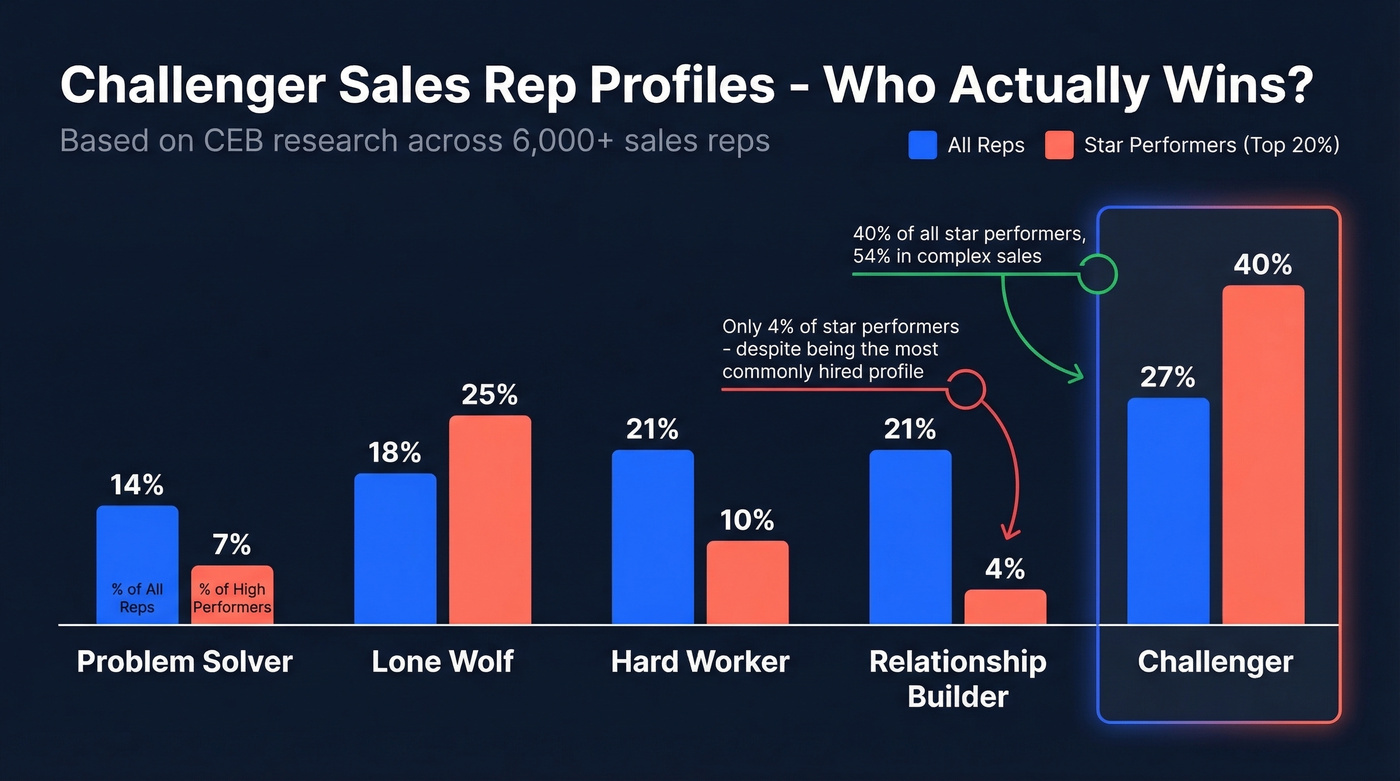
| Profile | % of All Reps | % of High Performers |
|---|---|---|
| Problem Solver | 14% | ~7% |
| Lone Wolf | 18% | ~25% |
| Hard Worker | 21% | ~10% |
| Relationship Builder | 21% | ~4-7% |
| Challenger | 27% | ~40% |
The original research is widely summarized as Challengers being roughly 40% of high performers. But Challenger Inc.'s updated profile page uses a higher figure: "nearly 54%" of high performers in complex sales. They replicated the research in 2020 and found consistent results.
Here's the stat that made the book a bestseller and made a lot of VP Sales uncomfortable: Relationship Builders - the profile most sales orgs instinctively hire for - represent just 4% of star performers in complex sales. Roughly 7% across all environments. That single finding upended two decades of "hire for likability" conventional wisdom.
Teach, Tailor, Take Control Explained
The three T's are the operational core of the methodology. They sound simple. They're not.
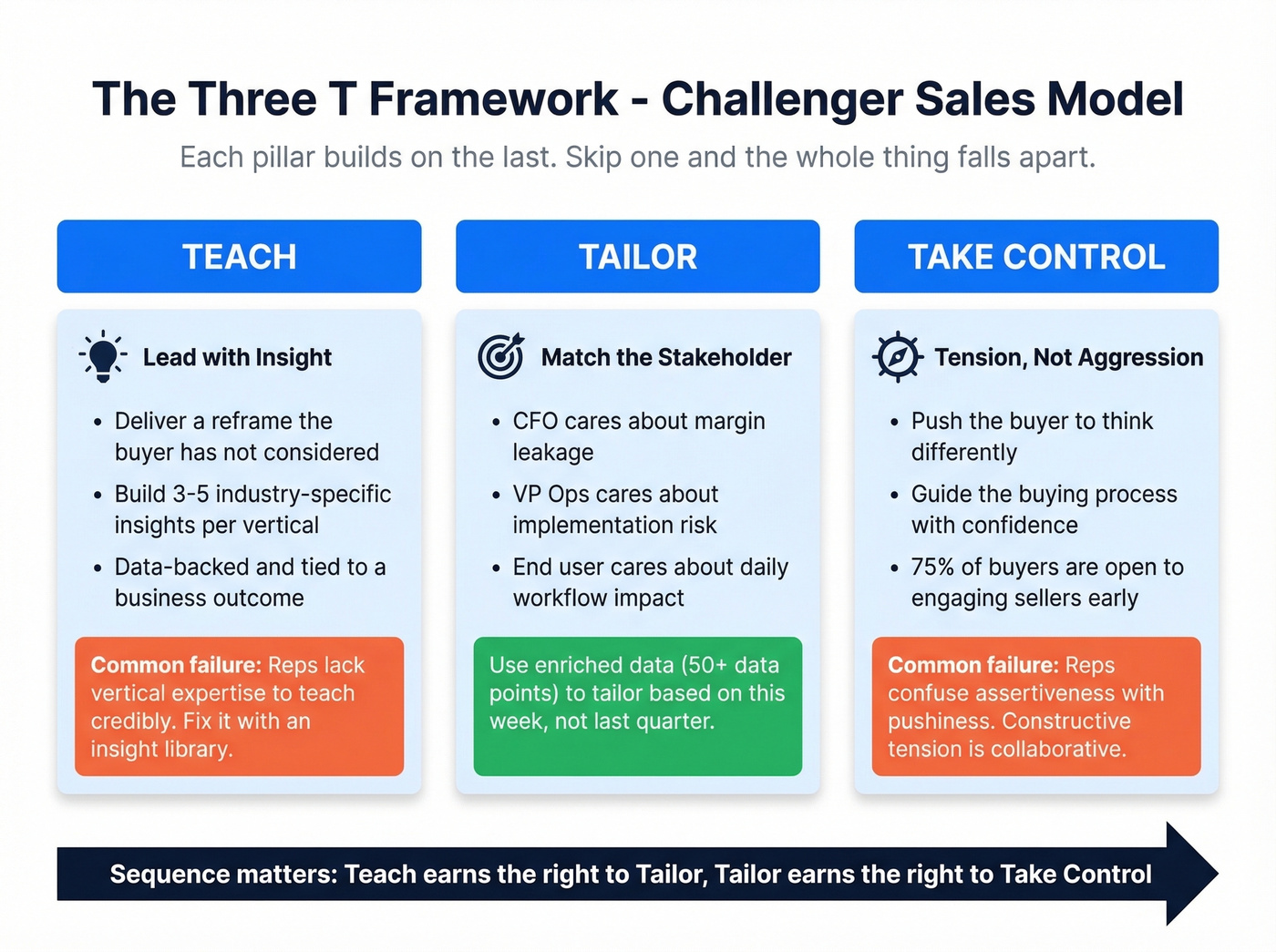
Teach - Lead with Insight
Commercial teaching means walking into a meeting with a point of view the buyer hasn't considered. Not a product pitch, not a discovery question, but a genuine reframe of their problem. This is where rollouts break most often, and the reason is straightforward: most reps don't have the vertical expertise to teach anyone anything.
One rep on r/sales put it bluntly - they sell custom manufacturing equipment across dozens of industries and can't realistically learn each one deeply enough to deliver a credible insight. That's not a rep problem. That's an organizational problem. If you're mandating the challenger approach without building an insight library, you're setting reps up to fail.
Narrow your insight library to 3-5 industry-specific reframes per vertical. Make them concrete, data-backed, and tied to a business outcome your product influences. Don't ask reps to become industry consultants overnight. Give them the ammunition.
Try this with your team: Grab a random object from someone's desk - a stapler, a coffee mug, whatever. Give each rep 90 seconds to "reframe" the buyer's understanding of that object. The stapler isn't a stapler - it's a document security risk. The mug isn't a mug - it's a hydration workflow bottleneck. Sounds ridiculous, but the muscle you're building is the same one reps need to reframe a prospect's billing process or hiring strategy. Run this for 10 minutes at your next team standup and watch who gets it immediately.
Tailor - Match the Stakeholder
Teaching the same insight to every person in the buying committee is a waste. The CFO is thinking about margin leakage while the VP of Ops is calculating implementation risk. The end user? They just want to know if this thing will make their Tuesday worse.
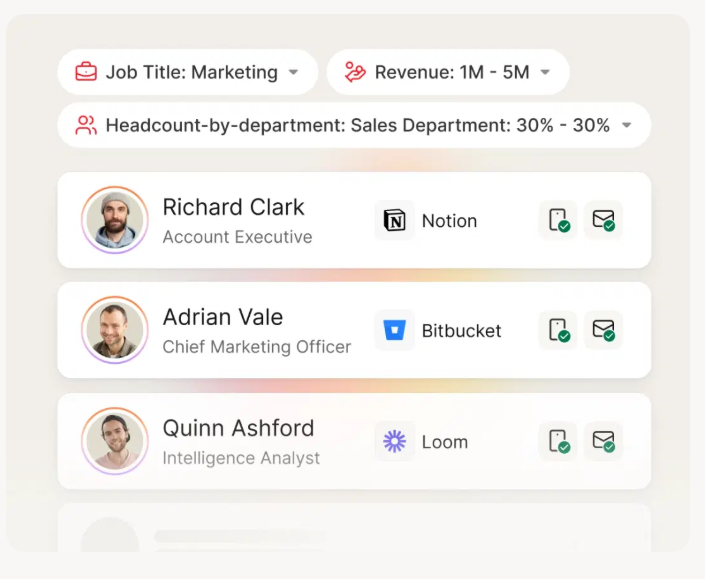
Tailoring means adjusting the insight's framing, data points, and emotional hooks for each stakeholder's priorities. This requires accurate, current data on the prospect's company and role. Prospeo's 50+ data points per enrichment on a 7-day refresh cycle mean you're tailoring based on this week's reality, not last quarter's CRM record. That's the difference between a generic "your industry is changing" pitch and a specific "your company just expanded headcount 30% while your billing stack hasn't changed since 2022" reframe.
Take Control - Tension, Not Aggression
"Take control" is the most misunderstood part of the framework. It doesn't mean steamrolling the buyer. Korn Ferry's critique calls Challenger "pushy" and "gimmicky," and when it's implemented badly, they're right. But their own research shows 75% of buyers are open to engaging sellers earlier and 54% find value in collaborative discussion - which is exactly what good constructive tension looks like.
You're pushing the buyer to think differently, not pushing them into a corner.
The Commercial Teaching Pitch
The commercial teaching pitch is a choreography, and the sequence matters - not just logically, but emotionally. The buyer should experience a specific arc: comfort, then discomfort, then resolution. This structure is what separates Challenger from generic consultative approaches.
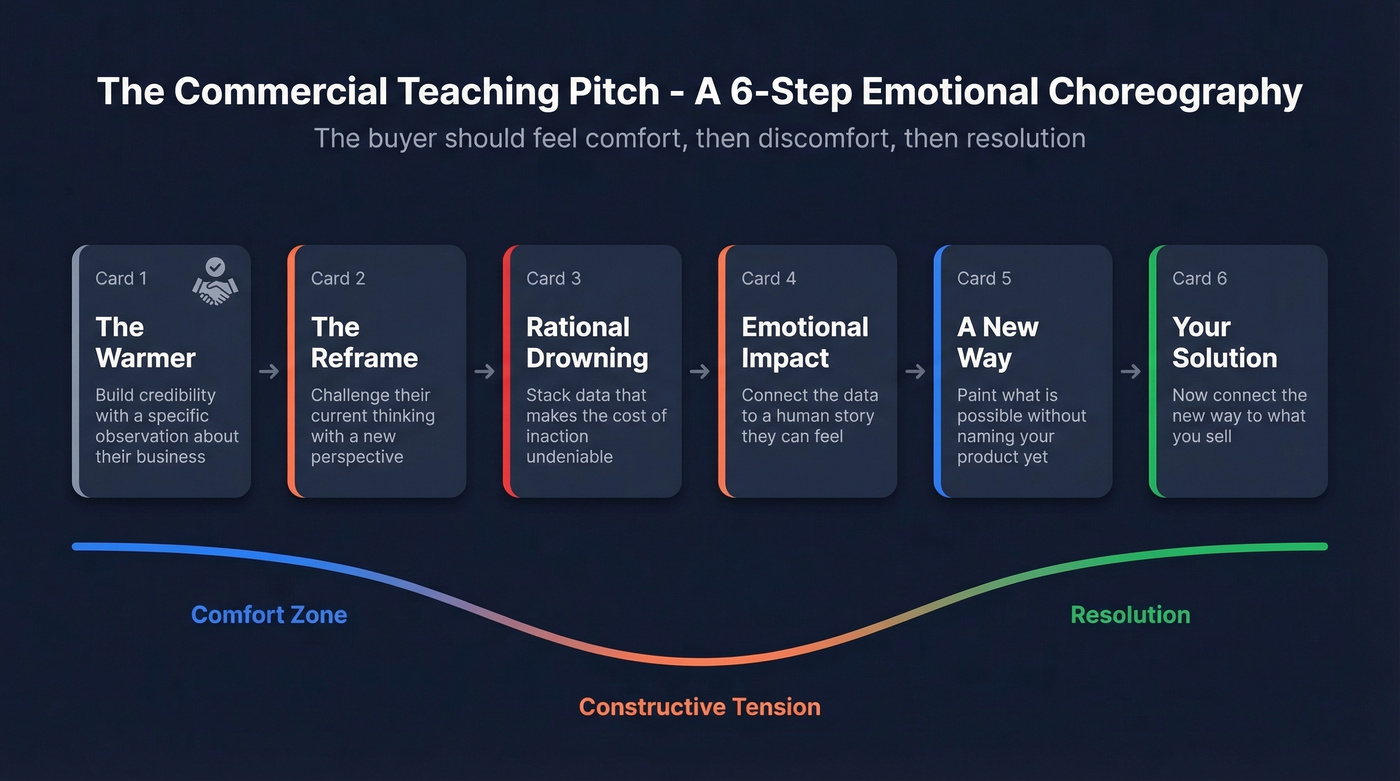
The Warmer. Build credibility with a specific observation about their business context. This creates comfort - the buyer feels understood.
The Reframe. Introduce an insight that challenges their current thinking. Comfort drops. This is the moment that separates Challenger from consultative selling.
Rational Drowning. Stack data and evidence that makes the cost of inaction undeniable. The buyer hits the emotional low point - the problem feels bigger than they thought.
Emotional Impact. Connect the rational case to a human story. A peer who faced the same problem. A team that suffered the consequences. This deepens the discomfort but makes it personal and solvable.
A New Way. Paint the picture of what's possible with a different approach - without naming your product yet. Relief begins.
Your Solution. Connect the new way to what you sell. Resolution.
Here's a worked example. Say you're selling a billing platform to a US telecom, targeting a $350K ARR deal with a 6-7 month cycle. Your warmer acknowledges their strong revenue growth. Your reframe: "Your revenue model is strong, but your renewal process is leaking margin every quarter." Rational drowning: show internal error rates, rework hours, and the downstream impact on renewals and plan launches. Emotional impact: a similar company that couldn't launch a new plan for six months because their billing system couldn't handle the pricing logic. New way: modern billing as a growth enabler. Then - and only then - your solution.
One critical anti-pattern: don't lead with fear. Challenger Inc.'s research shows that fear-based messaging triggers loss aversion and reinforces status quo bias. The prospect becomes more likely to do nothing. Constructive tension follows a different arc: empathy, solvable risk, emotional story, credible resolution, commercial insight.

Tailoring insights to each stakeholder requires more than guesswork - it requires current, granular data. Prospeo enriches every contact with 50+ data points on a 7-day refresh cycle, so your Challenger reps tailor based on this week's reality: headcount growth, tech stack, funding, department size. 98% email accuracy means your reframe actually reaches the right person.
Stop teaching to stale CRM records. Tailor with data that's actually fresh.
Why It Matters More in 2026
The buying environment has shifted dramatically, and every shift makes insight-led selling more relevant. Sales cycles compressed from 11.3 months to 10.1 months between 2024 and 2025. Buyers define their requirements 83% of the time before they ever talk to a rep. And 72% of B2B buyers now encounter AI-generated overviews during their research, with 80% trusting AI tools as part of their process.
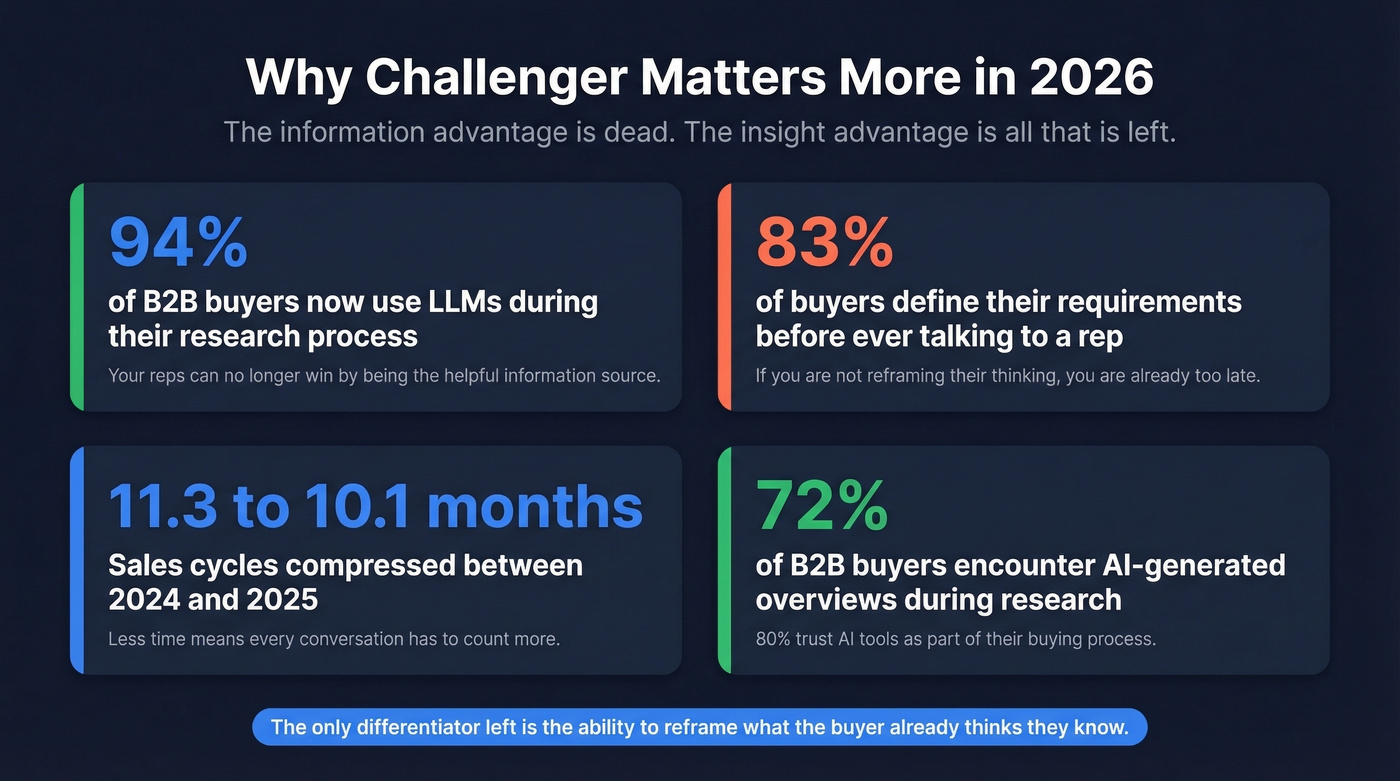
When 94% of buyers are using LLMs to research solutions, your reps can't differentiate by being knowledgeable. The information advantage is gone. What remains is the insight advantage - the ability to reframe a problem the buyer thought they already understood. That's the challenger sales model's core value proposition, and it's more defensible now than it was in 2011.
Here's the thing: most sales teams don't actually need a $50K methodology rollout. They need three good commercial insights and reps brave enough to lead with them. Challenger selling is a mindset before it's a program - and we've seen five-person teams outperform 50-person orgs that spent six figures on certification, simply because the small team built better insights and iterated faster.
The no-decision epidemic makes "Take Control" equally critical. Challenger Inc.'s own data puts the no-decision rate at 38% for complex B2B purchases; broader research from the JOLT Effect suggests 40-60%. Either way, 86% of B2B purchases stall. Typical buying decisions now involve 10+ people. Without a seller who can create urgency through insight and navigate a complex buying committee with confidence, deals die in committee - not because a competitor won, but because nobody built enough momentum to get a signature.
When It Doesn't Work
Rigid Enforcement Kills Deals
One enterprise seller on r/sales described their org losing roughly 90% of enterprise deals that weren't referrals. Leadership was "obsessed" with the methodology. A coworker got put on a PIP despite following it to the letter. The problem wasn't Challenger itself - it was that the org treated it as the entire sales strategy, ignoring multi-threading, competitive positioning, and account-based execution.
Challenger is a selling posture, not a complete go-to-market playbook.
No Insight Engine, No Results
We've seen this pattern repeatedly: leadership mandates the methodology, sends reps to training, and then expects them to generate commercial insights on their own. That's like buying a race car and expecting the driver to refine the fuel. The organization has to build and maintain an insight library - industry-specific reframes, competitive benchmarks, customer stories - and keep it updated. Without that infrastructure, "Teach" becomes "wing it," and reps revert to relationship selling within weeks. I've watched it happen at three different companies.
Broken Orgs Need Foundations First
A medical sales rep flagged this on Reddit: their company had too many internal issues to fix first, and the methodology was being used as a band-aid. No framework compensates for a bad product, broken territories, or a leadership team that changes strategy every quarter. Challenger amplifies a functional sales org. It doesn't rescue a dysfunctional one.
Challenger vs Other Methodologies
MEDDIC and Challenger aren't competitors - use MEDDIC to qualify, the challenger sales model to sell. That's the most important sentence in this section.
| Methodology | Best For | Core Posture | AI Compatibility | Deal Complexity |
|---|---|---|---|---|
| Challenger | Complex B2B, $50K+ | Prescriptive insight | Low (human insight) | High |
| MEDDIC/MEDDPICC | Enterprise qualification | Diagnostic rigor | High (CRM-mappable) | High |
| SPIN Selling | Discovery-heavy sales | Diagnostic questions | Medium | Medium-High |
| Sandler | SMB, founder-led | Mutual qualification | Low | Low-Medium |
| Solution Selling | Mid-market | Consultative | Medium | Medium |
| GAP Selling | Value-based deals | Current-to-future state | Medium | Medium-High |
Each framework has a ceiling. Challenger requires an insight engine most orgs never build. MEDDIC doesn't teach you how to sell - it teaches you whether to sell. SPIN's diagnostic posture feels passive when buyers arrive pre-informed. Sandler lacks structure for complex multi-stakeholder deals. Solution Selling has become so widespread it no longer differentiates. GAP Selling has a steep learning curve that slows adoption.
The AI-age angle matters here. MEDDIC maps cleanly to CRM fields that AI can auto-populate - deal stage, economic buyer, decision criteria. That makes it the strongest framework for AI-augmented sales ops. Challenger's strength is the opposite: insight differentiation that AI can't replicate. The best teams in 2026 are running both.
Skip Challenger entirely if you're under 20 reps selling deals below $50K ACV. Start with SPIN or basic consultative selling and layer in challenger principles as your deal complexity grows.
Training and Certification
Challenger Inc. offers training in three formats: instructor-led workshops, eLearning through their Challenger Activation platform, and hybrid courses. Certification typically takes 3-6 weeks and includes online modules, live instruction, and role-plays.
They don't publish pricing. Expect $15,000-$75,000+ depending on team size, format, and whether you're buying the full suite or just the core methodology. For context, other sales certifications run dramatically cheaper - NASP's CPSP is ~$695, CPSL ~$795, SMEI's CSE ~$989. Challenger Inc. reports 60% of salespeople earning $250K+ use their methodology.
If you're a 10-person sales team, that's a real investment for a methodology you don't need at your current scale. Consider whether you can implement the core principles through internal training before writing a six-figure check.
Implementation That Works
If you're rolling out the challenger sales process, here's the sequence that actually produces results.
Start by auditing your current sales process. You can't measure improvement without a baseline, and you need to understand what your reps are doing today before layering on a new framework. Then build an insight library - 3-5 industry-specific reframes per vertical, updated quarterly. This is the single highest-leverage investment in a Challenger rollout, and skipping it is the number one reason implementations fail.
Your data infrastructure matters just as much. Reps can't execute the Warmer or Tailor steps with stale CRM records. In our experience, the teams that nail Challenger execution are the ones obsessing over data freshness - making sure they know what's happening at the prospect's company this week, not last quarter.
- Train in cohorts. Start with your top performers. Let them prove the model works in your environment before rolling it org-wide.
- Layer MEDDIC for qualification. Challenger tells you how to sell. MEDDIC tells you whether you should be selling to this account at all.
- Measure leading indicators. Track reframe attempts per call, stakeholder coverage per deal, and multi-threading depth - not just close rates.
- Allow flexibility. Don't PIP reps for adapting the methodology to their style. The best Challengers internalize the principles and make them their own.
If you want a practical ramp plan for rolling this out to new hires, use a 30-60-90 structure and bake in role-plays around Teach/Tailor/Take Control.
The Challenger model fails when reps lack the context to deliver a credible insight. Prospeo gives your team 30+ search filters - buyer intent across 15,000 topics, technographics, job changes, headcount growth - so every rep walks into every call armed with a specific, data-backed reframe. At $0.01 per email, arming a 50-rep team costs less than one lost deal.
Give your Challengers the intelligence to actually challenge. Build your list now.
FAQ
What is the Challenger Sale?
The Challenger Sale is a research-backed sales methodology developed by Matthew Dixon and Brent Adamson based on a study of over 6,000 reps. It found that top performers teach buyers something new, tailor their message to each stakeholder, and take control of the deal - prioritizing commercial insight over rapport-building.
Is the challenger sales model still effective in 2026?
Yes - more than ever. With 94% of buyers using LLMs during research, insight-led selling is the only reliable differentiator left. The framework directly addresses the no-decision epidemic where 40-60% of qualified pipeline ends without a purchase. The principles are more relevant now than when the book launched in 2011.
What's the difference between Challenger and SPIN Selling?
SPIN starts with diagnostic questions to uncover pain. Challenger starts with a prescriptive insight to reframe the problem. SPIN is a doctor running tests; Challenger is a specialist arriving with a hypothesis. The best teams use SPIN for early discovery and Challenger for the pitch and deal progression.
How much does Challenger training cost?
Challenger Inc. doesn't publish pricing, but expect $15,000-$75,000+ depending on team size and format. Other sales certifications like NASP's CPSP run ~$695. The investment makes sense for teams of 20+ reps selling complex, multi-stakeholder deals above $50K ACV.
What tools help execute the Challenger approach?
You need accurate prospect data for the Tailor step - tools like Prospeo with 50+ enrichment data points and a 7-day refresh cycle keep stakeholder intelligence current. Pair that with a CRM for tracking engagement, a sequencing tool like Outreach or Salesloft, and multi-threading visibility across the buying committee.