How to Handle Sales Objections with Curiosity (Not Scripts)
Your prospect just said "we're happy with our current vendor" and your brain immediately jumped to the competitive battlecard. Stop. That instinct - the one that reaches for a rebuttal before you've even exhaled - is the single biggest reason reps lose winnable deals.
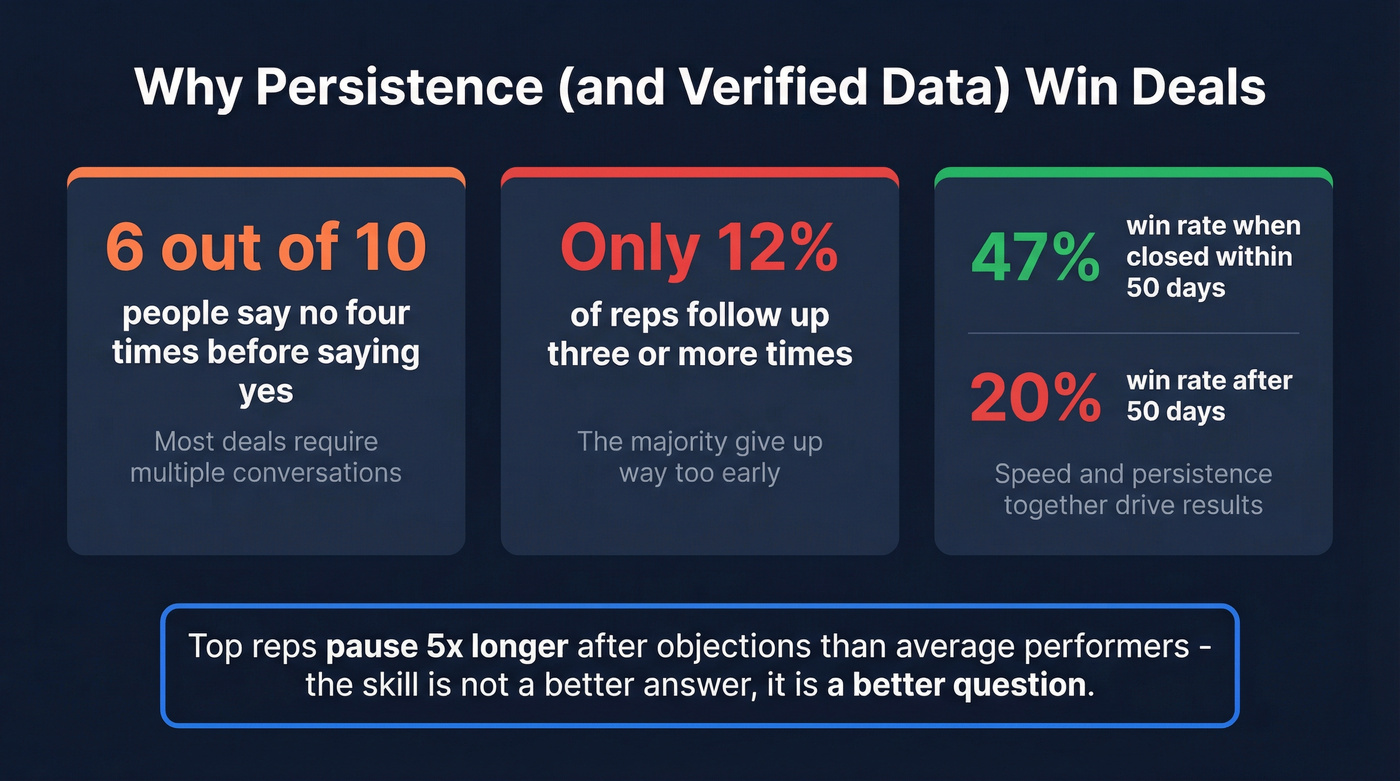
An analysis of 67,149 sales calls found something that should change how you think about objection handling entirely: the best reps don't respond faster. They pause five times longer than average performers after hearing an objection. Five times. The skill isn't having a better answer. It's having a better question.
The Short Version
One behavior: Pause 5x longer after an objection before speaking. Silence isn't awkward - it's strategic.
One framework: LAER (Listen, Acknowledge, Explore, Respond). The Explore step is where deals get saved.
One mindset shift: Objections aren't attacks. They're information you haven't collected yet. Treat every "no" as an incomplete sentence.
Why Reps Default to Rebuttals
Defensiveness isn't a character flaw - it's a threat response. When a prospect pushes back, your brain registers it the same way it registers any challenge: as something to fight or flee from. Scripts and battlecards feed that instinct by giving you a pre-loaded answer so you never have to sit in the discomfort of not knowing.
Here's the thing: prospects notice when you're reading a script. Chris Voss puts it well - "We are willing to be influenced by those we feel understood by." A memorized rebuttal signals the opposite of understanding. It signals you were waiting for your turn to talk. If you're still using Feel-Felt-Found, your prospects hear the formula before you finish the first sentence.
Six Mistakes That Kill Curiosity
These are the anti-patterns experienced reps still fall into, along with the curiosity-based fix for each.
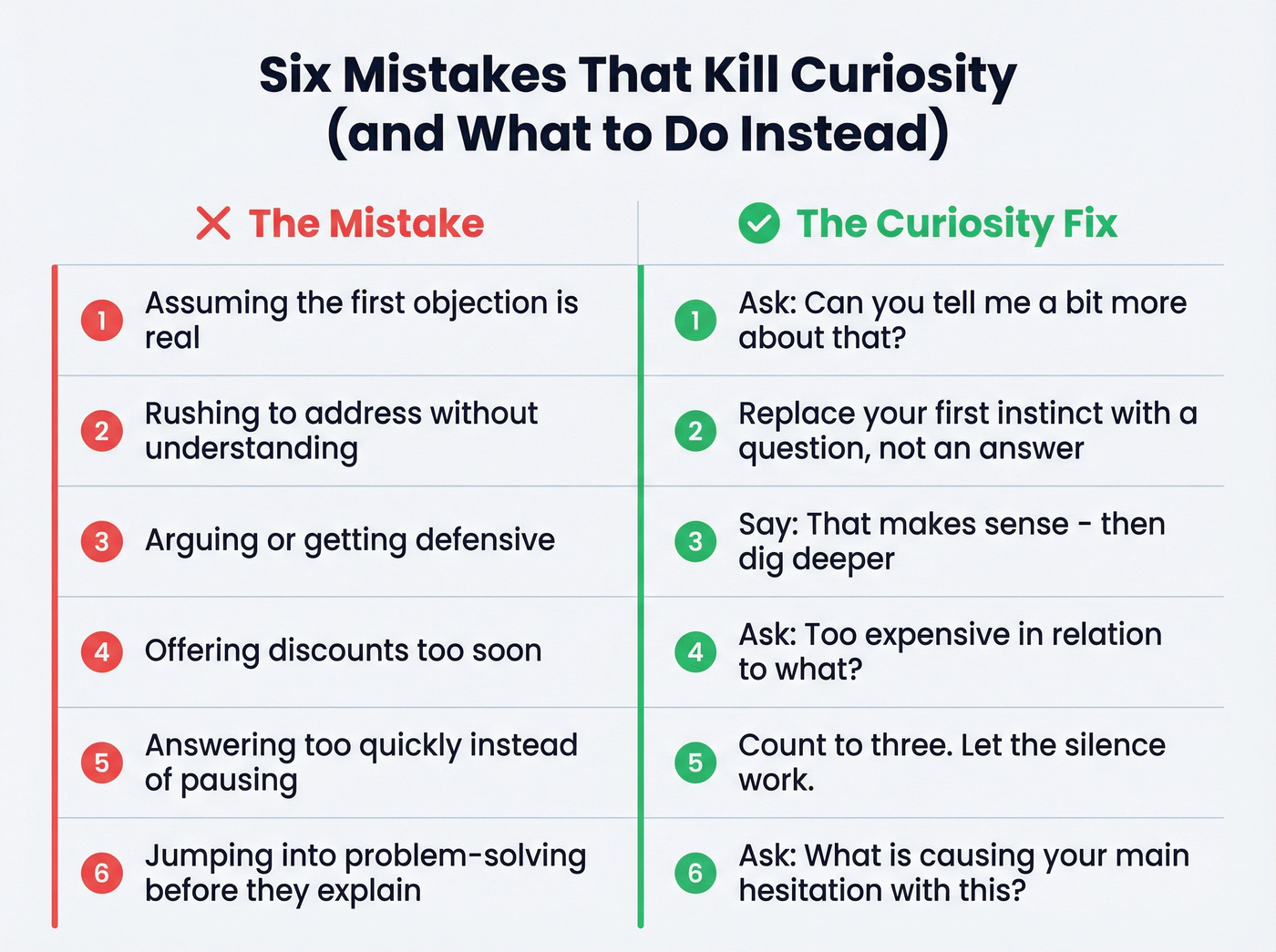
Assuming the first objection is real. It rarely is. Voss estimates at least 50% of stated objections are false - quick exits that mask the real concern. Ask "Can you tell me a bit more about that?" before you respond to anything.
Rushing to address without understanding. Jumping into defense mode shuts down discovery. Replace your first instinct with a question, not an answer.
Arguing or getting defensive. Resistance breeds resistance. Acknowledge the objection before exploring it - "That makes sense" buys you room to dig deeper.
Offering discounts too soon. This devalues your product and trains the prospect to negotiate harder. Ask "Too expensive in relation to what?" instead of reaching for a discount code.
Answering too quickly instead of pausing. Speed often reads as anxiety, not confidence. Count to three in your head. Let the silence work.
Jumping into problem-solving before the prospect explains in their own words. You can't solve a problem you've diagnosed yourself. Ask "What's causing your main hesitation with this?" and let them talk.
The LAER Framework Explained
Stop memorizing objection rebuttals. The entire concept of "rebuttal" is adversarial - you're not in a debate. LAER (Listen, Acknowledge, Explore, Respond) gives you a curiosity-first structure that actually works in live conversations.
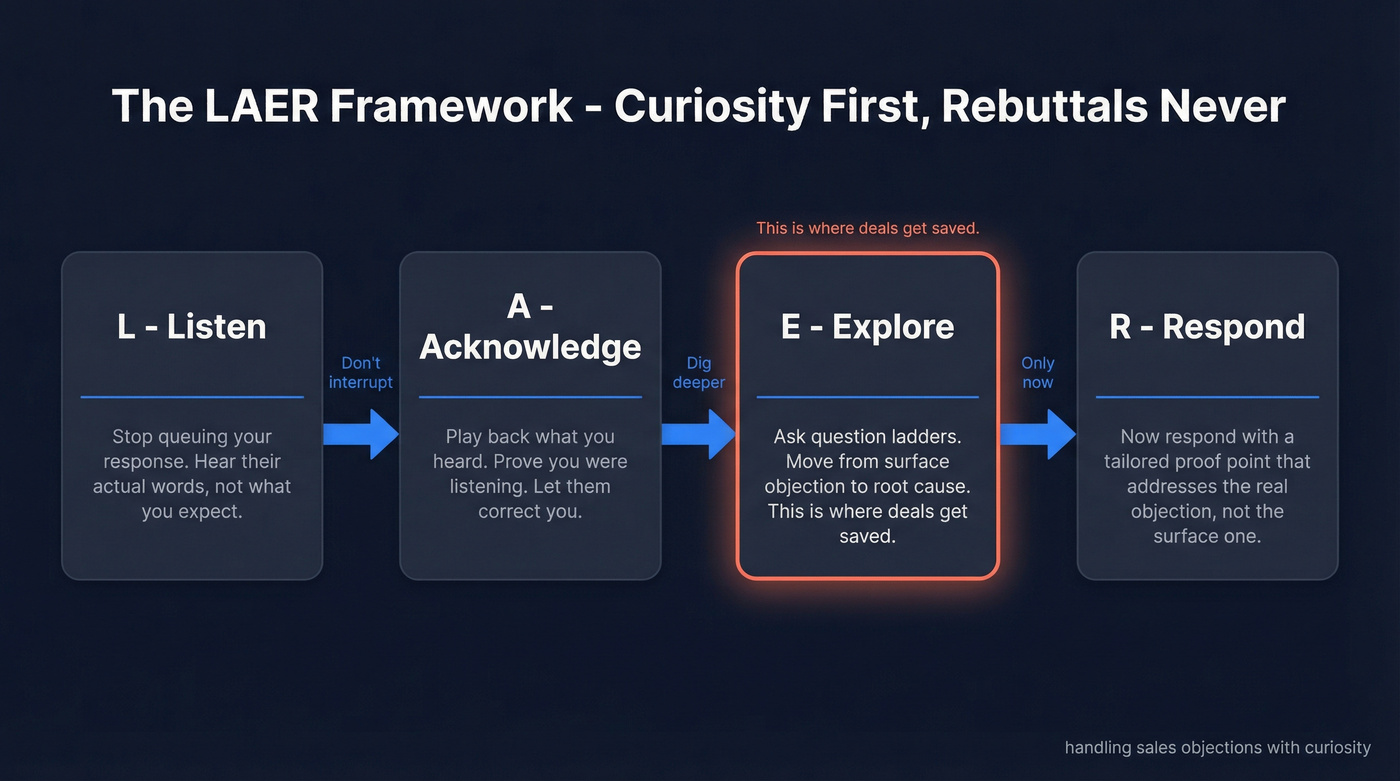
Listen
Don't interrupt. Don't nod along while mentally queuing your response. Actually listen to the words the prospect is choosing, because those words contain the real objection - which is almost never the one they lead with.
Acknowledge
Play back what you heard. "It sounds like implementation timeline is the core concern here" does two things: it proves you were listening, and it gives the prospect a chance to correct you. Both outcomes are useful.
Explore
This is where deals get saved.
The Explore step is a question ladder that moves from surface objection to root cause:
- "Which aspect of this is of most concern to you?"
- "What's the main challenge you're seeing with X?"
- "Often when I hear [surface objection], the real issue is [deeper problem 1] or [deeper problem 2] - do any of these resonate?"
See the full question bank below for objection-specific Explore prompts.
Sometimes the question itself resolves the objection. We've seen this play out repeatedly: a salesperson avoided pushing back on a CTO's "we can't implement this right now" objection, asked for detail instead, and the CTO talked himself into realizing it was a minor technical issue - saving a high six-figure deal. The surface objection was "timing." The real objection was a technical detail the CTO hadn't fully thought through. The rep didn't need a rebuttal. He needed patience.
Respond
Only now do you respond - with a tailored proof point, case study, or next step that directly addresses the root cause you uncovered. Not the surface objection. The real one.

Curiosity-driven objection handling only works when you reach the actual decision-maker. Prospeo gives you 98% accurate emails and 125M+ verified mobile numbers so your carefully crafted questions land with the person who can say yes - not a gatekeeper.
Stop perfecting your questions for the wrong contact.
Curiosity Questions for Every Objection Type
Here's a question bank organized by BANT category. Print this out. Tape it next to your monitor. Use it until the questions become instinct.
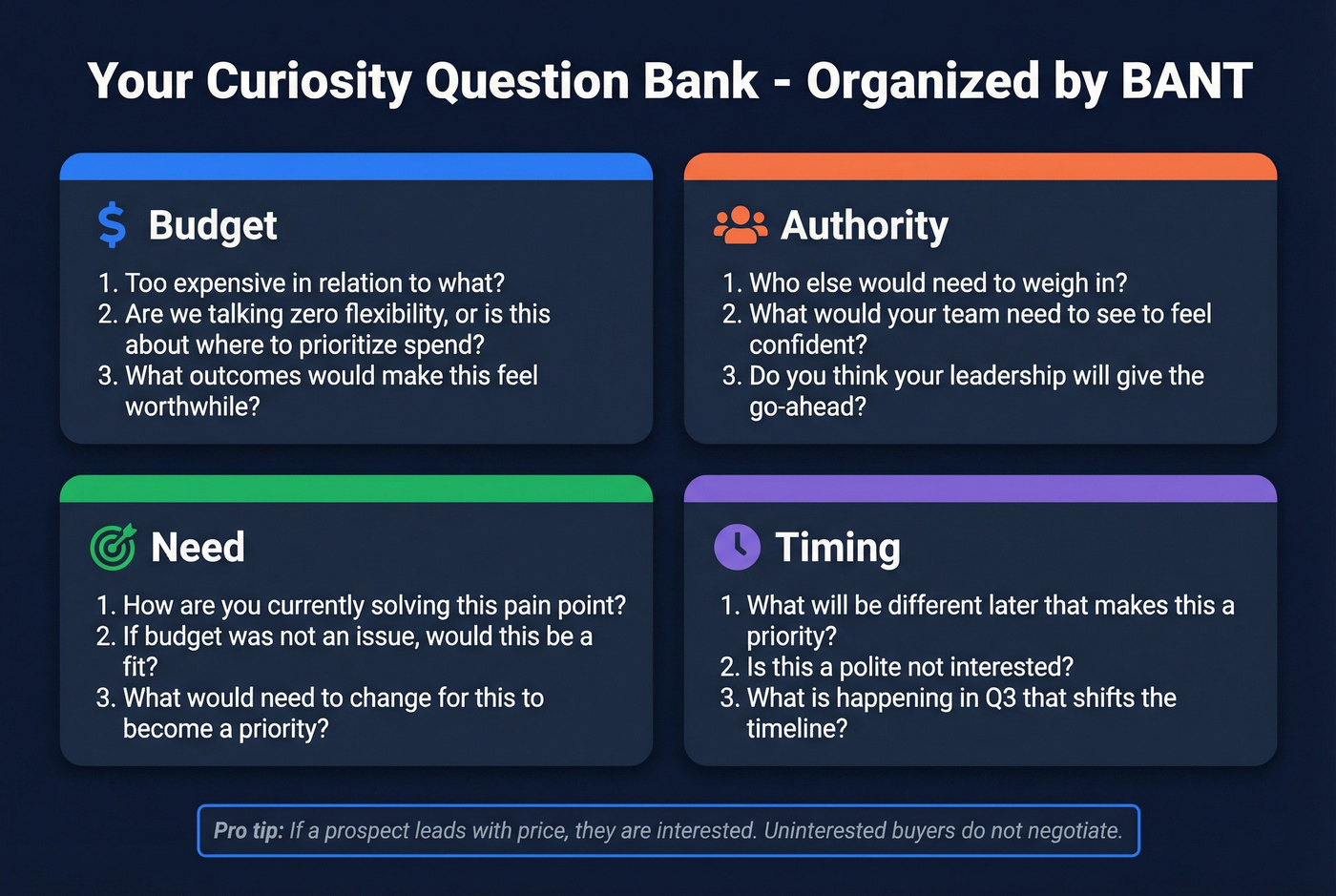
Budget
- "Too expensive in relation to what?"
- "Are we talking zero flexibility, or is this about where to prioritize spend?"
- "What outcomes would make this feel worthwhile?"
- "When you say 'right now,' do you expect budget later?"
Let's be honest about price objections: if a prospect leads with price, they're interested. Uninterested buyers don't negotiate. Top reps actually delay the pricing discussion - they redirect to value and outcomes first, then circle back to numbers once the prospect has articulated the problem they need solved.
Authority
- "Who else would need to weigh in?"
- "What would your team need to see to feel confident?"
- "Do you think your leadership will give the go-ahead?"
Need
- "How are you currently solving [pain point]?"
- "If budget wasn't an issue, would this be a fit?"
- "What would need to change for this to become a priority?"
Timing
- "What will be different later that makes this a priority?"
- "Is this a polite 'not interested'?"
- "What's happening in Q3 that shifts the timeline?"
Competition
- "How are you finding [competitor]... why did you choose them?"
- "How many other quotes will you be getting?"
- "What would the ideal solution do that they don't?"
Steal These Tactics from Chris Voss
Voss's negotiation techniques translate directly to objection conversations. Here are the ones worth practicing this week.
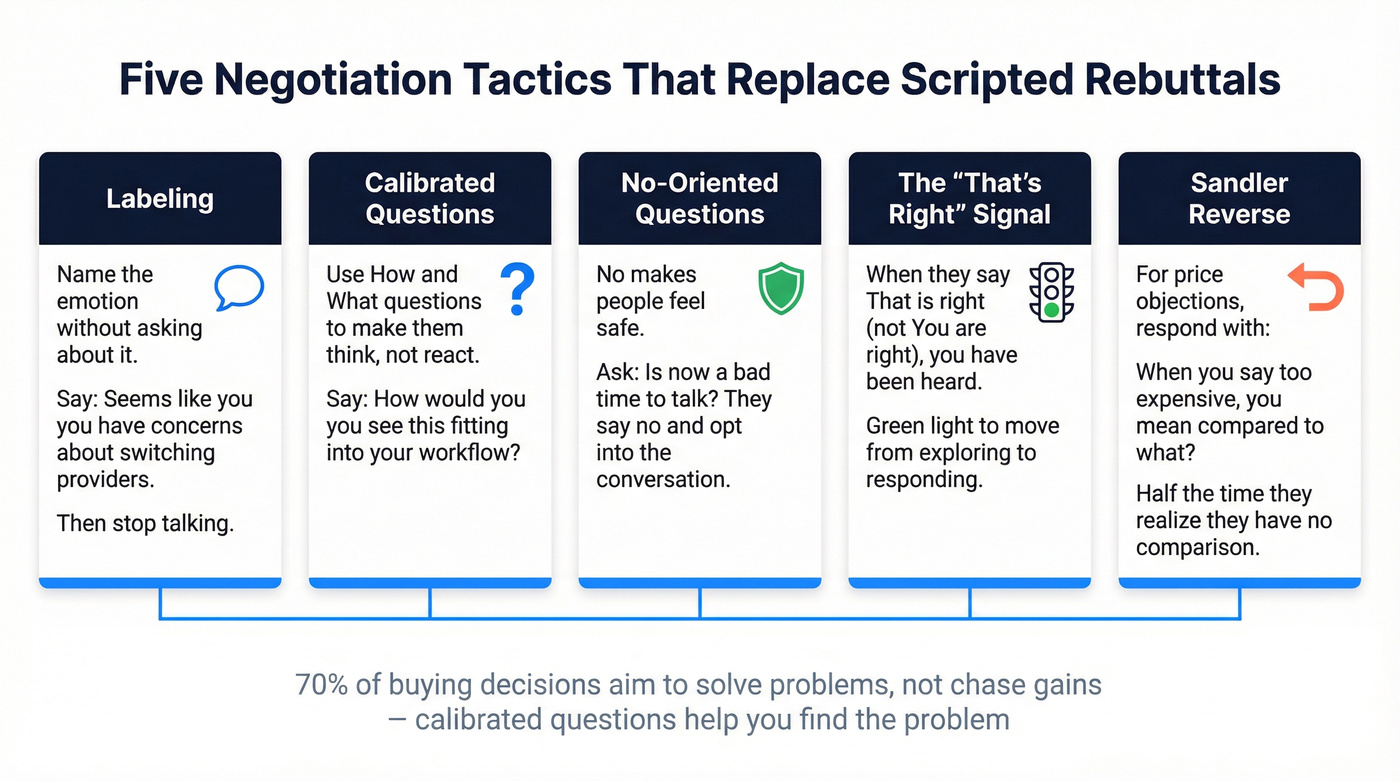
Labeling - Name the emotion without asking about it. "Seems like you've got some concerns about switching providers." Then stop talking. Silence after a label is where the real information surfaces. The prospect will either confirm, correct, or elaborate - all three outcomes give you more to work with than a scripted rebuttal ever would.
Calibrated questions - "How" and "What" questions force the prospect to think, not just react. "How would you see this fitting into your current workflow?" is dramatically better than "Does this fit your workflow?" 70% of buying decisions aim to solve problems, not chase gains - calibrated questions help you find the problem.
"No"-oriented questions - "Is now a bad time to talk?" feels counterintuitive, but "no" makes people feel safe and in control. A prospect who says "no, it's fine" has just opted into the conversation.
The "That's right" signal - When a prospect says "that's right" (not "you're right"), you've been heard. That's your green light to transition from exploring to responding.
Sandler's Reverse deserves a mention here too, specifically for price objections. Respond to "it's too expensive" with "And when you say too expensive, you mean compared to what?" It forces the prospect to articulate the comparison - and half the time, they realize they don't have one.
Micro-Behaviors That Make Curiosity Work
Let's come back to that 5x pause stat. In practice, this means a few seconds of deliberate silence after hearing an objection. It feels like an eternity on a live call. In our experience, the pause feels excruciating the first few times - but it becomes natural within a week of practice. It works because it signals confidence and gives the prospect space to keep talking, which they almost always do.
Tone matching matters too. If the prospect is measured and analytical, don't respond with high-energy enthusiasm. Mirror their cadence. But heed the warning from NetHunt's framework analysis: three consecutive questions without a statement or acknowledgment in between starts to feel like a deposition, not a discovery call. Alternate between questions and reflections.
From Reactive Rebuttals to Proactive Management
Once you've explored and responded, don't just move on. Ask the resolution check: "Is there anything else holding you back?" This question from Highspot's objection-handling framework confirms the objection is actually resolved and surfaces remaining concerns before they become deal-killers later. Then move to a concrete next step - not "let's circle back next week," but a specific action: "I'll send the implementation timeline by Thursday. Can we book 20 minutes Friday to walk through it with your CTO?"
The best reps don't stop there. They build proactive objection management into their entire sales process, anticipating the most common pushbacks for each persona and addressing them before the prospect raises them. When you surface a concern before the buyer does, you shift from defense to leadership, and the entire dynamic of the conversation changes.
Six out of ten people say no four times before confirming the purchase, but only 12% of reps follow up three or more times. Opportunities closed within 50 days carry a 47% win rate - after that, it drops to 20% or lower. Persistence matters, but only if your follow-up actually reaches someone. This is where most sequences die - not from lack of persistence, but from bounced emails and disconnected numbers. Tools like Prospeo verify every contact before it enters a sequence, so your curiosity-driven follow-ups actually land.
If you're building a repeatable follow-up system, start with a clean sales cadence and a simple prospect follow up plan that reps can actually execute.
You just learned to pause, explore, and uncover root-cause objections. Now make sure bad data doesn't kill the conversation before it starts. Prospeo's 7-day refresh cycle means you're never calling a number that's been dead for months or emailing someone who left the company six weeks ago.
Fresh data means more conversations worth saving.
FAQ
What's the best framework for curiosity-based objection handling?
LAER (Listen, Acknowledge, Explore, Respond) is the most structured curiosity-first method. The Explore step - where you ask a ladder of questions to uncover root cause - is where most deals get saved. Sandler's Reverse works best for budget pushback specifically, responding to "too expensive" with "compared to what?"
How long should you pause after hearing an objection?
Top reps pause roughly 5x longer than average performers - about 3-5 seconds of deliberate silence, based on an analysis of 67,149 sales calls. It feels uncomfortable at first but becomes natural within a week. The silence signals confidence and invites the prospect to elaborate.
How do you follow up after resolving an objection?
Ask "Is there anything else holding you back?" to confirm resolution, then book a concrete next step with a specific date and action - not a vague "let's reconnect." Make sure your follow-up sequence actually lands by verifying emails and direct dials before outreach begins.