Sales Messaging During a Recession: Scripts, Templates, and Tactics That Close Deals
Your champion just forwarded your proposal to the CFO, and the CFO replied with three words: "Not right now." That three-word email has killed more pipeline this year than any competitor ever could.
Every recession article tells you to "adjust your messaging." None of them show you what to actually say. Your sales messaging during a recession doesn't need adjustment - it needs a complete rebuild around how buyers actually make decisions when budgets are frozen and every dollar gets interrogated. This guide gives you the scripts, the templates, and the tactical shifts we've seen work across dozens of sales teams navigating this exact environment.
Three Changes to Make This Week
- Replace feature-led messaging with cost-of-inaction framing. Stop selling what your product does. Start selling what it costs to do nothing. Scripts below.
- Multi-thread every deal by the second call. Deals over $50K see a 130% win-rate boost when you engage multiple stakeholders.
- Verify your contact data. When every outbound touch costs more in rep time and domain reputation, bounces are budget killers. A 35% bounce rate isn't a data problem - it's a revenue problem. (If you need a quick stack audit, start with an email checker tool.)
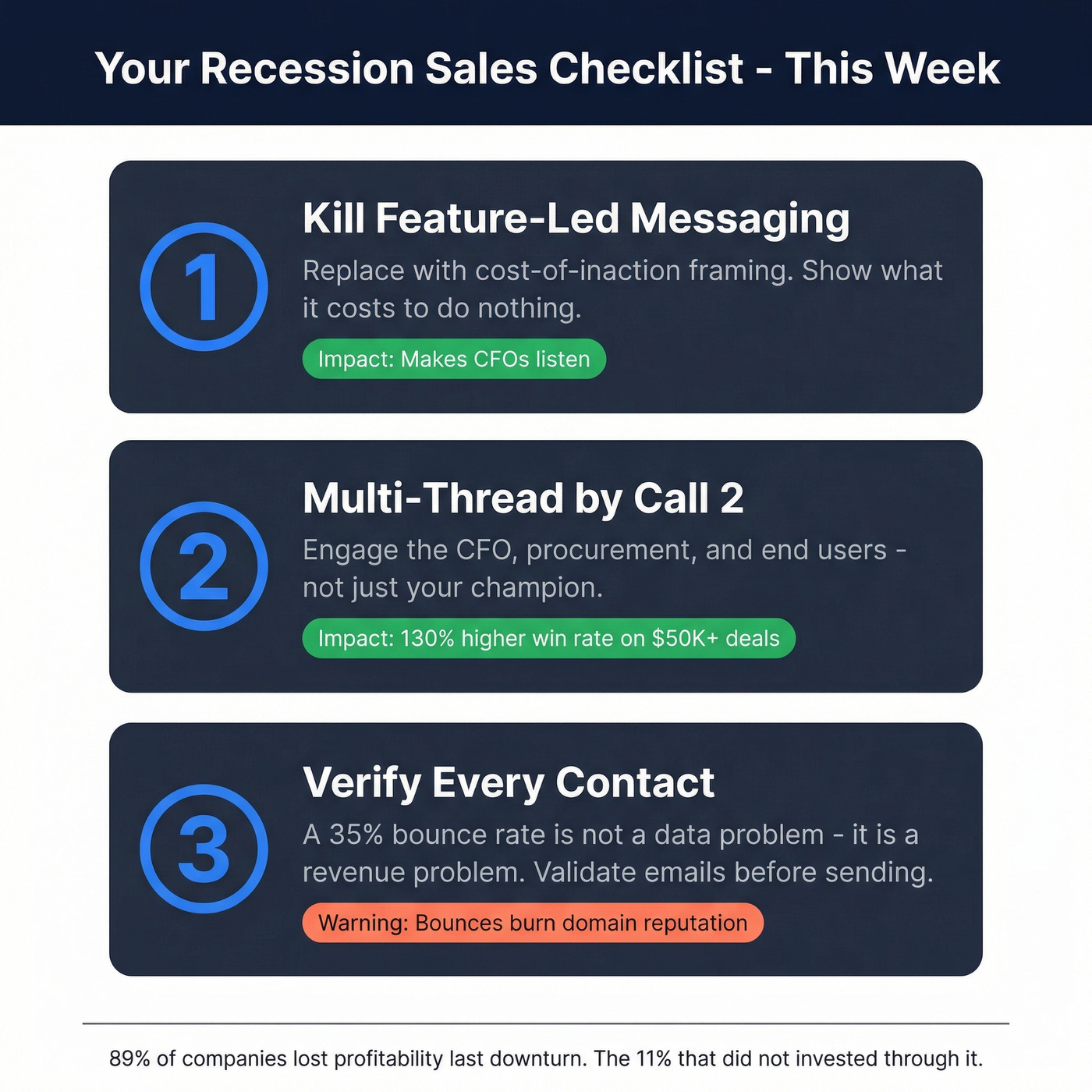
89% of companies lost profitability during the last major downturn. The 11% that didn't saw 17% higher revenue than during non-recession periods. The IPA Bellwether survey posted its first negative reading in four years in Q1 2025 - a net balance of -4.8% of companies cutting budgets. If your pipeline has felt tighter in 2026, the data explains why. Your old pitch stopped working because the buyer's world changed.
What Changes for Buyers in a Downturn
A recession doesn't eliminate buying. It restructures it.
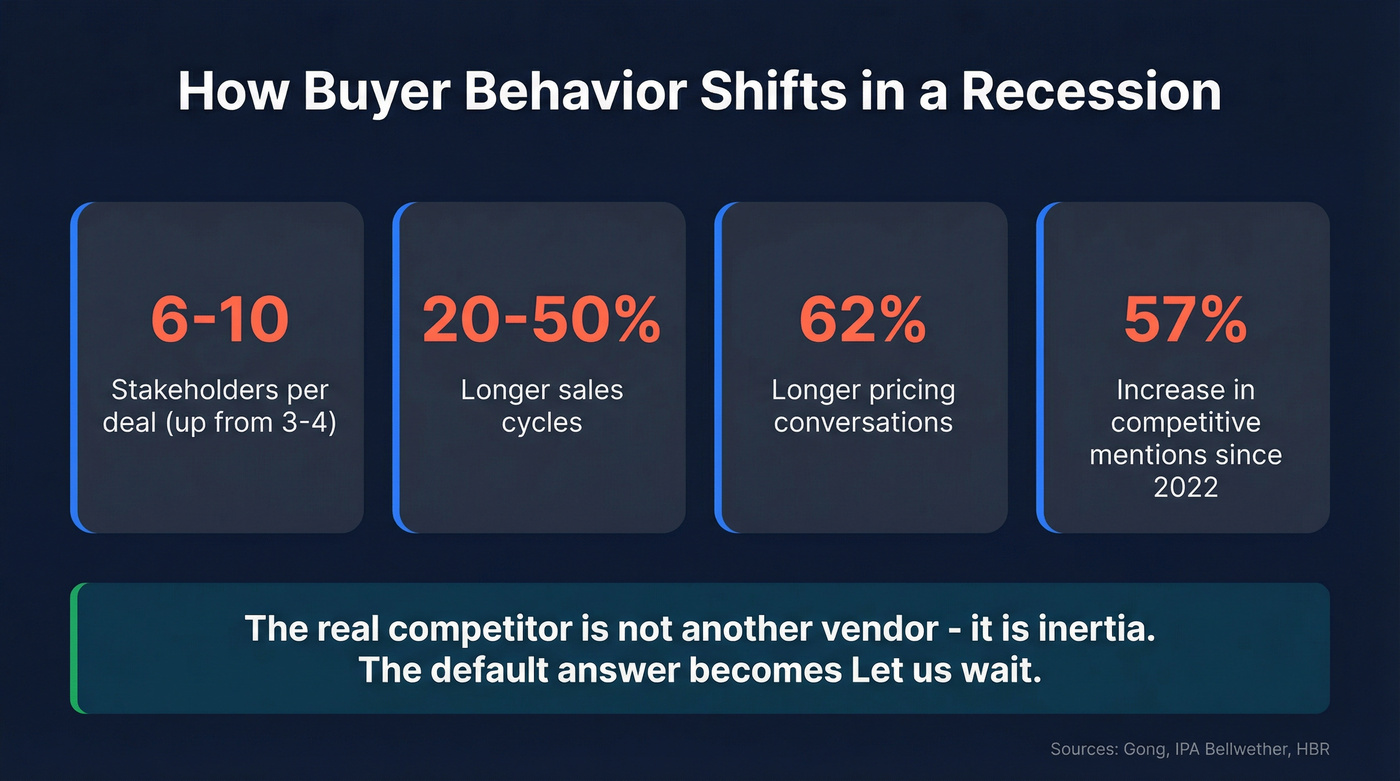
More stakeholders in every deal. The person who could sign a $30K contract solo last year now needs CFO approval, legal review, and a procurement committee. Many B2B deals involve 6-10 stakeholders on the buying committee, and enterprise deals average 17 contacts. Your single-threaded champion can't carry this alone. (If you want a deeper playbook, see what is multithreading in sales.)
Longer cycles with higher scrutiny. Sales cycles often extend 20-50% in downturns. Pricing conversations run 62% longer than they did in 2020, and pricing mentions are up 18% since 2022. Every dollar gets questioned, deal velocity drops, and procurement gets involved earlier than anyone expects. (This is where sales cycle acceleration work pays off.)
"Do nothing" becomes your real competitor. Competitive mentions are up 57% since 2022, which sounds threatening - but here's the counterintuitive part: early competitive mentions actually increase your odds of winning enterprise deals by 32%. Don't avoid the conversation. Your biggest threat isn't a named competitor. It's inertia. The default answer in a recession is "let's wait," and your messaging has to make waiting more expensive than buying.
HBR's analysis of companies across recessions since the 1970s confirms the same pattern - firms that invest through downturns emerge with disproportionate market share. The companies that cut everything don't just lose ground during the recession. They never fully recover.
Here's the flip side most teams miss. 47.8% of buyers will evaluate new vendors if their current providers aren't meeting expectations. And 53% of marketers are actually increasing tech spending - IT infrastructure and software are projected to see 5-6% growth even in a down market, with cloud, security, and data analytics leading the way. Recessions don't freeze all budgets. They reallocate them. Your job is to be on the receiving end of that reallocation.
Four Shifts to Make in Your Pitch
Let's break these down with before/after examples so you can audit your own messaging today.
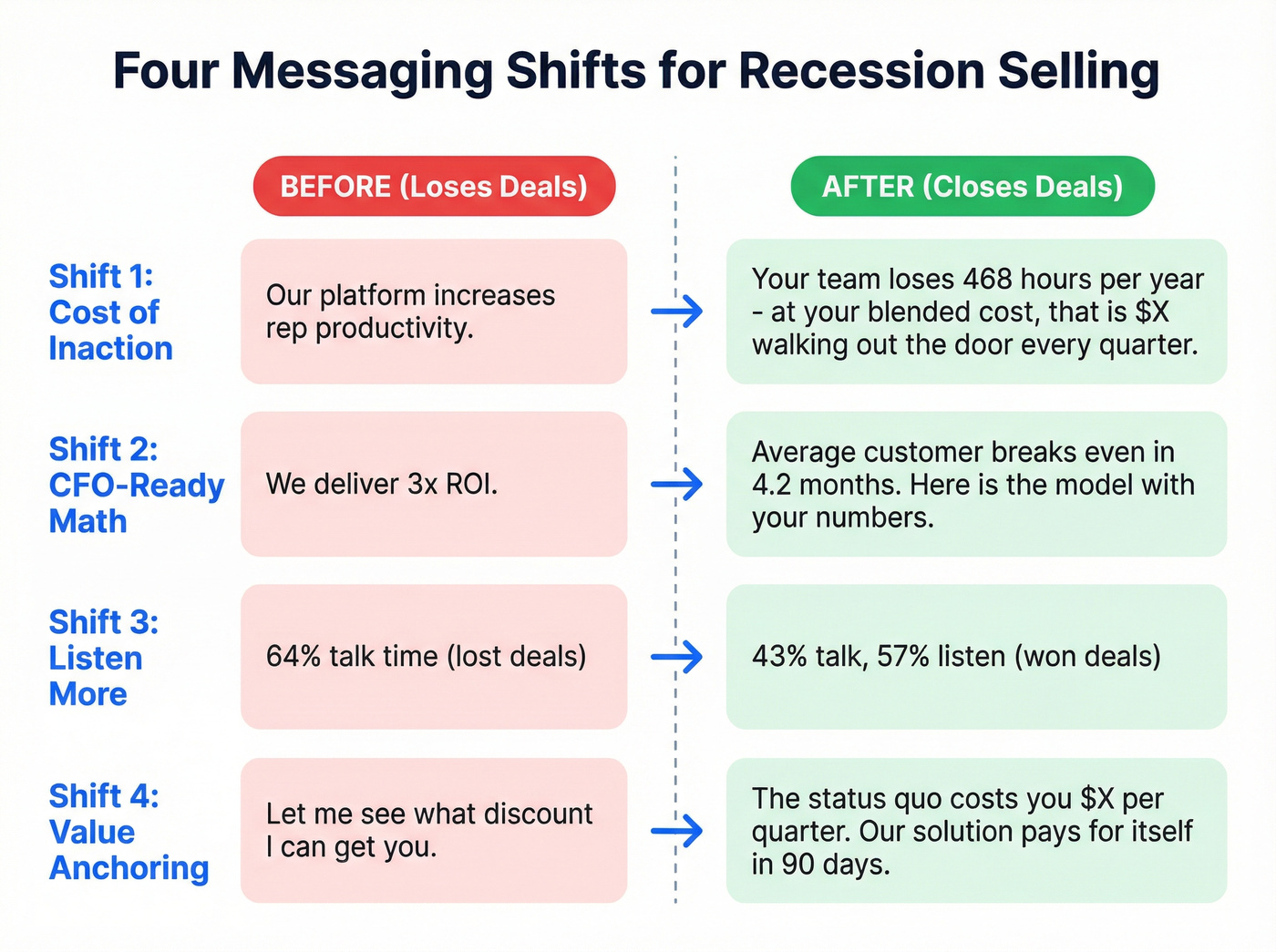
Shift 1: Feature-led to cost-of-inaction framing.
Before: "Our platform increases rep productivity."
After: "Teams using our product reclaim 9 hours per rep per week - that's 468 hours annually your team is currently losing. At your blended rep cost, that's $X walking out the door every quarter."
Shift 2: Generic ROI to CFO-ready math.
Before: "We deliver 3x ROI."
After: "Our average customer breaks even in 4.2 months. Here's the model with your numbers." CFOs don't trust multipliers. They trust payback periods and assumptions they can stress-test. (If you need a template, use a sales ROI calculator.)
Shift 3: Talking more to listening more.
The benchmark is clear: 43% talk, 57% listen. Low performers swing wildly - their talk time jumps 10 percentage points between won and lost deals, from 54% to 64%. High performers stay consistent. In a recession, consistency signals competence, and competence builds trust. Morgan J. Ingram calls this the 70/30 rule: let the prospect talk 70% of the time. The more they talk, the more they convince themselves. (To sharpen discovery, pull from these best open-ended sales questions.)
Shift 4: Discounting to value anchoring.
Discounting is the worst recession move you can make. It trains buyers to wait for downturns, it permanently erodes your margins, and it signals that your price was inflated to begin with. Use cost-of-inaction framing instead. Make the status quo more expensive than your product.
One caveat worth mentioning: if your average deal size is under $15K, you probably don't need to overhaul your recession messaging at all. Those deals close fast enough that inertia doesn't have time to kill them. This article is for teams selling $30K+ deals where the CFO has veto power and "let's wait" is a real threat.
Why Multi-Threading Is Non-Negotiable
If you're not multi-threading by the second call, you're going to lose to "no decision."
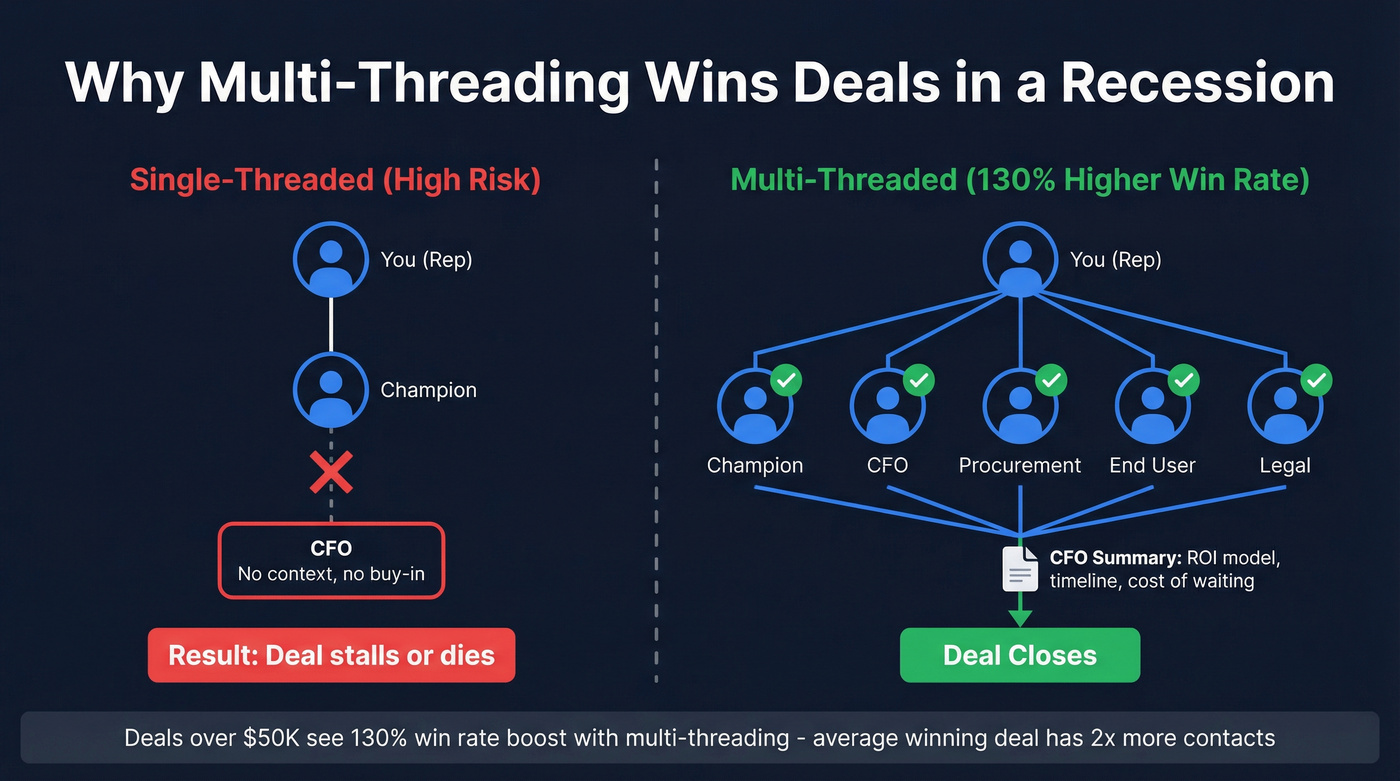
Across 1.8M opportunities analyzed, 77% of deals involve multiple contacts. Deals that close successfully have 2x as many buyer contacts as deals that don't. For deals over $50K, multi-threading boosts win rates by 130%. Strategic enterprise deals average 17 contacts - these aren't aspirational numbers, they're the baseline for winning in a tighter market. (If your team needs a system, start with buying group personas.)
The practical move: create a two-page CFO summary your champion can forward. It should contain four things - the quantified cost of the problem, your solution's ROI with their numbers, a 90-day implementation timeline, and the risk of waiting another quarter. This is the enablement asset that unsticks frozen deals.
Your champion wants to sell internally. Give them the ammunition. Don't make them build the business case from scratch using your marketing deck - they won't do it, and even if they try, they'll get the framing wrong.

Multi-threading requires verified contact data for every stakeholder on the buying committee. Prospeo gives you 98% accurate emails and 125M+ verified mobile numbers - so you reach the CFO, not their spam folder. At $0.01 per email, bad data stops bleeding your recession budget.
Stop losing deals to bounced emails when every touch counts.
Recession Objection Scripts That Actually Work
You've read 10 articles that say "lead with empathy." Here's what that actually sounds like in practice.
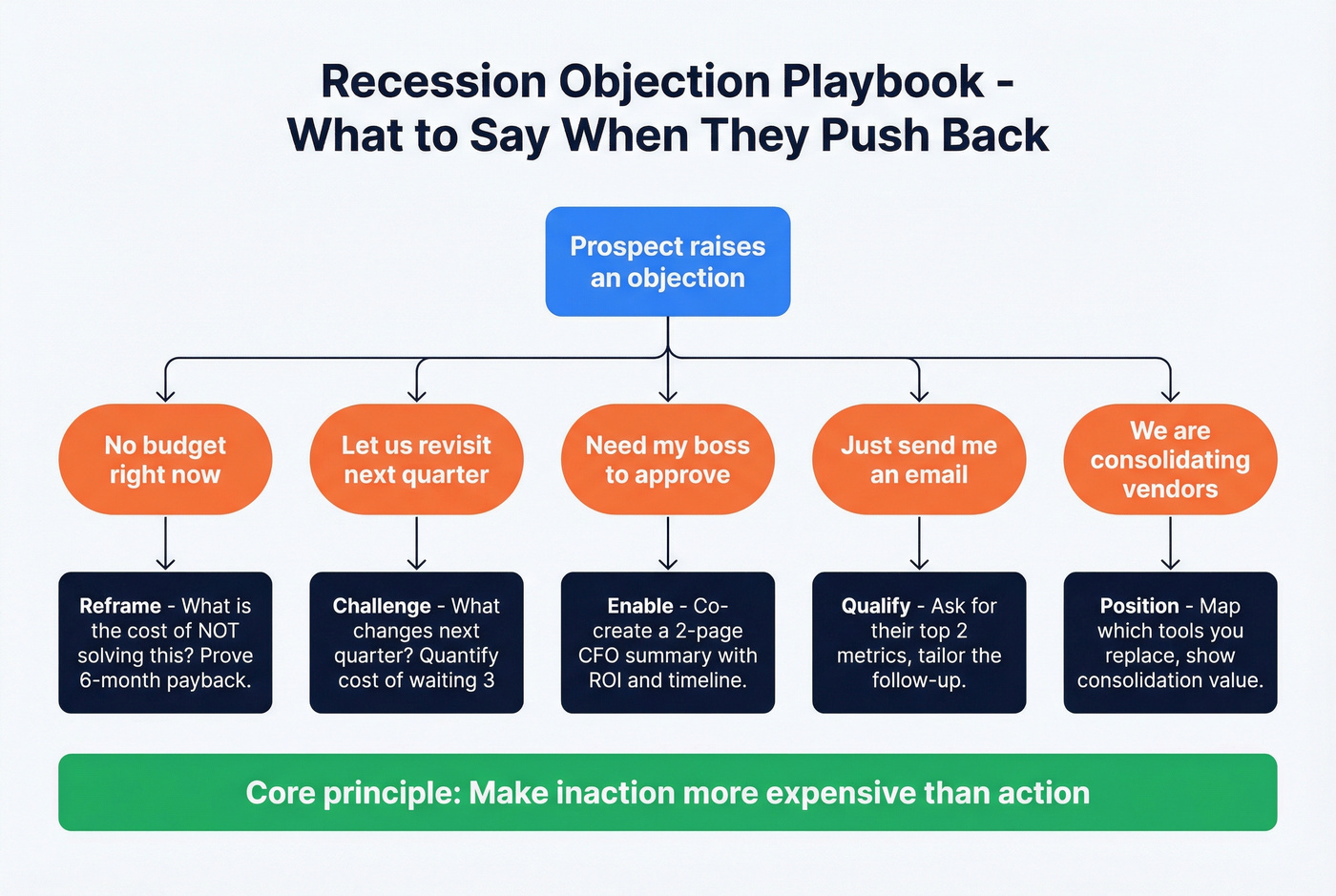
"We Don't Have Budget Right Now"
Prospect: "We don't have budget for this right now."
LAER Response (Listen, Acknowledge, Explore, Respond):
"I hear you - budget scrutiny is real right now, and I wouldn't expect you to commit without a clear payback. Can I ask: what's the current cost of the problem we've been discussing? Because if we could prove this solution pays for itself within six months, would budget still be the primary barrier?"
You're not arguing with the objection. You're reframing the conversation from "can we afford this?" to "can we afford not to?"
Alternative (Validate-Isolate-Reframe):
"That makes sense. If price wasn't the issue, is this the solution you'd choose? ... Great. Then let's build the ROI case together so you can take it to finance with confidence."
"Let's Revisit Next Quarter"
This is the most dangerous objection because it feels reasonable. It's not. It's a polite no disguised as a maybe.
Prospect: "The timing isn't right. Let's circle back in Q3."
"I respect that. Quick question: what's going to change between now and next quarter that makes this a better time? Because right now, your team is losing roughly $X per month on this problem. That's $3X by the time we'd be having this conversation again. What if we scoped a smaller pilot that starts delivering value in 30 days?"
"What changes next quarter?" forces the prospect to confront that nothing changes - the delay is emotional, not strategic. Quantifying the cost of waiting makes inaction feel expensive.
"I Need to Run This by My Boss"
Prospect: "This looks good, but I need to get my boss on board."
"Totally understand. Let's make that easy - I'll put together a two-page CFO summary with the ROI model, implementation timeline, and risk of waiting. Can we spend 15 minutes building it together so it addresses exactly what your boss will ask?"
You're not handing off control. You're co-creating the internal pitch, which means you control the narrative and your champion doesn't have to do the heavy lifting alone.
"Just Send Me an Email"
Prospect: "Can you just send me some info?"
"Happy to. So I send you something actually useful - what are the two metrics that matter most to your team right now? I'll tailor it to those and skip the generic deck."
If they answer, you've got real intel for a personalized follow-up. If they can't answer, they realize they need the conversation more than the email. Either way, you win.
"We're Consolidating Vendors"
Vendor consolidation is one of the strongest buying signals in a recession - if you position yourself correctly. The prospect just told you they're actively reviewing their stack. That's not an objection. It's an invitation.
Prospect: "We're actually looking to reduce the number of vendors we work with."
"That's exactly why companies are switching to us. We replace [tool A] and [tool B] with a single platform - fewer invoices, fewer integrations to maintain, one throat to choke. Would it help if I mapped out which of your current tools we'd consolidate?"
The Cold-Call Permission Opener
Morgan J. Ingram's 30-second permission-based opener flips the dynamic:
"Hey [Name], this isn't a sales call - it's actually to see if you'd be interested in getting on a sales call. Can I have 30 seconds to tell you why I called, and you can decide if we should keep talking?"
This works because it disarms the reflex "I'm busy" response. You're giving them control, which paradoxically makes them more likely to give you time.
Cold Email Templates for Tight Budgets
Cold email reply rates run 1-5% in typical conditions. Strong campaigns hit 10-20%. Open rates have dropped from 36% to 27.7% over the past two years. In a recession, every percentage point matters - and so does every deliverable address. Before you send any of these, verify your list. Sending to bad data doesn't just waste time; it burns your domain reputation in ways that take months to repair. (Use an email ID validator or follow this email verification for outreach workflow.)
Don't sleep on the phone, either. Top-quartile cold callers book 3x more meetings than average reps. Leaving voicemails boosts email reply rates from 2.73% to 5.87%. (More data here: benefits of cold calling.)
The Cost-Cutter
Subject: your [department] spend
We helped [similar company] cut $340K in [category] costs - a 41% reduction in 90 days. Most [prospect's industry] companies are overspending by 30-50% on [problem area] without realizing it.
Worth a 12-minute call to see if the same applies to your team?
The Time-Liberator
Subject: 9 hours back per rep
[Similar company]'s reps were spending 4-6 hours/week on [manual task]. We freed up 9 hours/week per rep - that's 468 hours/year your team could put toward pipeline generation instead.
Happy to show you the before/after. Reply "YES" and I'll send a 3-minute walkthrough.
The Low-Friction Opener
Subject: quick list for [company name]
I put together a short list of companies in your space that switched from [competitor] this quarter. Thought it might be useful context for your planning.
Want me to send it over? Reply "LIST."
Use "camouflaged" subject lines - short, internal-looking, no exclamation marks. These outperform salesy subject lines consistently. Personalize the first line. And remember, fewer sends to better-verified contacts will always outperform high-volume spray-and-pray outbound. (If you want more copy/paste options, grab an outreach email template.)
Your Data Is a Recession Liability
Most recession playbooks stop at messaging. They ignore the infrastructure underneath.
I've watched reps send perfect cold emails to contacts who left the company six months ago. We've seen this pattern over and over: teams invest in better scripts and sharper templates, then send them to a database that hasn't been refreshed in weeks. When resources are tight, every outbound touch carries more weight, and a bounced email isn't just a missed opportunity - it's burned domain reputation, wasted rep time, and a step closer to landing in spam. (This is classic B2B contact data decay.)
The proof point is stark. Snyk had 50 AEs prospecting 4-6 hours per week with a bounce rate between 35-40%. After switching to Prospeo, their bounce rate dropped under 5%, and AE-sourced pipeline jumped 180% - generating 200+ new opportunities per month. The messaging didn't change. The data did.

At roughly $0.01 per email with a 98% accuracy rate and a 7-day refresh cycle, verified data is the lowest-risk investment on your stack. Start with the free tier - 75 verified emails per month, no credit card - run it against your existing database, and see how many "verified" contacts from your current provider actually bounce. Most teams are surprised by the results. (If you’re cleaning lists end-to-end, use a CRM verify process.)
Stop sending more emails. Send better ones to real addresses.
Your recession outbound can't afford a 35% bounce rate torching your domain reputation. Prospeo's 5-step verification and 7-day data refresh cycle mean the contacts you reach are real, current, and reachable - from champions to CFOs. Teams using Prospeo cut bounce rates to under 4%.
Reach every stakeholder in the deal before inertia kills it.
The Enablement Toolkit Your Reps Need
Your reps can't sell alone when CFOs are gatekeeping every purchase. A generic content library won't cut it - your reps need assets built specifically for multi-threaded, recession-era deals where every stakeholder has veto power. 52.4% of marketers cite sales/marketing alignment as a top obstacle, and stale enablement is usually the root cause.
Here's what to build:
CFO summary one-pager. Two pages max. Problem cost, solution ROI, payback period, implementation timeline, risk of inaction. This is the document that gets forwarded. If you build only one asset from this list, make it this one.
ROI calculator. A simple spreadsheet or interactive tool where the prospect plugs in their numbers. Self-generated ROI is 10x more convincing than your slide deck's claims. Let the buyer sell themselves.
Competitive battle card. With competitive mentions up 57%, your reps will face "why not [competitor]?" on every deal. Give them three differentiators and the proof points to back each one. Update monthly - competitors change their positioning fast in downturns.
"Cost of inaction" one-slider. A single slide that quantifies what the prospect loses per month by doing nothing. This goes into every deck, every follow-up email. It's the visual version of the cost-of-inaction framing from your scripts.
Customer proof deck. Three case studies, each with a before/after metric. Match them to the prospect's industry or company size. Generic logos don't cut it when budgets are frozen.
Keep It Sharp With a Quarterly Audit
Run a Start/Stop/Continue exercise with your sales and marketing teams every quarter. What messaging should you start using? What should you stop saying immediately? What's working and should continue? This simple framework keeps your recession-era outreach sharp as buyer sentiment shifts month to month. Teams that adapted their approach during COVID-19 using this cadence were the ones who recovered fastest - the same discipline applies now.
Bonus move: recruit 6-12 customers into a client council. Meet every six months to pressure-test your messaging against their evolving objections. Nothing replaces hearing a buyer tell you, in their own words, why your last pitch didn't land.
FAQ
How much longer do sales cycles get during a recession?
Sales cycles typically extend 20-50% as more stakeholders enter the process and CFO approval becomes mandatory for purchases that previously closed at the director level. Build this extra time into your forecasting and pipeline coverage ratios.
Should I discount to close deals faster?
No. Discounting trains buyers to wait for downturns and permanently erodes your margins. Use cost-of-inaction framing instead - make the status quo more expensive than your solution. Protect your price and sell the payback period.
Does cold outbound still work in a recession?
Yes, but only with verified data and sharper targeting. Top-quartile cold callers book 3x more meetings than average reps. Pair tight segmentation with the scripts above, and verify every email before sending. Prospeo's free tier lets you test your existing list quality at zero cost - 75 verified emails per month, no credit card required.
How many stakeholders should I engage per deal?
As many as possible, as early as possible. Closed-won deals have 2x the buyer contacts of lost deals. For deals over $50K, multi-threading boosts win rates by 130%. Start mapping stakeholders by the second call - champion, economic buyer, end users, and procurement.
How do I make sure my emails actually reach prospects?
Use a data provider with real-time verification and frequent refresh cycles. A 98% email accuracy rate and 7-day data refresh mean fewer bounces and more conversations. Most teams are surprised by how many "verified" contacts from other providers actually bounce when tested against a fresh source.