

How to Accelerate Your Sales Cycle (Diagnose It, Then Fix It)
Your VP just asked why Q2 deals are taking 30% longer to close. You don't have a good answer - because you've never actually calculated your sales velocity.
Here's the thing: sales cycle acceleration starts with diagnosis, not tactics. Ebsta's data shows B2B sales cycles increased 32% year-over-year, buying committees now average 10 people, and 40-60% of deals die not because a competitor won, but because the buyer simply couldn't decide. As Mark Roberge's sales acceleration work established, technology alone doesn't fix this. You need to identify the broken variable first.
Three Highest-ROI Levers
- Disqualify ruthlessly. Too many deals clog your pipeline that shouldn't be there. Kill them early.
- Fix your contact data. Bad emails and wrong numbers add days to weeks of wasted motion per deal - classic B2B contact data decay.
- Multi-thread your serious deals. Single-threaded deals stall in procurement more often than you'd think - here’s what multithreading in sales actually looks like.
The Sales Velocity Formula
Sales velocity measures how much revenue your pipeline generates per day:
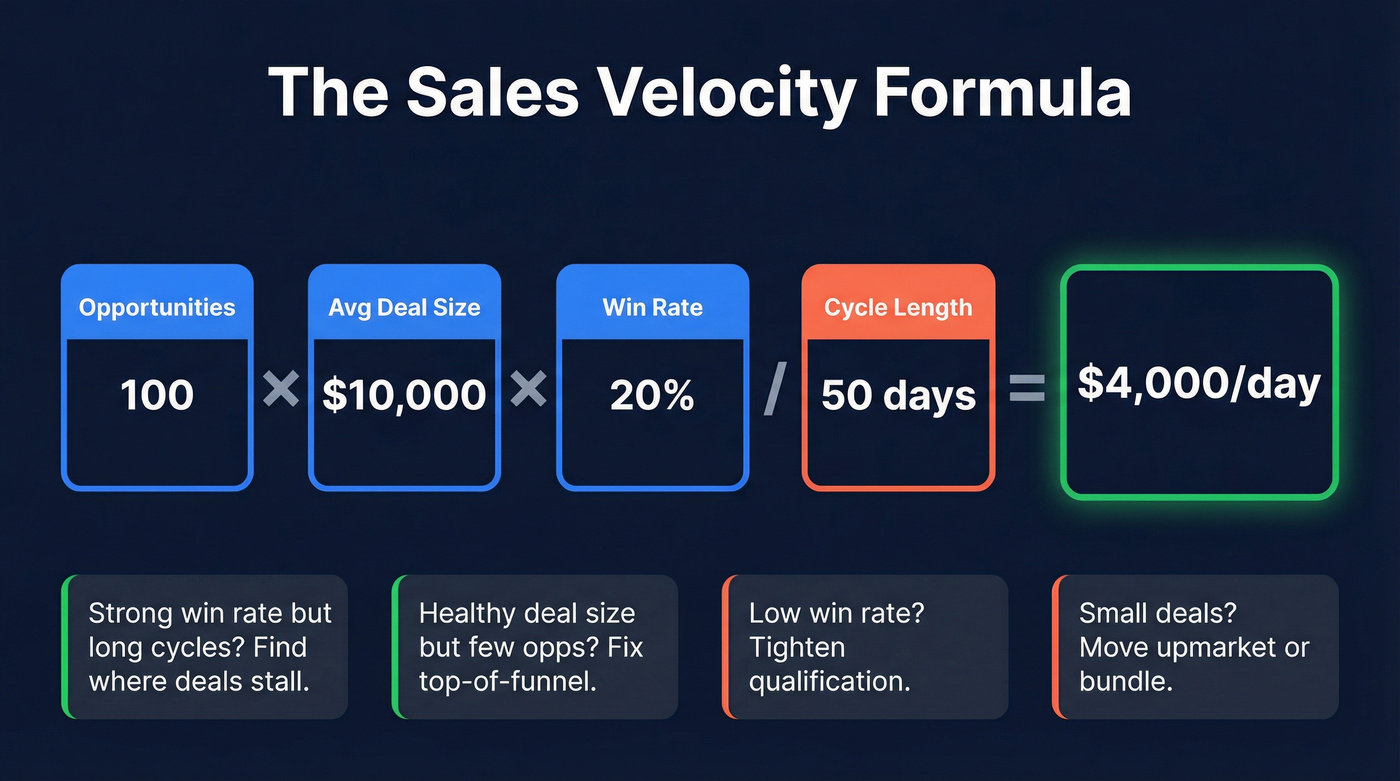
Sales Velocity = (Opportunities x Average Deal Size x Win Rate) / Cycle Length
Example: 100 opportunities, $10K average deal, 20% win rate, 50-day cycle. That's (100 x $10,000 x 0.20) / 50 = $4,000/day.
The diagnostic power is in isolating which variable drags you down. Strong win rate but lengthening cycles? You don't need more pipeline - you need to find where deals stall. Healthy deal size but low opportunity count? Your problem is top-of-funnel. And don't blend segments: a self-serve deal closing in 3 days and an enterprise deal taking 6 months produce a meaningless average that helps nobody.
Benchmarks by Segment
| Segment | Typical Cycle Length |
|---|---|
| Self-serve SaaS | 1-3 days |
| Transactional SaaS | 14-30 days |
| Mid-market | 45-90 days |
| Enterprise | 180-365+ days |
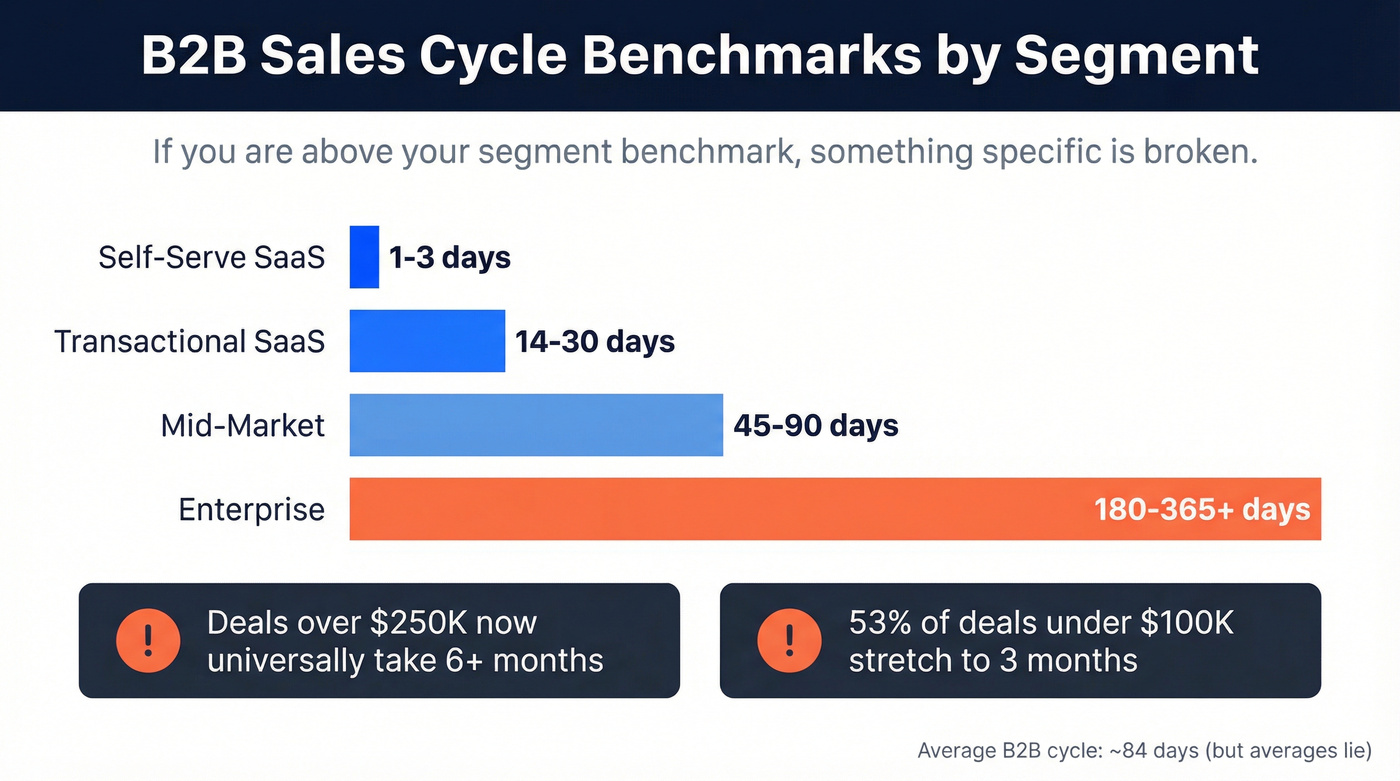
A commonly cited average B2B sales cycle is around 84 days. But averages lie. Deals over $250K now universally take six months or longer, and even deals under $100K see 53% stretching to three months. If you're above your segment benchmark, something specific is broken - often one of the sales pipeline challenges hiding in plain sight.

Your sales cycle is only as fast as your data. Every bounced email and wrong number adds days of wasted motion before a single conversation happens. Prospeo's 300M+ profiles with 98% email accuracy - refreshed every 7 days, not the 6-week industry average - eliminate the data drag that quietly stretches every deal.
Snyk's 50 AEs dropped bounce rates from 35% to under 5%. Your team can too.
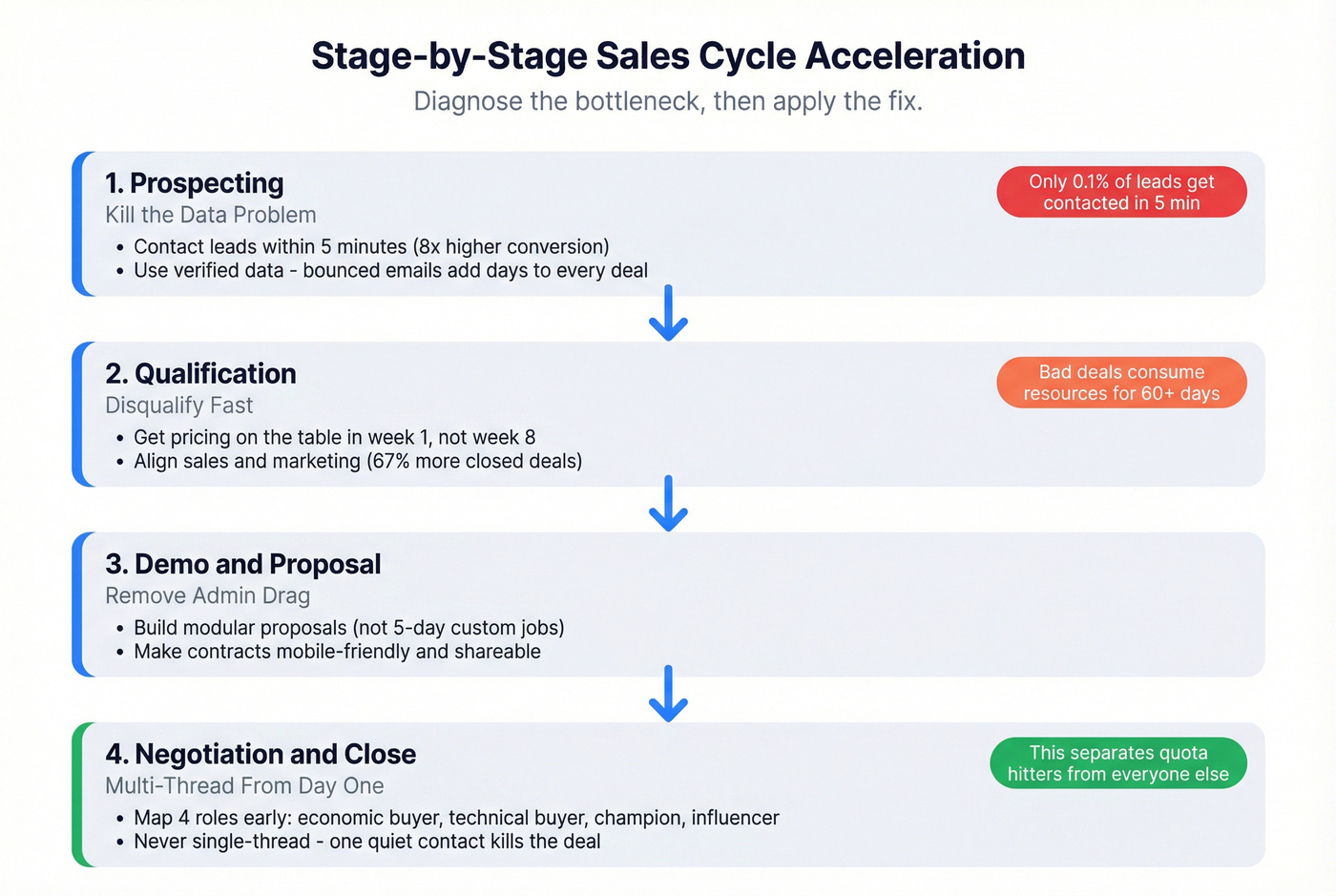
Stage-by-Stage Acceleration
Prospecting - Kill the Data Problem
Conversion rates are 8x higher when you contact a lead within five minutes of their first engagement. Yet only 0.1% of inbound leads get contacted that fast.
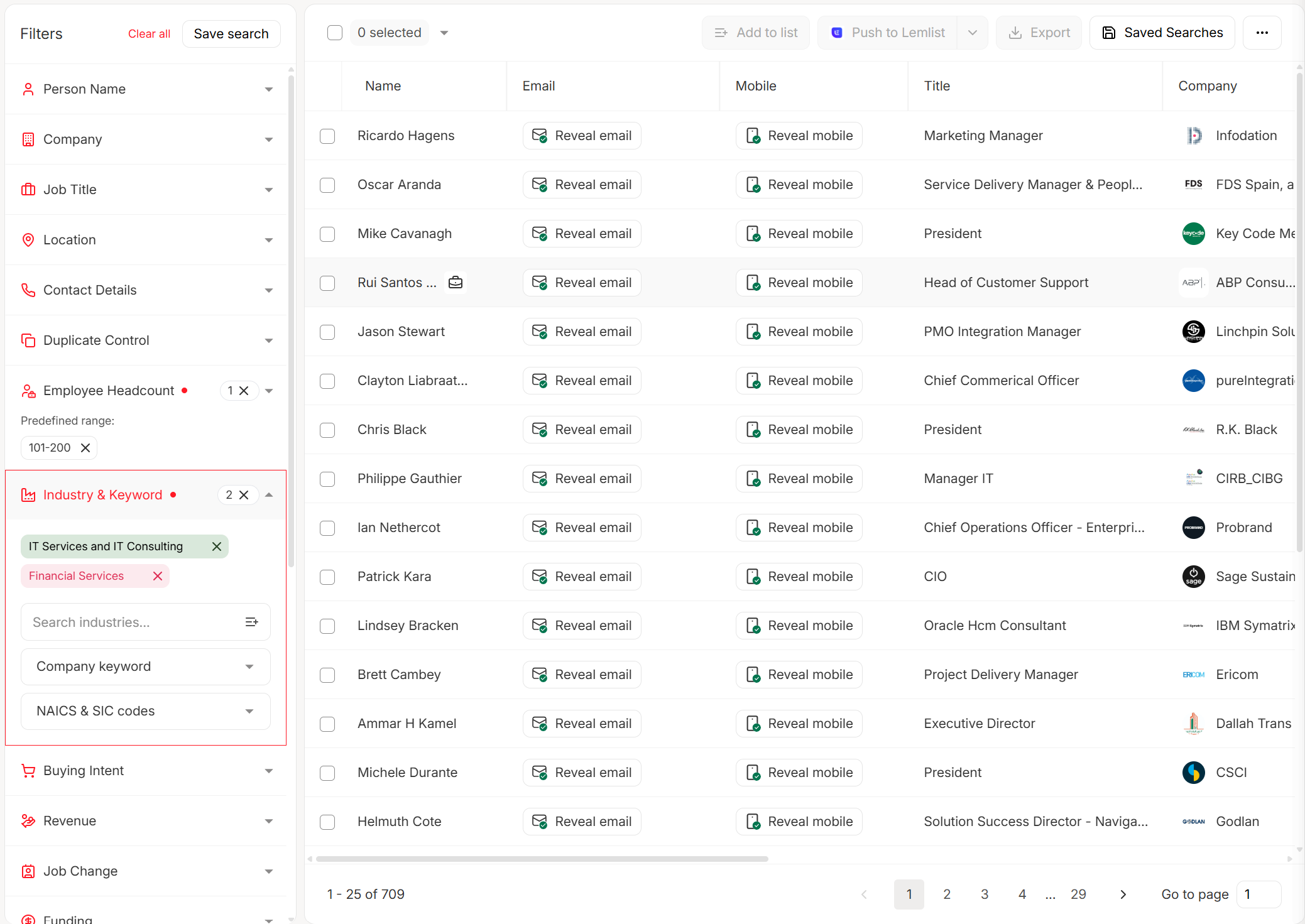
Speed-to-lead is impossible when your SDR sends 200 emails and 35 bounce while another 40 hit people who changed jobs last quarter. We've seen this pattern over and over - it's a data problem that adds drag to every deal before a single conversation happens. Prospeo's 300M+ profiles with 98% email accuracy and a 7-day refresh cycle fix this at the source. Snyk's 50-person AE team dropped bounce rates from 35-40% to under 5%, and AE-sourced pipeline jumped 180%. If you want to systematize this, start with email verification for outreach and basic data quality scorecards.
Qualification - Disqualify Fast
The fastest way to shorten your cycle isn't closing faster. It's killing bad deals before they consume resources - use a consistent lead qualification framework so reps don’t “feel” their way through it.
SiftHub's research found that transparent pricing prevents late-stage budget disqualification after you've already invested 60+ days. Get pricing on the table in week one, not week eight. Aligned sales and marketing teams close 67% more deals - misalignment alone adds weeks of back-and-forth that nobody budgets for in their forecasts.
Demo and Proposal - Remove Admin Drag
Deals stall because the proposal took five days to customize, legal couldn't open the PDF on mobile, and the champion had to re-explain your value prop to three stakeholders from memory. Build modular proposals, use interactive demos prospects can share internally, and make every contract mobile-friendly. These small operational fixes compress deal timelines more reliably than any single piece of sales tech.
Negotiation and Close - Multi-Thread From Day One
Single-threading kills deals. Period.
When your one contact goes on vacation or loses internal momentum, everything stops - and procurement and legal reviews are where cycles commonly get stuck. Map four roles from the first meeting: economic buyer, technical buyer, champion, and influencer. Multi-threading keeps momentum through negotiation even when one thread goes quiet, and the consensus on r/sales is that this single habit separates reps who consistently hit quota from those who don't.
Mistakes That Quietly Add Weeks
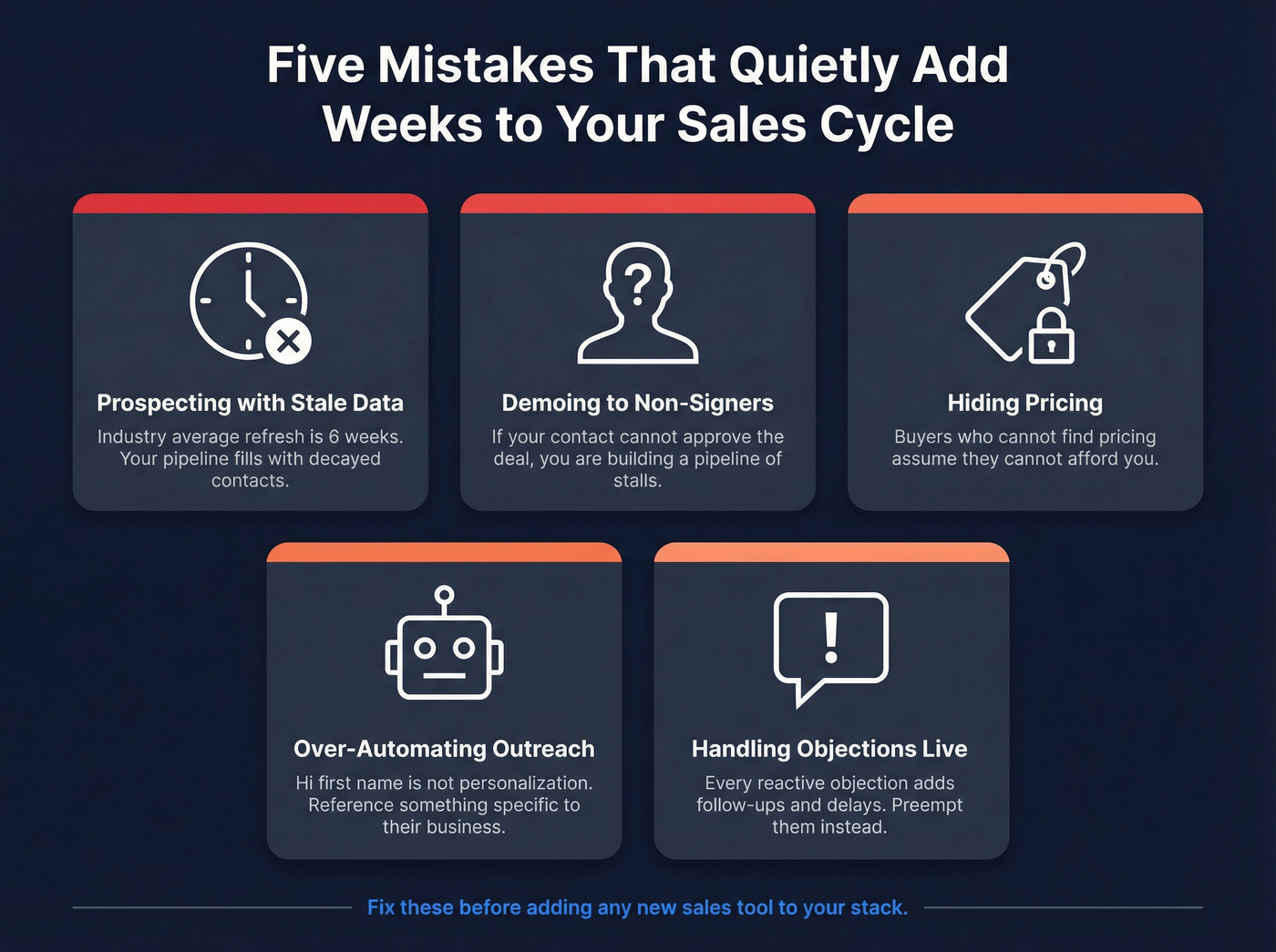
- Prospecting with stale data. The industry-average data refresh is about six weeks, and that's how pipelines fill up with decayed contacts that waste everyone's time.
- Demoing to non-signers. If your contact can't approve the deal, you're building a pipeline of stalls. Ask the uncomfortable question early.
- Hiding pricing. Buyers who can't find your pricing assume they can't afford you.
- Over-automating outreach. Personalization means referencing something specific to their business, not "Hi {first_name}, I noticed your company is growing." (If your team still uses that opener, swap it for better outreach email templates.)
- Handling objections live. Every objection you address reactively instead of preemptively adds follow-ups and delays.
How AI and Signals Shorten Cycles in 2026
81% of sales teams have implemented or are experimenting with AI, and teams using it are 1.3x more likely to see revenue growth. The real value is signal-based prioritization: signal-personalized outreach pulls 15-25% reply rates versus the 3-5% cold email average, and signal-qualified leads convert 47% better with 43% larger deal sizes. Only 25% of B2B companies use intent or signal tools - powered by providers like Bombora - making this a massive gap for teams willing to act on buying signals rather than spray-and-pray. If you’re building this motion, start with intent signals and a repeatable signal-based outbound workflow.
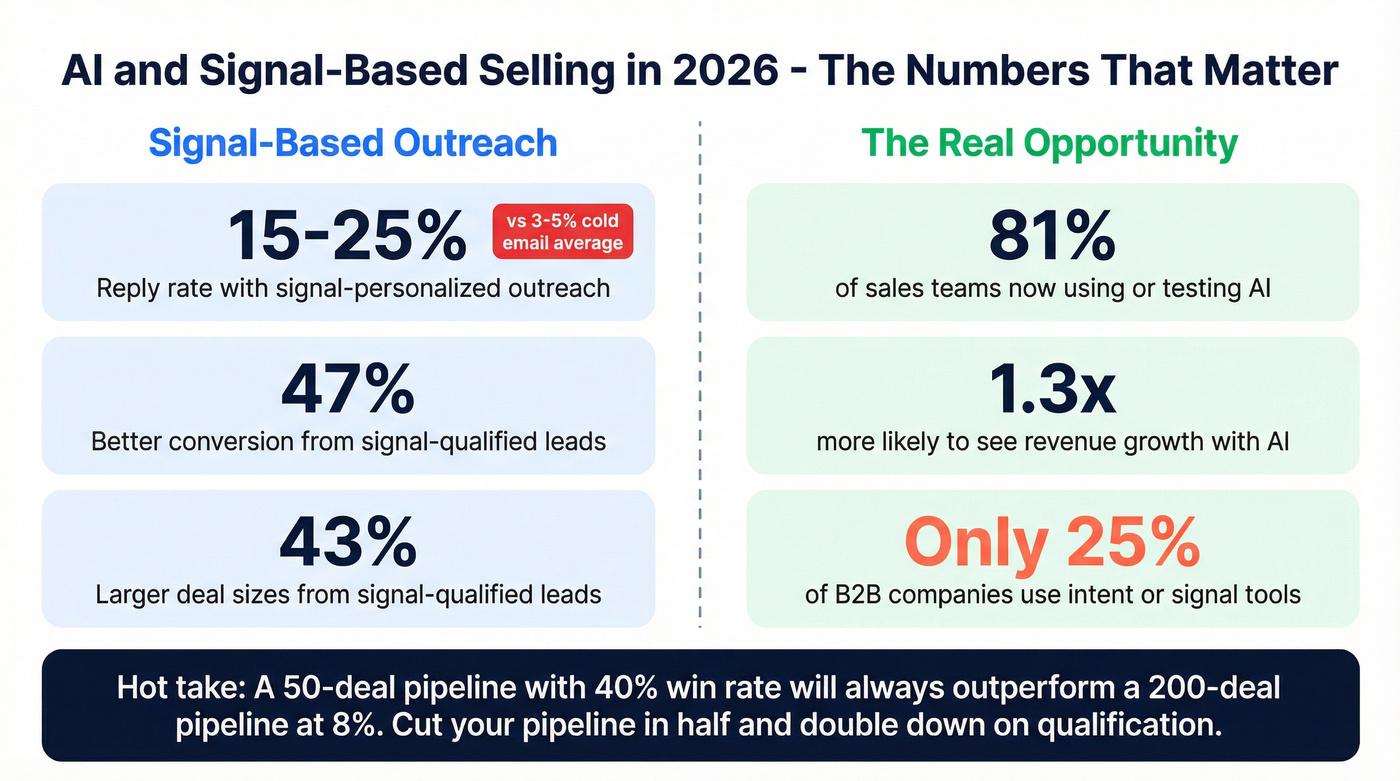
Let's be honest though: most teams don't need more AI-written emails. They need cleaner data and fewer deals in their pipeline. A 50-deal pipeline with 40% win rate will always outperform a 200-deal pipeline at 8%. In our experience, the teams that see the biggest acceleration gains are the ones who cut their pipeline in half and doubled down on qualification - not the ones who added another AI tool to the stack.
Multi-threading and signal-based selling only work when you can actually reach the 10-person buying committee. Prospeo gives you verified emails and 125M+ direct dials with a 30% pickup rate - so you connect with economic buyers, champions, and influencers from day one instead of single-threading into a stall.
Stop losing deals to no-decision. Start reaching every stakeholder at $0.01 per email.
FAQ
What's a good sales velocity score?
There's no universal benchmark - it varies by segment and deal size. Calculate yours per segment using the formula above, track it monthly, and optimize against your own baseline. A 10% month-over-month improvement is a strong signal you're moving in the right direction.
How much can you realistically shorten a B2B sales cycle?
Most teams see 10-30% reduction by tightening qualification and fixing contact data quality. Even shaving a few days off each stage compounds significantly: on a 90-day cycle, a 20% reduction means closing a full quarter's deals nearly three weeks earlier, which changes your revenue trajectory for the entire year.
What tools help with sales cycle acceleration?
CRMs like Salesforce or HubSpot for pipeline visibility, verified data platforms like Prospeo for accurate prospecting, intent data tools for prioritizing in-market accounts, and proposal automation to eliminate admin drag. Skip the shiny AI tools until you've fixed data quality - that's where the biggest ROI sits for most teams.