AI in Sales Cadences: What Works, What Doesn't, and What Nobody Tells You
You built a 12-step cadence. You plugged in AI. Your reply rate went from 3% to... 3.2%. Meanwhile, an AE at Deel is hitting 87% conversation rates with AI-powered personalization, and you're stuck wondering what went wrong. The answer isn't the AI - it's everything underneath it.
Here's the uncomfortable truth: 91% of cold emails still generate no reply. Reply rates have cratered to 1-5% industry-wide. Most teams deploying AI-driven sequences in 2026 are just spamming faster, and the gap between teams using AI well and teams using AI badly has never been wider.
What You Need (Quick Version)
- AI cadences work when the foundation is right - verified data, clear ICP, human oversight. Without those three, you're automating bad outreach at scale.
- Multi-channel cadences with 7-12 touches over 17-21 days outperform single-channel by 287%. That's not a marginal improvement. It's a different sport entirely.
- Fix your contact data before you optimize a single cadence step. 17% of cold emails get blocked because of bad data, not bad messaging. No amount of AI personalization saves an email that bounces.
What AI Actually Changes in Sales Cadences
The traditional sales cadence is a static flowchart. Day 1: email. Day 3: call. Day 7: follow-up. Every prospect gets the same sequence, same timing, same messaging - regardless of whether they opened your first email, visited your pricing page, or just got promoted to a role where they actually have budget.

AI changes three things fundamentally.
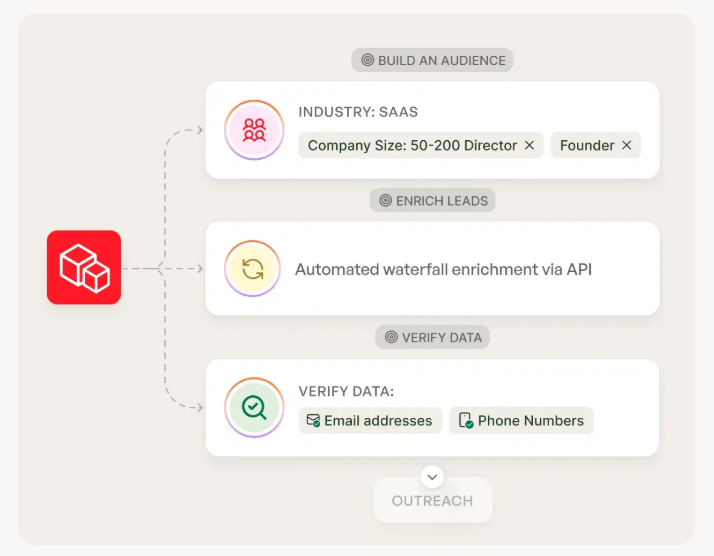
First, research compression. Gartner predicts that by 2027, 95% of seller research workflows will begin with AI - up from less than 20% in 2024. What used to take an SDR 30 minutes per prospect (scanning company news, funding rounds, tech stack, org chart) now takes seconds. Gartner calls these "atomic insights" - synthesized perspectives extracted from multiple data sources. The AI doesn't just find the data. It tells you what matters. And that matters because only 23% of buyers want to talk to a sales rep early in the buying process - your research has to be done before the first touch, not during it. (If you want a tighter process, use a prospect research checklist.)
Second, narrative automation. Those atomic insights get converted into hypertargeted value messages automatically. Instead of a rep writing "I noticed your company is growing..." for the 400th time, the AI drafts a message that references a specific hiring pattern, a specific technology gap, or a specific competitive pressure - and ties it to your product's value prop.
Third, adaptive sequencing. The cadence itself becomes dynamic. If a prospect opens email #2 but doesn't reply, the AI accelerates the phone touch. If they click a case study link, it swaps in a more bottom-funnel message. If they go dark after touch #5, it extends the spacing rather than hammering them daily.
The AI-powered sales tools market hit $3.1B, growing at 42% annually. 72% of sales teams now use some form of AI assistance. But adoption doesn't equal effectiveness. Most teams use AI for the easy stuff (email drafting, basic personalization) and ignore the hard stuff (data quality, cadence architecture, human oversight).
McKinsey's data backs this up: teams deploying systematic sales engagement processes see 10-20% pipeline improvements. The teams winning aren't the ones with the fanciest AI. They're the ones who built the right system around it.
2026 Benchmarks for AI-Powered Sales Sequences
Before you optimize anything, you need to know what "good" looks like:

| Sequence Type | Reply Rate | Meeting Rate |
|---|---|---|
| Cold outbound | 8-15% | 1-3% |
| Warm inbound | 20-30% | 8-12% |
| Customer expansion | 25-40% | 15-20% |
| Win-back/nurture | 10-18% | 2-5% |
Across all Outreach customers, the averages tell a sobering story: 27.2% open rate, 2.9% reply rate, 2.8% bounce rate, and 1.1% opt-out rate. Outreach users closing within 50 days achieve a 47% win rate versus 21% for the market average - speed matters.
If your cold outbound reply rate is above 12%, you're outperforming most teams. Above 15%, you're top quartile.
Now here's where AI changes the math. AI-led outreach converts at 14.2% versus 3% for fully manual sequences - when the personalization is good. That's a 4.7x improvement. But that "when" is doing a lot of heavy lifting. 88% of AI pilots stall before reaching production. They never get to the "good" part.
The median time to first positive response from an AI SDR is 22.7 days. Teams expecting AI to book meetings in week one are setting themselves up for disappointment - and usually kill the pilot before it has time to work.
The Economics - Human SDR vs. AI SDR
| Metric | Human SDR | AI SDR |
|---|---|---|
| Annual cost | ~$98K | ~$28K |
| Qualified opps/month | 15-20 | 40-60 |
| Ramp time | 3-6 months | 2-4 weeks |
| Cost reduction | - | 71% |

A human SDR costs roughly $98K/year when you add salary ($60K), benefits ($18K), training ($5K), tools ($3K), and management overhead ($12K). An AI SDR platform runs about $28K/year - platform fees ($12K), setup ($2K), data and integrations ($6K), and monitoring ($8K).
That's a 71% cost reduction on paper. And the output numbers look even better: 40-60 qualified opportunities per month versus 15-20 from a human rep.
Here's the part nobody puts in the pitch deck. Plan for 40-60 hours of data preparation before launch. Daily monitoring isn't optional - it's mandatory. You need someone reviewing outputs, someone catching when the AI starts hallucinating company names or referencing funding rounds from three years ago.
My recommendation: if you're starting from scratch with messy CRM data, plan for 6-9 months to positive ROI, not the 3-month timeline the vendors quote. With clean data and a defined ICP, 3-6 months is realistic. Start with 100-200 test accounts. Prove the model works before you scale it.

17% of cold emails get blocked because of bad data - not bad messaging. No AI cadence survives a 35% bounce rate. Prospeo's 98% email accuracy and 7-day data refresh cycle mean every touch in your sequence actually lands.
Stop letting stale data sabotage your AI-powered cadences.
Building Your AI Cadence - Two Proven Blueprints
The 7-Touch Framework (High-Value Targets)
This framework works best for mid-market prospects where you've got a clear ICP match but aren't running a full enterprise play.

| Day | Channel | Action |
|---|---|---|
| 1 | Personalized intro (AI-researched) | |
| 2 | Social | Profile view + connection |
| 4 | Follow-up with value asset | |
| 7 | Direct message | Short, conversational |
| 9 | Case study or social proof | |
| 11 | Phone | Voicemail if no answer |
| 14 | Re-engagement / breakup |
Engagement rises meaningfully through the 6th and 7th touch, then plateaus. Additional attempts after 7 increase spam complaints and disengagement risk without improving conversion. Multi-channel cadences see 50% higher engagement than email-only sequences. (If you need a baseline, steal a sales cadence example and adapt it.)
The key: AI handles the research and drafting for each touch, but the cadence architecture itself is fixed. You're not letting AI decide how many touches to send - you're letting it decide what to say in each one.
Some teams are experimenting with WhatsApp and direct mail as cadence touchpoints - early data suggests they cut through inbox noise, but they're harder to scale with AI. Worth testing if your deal size justifies the per-touch cost.
The 12-Touch Enterprise Framework
For deals above $50K ACV with multiple stakeholders, you need more runway:
| Day | Channel | Action |
|---|---|---|
| 1 | Personalized intro | |
| 3 | Social | Engage with content |
| 5 | Phone | Direct call attempt |
| 7 | Video | AI-personalized video |
| 10 | Follow-up + value | |
| 12 | Social | Share relevant content |
| 14 | Social | Direct message |
| 17 | Phone | Second call attempt |
| 19 | New angle / pain point | |
| 21 | Breakup email | |
| 25 | Phone | Final call attempt |
| 30 | Long-term nurture opt-in |
RAIN Group research shows meetings require 8 touches on average. For enterprise deals, plan for 16 touchpoints over 30 days. For high-volume plays, cap it at 4. For small deals, 2 touchpoints max.
The channel distribution that works: 40-50% email, 20-30% phone, 15-25% social, 5-10% video or other. Phone calls generate disproportionate response rates despite being only 20-30% of touches - don't skip them because they're uncomfortable. (See SDR cadence best practices if you want the guardrails.)
Personalization That Actually Works
Gartner's Personalization Tiers
Not all personalization is created equal. Gartner breaks it into three tiers based on depth: Tier 1 targets industry and role-level signals. Tier 2 goes deeper with company-specific research - funding rounds, tech stack, competitive moves. Tier 3 is fully individualized, referencing the specific person's priorities, recent activity, and context.

Most teams jump straight to Tier 3 automation and wonder why the output feels generic. Start with Tier 2 for your top 50 accounts - AI-enhanced research with human-crafted messaging. Use automated Tier 3 for everything else. (If you want a deeper teardown, read about AI cold email personalization mistakes.)
The Deel Playbook - 87% Conversation Rate
Jonathan Molina went from SDR to Senior AE at Deel by building an outbound strategy around one principle: contextual personalization at scale.
His result: 87% of recipients who received his personalized outreach started conversations. Not opened. Not clicked. Started conversations.
The key insight was deceptively simple. For Deel (a global HR platform), the strongest personalization signal was how global a prospect's team is. Global teams mean global hiring pain. Global hiring pain means product fit. So instead of generic openers, every message referenced specific signals - international job postings, new office locations, multilingual team structures.
"If your email feels generic, it dies. If it feels intentional, it gets answered."
AI automated the entire research workflow - scanning funding rounds, annual reports, tech stacks, job postings, org charts, expansion signals - without losing the 1:1 relevance. The AI did the research. The human defined what mattered.
The 4-Step Prompt Framework
Most AI sales tools are, as Thibaut Souyris puts it, "ChatGPT wrappers with a tendency to hallucinate." The quality of your output depends entirely on the quality of your input:
- Context dump - Feed the AI everything: prospect's company, role, recent news, tech stack, competitors, pain points
- Role assignment - "You're a senior AE selling [product] to [persona]. Your tone is direct and consultative."
- Task definition - "Write a 3-sentence cold email that references [specific signal] and asks one question."
- Format specification - "No more than 75 words. No exclamation marks. No 'I hope this finds you well.'"
Skip any of these four steps and you get the generic slop flooding every inbox right now.
Five AI Cadence Mistakes That Kill Your Reply Rates
Mistake 1: Letting AI run on autopilot.
AI amplifies whatever system it's placed into. If the underlying strategy, data, or review process is weak, AI accelerates those weaknesses. I've watched a team let their AI agent send hundreds of generic messages without anyone reviewing the output. By the time they caught it, their domain reputation was torched. The fix: implement a Send/Edit/Discard framework. Every AI-generated message gets triaged. 56% of reps report AI-related mistakes. Human review isn't optional.
Mistake 2: Scaling before validating message-market fit.
You wouldn't run a $50K ad campaign without testing creative first. Don't blast 5,000 AI-generated emails before you've proven the messaging works on 200 accounts. (Run it like an experiment: A/B testing lead generation campaigns.)
Mistake 3: Ignoring campaign length by deal size.
Enterprise targets (your top 30 accounts) deserve 16 touchpoints over 30 days. High-volume prospecting? Max 4 touchpoints. Small deals? 2 touchpoints, tops. One cadence doesn't fit all segments.
Mistake 4: Building on bad data.
If 17% of your emails are hitting spam because of stale data, no amount of AI personalization saves you. Verify before you send. An AI-crafted masterpiece that bounces doesn't just waste credits - it damages your sender reputation. (This is usually B2B contact data decay showing up as a deliverability problem.)
Mistake 5: Measuring activity instead of buyer response quality.
Message volume and send rate are vanity metrics. The metrics that matter: reply rate, positive reply rate, meeting conversion rate, and pipeline generated. If your AI is sending 500 emails a day and booking 2 meetings, you don't have a volume problem. You have a quality problem.
The Deliverability Problem Nobody Talks About
46% of the 347 billion daily emails sent worldwide are spam. Email providers aren't just filtering - they're at war. And your AI-generated cadence emails are increasingly caught in the crossfire.
Gmail now uses RetVec (a text vectorizer that catches character-level manipulation), Gemini Nano (on-device AI for content analysis), and TensorFlow models trained on billions of spam examples. Microsoft Defender uses behavioral modeling and threat intelligence. These systems don't just look for "FREE MONEY" in subject lines anymore. They analyze semantic meaning, engagement patterns, sender behavior, and - increasingly - whether content reads like it was generated by AI.
17% of cold emails get blocked by spam filters before a human ever sees them. That's not a messaging problem. That's an infrastructure problem.
The technical checklist every team needs:
- SPF, DKIM, and DMARC authenticated and passing. Non-negotiable in 2026. (If you need the setup path, use this SPF DKIM & DMARC guide.)
- Consistent sending cadence. Irregular spikes (sending 50 emails Monday, 500 Tuesday) are a red flag to every major email provider.
- Natural writing patterns. Avoid formulaic AI output. If every email follows the same [compliment] -> [pain point] -> [CTA] structure, spam filters notice.
- Clean contact data. Dead addresses, spam traps, and honeypots destroy your sender reputation faster than bad copy ever could. (Use an email verification list SOP if you don't have one.)

Multi-channel cadences outperform single-channel by 287% - but only if you have direct dials and verified emails to power them. Prospeo gives you both: 143M+ verified emails and 125M+ mobile numbers at $0.01/lead.
Build the data foundation your AI cadence actually needs.
Compliance in 2026 - CAN-SPAM, GDPR, and the EU AI Act
The compliance picture just got more complicated:
| Regulation | Model | Max Penalty | Key Requirement |
|---|---|---|---|
| CAN-SPAM | Opt-out | $51,744/email | Unsubscribe in 10 days |
| GDPR | Opt-in | 4% revenue or EUR 20M | Consent before contact |
| CCPA | Opt-out | $7,500/violation | Data access/deletion rights |
| CASL (Canada) | Consent | $10M/violation | Express or implied consent |
Washington State dropped a $500-per-email ruling in 2025 for misleading subject lines, with at least 8 lawsuits already filed. Those "Re: Our conversation" subject lines that some AI tools auto-generate? They're not just sleazy - they're legally actionable.
The big one coming is the EU AI Act. Article 50(2) mandates that AI-generated content must carry machine-readable markers by August 2026. AI-generated sales emails sent to EU recipients will likely need to be tagged as AI-produced. The direction is clear: transparency about AI-generated content is becoming a legal requirement, not a best practice. (If you're operationalizing this, start with GDPR for sales and marketing.)
68% of marketers already struggle to stay compliant with existing regulations. Build compliance into your cadence architecture now - geographic segmentation, consent tracking, regular list audits - rather than retrofitting it after you get a cease-and-desist.
Tools for AI-Powered Cadences
| Tool | Best For | Starting Price | Key Strength |
|---|---|---|---|
| Prospeo | Data quality | Free / ~$0.01/email | 98% accuracy, 7-day refresh |
| Outreach | Enterprise | ~$100-150/user/mo | Deepest workflow logic |
| Salesloft | Mid-market | $125/user/mo | Ease of use (8.8/10 G2) |
| Apollo.io | SMB/Startups | Free / $49/user/mo | Built-in 275M+ database |
Data Quality - The Layer Everyone Skips
Here's my hot take: if your average deal is under $30K, the highest-ROI move isn't a better sequencing tool - it's verifying the data feeding the sequencer. Buyers complete 68% of their research before speaking to a salesperson. If your email bounces, you don't even get a chance to be part of that process. Nurtured leads produce 20% more sales opportunities, but only if the nurture emails actually land. (If you want a shortlist, start with email lookup tools.)
Sequencing Platforms
Skip Outreach if your team is under 20 reps or your deal cycle is under 30 days - you'll pay for sophistication you won't use. But for complex, multi-stage enterprise sales, nothing else comes close. Conditional branching, the deepest CRM integrations in the category, and AI-powered deal coaching via Kaia (which shaves 11 days off sales cycles on deals over $50K). Expect ~$100-150/user/month for mid-tier, higher for enterprise packages with forecasting and conversation intelligence.
At $125/user/month, Salesloft hits the mid-market sweet spot. The visual drag-and-drop cadence builder is intuitive (8.8/10 ease of use on G2), and it auto-adjusts for weekends, time zones, and prospect behavior. Built-in dialer with local presence. The gap: no built-in prospecting database. Use this if your team values ease of adoption over raw feature depth.
If your team is 5-15 reps and you don't want a $50K annual commitment, Apollo.io is the obvious choice. Free tier available, paid plans from $49-79/user/month, and a built-in database of 275M+ contacts with email verification before send. The A/B testing in sequences is solid. The tradeoff: CRM integration depth lags behind Outreach and Salesloft, and the conversation intelligence features are basic. For the price, Apollo is hard to beat.
AI Writing and Coaching
Lavender coaches reps on email quality in real time - free tier available, $27/user/month for teams. It scores your emails and tells you exactly what to fix. Regie.ai handles enterprise cadence creation at scale (~$35K+/year). Copy.ai is the generalist - free tier, paid plans from $36/month - good for generating first drafts, less good for sales-specific coaching.
Real-World Results - Three Case Studies
Hartwell - 7x ROI in Two Months
Hartwell Property Services (Birmingham, UK, GBP 1.8M revenue) was drowning in slow follow-ups. Lead response time: 4-6 hours. Lead-to-meeting conversion: 18% - well below the 27% industry norm.
After a 2-week AI pilot in May 2023, they went full rollout in June. The AI handled multi-channel follow-up sequences - texts, emails, phone calls - with up to 7 custom touches over 14 days. AI lead scoring prioritized high-value leads (GBP 20K+ annual) for personal follow-up.
Response time dropped to under 60 seconds. Lead-to-meeting jumped from 18% to 26%. Client acquisition cost fell 28%. Staff training took 4 hours. Total ROI: 7x in less than two months.
Financial Services Provider - 150% More Meetings
A financial services company implemented skill-based routing with guided workflows. The results: 150% more meetings booked, 3.7x growth in average deal size, and a 225% surge in pipeline creation. The 98.3% reduction in wait times from skill-based routing was the unlock - prospects got connected to the right rep almost instantly instead of bouncing through a queue.
The AI Video Cadence - 3x Response Rates
A practitioner on r/salestechniques shared results from testing this across 20+ businesses over 4 months. The strategy: clone the CEO's likeness with AI video for BDR prospecting.
The 4-step cadence: AI video asking permission, then an AI audio follow-up (10 seconds), then an offer video (1-1.5 minutes), then an objection-handling video (under 1 minute), followed by standard follow-ups and a calendar link.
Result: tripled positive response rates. The key constraint - videos must be watched natively on the social platform, not via external links. Target: businesses with deal sizes of at least $12K.
Less than 0.1% of businesses are using this strategy. That's the kind of edge that disappears once everyone catches on, but right now, it's wide open.
The Honest Take - Will AI Cadences Work for You?
There's a historical parallel worth remembering. When Salesloft-style automated cadences first hit the market, they worked brilliantly. Then everyone started using them. Buyers got buried in templated sequences. Email response rates plummeted. The same thing happened with power dialers - connect rates cratered as prospects learned to screen.
AI-enhanced cadences are following the same curve.
The early adopters are seeing incredible results. The fast followers are getting diminishing returns. And the laggards will arrive just in time for the channel to be burned.
The practitioner recommendation we keep hearing from people who actually run outbound: "Do less volume with higher quality." That's not anti-AI. It's pro-strategy.
You're ready for AI cadences if:
- Your contact data is clean and verified (bounce rates under 5%)
- You've got a defined ICP with clear segmentation
- You have human capacity for oversight - someone reviewing outputs daily
- You've validated your messaging manually first
You're not ready if:
- Your CRM is a mess and nobody trusts the data
- You don't have a defined ICP (or it changes every quarter)
- You're expecting full automation with zero human involvement
- You haven't proven your outbound motion works manually yet
Look - 88% of AI pilots stall before production. Don't be part of that stat. Fix the foundation first, then let AI amplify what's already working. The teams getting real results from AI in sales cadences aren't the ones with the most sophisticated tools. They're the ones who nailed the basics before they ever turned the AI on.
FAQ
How many touchpoints should an AI sales cadence have?
Seven to twelve touchpoints over 17-21 days for most B2B cadences. RAIN Group research shows meetings require 8 touches on average, and engagement plateaus after touch 6-7. Enterprise deals justify 16 touches over 30 days; small deals should cap at 2-4.
Do AI sales cadences actually outperform manual ones?
AI-led outreach converts at 14.2% versus 3% for manual sequences - a 4.7x improvement when data and strategy are solid. But 88% of AI pilots stall before production, usually because of bad data or weak strategy. The gap between good and bad implementation is wider than the gap between AI and manual.
How do I keep AI-generated emails out of spam folders?
Verify your contact data before sending (tools like Prospeo's 5-step verification cut bounce rates below 4%), authenticate your domain with SPF/DKIM/DMARC, and avoid formulaic AI output that filters like Gmail's RetVec detect. Consistent sending volume matters too - irregular spikes trigger filters faster than bad copy.
Is the EU AI Act going to affect sales cadences?
Yes. Article 50(2) requires AI-generated content to carry machine-readable markers by August 2026. Sales emails sent to EU recipients will need to be tagged as AI-produced. CAN-SPAM penalties have also risen to $51,744 per non-compliant email. Build geographic segmentation and consent tracking into your cadence now.
What's the fastest way to improve AI cadence performance?
Fix your contact data first - 17% of cold emails get blocked by spam filters due to stale or invalid addresses, not bad messaging. After that, validate your messaging on 200 accounts before scaling, and implement daily human review of AI-generated outputs. Most teams see the biggest lift from data quality, not prompt engineering.