

7 AI Skills for Sales Reps in 2026
AI will automate 67% of the tasks sales reps do today - not 67% of reps, but 67% of what they spend their time on. And the AI skills for sales reps that actually matter aren't the ones most companies train on. 92% of sales pros already use AI in some form, yet 84% say the main benefit is saving time or optimizing processes. That's table stakes. The reps pulling ahead have moved past time savings into genuine competitive advantage, and the gap between them and everyone else comes down to AI fluency, not tool access.
The Seven Skills, Ranked
Priority order. The top three - prompt engineering, verification, and data literacy - are the ones your company is almost certainly ignoring.
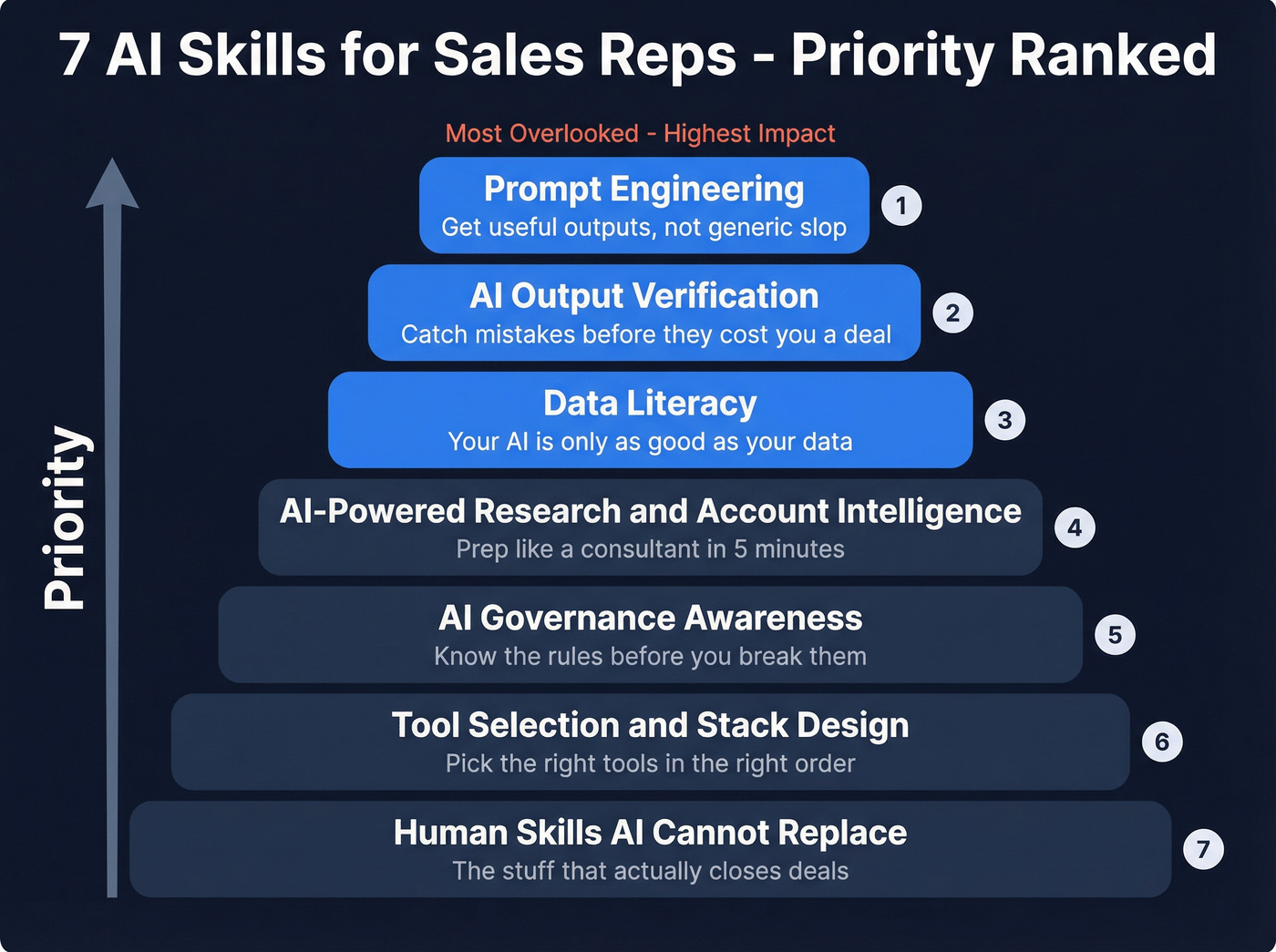
- Prompt engineering - get useful outputs instead of generic slop
- AI output verification - catch mistakes before they cost you a deal
- Data literacy - every AI tool is only as good as the data feeding it
- AI-powered research & account intelligence - prep like a consultant
- AI governance awareness - know the rules before you break them
- Tool selection & stack design - pick the right tools in the right order
- Human skills AI can't replace - the stuff that actually closes deals
The Skills Gap Nobody Talks About
Companies are pouring money into AI tools while ignoring the capabilities reps need to use them well. Over the next three years, 92% of companies plan to increase AI investments, but only 1% of leaders consider their organizations "mature" in AI deployment. Let's be honest: that's a staggering disconnect.
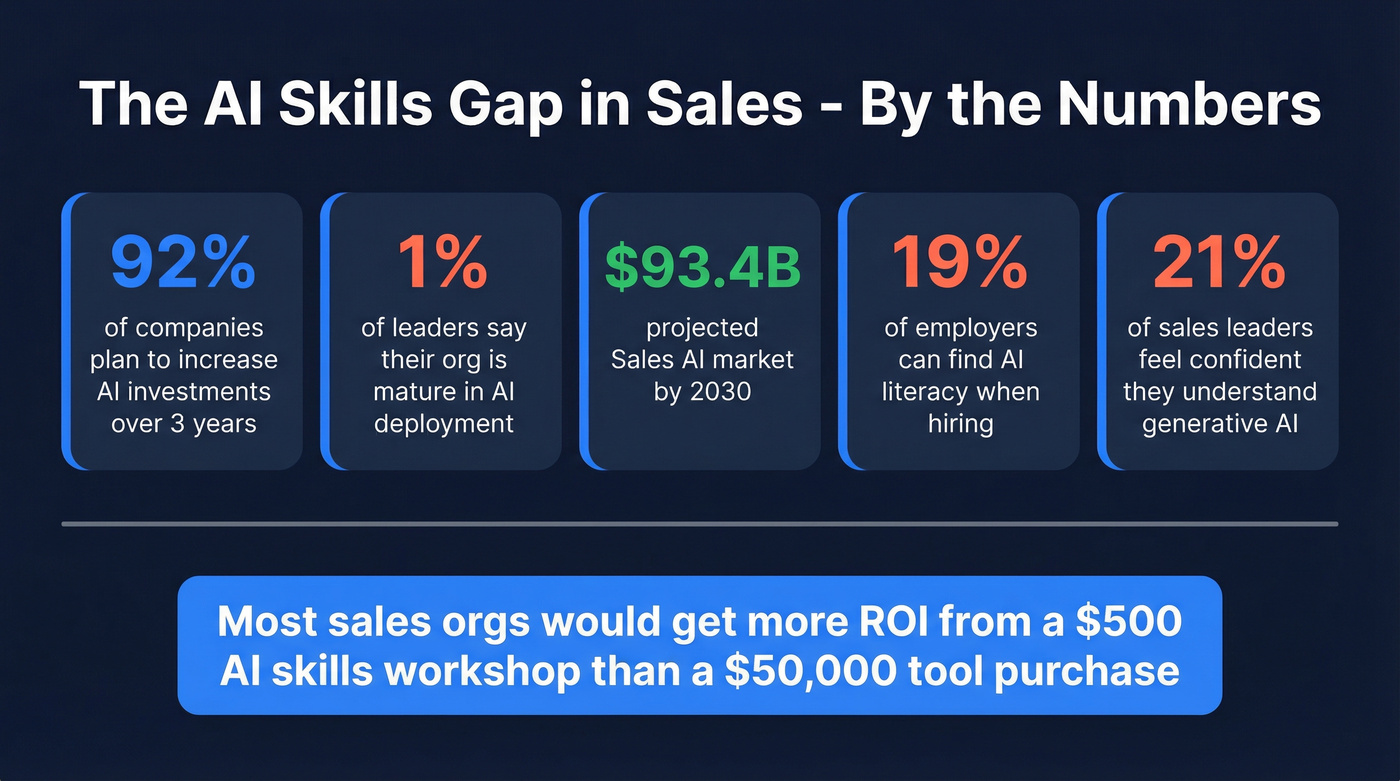
The Sales AI market is projected to hit $93.4B by 2030, and large enterprises are 48x more likely to deploy Sales AI than smaller firms. Yet ManpowerGroup's 2026 survey of 39,000+ employers found AI literacy is one of the hardest capabilities to hire for - only 19% of employers can find it. On the rep side, just 21% of sales leaders feel confident they understand generative AI.
The gap between "we bought the tools" and "our people can actually use them" is where quota-crushers separate from the pack.
Here's our take: most sales orgs would get more ROI from a $500 AI skills workshop than from a $50,000 tool purchase. The tools aren't the bottleneck. The skills are.

Every AI skill on this list is downstream of data quality. Snyk's 50 AEs dropped bounce rates from 35% to under 5% and grew pipeline 180% - not by changing AI tools, but by switching to Prospeo's 98% accurate, 7-day refreshed contact data. Your prompts and workflows are only as good as what feeds them.
Master AI skills all you want - garbage data still kills the campaign.
The 7 Skills That Matter Most
1. Prompt Engineering
Most reps type "write me a cold email to a VP of Marketing" and wonder why the output sounds like every other AI-generated email in their prospect's inbox. Prompting is a skill, not a text box.
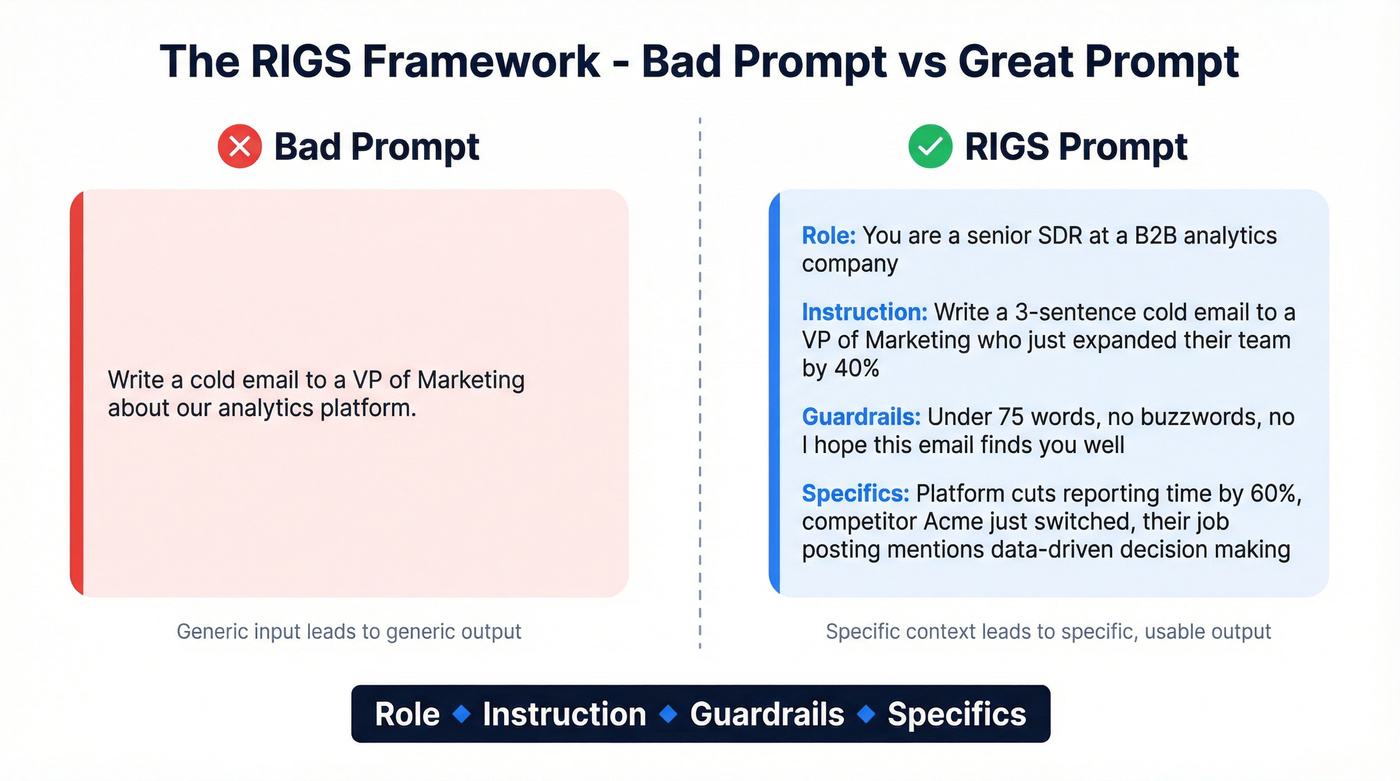
The RIGS framework makes this concrete - Role, Instruction, Guardrails, Specifics.
Bad prompt: "Write a cold email to a VP of Marketing about our analytics platform."
RIGS prompt: "You're a senior SDR at a B2B analytics company (Role). Write a 3-sentence cold email to a VP of Marketing who just expanded their team by 40% (Instruction). Keep it under 75 words, no buzzwords, no 'I hope this email finds you well' (Guardrails). Our platform cuts reporting time by 60%, their competitor Acme just switched to us, and their job posting mentions 'data-driven decision making' as a priority (Specifics)."
The difference in output quality is night and day. We've run this exercise with dozens of reps, and thirty minutes learning RIGS consistently outperforms hours of editing generic AI drafts. The consensus on r/sales backs this up - reps who invest in prompt craft see dramatically better results than those who just throw keywords at ChatGPT.
2. AI Output Verification
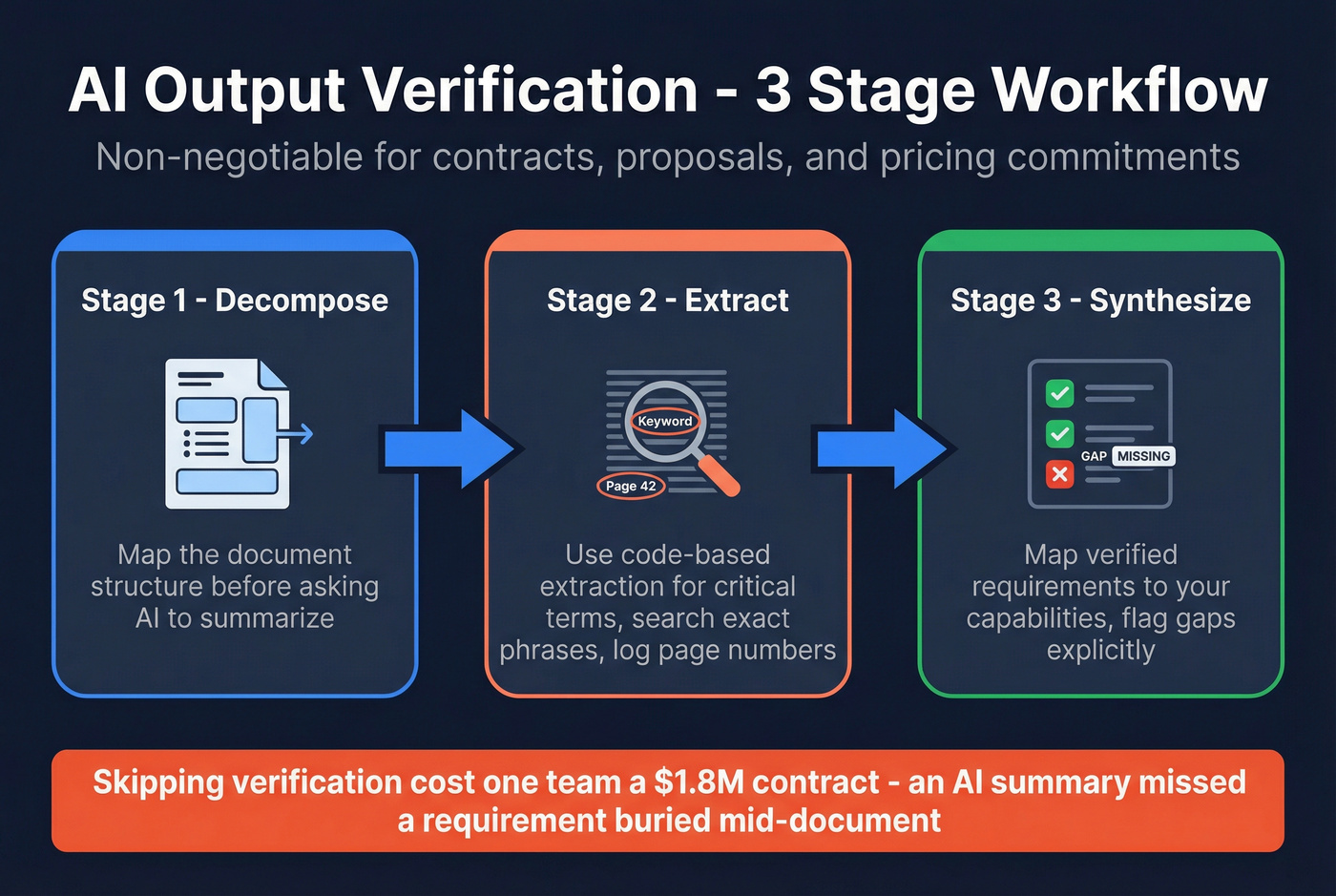
A team lost a $1.8M municipal contract because their AI summary of a 280-page RFP missed a prevailing wage requirement buried in the middle of the document. Not hypothetical. That's the kind of failure that happens when reps treat AI outputs as final drafts.
The core problem is "context rot." Large language models overweight the beginning and end of long documents; details in the middle get lost. About half of employees already worry about AI inaccuracy, and they're right to.
The fix is a three-stage verification workflow:
- Decompose: Map the document's structure before asking AI to summarize it.
- Extract: Use code-based extraction for critical terms - scripts that search exact phrases and log page numbers.
- Synthesize: Map verified requirements to your capabilities and flag gaps.
You don't need this rigor for every output. But for anything touching a contract, proposal, or pricing commitment, it's non-negotiable.
3. Data Literacy
Every AI skill on this list is downstream of data quality. Feed your AI tools garbage contacts and you'll get garbage results - beautifully written cold emails that bounce, perfectly researched accounts with the wrong decision-makers, flawless sequences sent to invalid addresses.

We've seen this play out dozens of times. A team launches a 5,000-contact outbound campaign, 800 emails bounce in the first 48 hours, their domain reputation tanks, and suddenly even the good emails land in spam. The AI wrote great copy. The data destroyed the campaign.
Snyk's story makes it concrete. Their 50-person AE team was running bounce rates of 35-40%. After switching to Prospeo's verified data - 98% email accuracy on a 7-day refresh cycle - bounces dropped under 5%, AE-sourced pipeline jumped 180%, and they generated 200+ new opportunities per month. The AI tools didn't change. The data did.
4. AI-Powered Research & Account Intelligence
The days of spending 45 minutes on pre-call research are over. AI compresses that into five minutes - but only if you know what to look for.
Enterprise deals now involve 6-10 stakeholders on the buying committee. The skill isn't just "use AI to research the company." It's mapping the full buying committee, understanding each stakeholder's priorities, and identifying intent signals that tell you who's actively in-market before you write the first email. Pair that with technographic and job-change filters, and pre-call prep goes from guesswork to precision.
Sentiment analysis adds another layer. AI tools can gauge a prospect's tone across public communications, earnings calls, and social posts, giving you a read on their priorities before you ever pick up the phone. For teams that sell into public companies, this is a genuine edge - you'll walk into calls knowing what the CFO said on last quarter's earnings call about budget priorities.
5. AI Governance Awareness
Forrester warned that B2B companies could lose $10B+ in enterprise value from ungoverned AI adoption. That sounds abstract until you see what "ungoverned" looks like in practice.
Picture a rep using an unapproved AI tool to generate a proposal with nonstandard pricing terms. Or a buyer-facing chatbot pulling capabilities from outdated web sources and making promises your product can't keep. Nearly 1 in 5 B2B buyers already report lower trust when interacting with AI-driven sales tools.
The skill here isn't technical. It's knowing which outputs need human review, which tools are approved, and where the compliance boundaries sit. Skip this one at your own risk - one bad AI-generated proposal can undo months of relationship building.
6. Tool Selection & Stack Design
The average sales team juggles 13 tools. Most buy them in the wrong order - grabbing an engagement platform before they have clean data to feed it. Intelligence layer first, automation second. Teams that fix their data layer first see 3-5x better ROI from the same tool budget.
| Category | Top Pick | Other Options | Starting Price |
|---|---|---|---|
| Account Intelligence | Gong | Demandbase, 6sense | Gong: ~$100-150/user/mo. Demandbase: custom |
| Conversation Intel | Fathom | Gong, Read AI | Fathom: Free / $19/mo. Read AI: Free / $19.75/user/mo |
| Sales Engagement | Salesloft | Outreach, Instantly | Salesloft: ~$75/user/mo. Outreach: ~$100/user/mo. Instantly: $30/mo |
| Forecasting | Clari | Aviso, SF Einstein | Clari: ~$50-80/user/mo. SF Einstein: $25-300/user/mo |
| Coaching & Role-Play | Second Nature | Mindtickle, Highspot | Second Nature: ~$30/user/mo. Mindtickle: custom |
Start with the prospecting and intelligence layer. If your data is wrong, nothing downstream matters.
7. Human Skills AI Can't Replace
As AI handles more mechanical work, human skills become more valuable, not less.
Emotional intelligence, multi-stakeholder negotiation, and consultative selling close complex deals. 65% of customers prefer remote human interactions or digital self-service over face-to-face - but they still want a human when the deal gets complicated. AI-driven role-play tools like Second Nature and Mindtickle can help you practice pitches and objection handling at scale, and they're genuinely useful for reps who want to sharpen their delivery.
But the real skill is reading the room live - catching the CFO's micro-hesitation on pricing, sensing when a champion is losing internal support, knowing when to stop selling and start listening. No AI replicates that yet. The reps who'll thrive aren't the ones using the most AI tools. They're the ones who use AI to handle the 67% of automatable tasks so they can pour all their energy into the conversations, negotiations, and relationships AI can't touch.
How to Upskill Your Team This Week
Don't try to master all seven skills at once. Five steps, starting today:
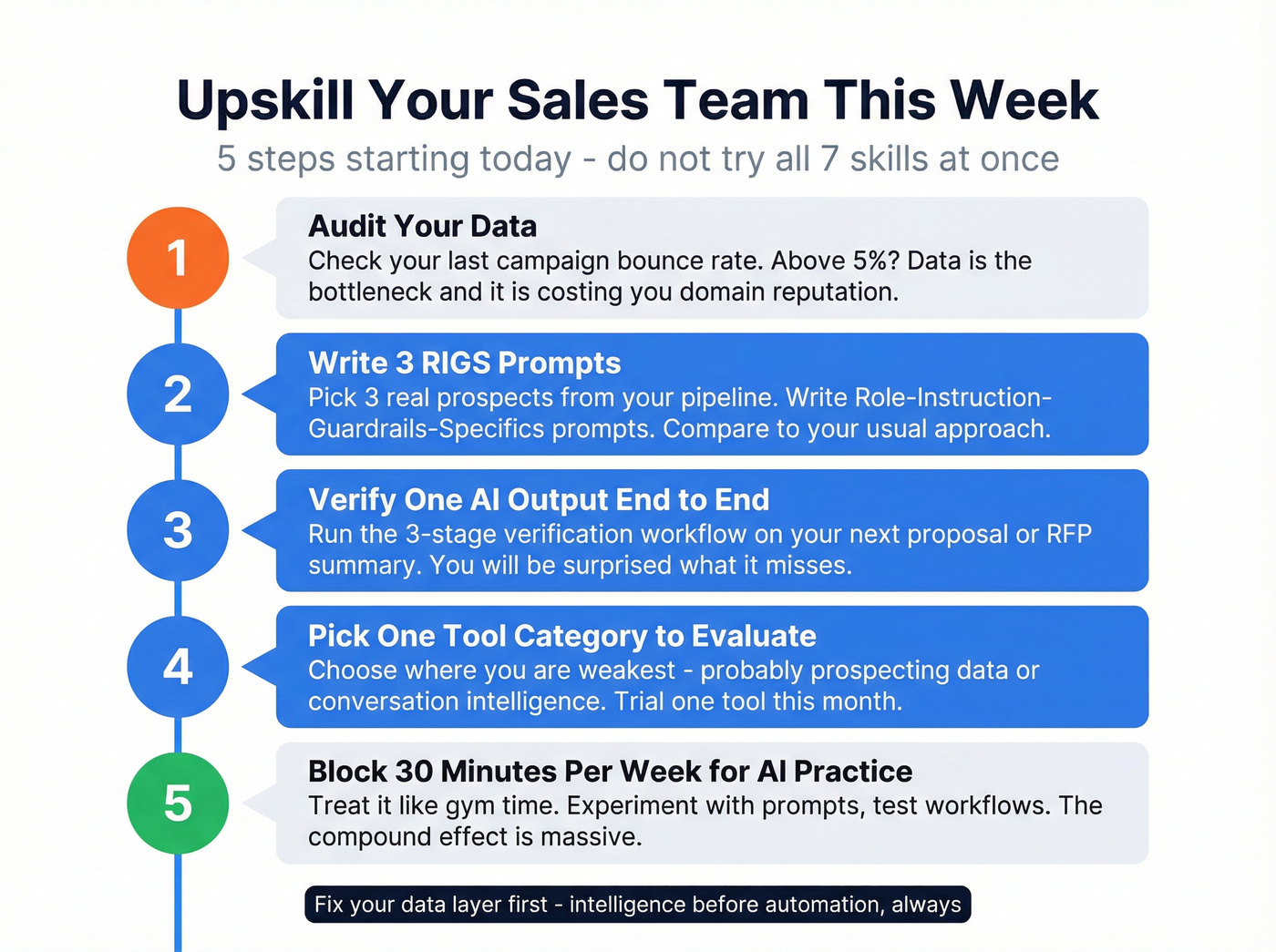
Audit your data. Check your last campaign's bounce rate. If it's above 5%, your data is the bottleneck - and it's costing you domain reputation with every send. (If you're seeing lots of bounces, start with the basics of hard bounce triage and prevention.)
Write three RIGS prompts. Pick three real prospects from your pipeline. Write a Role-Instruction-Guardrails-Specifics prompt for each. Compare the output to your usual approach.
Verify one AI output end-to-end. Take the next proposal or RFP summary your AI generates and run the three-stage verification workflow. You'll be surprised what it misses.
Pick one tool category to evaluate. Don't boil the ocean. Choose the category where you're weakest - probably prospecting data or conversation intelligence - and trial one tool this month. If you're already set on engagement but your bounce rates are ugly, skip the shiny new sequencer and fix your data first. (If you need a shortlist, start with sales prospecting platforms or cold email marketing tools.)
Block 30 minutes per week for AI practice. Treat it like gym time. Experiment with prompts, test new workflows, read what's working for other reps on r/sales and r/salestechniques. The compound effect is massive.
AI-powered research and account intelligence require real buyer signals, not stale records. Prospeo combines intent data across 15,000 topics, technographic filters, job-change signals, and 30+ search filters - so your AI stack works with precision data, not guesswork.
Feed your AI tools data that's 7 days fresh, not 6 weeks stale.
FAQ
Will AI replace sales reps?
AI replaces tasks, not people who develop the right capabilities. Estimates suggest AI will automate 67% of sales rep tasks but only 21% of managerial ones. Reps who learn to work alongside AI become more valuable. Those who don't adapt are the ones at risk.
What's the most important AI skill for a sales rep?
Prompt engineering and output verification, used together. A rep who writes precise prompts and catches AI mistakes will outperform someone who knows 10 tools but uses them at a surface level. Start with the RIGS framework and build from there.
How do I fix bad data before using AI tools?
Audit your bounce rate - anything above 5% means your data is costing you deals and domain reputation. A verified data source with a short refresh cycle keeps contact lists clean. Supplement with quarterly CRM deduplication and enrichment to maintain data hygiene over time.
How can I build AI fluency across my sales team?
Start with a shared prompt library and a weekly 30-minute practice session. Pair junior reps with AI-savvy teammates, run before-and-after comparisons on outreach performance, and measure adoption by output quality - not just tool logins. Consistent, low-friction practice builds fluency faster than any one-off training event.