Hunter Email Lookup: What Works, What Doesn't, and What to Use Instead
You upload 500 prospects and get emails back for 162 of them. That's Hunter email lookup's actual enrichment rate in independent testing - a 32.5% hit rate. An 11.2% hard bounce rate on top means a chunk of those emails won't even land.
Hunter is a decent tool for light email lookups, but most teams hit its ceiling faster than they expect. Here's the thing: if you're sending more than a few hundred emails a month, that bounce rate alone can wreck your domain reputation before you've booked a single meeting.
Quick version: Hunter works for light, email-only lookups, but its numbers mean most teams outgrow it fast. If you need verified emails plus phone numbers, skip to the alternatives section.
What Is Hunter Email Lookup?
Hunter is an email address finder built on a straightforward model: it crawls the public web, indexes professional email addresses, and predicts patterns for addresses it hasn't directly found. The database covers 100M+ professional email addresses, and every result includes the source URL and discovery date - a transparency feature most competitors skip.
You get three core methods to find and validate emails:
- Domain Search - enter a company domain, get a list of associated addresses with confidence scores and department filters.
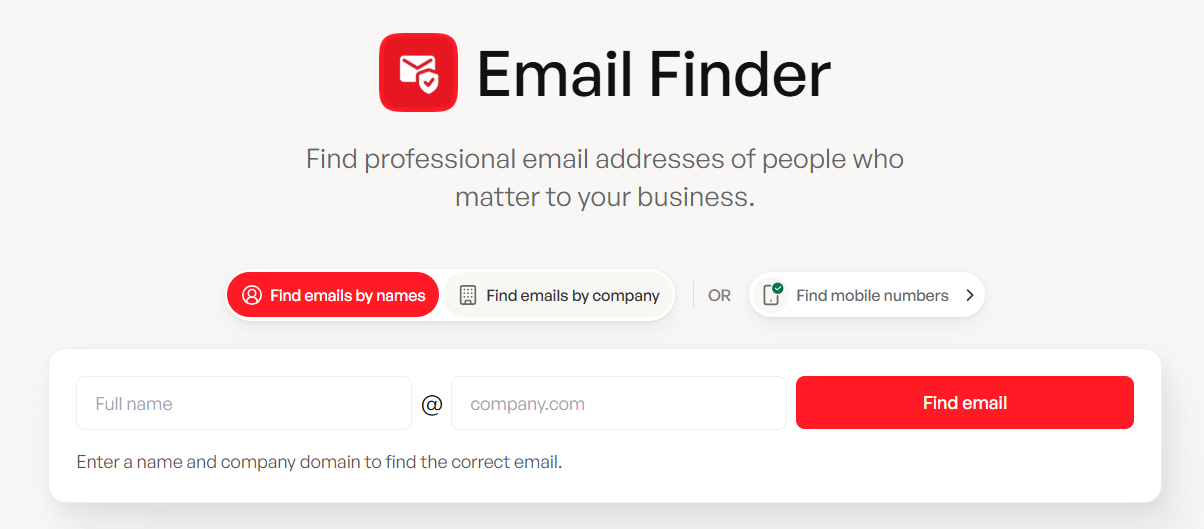
- Email Finder - provide a person's full name and company domain, get their specific email address back, already verified.
- Email Verifier - paste in any email address and Hunter checks whether it's valid, invalid, accept-all, or unknown.
Hunter's sourcing model is its biggest strength and its biggest limitation. Web-scraping and pattern prediction mean you can see exactly where data comes from. But the database only captures emails that appear publicly online, which leaves a lot of contacts uncovered.

How to Search Emails With Hunter
Domain Search
Use this when you know the company but not the specific person. Enter a domain like acme.com and Hunter returns every email address it's found associated with that domain, along with the person's name, title, and a confidence score. Filter by department - engineering, marketing, or sales - to narrow results. Each query costs 1 credit for up to 10 emails returned.
We've found this is Hunter's strongest feature. If you're building a prospect list for a target account, Domain Search gets you started fast.
Email Finder
Use this when you already know who you're looking for. Enter a full name and company domain, and the finder returns the most likely email address. The result comes back pre-verified with a confidence score, so you don't need to run it through the verifier separately. One credit per lookup, and if Hunter can't find an email, you don't get charged.
Email Verifier & Status Meanings
Hunter's verifier returns a few possible statuses, and understanding them matters for your deliverability:
- Valid - the email exists and accepts mail. Safe to send.
- Invalid - the address doesn't exist. Don't send. Ever.
- Accept-all - the recipient's mail server accepts everything regardless of whether the address is real. Hunter gives you a confidence score but can't guarantee delivery.
- Unknown - Hunter can't confirm the mailbox status, and you aren't charged.
Between 15-28% of B2B domains run catch-all configurations, so you'll see accept-all a lot.
Each verification costs 0.5 credits. If the status comes back "Unknown" or the address is disposable, no charge.
Bulk Processing & Chrome Extension
For volume work, Hunter supports CSV uploads of up to 50,000 contacts per file for bulk email finding and verification. The Chrome extension lets you pull emails from any website you're browsing - useful for quick one-off lookups when you're researching a prospect on the fly.

Pricing & Credit Economics
Hunter's pricing is credit-based, and the math matters more than the sticker price.
| Plan | Monthly | Annual (equiv.) | Credits/mo | Outreach Limit | Connected Accounts |
|---|---|---|---|---|---|
| Free | $0 | $0 | 50 | 500 | 1 |
| Starter | $49 | $34 | 2,000 | 2,500 | 3 |
| Growth | $149 | $104 | 10,000 | 5,000 | 10 |
| Scale | $299 | $209 | 25,000 | 15,000 | 20 |
| Enterprise | Custom | Custom | Custom | Custom | Custom |
All plans include unlimited users - your team shares one credit pool. Annual billing saves 30%.
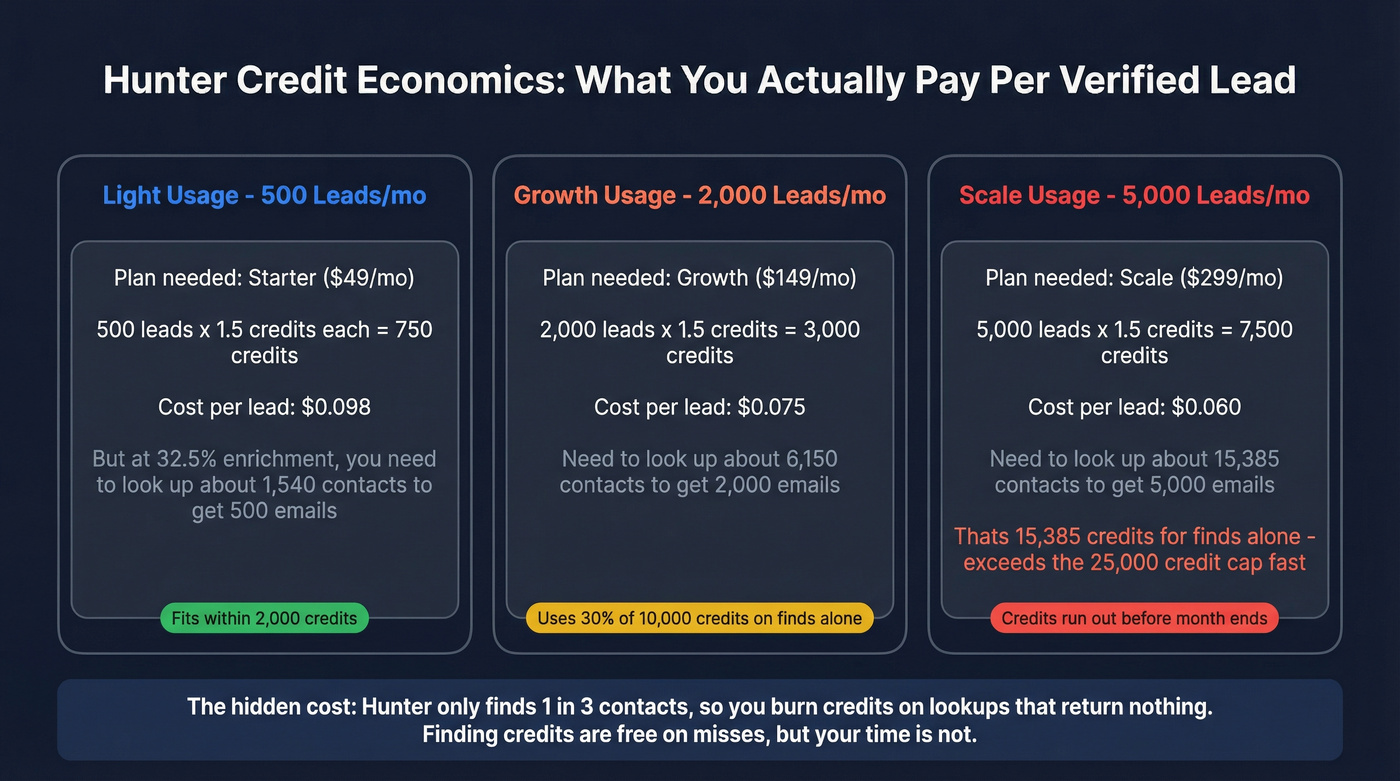
Here's where it gets tricky. Finding an email costs 1 credit. Verifying it costs 0.5 credits. One verified lead = 1.5 credits. On the Starter plan at $49/mo, 500 verified leads burn 750 credits, working out to about $0.037 per verified email. Not bad for light usage.
But the economics shift at scale. If you need 5,000 verified leads monthly, you're burning 7,500 credits - pushing you to the Growth plan at $149/mo. And that's before you account for Hunter's 32.5% enrichment rate. You'd need to look up 15,000+ contacts to actually get 5,000 emails back. Need extra connected email accounts for sending? That's another $10/mo each.
Is Hunter Email Search Accurate?
An independent benchmark by Dropcontact testing 20,000 contacts across 15 email-finding tools puts Hunter's results in context:
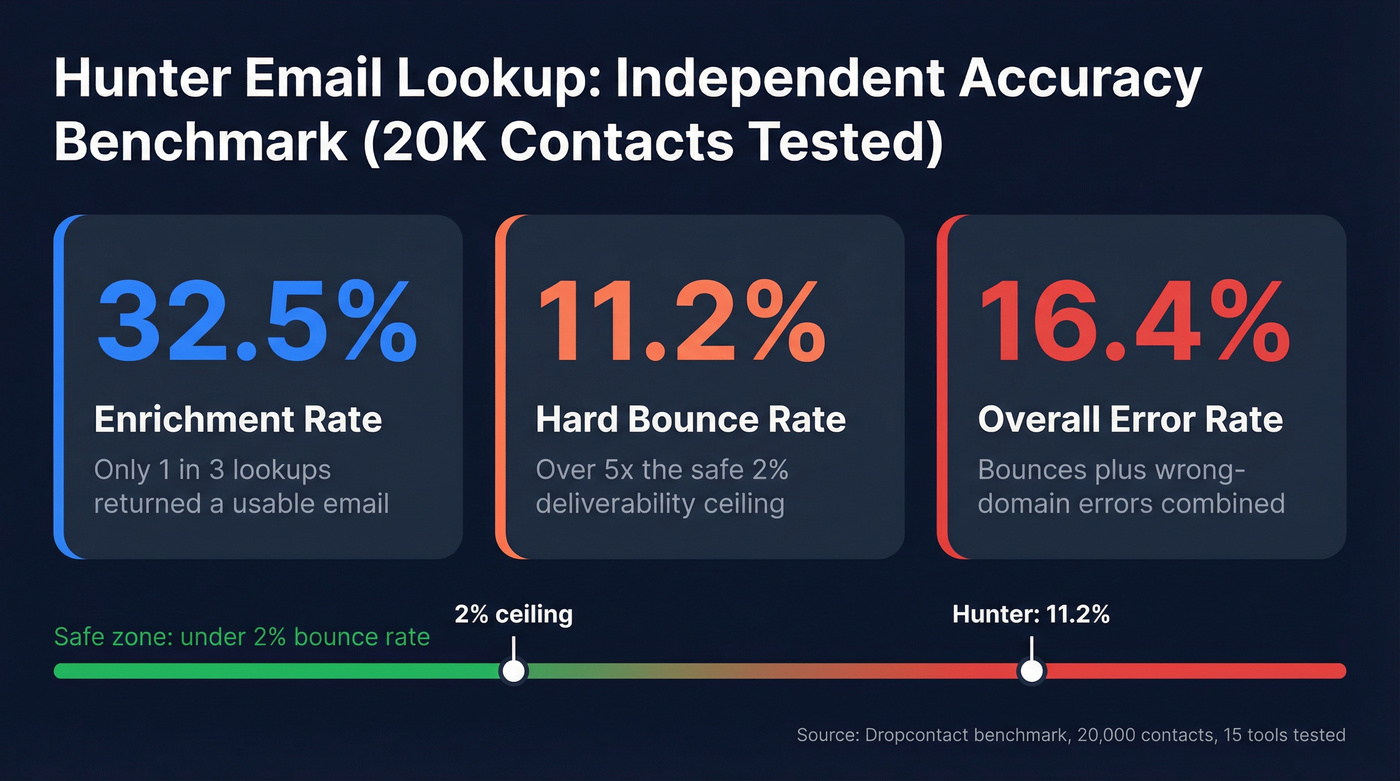
- Effective enrichment rate: 32.5% - Hunter found a usable email for roughly 1 in 3 lookups.
- Hard bounce rate: 11.2% - of the emails Hunter did find, more than 1 in 10 bounced.
- Overall error rate: 16.4% - combining bounces and wrong-domain errors.
A hard-bounce rate above 2% is the ceiling if you care about deliverability. Hunter's 11.2% is more than five times that threshold. That's not just a number - it's your domain reputation taking hits with every send.
The catch-all problem compounds things. When Hunter returns an "accept-all" status, it's saying "maybe." With 15-28% of B2B domains running catch-all configurations, you'll see that uncertain status constantly. The consensus on r/sales threads is pretty clear: Hunter works fine for small batches, but teams doing real outbound volume consistently report needing a second tool to backfill the gaps.
Let's be honest - Hunter is still a perfectly fine tool if you're a solo founder emailing 50 people a month. But the moment you're running outbound at any real volume, say 500+ prospects monthly, you're paying for a tool that can't find two-thirds of your contacts and bounces one in ten of the ones it does find. That math doesn't work.


Hunter's 32.5% enrichment rate means you're missing two-thirds of your prospects. Prospeo's 300M+ profile database returns verified emails at 98% accuracy - with an 83% enrichment match rate that triples Hunter's coverage. At $0.01 per email, you pay less and bounce less.
Stop losing prospects to a tool that can't find them.
API Quick Reference
Hunter's API is clean and well-documented - one of the tool's genuine strengths.
Base URL: https://api.hunter.io/v2/
Authenticate via query parameter (?api_key=YOUR_KEY), header (X-API-KEY), or Bearer token.
| Endpoint | Cost | Rate Limit |
|---|---|---|
| Domain Search | 1 credit / 1-10 emails | 15 req/sec |
| Email Finder | 1 credit / call | 15 req/sec |
| Email Verifier | 0.5 credit / call | 10 req/sec |
| Enrichment APIs | 0.2 credit / call | 15 req/sec |
Rate limits cap at 500 requests/min for search and 300/min for verification. There's no bulk API - each call processes one record. Handle 403 for rate limiting, 429 for usage limits, and 451 for legally restricted PII requests.
Where Hunter Falls Short
Use Hunter if:
- You need quick, occasional lookups for US/EU contacts
- You're a solo operator with under 500 prospects/month
- You want transparent sourcing - see exactly where each address was found
- You need a simple API for lightweight integrations
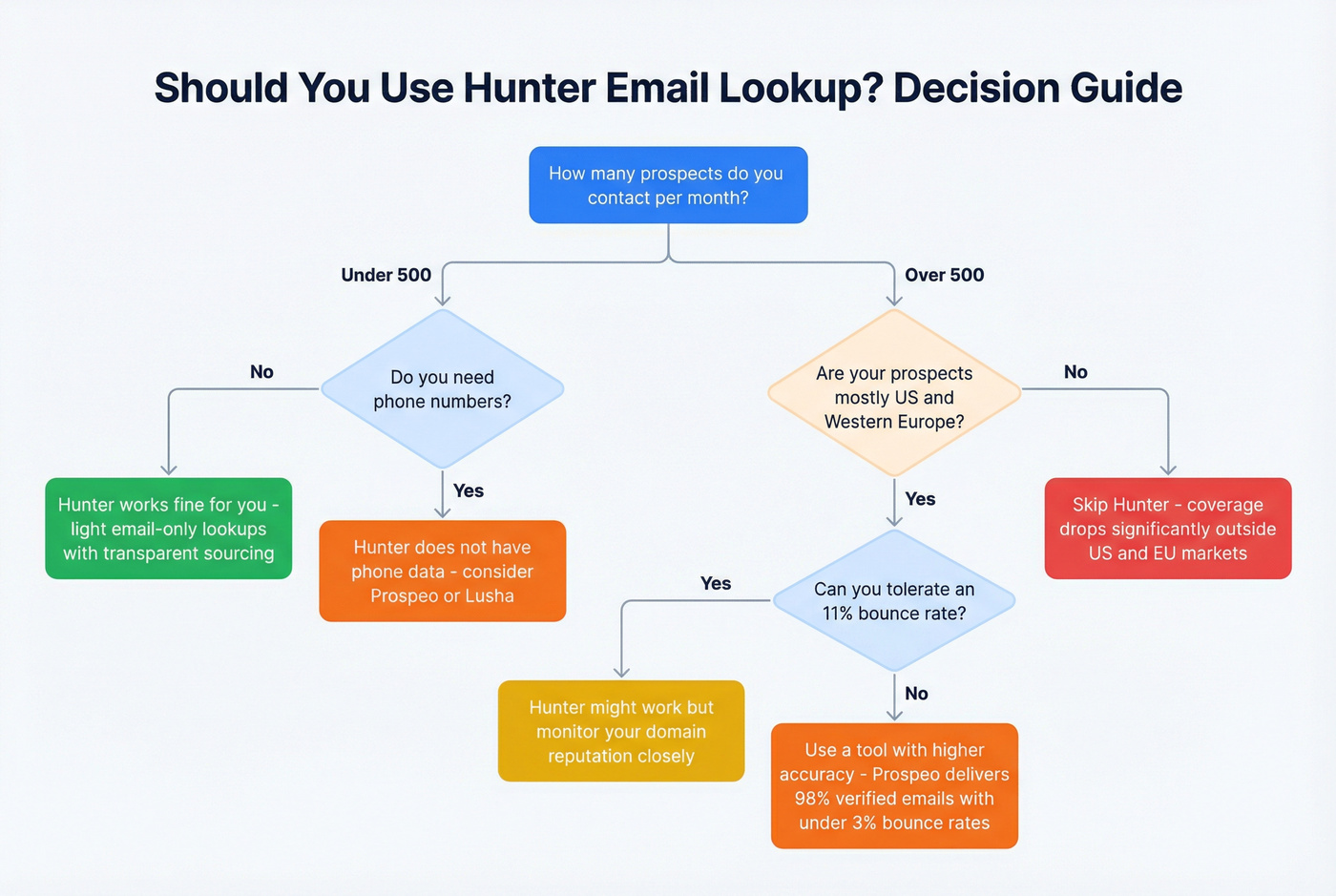
Skip Hunter if:
- You need phone numbers. Hunter is email-only, full stop.
- You're prospecting outside the US and Western Europe - coverage drops off in APAC, LATAM, and emerging markets because the web-scraping model depends on public web presence
- You need high enrichment rates - finding emails for 1 in 3 lookups doesn't cut it at scale
- You're running volume outbound - an 11.2% bounce rate will torch your domain
- You relied on the old professional network integration - Hunter removed it years ago, and the gap hasn't been filled
The fundamental constraint is Hunter's sourcing model. Web scraping only captures emails that are publicly listed, and that's a shrinking percentage of the professional email universe as companies tighten data privacy practices.
Better Alternatives to Hunter
| Tool | Verified Emails | Phone Numbers | Email Accuracy | Starting Price | Best For |
|---|---|---|---|---|---|
| Prospeo | 143M+ | 125M+ mobiles | 98% | Free / ~$0.01/lead | Accuracy + phones + freshness |
| Apollo.io | 275M+ | Yes (limited) | ~90% | Free / $49/user/mo | Sales intel + sequences |
| Snov.io | Not public | No | ~92% | Free / $39/mo | Finding + drip campaigns |
| Hunter.io | 100M+ | No | 11.2% hard bounce | Free / $49/mo | Light email-only lookup |
| Lusha | Not public | Yes (direct dials) | ~90% | ~$22/user/mo | Quick phone lookups |
| RocketReach | Large | Limited | ~88% | ~$39/user/mo | One-off exec lookups |
Prospeo
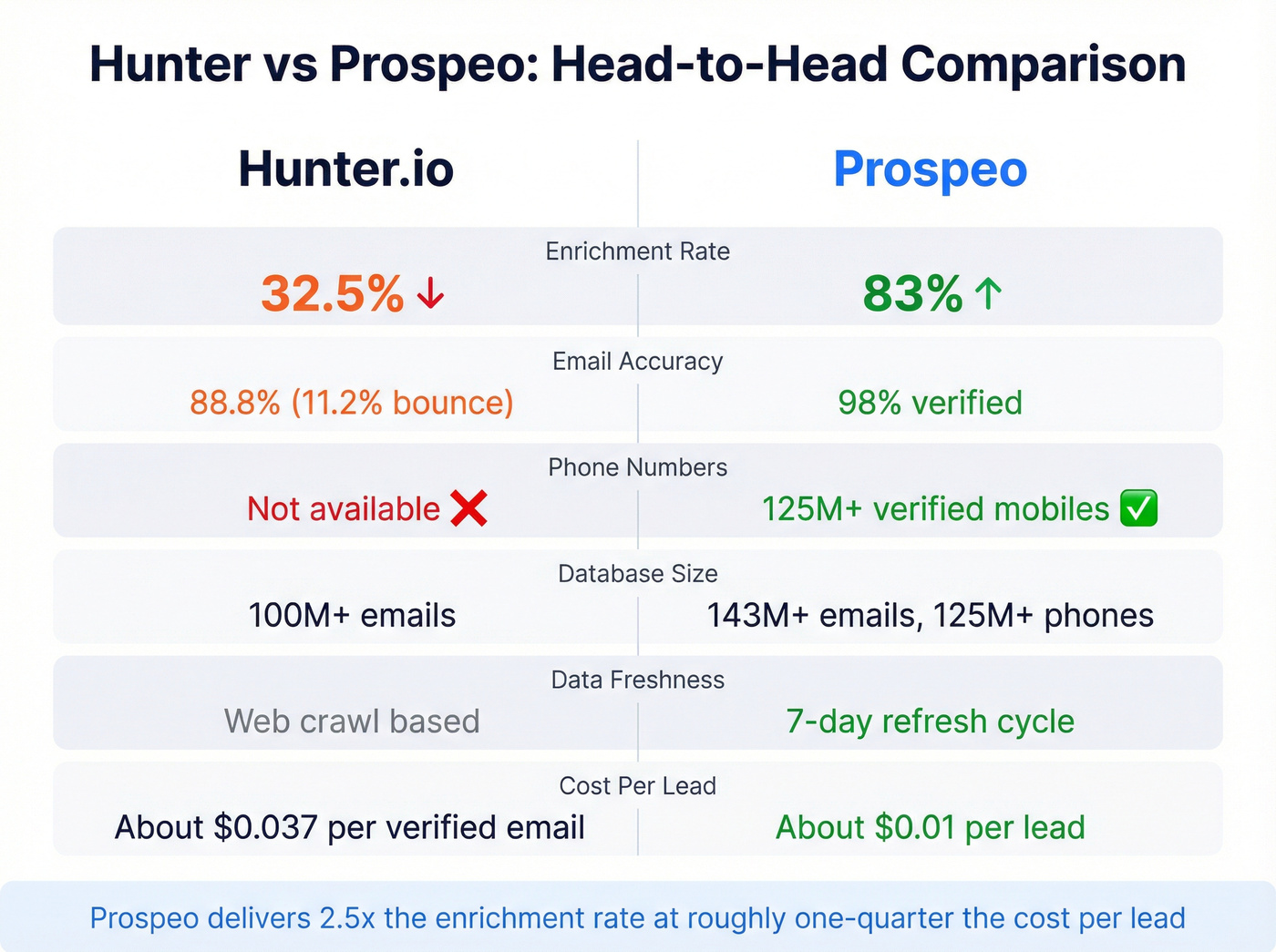
Where Hunter finds emails for 1 in 3 lookups, Prospeo's 92% API match rate and 83% enrichment match rate close the gap dramatically. The database spans 143M+ verified emails and 125M+ verified mobile numbers - that phone coverage alone fills Hunter's biggest gap. A 5-step verification process with catch-all handling, spam-trap removal, and honeypot filtering delivers 98% email accuracy on a 7-day data refresh cycle. The Chrome extension, used by 40,000+ people, works on any website or CRM - a direct upgrade from Hunter's extension since it returns phone numbers alongside emails.
The proof is in production results. Stack Optimize built from $0 to $1M ARR using Prospeo, maintaining client deliverability above 94% with bounce rates under 3% and zero domain flags. Pricing starts free with 75 emails + 100 Chrome extension credits per month, with paid plans at roughly $0.01 per lead. No contracts, self-serve onboarding, and native integrations with Salesforce, HubSpot, Smartlead, Instantly, and Lemlist.
Apollo.io
The real question with Apollo isn't whether it's good - it is - but whether you need everything it bundles. For a 10-person SDR team, you're looking at $6,000+/year before hitting usage caps, and that's just the $49/user/mo Starter tier. The database covers 275M+ contacts, the free tier is genuinely generous, and the built-in sequencer means you don't need a separate outreach tool. If you want an email finder with sales intelligence and sequences in one platform and don't mind per-seat pricing, Apollo is the obvious pick.
Snov.io
The best option for solo operators who want finding, verification, and drip campaigns behind a single login. Starter plan runs $39/mo for 1,000 credits. The workflow is dead simple: find, verify, send, all without switching tabs. It won't match the data depth of larger platforms, but for a one-person outbound operation, Snov.io keeps things lean.
Lusha
Two words: fast phones. Lusha's Chrome extension gets you direct dials in seconds, and that's really all you need to know. Pro plans start around $22/user/mo with credit-based access. Best for reps who live in their browser and need a number right now. Skip it if you're building large lists or need bulk prospecting - it's not built for that.
RocketReach
Steep pricing at $39-$249/user/mo, and we haven't tested it deeply enough to recommend for outbound at scale. Where it shines is one-off executive lookups - when you need the CEO's email for a specific deal and don't mind paying a premium. The value proposition narrows quickly outside that niche use case.
An 11.2% bounce rate destroys domain reputation. Prospeo's 5-step verification with catch-all handling, spam-trap removal, and honeypot filtering keeps bounce rates under 4% - even at scale. Plus you get 125M+ verified mobile numbers Hunter doesn't offer at all.
Protect your domain and reach prospects Hunter misses entirely.
Deliverability After the Lookup
Finding the email is step one. Getting it to the inbox is the actual game.
Verify before sending - always. Even "valid" emails from any tool should go through a dedicated verifier before hitting your sequences. A 2% bounce rate is the ceiling most ESPs will tolerate before throttling you.
Authenticate your domain with SPF, DKIM, and DMARC. These aren't optional anymore. Without them, you're fighting deliverability with one hand tied behind your back. Monitor bounce rates in real time - hard bounces above 2% mean your list quality is degrading, and you need to remove bad addresses immediately after every send.
Warm up new sending domains for 2-4 weeks minimum before running full-volume sequences. Rushing this is the fastest way to land in spam. And keep emails lean - Gmail clips content after 100KB, so strip unnecessary formatting and heavy images.
FAQ
Is Hunter.io free?
Yes, Hunter offers a free plan with 50 credits per month - roughly 33 verified emails after the 1.5-credit find-and-verify cost. Paid plans start at $34/mo on annual billing or $49/mo monthly for the Starter tier with 2,000 credits.
How accurate is Hunter email lookup?
An independent benchmark testing 15 tools across 20,000 contacts found Hunter's hard bounce rate was 11.2% with an effective enrichment rate of 32.5%. That means usable emails for about 1 in 3 lookups, and more than 1 in 10 of those bounced.
Does Hunter find phone numbers?
No. Hunter is strictly email-only and doesn't return phone numbers of any kind. For combined email and phone data, tools like Prospeo cover 143M+ verified emails and 125M+ verified mobiles in a single lookup, while Lusha specializes in quick direct-dial access.
What does "accept-all" mean in Hunter results?
The recipient's mail server accepts all incoming emails regardless of whether the specific address exists, so Hunter can't confirm delivery. With 15-28% of B2B domains running catch-all configurations, you'll encounter this status frequently - a key reason to use tools with dedicated catch-all handling.
What's the best Hunter alternative for accuracy?
For email accuracy specifically, look for tools with a 98%+ verified rate and a data refresh cycle measured in days, not weeks. Apollo.io is another strong option if you need built-in sequences, though per-seat pricing adds up fast. Snov.io works well for solo operators who want finding and outreach in one place.