When Should I Send a Follow Up Email? (2026 Timing Guide)
Most follow-ups fail for two boring reasons: they show up too soon (so you look needy) or too late (so you get buried under 200 other threads).
The fix isn't "be polite." It's having a simple timing rule per scenario, then sticking to it.
And yes, deliverability matters here more than people want to admit.
Quick answer: timing by situation
Use this as your default, then tweak it with the adjusters right under the table.

Checklist (fast rules)
- Cold outreach (no response): first follow-up in 2-3 business days.
- Warm intro / networking: 3-5 business days, but only if you're adding value.
- Client proposal / invoice / approval: 2 business days, then 7 days, then escalate to a call.
- Job application: follow up about two weeks after applying.
- After an interview: thank-you same day or next business day, then status check ~2 weeks if no timeline.
Mini-table: timing by scenario
| Scenario | First follow-up | Second follow-up | Stop point |
|---|---|---|---|
| Cold outreach | 2-3 biz days | +4-7 biz days | 3 follow-ups |
| Client/proposal | 2 biz days | +5 biz days | Day 14 close |
| Job application | ~2 weeks | +1 week | 2 follow-ups |
| Interview | next biz day | ~2 weeks | 2 checks |
| Networking | 3-5 biz days | +7-10 biz days | 2 touches |
Adjusters (the rules that prevent "pushy" follow-ups)
- Seniority: the more senior the person, the longer you wait. Execs get breathing room, and they punish spammy behavior faster.
- Urgency: if there's a real deadline, follow up 28-48 hours before it. Not daily.
- Promised timeline beats your cadence: if they said "Friday," you follow up after Friday, not "Day 3."
- Engagement signals: if they replied once, clicked, or asked for something, shorten the wait. You're not cold anymore.
- Risk + reward: follow-ups lift replies, but long sequences raise complaint risk. Keep it tight and purposeful.
If you got a bounce, a catch-all, or you're not sure the address is real, stop and verify before you follow up.
When should i send a follow up email? Use this decision tree first
Pick the branch that matches what you're doing, then apply the "business days" rule.
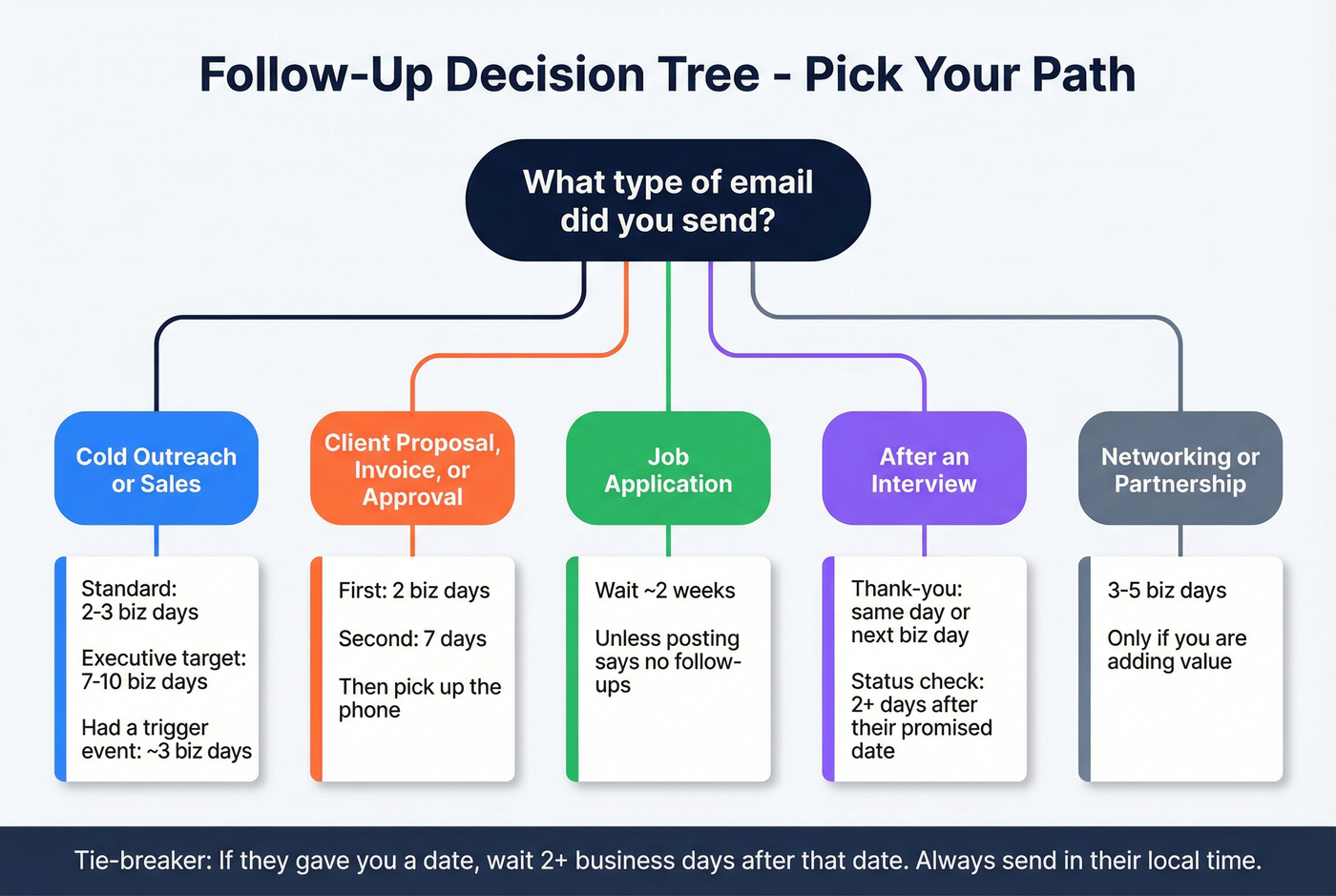
Decision tree (copy/paste logic)
Are you doing cold outreach / sales prospecting?
- Yes -> Follow up in 2-3 business days.
- If they're an exec -> wait 7-10 business days unless there's a real deadline.
- If you had a trigger (webinar attendee, inbound form, pricing page) -> follow up in ~3 business days.
Is this a client proposal, invoice, or stakeholder approval?
- Yes -> Follow up in 2 business days.
- If it's blocking work/cash -> follow up again at 7 days, then call.
Is this a job application (no interview yet)?
- Yes -> Follow up at ~2 weeks, unless the posting says "no follow-ups."
Was this after an interview?
- Yes -> Thank-you same day/next business day.
- Status check 2+ days after the date they promised (or ~2 weeks if they gave no timeline).
Is this networking / partnership / "quick intro"?
- Yes -> Follow up in 3-5 business days, but only with a value-add.
Tie-breaker rules (use these when you're unsure)
- Timeline rule: if they gave a date ("I'll get back to you Friday"), that date is your anchor. Follow up 2+ business days after it.
- Timezone rule: if it's outside their workday, wait until their next business day morning.
- Engagement rule: if they opened/clicked/replied once, shorten the wait by 1-2 business days because you're already on their radar.
Recipient-local-time rules (this beats "Tuesday at 10")
- Send in their local time: 8:00-10:00 or 1:00-2:00 works in most professional contexts. 4:00-5:00 can also work when people clear their inbox before end of day.
- Time-zone fairness: if you email after 3:00 pm their time, treat Day 0 as the next business day. Otherwise you're effectively asking for a same-day response.
- If you don't know their timezone: default to the company's HQ location.
Business days vs calendar days (don't mess this up)
- If your timing rule says "3 days," interpret it as 3 business days.
- Weekends and holidays don't count unless you're in a weekend-heavy industry (events, hospitality, urgent ops).
- If you send on Friday, 3 business days later is usually Wednesday.

You just dialed in your follow-up timing. But none of it matters if your emails bounce. Prospeo verifies every address through a 5-step process - catch-all handling, spam-trap removal, honeypot filtering - delivering 98% email accuracy. Stop following up into the void.
Verify before you follow up. 100 free credits, no card required.
Follow-up cadences that work (copy/paste schedules)
If I had to pick three cadences and ban everything else, it'd be these. They're simple, they're defensible, and they don't turn into inbox harassment.
Cadence comparison table (scenarios, wait windows, stop points)
| Scenario | Cadence (days) | Channel mix | Stop point |
|---|---|---|---|
| Cold outreach | 0 -> 3 -> 7 -> 14 | Email only | Day 14 close |
| Client/proposal | 0 -> 2 -> 7 -> 14 | Email + call | Day 14 close |
| Interview | +1 biz day -> ~14 | 2 status checks |

Cold outreach cadence (Day 0 -> Day 3 -> Day 7 -> Day 14 close)
Use this if: you're doing outbound and need a clean, repeatable rhythm for most prospects.
Skip this if: there's a hard deadline (event, end-of-quarter pricing, renewal). Compress it: Day 0 -> Day 2 -> Day 5 -> Day 9.
Here's the thing: follow-up #1 is your best shot.
In our experience running outbound for different ICPs, most sequences die because touch #2 is a "bump" that adds nothing, which trains the recipient to ignore you and trains spam filters to distrust you.
What to include in each touch (value progression)
- Day 0: one clear problem + one clear CTA (usually a 10-15 minute call or a yes/no). (If you want a stronger opener, borrow from these first lines.)
- Day 3: one new proof point or one sharp question. Keep it lighter than the first email.
- Day 7: handle one likely objection (timing, "already have a process," switching cost). If you need words for this, use a tight objection-handling script.
- Day 14: close the loop with an off-ramp ("Should I close this out?") or a reroute ("Who owns this?"). If you want more options, see follow up format.
Opinion: most cold sequences fail because follow-up #1 gets wasted on "just checking in." That's like using your best at-bat to ask the pitcher how their day is going.
Client/proposal cadence (Day 0 -> Day 2 -> Day 7 call -> Day 14 close)
Use this if: money or a decision is pending (proposal, invoice, approval).
Skip this if: you're waiting on a third-party dependency they can't control (legal review, procurement queue). Your job's to confirm the next milestone date, not to poke them every 48 hours.
What to include in each touch
- Day 2: a single decision CTA (approve / pay / pick a date) + a friction remover ("Reply 'approved' and I'll..."). If you want more conversion-focused wording, use a sales CTA.
- Day 7: escalation: call + email recap with the decision you need and the consequence ("We'll pause work until...").
- Day 14: close the loop: either park the project with a restart date or ask for a firm "no."
Day 7 is where you stop hoping email will magically do the job and you pick up the phone.
Interview cadence (next business day thank-you -> ~2 weeks status check)
Use this if: they didn't give a timeline, or the timeline slipped.
Skip this if: they told you "we'll update you by Friday." Wait until 2+ days after Friday.
I've seen candidates torch goodwill by following up too early after an interview. They're trying to show enthusiasm, but it reads like anxiety, and hiring teams already have enough noise in their inbox.
Timing rules by scenario (and what to say)
Timing isn't one-size-fits-all. Seniority, relationship temperature, and urgency change the clock.
Role/temperature timing that holds up in real life
- Top execs / key decision-makers: 7-10 business days
- Mid-level managers: 3-5 business days
- Warm leads: ~3 business days
- Hot leads with a deadline: follow up 28-48 hours before the deadline
Cold outreach / sales follow-ups (no response)
Woodpecker's follow-up benchmarks are a good "don't overthink it" reference: average reply rate sits around ~9% with no follow-ups, and ~13% when you add at least one follow-up. Among experienced senders, it's 16% with one email vs 27% with at least one follow-up, and their analysis also notes the first follow-up can drive a much bigger share of replies than the initial email. https://woodpecker.co/blog/follow-up-statistics/
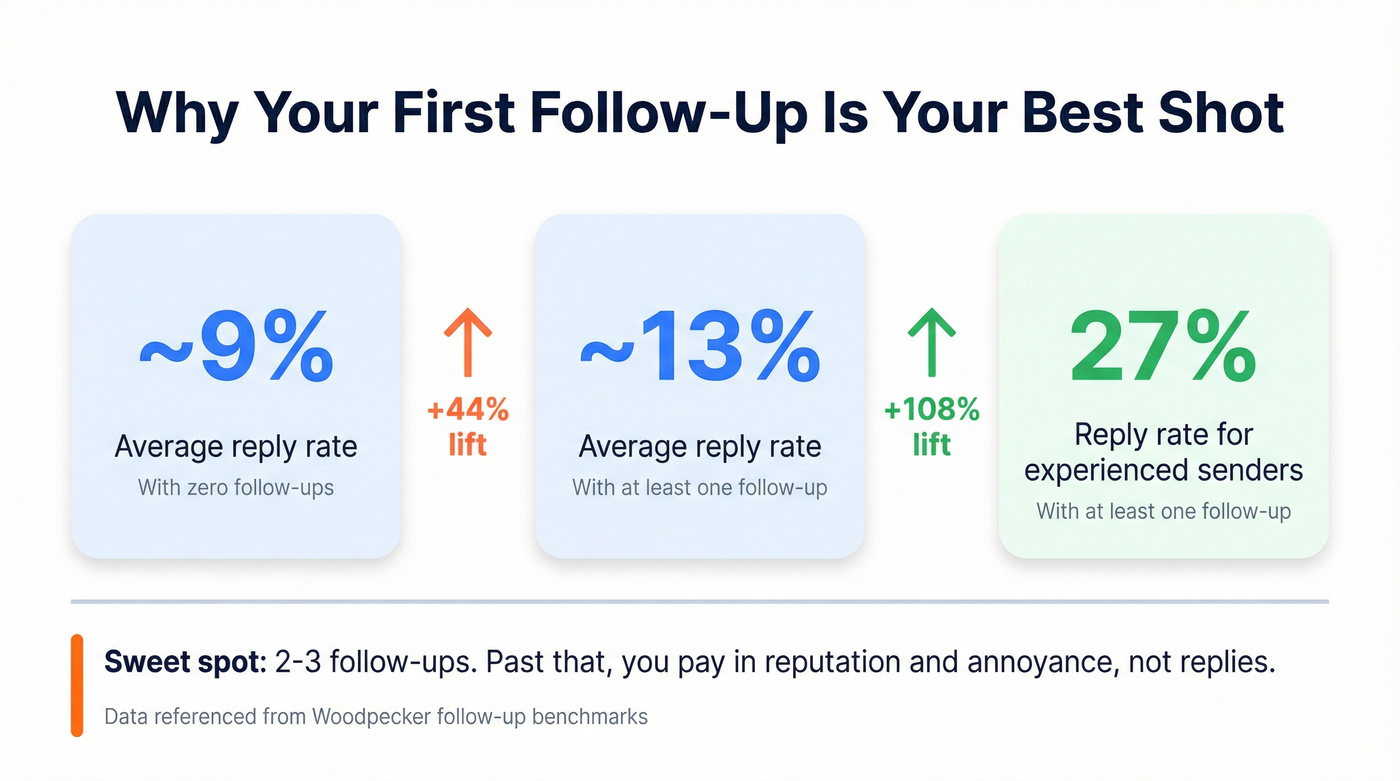
The practical takeaway: 2-3 follow-ups is the sweet spot. Past that, you're usually paying in reputation and annoyance.
Do
- Wait 2-3 business days for follow-up #1 (or 7-10 for execs).
- Make follow-up #1 a lighter lift than the first email: one question or one proof point.
- Keep the thread intact (reply in-thread) so they see context.
- Send during their business hours.
Don't
- Don't follow up the next day unless they're inbound/hot.
- Don't write "just checking in." It's content-free.
- Don't add new asks every time. Pick one CTA and stick to it.
Micro-template (follow-up #1 that actually earns a reply)
Subject: Re: [topic] "Quick one - if you're already handling [problem] internally, what's the tool/process you're using today? If not, I can send a 4-bullet outline of what we change to get [result]."
A quick scenario I've watched play out: one team ran a beautiful outbound list, but they hammered Day 1 and Day 2 follow-ups because "speed wins." Replies didn't go up. Complaints did. The copy wasn't the issue; the pacing was.
Client, proposal, invoice, or stakeholder approval
People go dark for boring reasons: they're slammed, they're waiting on someone else, or your email got buried. HubSpot has shared that a big chunk of professionals sit on 50+ unread emails, and that's enough to explain why proposals and invoices get missed even when the client likes you.
Use this if
- You need a yes/no to keep work moving: follow up in 2 business days with a clear CTA (approve, pay, pick a date, answer one question).
- If there's still no response by Day 7, call. Email's easy to ignore; a call forces a real update.
Skip this if
- You're missing a dependency (legal, finance, procurement). Then your follow-up is: "What's the next milestone date?" not "Any thoughts?"
Micro-template (client decision CTA)
Subject: Quick decision on [project] "Can you reply with A or B so we can keep momentum?
- A: proceed this week
- B: pause until [date] If there's a blocker, tell me the one thing to fix."
Job application follow-up (after applying, before interview)
Two weeks is the standard for a reason. Coursera's career guidance lands in that same window, and it matches how most hiring queues work: long enough to avoid looking impatient, short enough that you're still relevant.
Checklist
- Re-read the posting first. If it says no follow-ups, don't follow up.
- If you can identify the hiring manager, email them (not a generic inbox). (If you need help with that note, see how to email the hiring manager.)
- Keep it tight: 4-6 sentences, one reminder of fit, one ask.
Micro-template (job app follow-up)
Subject: Follow-up on [Role] application "Hi [Name] - I applied for [Role] on [date]. I'm still very interested, and I'm a strong match for [skill/requirement] based on [one outcome]. Is the team still reviewing candidates, and is there anything I can share that'd help?"
After an interview (thank-you + status check + second check)
Send the thank-you same day or next business day. It's not old-school etiquette; it's basic professionalism, and SHRM has repeatedly pointed out that thank-you notes still factor into hiring decisions because they're a signal of communication quality and follow-through.
Timeline that works
- Thank-you: same day or next business day
- Status check:
- If they gave a timeline: email 2+ days after the expected update date
- If they gave no timeline: email within ~2 weeks
- Second check: 5-7 business days after the first status check (then stop)
One sentence that keeps you sane: hiring timelines slip all the time, and it's usually not about you.
Networking / partnership / "quick intro" follow-ups
Wait 3-5 business days, then follow up only if you have something useful: a relevant intro, a short resource, or a forwardable summary.
Micro-template (networking value-add)
"Thought of you when I saw this: [link]. If it's not a priority right now, no need to reply - want me to circle back in a month?"
Best day/time to send a follow-up (myths vs what data says)
Myth: "Tuesday at 10 AM is the magic time."
Reality: obsessing over send time is usually procrastination.
What the data says
- Woodpecker's analysis suggests send time doesn't swing results enough to turn into a universal rule.
- Twilio SendGrid has published analyses where their team couldn't find a statistically significant "best open time" across broad datasets, which is a good reminder that audience variance beats internet folklore. https://www.twilio.com/en-us/blog/insights/the-best-time-to-send-your-email-campaign
- Siege Media's study of 85,000+ personalized emails found Monday and 6-9 AM PST performed best (2.8% reply rate). It's a useful signal, not a law of physics. https://www.siegemedia.com/marketing/best-time-to-send-cold-email
Operational rule (simple and effective)
- Pick a consistent window in recipient local time: 8:00-10:00 is a great default.
- Segment your audience (execs vs managers, US vs EU, inbound vs outbound) and A/B test windows, not random single times. If you want to systematize this, use AI send time optimization.
- For professional follow-ups, default to business hours unless you've got evidence your segment responds off-hours.
What to do before you follow up (so you don't look pushy)
If you don't have the right email address, timing doesn't matter. You can send the perfect follow-up on the perfect day and still get nothing because it bounced, hit a catch-all, or landed in spam.
Real talk: this is where most teams waste their best follow-up.
Pre-flight checklist (do this before follow-up #1)
- Reply in-thread. Don't start a new email.
- Use one clear CTA. One question, one next step.
- Add new info. A proof point, a relevant insight, or a "wrong person?" off-ramp.
- Check deliverability basics. If your domain's shaky, more follow-ups just digs the hole deeper. (If you want the full checklist, see email deliverability.)
- Verify the address. Unsexy step. Huge payoff. Use a proper email verification workflow.
We've tested this in outbound ops: cleaning the list before follow-up #1 often beats rewriting the copy, because fewer bounces and fewer risky addresses means more of your sequence reaches real inboxes and stays there. (It also helps to understand B2B contact data decay so you refresh before you send.)
Tools like Prospeo (The B2B data platform built for accuracy) make that workflow painless: 98% email accuracy, real-time verification, catch-all handling, spam-trap and honeypot filtering, and a 7-day data refresh cycle so your follow-up list doesn't rot between touches. Paste a URL or upload a CSV, verify, then export only valid addresses into your sequencer or CRM.
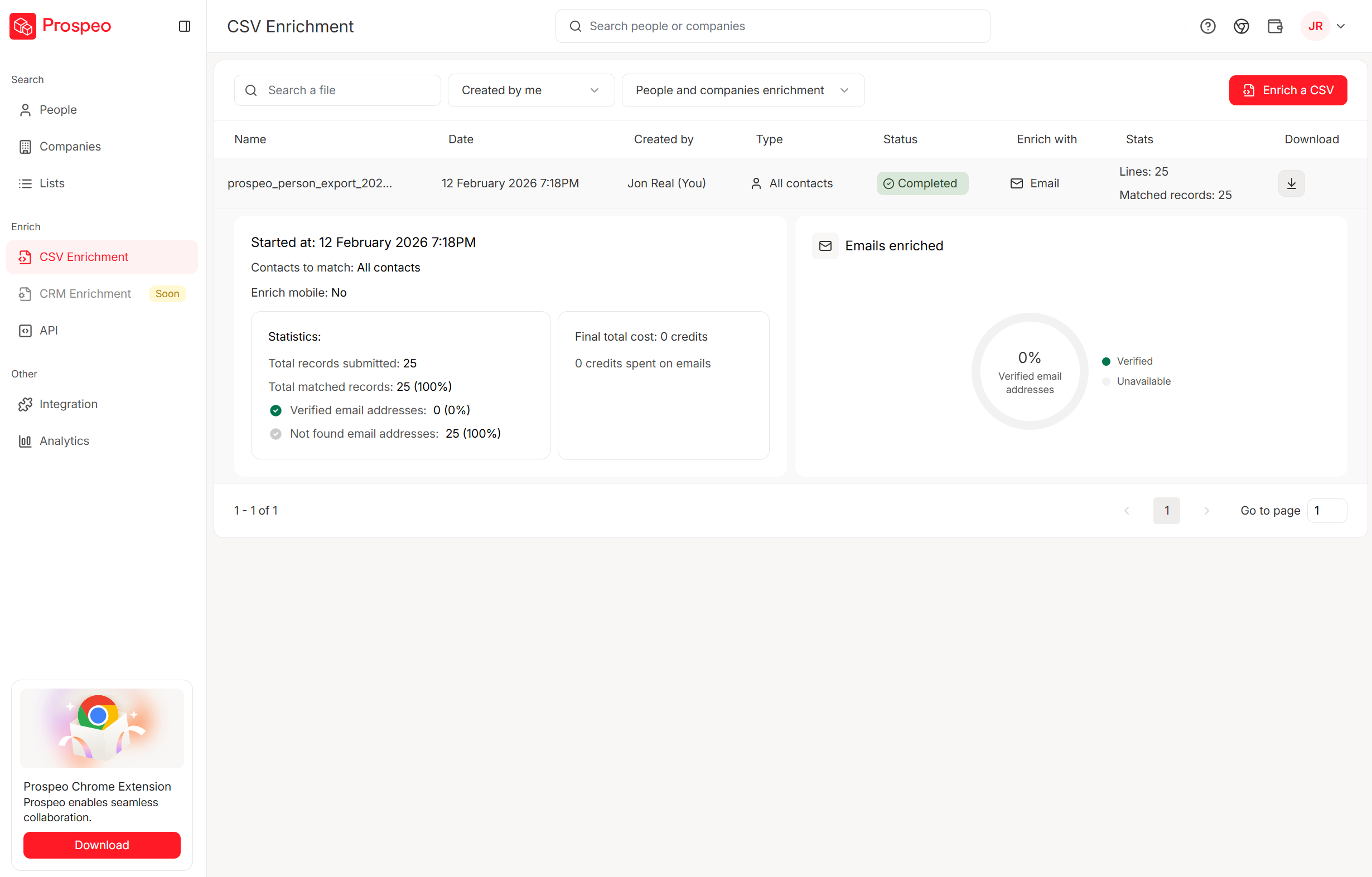
Bad data kills follow-up sequences before timing even enters the picture. Prospeo refreshes 300M+ profiles every 7 days - not every 6 weeks like competitors. That means the email you're sending Day 3 and Day 7 follow-ups to actually belongs to a real person at that company.
Fresh data turns your perfect cadence into actual pipeline.
When to stop following up (risk-based stop rules + breakup email)
Most people don't stop because they have a strategy. They stop because they feel awkward.
Use rules instead.
Belkins analyzed 16.5M cold emails across 93 domains (Jan-Dec 2024) and found a nasty tradeoff: once you hit 4+ emails in a sequence, unsubscribe and spam-complaint risk more than triples. They also found the highest reply rate came from a single email, and replies tend to decline as you add follow-ups, which is exactly why follow-ups should be about recovering misses, not brute-forcing attention.
Saleshandy has a practical rule I agree with: stop after 3-5 attempts. For cold outreach specifically, I keep it tighter: max 3 follow-ups (so 4 total emails including the first).
Stop matrix (by scenario)
| Scenario | Hard stop | Escalation | What "done" looks like |
|---|---|---|---|
| Cold outreach | 4 total emails | Switch channel after 2-3 touches | Day 14 close email |
| Client/proposal | Day 14 close | Call by Day 7 | Park until a date |
| Interview | 2 status checks | None (unless invited) | Final polite check |
| Job application | 2 follow-ups | None | Move on + keep door open |
| Networking | 2 touches | None | Leave it friendly |
Stop rules (use whichever triggers first)
- You've sent 4 total emails (initial + 3 follow-ups) with no engagement.
- The context is stale (event passed, role changed, quarter ended).
- You're not adding anything new.
- You got a soft "no" signal (asked to revisit later, not the right person, no priority).
Breakup email rule: your last email should make it easy to say "no," and easy to route you to the right person.
Breakup email (short):
Subject: Close the loop? "Should I close this out for now? If someone else owns [area], I'm happy to reach out to them instead."
What to do after you stop (so "no reply" still becomes progress)
- Tag the outcome in your CRM (no response / not now / wrong person).
- Set a 60-90 day reminder to re-engage with a new trigger (job change, funding, new initiative).
- Switch channels once, cleanly: one social touch or one call can outperform email-only persistence.
- Add to low-frequency nurture: a monthly resource email beats weekly "checking in" forever.
Edge cases (the "it's been 3 weeks" anxiety scenarios)
- Holidays: treat holiday weeks as half-weeks. If you emailed the week of a major holiday, restart your count the next full business week.
- OOO autoresponder: follow up on the return date + 1 business day, and reference it ("Noted your OOO - welcome back.").
- They said "next week" and it's now 3 weeks: send a calm timing check: "Wanted to re-sync on timing - should I expect an update this week, or has the timeline shifted?"
- Multi-threading: if you're stuck, loop in one additional stakeholder with context once. Don't CC-bomb. (If you need a clean method, use ABM multi-threading.)
Templates: follow-ups that add value (not "just checking in")
Steal these. They're short on purpose.
Value-add menu (pick one per follow-up)
- New insight: "Noticed [trigger] - here's what it usually breaks."
- Proof point: one metric, one sentence.
- Answer a likely objection: price, timing, switching cost, risk.
- Two time options: reduce back-and-forth.
- Forwardable summary: 4 bullets they can send internally.
Template bank (mapped to scenarios)
Cold outreach follow-up #1 (Day 3) - proof point
Subject: Re: [topic] "Quick follow-up - we helped a [similar company] cut [metric] by [result] in [time]. Worth a 10-min chat, or should I talk to someone else on your team?"
Cold outreach follow-up #2 (Day 7) - objection handling
"Common pushback is 'we already have a process for this.' If you're open, I can share a 4-bullet comparison of what teams change to get results faster. Want it?"
Cold outreach follow-up #3 (Day 14) - breakup
"Last note from me - should I close this out? If timing's bad, reply with a month and I'll follow up then."
Two time options (works for sales, clients, and interviews)
Subject: Quick scheduling question "Want to make this easy - does either of these work?
- Tue [date] at [time] [their timezone]
- Thu [date] at [time] [their timezone] If not, send two times that do and I'll lock it in."
"Wrong person?" redirect (high reply rate, low friction)
Subject: Re: [topic] "Am I reaching the right person for [area]? If not, who should I talk to - [role/title] or someone else?"
Client proposal follow-up (Day 2) - clear CTA
"Can you reply 'approved' and I'll send the next-step checklist - or tell me the one concern to address so we can finalize?"
Invoice follow-up - low-friction
"Quick check: is invoice #[X] queued for payment? If you need a PO number or vendor form from us, tell me what to send."
Interview thank-you - specific callback
"Thanks again - I enjoyed the discussion about [topic]. I'm excited about the role because [reason tied to their need]. If helpful, I can send a quick outline of how I'd approach [project]."
Interview status check - timeline-based
"Checking in on next steps. You mentioned an update around [date]. Should I expect news this week, or is there a new target date?"
Networking follow-up - value-add
"Sharing this because it's relevant to what you mentioned: [resource]. If it's useful, great. If not, no need to reply."
FAQ
How long should I wait before sending a second follow-up?
Wait 4-7 business days after your first follow-up for cold or general professional emails. For interview status checks, wait 5-7 business days after your first check. If they gave a promised date, ignore the math and follow up 2+ business days after that date.
How many follow-ups is too many?
For cold outreach, more than 3 follow-ups (4 total emails) is where you start paying real risk in unsubscribes and spam complaints. Belkins' dataset shows 4+ emails more than triples complaint risk. Keep sequences tight, then close the loop and move to nurture.
Should I follow up on a Monday or midweek?
Monday can work, but there's no universal best day. Woodpecker found send time doesn't swing outcomes much, and Twilio's analysis sometimes finds no statistically significant best open time. Use recipient local time, pick a consistent window, and optimize relevance and CTA clarity.
What should I write if I don't have anything new to add?
If you've got nothing new, don't send a content-free nudge. Send a decision email: ask a yes/no question, offer two time options, or use a "wrong person?" redirect. Your goal's to make replying easier than ignoring, without adding pressure.
What if I'm not sure the email address is correct?
Don't follow up blindly - verify first. A stale or catch-all address makes perfect timing useless and can hurt deliverability with bounces.
If you're still asking when should i send a follow up email, pick the scenario table, use business days, anchor to any promised timeline, and stop at the stop rule. Then make the next round easier: verify addresses before follow-up #1, and move non-responders into a calm 60-90 day nurture instead of endless nudges.