

Follow Up Format That Works in 2026 (With Examples)
Most follow-ups fail for one boring reason: they don't give the reader anything new to react to. It's the same ask, the same vague nudge, and the same "just checking in" filler - dressed up with a different subject line.
A reusable follow up format fixes that. Not a "template," a format: a few blocks that force clarity, a real reason to send today, and one clean decision the other person can make in five seconds.
We've tested this structure across cold outbound, warm intros, proposal chases, and internal pings. It keeps you honest, and it keeps you out of the "spam with manners" zone.
What you need (quick version)
- Keep it 50-125 words. Boomerang's analysis of 40M emails found that range earns the highest response rates. In practice, it's enough room for context + one useful line + a clear ask, without forcing a scroll.
- Use one clear ask + a "why now." If you can't name a real why-now, don't send the follow-up.
- Subject lines: 3-7 words. That length survives mobile truncation and looks like a real message, not a campaign. (If you want more options, see subject lines.)
- Cap your cadence + enforce stop rules. Belkins' 16.5M-email dataset found that 4+ emails in a sequence triples unsubscribes and drives more than 3x spam complaints. That's not "a bit annoying." That's reputation damage.
- Deliverability basics aren't optional. Yahoo requires authentication (SPF/DKIM/DMARC), easy unsubscribe, and low complaint rates. Bad list hygiene turns "follow-up" into "complaint."
Here's the thing: if your follow-up doesn't contain new information (timing, trigger, proof, or a sharper question), it's not a follow-up. It's noise.
The canonical follow-up email structure (copy/paste blueprint)
The simplest structure that keeps working is context → why now → ask. But if you stop there, you can sound transactional, like you're moving a deal object through a pipeline instead of talking to a person.
So we add two small pieces: a single value line (specific, not a pitch) and a clean close.
The 5 blocks (with word-count targets)
1) Context (8-18 words) Remind them what this is about. No guilt. No "bumping this."

2) Why now (8-18 words) A real reason you're following up today (timing, deadline, new info, trigger event, quick question).
3) Value (12-30 words) One concrete benefit, proof point, or relevant insight. Not a feature dump.
4) Ask (6-16 words) One action. One CTA. Make it easy to say yes/no. (More on building a clean ask: Sales CTA.)
5) Close (3-12 words) Polite, low-friction sign-off. Optional "either way" line.
Hard constraints (the "spec" part):
- One email = one decision. If you've got two CTAs, delete one.
- No "checking in." Replace it with a why-now trigger or a sharper question.
- If you must cut to ~60 words: compress Value to a single clause; never cut Ask.
- PS rule: a PS is allowed for one proof point (a metric or relevant customer). Never use PS as a second CTA.
Zendesk's framing is the right vibe: follow-ups should be courteous and usually quick - value + next step, not a re-pitch.
Fill-in-the-blanks template (copy/paste)
Subject: Quick question on [topic]
Hi [First name] - quick follow-up on [original context: meeting / note / proposal / intro].
Reason I'm reaching out today: [why now: timing trigger in 1 sentence].
If it helps, [value: 1 specific outcome / example / insight tied to their role].
Would you be open to [ask: 15-min call / reply with yes/no / point me to owner]?
Thanks - [Your name]
"Why now" triggers that don't feel pushy
Pick one. Don't stack them.
- Time-bound: "We're finalizing next week's rollout plan on Friday."
- New info: "We just saw
[relevant change]and it affects[their goal]." - Decision point: "Do you want me to send a short proposal, or pause?"
- Routing: "If you're not the right person, who owns
[area]?" (More routing scripts: ask for the right contact person.) - Permission-based: "Should I close the loop for now?"
Trigger-based "why now" (the highest-performing category)
If you've got a real engagement signal, use it. It's the cleanest justification for following up because it's anchored in their behavior, not your calendar.

Use these as your why-now line:
- Doc viewed: "You (or someone on your team) opened the rollout plan yesterday."
- Link clicked: "You clicked the security overview - want the 1-page FAQ too?"
- Pricing/product page visit: "Noticed you checked pricing - should I send a quick fit check?"
- Trial / POC milestone: "You're on day 10 of the trial - want a 2-step setup to hit value faster?"
- Webinar/event attendance: "Saw you joined the webinar - want the 3-slide summary for your team?" (If you run this motion, see webinar lead follow-up.)
- Job change / new role: "Congrats on the new role - want the quick 'first 30 days' playbook?"
Two examples using the same 5-block spec:
Example C: doc view follow-up (≈85 words)
Hi Taylor - quick follow-up on the onboarding plan I sent Monday.
Reaching out today because the doc was opened yesterday and I want to make sure it answered the right questions.
If it helps, the fastest path is a 2-step rollout: start with [step 1], then [step 2] to hit [metric] in week one.
Want me to tailor the plan to your current stack, or should I send the short checklist version?
Thanks,
Sam
Example D: trial milestone follow-up (≈95 words)
Hi Jordan - following up on your trial setup for [product/workflow].
Reason I'm reaching out today: you're at day 10, and this is where most teams either lock in value or stall.
The one move that changes outcomes is connecting [system] so [result] shows up automatically.
Do you want a 10-minute walkthrough, or should I send a 3-step setup guide you can forward internally?
Best,
Sam
Two more examples (same format, different intent)
Example A: after sending a proposal (≈90 words)
Hi Maya - following up on the proposal I sent Tuesday for [project].
Reason I'm pinging today: we're holding implementation time for next week.
Teams like yours care most about [metric] and [risk], so I included a one-page rollout plan.
Do you want to review it together for 15 minutes Thursday, or should I revise first?
Thanks,
Sam
Example B: no response to an intro email (≈70 words)
Hi Chris - quick follow-up on my note about helping [company] reduce [pain].
Reaching out today because you're hiring for [role], which usually means this problem's getting louder.
We cut [time/cost] by [range] in the first month.
Worth a quick yes/no: should I send 2-3 relevant examples?
Best,
Sam
Non-negotiable formatting rules (data-backed)
Boomerang's 40M-email analysis is the best general benchmark we've got for "emails that get responses," and it matches what we see in real sequences: short, clear, slightly human beats long and polished.
One more opinionated note: if your follow-up reads like a brochure, it belongs on your website, not in someone's inbox.
Do / Don't (the stuff that actually moves replies)
Do: stay in the 50-125 word zone. It's the sweet spot for context + value + CTA without forcing a scroll.

Don't: write a mini-essay. At 200-400 words, you're asking for attention you haven't earned.
Do: use slight sentiment (not neutral robot tone). Slightly/moderately positive or negative language gets more replies than neutral.
Don't: go overboard on enthusiasm. "Excited!!!" reads like marketing and performs like it.
Do: write for a 3rd-grade reading level. That's clarity, not condescension. Simple sentences win.
Don't: hide the ask in a paragraph. If your CTA is sentence #7, you've already lost.
Do: make it scannable. 1-2 sentence paragraphs. One optional bullet list max.
Don't: stack multiple CTAs. "Can we meet?" + "Should I send info?" + "Who's the owner?" = decision fatigue.

The best follow-up format in the world won't save you if you're sending to dead inboxes. Prospeo's 5-step email verification delivers 98% accuracy - so your carefully crafted "why now" line actually reaches the person who needs to read it. At $0.01 per email, bad data is no longer an excuse for bounced follow-ups.
Stop perfecting copy that bounces. Start with emails that land.
Subject line format that gets opened (and stays in-thread)
For 2026 inboxes, 3-7 words is the sweet spot: it survives mobile truncation and doesn't look like a newsletter. (More ideas here: reminder email subject lines.)
Threading rules (this matters more than people admit):
- If you're following up on the same request, reply in-thread. Keep the same subject so it groups.
- Start a new subject only when the topic changes. New problem, new value, new ask.
- Don't "RE:" a cold email manually. It looks fake and burns trust.
Reusable subject line formulas:
| Scenario | Formula (3-7 words) | Example |
|---|---|---|
| No response | Quick follow-up on [topic] |
"Quick follow-up on onboarding" |
| After proposal | [Proposal] next step |
"Proposal next step" |
| Scheduling | 15 min this week? |
"15 min this week?" |
| Routing | Who owns [area]? |
"Who owns rev ops?" |
| New info | Update on [trigger] |
"Update on your hiring" |
| Value drop | [idea] for [goal] |
"Idea for faster renewals" |
| Deadline | Before [date] |
"Before Friday" |
| Confirmation | Should I close this? |
"Should I close this?" |
| Meeting recap | Recap + next steps |
"Recap + next steps" |
| Breakup | Close the loop? |
"Close the loop?" |
Cadence: when to send follow-ups (and when to stop)
Belkins' 16.5M-email dataset has one brutal takeaway: your first email does most of the work. They saw the highest reply rate with one email: 8.4%.
Follow-ups help, but they aren't free. Once you hit 4+ emails, unsubscribes triple and spam complaints go past 3x. If you're doing outbound at scale, that isn't a "copy problem." It's a domain reputation problem.
When NOT to follow up (trust rules)
Don't send the follow-up if any of these are true:
- They gave you a timeframe and it hasn't passed. If they said "next week," don't check in on Wednesday.
- They're out of office. Don't follow up twice to an OOO. Wait until the return date + 1 business day.
- They replied "no," "not interested," or "remove me." Suppress and move on.
- Your only reason is "touching base." No why-now = no send.
- You're escalating emotion. If you're annoyed, stop. Annoyed follow-ups read like threats.
Real talk: the fastest way to sound unprofessional is to send a follow-up you wrote while irritated.
Decision tree (simple stop rules)
- If they replied: stop sequence, respond like a human.
- If they clicked or viewed a doc: send one follow-up with a single question, then stop.
- If you've sent 3 follow-ups with no signal: send a breakup/close-the-loop email, then stop.
- If you got an unsubscribe or "not interested": stop immediately (and suppress).
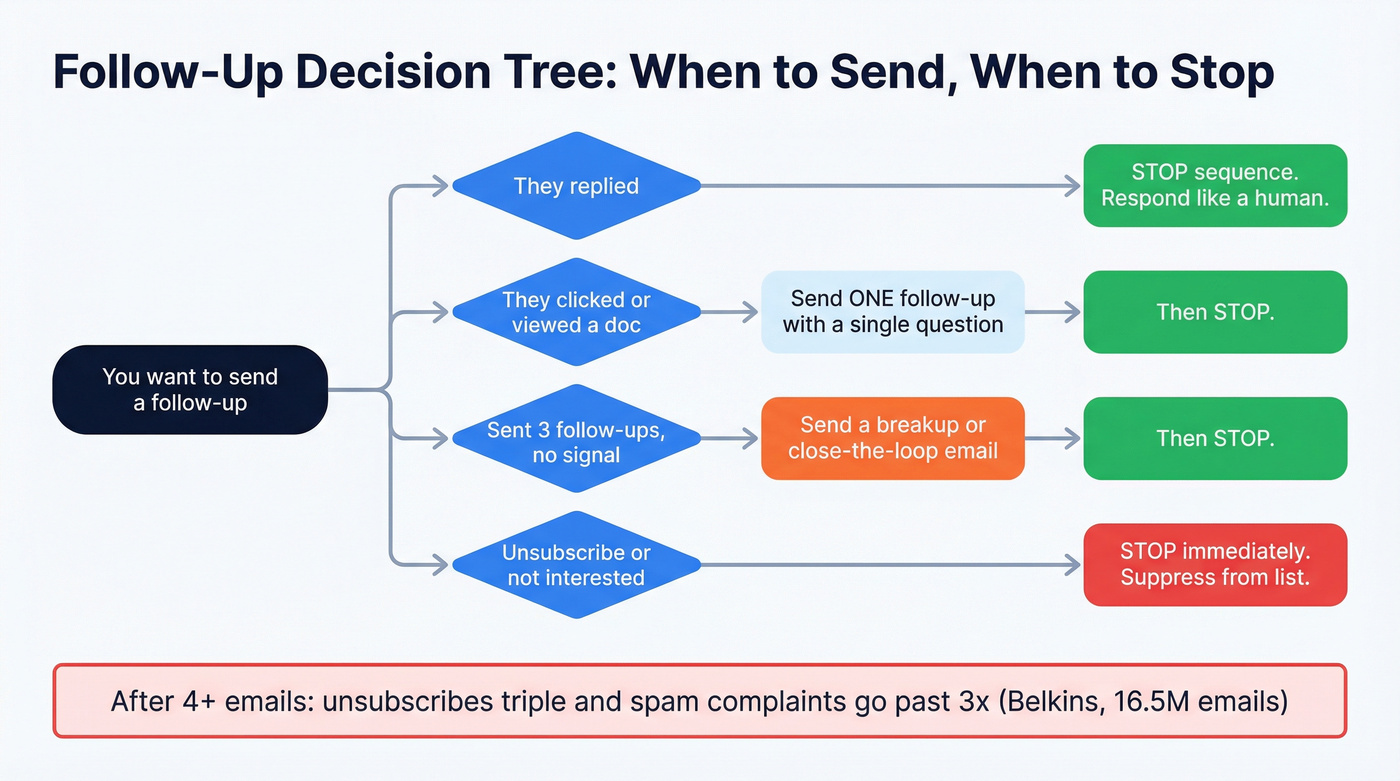
Default timeline (safe for most B2B)
| Day | Touch | What changes |
|---|---|---|
| 0 | Email #1 | Primary ask |
| 2 | Follow-up #1 | Why now + same ask |
| 5 | Follow-up #2 | New value + same ask |
| 9 | Follow-up #3 | Routing or yes/no ask |
| 14 | Breakup | Close loop + stop |
Notes that matter:
- Reply in-thread for the whole sequence unless the topic changes.
- Enterprise: tighten the sequence (fewer touches, more context). They complain faster.
- High volume: cadence isn't your biggest lever - relevance and list quality are. Cadence just determines how fast you burn reputation when relevance is weak. (If you're tuning this, use an email cadence definition + ruleset.)
Worked teardown: "lint" a follow-up before you send it
Here's a real-world way to improve a follow-up in 60 seconds: label each sentence as one of the 5 blocks. If you can't label it, delete it.
I've watched teams argue for 20 minutes about subject lines, then send a follow-up with no why-now and two CTAs. Fix the structure first.
Before (messy, common)
Subject: Checking in
Hi Priya, Just checking in on my last email. We help teams streamline onboarding and improve retention with our platform. Would love to connect sometime this week to tell you more. Let me know what works.
Thanks, Sam
After (same intent, now it follows the spec)
Subject: Onboarding question
Hi Priya - quick follow-up on my note about your onboarding workflow. (Context - 10 words) Reaching out today because you're hiring 3 CSMs this quarter. (Why now - 10 words) That's the moment onboarding either gets standardized or turns into tribal knowledge. (Value - 13 words) Open to a 10-minute call Thursday, or should I send a 5-bullet plan? (Ask - 18 words) Either way, happy to close the loop. (Close - 8 words)
What changed (and why it works):
- The "platform" pitch got cut. The value is tied to their situation.
- The ask is one decision (call or send plan). No third option.
- The why-now is specific and believable. No guilt, no pressure.
Multi-channel follow-up format (SMS, Slack, voicemail)
The structure stays the same. The constraints change.
SMS follow-up format (25-45 words)
Context → Why now → Ask (Value is implied; Close is optional)
Example (≈34 words): "Hi Maya - Sam here. Quick follow-up on the rollout plan we discussed. We're locking next week's schedule today. Want me to hold a 15-min slot Thu, or should I release it?"
Rules we follow:
- One sentence per block.
- No links unless requested (links in SMS feel spammy).
- Ask for a binary response ("hold/release," "yes/no").
Slack / Teams follow-up format (40-80 words)
Context → Why now → Value → Ask (Close is optional)
Example (≈62 words): "Hey Chris - quick follow-up on the onboarding checklist I shared. We're finalizing owners for next sprint today. The checklist cuts handoffs by making 'definition of done' explicit. Want me to tag the right owner here, or should I turn it into a 1-page SOP for your team?"
Rules we follow:
- Keep it to one screen.
- If it's internal, be direct: state the blocker and the deadline.
- Don't @-spam. One ping, then wait.
Voicemail follow-up format (15-25 seconds)
Context → Why now → Value → Ask → Close
Script (≈20 seconds):
"Hi Priya, Sam calling. Following up on the onboarding plan I emailed Monday. Reason for the call: we're setting next week's schedule today. I can send a 1-page rollout plan that's worked for teams hiring fast. Call me back at [number] or reply to my email with 'send it.' Thanks."
Rules we follow:
- One callback number, said slowly.
- One ask, not a pitch.
- If you can't say it in 25 seconds, your email's too long too.
Meeting follow-up format (recap that actually ships work)
Meeting follow-ups aren't "thanks again" notes. They're alignment documents. Send it within 24 hours while everyone still remembers what they agreed to, and while the awkward parts (owners, deadlines, scope) are still fresh enough to correct without drama.
The 5-part meeting follow-up format
- Appreciation (1 sentence)
- Recap (2-4 bullets: what you covered)
- Decisions (explicit: what's decided vs open)
- Next steps / action items (table)
- Next meeting (date/time or scheduling ask)
Copy/paste template
Subject: Recap + next steps - [Topic] ([Date])
Hi [Name] - thanks again for the time today.
Recap
[bullet][bullet]
Decisions
[decision][open item] (still open)
Links (optional)
[Doc] | [Deck] | [Recording]
Action items (see table below)
Next step
- If you're good with the above, I'll
[next step]. - Does
[day/time]work for the next check-in?
Thanks,
[Your name]
Action-item table (steal this format)
| Action Item | Owner | Deadline | Status |
|---|---|---|---|
| Send security doc | You | Feb 20 | Not started |
| Confirm stakeholders | Them | Feb 21 | In progress |
| Schedule technical eval | You | Feb 24 | Blocked |
Bad follow-up formats (and quick rewrites)
Three anti-patterns kill replies: vague, entitled, and no next step.
And yes, I hate the guilt-trip follow-up. It doesn't make you look "persistent." It makes you look like you can't read a room.
Bad: vague "checking in"
Before: "Just checking in to see if you had any thoughts." After: "Hi Ana - following up on my note about reducing invoice exceptions. Reaching out today because month-end's coming up. If it helps, I can share a 2-step workflow we've used to cut exceptions by 20-30%. Want me to send it?"
Bad: entitled / guilt
Before: "I haven't heard back, so I assume you're not interested." After: "Hi Dev - quick follow-up on the proposal. If priorities changed, no worries. Should I close this out for now, or is there someone else I should loop in?"
Bad: no next step
Before: "Let me know what you think." After: "Hi Priya - quick follow-up on the onboarding plan. Reason I'm reaching out today: we can start as early as next Monday. Do you want to review it together for 15 minutes, or should I send a revised version first?"
Bad: aggressive urgency
Before: "Need an answer today." After: "Hi Marco - following up because we're finalizing next week's schedule today. If you want to move forward, I can hold a slot; if not, I'll release it. Which should I do?"
Deliverability-safe follow-up formatting (2026 inbox rules)
If you're sending follow-ups at any real volume, formatting isn't just "writing." It's compliance + deliverability engineering, and the penalty for getting it wrong shows up later as lower opens, fewer replies, and a domain that suddenly can't reach anyone.
Yahoo's Sender Hub rules set a clear bar: keep spam complaints under 0.3%, authenticate with SPF/DKIM/DMARC, and support one-click unsubscribe (RFC 8058). They also require honoring unsubscribes within 2 days. CAN-SPAM gives you 10 business days to honor opt-outs, but inbox providers can be stricter than the law, and they're the ones deciding whether you land in the inbox.
Checklist: keep follow-ups from turning into spam signals
- Authenticate: SPF + DKIM + DMARC (DMARC must pass). (If you need the mechanics, see SPF/DKIM.)
- Unsubscribe: include a visible unsubscribe link and a working List-Unsubscribe header with one-click support.
- Honor opt-outs fast: within 2 days (Yahoo), and always within 10 business days (CAN-SPAM).
- One CTA doesn't just help replies - it reduces complaints.
- Avoid deliverability landmines: URL shorteners, heavy images, big HTML blocks, and fake "Re:" tricks.
- List hygiene before follow-up #2: remove bounces, suppress non-engagers, and verify addresses. (SOP: email verification list.)
Here's the execution step most teams skip: verify your list before follow-up #2. If follow-up #1 didn't get a reply, blasting follow-up #2 to bad addresses just adds bounces and complaints, and you pay for that twice: once in deliverability and again in wasted sending volume. (Related: B2B contact data decay.)
In our experience, this is where tools like Prospeo (The B2B data platform built for accuracy) earn their keep: 300M+ professional profiles, 143M+ verified emails, 98% email accuracy, real-time verification, and a 7-day refresh cycle so you're not following up to dead inboxes two weeks later.

Callout: the "follow-up #2 gate"
Before you send follow-up #2, run a quick hygiene pass:
- drop invalids
- suppress prior unsubscribes
- verify unknowns
- keep the segment tight
It's the cheapest way to protect domain reputation.
Quick template library (tight, curated)
These are intentionally short. Keep them in the 50-125 word range and swap in your Context / Why now / Value / Ask.
No response (post-initial outreach)
Nudge + why now "Hi
[Name]- quick follow-up on[topic]. Reaching out today because[trigger]. If it helps, we've helped[peer group]achieve[outcome]in[timeframe]. Open to a 10-15 minute chat this week, or should I send a 3-bullet summary first?"Routing ask "Hi
[Name]- following up on[topic]. If you're not the right owner, who handles[area]? I'll send a short note and keep it brief."Yes/no micro-CTA "Hi
[Name]- quick follow-up on[topic]. Is this a priority in the next 30-60 days? A simple 'yes' or 'no' helps and I'll adjust."
Proposal / quote follow-up
Decision + next step "Hi
[Name]- following up on the quote for[scope]. Reason I'm reaching out today: we can start[date]if you want that slot. Do you want to move forward, or should we adjust scope/pricing first?"Objection surfacing "Hi
[Name]- quick follow-up on the proposal. What's the main thing you'd need to see to feel confident moving ahead: security, ROI, or timeline? Reply with 1-2 words and I'll send the right info."
Meeting recap (short version)
- Recap + action items
"Hi
[Name]- thanks for today. Recap:[1 line]. Decisions:[1 line]. Next steps: I'll[your action]by[date]; you'll[their action]by[date]. Want to keep[day/time]for the next check-in?"
Intro follow-up (after someone connected you)
- Respect the introducer
"Hi
[Name]-[Introducer]suggested we connect about[topic]. Reaching out today because[why now]. If it's useful, I can share[specific artifact]that's helped[peer group]. Open to 15 minutes next week?"
Internal follow-up (cross-functional)
Unblock request "Hey
[Name]- quick follow-up on[task]. Reason I'm pinging now: it blocks[project]for[team]. Can you either (a) approve it today, or (b) tell me what's missing so I can fix it?"Status + deadline "Hey
[Name]- checking on[item]. We need it by[date]to hit[milestone]. Are you on track, or should we re-scope?"
Breakup / close-the-loop
The "close the loop" email works because it forces a clean decision and protects your sender reputation by ending the sequence. (More on this motion: prospect follow up.)
Permission to close "Hi
[Name]- I haven't heard back on[topic], so I'm going to close the loop on my side. If this is still relevant, reply with (1) 'talk this week', (2) 'circle back next month', or (3) 'not a fit'. Either way, thanks."Soft exit + routing "Hi
[Name]- last note from me on[topic]. If timing's off, no worries. If there's a better owner for[area], point me their way and I'll follow up once."
You just built a killer trigger-based follow-up. But "job change" and "new hire" signals only work if you catch them in real time. Prospeo refreshes data every 7 days and tracks job changes automatically - so your "congrats on the new role" email hits while it's still relevant, not six weeks late.
Trigger follow-ups need real-time data. Prospeo delivers it weekly.
FAQ
What is the best follow-up email format?
The best follow-up email format is a 5-block structure (Context → Why now → Value → Ask → Close) kept to 50-125 words with one CTA. It's fast to scan and forces a single decision. Use one trigger (like a deadline or new info) and end with a yes/no or scheduling ask.
How long should a follow-up email be in 2026?
A follow-up email should be 50-125 words, because that range earns more replies than longer messages and still leaves room for context, one value line, and a clear CTA. If you go past ~150 words, your ask gets buried and mobile readers bounce.
How many follow-ups is too many?
More than 3 follow-ups is too many for cold outreach, because sequences with 4+ emails triple unsubscribes and drive over 3x spam complaints. A safe default is 1 initial email + 3 follow-ups + 1 breakup, then stop unless you get a real engagement signal.
Should I start a new email thread or reply to the same one?
Reply in the same thread when you're continuing the same request, because it keeps context attached and reduces "who is this?" friction. Start a new thread only when the topic changes (new problem, new value, new ask) and you can justify a fresh subject line.
How do I reduce bounces and spam complaints when following up at scale?
Reduce bounces and complaints by authenticating SPF/DKIM/DMARC, keeping complaints under 0.3%, adding one-click unsubscribe, and verifying your list before follow-up #2. Prospeo helps by verifying emails in real time with 98% accuracy and refreshing records every 7 days, so you stop sending to dead inboxes.
Summary: the follow up format to keep (and reuse)
Stop hunting for "the perfect template" and use the spec: Context → Why now → Value → Ask → Close, written in 50-125 words, with one decision and clear stop rules.
Do that, keep your cadence sane, and your follow-ups will feel helpful instead of needy.