

How to Run Game Film Sessions in Sales That Actually Change Behavior
It's Thursday at 3 PM. Your SDR manager pulls up a call recording where the rep skipped discovery entirely, jumped straight to pricing, and lost the deal in four minutes. Everyone on the Zoom nods awkwardly. The manager says "let's do better next time." Nobody writes anything down. Nothing changes.
That's not a game film session - that's a group cringe watch. The term "game film" comes from sports: Belichick reviewing every snap, Kobe breaking down possessions frame by frame. The idea of coaching sales reps like athletes has been around for years, but 73% of managers spend less than 5% of their time coaching, and most teams that talk about "reviewing sales game tape" have no structure behind it.
What You Need to Start
You don't need a six-figure tech stack. Three things:
- A 60-minute session template so you're not winging it
- A call scorecard so feedback isn't vibes-based
- A conversation intelligence tool - Fathom at $15/user/month for small teams, Gong if you're enterprise
And before any of it: verified contact data so the calls you're reviewing were actually worth making. Coaching on top of garbage dials is like reviewing practice footage. It doesn't transfer.
The Business Case for Structured Coaching
Only 16% of reps hit quota in 2024. Just 26% received weekly coaching. Those two numbers aren't a coincidence.
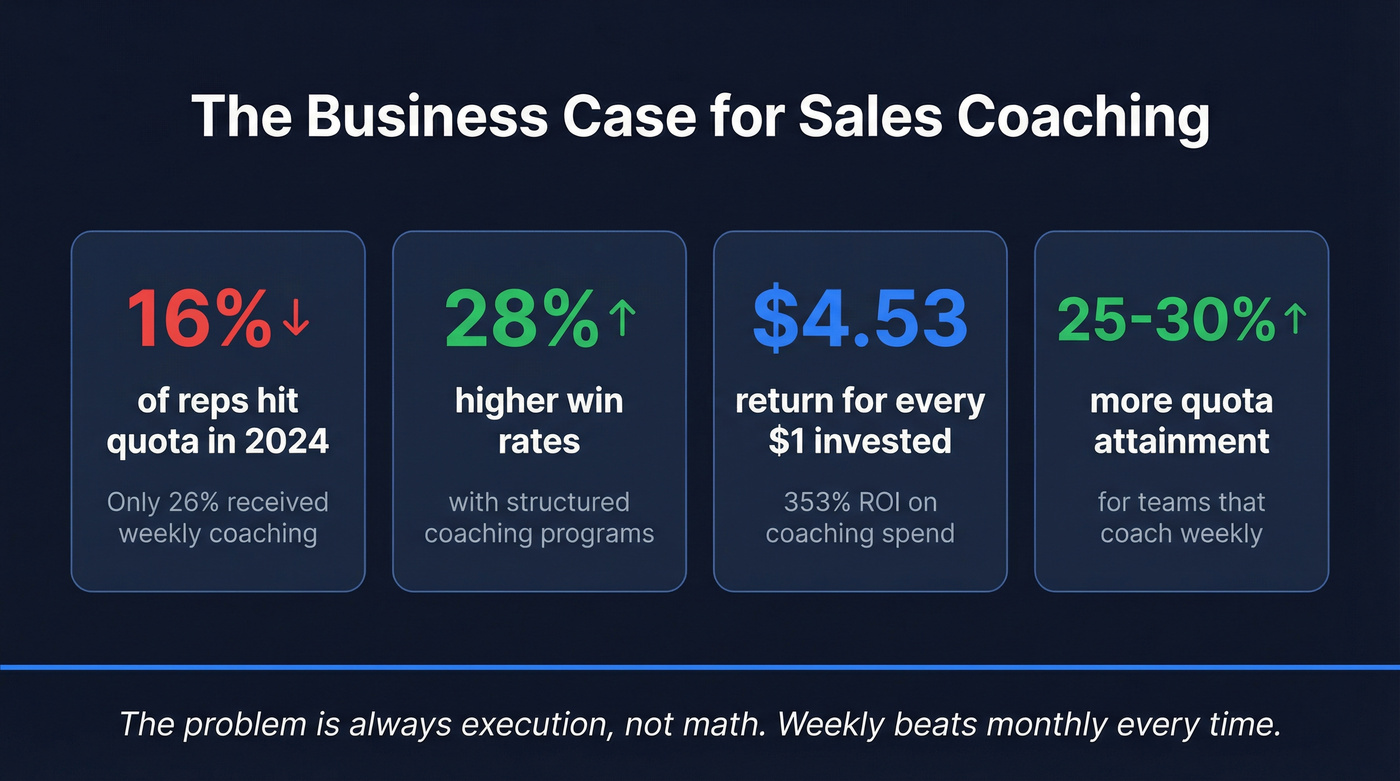
Structured coaching programs produce 28% higher win rates. The ROI runs about $4.53 for every $1 invested - a 353% return. Teams that coach weekly see 25% higher quota attainment and 30% more deals won. We've seen teams triple their coaching ROI just by switching from monthly to weekly sessions. The problem is always execution, not math. New team members don't ramp faster because of more training decks - they ramp faster through consistent, structured coaching conversations.
The 60-Minute Session Template
Most managers either skip coaching entirely or try to review twenty calls in a sitting. Both fail. Review two calls per week - one win, one loss - and go deep.
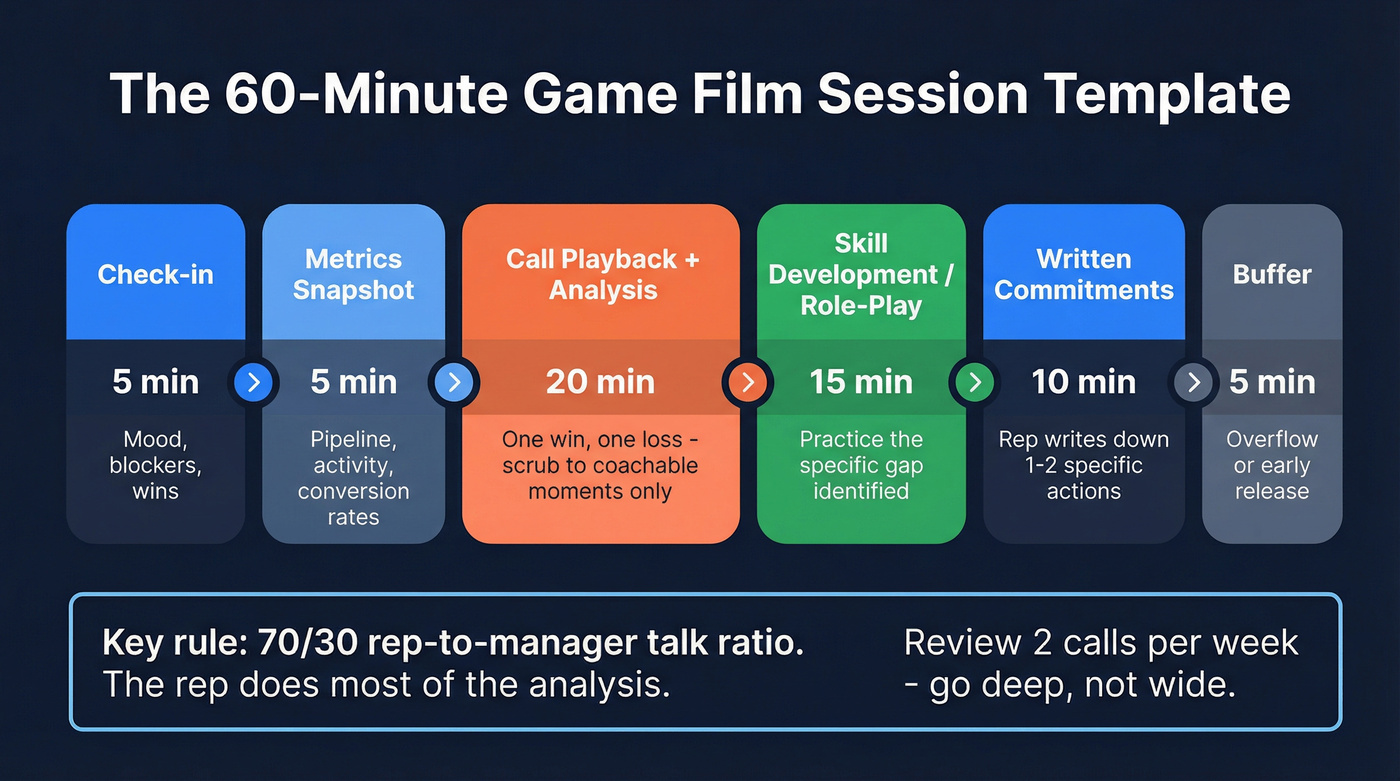
| Block | Time | What Happens |
|---|---|---|
| Check-in | 5 min | Mood, blockers, wins |
| Metrics snapshot | 5 min | Pipeline, activity, conversion |
| Call playback + analysis | 20 min | One win, one loss - coachable moments only |
| Skill development / role-play | 15 min | Practice the specific gap |
| Written commitments + close | 10 min | Rep writes down 1-2 actions |
| Buffer | 5 min | Overflow or early release |
Don't rewatch full calls. Scrub to the specific coachable moments - the discovery question that fell flat, the objection that derailed the deal, the close that landed. Your conversation intelligence tool should bookmark these automatically.
Maintain a 70/30 rep-to-manager talk ratio. The rep should do most of the analysis. When reps self-assess before hearing manager feedback, the learning sticks. Try asking "how would you handle that differently?" instead of "why did you say that?" - the first invites reflection, the second triggers defensiveness. Coaching within 24 hours of a call makes reps 2.5x more likely to improve performance, which is another reason weekly sessions beat monthly ones.
In our experience, the written commitment step is what separates sessions that change behavior from sessions that waste an hour. Writing down commitments increases completion by 67%. A verbal "I'll work on that" disappears by Monday. Small, documented improvements each week stack into massive performance gains over a quarter.
The Call Scorecard
Your top rep just had her best quarter. Nobody knows why. Without a scorecard, her success stays locked in intuition - the scorecard turns it into a repeatable playbook the whole team can learn from.
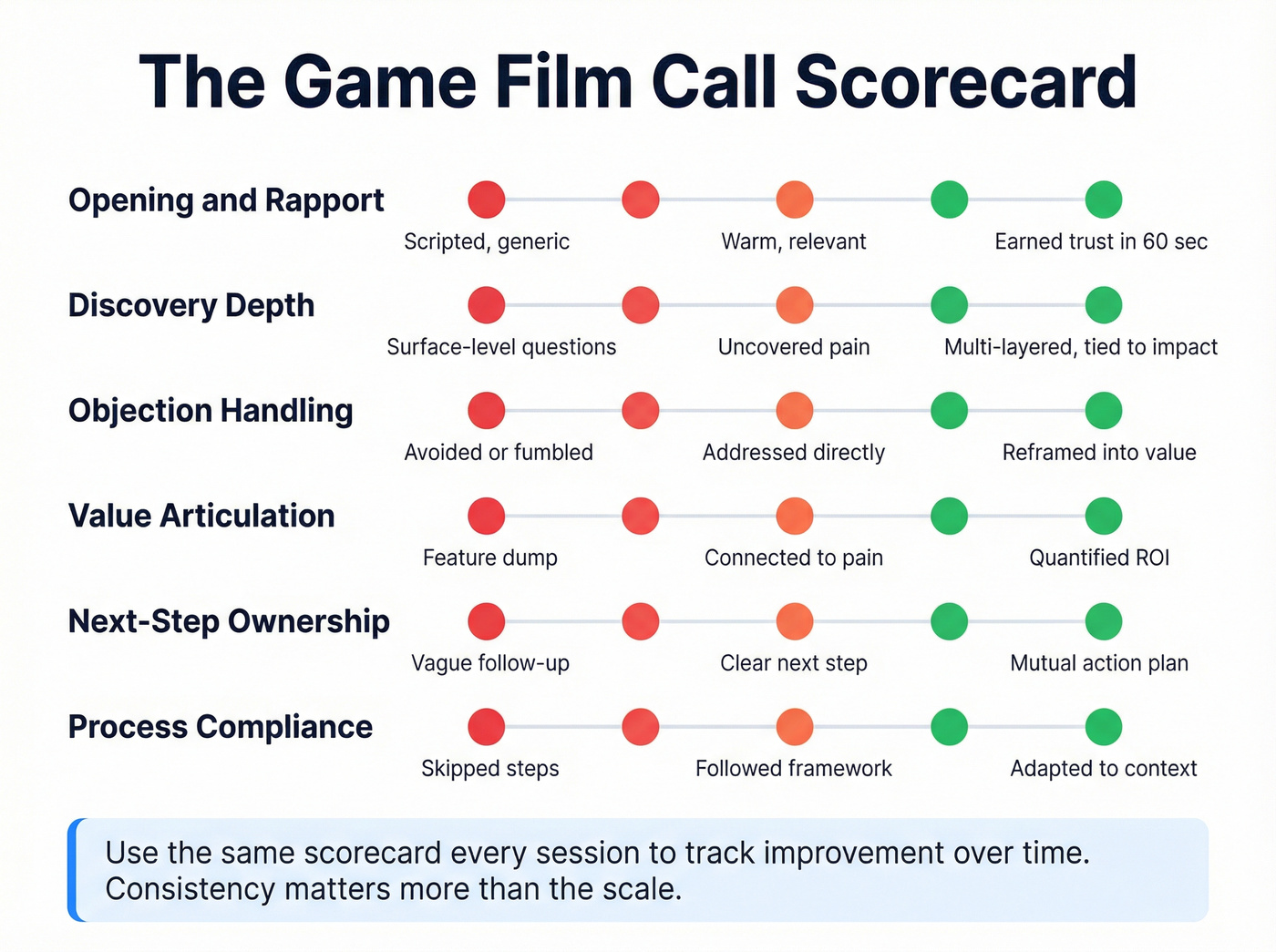
Here's one you can copy and start using this week:
| Category | 1 (Needs Work) | 3 (Solid) | 5 (Excellent) |
|---|---|---|---|
| Opening / rapport | Scripted, generic | Warm, relevant | Earned trust in 60 sec |
| Discovery depth | Surface-level questions | Uncovered pain | Multi-layered, tied to impact |
| Objection handling | Avoided or fumbled | Addressed directly | Reframed into value |
| Value articulation | Feature dump | Connected to pain | Quantified ROI |
| Next-step ownership | Vague follow-up | Clear next step | Mutual action plan |
| Process compliance | Skipped steps | Followed framework | Adapted to context |
Score each category 1-5. The scale matters less than consistency - use the same scorecard every session so you can track improvement over time. This is also how you replicate top performer behaviors: codify what they do differently in each category, then use those benchmarks to develop the rest of the team.
Coaching Different Seller Types
Not every rep needs the same approach. Here's the thing - understanding seller archetypes is what separates great sales managers from average ones.
The veteran who's plateaued. Don't lecture. Run a listening tour. Sit in on their calls for a week without giving feedback, then present patterns. Experienced reps respond to data, not directives. This is where coaching skill vs. will matters most: a veteran usually has the skill but may have lost the will.
The first-time seller. New reps need more structure and more frequent sessions. Use the GROW coaching model - Goal, Reality, Options, Will - to give them a framework for self-diagnosis. Pair them with a top performer for shadowing before they ever enter a review session.
The introvert. Some of the best closers are quiet listeners. Lean into their natural curiosity and depth of preparation. Create a culture where thoughtful questions are rewarded, not just loud energy.
The high-performer who can't articulate their process. Record everything. Use call reviews to help them see their own patterns, then document those patterns as coaching material for everyone else. The goal isn't cloning top performers into identical robots - it's extracting the principles behind their behaviors and adapting them to each rep's strengths.

Game film sessions only improve performance when reps are calling real buyers. Prospeo gives your team 98% verified emails and 125M+ direct dials - so every call you review in coaching is a call that actually reached a decision-maker.
Coach on calls that matter. Start with data that connects.
Five Mistakes That Kill Review Sessions
1. Random acts of coaching. Surprise criticism after a bad call isn't coaching - it's ambush feedback. Schedule sessions weekly, same time, same format. Consistency is the foundation everything else rests on.
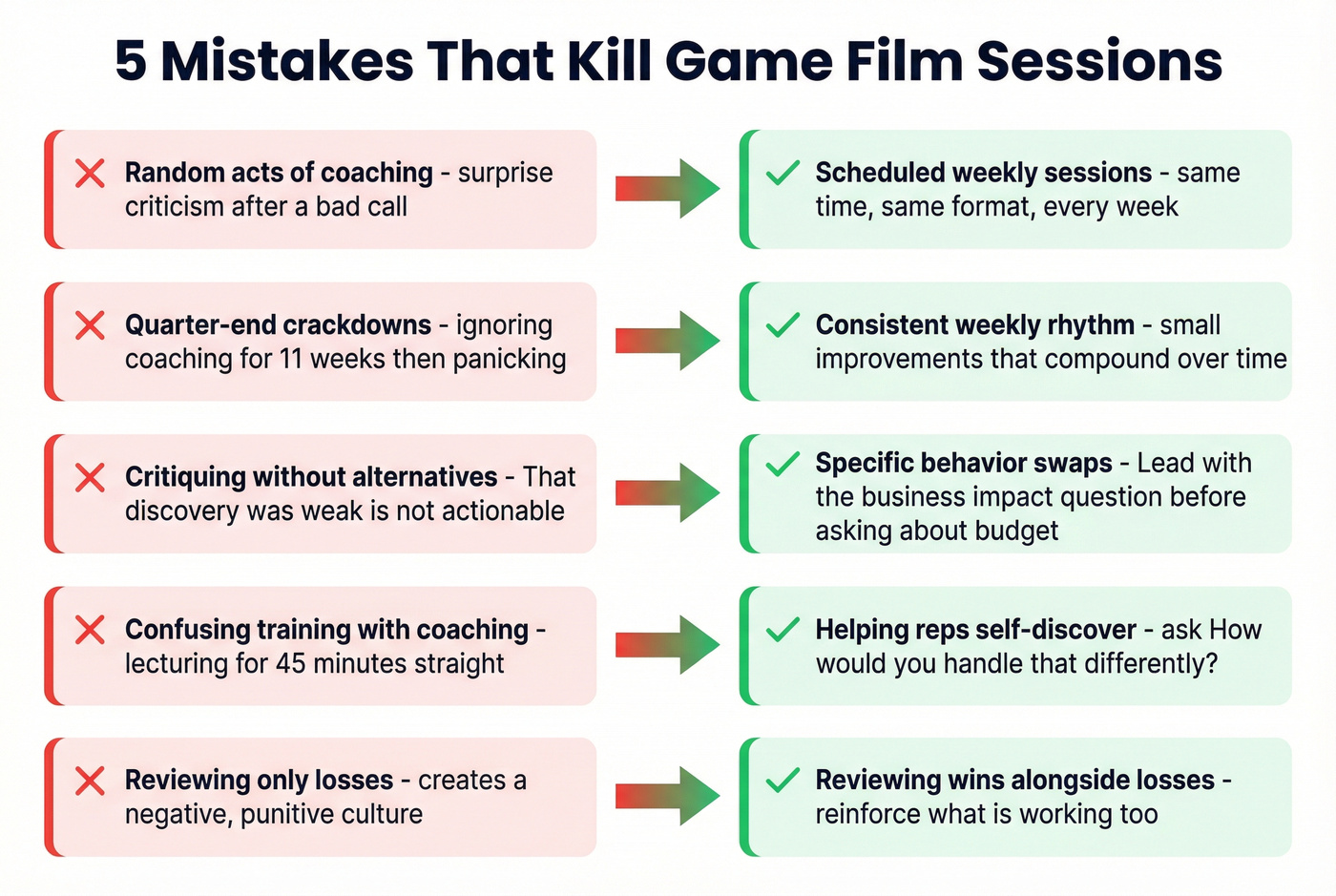
2. Fear-based quarter-end crackdowns. Ignoring coaching for 11 weeks then "cracking the whip" in week 12 creates short-term spikes and long-term dependency. This is one of the most common rep frustrations - inconsistent feedback that feels punitive rather than developmental.
3. Critiquing without alternatives. "That discovery was weak" isn't actionable. "Lead with the business impact question before asking about budget" is. Good coaching always includes a specific behavior to try next time.
4. Confusing training with coaching. Training is telling. Coaching is helping reps self-discover. If you're lecturing for 45 minutes, you're running a training session. Managers track numbers; coaches change behaviors.
5. Reviewing only losses. Wins contain just as much signal. Review wins alongside losses to reinforce what's working and keep the culture constructive.
Coaching for Burnout and Motivation
Game film sessions can feel like surveillance if you're not careful. Reps who are already struggling don't need another hour of being told what they're doing wrong - they need coaching that rebuilds confidence.
Start every session with a win, even a small one. Deliberately reframe a rep's narrative from "I'm failing" to "I'm improving in specific, measurable ways." Before the session, have reps answer two questions: What's one thing I did well this week? What's one moment I'd handle differently? These prompts prime the rep to own their development rather than bracing for criticism.
Let's be honest - gamification gets overused, but it works when applied to the right metrics. Leaderboards for scorecard improvement (not just revenue), team challenges around specific skills, or friendly competitions on discovery question depth all keep energy up. Frame sessions as deliberate practice, not performance reviews. Reps can literally rewire how they respond to objections through repetition. Game film sessions are the deliberate practice - position them that way.
The goal of coaching isn't just hitting quota. It's building reps who can diagnose and fix their own performance gaps long after the session ends.
How Much Time Should You Invest?
Research says managers should spend about 2 hours per week listening to calls and preparing, plus the 60-minute session itself. That's roughly 3 hours per week per team - about 15% of a manager's time.
If that sounds like a lot, consider the alternative: spending zero hours coaching and watching 84% of your reps miss quota. The teams that invest the hours outperform the ones that don't by 25-30%.
For managers coaching multiple teams, adapt the template. Your enterprise AEs need different coachable moments than your SDRs. Your customer success team might focus on expansion conversations rather than cold outreach. The 60-minute template stays the same; the scorecard categories shift.
Tools for Call Review Sessions
Recording calls is solved. The real question isn't "which tool records best?" - it's "which tool helps reps actually change behavior between sessions?"
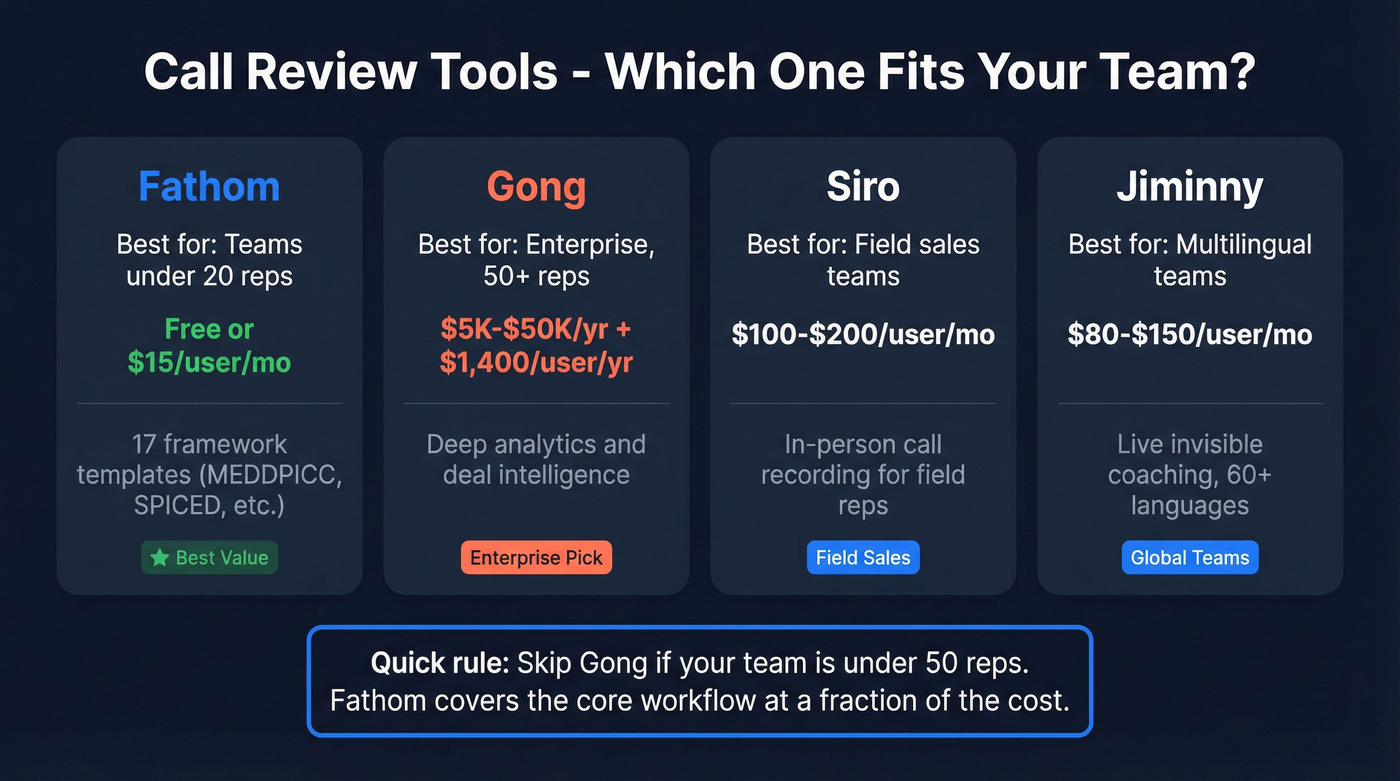
| Tool | Best For | Starting Price | Key Differentiator |
|---|---|---|---|
| Fathom | Teams < 20 reps | Free / $15/user/mo | 17 framework templates |
| Gong | Enterprise (50+ reps) | $5K-$50K/yr + ~$1,400/user/yr | Deep analytics + deal intel |
| Siro | Field sales | ~$100-$200/user/mo | In-person call recording |
| Jiminny | Multilingual teams | ~$80-$150/user/mo | Live invisible coaching, 60+ languages |
Skip Gong if your team is under 50 reps. Fathom covers the core workflow - recording, summaries, and framework-based templates - at a fraction of the cost. The free plan is genuinely usable, and at $15/user/month on paid tiers, a 20-person team runs sessions for $300/month. The 17 built-in summary templates map calls to frameworks like MEDDPICC and SPICED automatically, so there's no manual tagging required.
Gong is worth the pain if you're enterprise. Expect a $5,000-$50,000/year platform fee plus roughly $1,400 per user per year. First-year TCO for 100 users runs around $194,000, with 2-3 year contract lock-ins and no monthly option. The analytics are unmatched. The buying process is not.
Siro is one of the few tools purpose-built for field sales - it records in-person conversations from your pocket, no cell service needed, with a reported 36% improvement in close rates. If your reps are in living rooms and showrooms instead of Zoom calls, this is the category you want.
Jiminny lets a manager join a live call invisibly and message the rep mid-conversation. Transcription covers 60+ languages. There's a 14-day free trial, and you should expect a setup fee on top of the subscription.
Our hot take: if your average deal size is under $15K, you probably don't need Gong-level analytics. Fathom plus a weekly cadence will outperform an expensive platform nobody actually uses. Smart coaching comes from consistency, not software spend. In 2026, the tools that win are the ones that surface coaching opportunities automatically rather than requiring managers to hunt for them.
Fix the Upstream Problem First
We've run enough call reviews to spot a pattern that coaching can't fix: reps burning entire call blocks on disconnected numbers and bounced emails. You can have the best scorecard, the best cadence, the best conversation intelligence tool - and none of it matters if half the calls never connect. The consensus on r/sales threads about coaching ROI keeps circling back to the same thing: garbage in, garbage out.
Any verification tool works. The point is: don't coach on top of garbage data. Prospeo verifies emails at 98% accuracy and maintains 125M+ verified mobile numbers with a 30% pickup rate, refreshing data every 7 days versus the 6-week industry average. Think of it as Step Zero - verify your contact data before investing in coaching infrastructure. Clean data means more live conversations, which means more meaningful footage to review.

Your scorecard tracks discovery depth and objection handling - but none of that matters if reps are dialing wrong numbers. Prospeo's 7-day data refresh and 30% mobile pickup rate mean your team spends less time chasing dead leads and more time generating coachable moments.
Fill your game film library with real conversations, not voicemails.
FAQ
How often should you run game film sessions?
Weekly. Managers should spend about 2 hours per week listening to calls, and reps should spend 30 minutes reviewing their own. One structured 60-minute session plus individual review is the sweet spot. Only 26% of reps get weekly coaching - doing it consistently puts you ahead of 74% of sales orgs.
What if reps resist being recorded?
Less than 1% of customers reject recording when informed transparently. One-party consent applies in 39 states and Canada; two-party consent applies in 11 states, so disclose at the start of the call. Frame recording as a development tool, not surveillance - reviewing wins alongside losses helps reps drop their guard.
Do you need expensive software to start?
No. Fathom's free plan covers recording and summaries. Paid tiers start at $15/user/month - a 20-person team runs effective sessions for $300/month. The bigger investment is making sure calls are worth reviewing in the first place.
How do you coach new sellers using call reviews?
Start with observation, not critique. Have new reps watch two or three clips from top performers before reviewing their own calls. Then use the GROW model - Goal, Reality, Options, Will - to help them set a specific improvement target for their next conversation. The scorecard gives them a clear, non-subjective measure of progress each week.
What are the best books to supplement coaching sessions?
Three that pair well: The Coaching Habit by Michael Bungay Stanier for asking better questions, Cracking the Sales Management Code by Jason Jordan for connecting coaching to metrics, and Never Split the Difference by Chris Voss for the objection-handling skills you'll coach most often.