The 9 Best Email Enrichment Chrome Extensions in 2026
Your SDR installs three Chrome extensions, runs the same prospect through all of them, and gets three different email addresses. Two bounce. The third lands in spam. This isn't a hypothetical - it's Tuesday morning for most outbound teams.
The core problem: 98% of email enrichment Chrome extensions pull from the same underlying databases, and those databases decay roughly 22% per year. The extension you pick matters less than you think. The verification layer behind it matters more than anyone admits.
Our Top Picks
- Best accuracy + freshest data: Prospeo - 98% verified emails, 7-day data refresh, ~$0.01/email
- Best free tier for volume: Apollo - 10,000 email credits/month at $0, hard to beat for early-stage teams
- Best for EU contacts: Kaspr - 120M+ European contacts, ~90% accuracy on European prospects
How We Evaluated Each Tool
Most "best of" lists rank tools by feature count or G2 scores. We focused on what actually determines whether your outbound campaign works or tanks your domain reputation.
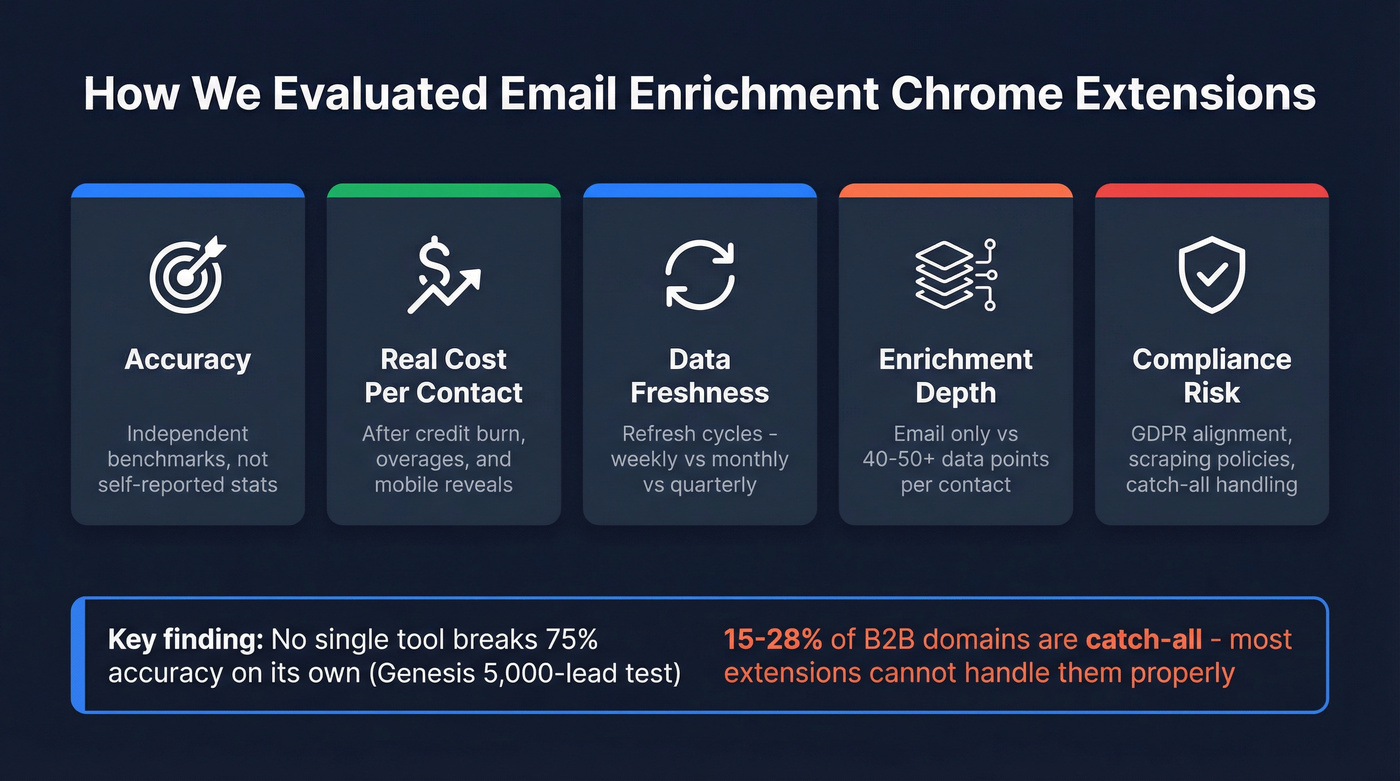
Two criteria matter above all else: accuracy from independent benchmarks (not self-reported numbers) and real cost per verified contact after credit burn and overages. Beyond those, we weighted data freshness and refresh cycles, enrichment depth beyond just an email address, and compliance risk around professional network scraping.
Two independent tests anchor our accuracy data. A Dropcontact benchmark ran 20,000 real-world tests across 15 tools, measuring effective enrichment rates and hard bounce rates. A Genesis test ran 5,000 identical B2B leads through SMTP verification. The headline finding from Genesis: no single tool breaks 75% accuracy on its own. That number surprised us too.
One technical detail worth understanding: 15-28% of B2B domains are catch-all, meaning they accept any email address regardless of whether the mailbox exists. Most extensions can't handle these domains properly, which inflates their "valid" numbers while your bounce rate tells the real story. We weighted catch-all handling heavily.
Let's also distinguish email finding from email enrichment. Finding retrieves an address. Enrichment layers on 20-50+ data points - job title, company revenue, technographics, intent signals, phone numbers. Most Chrome extensions marketed as "enrichment" are really just finders with a verification step bolted on.
The 9 Best Extensions Ranked
Prospeo - Best for Accuracy and Freshness
Prospeo's database covers 300M+ professional profiles, 143M+ verified emails, and 125M+ verified mobile numbers. The 98% email accuracy comes from a 5-step verification process that includes catch-all domain handling, spam-trap removal, and honeypot filtering - the exact things that trip up cheaper tools on those 15-28% catch-all domains.

The Chrome extension works on any website, professional profile, or CRM page, returning 40+ data points per contact from the extension alone and 50+ via full enrichment. That's genuine enrichment, not just an email address. There's also an intent data layer powered by Bombora tracking 15,000 topics, so you can see which accounts are actively researching solutions like yours.
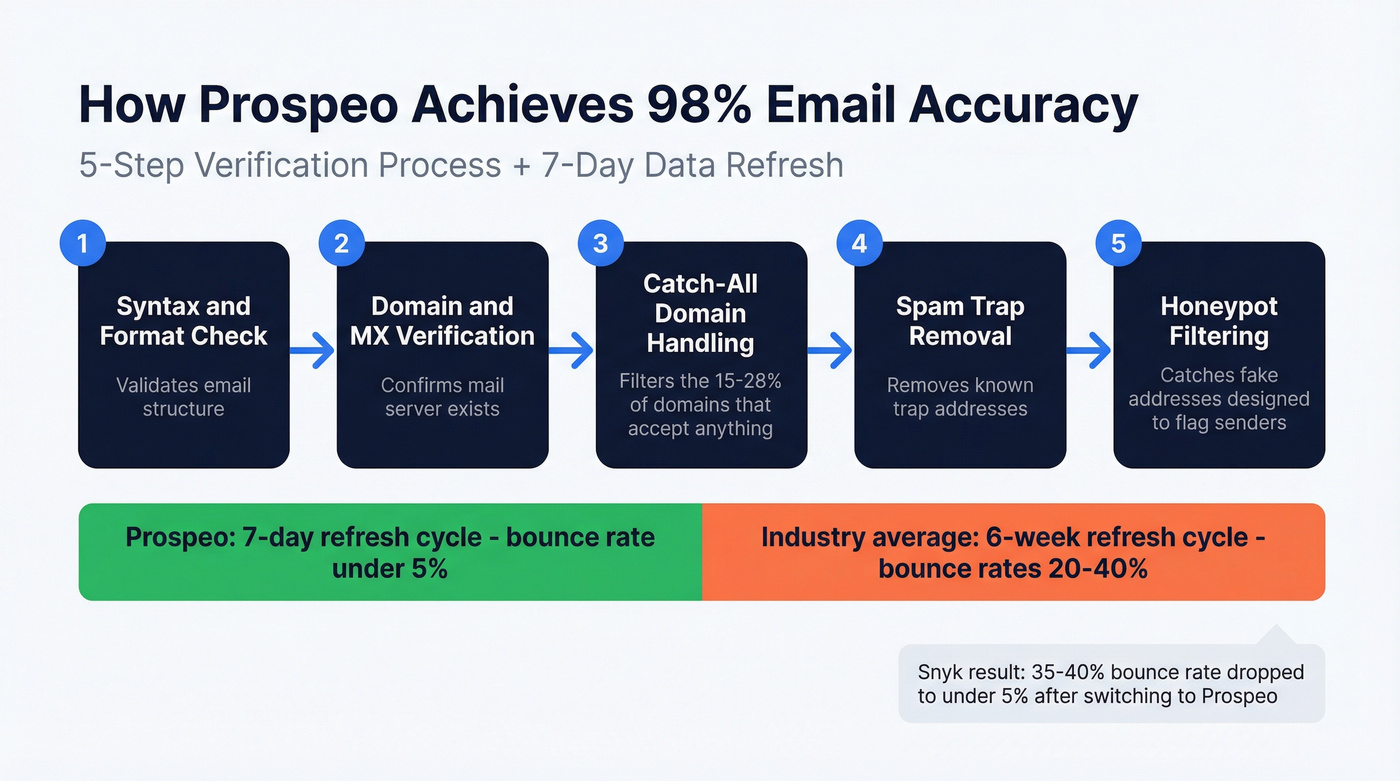
What sets Prospeo apart from every other tool on this list is the 7-day data refresh cycle. The industry average is six weeks. When databases decay 22% annually, that gap between weekly and monthly refreshes translates directly into bounce rates.
Snyk's 50 AEs dropped their bounce rate from 35-40% to under 5% after switching, generating 200+ new opportunities per month. Stack Optimize built from $0 to $1M ARR using Prospeo as their enrichment layer, maintaining 94%+ deliverability with bounce rates under 3% across all client campaigns.
Pricing is refreshingly transparent: the free tier gives you 75 emails and 100 extension credits per month. Paid plans run ~$0.01 per email, with mobile numbers at 10 credits each. No contracts, no "talk to sales" gates.
Verdict: Highest accuracy and freshest data of any contact enrichment extension on this list, with the most transparent pricing.
Use this if: You've been burned by stale data and need verified results without enterprise pricing.
Apollo - Best Free Tier for Volume
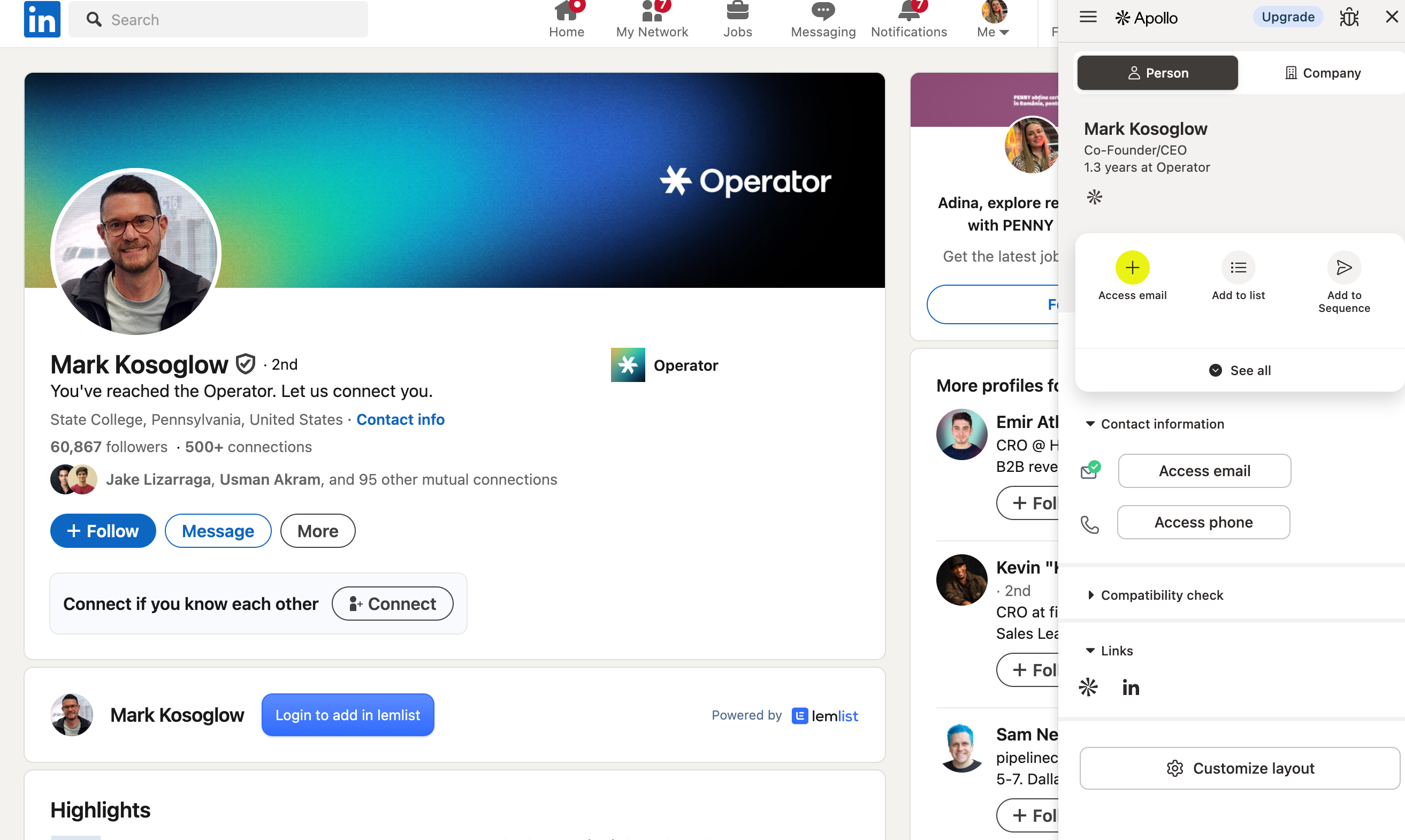
Apollo's free plan is the reason half the SDRs on r/sales have it installed. Ten thousand email credits per month - plus 5 mobile credits, 10 export credits, and 2 active sequences - at zero cost is genuinely generous, and the 275M+ contact database means you'll find someone at most companies. The extension integrates tightly with Apollo's built-in sequencer, so you can go from prospect to enrolled in a sequence without leaving the browser.
Here's the thing, though: Apollo self-reports 95%+ accuracy, but the Genesis 5,000-lead test measured 50.1% overall. US SaaS contacts hit 62.7%, which is respectable. EU B2B contacts? 29.4%. That's a coin flip with worse odds.
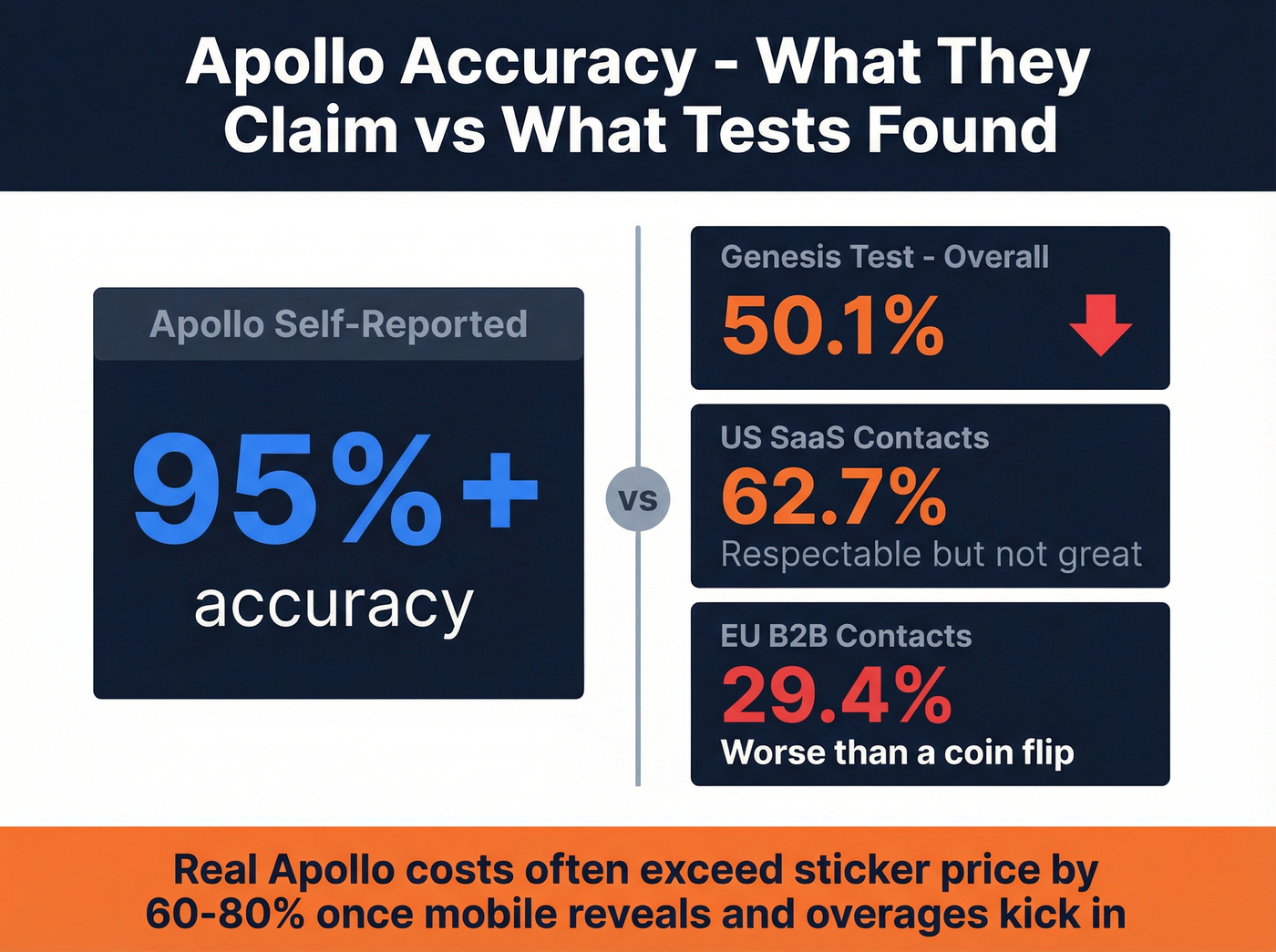
Paid plans start at $49/user/month on annual billing, with Pro at $79 and Organization at $119 (minimum 3 users). Mobile reveals cost 8 credits each, and overages run $0.20 per credit. Real Apollo costs often exceed the sticker price by 60-80% once mobile reveals and overages kick in.
Best for early-stage teams who need volume and can tolerate higher bounce rates. Skip if you're sending to EU prospects or your domain reputation is non-negotiable.
Hunter.io - Best for Pattern-Based Finding
Hunter takes a different approach. It's fundamentally an email finder that's very good at pattern recognition - if it knows a company's email format, accuracy jumps to 75-80%. On cold domains where it's guessing, overall accuracy drops to 45.4% in independent testing, with an 11.2% hard bounce rate.

The credit system is clean: 1 credit per email found, 0.5 credits per verification. Free tier gives you 50 credits/month. Starter runs $34/month on annual billing for 2,000 credits, Growth is $104/month for 10,000 credits. All plans include unlimited users, which is a nice touch for growing teams.
Where Hunter falls short is enrichment depth. You're getting email addresses, not the 40-50 data points that true enrichment tools provide. No phone numbers, no intent data, no technographics. It's a specialist tool, and it's honest about that.
Best for teams who already know their target domains and want reliable email finding. Skip if you need phone numbers, company data, or any enrichment beyond the email address itself.
Lusha - Best for Phone Numbers
Lusha's credit math tells you everything about its positioning. Email reveals cost 1 credit. Phone reveals cost 10. On the Pro plan at $29.90/user/month on annual billing with 250 credits, that's effectively $2.99 per phone number if you're burning credits on dials. The free tier offers up to 70 credits/month with the extension and CRM integrations included, enough to test the data quality.
Premium runs $69.90/user/month for 600 credits. The Scale plan is custom-priced with fair-use caps that reviewers consistently peg around 2,000 contacts/month.
Use this if direct dials are your primary workflow and you'll pay the premium. Skip if you're budget-conscious - phone reveals eat credits at 10x the rate of emails, and a team doing 200 phone reveals per month is spending $600 just on dials.
Kaspr - Best for EU Contacts
If your ICP lives in Europe, start here. Kaspr's ~90% accuracy on European contacts is the highest we've seen for EU-focused prospecting, backed by 120M+ European contacts that most US-centric tools simply don't have.
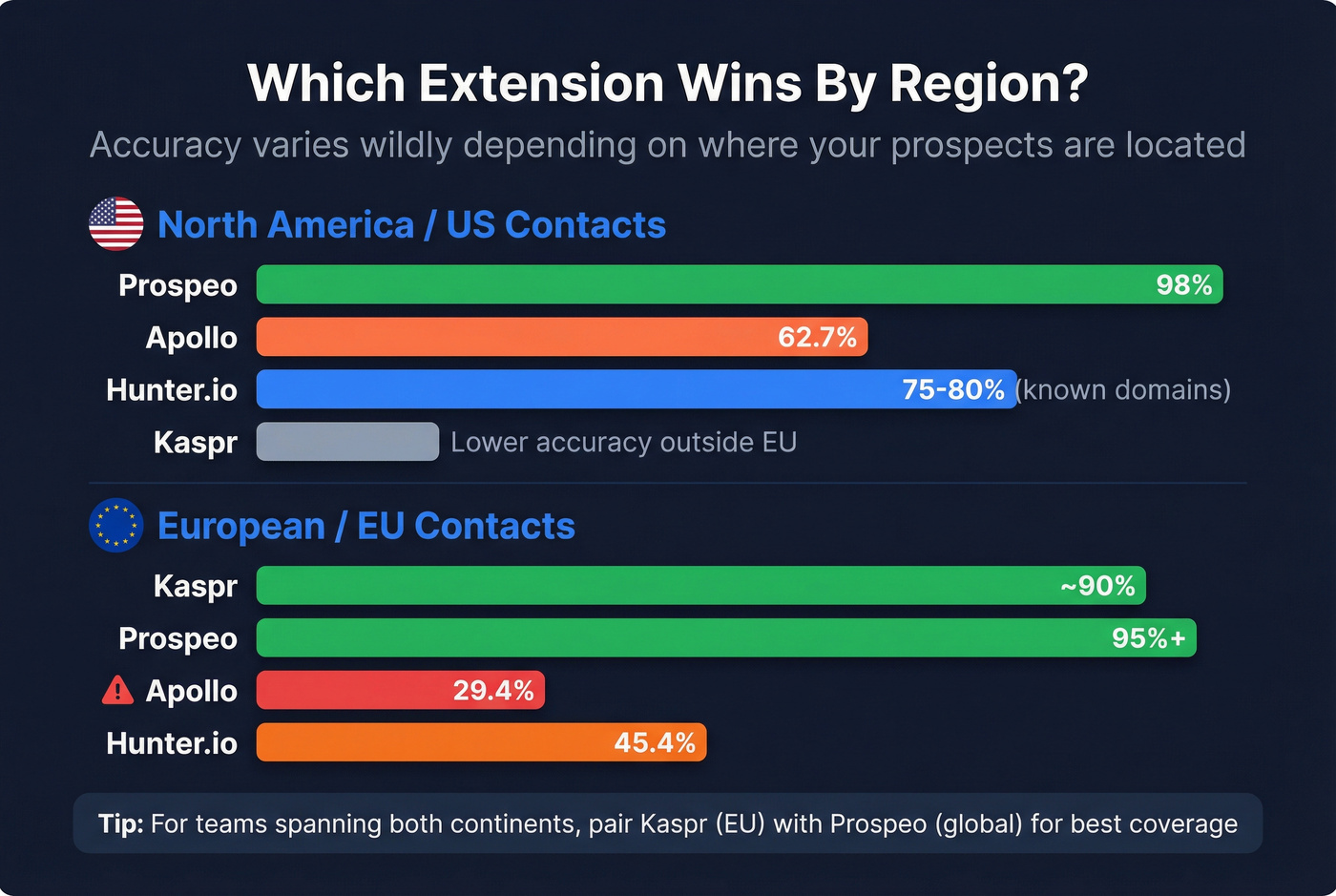
The free tier gives you 15 email credits and 5 phone credits per month. Starter runs ~EUR45/month with unlimited B2B emails and 100 phone credits. Higher tiers scale upward from there. The 500M+ global records sound impressive, but accuracy drops noticeably outside Europe. For teams whose ICP spans both continents, you'll likely need Kaspr paired with a US-strong tool like Prospeo or Apollo.
Best for EU/UK-focused teams where GDPR alignment matters. Skip if you're targeting North American prospects.
Snov.io - Best All-in-One for Outbound
Snov.io bundles email finding, verification, and cold email sequences into one platform. Starter is $29.25/month on annual billing for 1,000 credits and 5,000 recipients with unlimited seats. Pro runs $74.25/month for 5,000 credits and 25,000 recipients.
The catch: LinkedIn automation is a $69/month add-on per slot, not included in any base plan. Three reps running LinkedIn outreach? That's an extra $207/month on top of your Snov.io subscription. The base platform is solid for email-centric outbound, but the add-on pricing can sneak up on you fast.
Best for teams wanting email finding and sequences in one tool without juggling integrations. Skip if you need LinkedIn automation without paying the per-slot add-on.
ContactOut - Decent Data, Misleading Limits
The "unlimited" email plan at $49/month on annual billing isn't unlimited. Dig into the terms and you'll find a cap of 2,000 emails per month with 300 exports. The Email + Phone plan at $99/month adds 1,000 phone numbers and 600 exports. Free tier is 5 emails, 5 phones, and 5 exports per day.
Look, the data quality is reasonable for light users who won't hit the cap. But the misleading "unlimited" label is the kind of pricing trick that erodes trust before you've even started using the product. If you're pulling fewer than 2,000 emails monthly and don't mind the bait-and-switch branding, the per-contact cost is competitive at ~$0.025/email.
Clearout
Clearout is primarily a verification tool with a finding extension bolted on. Paid plans start around $20/month for 1,000 credits, with a free tier available. Solid if your workflow is "I already have emails, I just need to verify them," but limited enrichment depth beyond that. Think of it as a safety net, not a prospecting engine.
Skrapp.io
Skrapp focuses on email finding from professional profiles and company websites. Free tier available, paid from ~$29/month. Basic, functional, affordable - but it lacks the verification rigor and enrichment breadth of the tools ranked above it.
Honorable mentions: Leadspicker can add multiple people from a single search results page to your database, and Derrick offers spreadsheet-native enrichment. Neither matched the accuracy or enrichment depth of our top picks.

Most Chrome extensions give you an email and call it enrichment. Prospeo returns 40+ data points per contact - job title, company revenue, technographics, intent signals, and verified mobile numbers - all refreshed every 7 days, not every 6 weeks.
Get real enrichment from your Chrome extension, starting at $0.01 per email.
Pricing Comparison
The sticker price of an enrichment extension is almost meaningless without understanding credit mechanics. Here's how the math actually works:
| Tool | Free Tier | Paid From | Cost/Email | Cost/Phone |
|---|---|---|---|---|
| Prospeo | 75 emails/mo | ~$39/mo | ~$0.01 | 10 credits |
| Apollo | 10K emails/mo | $49/user/mo | ~$0.049 | 8 credits |
| Hunter | 50 credits/mo | $34/mo | ~$0.017 | N/A |
| Lusha | Up to 70 cr/mo | $29.90/user/mo | ~$0.12 | ~$2.99 |
| Snov.io | Trial only | $29.25/mo | ~$0.029 | N/A |
| Kaspr | 15 emails/mo | ~EUR45/mo | Unlimited* | ~EUR0.45 |
| ContactOut | 5/day | $49/mo | ~$0.025 | ~$0.099 |
| Clearout | Yes | ~$20/mo | ~$0.020 | N/A |
| Skrapp | Yes | ~$29/mo | ~$0.029 | N/A |
A few things the table doesn't show. Apollo's $0.049 sticker price balloons to $0.08-0.12 once mobile reveals and overages hit. ContactOut's "unlimited" plan caps at 2,000 emails. Snov.io's LinkedIn automation add-on runs $69/month per slot. And Lusha's per-phone cost of ~$2.99 means a team doing 200 phone reveals per month is spending $600 just on dials.
Our take: If your deal sizes sit below five figures, you probably don't need Lusha-level phone data or ZoomInfo's $15K+ annual commitment. A high-accuracy email tool with a solid sequence platform will outperform an expensive multi-channel stack that your reps only half-use.
The Extension Compliance Risk
Here's something most comparison articles won't tell you: several major enrichment extensions have been blocked or restricted by LinkedIn. Apollo and Seamless.AI had their company pages deleted. FullEnrich shut down their extension in June 2024 and hasn't relaunched it since.
This tracks with how enforcement is evolving. LinkedIn identifies risky automation and scraping through browser fingerprinting, automation library signatures, and suspicious network patterns. Shadow restrictions - where your account looks normal to you but your profile visibility drops - are increasingly common and hard to diagnose.
The tools flagged as at-risk include Apollo, Seamless.AI, Lusha, LeadIQ, Hunter, Snov.io, Clearbit, and ZoomInfo's ReachOut extension. Google is also tightening Chrome Web Store policies around background scraping and cookie injection, which will likely thin the field further this year.
This doesn't mean you shouldn't use browser-based enrichment tools. It means you should understand the risk and choose tools whose infrastructure doesn't depend entirely on scraping professional networks. If your entire prospecting workflow breaks when one platform changes its terms of service, that's a fragility problem, not a tool problem.
Why One Tool Isn't Enough
The Genesis benchmark headline bears repeating: no single tool breaks 75% accuracy. But combine them strategically, and you hit 92%.
The smartest teams we've worked with run a waterfall approach. Start with your highest-accuracy tool as the primary layer. For any contacts that don't return results, run them through a secondary tool like Apollo or Hunter to fill gaps. This costs slightly more per contact but dramatically reduces bounces and protects your sender reputation.
The math is straightforward. A 50% accuracy tool sending 1,000 emails means 500 potential bounces destroying your domain reputation. A 98% primary tool with a secondary fill means around 20 bounces total. At $0.01/email for the primary layer, the cost difference is negligible compared to the domain reputation you're protecting. In our experience, teams that adopt this waterfall model see bounce rates drop by 80%+ within the first month.
Choosing the right email enrichment Chrome extension comes down to accuracy, cost per verified contact, and how well the tool handles catch-all domains. Volume means nothing if half your sends bounce.
Independent tests show no single tool breaks 75% accuracy alone. Prospeo's 5-step verification - with catch-all handling, spam-trap removal, and honeypot filtering - is why Snyk's 50 AEs dropped bounce rates from 35-40% to under 5%.
Stop burning your domain reputation on stale data from other extensions.
FAQ
What's the difference between email finding and email enrichment?
Email finding retrieves an address from a name and company. Email enrichment adds 20-50+ data points on top - job title, company size, technographics, intent signals, phone numbers. Most Chrome extensions marketed as "enrichment" are actually finders with a verification layer. True enrichment returns 50+ fields per contact, giving you context to personalize outreach rather than just a deliverable address.
Are enrichment extensions safe to use?
Most are safe, but extensions that scrape professional networks carry real account-restriction risk. LinkedIn has blocked several major tools and restricted extension-based workflows. Choose extensions that use proprietary databases and official APIs rather than relying entirely on browser-level scraping of a single platform.
How many credits do I need per month?
For a single SDR prospecting 50 contacts per day, budget 1,000-1,500 credits monthly. Phone reveals cost 8-10 credits each on most platforms, which inflates usage fast. A rep doing 20 phone lookups per day could burn 4,000+ credits monthly on dials alone.
Which extension has the highest accuracy?
Prospeo delivers 98% email accuracy with a 5-step verification process and 7-day data refresh. Independent benchmarks show most other tools land between 45-55% accuracy in real-world conditions, despite self-reporting 95%+. The gap between claimed and actual accuracy is the biggest problem in this market.
Can I use multiple enrichment extensions together?
Yes, and you probably should. No single tool breaks 75% accuracy alone. A waterfall approach - starting with your highest-accuracy tool and filling gaps with a secondary source - can push overall accuracy to 92% while keeping costs manageable. The consensus on r/sales backs this up: stacking two or three tools with different data sources consistently outperforms going all-in on one.