

B2B Inbound Lead Generation: The 2026 Playbook With Real Benchmarks
Marketing hit the MQL target last quarter. Sales says the leads are garbage. Sound familiar?
This disconnect isn't a people problem - it's an operations problem. 80% of leads never convert, and today's B2B buyers need 70+ touchpoints across six channels before they're ready to talk. The gap between "generated" and "pipeline" is where most B2B inbound lead generation programs quietly bleed out. This playbook focuses on that gap: the benchmarks, the operational fixes, and the data quality discipline that separate programs generating revenue from those generating dashboards.
The Short Version
Three things separate inbound programs that build pipeline from those that build vanity metrics:
- Benchmark-driven strategy. Know your industry's visitor-to-lead conversion rate. B2B SaaS averages 1.1%. Legal services hits 7.4%. If you don't know your number, you can't improve it.
- Sub-5-minute lead response. Leads contacted within 5 minutes are 21x more likely to convert than those contacted after 30 minutes. This is the single biggest controllable variable in your funnel.
- Verified data at every stage. Stale contacts kill sequences before they start. Weekly refresh plus verification keeps your routing and nurture built on current information, not old records.
What Inbound Actually Means for B2B
Inbound lead generation attracts buyers to you - through content, search, social, and community - rather than interrupting them with cold outreach. The buyer initiates contact. Your job is to make that contact frictionless and fast.
The cost difference matters: inbound leads cost up to 60% less than outbound. But the real play is hybrid. Companies running both see 2x faster revenue growth than those relying on either alone. Channel-wise, 88% of B2B teams use email for lead gen, and among social users, 97% are on LinkedIn.
The Inbound Funnel With Real Numbers
Most guides talk about "top of funnel" and "bottom of funnel" without giving you a single number. Let's fix that.
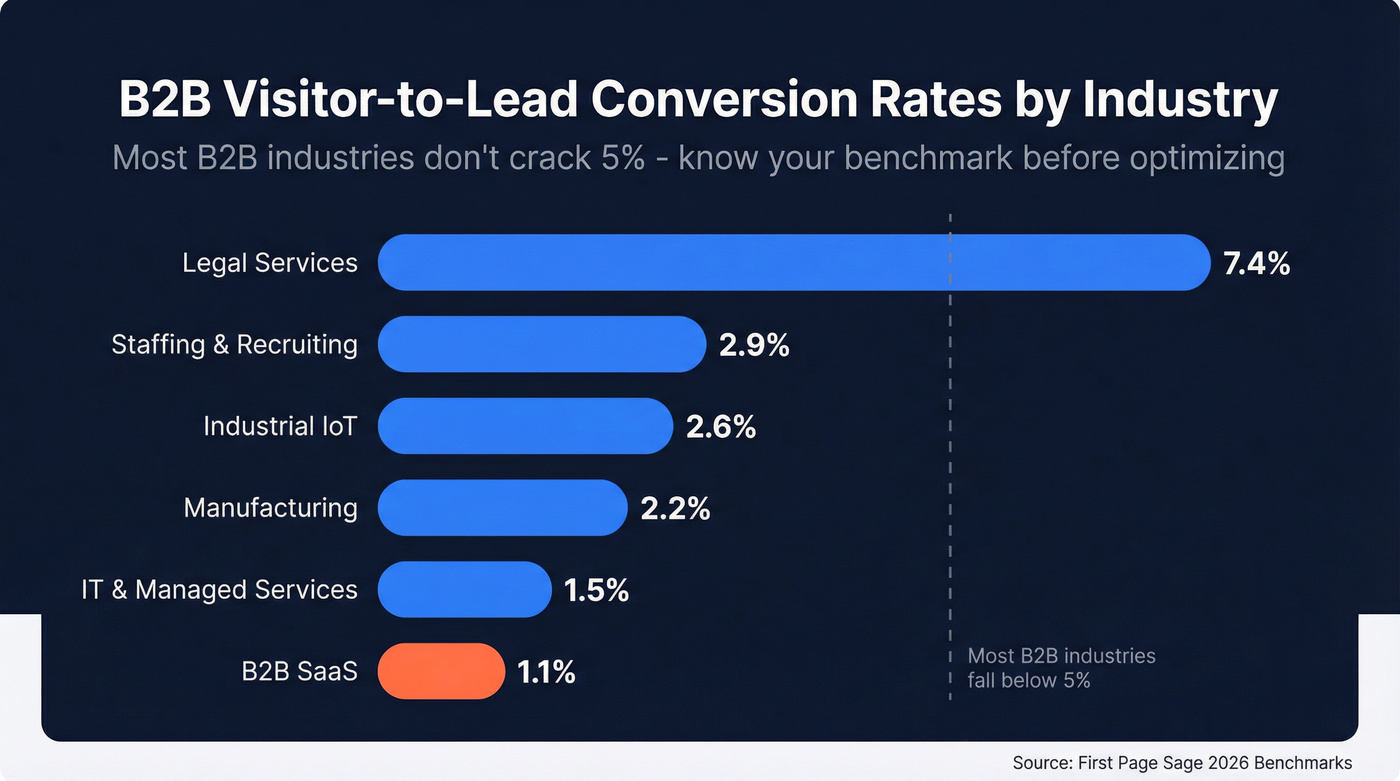
Here are visitor-to-lead conversion rates by industry:
| Industry | Visitor-to-Lead Rate |
|---|---|
| B2B SaaS | 1.1% |
| IT & Managed Services | 1.5% |
| Manufacturing | 2.2% |
| Industrial IoT | 2.6% |
| Staffing & Recruiting | 2.9% |
| Legal Services | 7.4% |
Most B2B industries don't crack 5%. Even Salesforce converts less than 5% of its traffic into qualified leads.
Once a lead is qualified, the numbers improve dramatically. The median qualified-to-booked meeting rate is 62%, with top performers hitting 78%+. Compare that to outbound, where initial-contact-to-meeting conversion typically runs 2-5%. Inbound leads are warmer - the question is whether your operations can capitalize on that warmth before it cools.
Six Strategies That Actually Work
SEO Content That Converts
Every competitor is publishing blog posts. The edge comes from prioritizing bottom-of-funnel content - comparison pages, competitor displacement content, integration guides - over top-of-funnel blog volume.
If you need examples of what "good" looks like, start with bottom-of-funnel content that maps to real buying intent.
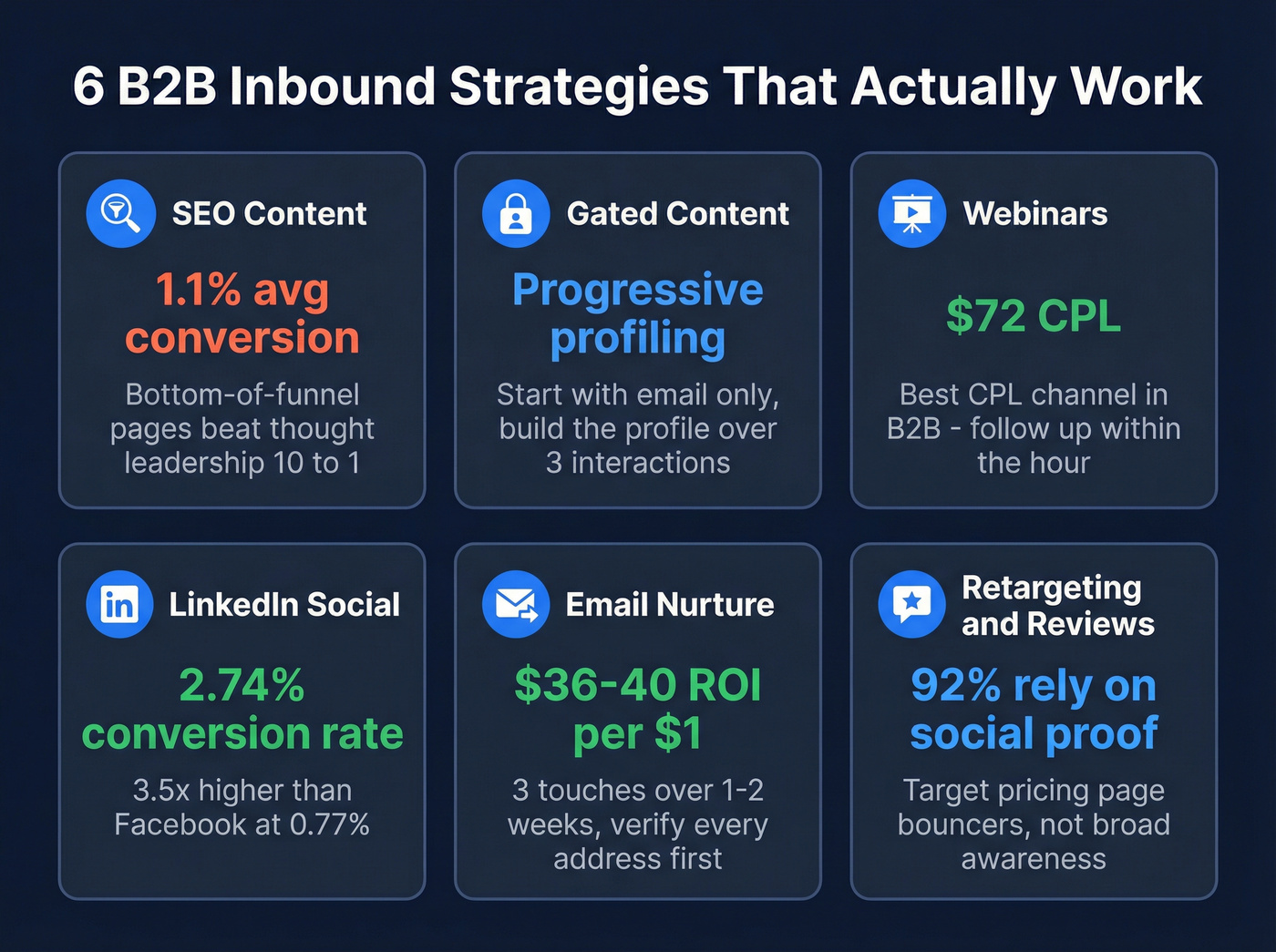
With B2B SaaS converting at just 1.1%, you need content that attracts buyers with intent. One well-targeted comparison page will outperform ten thought-leadership posts. We've seen this firsthand: getting organic leads starts with matching content to the search queries your best customers actually type before they buy, not the keywords with the highest volume.
Gated Content and Lead Magnets
The trick isn't gating more - it's gating smarter. Use progressive profiling to collect information across multiple interactions instead of front-loading a 12-field form.
Start with email only. Ask for title and company size on the second download. By the third interaction, you've got a complete profile without ever showing a form that makes someone close the tab.
If you're building this into your site, it helps to think in terms of lead capture mechanics and handoff rules, not just "forms."
Webinars Aren't Dead
Webinars remain the best CPL channel in B2B: ~$72 CPL versus ~$92 for SEM and ~$811 for trade shows. The catch is speed. Webinar intent decays fast, so your follow-up workflow needs to hit while the topic is still fresh - ideally within the hour, not the next business day.
LinkedIn-First Social
LinkedIn's visitor-to-lead conversion rate runs 2.74% versus Facebook's 0.77%. That's not a marginal difference - it's a different category entirely. The play isn't just posting content. It's engaging in comments, building relationships in industry groups, and using founder and exec profiles as distribution channels. Company pages alone won't move the needle.
To systematize this, treat it like social selling with a pipeline-first cadence.
Email Nurture Sequences
Email returns $36-40 per $1 spent. But that ROI assumes discipline: authenticate SPF, DKIM, and DMARC on your sending domain. Keep emails to 100-120 words. Run three touches over one to two weeks, not seven touches over three days.
We've tested sequences where a single unverified list tanked domain reputation for weeks. Verify every address before it enters a sequence, and tie your attribution model to closed opportunities, not last-click.
If you're tightening deliverability, use an email deliverability checklist and a dedicated email ID validator before anything hits your sequencer.
Retargeting and Review Platforms
92% of buyers rely on social proof before making a purchase decision. Your G2 and Capterra profiles aren't optional - they're part of the funnel. Pair review presence with retargeting ads aimed at pricing-page bouncers, and consider layering in anonymous visitor identification tools to capture the majority of traffic that never fills out a form. A retargeting campaign targeting pricing-page visitors will outperform broad awareness ads every single time.
If you're evaluating those tools, compare options like Lead Forensics alternatives before you commit.

Speed-to-lead only works if the contact data is accurate. One unverified email tanks your domain reputation and kills the sequence before it starts. Prospeo delivers 98% email accuracy with a 7-day refresh cycle - so when that inbound lead hits your CRM, you're routing to a real person, not a stale record.
Stop losing warm inbound leads to bad data.
Where Leads Die: Post-Conversion Ops
Here's the thing: most inbound programs don't have a lead generation problem. They have a lead handling problem. The most common frustration on r/sales and B2B ops forums isn't lead volume - it's that marketing and sales can't agree on what counts as qualified.
If you want a clean definition and handoff rules, align on inbound lead qualification before you touch tooling.
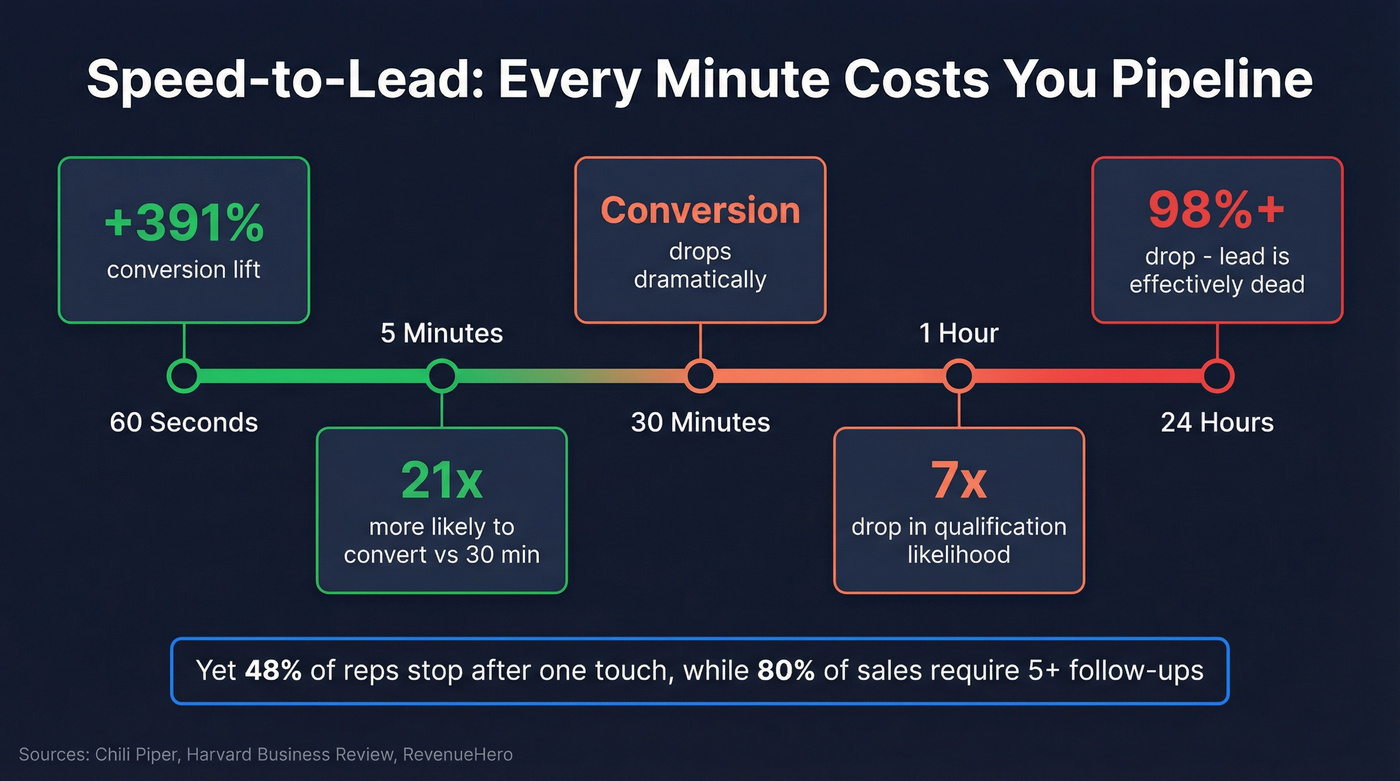
The speed-to-lead data is brutal. Connecting with a lead within 60 seconds increases conversion by 391%. Within 5 minutes, you're 21x more likely to convert than at 30 minutes. Wait an hour, and qualification likelihood drops 7x per Harvard Business Review research. After 24 hours, it drops by 98%+.
Yet 48% of reps stop after one touch, while 80% of sales require five or more follow-ups. The math doesn't work unless you automate routing and enforce follow-up cadences. We've seen teams adopt the AQO framework from LaunchLeads to fix this: count held meetings with a confirmed next step within 7 days - not booked meetings. It's a harder metric, but it's the one that correlates with pipeline.
The hidden bottleneck is data quality. Your "real-time" routing is only as good as the contact data feeding it. If enrichment records are six weeks old - the industry average refresh cycle - you're routing leads to wrong emails, dead phone numbers, and outdated job titles. Tag every lead with UTM parameters and enforce lead source tracking in your CRM, or you'll never diagnose where the funnel breaks.
To keep this clean long-term, build a lightweight CRM hygiene process and standardize CRM lead source tracking across teams.
Prospeo solves this at the source. With 98% email accuracy and a 7-day data refresh cycle, contacts entering your sequences are current and verified. Meritt went from a 35% bounce rate to under 4% after switching, and their pipeline tripled from $100K to $300K per week. When your data is clean, your routing works, your sequences land, and reps spend time selling instead of chasing dead addresses.
You're converting visitors at 1-3%. The leads that do come through deserve verified emails, direct dials, and 50+ enrichment data points - instantly. Prospeo's CRM enrichment hits a 92% match rate at $0.01 per email, so your nurture sequences and routing rules run on current, complete records.
Enrich every inbound lead before your competitor responds first.
AI-Powered Inbound in 2026
AI-driven lead scoring delivers 70-85% qualification accuracy versus 30-40% with manual methods. The cost shift is just as dramatic: cost per qualified lead drops from $50-200 to $15-50, and Gartner's data shows AI scoring reduces qualification time by up to 30%.
If your average deal size is under $10K, you probably don't need a $40K/year data platform. A lean stack with AI scoring, verified contact data, and intent signals will outperform an enterprise suite your team barely uses. Skip the bloated all-in-one if your team won't touch half the features.
If you're implementing scoring, start with a simple lead scoring system and evolve into RevOps lead scoring governance as volume grows.
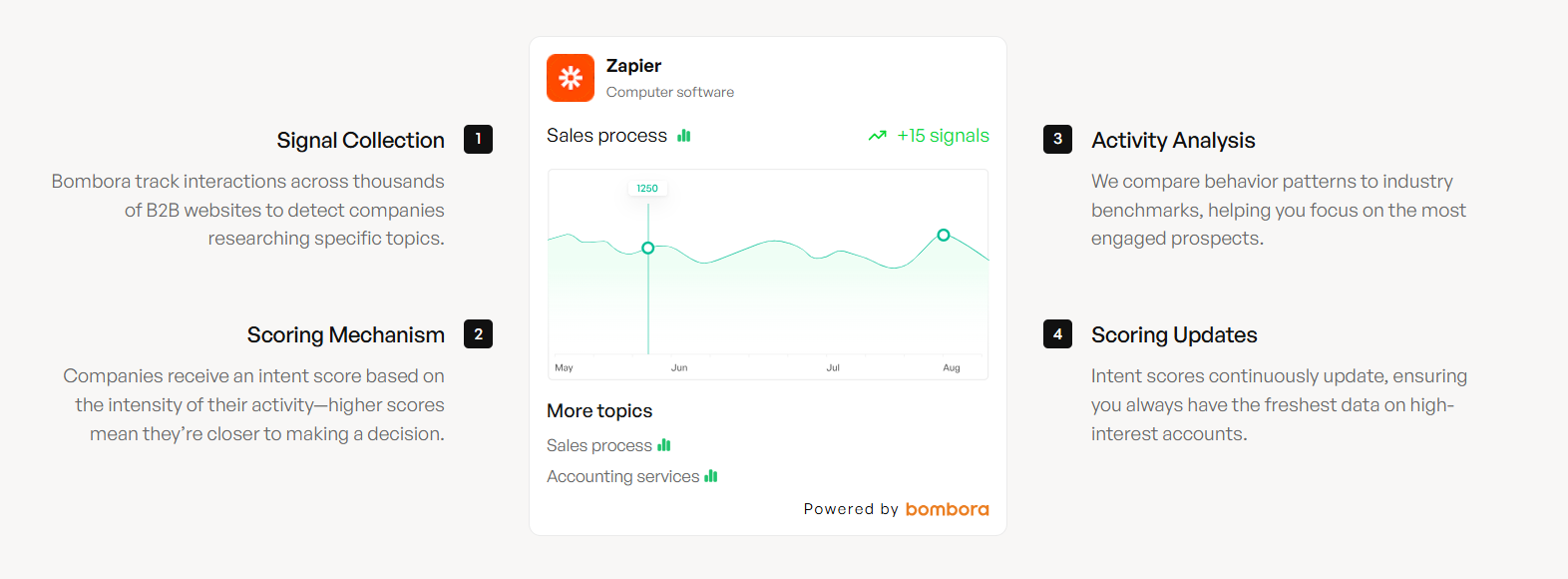
The practical starting point: analyze your last 500 closed deals. What titles bought? What company sizes? What content did they engage with before requesting a demo? Feed those patterns into your scoring engine and layer in intent data - tracking in-market buyer signals across thousands of topics - to separate high-converting inbound from noise. Expect 3-6 months for significant ROI as models learn your business patterns.
Build Your Inbound Stack
You don't need fifteen tools. You need five that work together.
If you're rationalizing tools, use a sales tools checklist to keep the stack lean and interoperable.
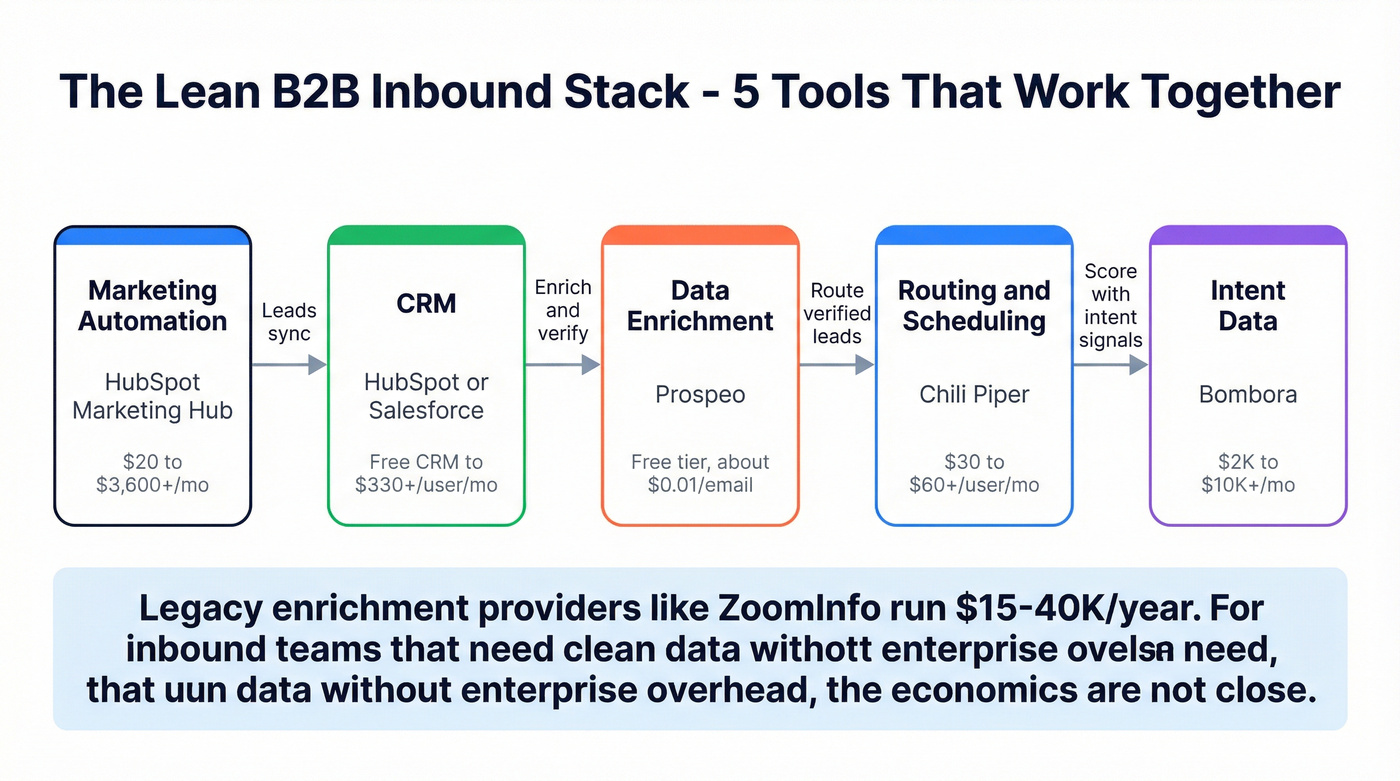
| Category | Tool Example | Approx. Pricing |
|---|---|---|
| CRM | HubSpot / Salesforce | HubSpot has a free CRM; paid suites ~$20-$330+/user/mo |
| Data Enrichment | Prospeo | Free tier; ~$0.01/email |
| Routing & Scheduling | Chili Piper | ~$30-$60+/user/mo |
| Marketing Automation | HubSpot Marketing Hub | ~$20-$3,600+/mo depending on tier |
| Intent Data | Bombora (standalone) | ~$2K-$10K+/mo (custom) |
The pricing contrast on data enrichment is worth a closer look. Legacy providers like ZoomInfo typically run $15-40K/year for comparable enrichment. For teams running inbound programs that need clean data without enterprise overhead, the economics aren't close.
B2B Inbound Lead Generation FAQ
What's a good inbound lead conversion rate for B2B?
Most B2B industries convert 1-5% of website visitors into leads. B2B SaaS averages 1.1%, IT & Managed Services 1.5%, and Legal Services leads at 7.4% per First Page Sage's 2026 benchmarks. If you're below your industry benchmark, prioritize conversion rate optimization before adding more traffic.
How do you generate inbound sales leads consistently?
Build a repeatable system: publish bottom-of-funnel content ranking for buyer-intent keywords, gate high-value assets with progressive profiling, and route every new lead to sales within five minutes. Treat it as an operations discipline - not a campaign - by pairing content velocity with automated follow-up cadences and verified contact data.
How fast should you follow up with an inbound lead?
Under 5 minutes. Leads contacted within that window are 21x more likely to convert than those contacted after 30 minutes. After one hour, qualification likelihood drops 7x. After 24 hours, it drops by 98%+. Automate routing and scheduling to eliminate manual delays - this is the highest-leverage operational fix in most inbound programs.
How do you prevent inbound leads from bouncing in email sequences?
Verify every email before it enters a sequence using a tool with 98%+ accuracy and a weekly data refresh cycle. Authenticate SPF, DKIM, and DMARC on your sending domain. Sunset unengaged contacts after 90 days to protect deliverability long-term.
The formula hasn't changed: benchmark your funnel, respond in minutes not hours, and never let bad data be the reason a warm inbound lead goes cold.