

The Buyer Intent Keywords List You Actually Wanted
Your content team published 20 blog posts last quarter. Traffic's up 40%. Pipeline hasn't moved.
The disconnect isn't volume - it's intent. You've been ranking for keywords that attract readers, not buyers. Most buyer intent keywords lists hand you 10 examples and a lecture about search intent theory. You came here for the actual list, so let's skip the preamble.
The quick version:
- The full modifier list is below - 200+ buyer-intent modifier ideas organized by intent tier and by vertical (SaaS, ecommerce, local services, B2B services).
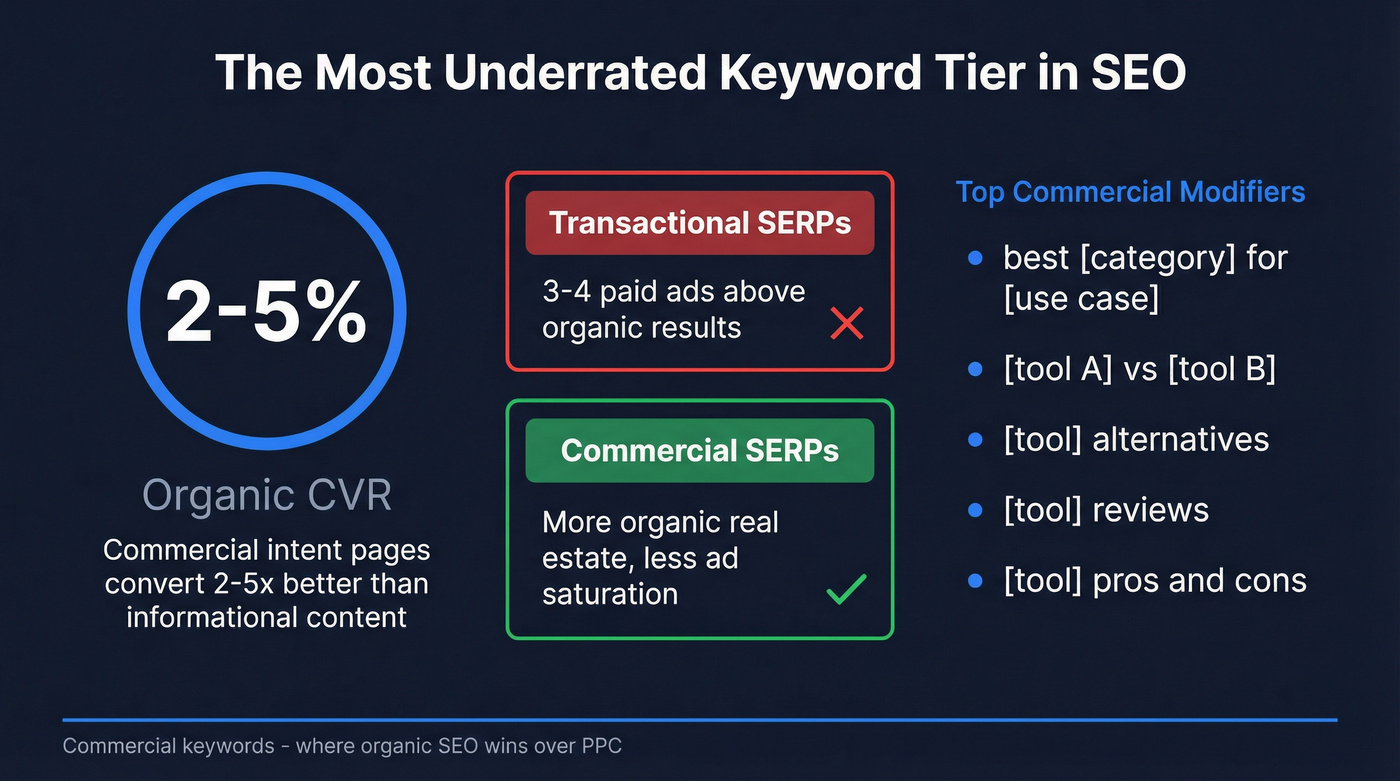
- Commercial intent keywords are the underrated opportunity. Transactional terms get dominated by paid ads, but commercial terms have more organic real estate and typically convert in the 2-5% range when the page matches the intent.
200+ Buyer Intent Keyword Modifiers
Every modifier below can be combined with your product, category, or brand to generate hundreds of targetable keywords. They're organized into three tiers that map to the buyer journey: problem-aware, solution-aware, and product-aware.
Tier 1 - Informational (Problem-Aware)
These keywords signal early research. The searcher knows they have a problem but hasn't started evaluating solutions. Low conversion, high volume, great for building trust.
| Modifier Type | SaaS / B2B | Ecommerce | Local Services | Professional Services |
|---|---|---|---|---|
| How-to | how to automate X | how to style X | how to fix X | how to hire a X |
| What-is | what is [category] | what is [material] | what does X cost | what is [service type] |
| Benefits | benefits of X | benefits of [material] | benefits of hiring X | benefits of outsourcing X |
| Ways to | ways to improve X | ways to wear X | ways to prevent X | ways to reduce X costs |
| Tips | tips for [workflow] | tips for choosing X | tips for finding X | tips for managing X |
| Guide | guide to [process] | buyer's guide X | guide to [home task] | guide to [compliance] |
| Examples | examples of X | X outfit ideas | X project examples | X case studies |
| Challenges | challenges with X | common X problems | X issues in [city] | challenges of X |
| Best practices | best practices for X | X care instructions | X maintenance tips | X best practices |
| Why | why does X matter | why is X expensive | why hire a X | why do you need X |
| Mistakes | common X mistakes | X buying mistakes | X hiring mistakes | mistakes when choosing X |
Tier 2 - Commercial (Solution-Aware)
This is the money tier for SEO. These searchers are actively comparing options. They often convert in the 2-5% range organically when the page is built for evaluation, and the SERPs usually aren't as ad-saturated as pure transactional terms.
| Modifier Type | SaaS / B2B | Ecommerce | Local Services | Professional Services |
|---|---|---|---|---|
| Best | best [category] for X | best [product] under $X | best [service] in [city] | best [service] for startups |
| Top | top [category] tools | top-rated [product] | top [service] near me | top [service] firms |
| Reviews | [tool] reviews | [product] reviews 2026 | [company] reviews | [firm] reviews |
| Comparison | [tool A] vs [tool B] | [product A] vs [product B] | [company A] vs [company B] | [firm A] vs [firm B] |
| Alternatives | [tool] alternatives | [brand] alternatives | alternatives to [company] | [firm] alternatives |
| For [use case] | CRM for startups | running shoes for flat feet | plumber for old houses | accountant for freelancers |
| For enterprise | [tool] for enterprise | - | - | [service] for enterprise |
| Which is best | which [tool] is best for X | which [product] is best for X | which [service] is best | which [firm] is best for X |
| Under $X | under $50/mo | under $200 | under $500 | under $5,000/mo |
| Features | [tool] features | [product] specs | [service] includes | [service] scope |
| Pros and cons | [tool] pros and cons | [product] pros and cons | [company] pros and cons | [firm] pros and cons |
| Compliant / certified | SOC 2 compliant [tool] | organic / certified X | licensed [service] | [regulation] compliant |
| Product attribute | - | noise-cancelling [product], waterproof [product] | eco-friendly [service] | bilingual [service] |
| Self-hosted / open source | self-hosted [category] | - | - | - |
| Lightweight | lightweight [tool] | lightweight [product] | - | - |
Tier 3 - Transactional (Product-Aware)
Highest intent, highest competition. These searchers have decided - they're looking for the checkout button, the demo form, or the phone number. PPC often dominates these SERPs, but ranking organically here is extremely valuable.
| Modifier Type | SaaS / B2B | Ecommerce | Local Services | Professional Services |
|---|---|---|---|---|
| Pricing | [tool] pricing | [product] price | [service] cost [city] | [service] pricing |
| Buy / order | buy [tool] license | buy [product] online | - | - |
| Demo / trial | [tool] demo | - | - | [service] consultation |
| Free trial | [tool] free trial | free sample [product] | free estimate [service] | free consultation |
| Discount / coupon | [tool] discount code | [product] coupon code | [service] discount | - |
| Sign up | sign up for [tool] | - | - | - |
| Contact / quote | contact [tool] sales | - | get quote [service] | request proposal [service] |
| Schedule / book | schedule [tool] demo | - | book [service] [city] | book consultation |
| Hire | - | - | hire [service] [city] | hire [service type] |
| Near me / local | - | [product] near me | [service] near me | [service] near me |
| Same day / emergency | - | same-day delivery X | emergency [service] | urgent [service] |
| Implementation | [tool] implementation | - | - | [service] implementation |
| Onboarding | [tool] onboarding | - | - | [service] onboarding |
| Migration | [tool] migration guide | - | - | migrate from [tool A] to [tool B] |
| Cancel / renew | cancel [tool], [tool] renewal | - | - | [service] contract renewal |
| Upgrade / downgrade | upgrade [tool] plan | - | - | - |
| Branded | [Brand] pricing | [Brand] sale | [Brand] [city] | [Brand] reviews |
| Branded action | [Brand] login | [Brand] order status | [Brand] phone number | [Brand] contact |
The three most underused modifiers: "implementation," "onboarding," and "migration." These signal a buyer who's already decided to switch - they're past evaluation and into logistics. If you're not creating content around these terms, you're missing some of the easiest conversions in your funnel. And don't sleep on "cancel" and "renew" - these are gold for retention teams trying to intercept churn before it happens.
What Are Buyer Intent Keywords?
Buyer intent keywords are search queries that signal someone is evaluating or ready to purchase a product or service. They're the difference between "what is CRM" and "HubSpot vs Salesforce pricing." If you've ever wondered why certain pages drive pipeline while others just drive pageviews, the answer is almost always intent.
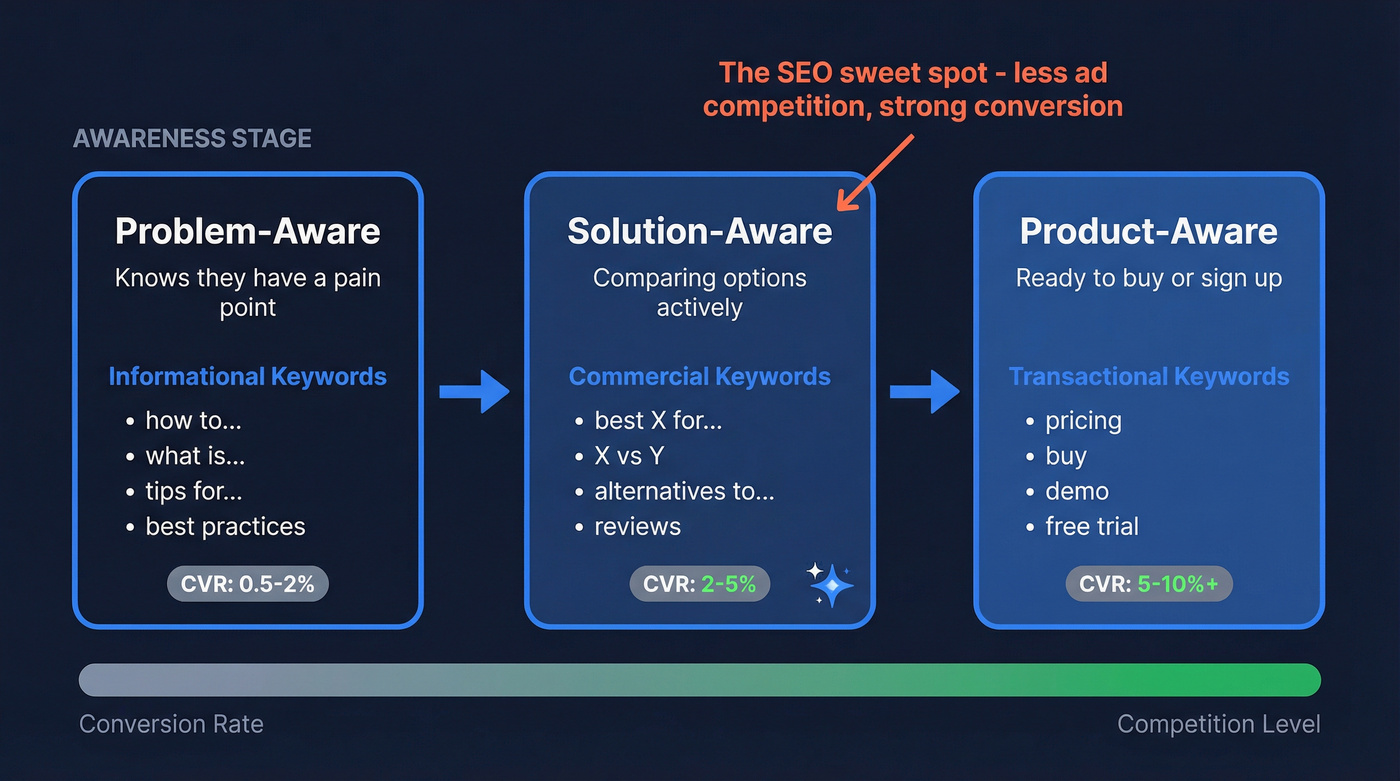
The standard taxonomy breaks search intent into four types: informational for learning, navigational for finding a specific site, commercial for evaluating options, and transactional for ready-to-act queries. Buyer intent keywords live primarily in the commercial and transactional buckets. Map these onto the awareness model and the progression becomes clear: problem-aware searchers use informational terms, solution-aware searchers use commercial terms, and product-aware searchers use transactional terms. The modifiers in the mega-list above follow this exact progression. If you want a deeper breakdown of intent keywords and how they map to content types, start there.
Why Purchase Intent Keywords Convert Better
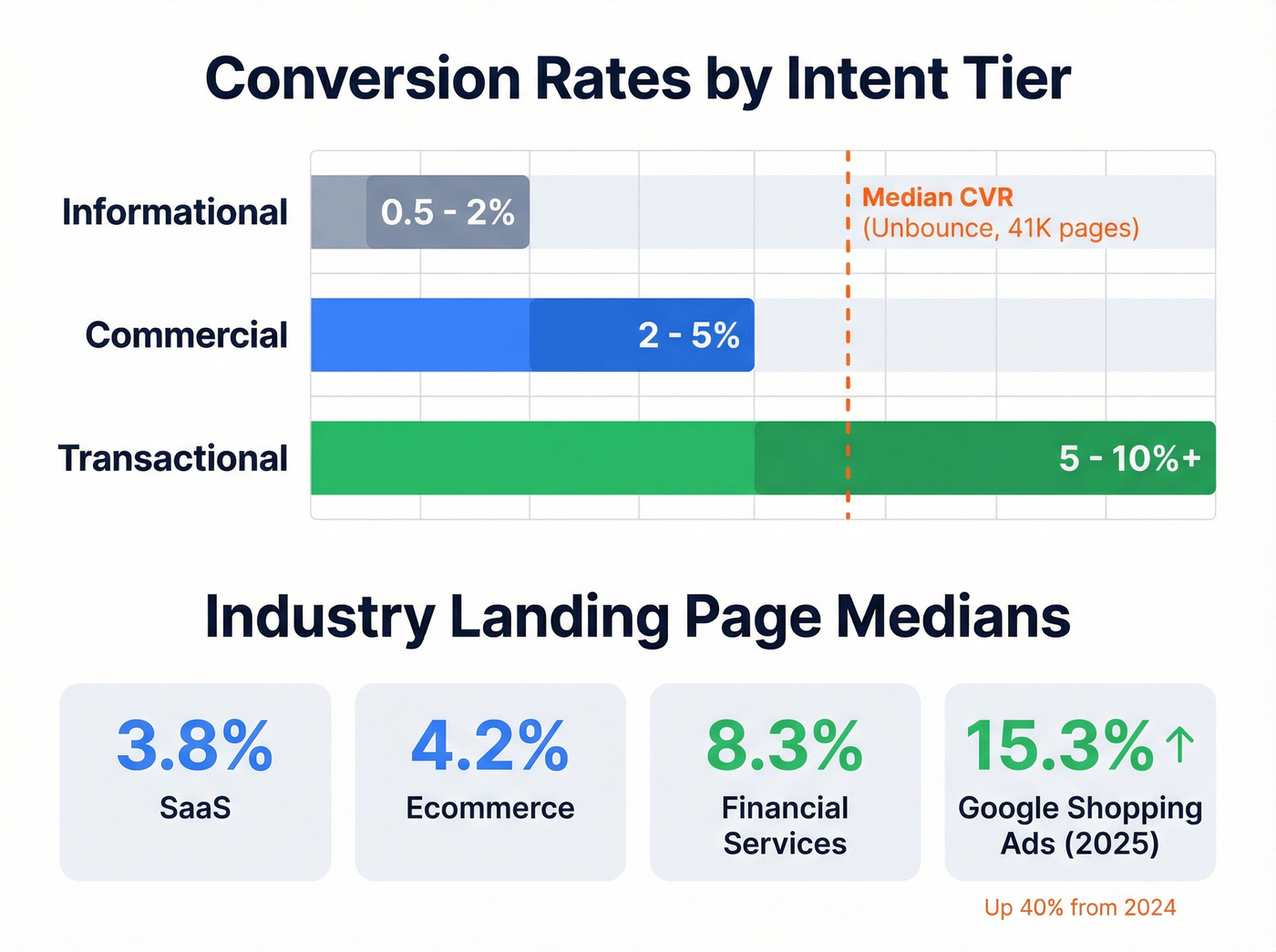
An Unbounce analysis of 41,000 landing pages across 464M pageviews and 57M conversions found a median conversion rate of 6.6% across industries. That median hides massive variation by intent tier.
| Intent Tier | Typical CVR Range | SERP Competition | Best Channel |
|---|---|---|---|
| Informational | 0.5-2% | Low-Medium | SEO (blog content) |
| Commercial | 2-5% | Medium | SEO (comparison/review pages) |
| Transactional | 5-10%+ | Very High | PPC + SEO (landing pages) |
For context, general website conversion rates sit much lower - B2B ecommerce averages 1.8%, B2C just 2.1%. That makes the 5-10% range on high-intent landing pages striking.
Industry-specific landing page medians reinforce the pattern: SaaS sits at 3.8%, ecommerce at 4.2%, financial services at 8.3%. Google Shopping Ads - almost entirely transactional - saw CVR jump from 10.9% in 2024 to 15.3% in 2025, a 40% improvement.
Here's the thing: stop obsessing over transactional keywords. Those SERPs are packed with ads - Google often shows multiple paid results before any organic listing. Commercial intent is where the real SEO opportunity lives. Terms like "best CRM for startups" or "HubSpot vs Salesforce" often convert in the 2-5% range organically and face far less paid competition. A common refrain on r/SEO captures it well: "I rank for 50 informational keywords and none of them convert." That's the intent gap in action, and commercial keywords are the fix.

Buyer intent keywords tell you who's ready to buy. Prospeo tells you exactly how to reach them. Layer intent data across 15,000 Bombora topics with 300M+ profiles, 30+ filters, and 98% verified emails - so the high-intent traffic you capture turns into pipeline, not just pageviews.
Stop ranking for keywords that attract readers. Start reaching the buyers behind them.
How to Build Your Own Intent Keyword List
1. Start With the Mega-List Above
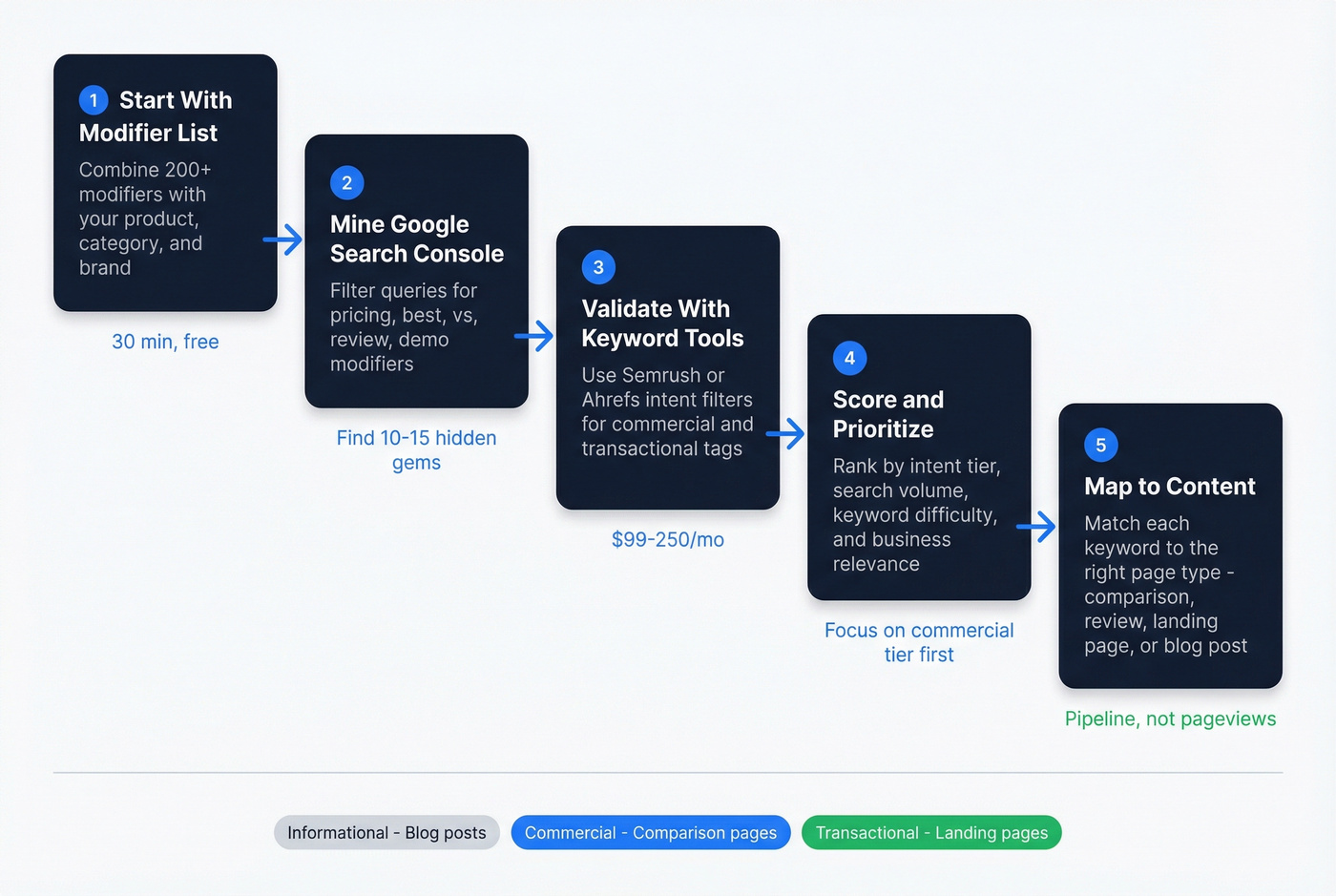
Take the modifier tables and combine them with your product category, brand name, and use cases. "Best [your category] for [your ICP's use case]" generates dozens of commercial-intent targets instantly. Run through all three tiers systematically - you'll have 50-100 keyword candidates within 30 minutes, and it costs nothing.
2. Mine Google Search Console
GSC is the best free source for high-intent keywords you're already ranking for but probably ignoring. Here's the workflow:
- Open Performance, then Search Results
- Filter queries containing high-intent modifiers: "pricing," "best," "vs," "review," "buy," "demo"
- Segment by landing page type and compare CTR across intent tiers
You'll often find you're ranking position 8-15 for commercial terms that just need a dedicated page to break into the top 5. We've seen this method surface 10-15 high-intent keywords most teams completely overlook - keywords that were already driving impressions but getting zero strategic attention.
3. Use Keyword Tools With Intent Filters
Semrush (~$130-$250+/mo depending on tier) and Ahrefs (~$99-$249+/mo depending on tier) both tag keywords by intent type, letting you filter for commercial and transactional terms at scale. Google Keyword Planner is free with a Google Ads account and works for volume estimates, though it doesn't classify intent.
For most teams, starting with GSC and then validating with one paid tool is the right sequence. If you want to go beyond keywords into search intent data workflows, that’s the next step.
4. Validate With SERP Analysis
Don't trust modifier-based classification blindly. Search the keyword and look at what Google actually ranks. If the top results are all blog posts, Google considers it informational - regardless of the modifier. If the top results are product pages and comparison articles, you've confirmed commercial or transactional intent.
I've watched teams build entire landing pages for keywords Google treats as informational. Check the SERP first. It takes 30 seconds and saves weeks of wasted effort.
5. Bridge to Account-Level Intent Data
Keyword research tells you what topics buyers care about. Intent data tells you which companies are actively researching those topics right now. This is where you shift from content strategy to pipeline generation - teams using keyword-level intent data report 40-60% less time spent on account research. This approach pairs naturally with signal-based outbound when you want sales to act on the same intent signals marketing is targeting.
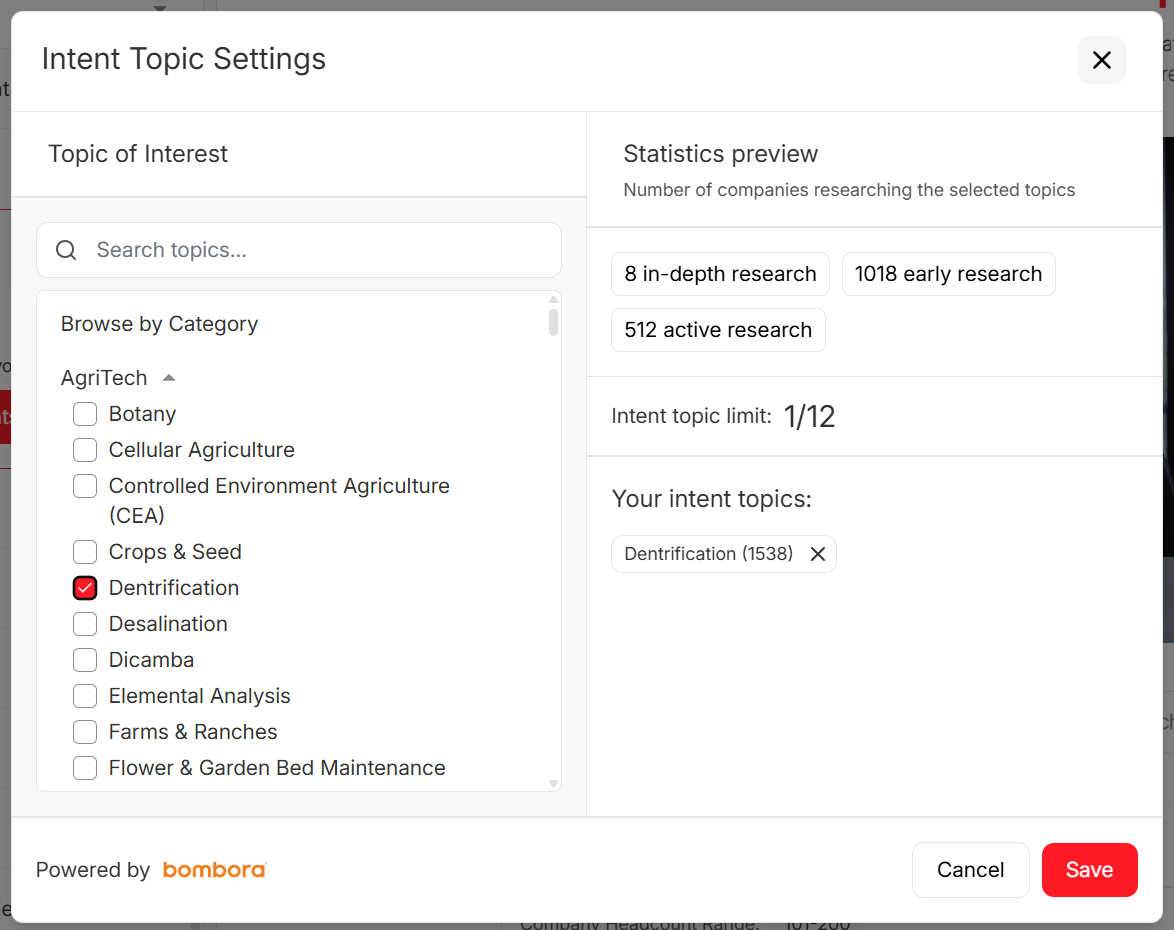
Prospeo tracks 15,000 intent topics via Bombora and lets you layer those signals with job role, company growth, and technographic filters to build prospect lists of companies showing active buying behavior. It's the bridge between "we know what keywords matter" and "we know who's searching for them." To operationalize it, most teams also define a lightweight account qualification rule set so reps know which accounts to work first.
You just mapped 200+ intent modifiers to your funnel. Now imagine filtering prospects by those exact buying signals - job changes, tech stack, headcount growth, funding - and getting verified direct contact data at $0.01 per email. That's what Prospeo's intent-powered database does.
Turn intent signals into booked meetings. 15,000 intent topics, 143M+ verified emails.
Score and Prioritize Your Keywords
Not all purchase intent keywords deserve equal effort. Use this scoring framework to prioritize.
| Factor | 1 (Low) | 3 (Medium) | 5 (High) |
|---|---|---|---|
| Intent Strength | Informational | Commercial | Transactional |
| Search Volume | <100/mo | 100-1K/mo | 1K+/mo |
| Competition (inverse) | Very high, many ads | Moderate | Low, organic opportunity |
Priority = (Intent x 2) + Volume + Competition. Score 12 or above means target immediately. 8-11 means plan content this quarter. Below 8 goes to the backlog.
The decision between SEO, PPC, or both follows naturally from the score. High-intent, high-competition terms like "[brand] pricing" need PPC to capture traffic now and SEO for long-term organic positioning. Commercial terms with moderate competition are pure SEO plays - build comparison pages and reviews. Low-intent informational terms are content marketing investments that pay off over months, not weeks.
Let's be honest about a mistake we see constantly: one SaaS company we worked with was ranking #3 for "[tool] pricing" - sending all that traffic to a blog post about industry trends. They built a dedicated pricing page and conversions jumped immediately. The scoring framework would have caught that: a score-15 keyword getting blog-post treatment is a painful miss.
Skip the scoring framework entirely if your average deal size is under roughly $10K and you have fewer than 50 target keywords. At that scale, just sort by intent tier and work top-down. The framework pays off when you're prioritizing across hundreds of terms. If you’re building a broader system, this plugs directly into lead prioritization and RevOps lead scoring.
B2B vs B2C Intent Modifiers
The modifiers that signal "ready to buy" differ sharply between B2B and B2C.
| Signal | B2C Modifiers | B2B Modifiers |
|---|---|---|
| Ready to purchase | buy now, add to cart | request demo, contact sales |
| Price sensitivity | discount, coupon code, free shipping | pricing, payment plan, ROI calculator |
| Urgency | same-day delivery, open now | implementation timeline, onboarding |
| Trust / validation | reviews, ratings, unboxing | case study, SOC 2, SLA, terms and conditions |
| Logistics | delivery times, return policy | migration, integration, deployment |
B2B decision-stage keywords often signal committee buying. When someone searches "SOC 2 compliant CRM," that's likely a security team member evaluating on behalf of a buying group - one person researching, five people deciding. B2C signals individual purchase readiness. This distinction matters for your landing page design and follow-up strategy, not just your keyword targeting. If you’re mapping those roles explicitly, use a buying group personas framework.
We've noticed B2B teams consistently undervalue the "logistics" row. Keywords around migration, integration, and deployment signal a buyer who's already past the decision - they're planning the switch. These terms have tiny search volumes but very high conversion rates because the intent is so specific. If you're only targeting "best X" and "X pricing," you're leaving the easiest conversions on the table.
Five Mistakes That Waste High-Intent Traffic
1. Sending high-intent traffic to blog posts. If someone searches "[your tool] pricing" and lands on a blog post about industry trends, you've burned that click. High-intent keywords need landing pages with CTAs, not educational content.
2. Misclassifying intent by modifier alone. "Free CRM" is transactional. "Free tips for managing teams" is informational. Always check context, not just the modifier.
3. Keyword cannibalization. Multiple pages competing for the same intent keyword split your authority. Audit existing content before creating new pages - you might just need to consolidate two underperforming posts into one strong page.
4. Ignoring SERP reality. You think "best project management tools" is commercial intent. Google ranks Reddit threads and listicles. Check the actual SERP before building a product-heavy landing page - what Google rewards tells you more than any intent model.
5. Treating all transactional keywords equally. "[Brand] login" is transactional but has zero conversion value for new customer acquisition. "[Brand] pricing" is gold. Use the scoring framework to separate signal from noise.
FAQ
What is a buyer intent keyword?
A search query signaling someone is actively evaluating or ready to purchase a product or service. Modifiers like "best," "pricing," "reviews," and "buy" indicate the searcher has moved past passive research into decision-making. The stronger the modifier, the closer they are to conversion.
What are examples of high buyer intent keywords?
"[Product] pricing," "buy [product] online," "[brand] vs [competitor]," "best [category] for [use case]," and "discount code for [brand]." The 200+ modifier tables above let you generate hundreds of examples by combining modifiers with your specific product category.
What's the difference between commercial and transactional intent?
Commercial means the searcher is evaluating options - "best CRM for startups." Transactional means they're ready to act - "HubSpot pricing" or "sign up for HubSpot." Commercial keywords often convert at 2-5% organically, while transactional terms hit 5-10%+ but face heavier paid competition.
Can intent data improve keyword strategy?
Yes. Intent data platforms track which companies are actively researching specific topics, turning your keyword research into actionable prospect lists. This bridges the gap between knowing what keywords matter and knowing who's searching for them right now - which is where content strategy becomes pipeline generation.