How to Follow Up on a Proposal Without Sounding Desperate
You sent the proposal. Now you're refreshing your inbox like it owes you money. Your prospect is getting 120+ emails a day, and yours is already buried somewhere between a Slack notification and a lunch order. A well-timed follow-up email to client after sending a proposal pulls it back to the top - and the difference between closing and losing often comes down to when and how you send that next message.
What You Need (Quick Version)
Wait 3 business days. If you want to optimize send time, Monday morning between 6-9am PST is a strong benchmark window from large-scale outreach data. Cap your sequence at 2-3 emails total. If that's all you needed, jump to the templates below. For the data behind those numbers and guidance on writing each message, keep reading.
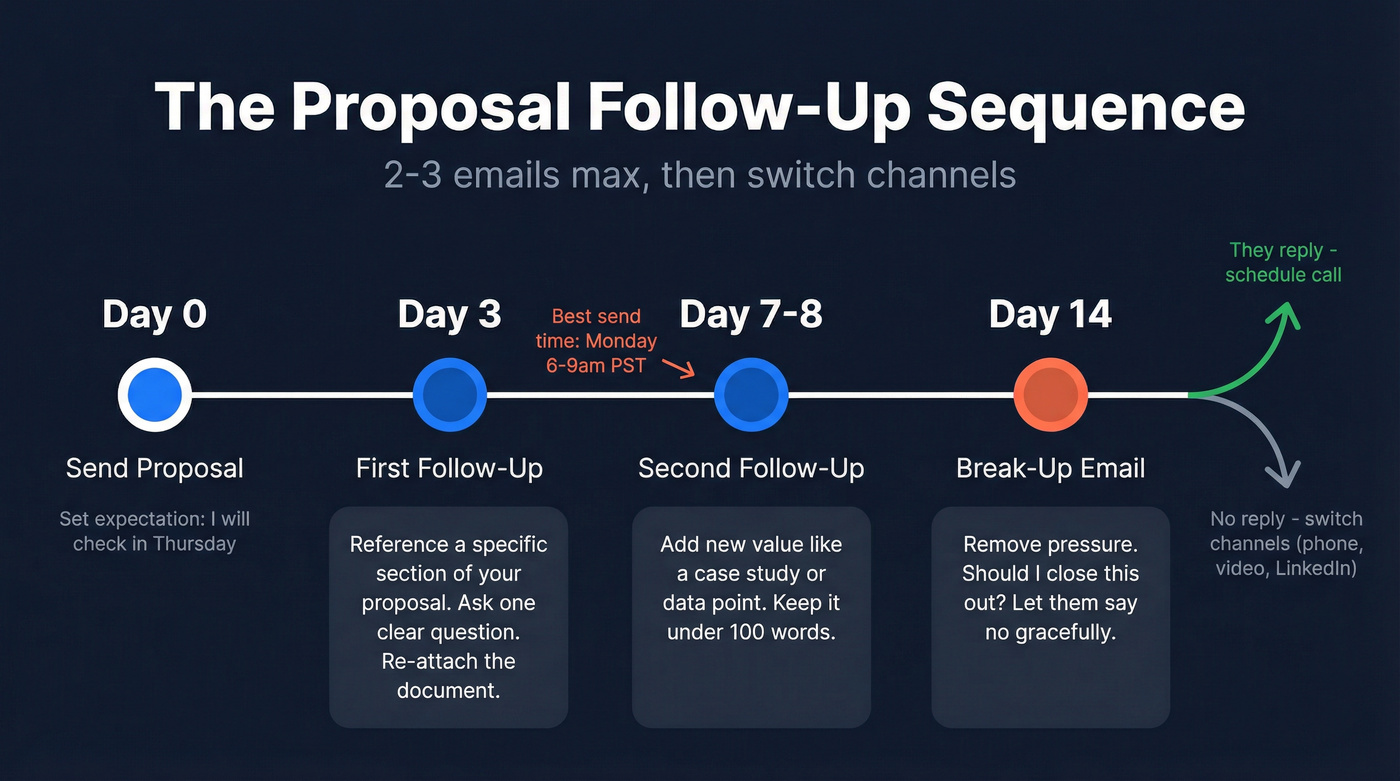
When to Send Your First Follow-Up
Three business days is the sweet spot. Sooner feels pushy. Longer risks being forgotten. Your prospect needs time to review internally, loop in stakeholders, and form an opinion before they're ready to respond.
An 85,000-email study from Siege Media found Monday mornings between 6-9am PST deliver the highest reply rates at 2.8%. Wednesday is a solid backup. You want to hit the inbox before the day's chaos starts, not compete with it. If Day 3 falls on a Friday, push to Monday - nobody's making buying decisions at 4pm on a Friday.
How Many Follow-Ups to Send
Most advice gets this wrong. The "send 7-8 follow-ups" crowd is optimizing for cold outreach, not proposal follow-ups. You've already had a conversation. The dynamic is different.
Belkins analyzed 16.5M cold emails across 93 business domains and found the highest reply rate - 8.4% - comes from a single-email sequence. Every additional touch drops that number. Worse, 4+ emails in a sequence more than triples your spam risk. We've seen this play out firsthand: the third email almost never converts a silent prospect, but switching channels does. Two to three emails is the ceiling. SMBs tolerate more follow-ups; enterprise contacts ghost quickly and punish persistence with spam reports.
The 6-Part Follow-Up Structure
Every proposal follow-up should hit these six elements:
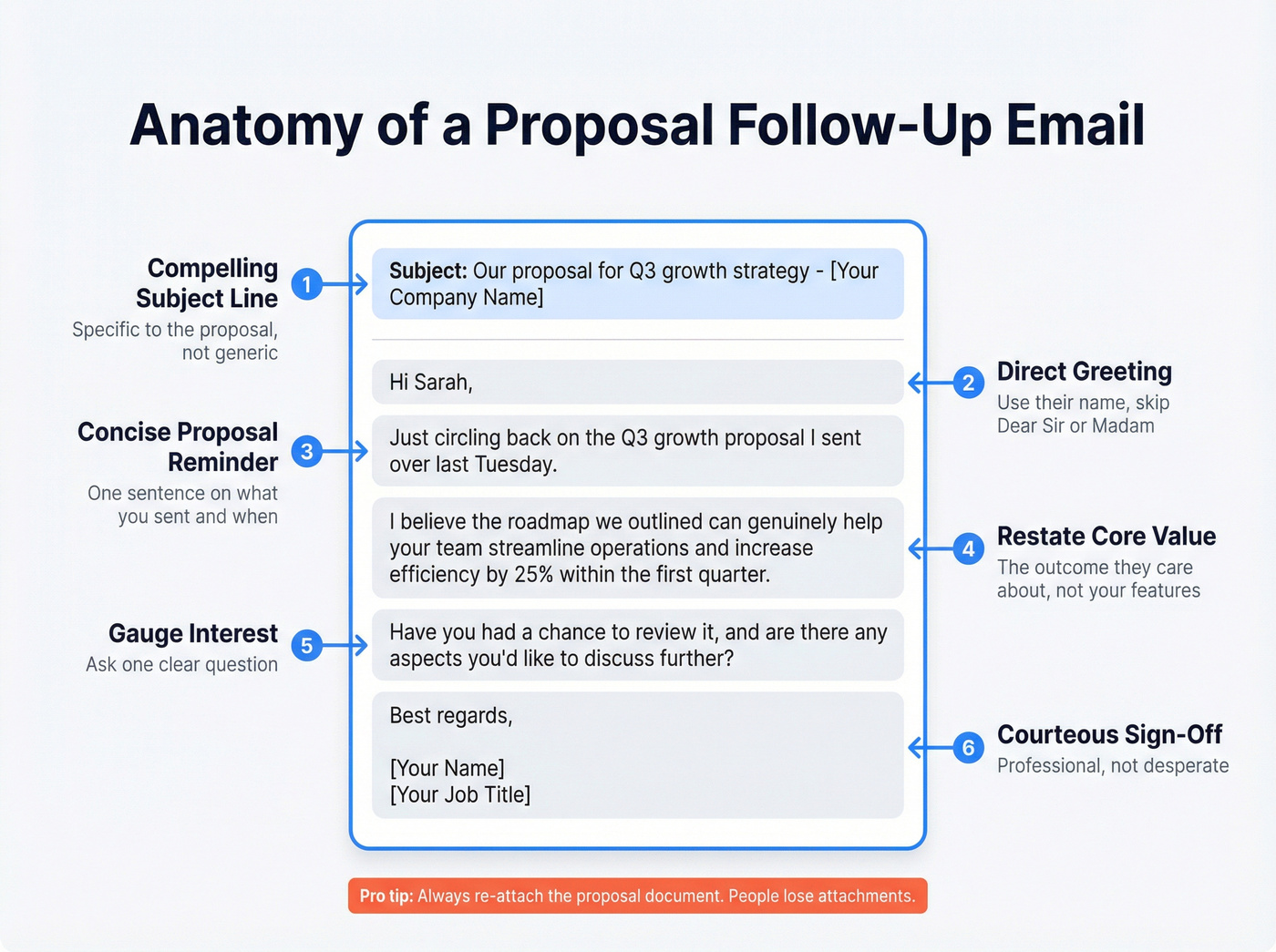
- Compelling subject line - specific to the proposal, not generic (see Subject Lines for Follow-Up Emails)
- Direct greeting - use their name, skip "Dear Sir/Madam" (more Follow-Up Email Greetings)
- Concise proposal reminder - one sentence on what you sent and when
- Restate the core value - the outcome they care about, not your features
- Gauge interest - ask one clear question (use open-ended sales questions when it fits)
- Courteous sign-off - professional, not desperate (tighten your closing with Closing Email Phrases)
Re-attach the proposal document every time. People lose attachments. Don't make them dig.
Set the follow-up expectation before you send the proposal. A simple "I'll check in Thursday" in your original email gives you a natural reason to reach back out - and it reframes the follow-up from interruption to expected next step.

You're crafting the perfect follow-up, but 1 in 5 B2B emails hit dead addresses with most providers. Prospeo's 98% email accuracy and 7-day data refresh means your proposal follow-up reaches the actual decision-maker - not a bounced inbox that tanks your domain reputation.
Stop following up with addresses that don't exist.
3 Follow-Up Email Templates After Your Proposal
First Follow-Up (Day 3)
Subject: Quick thought on the Q3 timeline we proposed
Hi {{first_name}},
I wanted to circle back on the proposal I sent over on {{date}}. Specifically, the phased rollout we outlined for Q3 - I think the timeline gives your team enough runway to onboard without disrupting current workflows.
One question: does the implementation window we proposed work with your internal planning cycle, or should we adjust?
Happy to jump on a 15-minute call to walk through any section. I've re-attached the proposal for easy reference.
Best, {{your_name}}
Second Follow-Up (Day 7-8)
Subject: Thought this might be relevant - {{company_name}} case study
Hi {{first_name}},
I know proposals can sit while other priorities take over. Totally understand.
I wanted to share a quick case study from a company in a similar space that saw a 40% reduction in {{relevant_metric}} within the first 90 days of implementation. Thought it might add useful context as you evaluate.
Worth a 10-minute conversation this week?
Best, {{your_name}}
Break-Up Email (Day 14)
Subject: Should I close this out?
Hi {{first_name}},
I haven't heard back, so I'm guessing the timing isn't right - and that's completely fine.
I'll close out this thread on my end, but if things change down the road, the door's open. No need to reply if now isn't the right moment.
Wishing you a great {{day_of_week}}, {{your_name}}
Alternative subject line: Am I emailing the right person?
Notice what's missing from all three: the phrase "just checking in." It's one of the most ignored openers in proposal follow-ups. Every template above references something specific - a timeline, a case study, a clear close. That specificity is what earns replies. Use any of these as a starting point and customize the details to your deal.
The "close this out?" email tends to get a fast yes-or-no because it removes pressure and forces a decision. Here's the thing: people who were going to say no but felt guilty about it will often respond to a break-up email just to clear their conscience. That's useful information either way.
If your proposal tool shows the prospect has viewed the document multiple times in one day, pick up the phone. That level of engagement means they're actively evaluating - and a conversation will close faster than another message sitting in their inbox.
What NOT to Say in Your Follow-Up
"Just checking in" - Replace with: "Wanted to revisit the implementation timeline we discussed for Q3."
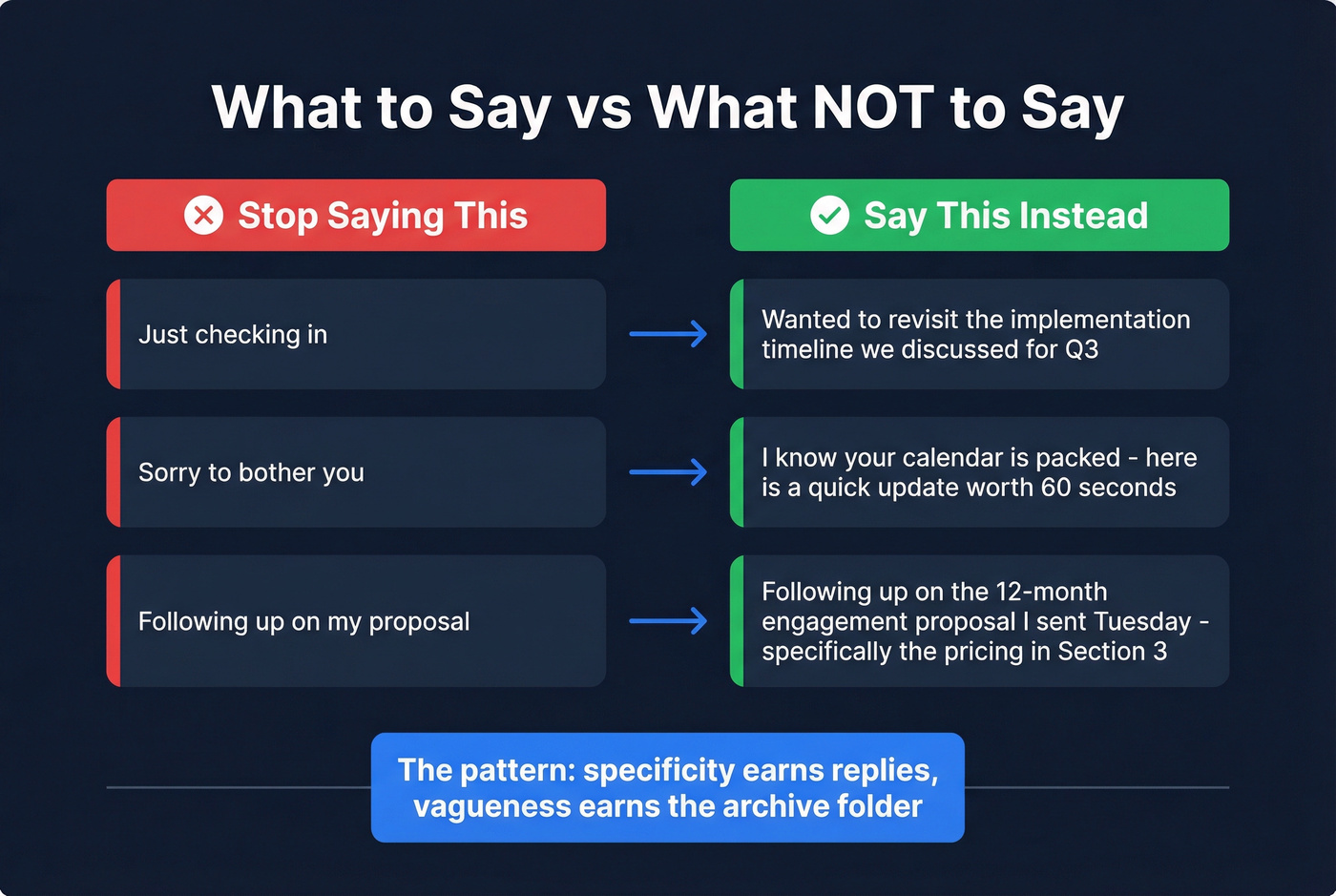
"Sorry to bother you" - Replace with: "I know your calendar's packed - here's a quick update worth 60 seconds."
"Following up on my proposal" - Replace with: "Following up on the 12-month engagement proposal I sent Tuesday - specifically the pricing in Section 3."
Every vague follow-up trains your prospect to ignore you. Every specific one gives them a reason to respond. The consensus on r/sales is pretty clear on this: generic follow-ups are the fastest way to get archived without a reply.
When Email Isn't Enough
After two unanswered emails, switch channels. RAIN Group's research shows it takes an average of 8 touches to get an initial meeting - and those touches shouldn't all be the same format. Multi-channel campaigns drive a 287% higher purchase rate than single-channel across B2B and B2C, according to Omnisend's data.
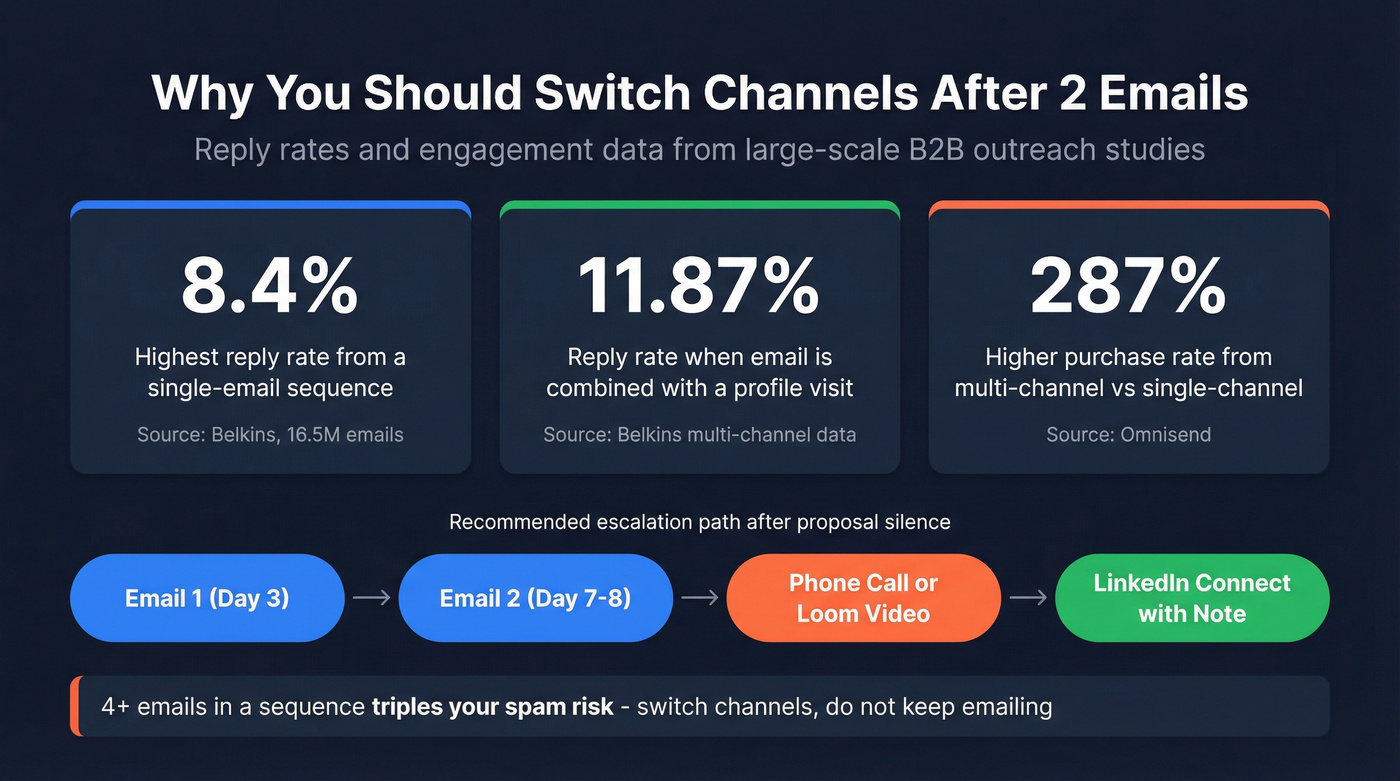
Let's be honest: a third email after proposal silence is almost never worth the domain reputation risk when you can switch channels instead. Pick up the phone (use this Outbound Calling Strategy). Send a short Loom video walking through the proposal's key section. Connect on a professional network with a brief, non-salesy note (see Social Selling B2B). Belkins found that combining a message with a profile visit drove reply rates up to 11.87% - higher than any email-only sequence. The medium change alone breaks through where repetition can't.
Verify Before You Follow Up
None of this matters if the email bounces. We've watched teams craft strong follow-up sequences only to discover their prospect's email address was wrong from the start - three carefully written emails, zero deliverability. Before you send that first follow-up email to a client after sending a proposal, verify the address (use an email checker tool or compare email ID validators). Prospeo runs a 5-step verification process with 98% email accuracy, including catch-all handling, spam-trap removal, and honeypot filtering. The free tier gives you 75 email verifications a month, enough to pre-flight your entire proposal pipeline without spending a dollar.
After two unanswered follow-ups, the article says pick up the phone. Prospeo gives you 125M+ verified mobile numbers with a 30% pickup rate - so when email silence hits, you have a direct dial ready.
Switch channels instantly with verified direct dials.
FAQ
How long should I wait to follow up after sending a proposal?
Three business days is the ideal window. Monday morning between 6-9am PST delivers the highest reply rates at 2.8% based on an 85,000-email study. If Day 3 falls on Friday, push to Monday. Waiting longer than a week significantly drops response rates as the conversation goes cold.
How many follow-up emails is too many after a proposal?
Cap it at two to three. Data from 16.5M emails shows 4+ emails triples spam risk with diminishing returns. After two unanswered messages, switch to phone or video. If you're running out of new things to say, that's your signal to change the channel entirely.
What should I say instead of "just checking in"?
Reference a specific section of your proposal and ask one direct question - for example, "Does the phased rollout still align with your Q3 planning cycle?" Specificity gives the recipient a concrete reason to reply, while "just checking in" gives them permission to ignore you.
Should I skip email follow-ups entirely for enterprise deals?
Not entirely, but don't rely on email alone. Enterprise buyers typically have longer evaluation cycles and more stakeholders involved. Your first follow-up should still be email, but if you don't hear back, a phone call or a short video walkthrough of the proposal's ROI section will outperform a third email almost every time.