

Social Selling B2B Playbook (2026): A Measurable Operating System
Social selling b2b isn't "posting more." It's building enough trust in public that your private outreach feels like a continuation of a conversation, not an interruption. The teams winning in 2026 aren't louder. They're consistent, targeted, and ruthless about turning signals into meetings.
Most teams don't have a social selling problem. They've got an ordering problem.
What you need (quick version)
If your motion feels messy, it's usually because you're doing the steps out of order. Earn context first, then message. And yes, the benchmark edge is real: notes + combo actions can push replies into the ~5-10% range, and Tuesday's the best push day.
Minimum viable system (do this before you "write better DMs"):
- A tight ICP (industry + role + trigger + "why now") in one paragraph
- A weekly signal list (job changes, hiring, funding, intent topics, stack changes)
- A daily engagement habit (comments > likes; 10-15 minutes)
- A 2-touch DM sequence (question -> value -> soft CTA)
- A simple tracking loop (conversations -> meetings -> pipeline influenced)
- Account-safety guardrails (pacing, spacing, no spam patterns)
If you only do 3 things this week
- Define ICP + pick 25-50 target accounts
- Leave 5 thoughtful comments/day on target accounts + their ecosystem
- Run a 2-touch DM: question -> value -> soft CTA
If you only report 3 metrics weekly
- New conversations started
- Meetings booked
- Pipeline influenced
What it is (and what it isn't)
This motion is relationship selling executed in public, then converted in private. You use social platforms to listen, show up with relevance, and earn permission to move a conversation forward, especially if you need a repeatable way to create meetings without spamming.

It's not the same thing as cold outreach. Cold outreach is interruption-based: pick a list and push a message. Social selling is context-based: pick a list, then earn attention through repeated, lightweight touches.
It's also not content marketing. Content marketing is one-to-many and brand-led (traffic, subscribers, MQLs). This is one-to-one and seller-led (conversations, meetings, pipeline). Content helps, but it isn't the core mechanic.
And it isn't "personal branding" as a vanity project. The goal isn't followers. The goal is credibility density inside your ICP: the right people seeing you often enough that outreach feels familiar.
Myths vs reality
- Myth: "If I post, inbound will happen." Reality: Posting helps, but commenting + DMs is where meetings come from.
- Myth: "Social selling is only LinkedIn." Reality: LinkedIn's the main arena for many teams, but X, Facebook Groups, Reddit, and Quora can outperform it in specific niches.
- Myth: "It's marketing's job." Reality: The best programs run on ABM alignment: marketing supplies assets + guardrails; sellers create conversations and move deals.
- Myth: "It's unmeasurable." Reality: Track signals -> touches -> conversations -> meetings -> pipeline and it becomes a normal revenue motion.
Why it matters now: omnichannel buyers changed the rules
McKinsey's B2B buying research explains why this keeps working even when everyone complains the platforms are "noisy." Buyers use 10 channels on average now (up from 5 in 2016). You're not competing with other sellers. You're competing with everything.
The "rule of thirds" is the part most teams ignore: at any stage, one-third of buyers want in-person, one-third want remote, and one-third want self-serve digital. Your job is to be present in the mode they prefer this week, not force everyone into your preferred channel.
Two more 2026 reality checks from the same research:
- E-commerce is now the top revenue channel for orgs that offer it, driving more than one-third of revenue.
- In-person revenue is down 5 percentage points year over year.
That's exactly why this works: it's the pre-sales trust layer that makes remote evaluation and self-serve conversion feel safer. When buyers can't (or won't) take five meetings, they lean on public proof, peer chatter, and "I've seen this person around" familiarity.
GenAI's the accelerant. McKinsey has 19% of sales orgs implementing genAI use cases and 23% experimenting. Teams blending personalization with genAI are 1.7x more likely to gain market share.
Here's the uncomfortable truth: genAI makes it easy to produce "good enough" outreach at scale, which makes average outreach easier to ignore. Social selling is the counterweight because it creates human proof: you show judgment in public, then you earn replies in private.
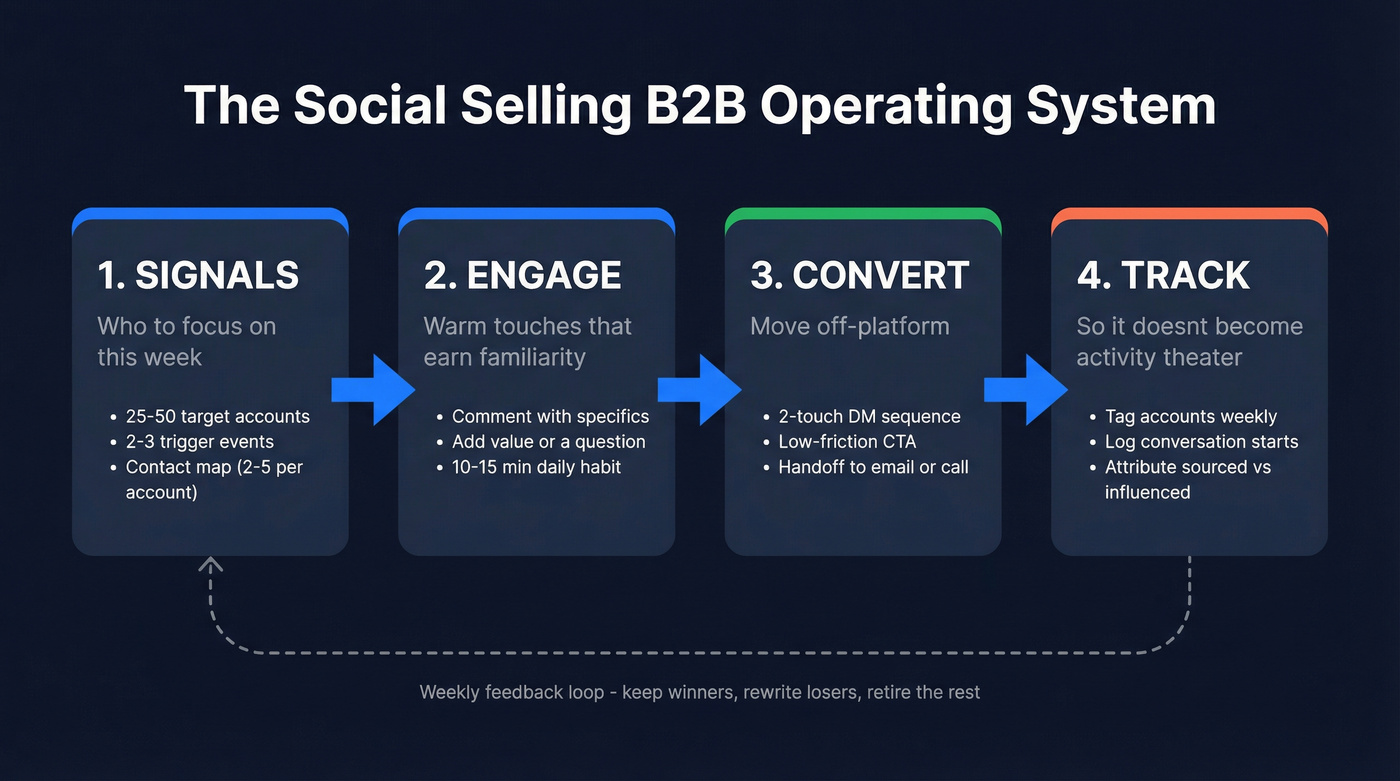
The Social Selling OS (Signals -> Engage -> Convert -> Track)
This is the operating system we've watched work across SDR teams, AEs, and CS leaders. It's not complicated. It's ordered.
Signals (who to focus on this week)
Do this first (ordering matters):
- Pick 25-50 target accounts for the week
- Choose 2-3 triggers you'll act on
- Build a contact map (2-5 people per account)
- Only then start engaging and messaging
High-signal triggers
- Job change (new VP, new director, new operator)
- Headcount growth (especially in your buyer's function)
- Funding / expansion (new geo, new product line)
- Intent topics (they're researching what you sell)
- Stack change (new tools often = new problems)
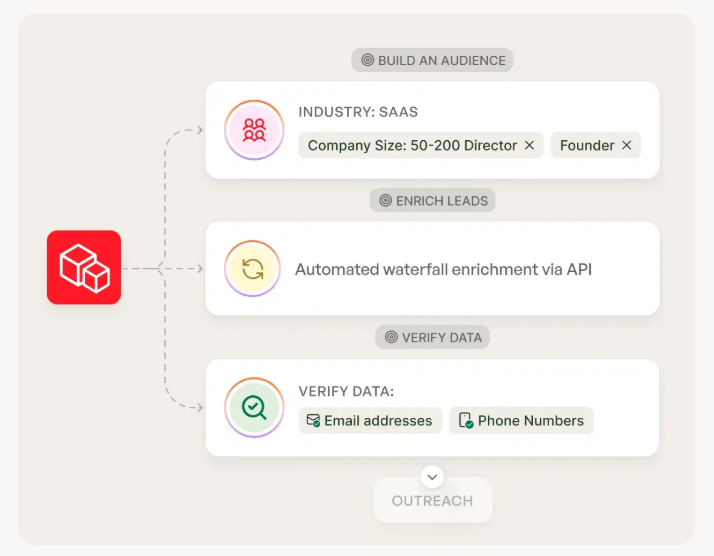
Data quality decides whether this feels smooth or miserable. If you can't reliably move off-platform because emails bounce or numbers are dead, your "warm outreach" dies on contact.
I've seen teams spend weeks rewriting openers while their bounce rate quietly nuked deliverability and made every "social-assisted" follow-up look like a ghost town.
Prospeo ("The B2B data platform built for accuracy") is a straightforward way to turn web sources into usable contacts: pull verified email/mobile from company websites or professional profiles, then export to CSV/CRM. It delivers 98% email accuracy on a 7-day refresh.

Engage (warm touches that don't look automated)
Engagement is where you earn familiarity. You're trying to become "that person I see around" inside a niche.
Comment framework (fast, repeatable)
- Agree with a specific point (quote a phrase)
- Add one example, metric, or counterpoint
- Ask one real question that invites a reply
Keep it short. Two to four lines. If it reads like a blog comment from 2012, it's too long.
Micro-DMs that work
- Reference a specific post or comment thread
- Ask a question that's easy to answer in one sentence
- Don't pitch on touch #1
Look, the fastest way to get ignored is acting like you "built a relationship" because you liked three posts. Comments and questions are the only warm touches that count.
Convert (move off-platform)
Social platforms are great for context. They're not great for running a sales process.
Your conversion goal is a low-friction next step:
- "Worth a 15-minute triage call?"
- "Want me to send a 3-bullet teardown?"
- "Should I email this to you or someone else on your team?"
If you're running sequences (Outreach, SalesLoft, Apollo, etc.), this works best as the front-end warming layer. When prospects see your name in two places (feed + inbox), reply rates jump because the outreach feels familiar, not random, and the buyer's brain doesn't have to do the "who is this and why are they in my inbox?" work.
Strong opinion: if your average deal is on the smaller side, you probably don't need a complicated "social selling tech stack." You need a tight list, real comments, and a clean handoff into email.
Track (so it doesn't become "activity")
If you don't track, this becomes performance art: lots of taps, no pipeline.
Minimum tracking that works
- Tag every target account weekly: Cold / Warm / Active convo / Meeting set
- Log conversation starts (not just sent messages)
- Attribute meetings as sourced or influenced (both matter)
Add the enablement loop (this is where most teams level up)
- Pick 3 approved assets for the month (one POV, one proof, one "how it works")
- Share them via DM/email or a digital sales room
- Track opens/clicks/time viewed
- Feed results back to enablement weekly: keep winners, rewrite losers, retire the rest
This loop turns "content" into a measurable sales asset system instead of random posting.

You just spent weeks warming up accounts with comments and DMs. Don't let that trust die to a bounced email. Prospeo delivers 98% email accuracy on a 7-day refresh cycle - so when you move off-platform, your outreach actually lands.
Turn every warm conversation into a real meeting, not a bounce notification.
Benchmarks: what "good" looks like in 2026 (so you don't quit early)
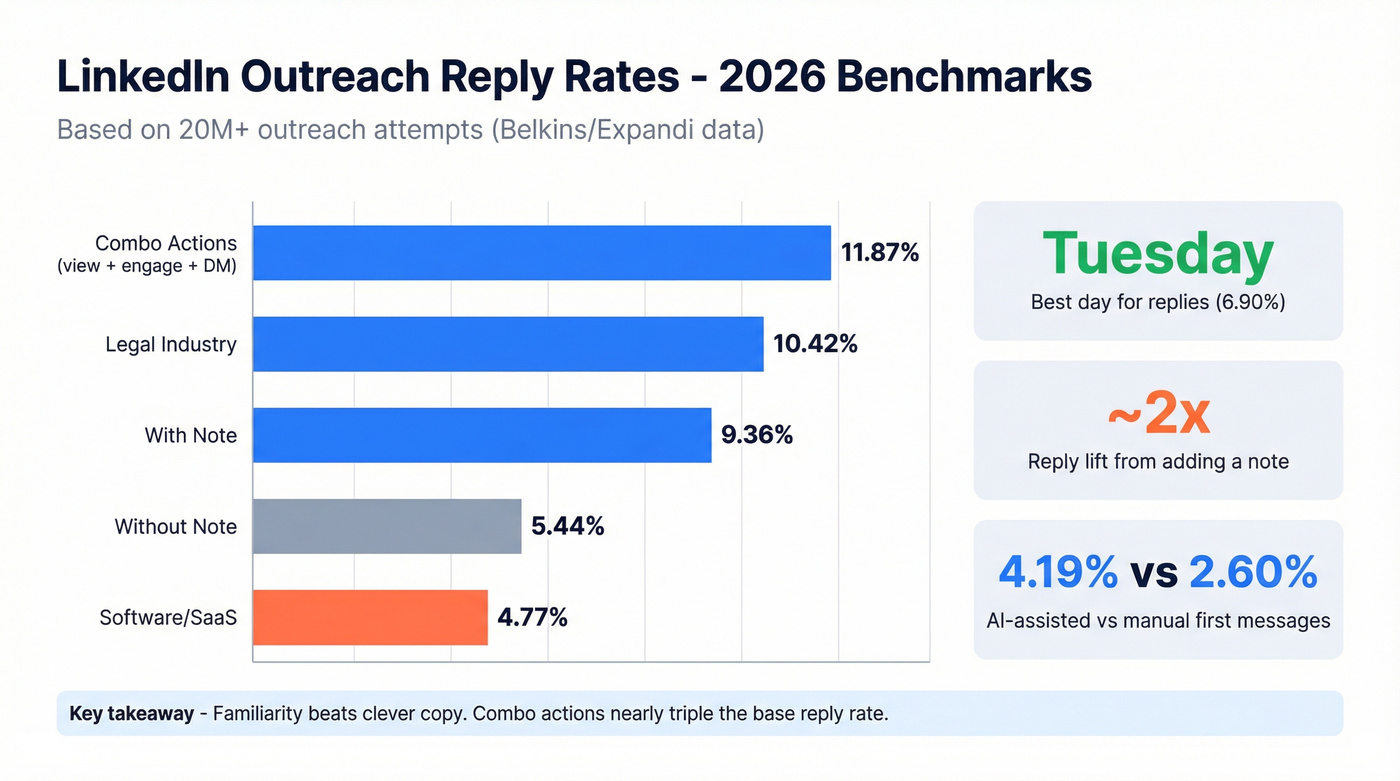
Belkins' write-up of Expandi data (20M+ outreach attempts across 2024, published Jul 11, 2026) gives a useful reality check for connection and reply performance.
Outreach benchmarks (connection + replies)
| Metric | Benchmark |
|---|---|
| Accept rate (with note) | 26.42% |
| Accept rate (no note) | 26.37% |
| Reply rate (with note) | 9.36% |
| Reply rate (no note) | 5.44% |
| Best day (reply) | Tue 6.90% |
| Lowest day (reply) | Sat 6.40% |
| Legal reply rate | 10.42% |
| Software/SaaS reply | 4.77% |
| Combo actions reply | 11.87% |
How to use this without lying to yourself
- Notes barely change acceptance, but they nearly double replies. Optimize for replies, not vanity acceptance.
- If you only have one "push day," make it Tuesday.
- Industry variance is brutal. If you sell into Software/SaaS, a "good" reply rate can look mediocre next to Legal.
- "Combo actions" (profile view + engage + DM) pushing replies to 11.87% matches what we see: familiarity beats clever copy.
AI-assisted first messages can lift first-message replies (4.19% vs 2.60%), but follow-ups can do slightly better without AI. Use AI for structure, then rewrite so it sounds like you.
Link: Belkins' LinkedIn outreach study
Role-based playbooks (SDR vs AE vs CSM)
This fails when everyone runs the same play. SDRs need repeatable pipeline motion. AEs need multi-threading and deal acceleration. CSMs need listening and champion-building.

The shared philosophy in 2026: fewer, higher-signal touches. Spammy automation patterns get flagged, and the accounts that survive are the ones that slow down, mix actions, and act like humans.
SDR playbook (pipeline creation)
This is where sales development lives or dies: tight lists, consistent public touches, and clean handoffs, not "spray and pray" DMs.
Daily (30 minutes)
- 10 min: scan signals (job changes, hiring, intent topics)
- 10 min: leave 3-5 comments on target accounts + adjacent voices
- 10 min: send 5-10 connection requests (use notes only when you can be specific)
Twice weekly (45 minutes)
- Run the 2-touch DM sequence to new connections
- Build a "warm list" for email follow-up (people who engaged back)
Handoff rules (so AEs don't hate you)
- Hand off only when you've got: confirmed role, a trigger, and a stated problem (one sentence's enough)
- Include context: "They replied to my question about X; they're doing Y this quarter."
What good looks like
- 10-20 new conversations/week
- 3-6 meetings/week from social-assisted motion
A concrete example: on a 12-rep SDR team we worked with, meetings jumped after we banned "connect + pitch immediately" and forced one public touch (a real comment) before any DM. Same list, same product, same rep count. Better timing.
Skip this if you're selling a $99/mo self-serve product with no sales motion. You'll get more ROI from product-led loops than from seller-led social.
AE playbook (multi-threading + deal acceleration)
Weekly (60-90 minutes)
- Map stakeholders: champion, economic buyer, blockers, users
- Engage with 2-3 stakeholders (not just the champion)
- Post 1 POV asset: "what we're seeing in the field" beats product updates
Deal acceleration prompts (DM or comment)
- "When this stalls, it's usually because ____ isn't aligned. True on your side?"
- "If you had to pick one success metric for the first 30 days, what is it?"
- "Who else gets pulled in at procurement/security?"
Run a mutual action plan (MAP) in plain English
- "Here's the path to 'yes': security, pilot, legal, procurement, go-live. Who owns each step on your side?"
In our experience, multi-threading consistently beats "more sequences." The win-rate lift isn't subtle - you feel it the moment a deal hits procurement and you already know who legal trusts, what security needs, and which internal stakeholder will actually push the PO through.
CSM playbook (expansion + retention)
CS social selling is underused, and it's the easiest place to be authentic because you're not "prospecting." You're supporting outcomes.
Daily (15 minutes)
- Listen for risk signals: leadership changes, negative posts, hiring freezes
- Engage with champions' wins (promotions, launches) without making it about you
Monthly (60 minutes)
- Publish a value recap post: what customers achieved, what changed, what to watch next
- Spotlight a customer lesson (no logos needed if you can't name them)
What good looks like
- More exec engagement on QBR invites
- Expansion intros sourced from champions
- Earlier detection of renewal risk
Content that drives conversations (not vanity reach)
If your content doesn't give someone a reason to DM you, it's entertainment. That's fine. Just don't call it pipeline.
SocialInsider benchmark data (1M posts analyzed over 2024) puts mid-2025 LinkedIn engagement rate by impressions at 5.20%. Format matters:
- Multi-image: 6.60%
- Document: 6.10%
- Video: 5.60%
- Text: 4.00%
- Polls get the highest impressions (great for reach)
Link: SocialInsider's LinkedIn benchmarks
Rules of thumb I'd bet my quota on
- Post what you'd say on a call: "Here's the pattern we're seeing" beats "5 tips for..."
- One strong point > five weak points
- Write for the person who's already problem-aware, not the person who's never heard of your category
Conversation-starters that work
- "Three reasons these deals stall at legal/security (and how to pre-wire it)."
- "If you're hiring 5 SDRs, fix this first or you'll churn them in 90 days."
- "Hot take: your 'personalization' is making reply rates worse."
I'll be blunt: if your post could've been written by any rep in any industry, it won't start conversations. Specificity's the whole game.
Platform constraints & account safety (what gets you restricted)
Social selling in 2026 has a tax: account safety. Platforms use behavioral patterns to spot automation and spam. Treat your account like a disposable sending machine and you'll get throttled.
Assume ~100 connection requests/week unless your account proves otherwise. Keep it under ~25/day and space actions out. Premium plans don't magically protect you from limits.
Guardrails checklist
- Space actions out; bursts look botty
- Mix actions: view, comment, connect, DM
- Don't copy/paste the same message with tiny token swaps
- Use Groups/Events messaging when relevant; don't treat it like a spam loophole
Here's the thing that frustrates me: teams get warned, ignore it, then act shocked when the account gets restricted right before quarter-end. Slow down, vary actions, and stop trying to "hack" your way around basic platform behavior detection.
Social selling b2b metrics that matter: SSI vs meetings vs pipeline (with a weekly scorecard)
SSI (Social Selling Index) is a 0-100 score across four pillars: professional brand, finding the right people, engaging with insights, and building relationships. Treat SSI as a behavior score, not a revenue KPI.
If SSI goes up but meetings don't, you're doing social media, not social selling.
Weekly scorecard (copy/paste)
| Metric | Target | Actual |
|---|---|---|
| New convos started | 10-20 | |
| Meetings booked | 3-6 | |
| Pipeline influenced ($) | $X | |
| Target accts engaged | 25-50 | |
| Comments left | 25-50 | |
| DMs sent | 20-40 | |
| SSI (directional) | +1-3 |
Mini ROI math (simple model)
- Conversations/week = ___
- Meeting rate from conversations = ___%
- Opp rate from meetings = ___%
- Avg pipeline per opp = $___
Weekly pipeline influenced = conversations x meeting rate x opp rate x avg pipeline/opp
One sanity check: if you're not generating new conversations, you're not doing social selling. You're just consuming content with extra steps.
Governance & compliance checklist (FINRA-translated, usable anywhere)
Sellers should care about governance for one reason: one sloppy claim or unretained DM can create a compliance fire drill that kills the whole program.
Even outside financial services, FINRA's guidance is a solid "adult supervision" framework for social selling. Translate it into recordkeeping, supervision, training, and clear boundaries.
Governance checklist
- Retention: keep business-related social communications for >= 3 years
- Supervision model: define what's monitored, by whom, and how often
- Static vs interactive rules:
- Static (posts, profiles, long-lived assets): pre-approval is the safe default
- Interactive (comments, DMs): no pre-approval, but supervised like correspondence
- Third-party content ("adopted/entangled"):
- If an employee endorses a third-party claim, treat it like your own
- Don't let partners post promissory results without review
- 2026 oversight reality: influencer review + retention is table stakes; if you can't retain it, don't run it
- GenAI supervision: review AI-assisted communications; retain chatbot chats; ensure claims are fair, balanced, and include risks
- Training before access: no training, no posting for business
Mini policy template (steal this)
- Allowed channels: ___
- Prohibited channels/features: ___
- What counts as "business communication": ___
- Approval required for: static posts, customer stories, performance claims
- Disclosures required: employment, partnerships, incentives
- Recordkeeping owner + tool: ___
- Escalation path for negative posts: ___
- AI use rules: allowed tools, required review, retention
If you want a non-regulated starting point, Sprout Social's social media policy template is a solid baseline.
Templates that don't sound like a bot (connection, follow-up, comment)
Most template libraries teach people to be cringe: flattery + immediate ask. The fix's simple: be specific, be brief, and earn the next step.
Also: send your "important" touches on Tuesday when you can. It's the best day in the benchmark data, and it matches real-world attention patterns.
Connection request (with note)
Don't "Hey Sarah, love your content! You're crushing it. Would love to connect and show you how we help teams like yours."
Do "Hey Sarah - saw your post on onboarding new AEs. Quick question: are you standardizing MEDDICC before or after ramp? Curious what's working."
Goal: replies, not acceptance.
2-touch DM sequence (question -> value -> soft CTA)
Touch 1 (question, 1 sentence) "Curious - when you say 'pipeline quality is down,' is it more no-shows, low intent, or deals stalling in stage 2?"
Touch 2 (value + soft CTA, 2-3 sentences) "Got it. We've been seeing stage-2 stalls when stakeholders aren't mapped early. If helpful, I can send a 6-line checklist we use to multi-thread fast. Want it here or over email?"
Comment framework (agree/add/ask)
- Agree: "The point about procurement pulling timelines is spot on."
- Add: "We see it when security isn't looped in until after the pilot."
- Ask: "Do you pre-wire security with a one-pager, or wait until they ask?"
Move off-platform ask (email/phone/15-min triage)
"Happy to compare notes. If a 15-min triage's easier, I can do Tue/Wed. Or I can send the summary by email - what's best?"
Tool stack (lightweight): what you actually need to run the OS
You don't need a monster stack. You need capabilities covered end-to-end: prospecting, signals, personalization, compliant automation, revenue tracking, content library/asset analytics, and CRM integration.
Sales Navigator pricing (useful baseline)
- Core: $99.99/mo
- Advanced: $149.99/mo
- Advanced Plus: custom (enterprise)
Lightweight stack rubric (pick one per row)
| Need | Capability | Examples (typical pricing) |
|---|---|---|
| Prospecting | Account & contact search | Sales Navigator ($100-$150/mo) |
| Signals | Intent/news monitoring | ~$200-$1,500+/mo depending on depth |
| Outreach | Sequencing | Apollo ($49-$119/user/mo), Outreach ($100-$200+/user/mo), SalesLoft ($100-$200+/user/mo) |
| Listening | Social monitoring | ~$99-$299/mo (solo) to $500+/mo (teams) |
| Scheduling | Calendar links | ~$10-$20/user/mo |
| System of record | CRM | HubSpot ($20-$150+/seat/mo) or Salesforce (~$25-$330/user/mo) |
Where teams blow it: they try to run social selling on bad contact data, then blame "messaging." Fix the data and the whole motion gets easier, especially in tech sales, where buyers expect you to know their stack and timing before you ask for a meeting.
If you're picking a data layer, prioritize accuracy and refresh rate. Prospeo is best-in-class on both: 98% email accuracy, 7-day refresh (industry average: 6 weeks), 300M+ professional profiles, 143M+ verified emails, and 125M+ verified mobile numbers with a 30% pickup rate. It's self-serve, credit-based, and doesn't lock you into annual contracts.
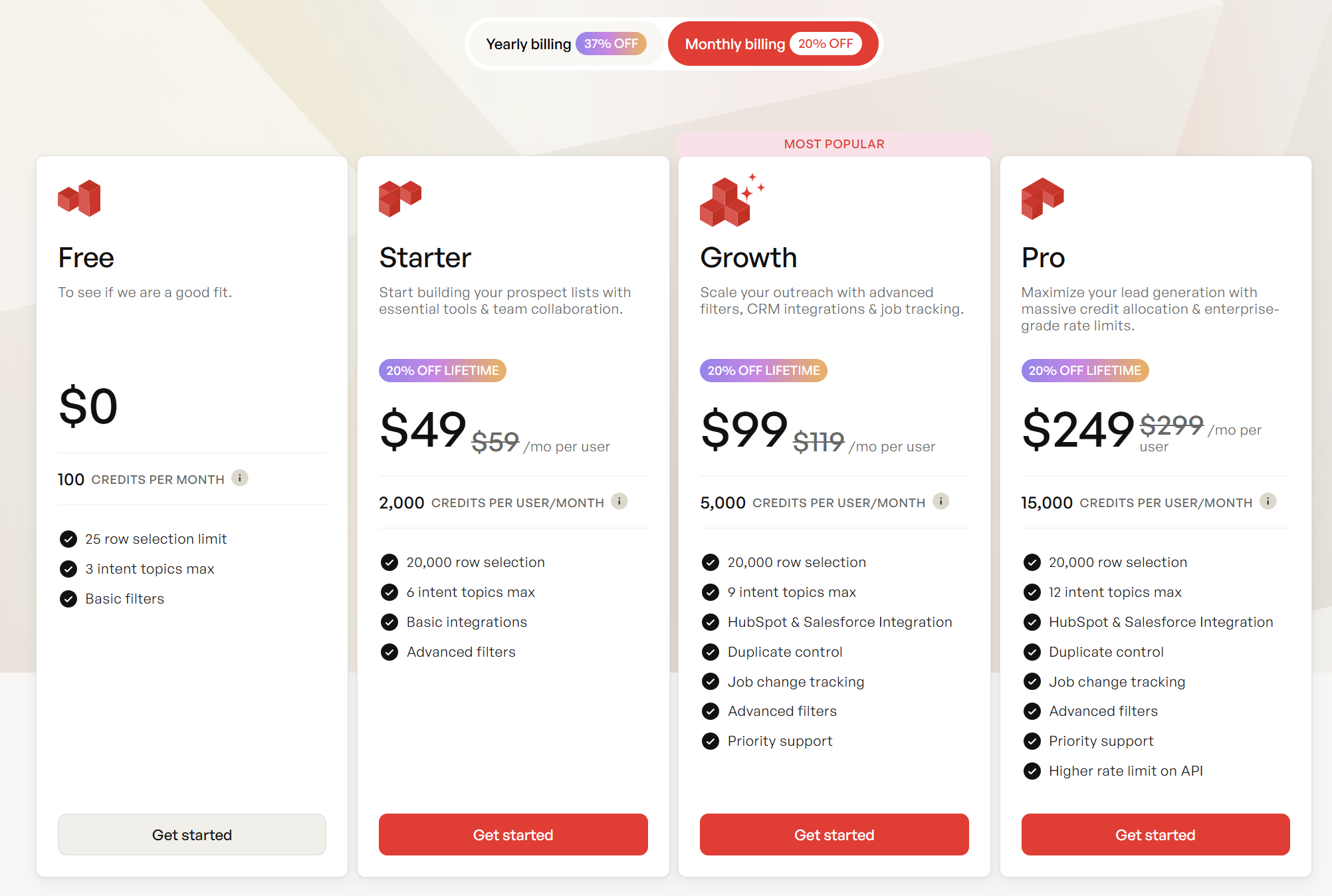
Job changes, funding rounds, stack swaps - your signal list is only as good as the contact data behind it. Prospeo maps 300M+ profiles with 30+ filters including intent data, technographics, and headcount growth - all at $0.01/email.
Stop rewriting openers. Start fixing the data underneath them.
Summary: make it a system, not a vibe
Social selling b2b works in 2026 when you treat it like an operating system: pick high-signal accounts, show up with real engagement, convert with low-friction next steps, and track conversations through to pipeline. Keep the stack simple, protect your account, and obsess over signal quality and consistency, not "clever" DMs.
FAQ
What is B2B social selling (in one sentence)?
B2B social selling is using social platforms to spot buying signals, build trust through public engagement, and convert that trust into private conversations that lead to meetings and pipeline.
Does LinkedIn SSI actually matter for revenue?
SSI's a 0-100 behavior score, so it matters only as a consistency check, not as a revenue KPI. If SSI rises but you're not booking meetings (or your team's equivalent), you're optimizing activity instead of outcomes.
How many connection requests per week is safe in 2026?
For most accounts, plan around ~100 connection requests/week and stay under ~25/day, spaced out across the day. Mix actions (view, comment, connect, DM) and avoid repeated copy/paste patterns, because restrictions usually trigger on behavior patterns, not intent.
What should I post if I'm an SDR/AE and not a "content creator"?
Post what you'd say on a strong discovery call: 1 observation + 1 example + 1 question in under 120-180 words. One "pattern I'm seeing" post per week plus daily comments (3-5/day) typically drives more DMs than generic "5 tips" content.
How do I get verified emails/phones for social selling outreach?
Use a data platform that verifies in real time and refreshes frequently, then export into your sequencer/CRM so warm outreach doesn't die on bounces. Prospeo delivers 98% email accuracy, 125M+ verified mobile numbers with a 30% pickup rate, and enrichment that returns contact data for 83% of leads.