How to Use Intent Data for Upsell and Cross-Sell (and Actually Get Results)
Three people at your biggest customer are researching a competitor's pricing page right now. Your CS team doesn't know. Your AE hasn't logged into the CRM in two days. By the time someone notices, the renewal conversation starts with "we've been evaluating other options."
That's the expansion revenue gap - and intent data closes it.
84% of reps missed quota last year. Net-new B2B sales dropped 19-30% in 2023, and the recovery has been sluggish. Meanwhile, 80% of B2B sales interactions happen in digital channels, and B2B buyers are adopting AI-powered search at 3x the rate of consumers - meaning more research happens off your website entirely. When net-new gets harder, existing customers become your highest-ROI revenue source. Intent-informed outreach generates 2-3x higher response rates than cold outreach, and 84% of buyers select a preferred vendor before they ever contact sales.
If you're not capturing expansion signals, someone else is.
What You Need to Start
Three things make intent-driven expansion work:
- A signal source - first-party product usage data plus third-party research behavior (see intent signals).
- Contact resolution - account-level intent is useless if you can't reach the right person (start with account qualification).
- A 48-hour activation SLA - signals decay fast, and 64% of teams collect intent data but can't operationalize it (build signal-based outbound rules).
Intent Signal Basics for Expansion
First-party signals come from your own assets: product usage spikes, pricing page visits, support ticket patterns. Third-party signals come from external publisher networks and review sites, tracking what your customers research across the web - the "dark funnel" where buying research happens anonymously.
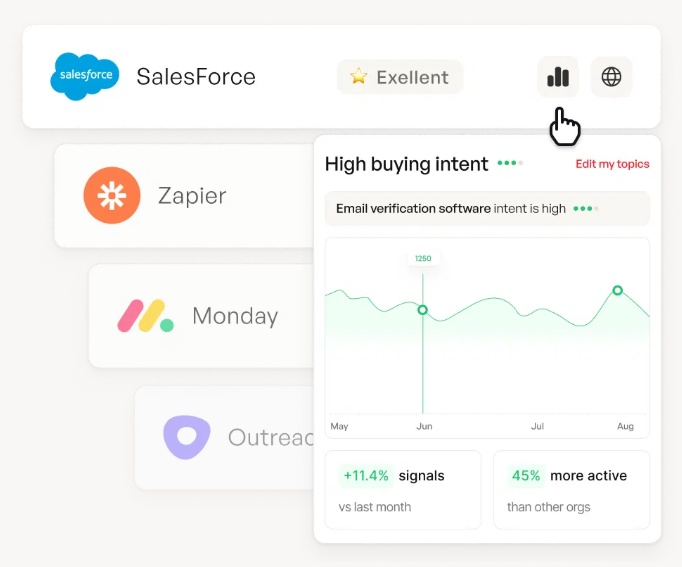
Scoring works on three axes: frequency, recency, and relevance. Three visits to a competitor pricing page in a week scores far higher than a one-off blog skim. The scoring logic uses NLP, machine learning, and IP reverse lookups to connect behavior to accounts (more on search intent data).
Here's the thing: 30-50% of third-party intent signals represent non-buying behavior - competitive research, content creation, academic interest. And most third-party data resolves to the account level, not the contact level. For expansion, you don't need to know "Acme Corp is researching workflow automation." You need to know which person at Acme is doing the research and how to reach them. That last-mile gap between account-level signals and contact-level action is where most expansion programs die.
The Fit + Intent + Engagement Framework
Intent alone fails. We've seen teams chase every surge signal and burn CS bandwidth on accounts that were never going to expand. The fix is a three-signal model:
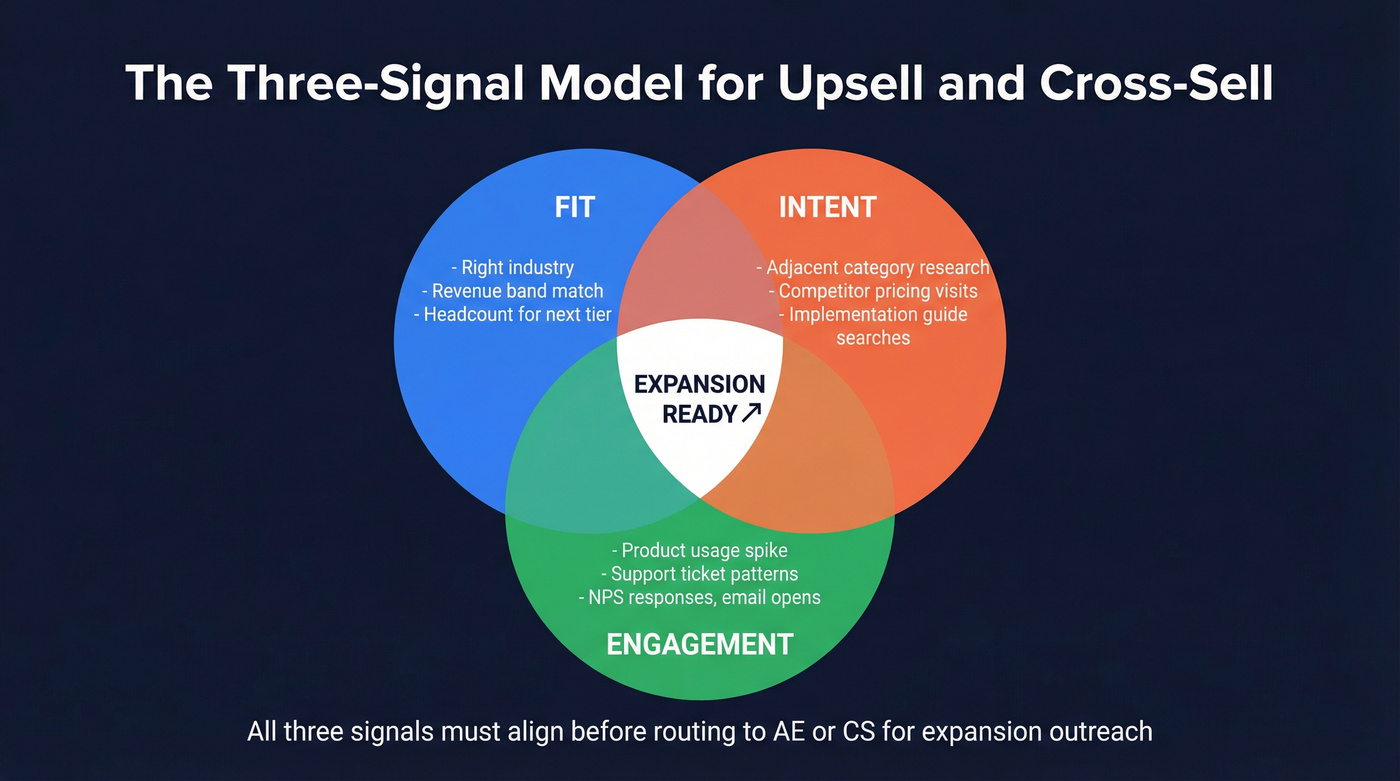
- Fit - firmographics and demographics (use firmographic and technographic data). Right industry, revenue band, headcount for your next tier?
- Intent - adjacent product categories, competitor pricing, implementation guides? (see intent keywords)
- Engagement - product usage trends, support ticket volume, NPS responses, email open rates (tie it into ABM lead scoring)
The expansion-ready combination: product usage spike + intent surge on an adjacent category + firmographic fit for your next tier. Customer success can intervene with expansion offers at the exact moment usage increases. That's the window. Miss it and you're back to cold outreach on a warm account.
Five Plays That Drive Expansion Revenue
Play 1: Adjacent category research -> cross-sell. Your customer surges on topics related to a product you sell but they haven't bought. The AE or AM reaches out: "Your team's been evaluating [category] - we have a module for that. Want a 15-minute walkthrough?"
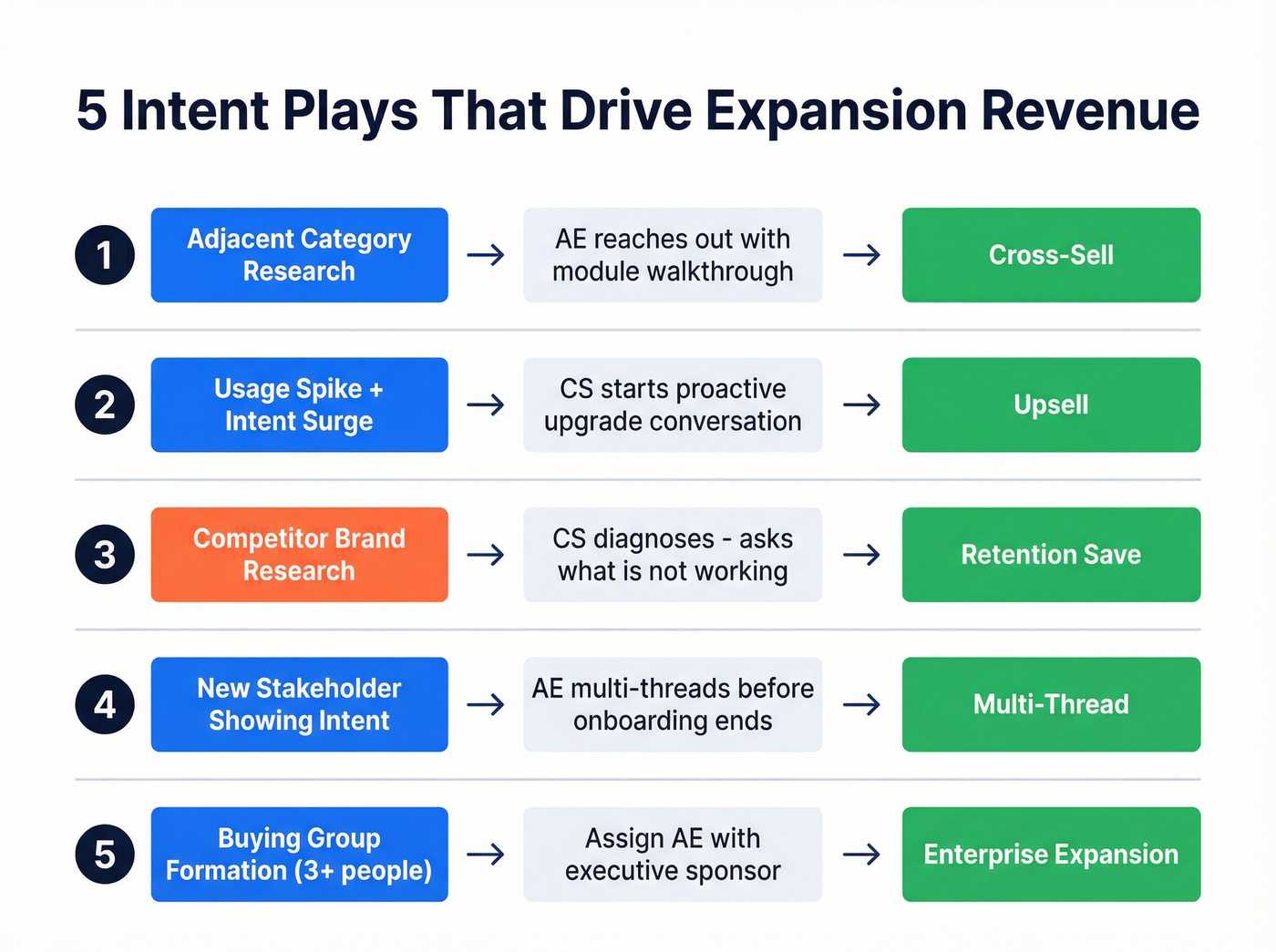
Play 2: Usage spike + intent surge -> upsell. Product usage hits 80%+ of tier limits while the account simultaneously researches scaling or enterprise features. CS proactively starts the upgrade conversation before the customer hits a wall. In our experience, the accounts that churn hardest are the ones that outgrew their tier and nobody noticed until the renewal call went sideways.
Play 3: Competitor research -> retention save. Don't pitch - diagnose. When an existing customer surges on competitor brand terms, the worst response is a feature dump. The right response is a question: "What's driving the evaluation? Let's talk about what's not working."
Play 4: New stakeholder showing intent -> multi-thread. A new hire at an existing account starts researching your product category. Your AE reaches out before they finish onboarding. Prospeo surfaces job-change signals alongside verified emails and direct dials, so you can multi-thread the relationship before a single-threaded champion leaves and takes the deal with them (see what is multithreading in sales).
Play 5: Buying group formation -> enterprise expansion. Research shows 92% of B2B buying involves groups of 3+. When you see that pattern forming inside your install base - three or more people at a customer account showing coordinated intent on a new use case - treat it as an enterprise deal, not a feature request. Assign an AE with an executive sponsor (map roles with buying group personas).

Account-level intent without contact-level data is the #1 expansion killer. Prospeo bridges that gap - 143M+ verified emails and 125M+ direct dials with 98% accuracy, refreshed every 7 days. Layer job-change signals, buyer intent from 15,000 Bombora topics, and 30+ filters to reach the exact stakeholder driving the evaluation.
Turn every intent surge into a name, email, and direct dial within 48 hours.
The Operational Playbook
Signals without routing rules are just noise.
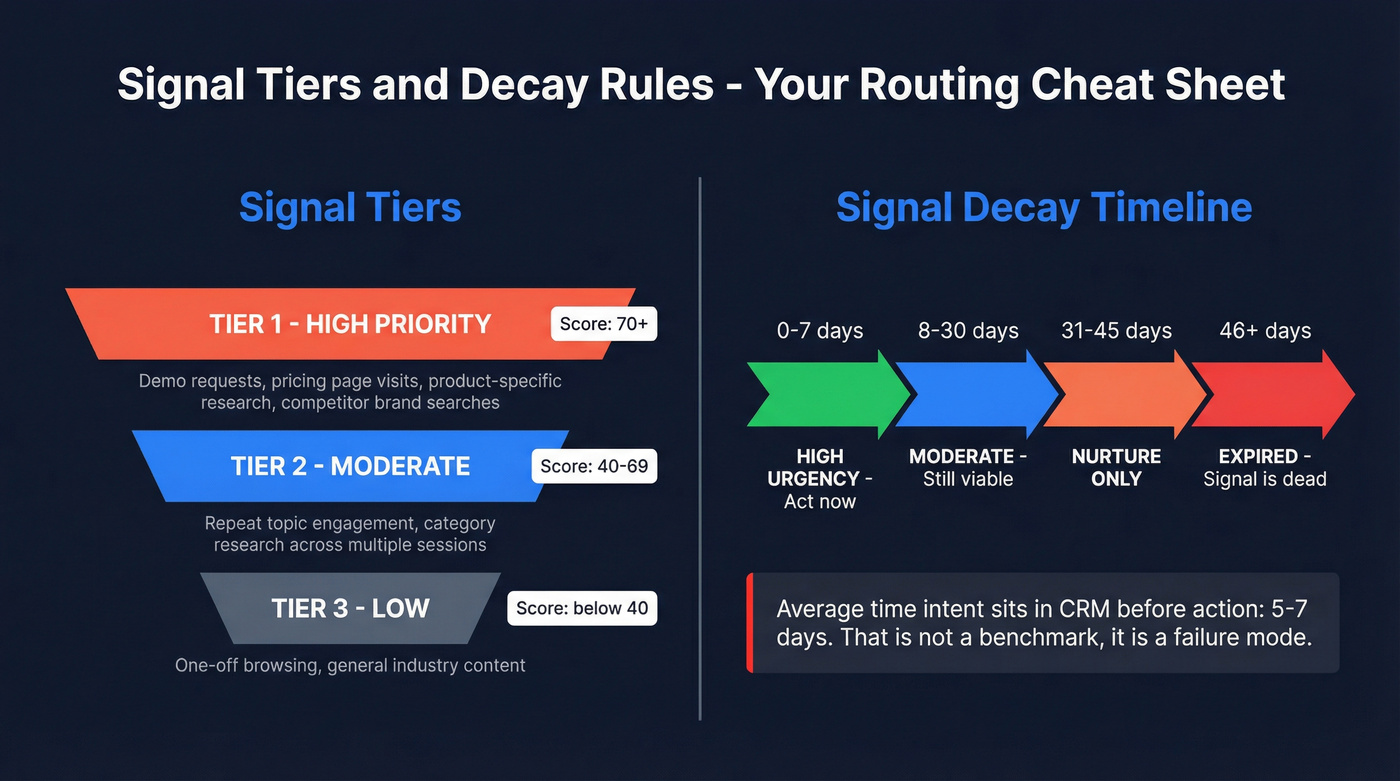
Rank signals into tiers. Tier 1 is high priority: demo requests, pricing page visits, product-specific research, competitor brand searches. Tier 2 is moderate: repeat topic engagement, category-level research across multiple sessions. Tier 3 is low: one-off browsing, general industry content. Flag accounts at 70+ on most platforms. Below that, you're chasing noise.
For decay, treat 0-7 days as high urgency, 8-30 days as moderate, 31-45 days as nurture-only, and 46+ days as expired. High-intent accounts sit in CRM 5-7 days on average before anyone touches them. That's not a benchmark - it's a failure mode. By day five, a competitor has already engaged.
Build routing as Salesforce or HubSpot workflows: Tier 1 competitor research triggers a CS save play, Tier 1 adjacent product research triggers an AE cross-sell, Tier 2 signals feed an AM nurture sequence. Automate this (use a no code sales automation approach). A Slack message someone forgets to read isn't a routing rule.
Five Mistakes That Kill Expansion Programs
1. Treating all signals equally. A pricing page visit and a blog skim aren't the same thing. Without a signal hierarchy, reps waste time on Tier 3 noise and miss Tier 1 buying behavior.
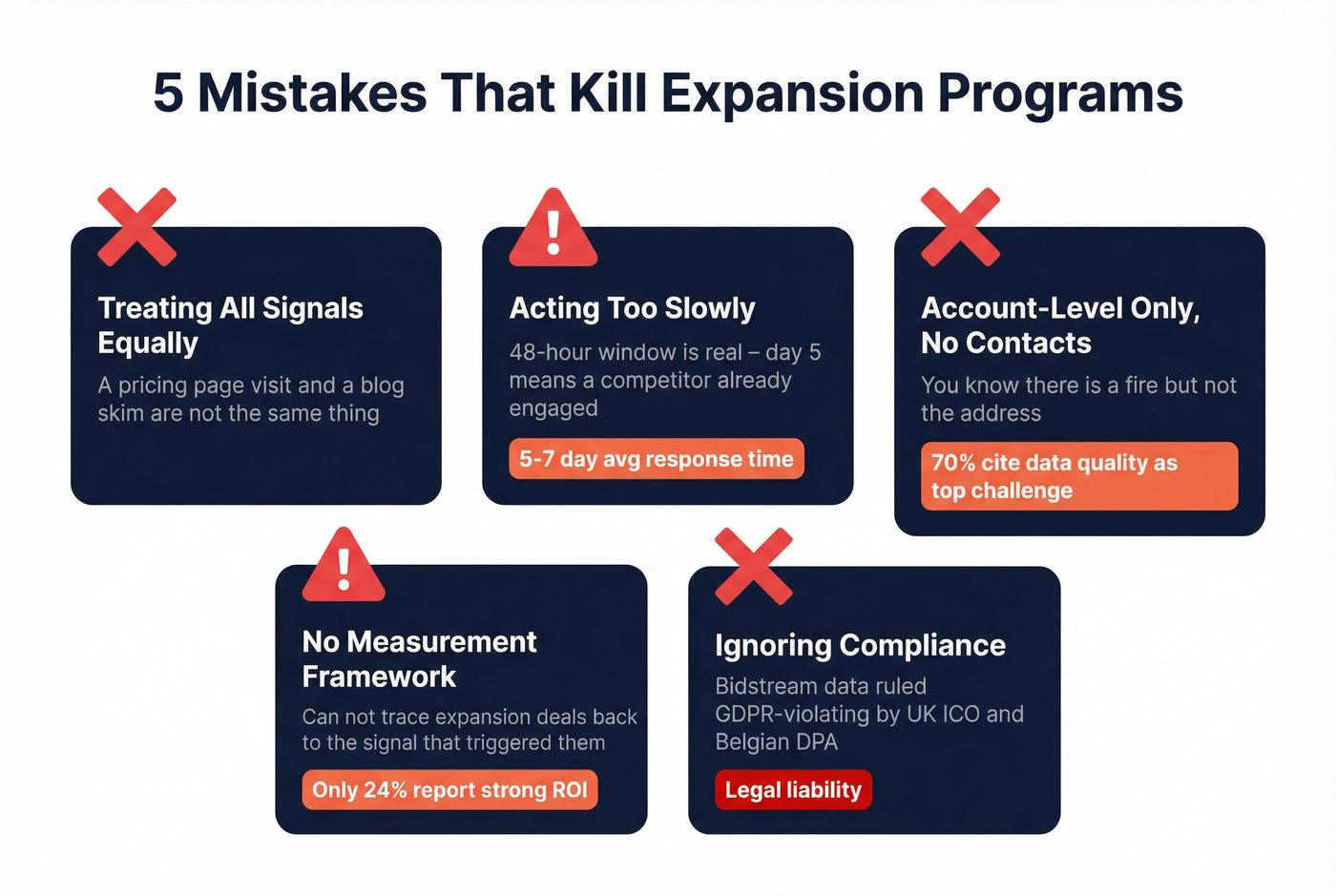
2. Acting too slowly. The 48-hour window is real. If your team can't operationalize a signal within two days, you're leaving revenue on the table.
3. Account-level intent without contact-level data. You know there's a fire but not the address. 70% of teams cite data quality as their top challenge, and this is exactly why (fix it with a data quality scorecard).
4. No measurement framework. Only 24% of teams report strong ROI from intent data - mostly because they never built attribution into the workflow. If you can't trace a closed expansion deal back to the signal that triggered it, you'll never get budget to scale the program (use ABM reporting to standardize it).
5. Ignoring compliance. Bidstream data - signals harvested from programmatic ad auctions - has been ruled GDPR-violating by the UK ICO and Belgian DPA. If your provider relies on bidstream, you've got a legal liability sitting in your tech stack. This should be your first question to any intent vendor.
Tools for Intent-Driven Expansion
| Tool | Best For | Key Stat | Pricing |
|---|---|---|---|
| Prospeo | Teams under 50 needing intent + contact data | 15K topics, 143M+ verified emails, 98% accuracy | Free tier; ~$0.01/email |
| Bombora | Enterprise intent signal source | 12K+ topics, 5K+ publishers | ~$25-50K/yr |
| 6sense | Full ABM suite, 100+ employees | Complete ABM platform | ~$35K+/yr |
| Demandbase | Fit+Intent+Engagement model | Account-based orchestration | ~$30-75K/yr |
| ZoomInfo | Large US database + intent add-on | Broad US coverage | ~$15-40K/yr |
| Gainsight | CS-led expansion, enterprise | Health scoring, playbooks | ~$30-100K/yr |
| ChurnZero | Mid-market CS teams | Real-time usage alerts | ~$15-40K/yr |
| Totango | Budget-conscious CS teams | 200+ playbook templates | Custom pricing |
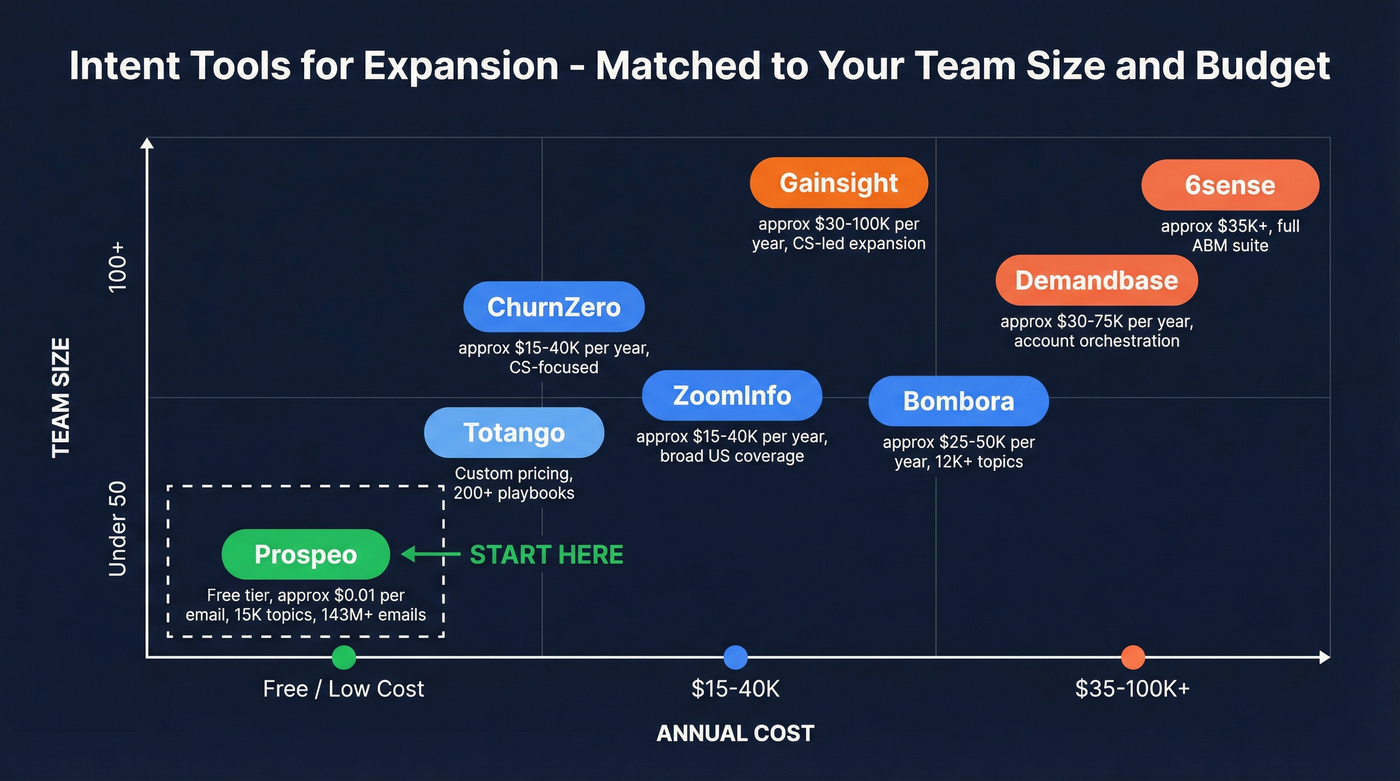
6sense is a powerful platform. But it's $35K+ with 3-6 month implementations. Skip it if your team is under 50 people - you don't need that complexity to start running expansion plays.
Let's be honest about what most teams actually need: verified contact data paired with intent signals and a CRM workflow that routes signals in under 48 hours. Prospeo tracks 15,000 intent topics powered by Bombora, pairs every signal with verified emails and direct dials, and refreshes data every 7 days - at roughly 90% less cost than ZoomInfo. Start there, prove ROI, then scale up if the numbers justify it. The consensus on r/sales is that most teams overbuy on ABM tooling before they've even nailed their signal routing - and that tracks with what we've seen.
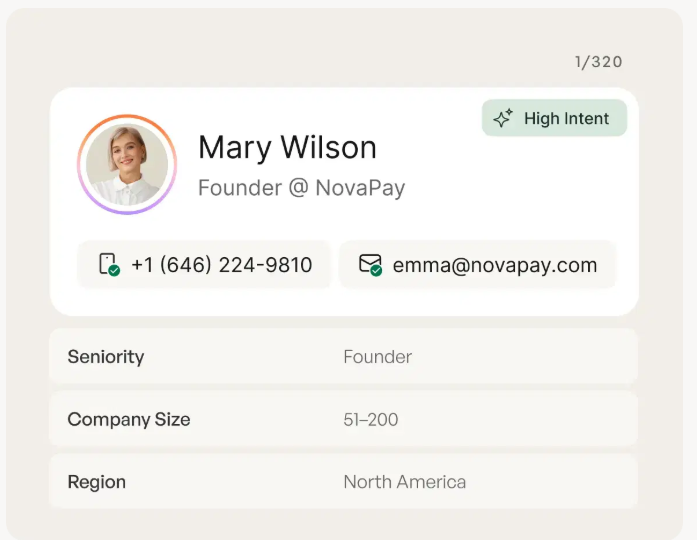
Three people at your customer account are researching competitors right now. Prospeo's intent data tracks 15,000 topics and resolves signals to verified contacts - not just account names. Pair that with job-change alerts to multi-thread before your champion leaves. At $0.01 per email, scaling expansion outreach costs less than one lost renewal.
Stop losing expansion deals to the last-mile data gap.
Measuring Impact
Track expansion conversion rate - signal to closed expansion deal - and time-to-expansion, the number of days from first signal to closed revenue. Those are your leading indicators. For the board, track net revenue retention impact and signal-to-opportunity ratio: what percentage of flagged signals become real pipeline (see how to measure intent data).
Expect 60-90 days before meaningful pipeline impact. Using intent data for upsell and cross-sell isn't a light switch. It's a compounding advantage that gets better as your routing rules tighten and your team learns which signal combinations actually predict expansion. For attribution, track both sourced (the intent signal created the opportunity) and influenced (the signal accelerated an existing one).
Here's the NRR scenario that should scare you: your VP asks why NRR dropped 8 points last quarter. You pull up CRM and see 12 accounts showed competitor intent spikes over 90 days. Nobody acted on a single one. I've watched that exact scenario play out at three companies in the last year. Don't be the fourth.
This playbook focuses on B2B SaaS expansion. Ecommerce cross-sell uses different intent signals and different tooling - that's a separate guide.
FAQ
What's the difference between first-party and third-party intent data?
First-party comes from your own assets - product usage, website visits, email clicks. Third-party comes from external publisher networks tracking research behavior across the web. For expansion, combine both: first-party shows engagement depth, third-party reveals off-site research you'd otherwise miss entirely.
How quickly should we act on an intent signal?
Within 24-48 hours. High-intent accounts sit in CRM an average of 5-7 days before outreach - by then the signal has decayed and a competitor has likely engaged. Build automated routing rules so signals hit the right rep's queue immediately.
Can we run intent-driven expansion without an enterprise platform?
Yes. You need a signal source, verified contact data to reach the right person, and a CRM workflow with routing rules. Prospeo pairs 15,000 intent topics with 143M+ verified emails starting on a free tier - enough to prove ROI before committing to a $30K+ platform.
How do we avoid acting on false-positive intent signals?
Layer the Fit + Intent + Engagement framework. A single topic surge alone is unreliable - 30-50% of third-party signals are non-buying behavior. Require at least two of three signals before routing to a rep: firmographic fit, intent surge, and product engagement spike. That filter alone cuts false positives dramatically.