SaaS Sales in 2026: What's Actually Working (and What's Not)
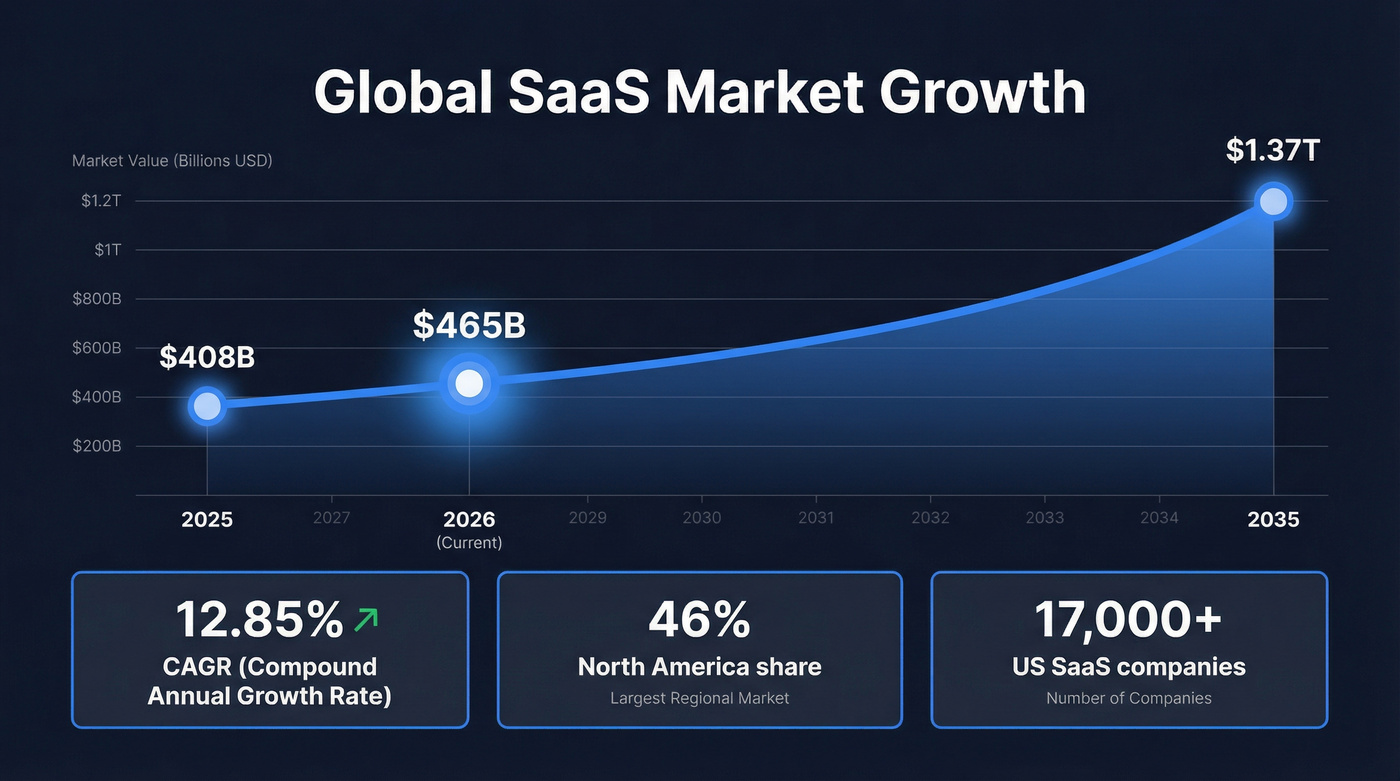
The recurring thread on r/sales every quarter goes something like this: "SaaS sales is dead." "Nobody's buying." "My pipeline is a graveyard." And every quarter, the global SaaS market gets bigger - projected to hit $465B in 2026, growing at 12.85% CAGR through 2035. The discipline isn't dying. Lazy selling is dying - the spray-and-pray, blast-a-thousand-emails, book-a-demo-and-hope approach that worked in 2019.
Reps who effectively partner with AI tools are 3.7x more likely to hit quota. Buyers spend just 17% of their purchase time talking to any vendor, so every touchpoint has to deliver real value. The old playbook is gone. What works now: AI-augmented account research, multi-threading into buying committees of four or more stakeholders, PLG-assisted motions that let the product do the early selling, and verified data that actually reaches real inboxes.
What Is SaaS Sales?
At its core, the definition is straightforward: selling subscription software - recurring revenue instead of a one-time license fee. That single difference changes everything about how you sell. The relationship doesn't end at close; it starts there.
Retention, expansion, and upsell revenue are baked into the business model, which means a rep who closes a deal and disappears is actively destroying value. Compared to traditional software with perpetual licenses, long implementation cycles, and separate maintenance contracts, SaaS compresses the initial sale but extends the revenue relationship indefinitely. Your customer's renewal decision next year matters as much as the signature today. Post-sale engagement, product adoption, and customer success aren't support functions - they're revenue drivers.
Understanding this at a business-model level, not just the acronym but the implications for how you prospect, demo, negotiate, and retain, is what separates reps who build pipeline from those who churn through it.
The Market in 2026
The global SaaS market hits an estimated $465B in 2026, up from $408B in 2025, on track to reach $1.37 trillion by 2035. North America holds 46% of that market. The U.S. alone has 17,000+ SaaS companies competing for wallet share.
Large enterprises account for 62% of revenue, but the mid-market is where growth is accelerating fastest. Buyer scrutiny is real - evaluation cycles are longer, procurement teams are more involved, and stack consolidation is the default posture. Companies aren't adding new tools casually anymore. They're replacing existing ones and demanding proof of ROI before signing.
That scrutiny cuts both ways. It makes lazy selling harder, but it rewards reps who can articulate clear business value and navigate complex buying committees. If you're selling into this market with stale data and generic messaging, you're going to lose to someone who isn't.
The B2B Buyer Has Changed
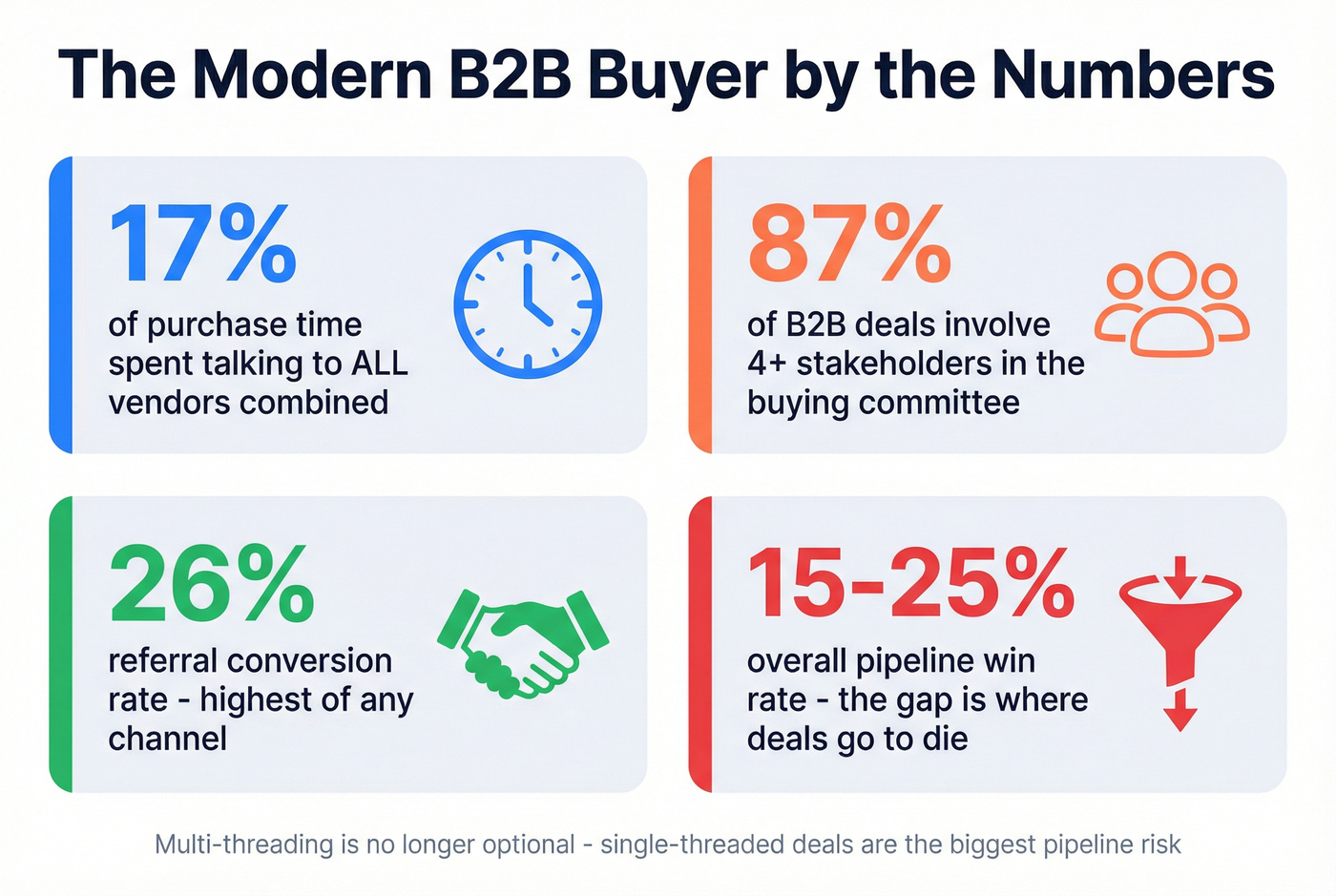
Here's the number that should reshape how you think about every deal: buyers spend roughly 17% of their total purchase time engaging with vendors. All vendors combined. If three vendors are in the evaluation, you're getting maybe 5-6% of the buyer's attention during the entire purchase process.
You don't get throwaway interactions anymore.
The buying committee has expanded too - 87% of B2B deals now involve four or more stakeholders. Multi-threading isn't a nice-to-have; it's the only way to avoid single-threaded deals dying when your champion changes roles or loses internal momentum. We've seen teams lose six-figure deals because they built the entire relationship on one contact who went on parental leave. Referrals convert at roughly 26%, social sellers create 45% more opportunities than those who don't, and qualified opportunity close rates sit around 29%. But overall win rates across the full pipeline run 15-25%. The gap between those two numbers is where most pipeline waste lives.
The SaaS Sales Process
Every deal follows a version of the same arc, though the stages compress or expand depending on your model:
- Prospecting - Identify accounts that match your ICP using intent signals, technographic data, and firmographic filters. This is where data quality makes or breaks your pipeline before it even starts.
- Discovery & Qualification - Understand the buyer's pain, budget, timeline, and decision process. MEDDPICC or BANT frameworks work here, but only if you actually disqualify bad fits instead of dragging them forward.
- Demo / Value Presentation - Show the product solving their specific problem, not a generic feature tour.
- Proposal & Business Case - Quantify ROI in the buyer's language. The CFO doesn't care about your features; they care about revenue impact and cost savings.
- Negotiation - Handle procurement, legal review, security questionnaires, and pricing discussions. Enterprise deals add 4-8 weeks here.
- Close - Get the signature. In subscription software, this is the beginning, not the end.
- Onboarding & Expansion - Drive adoption, prove value, and set up the upsell. Net revenue retention above 120% is what separates great SaaS companies from mediocre ones.
Self-service models skip stages 2-5 entirely. Enterprise deals add security reviews, multi-stakeholder alignment, and sometimes a formal RFP process. The key insight: don't run an enterprise process on an SMB deal, and don't try to self-serve a $200K contract.
Four SaaS Sales Models
A common framework lists three models: self-service, transactional, and enterprise. That framework is incomplete in 2026. Product-led growth has earned its own category.
Self-Service, Transactional, Enterprise, and PLG
| Model | ACV Range | Cycle Length | Team Structure | Examples |
|---|---|---|---|---|
| Self-Service | <$1K | Minutes to days | No reps; marketing + product | Canva, Notion |
| Transactional | $1K-$25K | 1-3 months | SDRs + SMB AEs | HubSpot Starter, Asana |
| Enterprise | $50K-$500K+ | 6-18 months | AEs + SEs + CSMs | Salesforce, Workday |
| PLG | $0-$25K | Days to months | Product + Growth + Sales-assist | Slack, Dropbox, Figma |
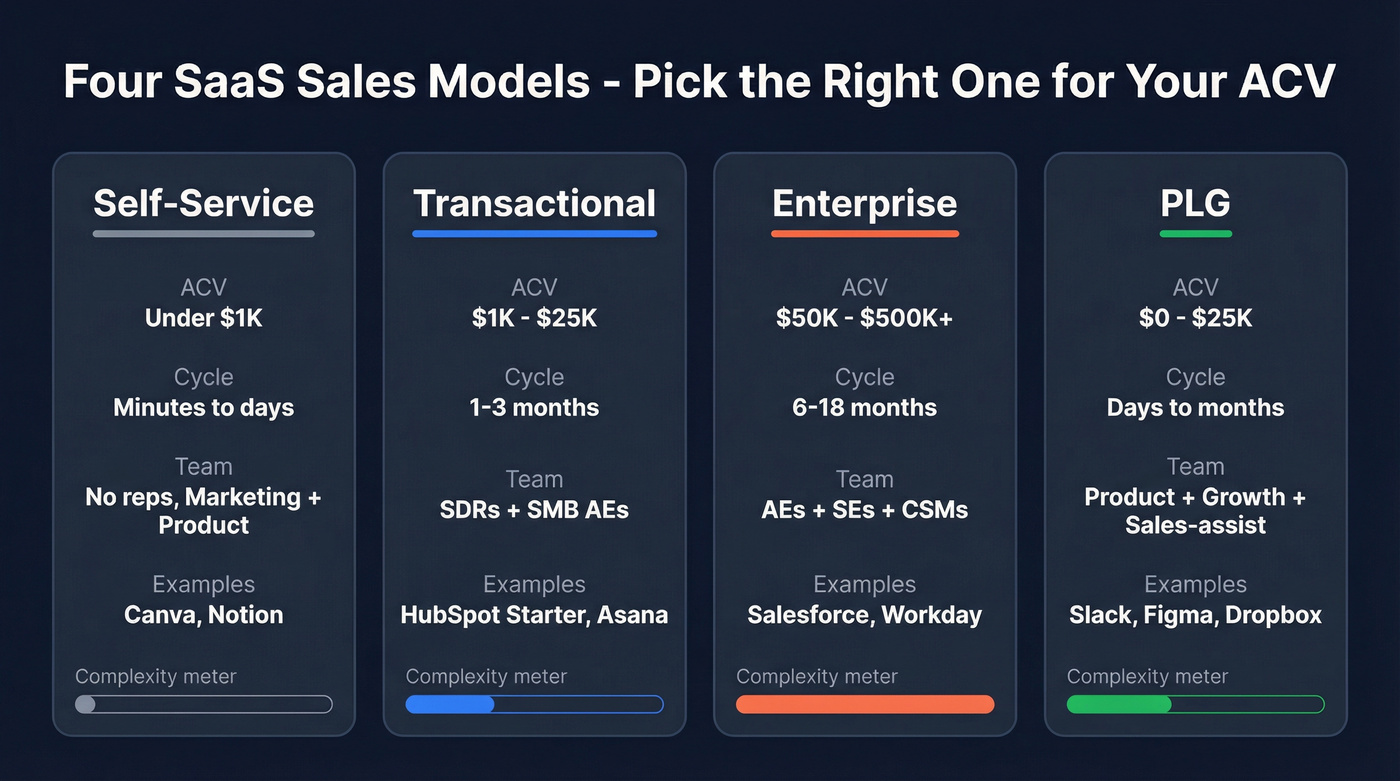
What matters more than memorizing these categories is understanding where your product actually fits - and not trying to run an enterprise motion on a $5K ACV product. That mismatch is one of the most common and expensive mistakes in software selling.
Product-Led Growth: The Fourth Model
58% of B2B SaaS companies now report having a PLG motion, and 91% plan to increase their investment - 47% plan to double it. This isn't a trend anymore. It's the dominant go-to-market strategy for a majority of the market.
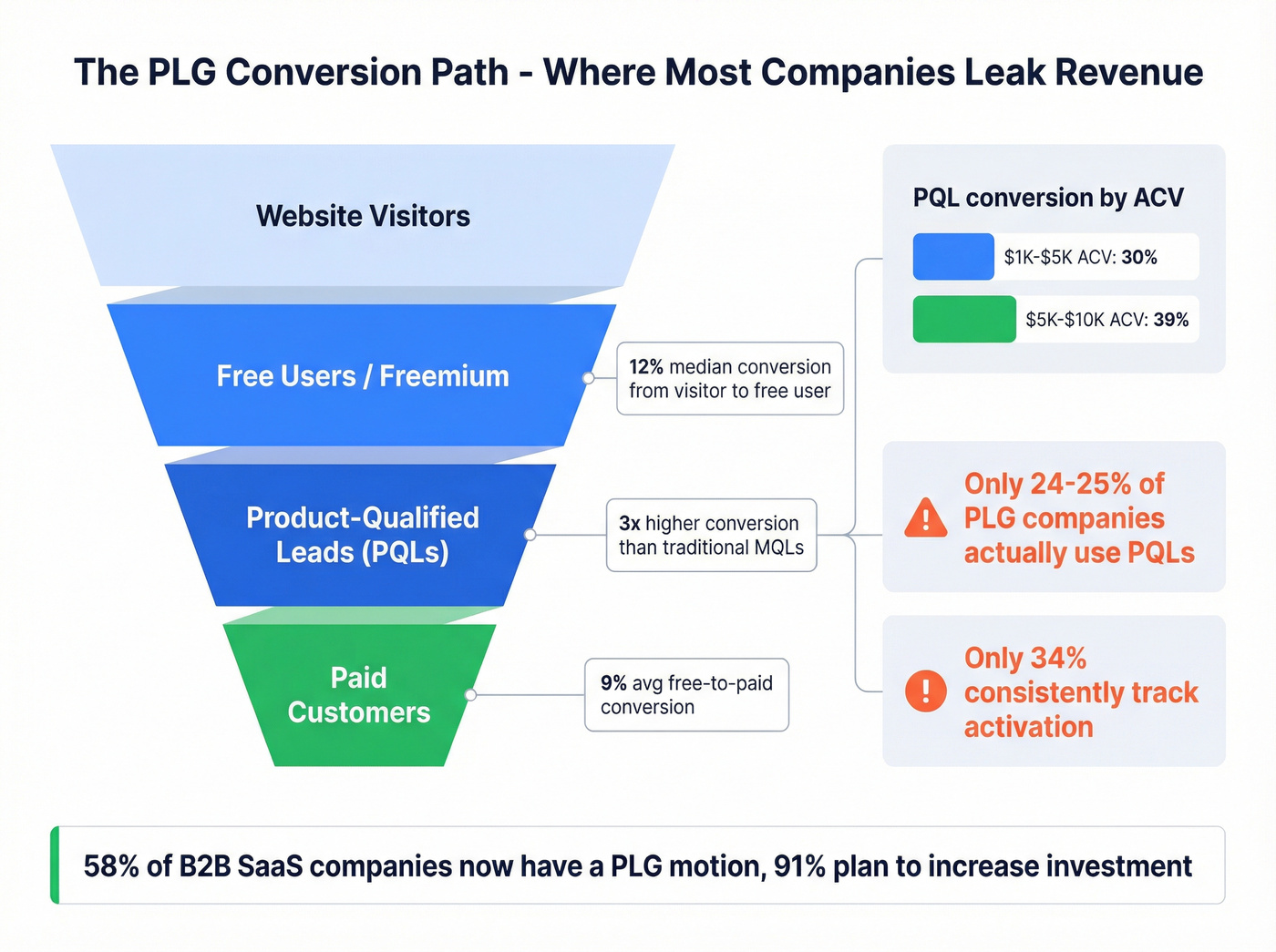
Average free-to-paid conversion across PLG models runs about 9%. That sounds low until you compare it to outbound conversion rates, which are often below 1%. Freemium converts visitors at a 12% median - higher than free trials. When companies actually implement product-qualified leads, conversion jumps to roughly 3x higher than traditional MQLs. PQL-based free-trial conversion by ACV bracket tells an even sharper story: 30% at $1K-$5K ACV, and 39% at $5K-$10K.
But only 24-25% of PLG companies actually use PQLs. And only 34% consistently track activation - the metric that predicts whether free users will ever convert. The rest are leaving massive conversion gains on the table because product, marketing, and sales can't agree on who owns the free-to-paid motion.
Here's the thing: if your deal sizes sit below $25K and you don't have a PLG motion, you're fighting with one hand tied behind your back. And if you're at a PLG company and nobody's defined what a PQL looks like, that's your highest-leverage project this quarter - not another email sequence.

Buyers spend just 17% of their time with vendors. Every touchpoint has to count - which means reaching real inboxes, not bouncing off bad data. Prospeo delivers 98% email accuracy with a 7-day refresh cycle, so your SaaS pipeline starts with contacts that actually connect.
Stop burning quota on stale data. Build pipeline that converts.
How AI Is Reshaping the Selling Motion
AI adoption in sales has moved from experiment to expectation. HubSpot tracked adoption rising from 24% in 2023 to 43% in 2024. LinkedIn's data showed 56% of sales professionals using AI daily, and AI users were 2x as likely to exceed their targets.
The performance gap is stark. Gartner found that sellers who effectively partner with AI tools are 3.7x more likely to meet quota. Bain's research showed early AI deployments boosting win rates by 30% or more. These aren't marginal improvements - they're the difference between a rep who hits plan and one who doesn't.
Where AI actually delivers: account research that used to take 30 minutes now takes 3, email personalization that references specific company initiatives instead of "I noticed your company is growing," call prep that surfaces the three things most likely to matter to this specific buyer, and pipeline forecasting that catches deals going sideways before the rep's gut does. In our experience, the biggest AI wins come from research automation and pipeline intelligence, not AI-generated email copy - buyers can smell that from a mile away.
Reps still spend only about 25-30% of their working hours on actual selling. The rest is admin, CRM updates, research, and internal meetings. AI's biggest impact isn't making reps better at selling - it's giving them more time to sell in the first place.
Compensation Benchmarks
Money talk. Here are the current compensation bands:
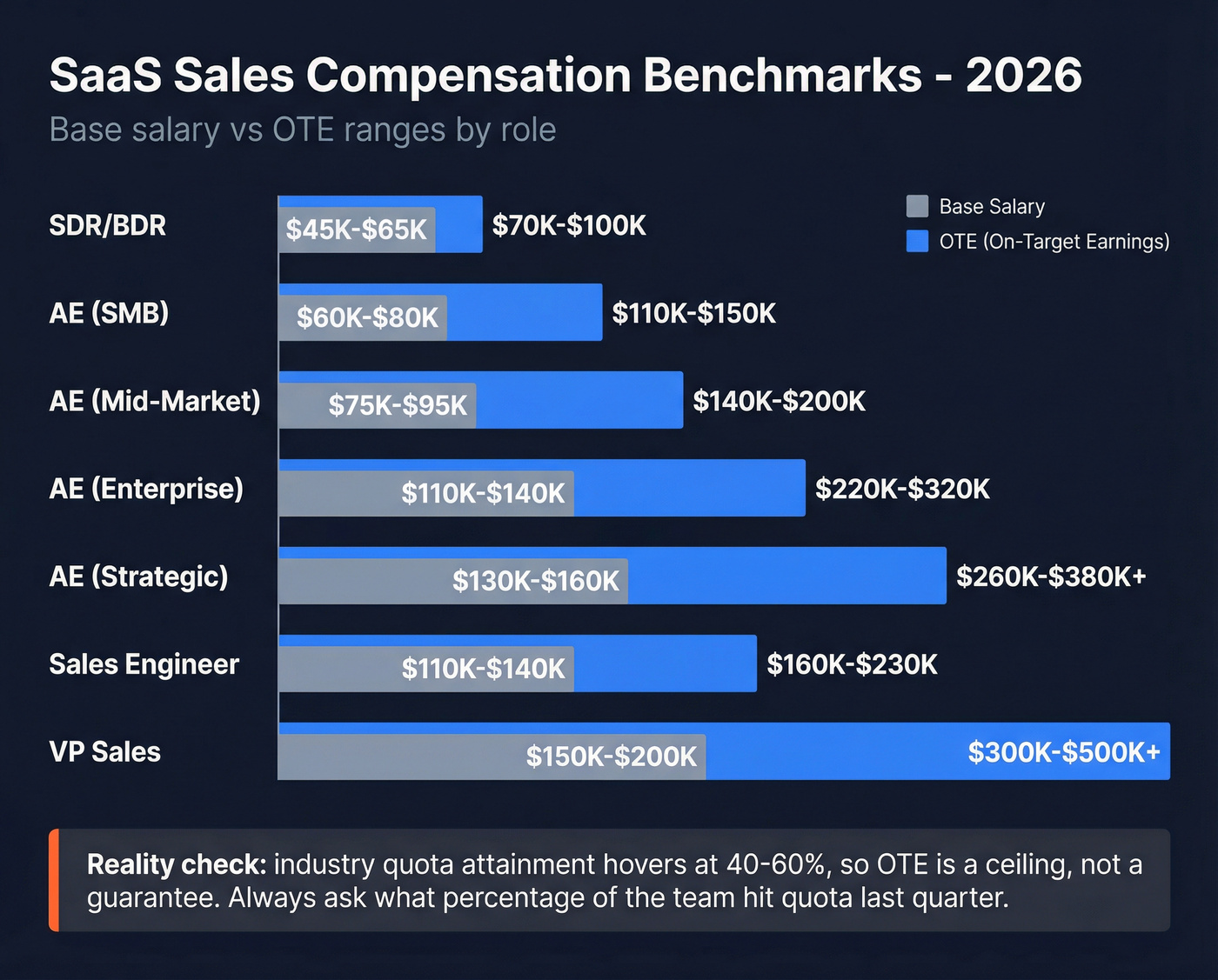
| Role | Base Range | OTE Range | Typical Split |
|---|---|---|---|
| SDR/BDR | $45K-$65K | $70K-$100K | 60/40-70/30 |
| AE (SMB) | $60K-$80K | $110K-$150K | 50/50 |
| AE (Mid-Market) | $75K-$95K | $140K-$200K | 50/50 |
| AE (Enterprise) | $110K-$140K | $220K-$320K | 50/50 |
| AE (Strategic) | $130K-$160K | $260K-$380K+ | 50/50 |
| Sales Engineer | $110K-$140K | $160K-$230K | 70/30 |
| Sales Manager | $120K-$150K | $200K-$280K | 60/40 |
| VP Sales | $150K-$200K | $300K-$500K+ | 60/40 + equity |
The BLS median for sales roles in software publishing sits at $98,370. Top performers who blow past 120% attainment can hit accelerators of 1.5x-2x their standard commission rate.
Now for the part nobody puts in the job posting: OTE is a marketing number. It represents what you'd earn at 100% quota attainment, and quota attainment across the industry hovers around 40-60% depending on the segment and the year. The Reddit threads asking "is this career still worth it?" are really asking "can I actually earn the OTE they're advertising?" The honest answer: at a well-run company with product-market fit, yes. At a pre-revenue startup burning through runway, probably not.
Before you accept an offer, ask three questions: what percentage of the team hit quota last quarter, what's the median attainment (not the average, because one whale skews averages), and whether there are clawback provisions on multi-year deals. Those answers tell you more than the OTE number ever will.
The Modern Sales Tech Stack
A bloated tech stack doesn't make you more productive. It makes you slower. Every tool should tie to a revenue outcome, and you should audit your stack twice a year to kill redundancy.
What Your Stack Should Include
Six categories cover the modern selling motion:
- CRM - Salesforce or HubSpot. Your system of record.
- Sequencing/engagement - Outreach, Salesloft, or Instantly for multi-channel cadences.
- Data enrichment and verification - the layer that determines whether your sequences actually reach real people.
- Intent data - signals showing which accounts are actively researching solutions like yours.
- Conversation intelligence - Gong or Chorus for call analysis and coaching.
- Enablement - content management and training platforms that keep reps sharp.
Data Quality Wins Deals
Reps spend roughly 30% of their week selling. Bad data eats into that number ruthlessly - bounced emails waste sequence capacity, damage your sending domain, and produce zero meetings. Data freshness is the most underrated factor in the entire stack. A contact database that refreshes every six weeks is serving you stale records for 80%+ of the year.
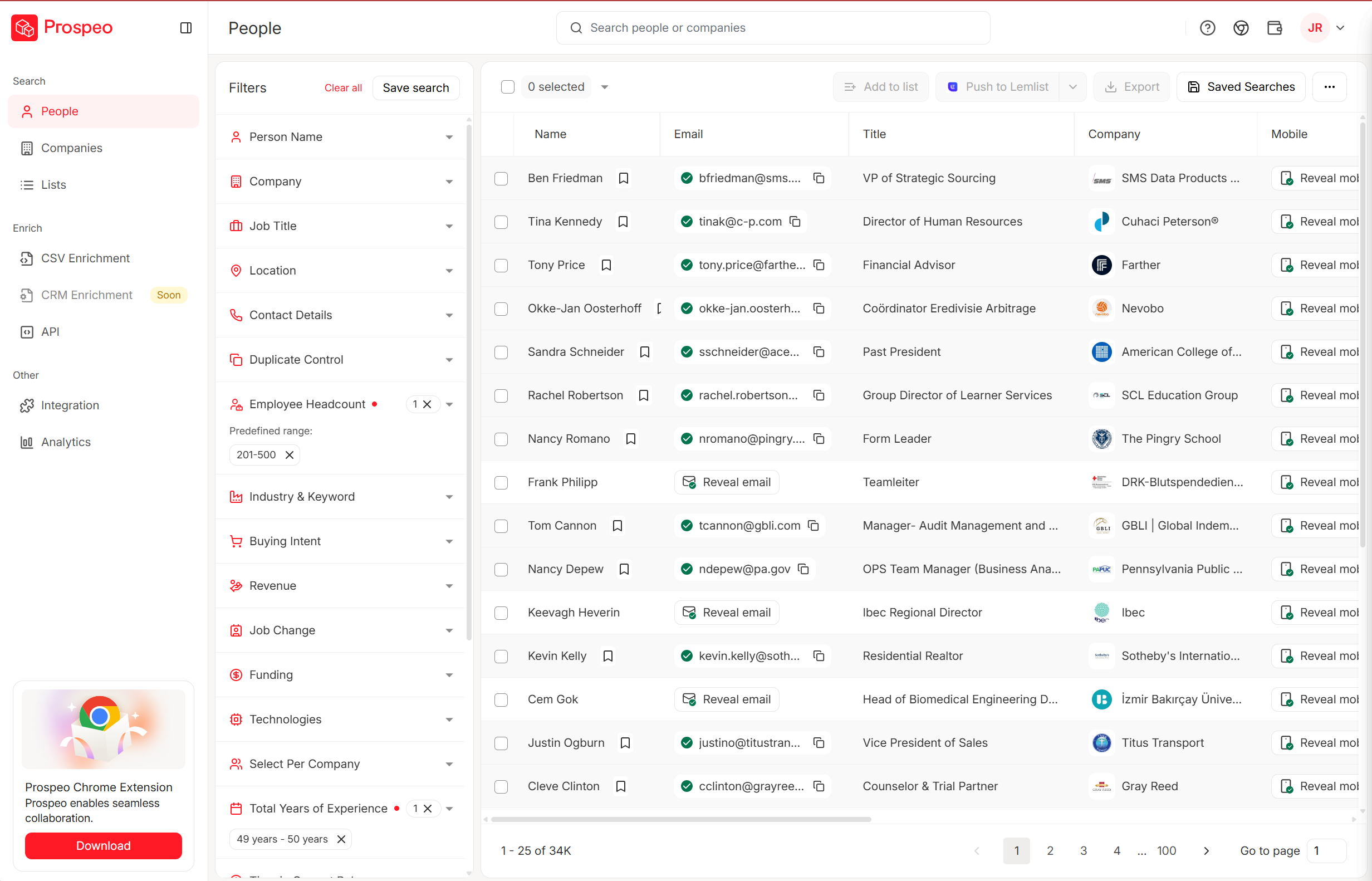
When Snyk rolled out Prospeo across 50 AEs who were each prospecting 4-6 hours per week, their bounce rate dropped from 35% to under 5%, and AE-sourced pipeline jumped 180% - generating 200+ new opportunities per month. That's what happens when your data layer actually works. With 98% email accuracy, a 7-day refresh cycle, and 30+ search filters covering buyer intent, technographics, job changes, and funding signals, building targeted lists takes minutes instead of hours.
Multi-threading into 4+ stakeholder buying committees demands verified contact data at scale. Prospeo gives you 300M+ profiles with 30+ filters - buyer intent, technographics, headcount growth, funding - so you can map entire SaaS buying committees in minutes, not days. At $0.01 per email, it's 90% cheaper than ZoomInfo.
Find every stakeholder in the deal before your competitor does.
Metrics That Actually Matter
If you're only tracking MRR and churn, you're flying blind.
Pipeline coverage should run 3-5x your revenue target. Below 3x and you're one bad month from missing the quarter. Win rates on qualified opportunities average around 29%; across the full pipeline including early-stage, expect 15-25%. SMB deals close in 1-3 months, mid-market in 3-6, and enterprise cycles regularly exceed 12 months.
CAC and CLTV are the unit economics that determine whether your selling motion is sustainable. Target a CLTV:CAC ratio of 3:1 or better. Below that, you're spending too much to acquire customers relative to what they're worth. Quota attainment is the metric nobody wants to talk about honestly - across the industry, roughly 40-60% of reps hit plan in any given quarter. If your org is significantly below that range, the problem isn't the reps. It's the territory design, the product, or the targets.
We've seen teams transform their quarter by simply fixing pipeline coverage from 2x to 4x. The orgs that treat metrics as a living system - adjusting territories, refining ICP, and reallocating resources based on what the data says - consistently outperform those running on gut feel.
Breaking Into SaaS Sales
The career ladder is well-established: SDR, AE, Enterprise AE, Manager, VP, CRO. The path is real, and the compensation ceiling is high. But where you start matters enormously.
Look for a mid-market company with a proven product where 50% or more of reps are hitting quota. That environment teaches you the fundamentals without the chaos of a pre-revenue startup or the bureaucracy of a 10,000-person enterprise. Skip companies that can't tell you their quota attainment numbers - that's a red flag.
The three highest-leverage skills for 2026: AI fluency (not just using ChatGPT, but integrating AI into research, personalization, and pipeline management), multi-threading (building relationships with 3-4 stakeholders per deal instead of just your champion), and commercial acumen (understanding your buyer's business well enough to quantify the impact of your solution). Cold-call volume and email blast quantity are table stakes, not differentiators.
Let's be honest about the job search: treat it like an SDR motion. Prospect hiring managers directly, personalize your outreach to their specific team and challenges, and follow up persistently. What hiring managers actually look for hasn't changed as much as people think - coachability, intellectual curiosity, and a track record of competing at something. Sales, athletics, academics, anything that shows you can handle rejection and keep going. Pair those traits with genuine AI fluency and you'll stand out from 90% of candidates.
FAQ
What does SaaS sales mean?
It means selling cloud-based subscription software where customers pay recurring fees rather than a one-time license. The subscription model ties revenue to retention and expansion, not just new logos - making post-sale engagement, product adoption, and customer success core parts of the selling function.
Is this still a good career in 2026?
Yes. The market hits $465B in 2026 and grows at 12.85% CAGR through 2035. Roles are evolving fast - AI fluency matters more than cold-call volume - but demand for skilled sellers has never been higher. Target companies where 50%+ of reps hit quota.
How long is a typical sales cycle?
SMB deals close in 1-3 months, mid-market runs 3-6 months, and enterprise cycles regularly exceed 12 months. The biggest variable is stakeholder count - 87% of B2B buying decisions involve four or more people, and each additional decision-maker adds friction.
What tools do teams need most?
Six categories: CRM, sequencing, data enrichment and verification, conversation intelligence, intent data, and enablement. For data quality specifically, look for platforms with verified emails, frequent refresh cycles, and intent signal layering - stale records are the fastest way to burn your sending domain.
How much do reps actually earn?
SDR OTE ranges from $70K-$100K. Mid-market AEs earn $140K-$200K OTE. Enterprise AEs reach $220K-$320K. Always ask what percentage of the team hit quota last quarter before accepting an offer - OTE means nothing if attainment is below 40%.