Social Selling Thought Leadership: A Comment-First System That Creates Pipeline (2026)
Social feeds are louder than ever, and buyers are tired. The fastest way to get ignored is to show up like "another person selling."
Here's the move that still works: earn attention in public first, then take the conversation private only after you've built trust.
We've tested this with reps, founders, and CS leaders who needed meetings, not vanity metrics. The pattern's consistent: posting-first burns people out; comment-first builds familiarity in the right circles and turns that familiarity into DMs, calls, and real pipeline.
The minimum viable setup (so you don't overthink it)
You don't need a content calendar that looks like a NASA launch plan. You need four things that actually move the needle: targeting (who you show up around), POV (what you're known for), logging (so it becomes pipeline), and time boxes (so it survives a busy week).

Get those right and the rest is just tuning.
Checklist (set this up once)
- Pick 25 target accounts and 50 target people (champions + adjacent stakeholders).
- Build a comment list: 10 creators, 10 practitioners, 5 customers, 5 partners.
- Define 3 POV themes you'll repeat for 90 days (not 30 random topics).
- Create a simple CRM field or tag: "Social engaged" + date + link to the post.
- Block 15 minutes daily + 1 hour weekly + 45 minutes weekly on your calendar.
The 30-day mini-plan
If you only do three things for the next 30 days:
- 5 meaningful comments/day (Mon-Fri)
- 2 posts/week (one POV, one practical)
- 1 weekly conversation-to-meeting block (45 minutes, permission-based outreach)
That cadence is built to produce replies first, then DMs, then 1-3 meetings/week by week 6-8 once your name becomes familiar in the right rooms.
What "social selling thought leadership" actually means
It's earning attention through useful perspective, then converting that attention into relationships that create pipeline.
It's not "being a creator." It's not motivational posting. And it's definitely not pitching in DMs the second someone likes your post.
A practical model is the SSI pillars: build your professional brand, find the right people, engage with insights, and build relationships. You don't need to worship the score, but the pillars are directionally right: brand + targeting + engagement + relationships.
What it is:
- A consistent POV about a real problem your buyers have
- Proof you understand the messy middle (tradeoffs, constraints, politics)
- Repetition across comments, posts, and conversations until people associate you with a category of help
What it isn't:
- Posting hot takes with no follow-through
- "Thought leadership" that's just product features in a trench coat
- Confusing reach with revenue
Here's the thing: posting-first fails; comment-first wins.
Posting-first fails because you're asking the algorithm and your network to care about you before you've shown you care about them. Comment-first wins because it's the fastest way to get seen by the right people, learn what they react to, and earn the right to start a conversation.
Why this works now: hidden buyers + stalled deals
Buying groups didn't get smaller. They got harder to see.

Edelman and LinkedIn's B2B Thought Leadership Impact research (their 2025 edition) highlighted "hidden buyers" - people who influence the decision without showing up on your calendar invite list. That's the real game: you're not just persuading a VP; you're helping the VP win an internal argument with Finance, Security, IT, and whoever else can slow the deal down.
And internal arguments are why deals stall. That same research pointed to 40%+ of B2B deals stalling due to internal misalignment, a theme that lines up with Matt Dixon's The JOLT Effect.
Thought leadership isn't a nice-to-have. It's pre-selling alignment:
- Giving champions language they can reuse internally
- De-risking the decision with examples and tradeoffs
- Making your approach feel like the safe internal choice
One strong opinion: if your average deal is small, you probably don't need "big thought leadership." You need consistent, high-trust visibility with the exact people who can buy. Comments do that better than chasing a viral post.
We've seen this repeatedly: the seller who shows up in comments for 30 days becomes the "familiar name" when the buying group finally starts shortlisting. Not because they went viral - because they were consistently helpful in the right rooms.

You've built familiarity through comments. Now you need verified contact data to take the conversation private. Prospeo gives you 98% accurate emails and direct dials for the exact buyers on your target account list - so your DM-to-meeting block actually produces meetings.
Turn social selling warmth into booked calls with data that connects.
How distribution works in 2026 (and why comments beat posts)
Most people treat distribution like magic. It's not. It's a set of filters.
Hootsuite's explanation of feed ranking is a clean mental model: quality filter -> engagement test -> ranking. Your post (or comment) gets screened for spammy signals, then tested with a small audience, then expanded if it performs.
Two mechanics matter more than people admit.
1) Dwell time is the quiet driver
If someone stops scrolling to read, that's a stronger signal than a lazy like. Long-form comments and posts that actually get read tend to travel farther, and they also pull the right kind of inbound because they show you can think, not just post.
2) The "golden hour" is behavior, not superstition
Early engagement helps distribution. Not because of a mystical timer, but because the engagement test needs data fast. If you reply quickly, you create more threads, which increases dwell time, which increases reach.
Now the hot take: comments beat posts for most sellers.
- Comments piggyback on someone else's distribution.
- Comments are lower effort, so you can do them daily.
- Comments create conversation gravity: people reply, and now you've got a reason to connect.
LinkedIn-first (for B2B) + formats that work
If you only pick one platform for B2B, pick LinkedIn. It's where buying groups, operators, and partners already overlap, and it's where comments can put you in front of the right people without begging for attention.
Three formats I'd bet on in 2026:
- POV text posts (clear stance + tradeoff + "do this instead")
- Document/carousel posts (checklists, teardown slides, frameworks)
- Newsletter repurposing (turn your best monthly POV into a longer asset you can reference in comments and DMs)
For targeting, Sales Navigator is still the cleanest way to build lists, set alerts (job changes, new posts), and keep your comment list from going stale.
Guardrails that keep you out of the spam bucket
These aren't laws of physics. They're habits that keep your content easy to classify and harder to ignore.
- Use 3-5 hashtags max.
- Leave 12 hours between posts if you're posting more than once a day (most people shouldn't).
- Don't tag irrelevant people. It's the fastest way to look like you're farming reach.
- Don't do engagement bait ("comment YES," "tag a friend," "agree?"). It trains the platform to treat you like low-quality content.
You don't need hacks. You need to stop doing the stuff that screams "I'm here for me."
Comment-first workflow: Comment -> Content -> Conversation
This is the system we'd roll out for a seller who wants meetings, not vibes. It's built around time boxes so it survives real life, and it assumes you'll miss days because you're not a full-time creator.
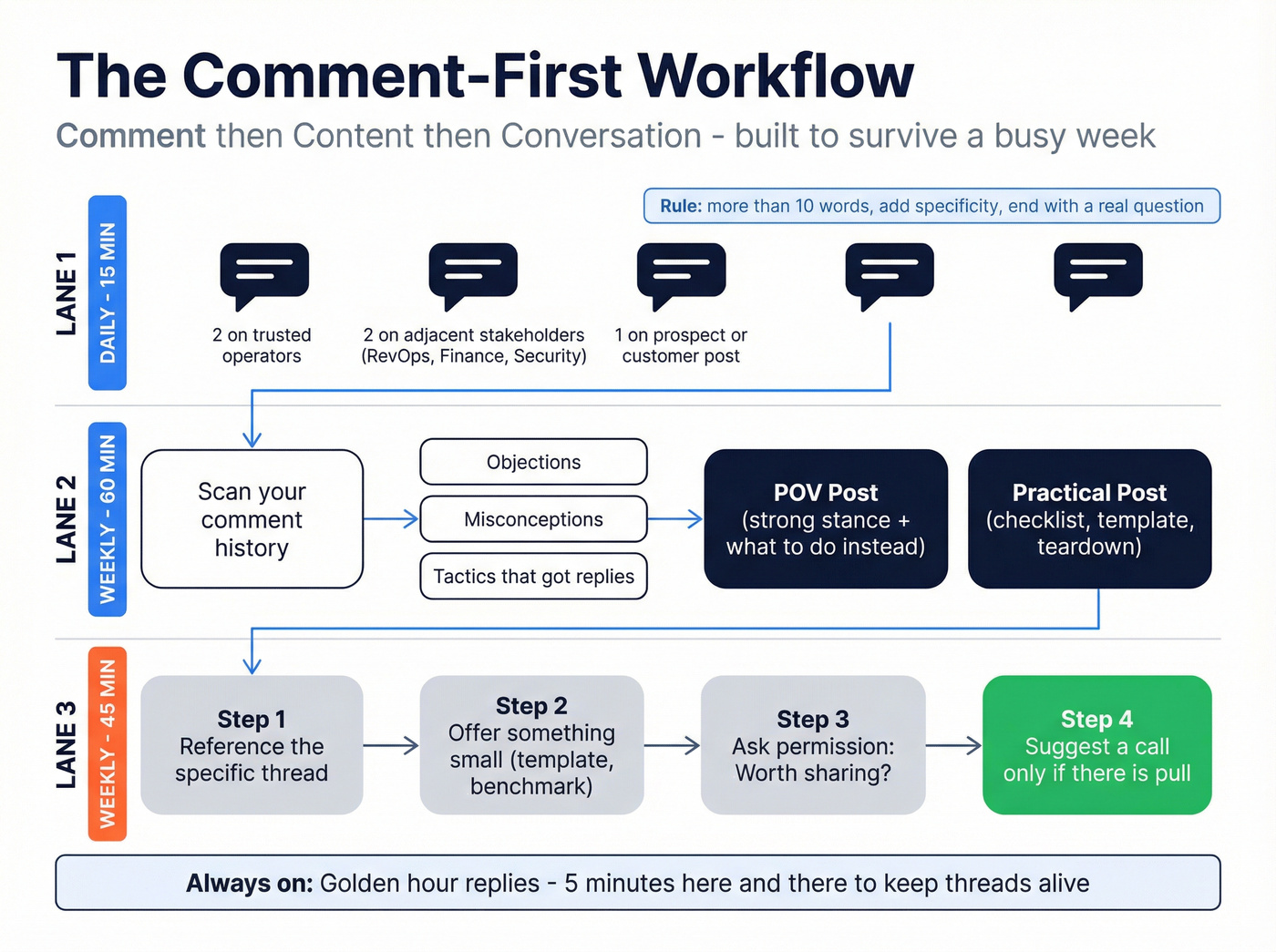
The time boxes
- Daily: 15 minutes (comments)
- Weekly: 60 minutes (turn comments into posts)
- Weekly: 45 minutes (conversation-to-meeting block)
- Always-on: golden hour replies (5 minutes here and there)
One concept that changes how you behave: posts can resurface days or weeks later when new engagement happens. So you're not "missing your window" if you didn't post at the perfect time. You're building a library of resurfacing assets.
Daily (15 minutes): 5 comments that earn replies
Where to comment

- 2 comments on posts from people your buyers already trust (operators, not influencers)
- 2 comments on posts from adjacent stakeholders (RevOps, IT, Finance, Security - whoever slows deals down)
- 1 comment on a prospect/customer post (wins, launches, hiring, lessons)
What to look for
- Posts with 5-30 comments already (alive, but not flooded)
- Posts that mention a constraint: budget, headcount, tooling, politics, compliance
- Posts where you can add a missing step, a tradeoff, or a "here's what breaks in practice"
Comment depth rule: write more than 10 words.
Not because the platform counts words. Because >10 words usually forces specificity (example, tradeoff, question), and specificity earns replies.
Avoid
- "Great post!" (translation: I want attention)
- Generic agreement with no added value
- Turning the comment into a pitch
A formula that works: Agree or disagree -> add a specific nuance -> ask a real question.
That last part matters. Questions create replies, and replies create relationships.
Weekly (60 minutes): turn comments into 2 posts
Your comments are your research. Every week, scan your own comment history and pull:
- 3 objections you saw repeatedly
- 3 misconceptions people keep repeating
- 3 "this worked for us" tactics that got replies
Then write two posts:
- Post 1 (POV): a strong stance on one misconception + why it's wrong + what to do instead
- Post 2 (practical): a checklist, template, or teardown someone can use today
Teams that "brainstorm content" from scratch die by week three. Comment-first fixes that because the market's literally telling you what it cares about, and it does it in plain language, not in a marketing brief.
Weekly (45 minutes): conversation-to-meeting block
This is where most people either freeze or go full spam. Neither works.

Use a permission-based approach:
- Start with context: reference the specific thread/post
- Offer something small: a template, a teardown, a benchmark
- Ask permission: "Worth sharing?" / "Want the doc?"
- Only then suggest a call if there's pull
A meeting ask that doesn't feel gross:
- "If you're solving this in Q1, I can share what we're seeing across a few teams. Want to compare notes for 15 minutes?"
Routing: tag, log, follow up (without spamming)
If you want this to create pipeline, you need routing. Not complicated routing - just consistent.
Log it the same way every time (copy/paste):
Social engaged | 2026-02-17 | [post URL] | Angle: security objections | Next: send checklistSocial engaged | 2026-02-17 | [post URL] | Angle: pricing pushback | Next: ask 1 questionSocial engaged | 2026-02-17 | [post URL] | Angle: implementation timeline | Next: book 15-min compare-notes
Naming convention that keeps teams sane
- Tag:
Social engaged - Angle (pick one):
Security / Pricing / Workflow / Integration / ROI / Change mgmt - Next step (pick one):
Send asset / Ask question / Invite / Book
And yes, when you move from conversation to outreach, contact quality matters. Bad data doesn't just waste time; it wrecks deliverability and makes your whole motion look sloppy.
Prospeo - "The B2B data platform built for accuracy" - is our go-to when a team needs verified follow-up contacts fast: 300M+ professional profiles, 143M+ verified emails, 125M+ verified mobile numbers, 98% email accuracy, and a 7-day refresh cycle (industry average: 6 weeks). In practice, that means you can capture a URL, verify email/mobile, and enrich your CRM without playing guessing games.

Comment templates you can copy/paste (that won't sound fake)
These patterns are based on common social selling templates, but rewritten so they sound like a real person who actually does the work.
Agree + add (the safest "value" comment)
- "Yes. The part people miss is [nuance]. We've seen [specific outcome] when teams [do X]. Curious - how are you handling [constraint]?"
Example:
- "Yes. The part people miss is that 'more activity' isn't the same as 'more pipeline.' When teams track conversations-to-meetings, they cut the fluff fast. Curious - are you measuring DMs started or meetings booked?"
Respectful counterpoint (high signal, high trust)
- "I mostly agree, but I think [assumption] breaks when [scenario]. In those cases, [alternative] tends to work better. What's your experience in [segment]?"
Example:
- "I mostly agree, but I think 'post daily' breaks when you're selling into regulated teams. Consistency matters, but quality + relevance matters more. What's your experience in security/compliance-heavy accounts?"
Method question (turn their post into a mini-interview)
- "How are you defining [term]? And what did you exclude when you measured [result]?"
Example:
- "How are you defining 'engaged account' here - anyone who viewed, or only commenters/clickers? And did you exclude employees/partners from the count?"
Structured steps (the mini playbook comment)
- "If someone wants to replicate this, I'd do:
- ...
- ...
- ... The key is [one constraint]."
Example:
- "If someone wants to replicate this, I'd do:
- Build a 25-account list
- Comment daily for 2 weeks
- Turn the top 3 comment themes into posts The key is logging engagement so you can follow up without guessing."
Add implications (make their point more valuable)
- "This also changes [downstream thing]. If you do [their advice], you'll usually see [2nd-order effect]."
Example:
- "This also changes enablement. If you coach reps on comments first, you'll see better discovery calls because they've already practiced articulating the problem in public."
Comment teardown examples (before -> after)
Teardown #1: The empty compliment
- Before: "Great post - totally agree!"
- After: "Agree. The tradeoff is speed vs trust: outbound can start fast, but it stalls when the buying group isn't aligned. What's one question you ask to surface misalignment early?"
Teardown #2: The stealth pitch
- Before: "We help teams solve this - DM me."
- After: "One tactic that's worked for us: write the internal email your champion forwards as the post itself (risk, options, recommendation). Want a simple template for that?"
Teardown #3: The generic 'insight'
- Before: "Insightful perspective, thanks for sharing."
- After: "This matches what I see: the moment Finance gets involved, the deal turns into a risk conversation. How do you arm champions with ROI and risk language?"
Anti-patterns (don't do these)
- Engagement bait: "Comment YES and I'll send it"
- Irrelevant tagging: "@randomperson thoughts?"
- Filler: "Insightful perspective! Thanks for sharing!"
- Hijacking: turning their post into your pitch deck
Real talk: the goal of a comment isn't to look smart. It's to earn a reply from the right person.
Permission-based DM script (3 messages, no cringe)
Message 1 (context + permission)
- "Saw your comment on [topic] in that thread. I've got a 1-page checklist for handling [constraint]. Want it?"
Message 2 (deliver + one question)
- "Here you go: [link]. Quick question - are you dealing with [A] or [B] right now? That changes the order of ops."
Message 3 (invite only if there's pull)
- "If it's helpful, happy to compare notes for 15 minutes. No deck - just what's working across a few teams."
Build a POV engine (so your thought leadership isn't random)
Random posting creates random results. A POV engine creates compounding results because people start to recognize your thesis, and recognition is what turns "I've seen you around" into "I trust you enough to talk."
Use this category narrative sequence:
- Big change (what shifted)
- Problem (why the old approach fails)
- De-position the status quo (what most teams do that's now risky)
- Promised land (what "good" looks like)
- Category as the path (the approach that gets you there)
It works because it forces a falsifiable thesis and repeatable angles. You stop posting "tips" and start building a point of view people can recognize - and argue with.
Fill-in prompts (steal these)
- Big change: "In 2026, buyers are ____ because ____."
- Problem: "That creates a new failure mode: ____."
- Status quo: "Most teams respond by doing ____, which backfires because ____."
- Promised land: "The teams winning do ____. They get ____ without ____."
- Path: "The path is ____. It works because ____."
Now turn that into a 90-day map:
- 3 pillars (your POV themes)
- 5 recurring formats (teardown, checklist, story, counterpoint, template)
- 10 evergreen objections you'll answer repeatedly
One more opinion, because it saves people months: if your POV can't survive being repeated for 90 days, it's not a POV. It's a mood.
Measuring it: from leading indicators to influenced pipeline
Likes don't matter.
Ok, they matter a little, but only as a weak signal that something got seen. What matters is whether your activity creates conversations -> meetings. Everything else is upstream.
Force Management's buckets are a decent starting point: expressions of interest (likes, comments, clicks), profile views, and network growth. That's fine for week one. You still need a KPI ladder that ends in pipeline.
Starter dashboard (seller/manager)
Track these weekly (15 minutes, same day every week):
- Meaningful comments left (target: 25/week)
- Replies received (target: 10+/week)
- New relevant connections (target: 10-30/week)
- Inbound DMs started (target: 2-5/week)
- Outbound permission-based DMs sent (target: 5-10/week)
- Conversations created (real back-and-forth, target: 3-8/week)
- Meetings booked from social (target: 1-3/week after ramp)
Cadence:
- Sellers review weekly.
- Managers review biweekly with two questions: "What angle is working?" and "Where are conversations stalling?"
I've run this with teams where the "top poster" produced fewer meetings than the "top commenter." The commenter had fewer impressions and more pipeline.
That isn't a fluke. It's the model.
Measurement maturity ladder
| Stage | What you track | Tooling | Output |
|---|---|---|---|
| Beginner | Native analytics + CRM notes | Platform + CRM | Meetings list |
| Intermediate | UTMs + landing pages + CAPI | Web + ads + CRM | Influenced leads |
| Advanced | Company-level engagement | Partner tools + attribution | Influenced pipeline $ |
Advanced attribution (RevOps)
Once you want company-level ROI, the question changes operationally.
You stop asking "Which post drove the deal?" You start asking "Which companies engaged before the meeting, and did engagement shorten cycle time or increase win rate?"
Moves that work:
- Create an "Engaged accounts" view (weekly) and route it to SDR/AE pods.
- Run a simple experiment: engaged vs non-engaged accounts, same outbound motion, compare meeting rate.
- Add a required field on opp creation: "Social touch present?" (yes/no) + link(s).
Attribution isn't about being academically correct. It's about being useful enough to change behavior, which is the only kind that survives budget season.
Advanced attribution in 2026: company-level engagement is measurable
For years, social attribution was stuck at the individual level: impressions, clicks, maybe a form fill. That's not how B2B buying works.
LinkedIn's Intelligence API (as described in partner write-ups) exposes aggregated company-level engagement across organic and paid, so you can answer: "Which target accounts are engaging with our people and our ads?"
What you can see (company level):
- Paid impressions
- Paid clicks
- Paid leads
- Organic impressions
- Organic engagements
- Company rollups you can use for audiences and alerts
Most teams won't implement this raw. That's why the partner ecosystem matters; examples include Channel 99, Octane11, Dreamdata, and Fibbler.
Reported beta outcomes from partner materials include:
- 287% more companies reached
- 75% more MQLs
- 96% more SQLs
- 43% lower CPA
Paid amplification (optional): Thought Leader Ads
Thought Leader Ads are simple: take a high-performing post from an individual (exec, AE, founder) and run it as a paid ad with their consent. It keeps the voice human while giving you targeting and scale.
Use them when:
- You've already got 2-3 posts that earn comments organically (don't pay to amplify a dud).
- You want to reach engaged companies again with a POV that reinforces your category.
- You're trying to warm up a named-account list before outbound.
Measure:
- Lift in meeting rate for engaged vs non-engaged companies
- CPA shift (especially if you're routing engaged accounts to sales)
- Down-funnel impact: opp creation rate and cycle time for accounts exposed to the ad
How to implement (without a 6-month analytics project)
- Pick one partner tool that fits your stack.
- Define your "engaged company" threshold (example: 3+ engagements in 14 days).
- Create two automations:
- Sales alert: engaged target account -> notify owner + create task
- Audience sync: engaged companies -> ad audience for Thought Leader Ads or retargeting
- Run a 60-day test: compare meeting rate and cycle time for engaged vs non-engaged accounts.
Pricing reality: attribution tools often land in the $500-$5,000/month range depending on traffic sources, seats, and how deep you go on multi-touch.
Operationalize across a team (employee advocacy + governance)
Solo social selling is a hobby. Team social selling is a pipeline channel - if you operationalize it.
DSMN8's 2026 benchmarks (across 200+ programs) show:
- 68% of programs share 3+ times/week
- 87% provide training
- Sales drives 33% of advocacy activity
- The top challenge is "what content to share" (18%)
Hootsuite's employee advocacy benchmarks (Amplify data) are also a reality check:
- 40-50% active users
- 1.2 shares/employee/week
- Average reach per post: 21,920
So no, you won't get 90% adoption. And you don't need it.
The 6-step rollout
This structure forces the internal work:
- Identity: what's the program called, and what's the why?
- Leadership: execs participate first (or nobody believes it matters)
- Trends: adapt to what's working now (comments, dwell time, real POV)
- Tailoring: different roles share different angles (AEs != engineers != CS)
- Employee-first: make it easy and safe (templates, guardrails, time boxes)
- Tech: a place to find approved assets + track participation
I've seen programs fail because marketing treated it like a distribution machine. The winners treat it like enablement: coaching, practice, feedback loops, and a steady supply of "here's what to say" prompts that don't make people feel like corporate parrots.
Benchmarks to set expectations
Set targets that don't insult people's calendars:
- Participation: 30% is a win, 50% is elite
- Cadence: 1-2 shares/week + 5 comments/week per participant
- Training: 30 minutes onboarding + monthly refresh
- Content supply: 10-20 starter posts per month + weekly comment prompts
Reward the behavior you want. Not impressions - conversations started and meetings influenced.
Governance & compliance
You need a one-page policy. Keep it simple:
- Do: disclose relationships when required, be respectful, add personal context
- Don't: share confidential info, dunk on competitors, make legal claims, tag irrelevant people
- Approvals: only for regulated industries or sensitive announcements
- Escalation: who to ping if someone gets a hostile comment or press inquiry
Governance isn't bureaucracy. It's what makes participation feel safe.
Common mistakes (and what to do instead)
Use this as a "stop doing dumb stuff" checklist.
Do this
- Comment where your buyers already pay attention
- Write comments that add a nuance, step, or tradeoff
- Reply fast in the golden hour to build threads
- Turn comment themes into posts (market-led content)
- Ask permission before moving to a meeting
- Build lists and alerts (Sales Navigator) so you're not randomly scrolling
Skip this
- Engagement bait (it gets suppressed and makes you look desperate)
- Irrelevant tagging (it's spam with extra steps)
- Hashtag abuse (3-5 is plenty)
- Over-posting (quality drops, trust drops)
- AI-sounding comments (people can smell them instantly)
- DM pitching immediately ("Loved your post - want a demo?" is the fastest block)
If you want one rule: earn the right to DM by being useful in public first.
FAQ
How long does social selling thought leadership take to produce meetings?
Most sellers see early signals (replies, profile views, new connections) in 1-2 weeks, first real conversations in weeks 2-4, and consistent meetings in weeks 4-8. The compounding effect usually shows up around month 3 when your POV becomes recognizable and posts resurface through ongoing comments.
What should I comment on if I'm not a "content person"?
Comment on execution details: tradeoffs, steps, pitfalls, and what breaks in real life. A strong non-creator comment is "Here's the checklist I'd use" or "One thing to watch out for is..." because it's practical, not performative. Aim for 1 example + 1 question.
How do I turn engagement into outreach without being spammy?
Use a permission-based transition: reference the specific thread, offer a small asset, ask if they want it, then suggest a short call only if they pull. Keep the first DM under 250 characters and make it impossible to copy/paste to 50 people without editing.
How do I measure ROI beyond likes and impressions?
Track a ladder: comments/replies -> new relevant connections -> DMs started -> conversations -> meetings booked -> opportunities influenced. Log "Social engaged" touches in your CRM so you can report influenced pipeline later. If you can't name the meetings, you don't have ROI.
What tools help you follow up with engaged accounts?
Use your CRM plus an attribution tool once you're ready for company-level reporting, then add a data layer for clean outreach. Prospeo is a top pick because it verifies contacts at 98% email accuracy and refreshes data every 7 days, so you can follow up without wrecking deliverability.
Your 25 target accounts and 50 target people need more than LinkedIn comments. Layer Prospeo's 30+ filters - job changes, buyer intent, headcount growth - to spot when those hidden buyers are ready to engage. At $0.01 per email, your comment-first pipeline stays profitable.
Stop guessing who's ready to buy. Let intent data tell you.
Summary: make it a system, not a vibe
Social selling thought leadership isn't about posting more or chasing reach. It's about earning familiarity in the right rooms, then turning that familiarity into conversations and meetings you can track.
Run the comment-first cadence for 30 days, build a POV engine so your ideas compound, and measure what matters (conversations -> meetings -> influenced pipeline). That's how you turn visibility into revenue in 2026.