

Personal Branding for Sales Professionals: The Tactical Playbook for 2026
You send 200 cold emails. You get 3 replies. One prospect actually Googles your name before responding - and finds a blank LinkedIn profile with a stock headshot and a job title that says "Sales Executive at [Company]." They don't reply.
Your competitor's AE, meanwhile, has been posting insights about the exact problem that prospect is trying to solve. That AE gets the warm intro. That AE gets the meeting. That AE didn't send a single cold email.
Per Momentum Itsma research, 99% of B2B buyers say thought leadership is important or critical in their purchasing decisions. But here's the contrarian take most articles about personal branding for sales professionals miss: you don't need 50,000 followers. You don't need to become a LinkedIn influencer. You need 50 decision-makers who recognize your name when it hits their inbox. That's it. That's the whole game.
Your brand isn't just your LinkedIn feed. It's how you show up on video calls, how you carry yourself at trade shows, and the impression you leave in every interaction. But in 2026, the digital layer is where most of the action lives - so that's where this playbook focuses.
What You Need (Quick Version)
If you read nothing else, internalize these five things:

- Your audience is ~1,000 people across ~100 companies who could realistically buy from you. Build for them, not for the LinkedIn masses.
- Document posts (carousels) hit 6.60% engagement in 2026 - that's 6x more than text-only posts. Use them.
- Check your LinkedIn SSI score today. High-SSI sellers create 45% more opportunities than their peers.
- You need 3-4 hours per week, not 3-4 hours per day. Batch your content like you'd batch your prospecting calls.
- When prospects engage with your content, find their verified contact data and follow up within 24 hours. Engagement without follow-up is just entertainment.
Why a Strong Personal Brand Directly Impacts B2B Pipeline
Let's kill the "personal branding is soft" objection with numbers.

73% of decision-makers say thought leadership content is more trustworthy than marketing materials and product sheets, per the 2024 Edelman-LinkedIn B2B Thought Leadership Impact Report. That's not a marginal preference - nearly three-quarters of your buyers trust a well-written post from a person more than the polished PDF your marketing team spent six weeks on.
It gets worse if you're ignoring this. 66% of buyers say they wouldn't work with a provider whose thought leadership was poor. Not "mediocre." Poor. Having no presence at all counts as poor.
And 75% of decision-makers say a piece of thought leadership has led them to research a product they weren't previously considering. Your content doesn't just warm existing pipeline - it creates net-new demand from buyers who didn't know they needed you.
78% of businesses using social selling outperform those that don't. That's not a correlation - it's a competitive gap. If your competitors are building presence and you're not, you're handing them mindshare you'll never get back. 75% of B2B buyers use social media to make buying decisions, with half using LinkedIn specifically as a trusted source. And 89% of buyers are more likely to purchase from reps who understand their mission and goals - which is exactly what your content demonstrates before you ever get on a call.
Here's the thing: only 5% of the companies you're targeting are ready to buy at any given time. The other 95% need nurturing. Your brand is the nurturing engine that runs while you sleep, while you're on calls, while you're on vacation.
71% of B2B buyers say most sales interactions feel transactional. Your personal brand is the antidote. It makes the first conversation feel like a continuation, not a cold start. It takes 5 to 7 impressions for someone to remember a brand - your content creates those impressions passively. By the time you reach out, you're not a stranger. You're "that person who posts the good stuff about [their problem]."
Here's the hot take: Your personal brand is the only asset in sales that's truly yours. A mid-market AE I know left their company last year. Within two weeks, three clients from their old book followed them to the new role - unprompted. As one Reddit practitioner put it: "A lot of my connections and deals follow me as a person, not my company." Your quota resets every quarter. Your brand compounds forever.
The LinkedIn Algorithm in 2026: What Actually Gets Reach
LinkedIn's algorithm went through a major overhaul, and most reps haven't caught up. Richard van der Blom's algorithm insights report - a detailed annual analysis of LinkedIn's distribution mechanics - found that views are down 50%, engagement is down 25%, and follower growth is down 59% year-over-year.
That sounds terrifying. It's actually good news for you.
LinkedIn shifted from rewarding viral, engagement-bait content to rewarding depth and authority. The algorithm now identifies your "topic DNA" and distributes your content based on demonstrated expertise, not network size. If you've been posting consistently about a specific topic, you'll reach more of the right people - even if your total impressions drop.
Dwell time beats likes. The algorithm measures how long people actually engage with your content, not just whether they tapped a reaction button. The first 60 minutes are critical - LinkedIn tests your post with 2-5% of your network, and only 5% of posts that underperform in that first hour ever recover.
External links see roughly 60% less reach. The old "link in first comment" workaround is also penalized as of early 2026. If you're sharing a blog post, write a native post about the insight and tell people to comment for the link.
Best posting times: Wednesday at 9 AM is the peak. Tuesday through Thursday, 8-10 AM in your audience's timezone, is the sweet spot. Profile quality now influences distribution too - a clear bio, coherent specialty, and description aligned with your content helps LinkedIn decide who sees your posts.
Content Formats That Actually Work
Document posts (PDF carousels) hit a 6.60% engagement rate - the highest of any format on LinkedIn in 2026. That's 278% more engagement than video and 596% more than text-only posts.
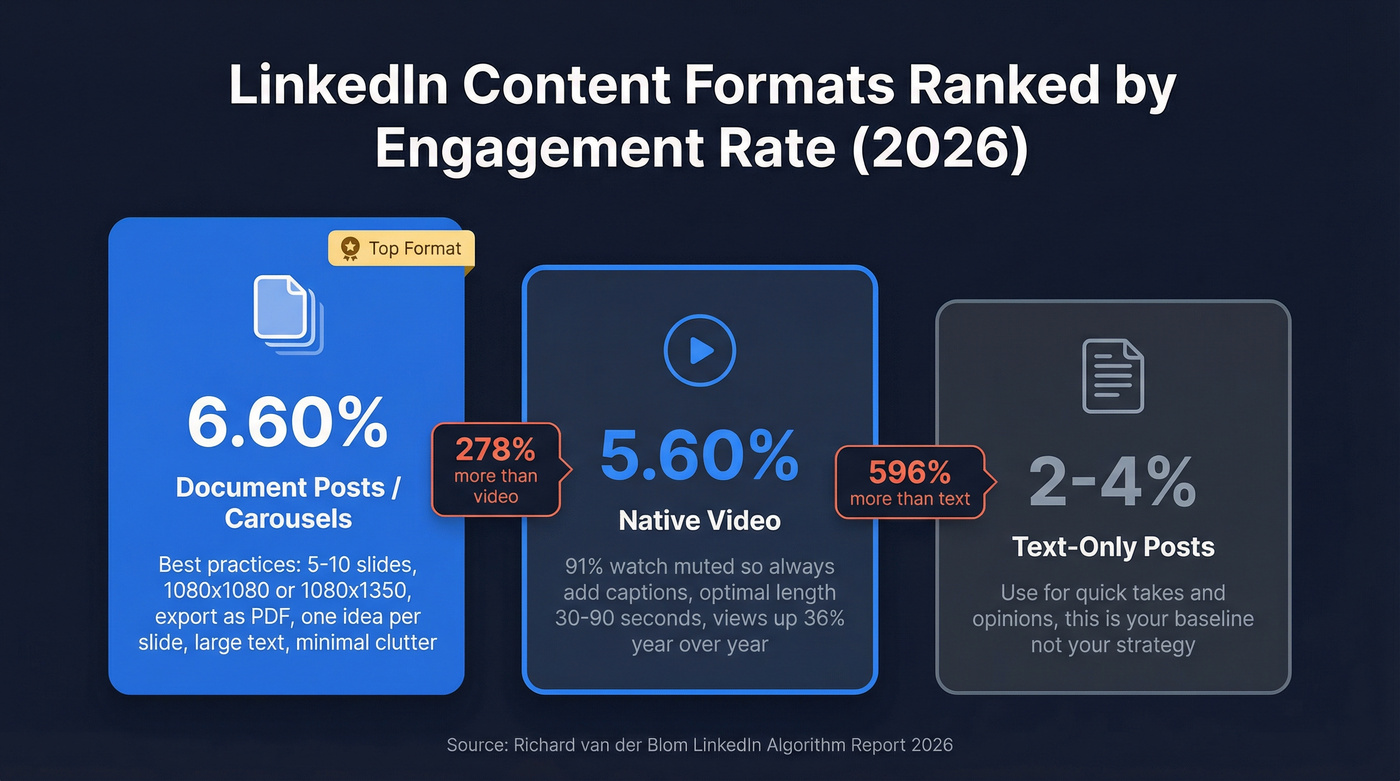
Carousel best practices: 5-10 slides, 1080x1080px or 1080x1350px, exported as PDF. Think of each slide as a billboard - one idea, large text, minimal clutter. Example that works for sales reps: "The Discovery Call Script That Doubled My Close Rate" - practical, specific, and directly useful to your buyers (or at least intriguing enough to stop the scroll).
Native video is the second-best format at 5.60% engagement, with video views up 36% year-over-year. But 91% of LinkedIn users watch video muted. Always add captions. Optimal length: 30-90 seconds.
Standard text posts still work at 2-4% engagement, but they're the baseline, not the strategy. Use text for quick takes and opinions. Use carousels and video for your pillar content.
The "Topic DNA" Shift
This is the most important algorithm change for sellers building a brand. LinkedIn now distributes content based on interest, not just your network. Your post about solving a specific procurement challenge can reach procurement leaders who don't follow you - if the algorithm recognizes you as an authority on that topic. This shift is especially relevant for anyone figuring out how to brand yourself in sales: consistency on a single topic is now rewarded more than ever.
The flip side: if you post about random topics every week, the algorithm can't categorize you.
Pick your lane and stay in it.
Deep signals matter more than superficial ones. Saves, shares, and meaningful comments carry far more weight than likes. A post that gets 50 likes and 2 shares will underperform a post that gets 20 likes, 8 shares, and 15 substantive comments. I've seen posts from three weeks prior suddenly spike because the algorithm matched them to a new cluster of interested users - a massive shift from the old "48-hour shelf life" model.

A prospect just liked your carousel post. Now what? Prospeo turns content engagement into pipeline - find verified emails and direct dials for every decision-maker who interacts with your brand. 98% email accuracy, 125M+ verified mobiles.
Stop letting warm engagement go cold. Follow up with verified data.
Your LinkedIn SSI Score: The Metric That Predicts Quota Attainment
LinkedIn's Social Selling Index measures your performance across four equally weighted pillars, each worth up to 25 points (max 100):

- Establish your professional brand - profile completeness, content sharing, thought leadership
- Find the right people - search efficiency, targeting the right prospects
- Engage with insights - publishing, commenting, reacting to industry discussions
- Build relationships - connection quality, response rates, network growth
Sales professionals with high SSI scores are 50% more likely to meet or exceed their quotas and create 45% more opportunities. Those aren't marginal gains - that's the difference between hitting your number and missing it.
Benchmarks: the average professional scores 20-30. Most sales reps land between 40-60. Top performers hit 70+. Check yours today - it takes 10 seconds and it's free.
Here's how to improve each pillar:
Professional brand: Your headline should blend niche + value + credibility, under 220 characters. "Helping mid-market CFOs cut procurement costs by 30% | 8 years in enterprise SaaS" beats "Sales Executive at Company." Your About section should follow this flow: problem your buyer faces, how you solve it, proof, call to connect. Keep it under 200 words. Pin your best posts and case studies in the Featured section. This is the foundation of your digital presence that sales leaders and buyers will evaluate before they ever take a meeting.
Find the right people: Use Sales Navigator filters to connect with decision-makers in your ICP. Don't spray connection requests - target deliberately. Set up saved searches and lead lists so you're notified when new prospects match your criteria.
Engage with insights: Comment on 5-10 posts per day from people in your target accounts. Not "Great post!" - add a genuine perspective. This is the highest-ROI activity most reps skip.
Build relationships: Respond to every comment on your posts. Send personalized connection requests. Follow up on DMs within 24 hours. Engage with existing customers' content too - happy customers who see you in their feed are your best referral engine.
Your profile should instantly answer five questions: Who are you? What do you do? How do you do it? Who do you do it with? Why should they care? If a prospect can't answer all five within 10 seconds of landing on your profile, you're losing meetings.
How to Build Your Sales Brand in 90 Days
Define Your 1,000 People
Mike Nicholson, who's spent seven years building personal brands for senior executives, frames it perfectly: "Imagine there are 1,000 people across 100 companies that matter most to your business. Your personal brand should exist to influence those 1,000 people, not the millions who will never buy from you."

This reframe changes everything. You're not trying to go viral. You're not competing with influencers. You're building familiarity with a specific, finite audience of potential buyers. Define your ICP audience - the titles, industries, company sizes, and geographies that match your quota. Align every piece of content with what those 1,000 people care about.
Build Your Content Pillars (The 3x3 Matrix)
Take your three key audience segments and identify three stories per segment. That gives you nine rotating topics - enough variety to stay interesting, enough focus to build your topic DNA.
Each story should include "something for you and something for them" - a topic that lets you talk about what matters to your business while being genuinely interesting to your audience. If you sell to CFOs, a post about "how we helped a client cut procurement costs by 40%" serves both purposes. When someone sees your name, they should know exactly what value to expect.
59% of buyers say they've seen nearly identical content from at least two providers. If your posts sound like everyone else's, you're invisible. The 3x3 matrix forces specificity - and specificity is what separates "another sales rep posting on LinkedIn" from "the person who actually understands my problem."
Real talk: the biggest mistake I see is posting for peers instead of buyers. A Reddit practitioner nailed this - "The people I'm selling to aren't fellow sales professionals, so maybe my content should be more tailored to people who might be decision makers at my prospect company." Exactly. Your content about cold calling techniques gets likes from other SDRs. Your content about solving your buyer's specific problem gets meetings.
Don't overthink the creation process. Curated content - sharing an industry article with your take added - is a perfectly valid starting point. Low-effort, and it positions you as someone who stays informed.
What to Post When You Think You Have Nothing to Say
Every sales professional hits this wall. "I'm not a thought leader. I don't have anything original to say." Here's your content menu:
- Case studies with metrics. "We helped [anonymized client] reduce [problem] by [X%] in [timeframe]." These are gold.
- Buyer pain points. What questions do your prospects ask on discovery calls? Turn each one into a post. Your buyers' problems are never boring to your buyers.
- Personal experiences, including failures. "I lost a $200K deal because I skipped the champion-building step. Here's what I'd do differently."
- Industry trends with your take. Don't just share the news - add your perspective on what it means for your buyers.
- Process breakdowns. "The exact framework I use for [specific sales activity]" - carousels work perfectly for these.
Build a "second brain." Transcribe your sales calls, capture voice notes after meetings, save interesting questions from prospects. Upload everything into a custom GPT to retrieve your real words later. AI can write about you, but it can't write like you - and audiences pick up on AI-generated content instantly.
Your Posting Cadence and Engagement Routine
Post at least once per week, ideally twice. Daily is fine if every post is genuinely useful, but never post filler. One valuable post per week outperforms five forgettable ones. 33% of businesses report that brand consistency alone boosts revenue by 20% or more - so showing up regularly matters more than showing up perfectly.
Here's a tactic most reps miss: combine organic and paid. Publish your post, wait 24 hours for the algorithm to do its initial distribution, then boost the top performers via LinkedIn Ads Manager. Even $20-50 behind a strong post can put it in front of hundreds of additional decision-makers in your ICP.
Engagement is as important as posting. Commenting on your prospects' posts - with genuine, thoughtful responses - is one of the highest-ROI activity in sales. It puts your name in front of them without the awkwardness of a cold outreach. Join communities where your buyers hang out: LinkedIn Groups, Slack communities, niche forums.
Turn Engagement Into Pipeline
When someone comments on your post, views your profile, or reacts to your content, that's a buying signal. They're aware of you. They've engaged. The window is open.
Measure what matters: profile views from target accounts, DMs from prospects, inbound meeting requests, connection acceptance rate. Not likes. Not impressions. Not follower count.
Personal Branding Mistakes That Kill Pipeline
1. Posting for peers instead of buyers. This is the #1 mistake. Your post about "5 cold calling tips" goes viral - with other salespeople. Your prospects didn't see it, didn't care, and didn't engage. Every post should pass the test: "Would my buyer find this useful?"
2. Perfection paralysis. You're waiting for the perfect headshot, the perfect first post, the perfect content strategy. Meanwhile, your competitor's AE has been posting mediocre-but-consistent content for six months and owns the mindshare in your territory. Start now. Start ugly.
3. Ignoring the algorithm. As little as 6% of your audience sees your content organically if you don't understand how distribution works. The format, timing, and engagement patterns covered in this guide aren't optional - they're the difference between reaching your buyers and shouting into the void.
4. Relying on AI to write your content. Both algorithms and audiences detect AI-generated content, and they're getting better at it. Use AI to brainstorm, outline, and edit - but write in your own voice. Voice notes transcribed and cleaned up will always outperform ChatGPT's generic output.
5. Selling instead of helping. If your posts read like product pitches, you're reinforcing the exact perception you're trying to overcome. The selling happens in the DMs and on calls - not in your feed.
6. Relying on a single platform. LinkedIn is the primary channel for B2B thought leadership, but it's not the only one. A simple personal website, an email newsletter, or even a presence in industry Slack communities creates multiple touchpoints. If LinkedIn's algorithm changes tomorrow (and it will), you want backup channels.
7. Tracking vanity metrics instead of pipeline metrics. Likes feel good. Meetings feel better. Skip the self-congratulation and look at the numbers that actually correlate with revenue.
Why SDRs and BDRs Should Start Building Now
If you're early in your sales career, you might think building a brand is something for senior AEs and VPs.
It's not.
For SDRs, it's arguably more impactful because you're doing the highest volume of cold outreach - and name recognition is the single biggest lever for improving reply rates at scale. The SDR who posts about the problems their prospects face gets warmer responses than the SDR who's invisible online. And the compounding effect means that by the time you're promoted to AE, you've already built the reputation that most reps don't start thinking about until they're carrying a $1M quota.
The "I Don't Have Time" Objection (Solved)
Look, I get it. You're already stretched. 40% of salespeople say prospecting is the hardest part of their job, and reps spend as little as 20% of their time actually selling. Between CRM updates, internal meetings, and admin work, adding "become a content creator" to the list feels impossible.
But you're already spending 6-8 hours per week on prospecting activities. Building a recognizable brand doesn't replace prospecting - it makes prospecting work better. When your name is familiar before the cold email lands, reply rates go up. When your profile demonstrates expertise before the discovery call, trust is pre-built.
A mid-market AE we worked with went from 2% reply rates to 8% after 90 days of consistent posting - same messaging, same ICP, same product. The only variable was that prospects recognized the name in their inbox.
Justin Welsh, who built a massive personal brand while running a business, creates a full week's content in just 4 hours through batching. You don't need 4 hours. Here's the realistic weekly allocation:
| Activity | Time | Frequency | Weekly Total |
|---|---|---|---|
| Engagement (comments) | 15 min | Weekdays | ~75 min |
| Content creation | 45-60 min | 1 batch/week | ~60 min |
| Profile maintenance | 10 min | Weekdays | ~50 min |
| Total | ~3-4 hrs |
Time-block it like you would prospecting calls. Tuesday morning: batch-create two posts for the week. Daily: 15 minutes of commenting before your first call block, 10 minutes of profile and network maintenance at end of day. Schedule your posts for consistency - don't rely on remembering to hit "publish."
3-4 hours per week. That's less time than most reps spend in internal meetings that could've been emails.
Your Personal Branding Toolkit
You don't need 15 tools. You need a tight stack that covers content creation, prospect discovery, and distribution.
| Tool | Purpose | Price |
|---|---|---|
| Prospeo | Prospect data & verification | Free (75 emails/mo), ~$0.01/email |
| Sales Navigator | Prospect search & insights | $79.99/mo (30-day free trial) |
| Canva | Carousel & visual design | Free; Pro $15/mo |
| Apollo | Prospecting database | Free plan; from ~$49/mo |
| CapCut | Video editing & captions | Free; Pro $10/mo |
| Copyfolio | Personal website | Premium $15/mo |
Your brand fills the top of your funnel with warm awareness. But awareness doesn't close deals - conversations do. When a prospect engages with your content, you need their verified email or direct dial to follow up. Prospeo's B2B database covers 300M+ professional profiles with 98% email accuracy, and the free tier gives you 75 verified emails per month to start. No contracts, no sales calls required. The 7-day data refresh cycle means you're not reaching out to someone who changed jobs two months ago - a problem I've watched sink entire outbound campaigns built on stale data.
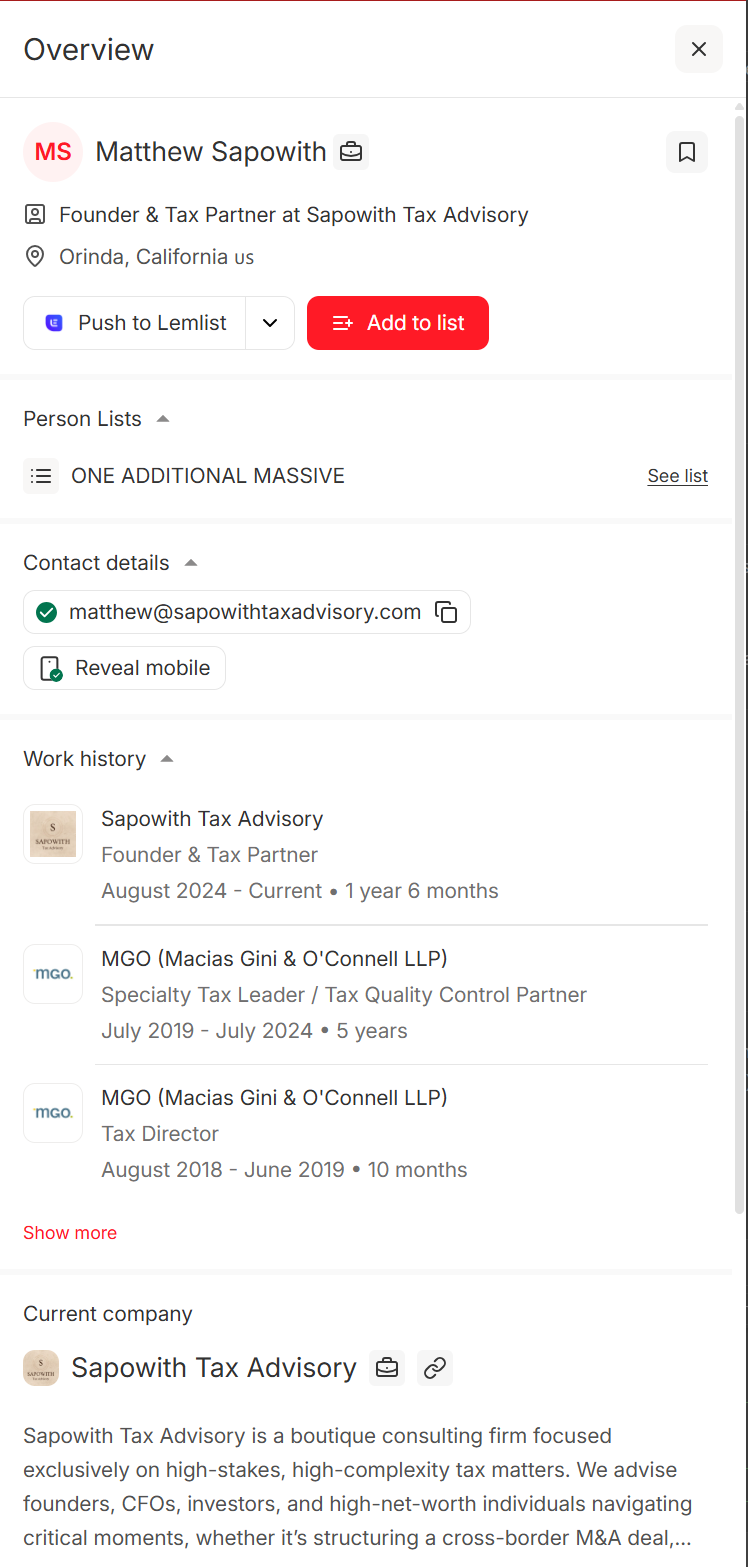
Sales Navigator is non-negotiable for finding and monitoring your 1,000 target people. The $79.99/mo is worth it for the advanced search filters and lead alerts alone.
Canva handles your carousel creation - the free plan is sufficient for most reps, and Pro is worth it if you're creating video content too. CapCut is the fastest way to add captions to short-form video (remember: 91% watch muted). Apollo's free plan gives you a solid prospecting database to supplement your workflow. For a personal website - which you should have, even a simple one - Copyfolio at $15/mo gets you a clean portfolio page that shows up when prospects Google your name.
You built a brand that reaches ~1,000 ideal buyers. Now reach their inbox without bouncing. Prospeo delivers 98% accurate emails at $0.01 each - so your personal brand converts to meetings, not just impressions.
Your brand opens doors. Prospeo gives you the address.
Measuring What Matters
Stop tracking likes. Start tracking pipeline signals.
| Vanity Metrics (Ignore) | Pipeline Metrics (Track) |
|---|---|
| Likes | Target account profile views |
| Impressions | DMs from prospects |
| Follower count | Inbound meeting requests |
| Post views | Connection acceptance rate |
| Shares from peers | SSI score trend |
Set alerts for your name. Monitor who's commenting, sharing, and DMing - especially if they match your ICP. The goal isn't to be famous; it's to be familiar.
It takes 5-7 impressions for brand recall. Your first month of posting won't generate meetings. Your second month will generate profile views. By month three, if you're consistent, you should see inbound DMs and meeting requests from people who've been quietly watching your content.
90-day checkpoint: Has your SSI score improved by 10+ points? Are you getting profile views from people at target accounts? Have you received at least one inbound message from a prospect? If yes to all three, your brand is working. If not, revisit your content pillars - you're probably posting for peers instead of buyers.
FAQ
How long does it take to see results from building a personal brand in sales?
Most sellers see increased profile views and inbound DMs within 30-60 days of consistent posting. Measurable pipeline impact - meetings booked from inbound interest - typically appears within 90 days. SSI score improvements show up faster, often within 2-3 weeks of optimizing your profile and engagement habits.
Do I need to post every day on LinkedIn?
No. One to two high-quality posts per week consistently outperforms daily low-effort content. The 2026 LinkedIn algorithm rewards depth and expertise over frequency. Batch-create your content in one sitting and schedule it throughout the week.
What should I post about if my industry feels too boring for content?
Use the "second brain" method: transcribe your sales calls, capture the questions prospects ask, and turn those into posts. Anonymized case studies - "how we helped a [industry] company solve [specific problem]" - consistently drive engagement regardless of how "boring" the vertical seems. Your buyers' pain points are never boring to your buyers.
Should I post sales tips or content about my buyers' problems?
Post about your buyers' problems. Sales tips get engagement from other salespeople - not from decision-makers who sign contracts. The 3x3 content matrix keeps you focused on buyer-relevant topics that generate meetings, not peer applause.
What free tools help with personal branding follow-up?
Prospeo's free tier (75 verified emails/month) lets you find contact data for prospects who engage with your content. Pair it with Canva's free plan for carousel creation and LinkedIn's free SSI dashboard to track progress. That stack costs $0 and covers content creation, prospect discovery, and performance measurement.